What Makes The Best Pickleball Paddle From Factory Perspective
What Makes The Best Pickleball Paddle From Factory Perspective
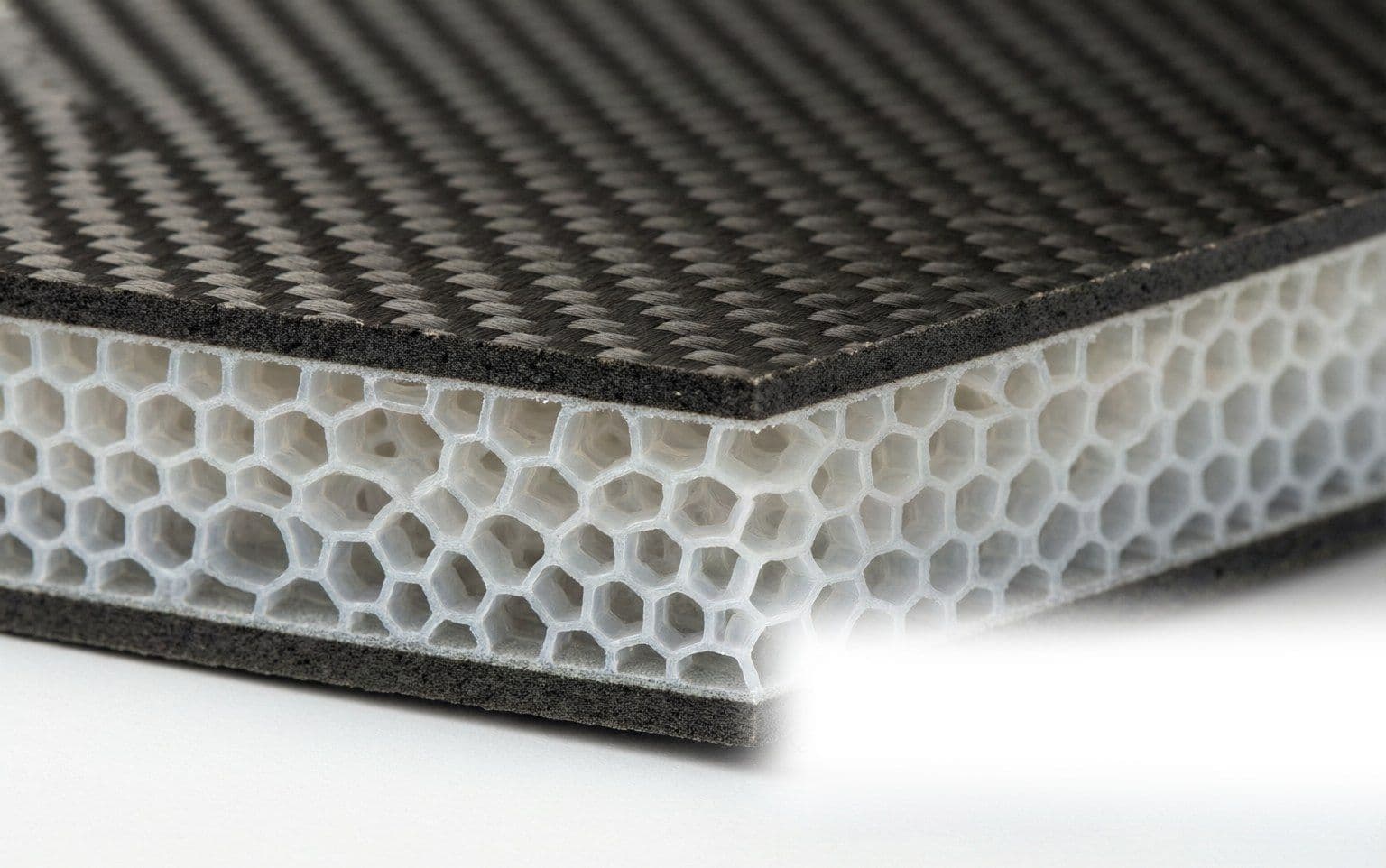
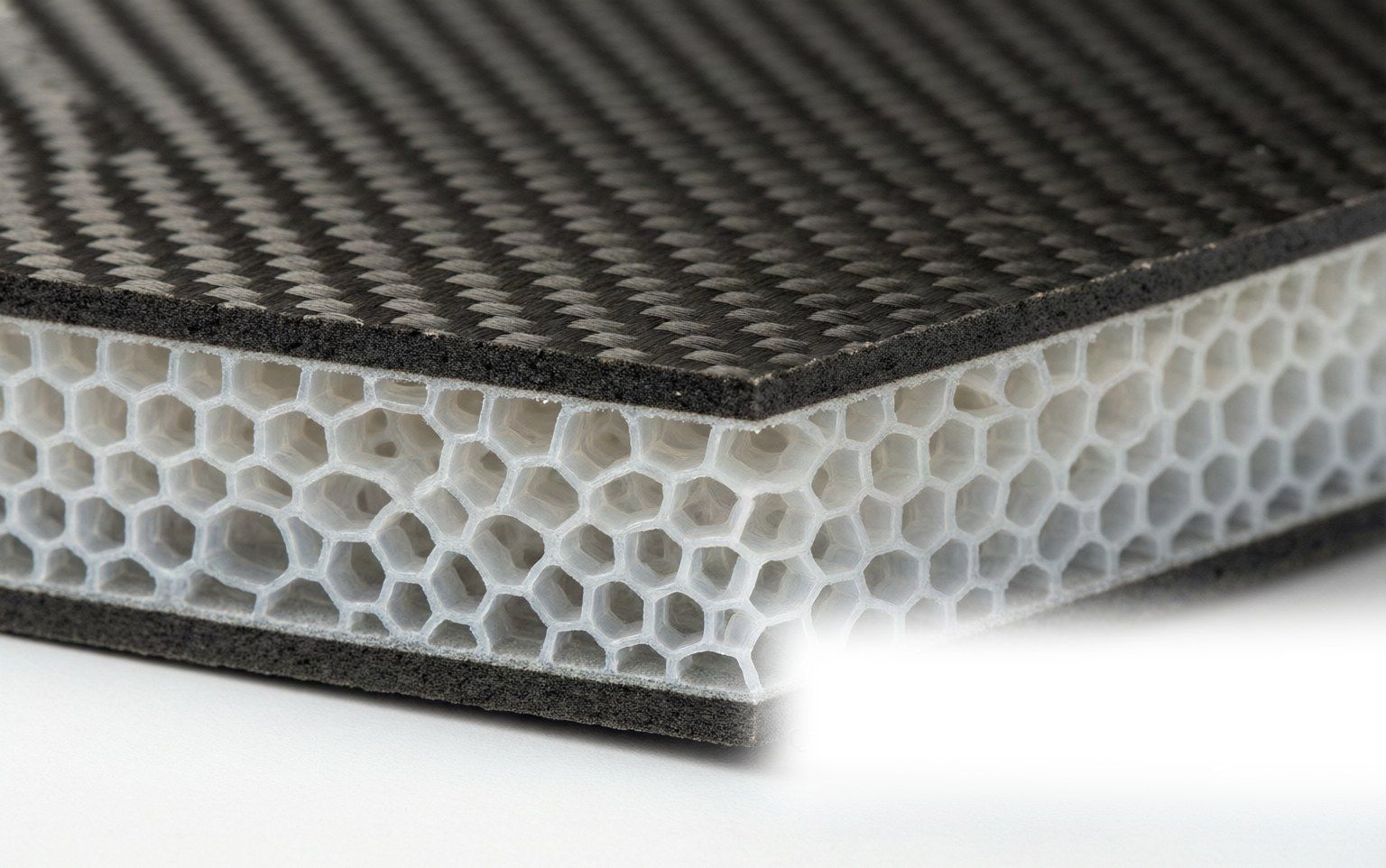
Most articles about the best pickleball paddle start with player testimonials or brand comparisons. From a factory floor, those conversations miss the point entirely. Paddle quality is determined long before a player grips the handle — it is decided by the carbon fiber grade laminated onto the face, the core cell geometry bonded beneath it, and the temperature and pressure profile used to fuse those layers together.
A factory does not judge a paddle by how it feels during a rally. A factory judges a paddle by whether its surface roughness stays within the governing body’s limits (average Rz ≤ 30 µm and average Rt ≤ 40 µm under the current USA Pickleball Equipment Standards Manual), whether its weight holds a plus-or-minus 3 gram tolerance, and whether the face-to-core bond survives 500 hours of accelerated aging without delamination. This article breaks down the engineering decisions that separate a well-made paddle from a mediocre one.

How a Factory Defines the Best Pickleball Paddle
A consumer article defines the best pickleball paddle by how it performs during gameplay. A factory defines it by how consistently it can be reproduced at scale. These are fundamentally different criteria, and understanding the distinction changes how you evaluate any paddle you pick up.
From a manufacturing standpoint, three variables determine paddle quality: material selection, process control, and testing rigor. Material selection covers the carbon fiber grade, core substrate, adhesive chemistry, and edge guard compound. Process control covers the lamination temperature, press pressure, cure time, and trimming precision. Testing rigor covers every measurement taken between raw material incoming inspection and final packaging.
The factories that produce the highest-quality paddles are not necessarily the ones with the most expensive raw materials. They are the ones that hold tightest tolerances across every production variable. A T700 carbon fiber face laminated with precise temperature control and verified by consistent QC testing will outperform a T800 face laminated with sloppy process control. The engineering details in the sections below explain exactly what to look for.
Carbon Fiber Face Engineering: T700 vs T800 vs Kevlar
The face sheet is the first surface the ball contacts, and its material properties directly influence spin generation, power transfer, and durability. The three dominant face materials in factory production are T700 carbon fiber, T800 carbon fiber, and Kevlar (aramid fiber). Each has distinct engineering trade-offs that a buyer should understand before placing an order.
T700 carbon fiber, produced by Toray and equivalent manufacturers, offers a tensile strength of approximately 4,900 MPa with a modulus of around 230 GPa. It produces a face with a larger sweet spot and more flex, which translates to a forgiving feel and additional pop on off-center hits. T800 carbon fiber pushes tensile strength to approximately 5,490 MPa with a higher modulus, creating a stiffer face that delivers more precise ball placement at the cost of a smaller effective hitting area.
Kevlar faces occupy a different position. Aramid fiber offers higher impact resistance than either carbon fiber grade, which makes it durable under heavy use. However, Kevlar is more difficult to finish to a consistent surface texture. The fibrous nature of aramid means that achieving the uniform roughness required for spin generation demands additional processing steps. It also costs more per square meter than carbon fiber.
| Property | T700 Carbon Fiber | T800 Carbon Fiber | Kevlar (Aramid) |
|---|---|---|---|
| Tensile Strength | ~4,900 MPa | ~5,490 MPa | ~3,620 MPa |
| Modulus | ~230 GPa | ~294 GPa | ~70-130 GPa |
| Sweet Spot Size | Larger | Smaller | Medium |
| Surface Finish Consistency | High | High | Moderate |
| Impact Resistance | Good | Good | Excellent |
| Relative Cost | Moderate | Higher | Highest |
The face material choice also affects downstream manufacturing. T700 and T800 both bond well with standard epoxy adhesives used in paddle lamination. Kevlar requires surface treatment or specialized adhesive formulations to achieve comparable peel strength. This processing difference adds cost and complexity, which is why Kevlar faces remain less common in high-volume production.
For brands evaluating suppliers, the key question is not which material is objectively best. It is which material matches the target player profile and whether the factory can hold consistent surface quality across production runs. Our 3K carbon fiber pickleball paddle line demonstrates the T700 construction approach at production scale.
Explore the full product range and examine face construction details.
Browse All Paddle ModelsCore Material Science: Polymer Honeycomb vs Nomex vs Foam
The core accounts for the majority of a paddle's thickness and has the single largest influence on how a paddle plays. Three core types dominate factory production: polymer honeycomb, Nomex honeycomb, and foam. Each has a different engineering profile that affects power, control, vibration, and noise.
Polymer honeycomb cores, typically made from polypropylene, use a hexagonal cell structure with cell sizes commonly ranging from 3/8 inch to 1/2 inch. The cell wall thickness and polymer density determine how much the core compresses on ball impact. Thicker walls and higher density produce a stiffer core that returns more energy to the ball. Thinner walls and lower density create a softer feel with more vibration absorption.
Nomex honeycomb cores use aramid paper impregnated with phenolic resin, formed into a hexagonal cell structure originally developed for aerospace applications. Nomex is significantly stiffer than polymer honeycomb, which produces a harder hit and more power. The trade-off is increased vibration transmission to the player's hand and a louder impact sound. Some players prefer this feedback; others find it uncomfortable during extended play.
Foam cores, typically made from expanded polypropylene or similar closed-cell foams, offer the softest feel and the quietest sound. They absorb more energy on impact, which reduces power but increases control for players who prefer a softer touch. Foam cores can compress over extended use, which may change playing characteristics over the paddle's lifespan.
| Property | Polymer Honeycomb | Nomex Honeycomb | Foam |
|---|---|---|---|
| Stiffness | Medium | High | Low |
| Power Output | Balanced | Highest | Lowest |
| Vibration Dampening | Good | Poor | Excellent |
| Noise Level | Moderate | Loud | Quiet |
| Long-Term Durability | High | High | Moderate |
| Relative Cost | Moderate | Higher | Lowest |
Core selection is not a matter of one material being universally superior. It is a design decision that must align with the target player profile and the face material it will be paired with. A T800 face on a stiff Nomex core produces a very different paddle than the same face on a polymer honeycomb core. The factory's role is to execute the combination consistently and verify that each unit meets the specified parameters.
Thermoforming vs Cold-Forming: The Manufacturing Divide
The lamination process — how the face sheet is bonded to the core — is where many factories diverge in quality. Two methods dominate production: thermoforming and cold-forming. The choice between them affects bond strength, production speed, cost, and ultimately the paddle's durability under repeated impact.
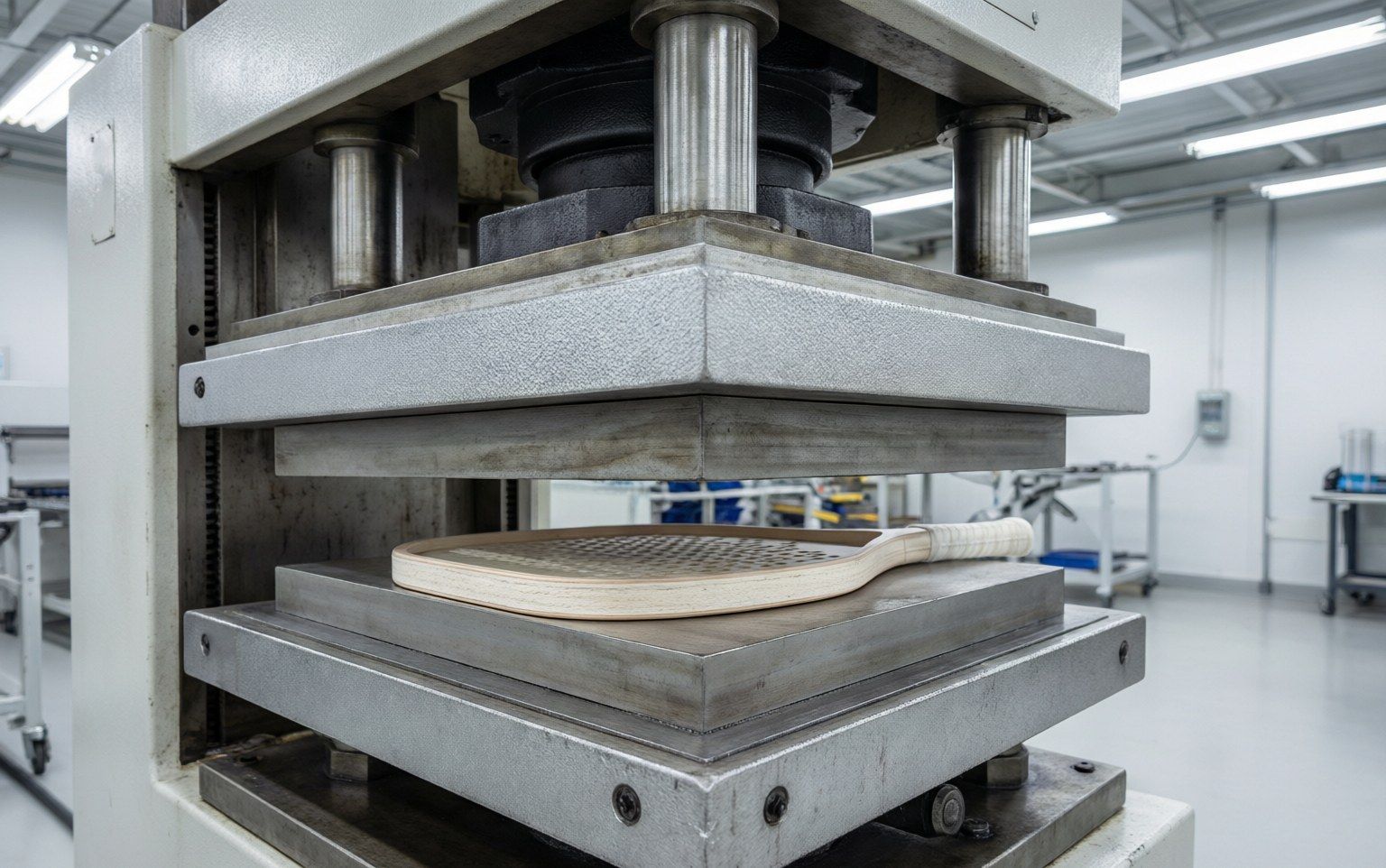
Thermoforming bonds the face sheet to the core under heat and pressure, typically at temperatures between 120 and 150 degrees Celsius. The heat activates the adhesive throughout the entire bond line, creating a chemical bond that penetrates the surface of both materials. The result is a higher peel strength — the force required to separate the face from the core. Thermoformed paddles resist delamination more effectively, especially under the repeated stress of hard hits near the paddle edge.
Cold-forming uses room-temperature adhesive bonding. The adhesive cures without external heat, which makes the process faster and less energy-intensive. However, cold-formed bonds generally achieve lower peel strength than thermoformed bonds. The adhesive sits more on the surface rather than penetrating deeply, which makes the bond line more vulnerable to separation over time.
| Parameter | Thermoforming | Cold-Forming |
|---|---|---|
| Bond Temperature | 120-150 degrees C | Ambient (20-25 degrees C) |
| Peel Strength | Higher | Lower |
| Cycle Time | Longer | Shorter |
| Delamination Resistance | Superior | Moderate |
| Production Cost | Higher | Lower |
| Equipment Investment | Higher (heated press) | Lower |
Not all thermoforming is equal. The temperature profile, pressure applied, and hold time all require precise calibration. A factory that runs its press at 130 degrees C for 8 minutes produces a different bond than one running at 145 degrees C for 12 minutes. The optimal parameters depend on the specific adhesive, face material, and core substrate being used. Consistent results require documented process parameters and operator training.
For brands sourcing paddles, asking whether a factory uses thermoforming or cold-forming is a starting point. The follow-up question should be what process parameters they use and how they verify bond strength on each production run. A factory that cannot answer these questions with specific data is not controlling its lamination process.
Weight Engineering: Swing Weight vs Static Weight
Paddle weight specifications on product listings typically show a single number — the static weight measured on a scale. From an engineering perspective, static weight tells only part of the story. Swing weight, which accounts for how the mass is distributed along the paddle's length, has a larger effect on how the paddle feels during play.
Two paddles can both weigh 7.8 ounces on a scale but feel completely different in hand. A paddle with more mass concentrated toward the head has a higher swing weight and feels heavier during swings. A paddle with mass distributed toward the handle has a lower swing weight and feels lighter, even though the static weight is identical. The balance point — measured from the handle end — is the key variable.
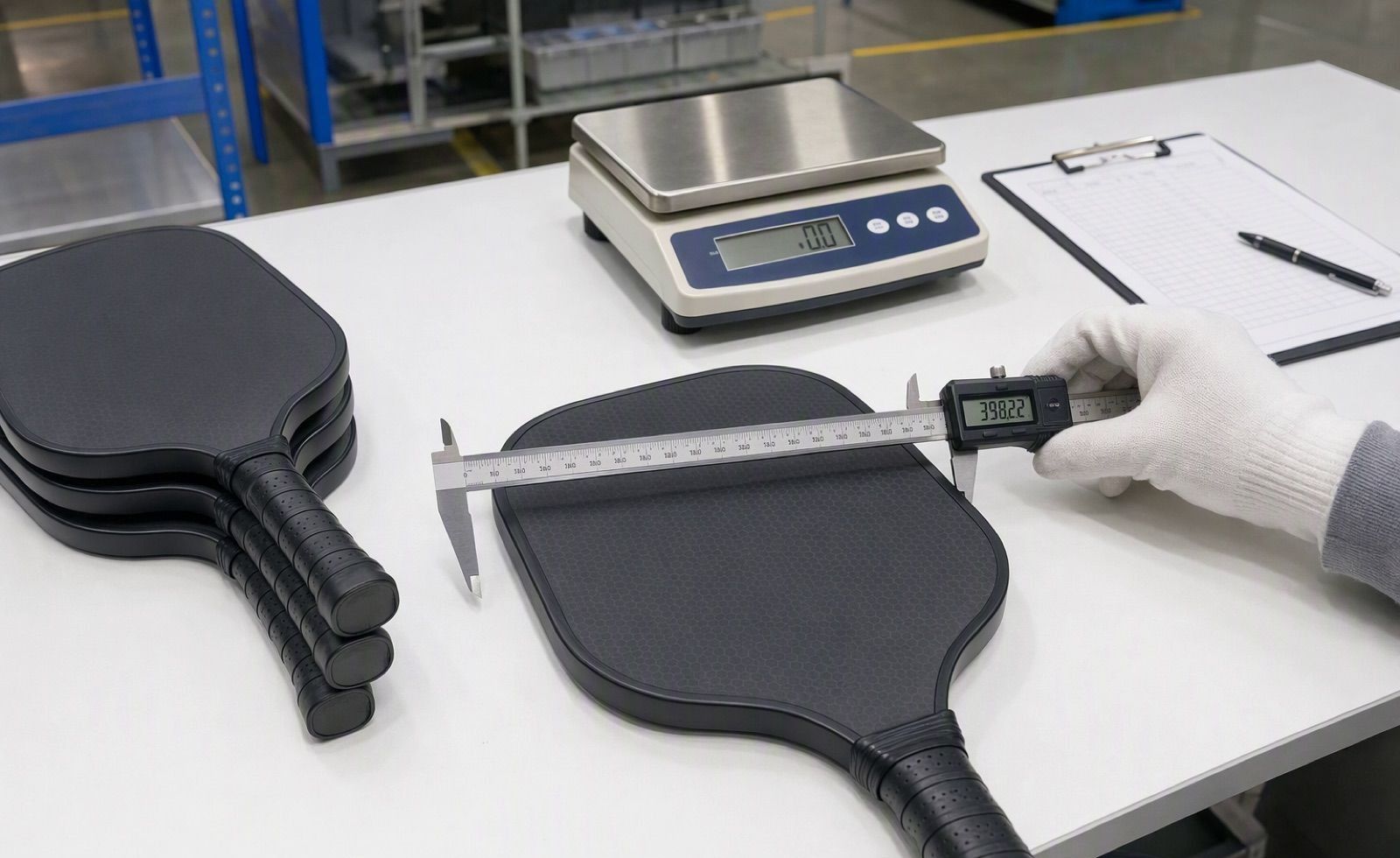
Factories control weight through material selection, core density, and resin content. Holding a tight static weight tolerance (typically plus or minus 3 grams) requires consistent material inputs and process control. Variations in resin application, core density, or face sheet thickness all contribute to weight deviation. The best factories track weight at multiple production stages to catch deviations before final assembly.
Swing weight is measured using a pendulum-based apparatus that calculates the moment of inertia around a pivot point. Brands that specify both static weight and balance point give their customers a more complete picture of how the paddle will perform than static weight alone.
USAPA Certification: What It Actually Tests
USA Pickleball (formerly USAPA) certification is required for paddles used in sanctioned tournament play. The certification process tests several specific performance parameters, and understanding what these tests measure helps brands and buyers evaluate whether a paddle meets competitive standards.
Surface roughness is tested using a profilometer that measures the Rz parameter — the average maximum peak-to-valley height across the test surface. The current USA Pickleball Equipment Standards Manual requires average Rz not to exceed 30 micrometers and average Rt not to exceed 40 micrometers. The paddle certification program has also been updated to include PBCoR (paddle coefficient of restitution) rebound testing, so certified paddles are now checked for surface roughness, rebound performance, deflection, reflectivity, and dimensions. This limit exists because an excessively rough surface can generate spin levels that exceed what the governing body considers acceptable for competitive play. The test is performed at multiple points on the paddle face to ensure consistency.
Deflection testing measures how much the paddle face deforms under a standardized load. A paddle that deflects too much may have a trampoline effect that returns excessive energy to the ball. The coefficient of restitution (COR) test measures this energy return directly by launching a ball at the paddle surface at a controlled speed and measuring the rebound velocity. Paddles with COR values above the threshold are rejected.
Dimensional requirements include maximum length (17 inches), maximum width (8.5 inches for standard shapes), and a combined length-plus-width limit of 24 inches. These are straightforward measurements, but they matter because some manufacturers push dimensions to the edge of legal limits to maximize the hitting surface area.
Reflectivity testing ensures the paddle surface does not create glare under court lighting. For factories, USAPA certification requires maintaining consistent production quality across every unit — not just passing a sample through testing.
Quality Control: The Tests Every Factory Should Run
Quality control in paddle manufacturing extends well beyond the USAPA certification tests. A factory running a comprehensive QC protocol tests every paddle — not just samples — across multiple parameters before it ships. The following checklist represents the minimum testing regimen that a quality-focused factory should perform.
Incoming material inspection: Raw carbon fiber sheets are checked for weave consistency, resin content, and surface defects. Core material is verified for density and cell structure uniformity. Adhesive batches are tested for viscosity and cure characteristics. These incoming checks prevent material defects from propagating through production.
In-process weight checks: Each paddle is weighed at the lamination stage and again after trimming. Paddles outside the target tolerance are flagged for investigation. Tracking weight at multiple stages helps identify which process step is introducing variation.
Drop testing: Finished paddles are dropped from a specified height onto a hard surface to simulate impact stress. The paddle is then inspected for cracks, delamination, or edge guard separation. This test catches bonding defects that might not surface during normal play but would cause premature failure.
Flex testing: A standardized load is applied to the paddle face and deflection is measured. Paddles that deflect outside the acceptable range indicate inconsistencies in core density or bond quality. This test correlates with the USAPA deflection standard but is performed at the factory level on every production run.
Surface friction testing: The paddle face roughness is measured to ensure it falls within the desired range for spin generation. Too smooth and the paddle underperforms on spin; too rough and it risks exceeding USAPA limits. This test is critical for brands that market spin-oriented paddles.
Edge guard adhesion: A pull test measures the force required to separate the edge guard from the paddle body. Weak adhesion indicates insufficient adhesive application or improper surface preparation, which would lead to edge guard failure during use.
Visual inspection: Every paddle is inspected for surface defects including resin voids, fiber exposure, cosmetic blemishes, and printing quality.
OEM Spec'ing: How Brands Can Order the Best Paddle
For brands looking to source paddles from a factory, the quality of the final product depends heavily on how precisely the brand communicates its specifications. A vague spec sheet produces inconsistent results. A detailed engineering specification gives the factory clear targets to hit and verify.
The essential parameters to specify include: face material and grade (for example, T700 3K twill weave carbon fiber), core type and density (for example, polypropylene honeycomb at 0.45 g/cm3), lamination method (thermoformed at specified temperature and pressure), target weight with tolerance (for example, 7.8 oz plus or minus 3g), balance point range (for example, 245-250 mm from handle end), grip circumference and length, edge guard type and adhesion requirement, and surface finish specification including roughness range.
Beyond the physical specifications, brands should also define the testing protocol. Specify which QC tests the factory must perform, the acceptable ranges for each test, and the sampling frequency. Require that the factory provides a QC report with each shipment documenting the test results for that production run.
Requesting samples at each development stage — material swatches, prototype paddles, pre-production samples, and production samples — gives the brand multiple checkpoints to verify specifications before full production.
Share your target specifications with our engineering team. We will provide material recommendations, process parameters, and a production timeline.
Discuss Paddle Specs on WhatsAppFor brands evaluating manufacturing partners, we recommend visiting the factory in person. Seeing the lamination press, the QC equipment, and the production workflow reveals more about a factory's capabilities than any spec sheet. Our OEM customization services page outlines the process from initial inquiry to production delivery, and our factory tour information shows what to expect during a site visit.
Conclusion: The Spec Sheet Perspective
The best pickleball paddle, from a factory perspective, is the one that meets its design specifications consistently across every unit in a production run. Material selection — whether T700 or T800 carbon fiber, polymer or Nomex honeycomb — is a design choice, not a quality indicator. Quality is determined by how tightly the factory holds its tolerances on every variable from face roughness to bond strength to weight distribution.
The factories that produce the most reliable paddles are the ones that invest in process control and testing infrastructure. They thermoform rather than cold-form. They test every paddle, not just samples. They document their process parameters and share QC data with their brand partners. These are the engineering decisions that separate a quality paddle from an inconsistent one.
Frequently Asked Questions
What is the difference between T700 and T800 carbon fiber for pickleball paddles?
T700 carbon fiber has a tensile strength of approximately 4,900 MPa, while T800 reaches approximately 5,490 MPa. T800 produces a stiffer face with a slightly smaller sweet spot but offers more control. T700 provides a larger sweet spot with more pop. The choice depends on the intended playing style and the brand's target market positioning.
Is thermoforming better than cold-forming for pickleball paddles?
Thermoforming produces a stronger bond between the face sheet and core because heat activates the adhesive more thoroughly, resulting in higher peel strength. Cold-forming is faster and less expensive but yields a weaker bond. Thermoformed paddles tend to last longer and resist delamination under heavy use. The manufacturing method directly affects durability and consistency.
What does USAPA certification actually test on a pickleball paddle?
USA Pickleball certification tests paddle surface roughness (average Rz must not exceed 30 micrometers and average Rt must not exceed 40 micrometers under the current Equipment Standards Manual), deflection characteristics, reflectivity, and the trampoline effect (coefficient of restitution), plus PBCoR rebound testing in the current paddle certification program. The paddle must also meet dimensional requirements for length, width, and combined length plus width. Surface roughness is measured using a profilometer.
What quality control tests should a pickleball paddle factory run?
A comprehensive QC protocol includes drop tests from specified heights to check structural integrity, flex tests to measure face deflection consistency, surface friction tests for spin potential, weight tolerance verification within plus or minus 3 grams, edge guard adhesion pull tests, and visual inspection for surface defects. Some factories also run accelerated aging tests to simulate long-term use.
How does core material affect pickleball paddle performance?
Polymer honeycomb cores provide a balance of power and control with good vibration dampening. Nomex honeycomb cores are stiffer and produce more power but transmit more vibration. Foam cores are the quietest and softest but offer less power and can compress over time. The core cell size, wall thickness, and material density all contribute to the final playing characteristics.
Want to source this quality for your brand?
Contact our factory directly on WhatsApp for an instant MOQ and pricing quote.