Can You Recycle Pickleballs? A Club Collection Plan
For U.S. clubs: a courtside bin can fill up before anyone has agreed where the balls will go. Yes, used pickleballs can enter specialised recycling programs in parts of the United States. They should not go into a household recycling bin unless your local provider expressly accepts them. For a club, choose a current collection or return route, confirm its accepted balls and geographic coverage, and assign the handover before opening a bin. A bin full of balls is collected material; it is not proof that recycling has happened.
This plan is for a U.S. club managing retired balls. It compares real, geographically bounded programs checked in October 2026, then turns their different handover rules into a club routine. It does not promise nationwide pickup, free postage, a recycling partnership with PickleOEM or a measured environmental saving.
Key Takeaways
- Plastic type and a resin code do not establish local recycling acceptance.
- Choose the recipient before installing a collection bin.
- Lexington's dedicated park bins, Pittsburgh's volunteer relay and a P3 return shipment have different handovers.
- A free collection bin does not necessarily include return postage.
- Keep pickleballs, tennis balls, packaging and trash in their accepted streams.
- Record collection, dispatch and receipt separately; claim processing only when supported.
See a regional collection route
How we recycle broken pickleballs in Pittsburgh PA, Verona Pickleball. Linked from the Allegheny CleanWays program page; this is regional context, not confirmation of your club’s participation or a measured environmental benefit. Watch on YouTube.
A resin code does not answer the recycling question
The useful question is whether a named recipient accepts your used balls, in their present condition, through the route you can use. The U.S. Environmental Protection Agency's recycling guidance explains that a plastic resin code does not guarantee local recyclability. It directs people to check acceptance with their local provider. That matters even if you know the ball's polymer.
A material that a specialist can process may still lack an outlet in the household system. Lexington's city government provides a concrete example: its pickleball recycling page says the Lexington Recycle Center does not have an outlet for this plastic, while dedicated pickleball bins route the balls through P3 Cares. “Not accepted here” and “no recycling route exists” lead to different decisions.
Keep the retirement decision separate too. This article does not set a new test for whether a worn ball remains fit for play. Use the club's existing ball inspection and replacement criteria; keep rejected balls out of playing stock. The ball QC guide addresses the separate inspection question.
Choose a route with a real receiving end
Match the route to your location and available help. A directory pin is a starting point: confirm that the site still hosts a bin, accepts your delivery and has access you can use. A private facility's listing is not permission to enter it or leave an unarranged sack at its door.
| Route | Published scope | Who moves the balls? | Club decision |
|---|---|---|---|
| Lexington park bins | Kirklevington Park and Shillito Park, Kentucky | Player uses the dedicated bin | Use the named pickleball stream |
| PickleUp | Greater Pittsburgh, Pennsylvania | A local volunteer takes collected balls to a hub | Arrange court permission and a volunteer |
| Back in Play | Listed New Jersey facilities; confirm proposed site | Program collects, counts and ships | Confirm local participation before relying on pickup |
| P3 Cares return | Program participation requires current confirmation | Partner ships to the receiving facility | Budget return postage and follow instructions |
Sources: Lexington city page; Allegheny CleanWays PickleUp; Back in Play; P3 Cares program instructions. These links document published program rules. Before any handover, contact the intended recipient to confirm current access, accepted materials and service arrangements for your site.
PickleUp explicitly serves greater Pittsburgh. Its page requires court-owner or manager permission and at least one volunteer to collect the balls and deliver them to a named receiving location. The volunteer takes the balls to the receiving hub. A club with a willing bin host but nobody to make that journey has not yet completed the plan.
Back in Play publishes active New Jersey locations and says it handles collection and shipping at no cost to participating facilities. Its site also describes future chapter expansion. Confirm the proposed club's participation; an expansion invitation does not establish pickup throughout the country.
P3's instructions describe a different arrangement: partners currently fund return shipping. A club choosing that route needs packaging, the current receiving instructions and someone authorised to pay for dispatch. Do not copy a postal address from an old article and assume a box will be accepted.
Copy this enquiry to your proposed recycling recipient
Use the official contact for the programme that serves your location. For the Bergen County example, ask Back in Play directly; its published contact is not a nationwide acceptance promise. For another location, use your own chosen programme or local waste provider.
| Include | Your message |
|---|---|
| Club and location | Club ______; city/state/ZIP ______; contact ______. |
| Material and condition | Indoor/outdoor pickleballs ______; brands/material if known ______; cracked/worn/mixed ______; photos attached ______. |
| Batch and timing | Approximate count/weight ______; current stock and recurring volume ______; desired handover date ______. |
| Acceptance questions | Accept our location and batch? Confirm sorting, cleaning and packaging requirements. |
| Transport and cost | Confirm route, destination/contact, transport owner and all collection/shipping charges. |
| Confirmation | Confirm available receipt/processing evidence and arrangement before deposits or shipment. |
Keep the batch pending if acceptance, destination or responsibility remains unconfirmed. This message goes to the recipient; a new-ball supplier cannot confirm another organisation’s recycling acceptance.
Keep each ball stream separate
Keep loose balls apart from their packaging. The Back in Play FAQ accepts cracked, broken or worn-out indoor and outdoor pickleballs from any brand, while excluding tennis balls and trash. That is its receiving rule, not a rule for every recycler. Obtain the recipient's instructions before adding other items or treating every damaged plastic ball as equivalent.
A facility offering both tennis and pickleball needs two clear material paths. RecycleBalls' Quick Label Page 2024 describes tennis-ball collection and includes QUICKSHIP information for tennis facilities and coaches. This dated page does not confirm 2026 rates or current eligibility. Its prepaid-label description should not be treated as permission to add pickleballs. Confirm current terms and acceptance of any unlisted material directly with the intended recipient before shipping.
Make the label name the accepted item: “Retired pickleballs only” is clearer than “Sports recycling”. Put the exclusion beside it. Keep wrappers, bottles and food waste out, then remove misplaced items during the scheduled bin check. This is a proposed club routine that follows the recipient's material rules.
Check campaign dates as well as websites. The Another Bounce page still displays an arrival deadline of 31 August 2026 for its collection campaign. That deadline has passed as of this guide's check. Contact the organisation for a current route before shipping; the surviving page alone cannot establish that the campaign remains open.
Set up the bin only after the handover is agreed
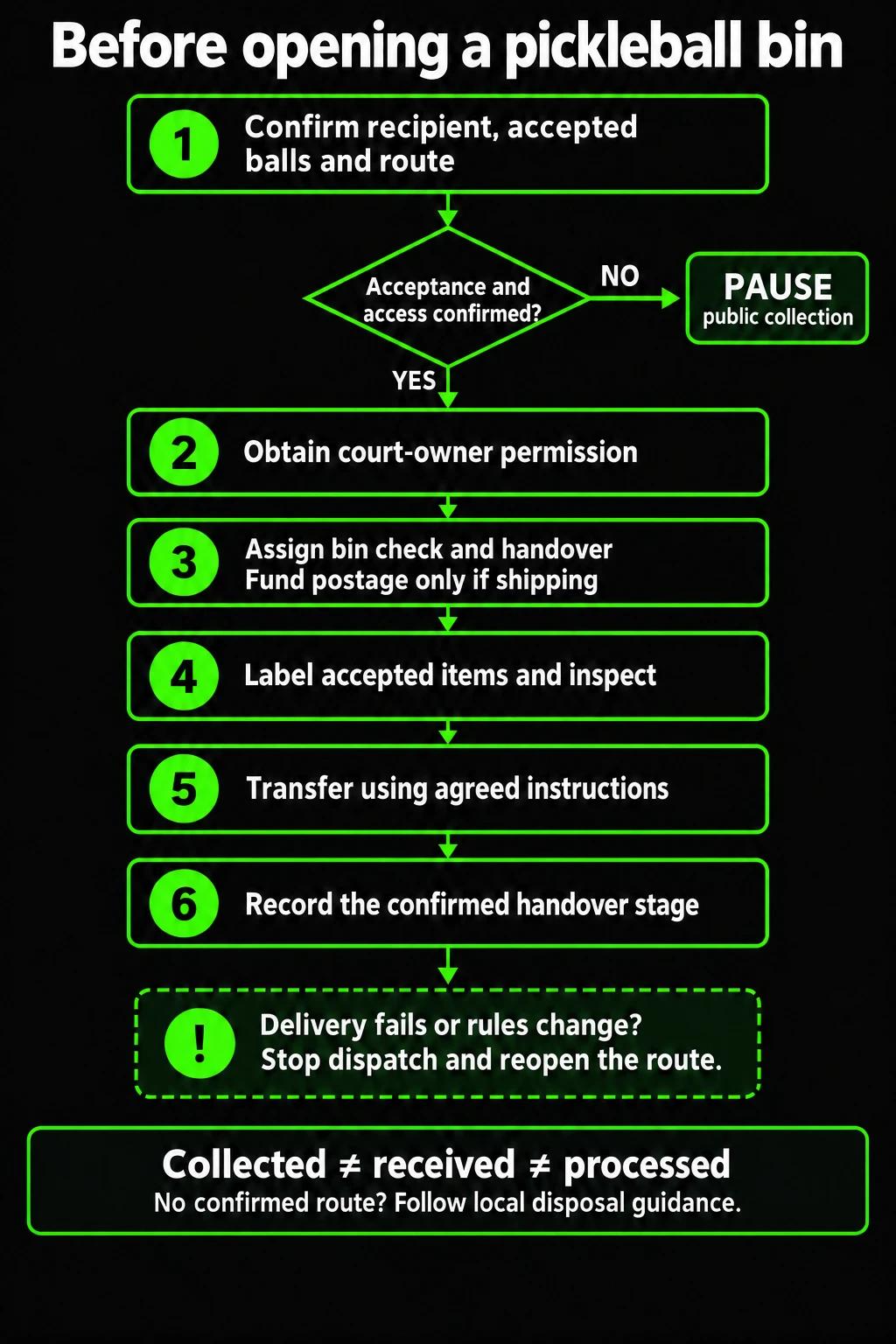
Open the bin only when the receiving route is confirmed. Use this procedure as a club operating plan, adapting the bin and packing details to the selected program's actual instructions.
- Confirm acceptance. Name the recipient, the exact balls accepted, the geographic or access limit, and whether drop-off, pickup or shipping is available. If any of those remains unanswered, retain the balls separately and pause public collection.
- Obtain site permission. Agree the bin location with the court owner or manager. Choose a position staff can check without obstructing court access. PickleUp expressly makes permission a participation condition.
- Assign the handover. Name the person checking the bin and the person delivering or dispatching it. For a return shipment, assign the postage budget and obtain current packing instructions. For a pickup, retain the request contact and collection conditions.
- Label and inspect. Display the accepted-item rule and exclusions. Check contents at a club-defined interval and when staff notice contamination. Follow the recipient's cleaning or preparation requirements; do not invent a washing or crushing requirement.
- Transfer under the agreed route. Make the scheduled drop-off, request collection or dispatch the correctly prepared parcel. Keep the handover record and ask what acknowledgement the recipient provides.
- Close the loop in the log. Mark the batch received when you have confirmation. If a delivery fails or the recipient changes its rules, stop further dispatch and reopen the route decision.
The club can choose its check frequency and fullness trigger; these are operating decisions, not measured thresholds from a recycler. A small staffed pilot is easier to control than placing bins at several courts before anyone owns the transport job.
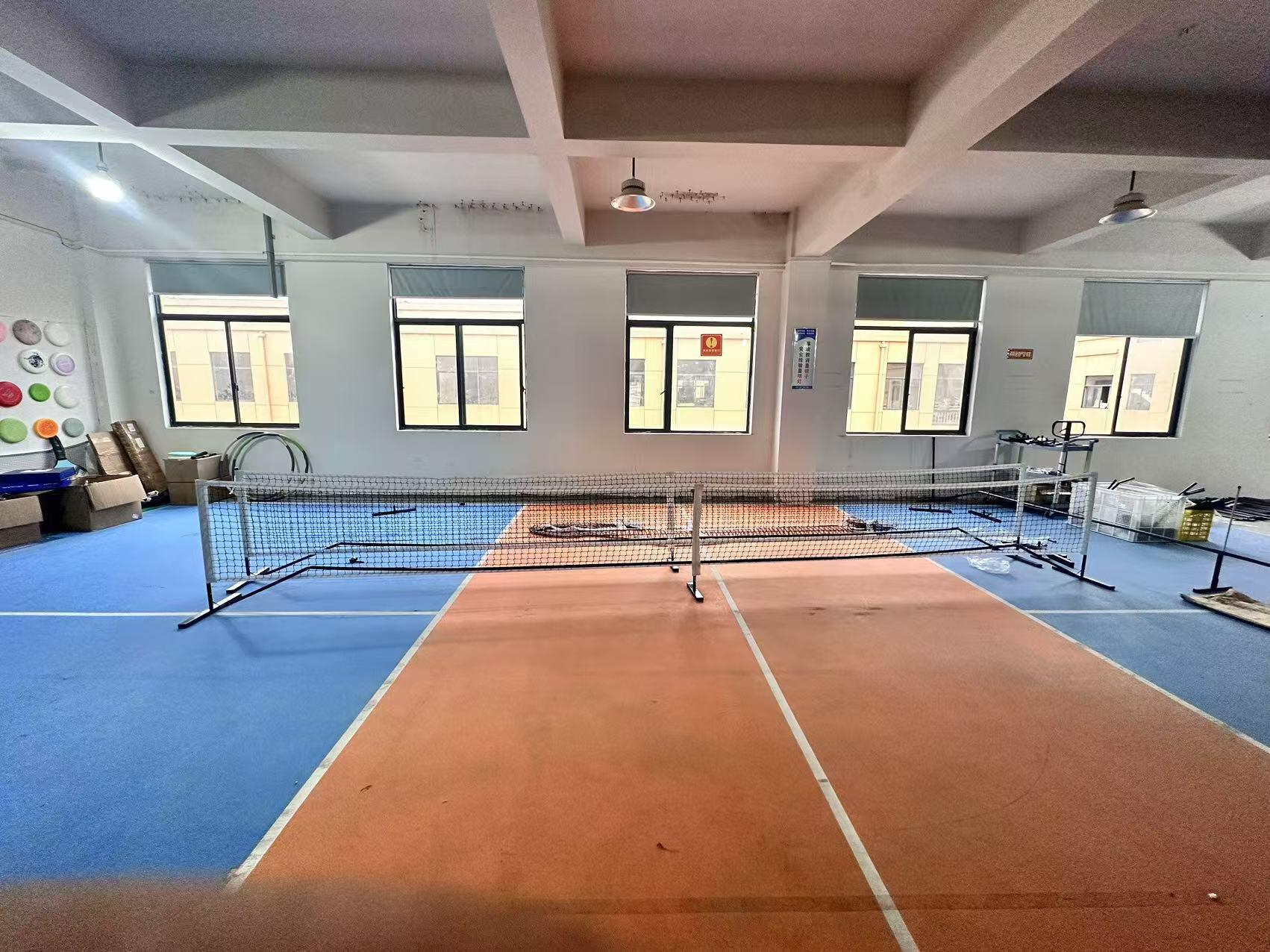
Test the plan before inviting players to use it
This is an illustrative club scenario, not a recorded PickleOEM project. A club in greater Pittsburgh has owner permission, confirms participation with PickleUp and assigns a volunteer who can use an agreed receiving hub. It can open a labelled collection bin once the acceptance and handover arrangements are settled. It does not need to assume nationwide shipping or a free courier.
Change one condition: the volunteer can no longer make the journey. The bin remains useful storage, but the collection service is no longer operational. Assign another agreed delivery arrangement or pause intake before capacity becomes a problem. Paying for a parcel is an alternative only after a recipient has confirmed that route, its packing requirements and its costs.
Now move the club outside the project's service area. The Pittsburgh instructions no longer establish local eligibility. Search a current specialist directory, check with a program serving the new location, or ask the local waste provider whether it has an accepted route. If no recipient is confirmed, follow local disposal guidance; do not put the balls into household recycling because the first club had a specialist outlet.
Record the stage you can actually prove
Record the stage you can verify. Collection, transport, receipt and processing are separate events. A photograph of a full bin supports collection. A carrier tracking record supports dispatch or delivery as recorded by the carrier. It does not by itself show what the processing facility did with the material.
| Stage | Record | Bounded statement |
|---|---|---|
| Collected | Batch date, accepted items, count method | Collected retired balls |
| Sent | Recipient, date, drop-off or dispatch record | Sent to the named program |
| Received | Recipient acknowledgement or delivery status | Received or delivered, as documented |
| Processed | Recipient's processing confirmation and scope | Processed only to the confirmed extent |
Assign a staff member to check each outstanding transfer. If a receipt is missing, retain the dispatch record, request acknowledgement from the named recipient and set a club follow-up date. Keep the batch at the documented stage until that reply arrives; carrier delivery still does not establish processing. Reconfirm the route before sending another batch if the recipient cannot explain the delay. When requesting an update, identify the batch date, transfer date, recipient and available dispatch reference so the recipient can locate the consignment. Save the response alongside that reference, including any refusal or preparation problem that changes the next collection.
Do not turn a ball count into carbon savings or promise that every collected ball becomes a new competition ball. Those claims need evidence beyond the club's collection record. Keep refused or pending batches visible too. “Awaiting confirmed recipient” is a useful status because it identifies the missing action.
Collection also does not supply replacement inventory. Keep the club's replenishment plan separate: identify the playing model, venue, quantity and required arrival date. When comparing replacement offers, ask for current availability and whether the lead time ends at dispatch or arrival. No factory lead time or minimum order is established by this recycling guide. For a separate new-ball enquiry, send the ball type/model, quantity, destination and required arrival date through the factory enquiry route; do not send recycling acceptance requests there. The ball and equipment catalogue can help identify the proposed replacement model; it does not establish a recycling arrangement.
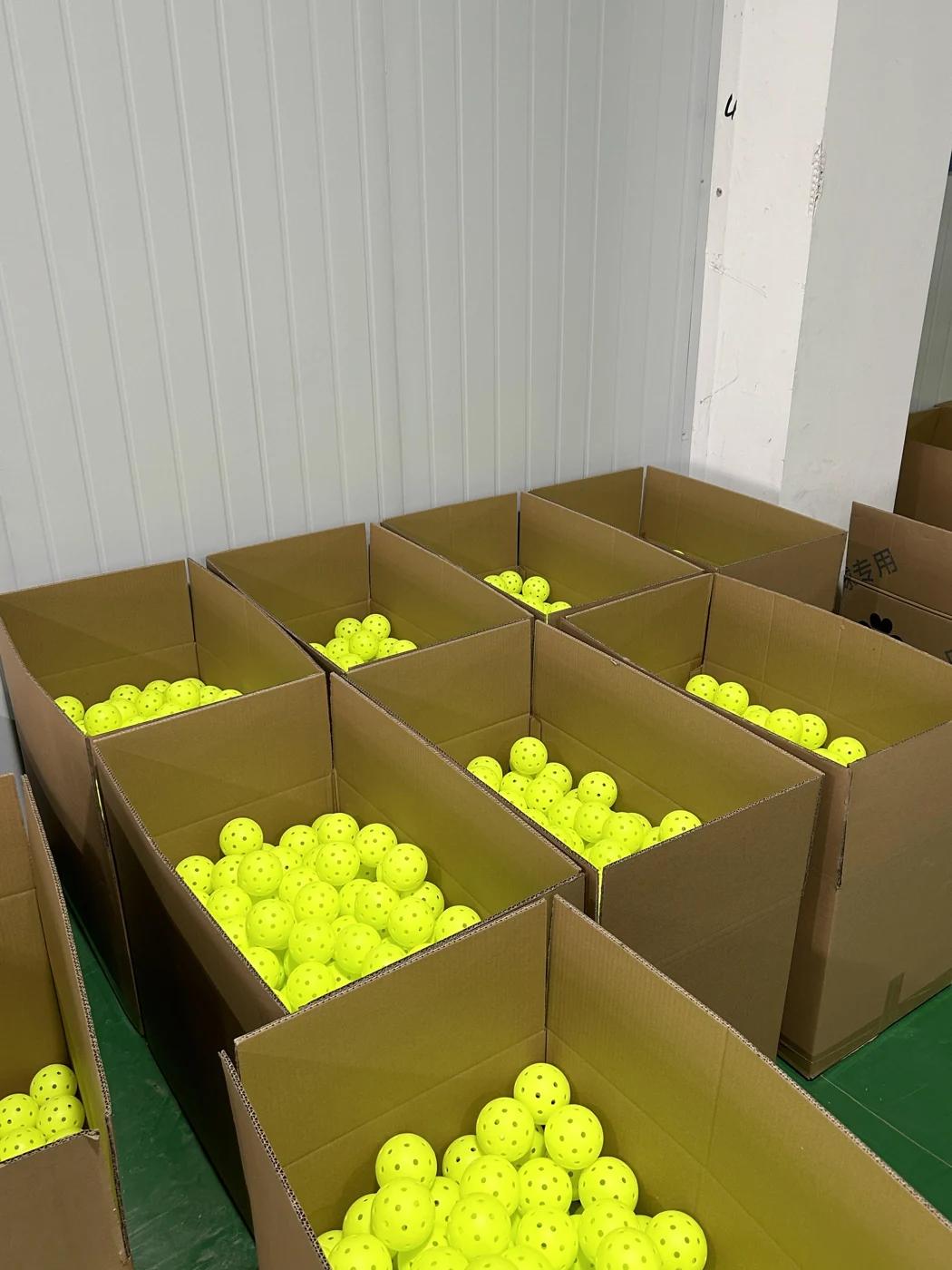
For a club preparing its next stock order, Review replacement ball models. Match the playing requirement separately from the retired-stock handover.
Conclusion
Before requesting a bin, prepare the club location, ball types and condition, court permission, available transport and return-postage budget. Give those details to the proposed program and retain its current answer. If the recipient or handover remains unconfirmed, keep the collection provisional. Once the route works, record each transfer and report only the stage the evidence supports.
FAQ
Can I crush the balls to reduce parcel size?
Only if the receiving program confirms that preparation. Follow its current packing instructions; one program's acceptance of broken balls does not automatically permit every processing method.
Does a free bin include free postage?
Not necessarily. P3 currently asks partners to fund return shipping, while some local managed programs handle shipping themselves. Confirm the terms for your participating facility.
Does PickleOEM accept returned balls for recycling?
No PickleOEM take-back program is verified in this guide. Contact the named collection program about its own acceptance rules; a replacement-ball enquiry is a separate matter.
Keep recycling and new-ball sourcing separate
For U.S. collection, contact the recycler named in the article to confirm acceptance, transport, costs and receipt. DJW is not presented as a recycler or take-back operator. The factory inquiry below concerns new replacement balls only. Availability, suitability, MOQ, pricing and lead time require confirmation; no response time or shipping service is promised.