Pickleball Paddle Grips Wholesale: Specs, MOQ and Compliance
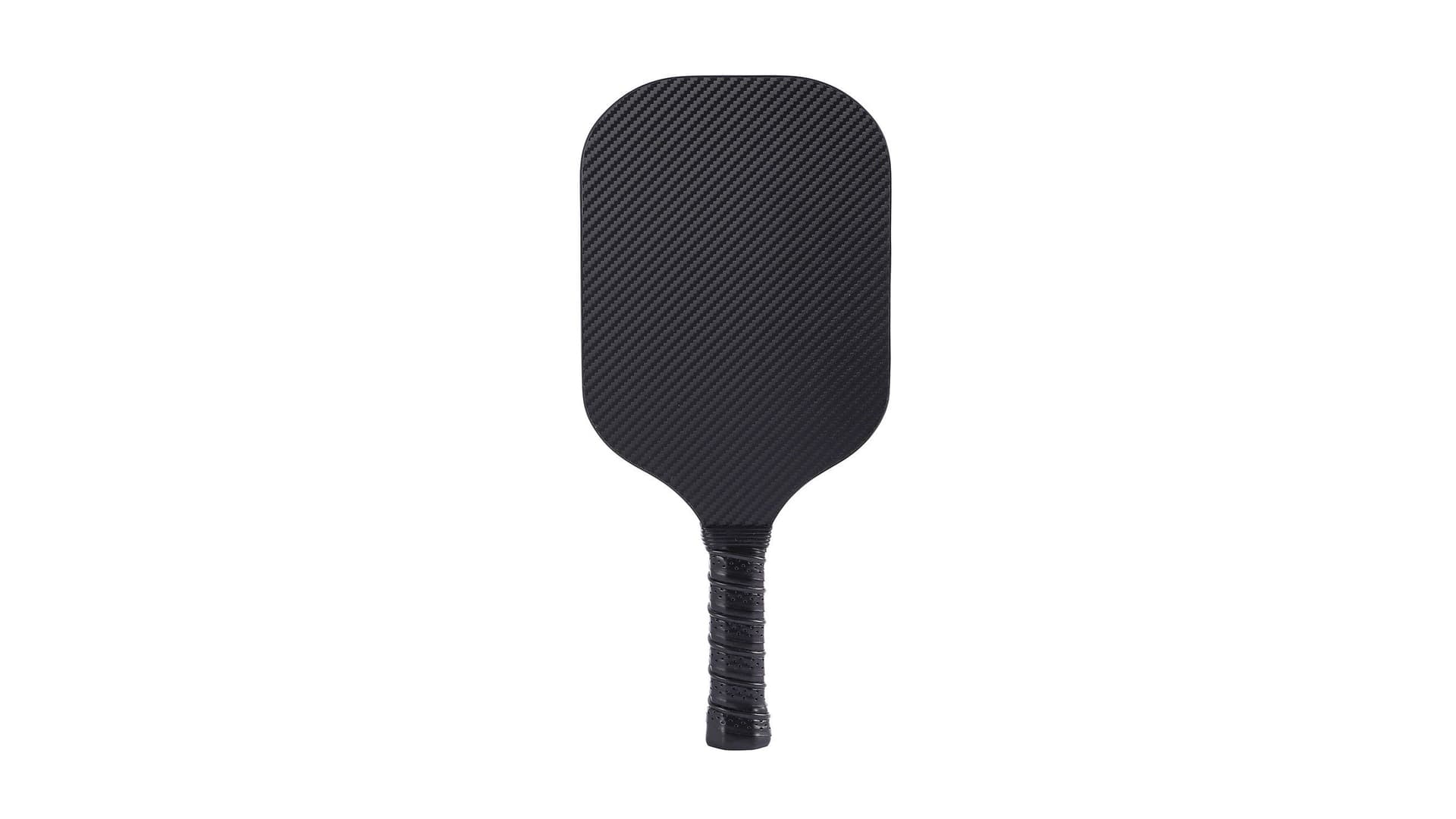
Most quotes for pickleball paddle grips wholesale arrive with the grip buried inside the paddle price, described in three words: "PU cushion grip." That single line covers a component with at least six independent variables — base material, foam thickness, perforation pattern, wrap length, butt-cap geometry and finishing-tape position — and every one of them changes either how the paddle feels in the hand or whether it still measures legal. The buyer signs off on "PU cushion grip," the first container lands, and the returns start arriving with a complaint nobody wrote a spec for.

Key Takeaways
- Re-gripping does not void certification. USA Pickleball's Equipment Standards Manual (Rev. 3.0, Jan 2025) lists "changes to the grip size via inserts, grip wraps, OEM interchangeable grips" as permitted alterations to a commercially produced paddle as certified.
- Overgrips and replacement grips are different products. Verified overgrips run 0.44 mm (Tourna) to 0.6 mm (GAMMA PureTac, 790 mm × 27 mm, padded polyurethane); cushioned replacement grips are published at 1.5–2.5 mm.
- Real overgrip MOQ is 500 pcs per colour, not per order — published by Xiamen Mega and independently by Xiamen Keet. Colour count, not total volume, is what sets your commitment.
- Construction moves price more than volume. One factory publishes US$0.35/pc at 500 pcs for a sticky PU overgrip and US$0.49/pc at 500 pcs for a perforated quick-dry version — a 40% delta at identical quantity.
- Grip tape enters the US under a different tariff line from the paddle. CBP ruling NY G86708 classifies racket grip tape in HTSUS 9506.59.8060; complete paddles typically enter under 9506.99.60. Both carry a 4% general rate today.
- The butt cap counts toward the 17-inch length limit. ESM 2.E.3 measures length "including any edge guard and butt cap" — a late grip change can push a paddle out of spec.
- No standardised tack-retention test exists for racquet grips. Any supplier quoting a cycle count is quoting their own protocol — make them write it down.
What you are actually buying when a quote says "grip"
There is a structural reason the grip line is vague on most paddle quotes, and it is worth understanding before you try to negotiate it. At a paddle factory the grip is not a stocked product — it is a consumable fitted during assembly. Reviewing DJW's own exported SKU range makes the point concretely: nineteen SKU rows across the 3K carbon and T700 frosted lines, covering 13 mm and 16 mm cores, orange, black and white finishes, framed and frameless builds, and not one of those nineteen rows is a grip-only line item.
Every row is a complete paddle. The grip is inside each of those prices, unpriced and unnamed.
That is normal, and it is not evidence of anything shady. But it does mean that asking "how much is the grip?" produces a made-up number, because nobody at the factory has ever had to answer it. The productive question is different: ask the supplier to quote the paddle with the grip removed, then quote each grip option as a delta.
A factory that can produce that breakdown within a day is one that actually knows its own bill of materials. A factory that cannot is quoting you a grip it buys from a third party without a specification of its own — which is precisely the situation where your second production run comes back feeling different from your first.
Three products, one word
The word "grip" is doing triple duty in supplier conversations, and conflating the three is the single most common source of spec disputes. The replacement grip (sometimes "base grip" or "cushion grip") is the layer bonded directly to the bare handle — it is what your factory installs, what defines the paddle's out-of-box feel, and what the buyer is really specifying.
The overgrip is a thin consumable the end user wraps on top, replaced every few weeks. The grip tape or finishing tape is the small adhesive band that secures the top edge of either. These carry different thicknesses, different price points, different MOQs and — as covered below — different customs treatment.
Getting the vocabulary wrong has a specific commercial consequence. A buyer who says "include an overgrip" to a paddle factory often receives paddles with a thin 0.5 mm overgrip fitted as the base layer, over a bare handle. The paddle feels hard and thin, the bevels dig into the palm, and the whole programme reads as cheap even though every other component was specified correctly. Say "replacement grip" when you mean the bonded base layer, and say it in writing.
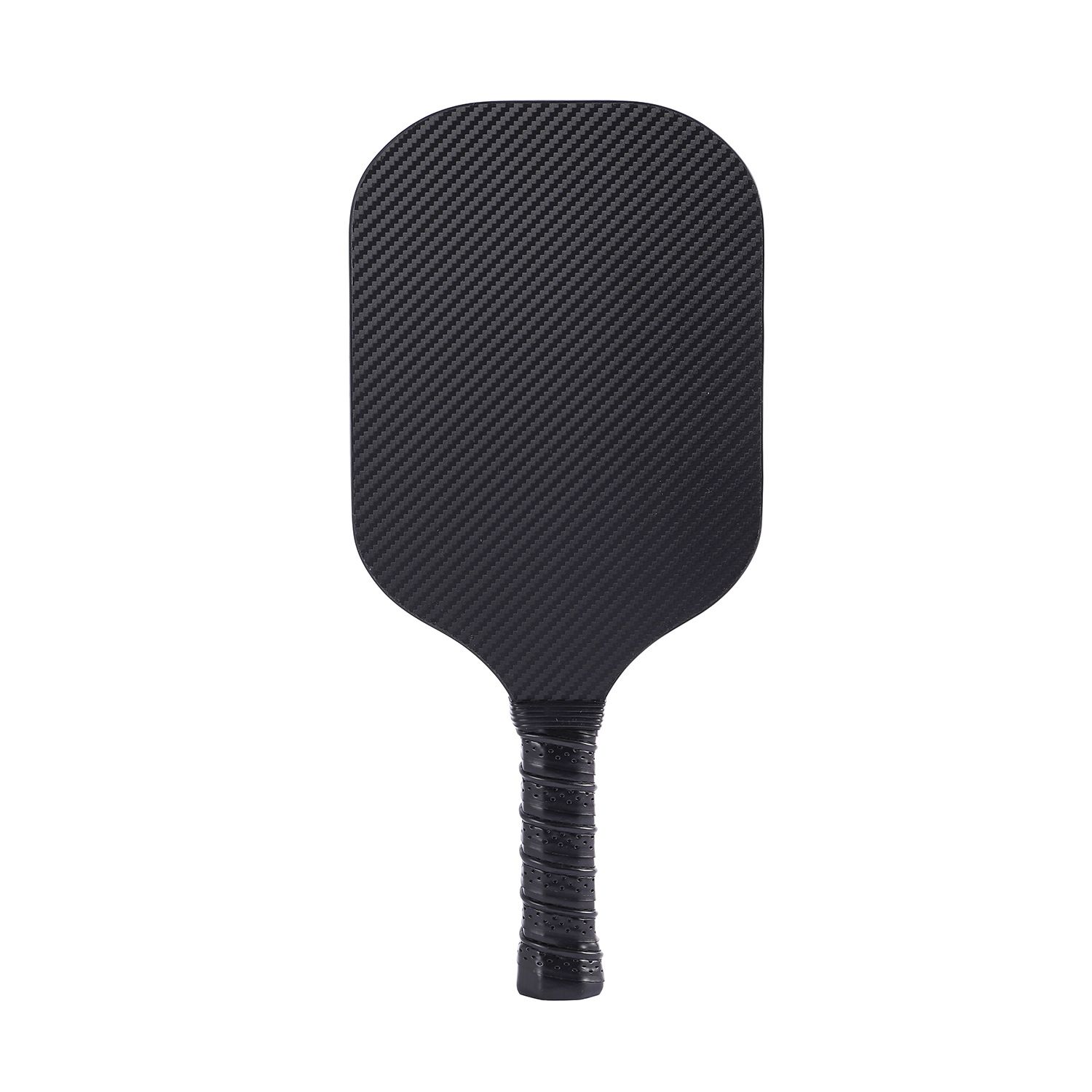
A frameless 16 mm build from DJW's SKU range. The ribbed spiral and the perforation pattern on this handle are both specifiable variables — and neither appears on a quote that just says "PU cushion grip."
Grip material and construction: the specification table
Nearly every pickleball grip on the market is polyurethane over a foam carrier, but that description hides the variable that matters most. Xiamen Keet, a dedicated grip manufacturer, publishes its replacement grip as PU+EVA — a polyurethane skin over an EVA foam substrate. The PU skin controls tack and abrasion resistance. The EVA layer controls cushioning, shock absorption and, critically, how much the grip compresses under wrap tension. Two grips can both be honestly described as "1.8 mm PU" and behave completely differently because one has a dense EVA core and the other has an open, soft one.
This is where a buyer has to accept an uncomfortable reality: no grip manufacturer reachable at the time of writing publishes a foam density in kg/m³ or a Shore A durometer value for its grip foam. Those numbers exist inside the factory, on the foam supplier's technical data sheet, but they are not public. Anyone who quotes you an industry-standard density figure for pickleball grip foam is giving you a number they cannot source.
The practical response is not to guess — it is to make density and hardness mandatory fields on your specification sheet and to fix them to an approved golden sample, so that whatever the value is, it is the same value in run two as in run one.
| Product | Thickness | Length × width | Material |
|---|---|---|---|
| Tourna Grip (overgrip) | 0.44 mm | Not published | Woven, dry-feel |
| GAMMA PureTac (overgrip) | 0.6 mm (.02") | 790 × 27 mm | Padded polyurethane |
| Xiamen Mega OEM overgrip | 0.5 / 0.6 / 0.65 / 0.75 / 1.5 / 1.80 mm | 1050–1200 × 25–27 mm | PU |
| Xiamen Keet replacement grip | 1.5–2.5 mm (0.55 mm standard size line) | 1100 × 25 mm | PU + EVA |
Two things in that table are worth pausing on. First, the length column separates pickleball from tennis: a pickleball handle is short, so a grip cut at 790 mm wraps it correctly while the 1,100–1,200 mm stock lengths are tennis and padel inventory. If a supplier offers you a grip at 1,200 mm for a pickleball paddle, they are selling you existing stock and your assembler will be trimming 30% of every unit into the bin — you pay for that waste in the unit price.
Second, the Xiamen Mega thickness list runs from 0.5 mm all the way to 1.80 mm under a single "overgrip" product heading. The category label tells you nothing. Only the millimetre figure does.
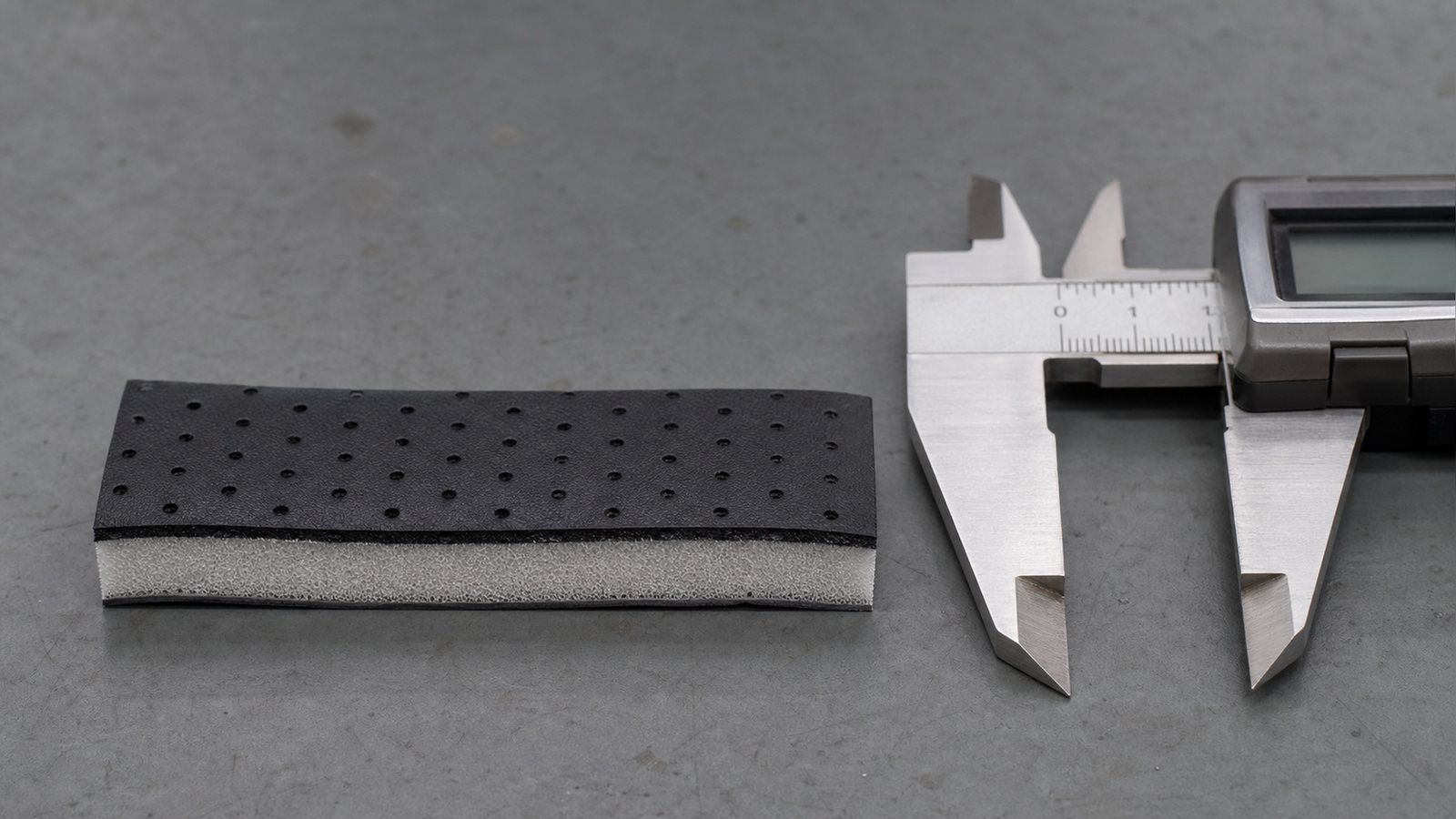
The two layers a single spec line hides: a perforated PU skin over an EVA foam carrier. Thickness is measurable on arrival; foam density is not, which is why it has to be fixed to a golden sample.
Perforation, ribbing and embossing are separate decisions
Surface treatment is where suppliers quietly differentiate, and where your logo lives. Keet describes its perforation process as evenly distributed micro-holes to enhance breathability, and lists stitching, embossing and logo embossing as distinct processes. Each is a separate tooling and labour step. Perforation improves moisture handling but reduces the effective contact area, which slightly lowers dry tack.
Ribbing — the raised spiral visible on most factory grips — gives torsional purchase but creates a wear pattern where the ridges abrade first. Embossed logos look premium and cost tooling; printed logos cost nothing extra and wear off. Decide which of those trade-offs your price point can carry, and write the decision down rather than leaving it to the factory's default.
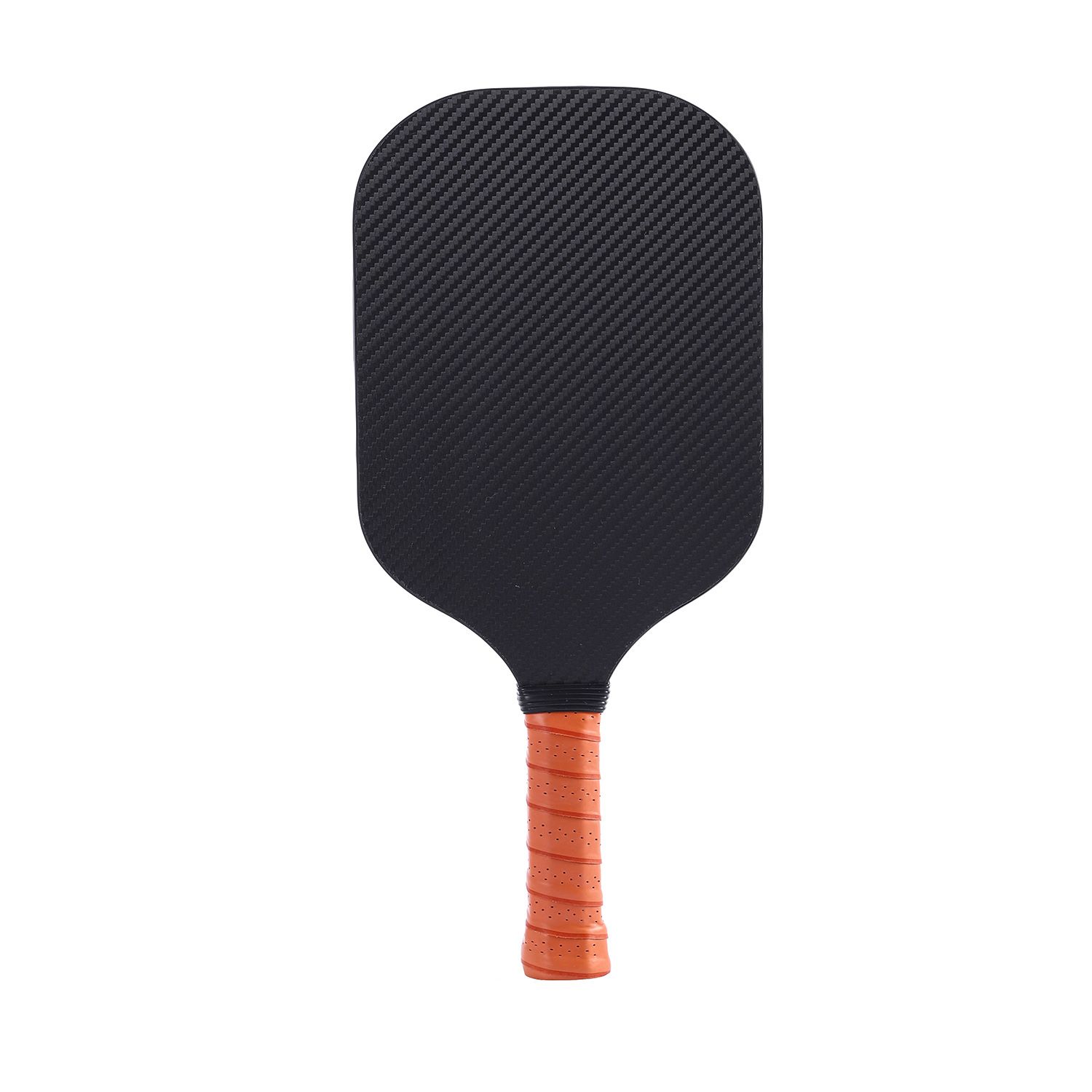
Perforation pattern, ribbing pitch and the black finishing tape at the throat are three separate line items on a grip specification. Colour matching the grip to the paddle finish is a fourth.
From wrap thickness to finished circumference: the arithmetic
Here is a piece of arithmetic that almost no supplier will run for you, and that resolves a contradiction sitting in plain sight across the entire racquet-sports industry. Wrapping a handle in a layer of material of thickness t increases the handle's radius by t, and therefore increases its circumference by 2πt. That is not a modelled estimate; it is the geometry of a circle. Run it against the verified thickness figures and the numbers come out like this.
| Wrap thickness | Geometric circumference gain | In inches |
|---|---|---|
| 0.44 mm (thin woven overgrip) | 2.77 mm | 0.109 in |
| 0.60 mm (standard PU overgrip) | 3.77 mm | 0.148 in |
| 1.80 mm (thick PU wrap) | 11.31 mm | 0.445 in |
| 2.50 mm (max cushioned replacement) | 15.71 mm | 0.618 in |
Now hold that against the rule of thumb repeated across racquet-sports retail: that one overgrip adds about 1/16 inch, or 0.0625 in, to grip size. Working backwards from that figure, 1/16 inch of circumference implies a wrap only 0.253 mm thick — roughly half the thinnest real overgrip on the market, and well under half a standard 0.6 mm PU overgrip. The convention and the geometry disagree by a factor of two or more.
The rule of thumb is not wrong so much as it is measuring something else. Three effects account for the gap. Wrap tension compresses the foam, so an uncompressed 0.6 mm sheet does not sit at 0.6 mm once it is stretched onto a handle — and the softer the EVA carrier, the more it loses.
The spiral overlap means much of the handle carries a single thickness while the overlap bands carry two, so the palm perceives an average rather than a maximum. And "grip size" as sold at retail is a nominal bevel-to-bevel step in eighth-inch increments, not a measured circumference of the finished wrap.
Why does this matter on a purchase order rather than in a physics lecture? Because it tells you that finished handle circumference cannot be derived from a grip thickness spec, and therefore cannot be inspected against one. If your specification says "4 1/4 inch grip" and your supplier's grip stock changes from a 0.6 mm to a 0.75 mm wrap — both of which they legitimately call a PU overgrip — the finished handle changes by roughly 0.9 mm of circumference while the paperwork stays identical.
The fix is to specify both: the wrap thickness in millimetres and the finished circumference measured on the assembled paddle, with a tolerance. Then require the factory to measure the finished figure on a sample from each production run and report it. That is a two-line addition to a spec sheet that eliminates an entire category of dispute.
Real overgrip MOQ and what a grip actually costs
The MOQ question has a specific answer that differs from what most buyers expect, and the difference is expensive. Xiamen Mega publishes a minimum order quantity of 500 pieces per colour on its custom-logo pickleball overgrip. Xiamen Keet, an entirely independent grip specialist, publishes 500 pieces on its PU+EVA replacement grip. Two unrelated manufacturers landing on the same floor is a reasonable signal that 500 is the real industry entry point rather than one supplier's quirk.
The phrase "per colour" is the one that catches people out. A brand launching with a four-colour range is not committing to 500 grips; it is committing to 2,000, because each colourway is a separate dye lot and a separate minimum. This is why experienced private-label programmes launch on one or two grip colours and add colourways at the second reorder, once sell-through data exists. Launching with six colours to look like a full range on a shelf is how a new brand ends up with 3,000 units of dead stock in colours nobody bought.
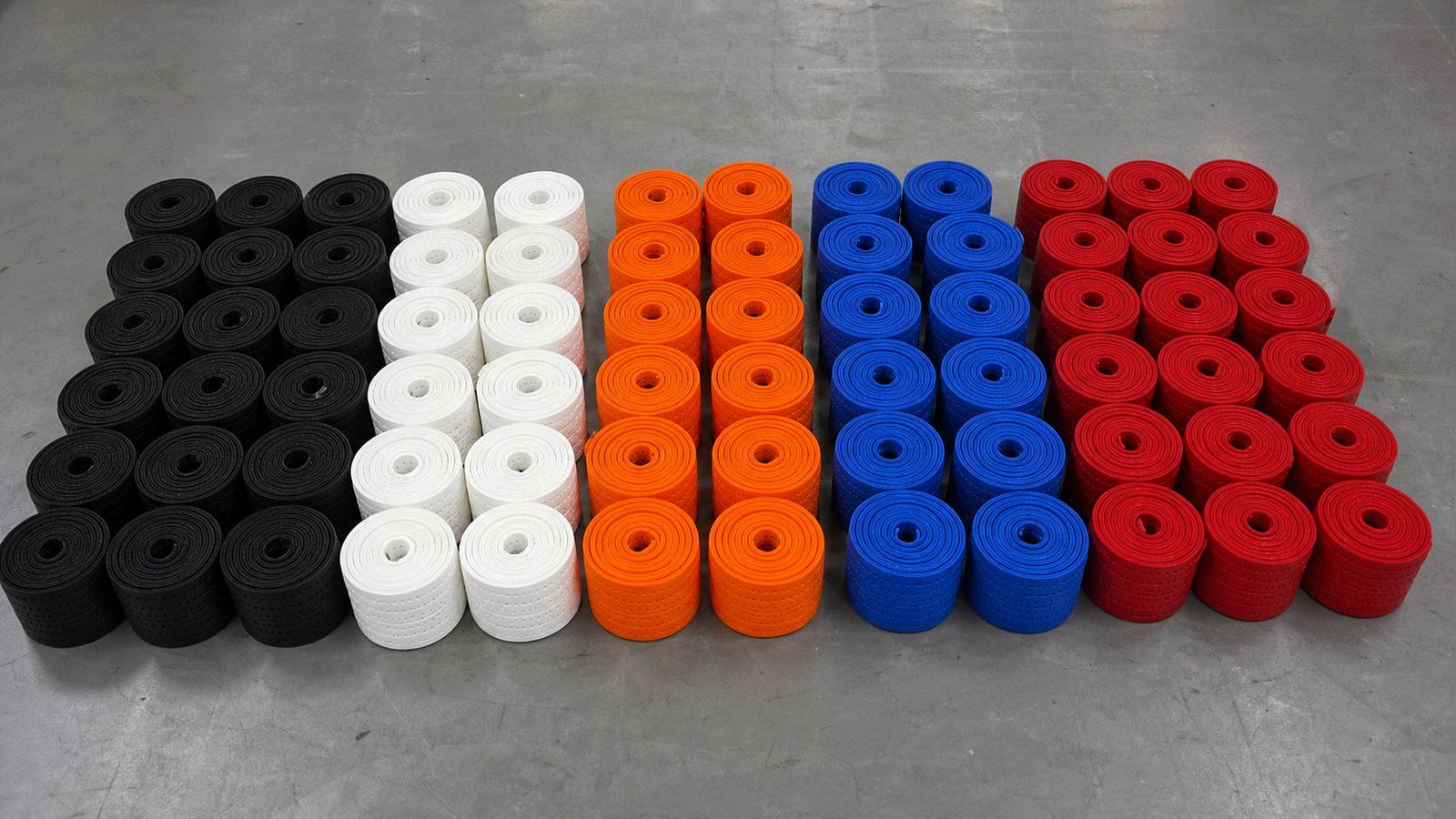
Each colour block is its own 500-piece minimum. Range width, not total volume, is what sets a first order's grip commitment.
On price, the same manufacturer's two published ladders make a point that a single quote never reveals. Their sticky PU overgrip runs US$0.35 per piece at 500–9,999 units, US$0.32 at 10,000–99,999, and US$0.28 at 100,000 and above. Their perforated quick-dry overgrip runs US$0.49 at 500–4,999, US$0.44 at 5,000–49,999, and US$0.39 at 50,000 and above. Same factory, same 500-piece minimum, and a 40% price difference at the entry tier — driven entirely by construction, not by volume.
Read those two ladders together and the strategic conclusion is uncomfortable for anyone negotiating on quantity alone. Moving from 500 units to 100,000 units on the sticky PU line saves US$0.07 per piece. Switching construction at the same 500-unit quantity costs US$0.14 per piece — twice the saving that a 200-fold volume increase delivers. If your cost model assumes that scale is the main lever on grip price, it is pointed at the wrong variable. Specify the construction first, then negotiate volume.
Those figures are published by named third-party grip manufacturers, cited so you have a real benchmark. They are not DJW's prices, and DJW's exported SKU data contains no standalone grip line to compare against.
Putting the grip delta in proportion
A grip upcharge only means something against the paddle it sits on. DJW's own 1688 SKU export lists wholesale figures of CNY 35 to CNY 52 per paddle across its nineteen SKUs, with the CNY 35 row being the entry 3K carbon build and CNY 52 the T700 frosted 16 mm builds. Against a paddle in that band, a grip construction change worth roughly US$0.14 is a small fraction of unit cost — which is the actual argument for specifying the better construction rather than defaulting to the cheapest.
The grip is the only part of the paddle the customer physically touches for the entire life of the product, and it is one of the least expensive components to upgrade. Buyers who cut cost here are optimising the wrong line.
One caveat worth stating plainly, because it changes the arithmetic: those published overgrip prices are for grips bought as standalone goods in their own packaging. A grip fitted during paddle assembly does not carry the same cost structure — no retail packaging, no separate freight, but added assembly labour. This is exactly why the grip-removed quote described earlier is worth insisting on. It is the only way to see which of those costs your supplier is actually carrying.
Tack retention: writing a protocol when no standard exists
Tack retention — how long a grip stays sticky in use — is the single most common warranty complaint on paddle programmes and the single least specified property on paddle spec sheets. There is a reason for that gap, and buyers deserve the honest version: there is no published, standardised tack-retention test for racquet-sports grips. No ASTM method, no ISO method, no USA Pickleball requirement.
When a supplier tells you their grip "retains tack for 40 hours of play," they are quoting an internal protocol you have not seen, using a rig you cannot inspect, against a pass criterion they defined. That number is not comparable to any other supplier's number.
The correct response is not to demand a figure — it is to define the test yourself and make every supplier run the same one. A protocol does not need laboratory equipment to be useful; it needs to be identical across candidates and repeatable across production runs. The following structure is written to be executable by a sourcing team or a third-party inspector with ordinary equipment.
A tack-retention protocol you can put in a purchase order
- Fix the sample set: five grips from the same production lot, all fitted to identical handles, all wrapped by the same operator at the same tension. Record the lot number. Variation between operators is larger than most of the effects you are trying to measure.
- Define one abrasion cycle: a fixed number of rubbing passes with a standardised synthetic-leather or cotton pad under a fixed mass, at a controlled temperature and humidity. The absolute values matter far less than writing them down and never changing them.
- Choose a measurable proxy for tack: peel force on a strip of standard adhesive tape applied and removed under fixed conditions, or coefficient of friction on an inclined plane. Both are cheap. Both produce a number that can be trended.
- Add a moisture condition: repeat the cycle set with the pad dampened to a fixed water content. PU grips and dry-feel woven grips behave in opposite directions when wet, so a dry-only test will mis-rank them.
- Set the pass criterion as a ratio, not an absolute: require that measured tack after N cycles remains above an agreed percentage of the initial reading for that same lot. This survives changes in your test rig and makes the golden sample the reference point.
- Bind it to the golden sample: run the protocol on the approved sample, archive the result, and require each production run to be tested against that archived figure rather than against a specification written in the abstract.
The value here is comparative, not absolute. You will not learn the true service life of a grip in hours of play, and any supplier who claims to have is overselling. What you will learn is which of four candidate grips degrades fastest under identical treatment, and whether run four still matches the sample you approved in run one. That is the question that actually generates returns, and it is answerable.
Certification, decals and the compliance envelope
One rule in the USA Pickleball Equipment Standards Manual is worth more to a private-label buyer than the rest of the document combined, and it is routinely misunderstood. Rule 2.E.5.a states that player alterations to a commercially produced paddle as certified may include "changes to the grip size via inserts, grip wraps, OEM interchangeable grips, OEM replacement paddle faces." Re-gripping a certified paddle does not invalidate its approval. For a brand building on a certified platform, that is the clause that makes a distinct grip specification commercially possible.
Read it precisely, though, because the wording is narrower than the summary. The permission is framed around a commercially produced paddle as certified, and the manual is explicit at 2.E.5 that altered paddles must still meet all specifications. It is a rule about what may change on an approved paddle, not a licence to treat the grip as outside the certification envelope during original manufacture.
If you are changing the grip on your own production build before it is submitted, the paddle you submit for testing must be the paddle you ship. Confirm the current requirements with USA Pickleball directly before committing tooling, since equipment standards have been revised repeatedly and the manual in force at the time of writing is Revision 3.0 of January 2025.
Two dimensional limits the grip can break
The manual's size rule at 2.E.3 sets a combined length-plus-width limit of 24 inches (60.96 cm) and a maximum length of 17 inches (43.18 cm), and it specifies that the measurement includes "any edge guard and butt cap." That inclusion is the trap. A butt cap is a grip-system component, often changed late in development for aesthetic reasons or to accommodate a thicker wrap, and a taller butt cap adds directly to measured length.
A paddle designed at 16.8 inches has 0.2 inches of headroom; a butt-cap change late in the sampling cycle can consume it. If your design sits within a quarter-inch of either limit, re-measure after every grip or butt-cap revision, not just at design freeze.
The second limit governs branding. Rule 2.E.5.b allows decals and tape to extend no farther than 1.0 inch (2.54 cm) above the top of the grip, and no more than 0.5 inch (1.27 cm) inside the outer edge or inside the edge guard. Brands regularly design a logo band that runs up the throat from the finishing tape as a styling feature. Anything above one inch from the top of the grip is outside what that rule permits.
Catching this at artwork approval costs nothing; catching it after a container has landed costs a relabelling operation. Note also that weight is not a constraint here — the manual states plainly at 2.E.4 that there is no restriction on paddle weight, so grip weight is a swingweight and feel decision for your product team rather than a compliance one.
When the grip pulls the paddle into children's-product rules
A plasticised PU grip is exactly the kind of component US children's-product regulation reaches — but only when the product is a children's product in the first place. Under 16 CFR Part 1307, a children's toy is defined as a consumer product designed or intended by the manufacturer for a child 12 years of age or younger for use when the child plays.
Where that applies, concentrations above 0.1 percent of DEHP, DBP or BBP are prohibited, as are concentrations above 0.1 percent of DINP, DIBP, DPENP, DHEXP or DCHP. Critically for grips, 1307.3(c) extends those restrictions to "any plasticized component part" — the grip does not escape scope because the paddle as a whole is mostly carbon fibre.
The practical read for a paddle programme: an adult performance line is generally outside this, while a junior line marketed to under-13s pulls the grip squarely into scope and makes phthalate testing on the grip material a real requirement rather than a nice-to-have. Because scope turns on how you market the product, this is a decision your marketing copy can make for you accidentally. Requirements vary by product, channel and the importer's role, so confirm your specific obligations with a compliance consultant or the CPSC before finalising a junior-line specification.
Why grips and paddles clear customs on different lines
Buyers who ship spare grips alongside paddles frequently assume both travel on the paddle's tariff line. US Customs and Border Protection has ruled otherwise, and the ruling is public. In NY G86708, issued 2 February 2001, CBP classified a fabric tape grip for racket handles — cotton fabric with a plastic coating on both sides, sold as an accessory to tennis and badminton rackets — under HTSUS 9506.59.8060, at 4 percent ad valorem. A complete pickleball paddle typically enters under a different subheading, 9506.99.60.
The punchline is that the rate is the same and the line is not. Both 9506.59.80 and 9506.99.60 currently carry a 4% general rate and a 40% Column 2 rate on the USITC schedule. So the duty arithmetic on grips is unlikely to surprise anyone — but the entry paperwork will, if your broker has classified an entire shipment under the paddle line and separately-shipped grip stock is sitting in it. Misclassification is a compliance exposure independent of whether you underpaid, and the fix is trivial if it happens before the entry rather than during a review.
Two qualifications matter. Classification turns on the specific article and its construction, and the 2001 ruling addressed a coated-cotton tape grip rather than every grip on the market. And the general rate is only part of a landed cost — additional duties can apply depending on origin and current trade measures, which is a separate exercise from base classification and one this site covers in its Section 301 tariff guide for pickleball paddles. Have your customs broker confirm the classification for your exact article before entry rather than relying on a ruling issued for someone else's product.
Which grip specification fits your programme
The right grip specification is a function of who buys the paddle and how it gets used, not of which option sounds most premium. Three programme types account for most private-label volume, and they pull in genuinely different directions.
A rental and institutional programme — clubs, resorts, schools, facility operators — is buying abrasion resistance and cleanability, because the paddle cycles through many hands per day and is rarely re-gripped on schedule. Specify toward the top of the cushioned band, 2.0–2.5 mm of the published 1.5–2.5 mm range, in a dark colour: a light tacky PU grip will look filthy within weeks and generate complaints that have nothing to do with performance.
The cost logic is favourable here — at Xiamen Mega's published US$0.35 entry tier, upgrading grip construction across a 500-paddle rental fleet is a sub-US$100 decision against a fleet that will be re-gripped, or discarded, on the strength of how it looks. This is the one segment where a heavier grip is an advantage rather than a compromise.
A retail performance brand is selling feel, and the grip is a meaningful part of the out-of-box impression. Here a thinner base grip with intentional bevel definition and a tacky surface matches what an experienced player expects — and the working assumption is that the customer adds their own 0.44–0.6 mm overgrip within weeks, which argues against building excess thickness into the base layer.
Get this wrong in the obvious direction and the arithmetic bites: a 2.5 mm base grip plus a 0.6 mm overgrip adds about 19.5 mm of circumference over the bare handle by pure geometry — more than six times the 3.17 mm that a 1/8-inch grip-size step represents. Real compression under wrap tension pulls the delivered figure well below that, which is the whole reason the finished circumference has to be measured on the assembled paddle rather than derived from the spec sheet. Retail programmes also carry the packaging and colour-matching burden, which is where per-colour MOQ arithmetic bites hardest.
A promotional or gift programme — corporate branding, event giveaways, the kind of build represented by the private-label paddles in DJW's own SKU range — optimises differently again. Appearance and logo reproduction dominate, service life expectations are modest, and the grip's job is largely to match the brand's colours cleanly.
This is the programme most exposed to the per-colour minimum, because brand-matched colours are the whole point: a corporate order in a single custom Pantone still triggers the same 500-piece floor as a full commercial range, so a 200-paddle event order carries 300 pieces of grip stock nobody will use. Spending on a premium tack construction here, by contrast, is money the end recipient will never notice.
| Grip approach | Best for | Not ideal for |
|---|---|---|
| Thick cushioned PU+EVA, dark colour, perforated | Rental fleets, schools, resorts, high-cycle institutional use | Performance retail — mutes bevel feel and adds swingweight |
| Thin tacky PU base, defined bevels | Retail performance lines where players add their own overgrip | Rental use — shows soiling fast and wears through sooner |
| Colour-matched printed grip, standard construction | Promotional, corporate gift and event programmes | Any line sold on feel or durability claims |
| Separately stocked overgrip SKU (500 pcs/colour) | Brands with an existing customer base and repeat accessory revenue | First-run launches — per-colour minimums create dead stock |
Worth naming the honest trade-off across all four rows: the thicker and softer the grip, the more it dampens the feedback that experienced players use to judge a paddle. A grip specification that makes a rental fleet last longer will make a performance line feel dead. There is no single correct answer, only a correct answer for a stated buyer — which is why this decision belongs to whoever owns the customer, not to the factory's default.
What we check on a grip before an order is confirmed — and where we stop
To make the checklist concrete, here is the documented procedure on our side of a DJW paddle order, stated plainly so you can see both what it covers and what it does not. Our paddle programme runs at a 50-piece MOQ across a range that currently spans 13 mm and 16 mm cores in 3K carbon and T700 frosted faces, framed and frameless, in orange, black and white. The grip is fitted during assembly on every one of those builds.
- Grip type and construction confirmed in writing before sampling — replacement grip or overgrip, and the material stack, never the phrase "PU cushion grip" alone.
- Colour approved against a physical sample, not a screen render, with the colour count fixed early because per-colour minimums sit upstream of us at the grip supplier.
- Finished handle circumference measured on the assembled paddle from the approved sample, so there is a recorded baseline to compare a later run against — the figure that a 0.6 mm versus 0.75 mm grip-stock substitution moves by roughly 0.9 mm while the paperwork stays identical.
- Overall length re-measured including the butt cap against the 17 inch (43.18 cm) limit whenever the grip or butt cap changes, rather than only at design freeze, and against the 24 inch (60.96 cm) combined length-plus-width figure.
- Logo and finishing-tape position checked against the 1.0 inch (2.54 cm) clearance above the top of the grip, and the 0.5 inch (1.27 cm) inset from the edge guard, at artwork approval.
- Packed weight recorded — 200 g per unit on the current 3K carbon build — so a grip change that moves shipping weight is caught before it reaches a freight quote.
- The approved paddle retained as the golden sample, so "same as last time" refers to a physical object rather than a memory.
Where we stop is equally worth stating. We do not publish a foam density or a Shore A durometer figure for our grip stock, because those values live on our foam supplier's technical data sheet rather than in our own published specifications — if you need them fixed contractually, ask and we will pursue them upstream rather than quote you a number we cannot evidence. We do not hold a standardised tack-retention curve, because as covered above no industry-standard test exists to produce one. And we do not currently carry a standalone grip SKU: the grip is quoted inside the paddle, which is exactly why the grip-removed quote described earlier is the right thing to ask any supplier, including us.
The grip fields to put on your specification sheet
Everything above collapses into a short list of fields. If a specification sheet carries these, a grip dispute becomes a factual question with a documented answer instead of an argument about what "PU cushion grip" meant. If it carries only the phrase "PU cushion grip," every one of these becomes the factory's decision by default.
- Grip type, named explicitly: replacement/base grip or overgrip. Never the bare word "grip".
- Base and carrier material: e.g. PU skin over EVA foam, with both layers named separately.
- Uncompressed thickness in mm, with tolerance — not a category label.
- Wrap length and width in mm, so you are not paying for tennis stock trimmed to fit.
- Finished handle circumference on the assembled paddle, with tolerance, measured and reported per production run. This is the field that actually protects you.
- Foam density and durometer, fixed to the approved golden sample even if the supplier will not publish absolute values.
- Surface treatment: perforation pattern, ribbing pitch, embossing versus printing, each specified separately.
- Colour reference, to a physical standard rather than a screen colour, plus the colour count so per-colour MOQ is priced in.
- Butt-cap height and finishing-tape position, with a re-measurement trigger against the 17-inch length limit and the 1.0-inch decal clearance.
- Tack-retention protocol and pass ratio, referenced to the archived golden-sample result.
A worked example: launching a two-colour retail line
Take a brand launching 1,000 paddles across two colourways on a certified platform. The grip decision chain runs like this. Programme type is retail performance, so the base grip is thin and tacky rather than thick and cushioned. Two colourways at 500 pieces per colour means the grip minimum is 1,000 — which happens to match the paddle quantity exactly, so no dead stock, but a third colour would have added 500 units of committed inventory for no additional paddle volume. That is the moment to hold the range at two.
Next, the paddle sits at 16.9 inches overall, so the butt cap goes on the re-measure list and the logo band on the throat gets checked against the 1.0-inch clearance above the top of the grip at artwork approval rather than at production. Grip construction is specified as PU over EVA with thickness stated in millimetres and a finished circumference tolerance the factory must measure on a sample from each run.
The tack protocol is run on the golden sample, the result is archived, and the purchase order references that archived figure. The paddles are marketed to adults, so the junior-line phthalate question does not arise — but if the same brand later adds a youth SKU, the grip material comes back into scope and needs testing before that SKU ships.
None of that is exotic. It is roughly a half-page of additional specification, decided once, and it removes the three failure modes that generate most grip complaints: a feel that changes between runs, a paddle that measures out of spec after a late component change, and a returns queue nobody can diagnose because no baseline was ever recorded.
Buyers building a paddle programme from scratch will find the same discipline applies to face and core selection, covered in the 3K carbon fibre paddle specification that these grip options are fitted to, where a 50-piece paddle MOQ makes it realistic to trial more than one configuration before committing to a full run.
Conclusion
The grip is the cheapest component on a pickleball paddle and the only one the customer touches for the product's entire life. It is also the component most likely to be described in three words on a quote, which is why it produces a disproportionate share of feel complaints, spec disputes and second-run surprises. Specifying thickness in millimetres, finished circumference with a tolerance, colour count against per-colour minimums, and a tack protocol tied to a golden sample turns all of that from an argument into a measurement.
If you are specifying a grip for a private-label paddle programme, the most useful next step is to ask your current supplier for the paddle quoted with and without the grip. What comes back — and how quickly — tells you most of what you need to know about whether they control that part of the build.
Frequently Asked Questions
Does changing the grip void a paddle's USA Pickleball approval?
No. The Equipment Standards Manual (Rev. 3.0, Jan 2025) lists grip wraps, inserts and OEM interchangeable grips as permitted alterations to a commercially produced paddle as certified. Altered paddles must still meet all other specifications.
What is a realistic MOQ for custom-logo pickleball overgrips?
Two independent Chinese grip manufacturers publish 500 pieces. Xiamen Mega states 500 pieces per colour, so a four-colour range commits you to 2,000 units, not 500.
Can I ship spare grips in the same container as paddles?
Yes, but they may need entering on a separate tariff line. CBP ruling NY G86708 classified racket grip tape under HTSUS 9506.59.8060, while complete paddles typically enter under 9506.99.60. Confirm with your broker.
How many overgrips equal one grip size?
Retail convention says one overgrip adds about 1/16 inch, but geometry disagrees: a 0.6 mm wrap adds 3.77 mm (0.148 in) of circumference. Compression and overlap explain the gap, which is why finished circumference must be measured, not calculated.
Does a heavier grip affect paddle legality?
Not directly. The Equipment Standards Manual states there is no restriction on paddle weight. Grip weight is a swingweight and feel decision. Grip and butt-cap dimensions do matter, because length is measured including the butt cap.
Do phthalate limits apply to my paddle grips?
Only if the paddle is a children's product — designed or intended for children 12 or younger. Then 16 CFR 1307.3(c) reaches any plasticized component part, including the grip. Adult performance lines generally fall outside this scope.
Want to source this quality for your brand?
Contact our factory directly on WhatsApp for an instant MOQ and pricing quote.