Portable Pickleball Net System: The Frame Specs That Actually Differ
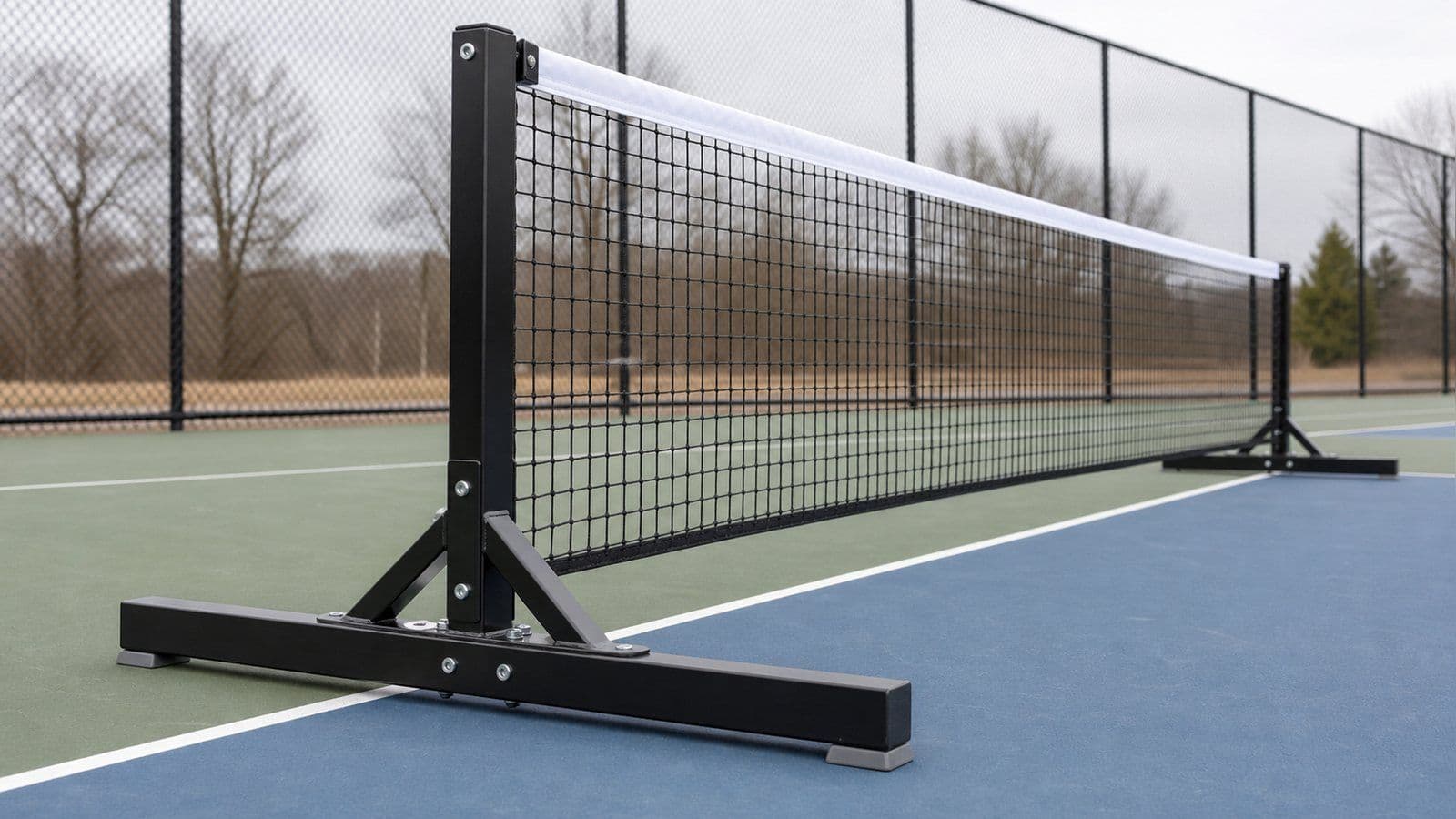
A portable pickleball net system is the only piece of court equipment a buyer specifies almost entirely by feel. Paddles get a certification database, balls get a bounce test, and nets get "22 feet, regulation height, powder-coated steel" — which is the description of every net in the market, from a 24 lb driveway kit to a $1,004.95 institutional frame that breaks into five-foot sections. The words are identical. The frames are not remotely the same object.
What separates them is the part no catalogue photograph shows: tube wall thickness, how the telescoping joints carry load after a few hundred setup cycles, how wide the base footprint is relative to the height it supports, and whether the finish is a decorative coat or a specified one. This guide is written for the buyer who has to write those fields onto a purchase order and defend them when the first replacement claim arrives. It covers what the 2026 rulebook actually requires (which is less than most suppliers imply, and different from what several published spec sheets claim), how to read a frame spec without a lab, and where the money genuinely goes.

Key Takeaways
- The 2026 USA Pickleball Rulebook requires 36 inches ± 0.25 inch at the sidelines and 34 inches ± 0.25 inch at the centre — sidelines are the higher number. Get this backwards on a spec sheet and you have ordered a non-compliant SKU.
- A centre strap is permitted, not required (Rule 3.B.5 says a strap "may be placed"). What is binding is the 34-inch centre height — how you hold it is the supplier's engineering problem.
- ASTM A500 permits the wall at any point to run 10% under nominal, so a quoted 1.2 mm tube can legally arrive at 1.08 mm. Specify the tolerance, not just the number.
- Frame weight is the honest proxy for tube gauge: commodity systems land near 24 lb, club frames in the tens of pounds, and 11-gauge institutional builds at 128 lb to 259 lb.
- The rulebook sets no mesh cord diameter and no mesh size — only that a ball must not pass through. Any "regulation 1.75 mm mesh" claim is market convention quoted as if it were a rule.
- Published setup times span 2 minutes to 30–45 minutes for the first build. These are vendor claims, not measured results, and they track frame tier almost perfectly.
- Do the centre-height arithmetic on any spec sheet before you order — at least one widely sold "regulation size" net publishes 31 inches at the middle, three inches out of tolerance.
What the rulebook actually constrains — and what it leaves to you
Start here, because a surprising amount of net marketing quotes the rulebook loosely and a few published spec sheets contradict it outright. The 2026 USA Pickleball Official Rulebook constrains the net in seven short clauses, and the two that matter most are the heights. Rule 3.B.6 sets the sideline height at 36 inches ± 0.25 inch (91.44 cm ± 0.635 cm) where the net crosses the outer edge of the sidelines. Rule 3.B.7 sets the centre at 34 inches ± 0.25 inch (86.36 cm ± 0.635 cm), and adds that if a centre strap is present, the strap is included in that measurement.
Note the direction: the sidelines are higher than the centre. This gets inverted constantly, including in trade copy written by people who otherwise know the sport, and the inversion is not cosmetic — a frame engineered to hold 34 inches at the posts sits two inches low across the whole span, which makes the SKU unsellable into any tournament-adjacent channel. A quarter-inch band on a 22-foot span is also tighter than it sounds, which is why a sagging top cable is a compliance problem rather than a cosmetic one.
Now the clauses that are looser than the market implies. Rule 3.B.5 says a strap may be placed at the centre of the net, centred 10 feet from the outside edge of the sidelines, "to enable adjustment to the required center net height." That is permissive language. Any supplier or competing guide telling you a net without a centre strap is by definition non-regulation has overread the rule — what is binding is the 34-inch centre height, and a stiff enough centre support or a properly tensioned top cable can hold it without a strap to the floor. On a portable system with no floor anchor available, that engineering choice is exactly what you are buying.
Rule 3.B.1 is looser still: the net "may be made of any mesh fabric material that will not allow a ball to pass through it." There is no cord diameter and no mesh aperture in the rulebook. So when a quotation cites "regulation 1.75 mm knotless mesh," the 1.75 mm is market convention — which means it is negotiable, and a supplier presenting it as a legal requirement is leaning on your not checking. The genuinely specified numbers on the cloth side are the 2-inch (5.08 cm) white tape binding that must rest upon a cord or cable running through it (3.B.4), a net length of at least 21 feet 9 inches (6.63 m), and a drop of at least 30 inches from bottom edge to top (3.B.3).
For the frame itself the rulebook says almost nothing — posts 22 feet ± 1.0 inch inside-to-inside, maximum post diameter 3 inches (3.B.2). That is the entire structural specification. Everything that determines whether a frame survives a rental fleet is unregulated, which is exactly why it has to be specified contractually instead.
Tube wall and gauge: the number that decides everything else
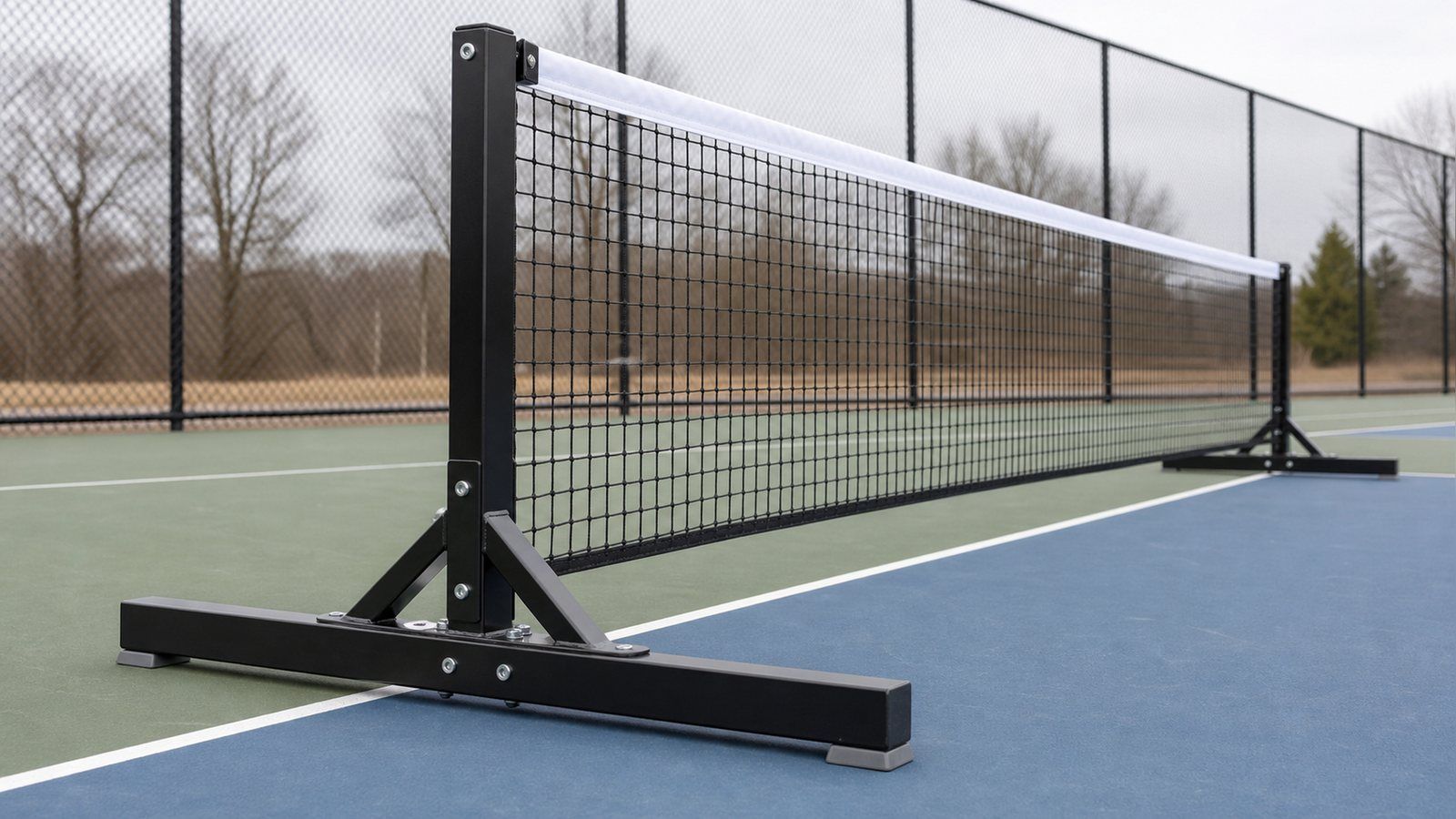
Ask a net supplier for tube outside diameter and you will get an answer immediately. Ask for wall thickness and the reply slows down, because wall is where cost is removed without changing a single photograph. A 25 mm square tube at 1.5 mm wall and the same tube at 0.8 mm wall look identical in a catalogue, ship in the same carton, and behave completely differently the fiftieth time somebody leans on the post to get the tape taut.
Two grounded facts make this specifiable rather than a matter of trust. The first is tolerance. Under ASTM A500, the minimum wall at any point of measurement may be up to 10% less than the specified wall, and the maximum (excluding the weld seam) up to 10% greater. That is the standard behaving normally, not a supplier cheating. But it means a nominal 1.2 mm wall can legally arrive measuring 1.08 mm, and a nominal 0.8 mm can arrive at 0.72 mm — thin enough that the snap-button hole becomes a stress riser. If your purchase order says "1.2 mm wall" and nothing else, you have agreed to 1.08 mm without noticing. Write the acceptance limit you actually intend.
The second is the gauge translation, because institutional frames are quoted in gauge and commodity frames in millimetres, and buyers routinely compare the two without converting. On the Manufacturers' Standard Gauge for sheet steel, 11 gauge is 0.1196 in (3.038 mm), 16 gauge is 0.0598 in (1.518 mm), 18 gauge is 0.0478 in (1.214 mm) and 20 gauge is 0.0359 in (0.911 mm). So the 11-gauge square posts on institutional systems are running roughly three millimetres of wall, while the 0.8 mm poles catalogued on commodity retail nets sit below 20 gauge. That is not a modest difference in grade — it is close to a factor of four in wall, and it is the clearest single explanation of the price spread across the tiers below.
Grade is the smaller lever, but worth naming so you can tell whether a supplier knows their own material. ASTM A500 Grade B round tubing carries a minimum yield of 42,000 psi and minimum tensile of 58,000 psi; Grade C round rises to 46,000 psi yield and 62,000 psi tensile. Stepping B to C adds roughly a tenth to yield strength. Stepping 0.8 mm to 1.5 mm wall nearly doubles the material carrying the load. If a supplier talks about steel grade but will not commit to wall, the conversation is being steered.
| Nominal wall | Gauge equivalent | Legal minimum at −10% | Where it shows up |
|---|---|---|---|
| 0.8 mm | thinner than 20 ga (0.911 mm) | 0.72 mm | Commodity retail kits, e-commerce house brands |
| 1.2 mm | ≈18 ga (1.214 mm) | 1.08 mm | Mid-market club and school portables |
| 1.5 mm | ≈16 ga (1.518 mm) | 1.35 mm | Rental-fleet and high-cycle club frames |
| 3.0 mm | ≈11 ga (3.038 mm) | 2.70 mm | Institutional and tournament frames on casters |
The joints fail, not the tubes
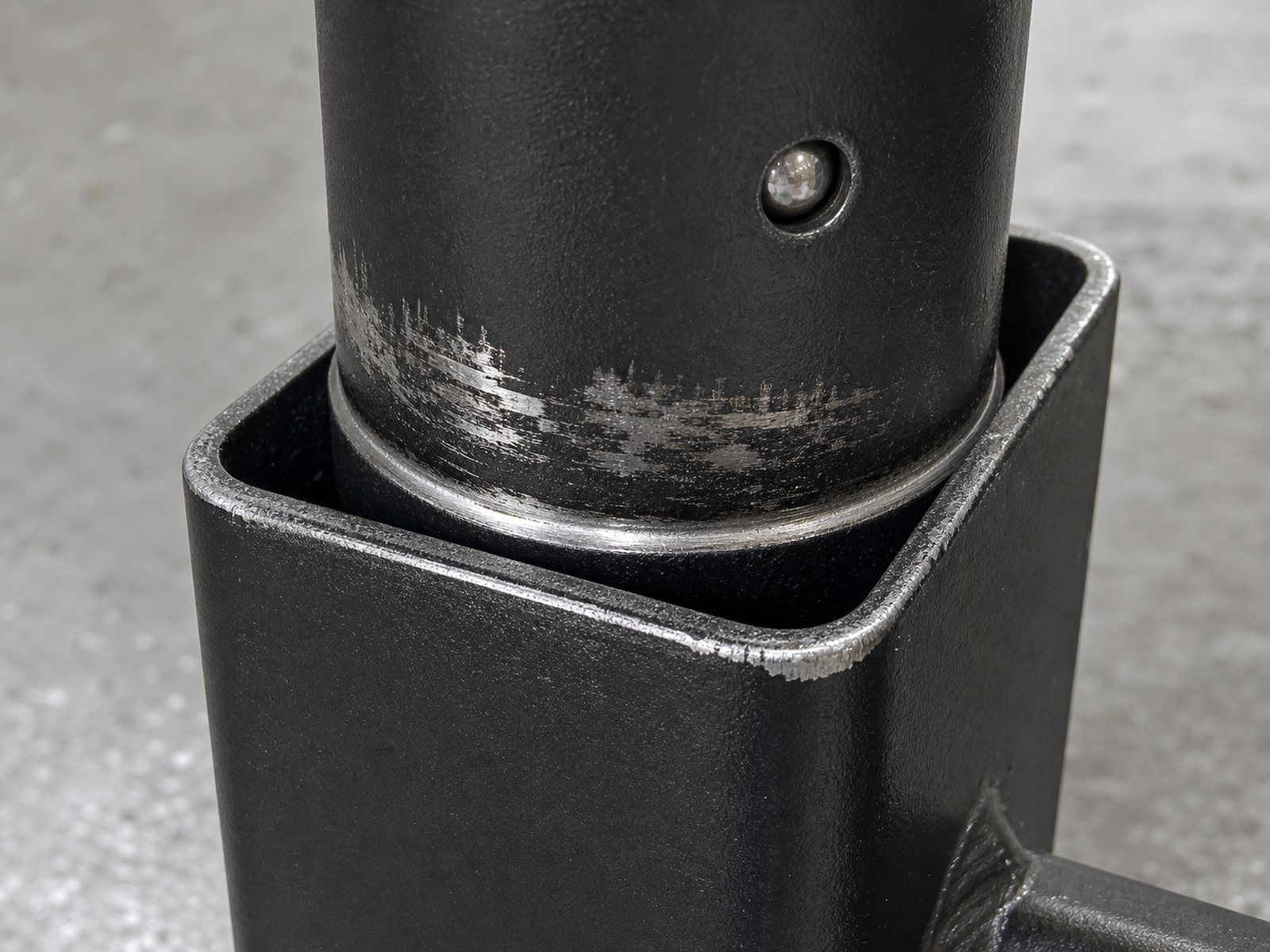
Straight tube almost never fails on a pickleball net. Joints do. Every portable system is a set of telescoping or pinned connections that get worked twice a day, and the wear is progressive rather than sudden — which is why it escapes incoming inspection and shows up as a warranty claim in month nine.
The mechanism tells you what to look at. A round upright sliding into a socket bears on a very small contact area. Every setup cycle rotates and rocks the tubes against each other, polishing the coating off inside the socket first, then wearing a slight oval into the softer tube. Once there is play the geometry changes: the post leans a fraction of a degree, top-cable tension pulls it further, and the sideline height drifts out of that quarter-inch band from Rule 3.B.6. The net has not broken — it has stopped being compliant, which for a club running sanctioned play is the same problem.
Snap-button detents fail in a related way. The button is a spring-loaded pin through a punched hole, and the hole is a stress concentration in a thin wall. On a 0.8 mm tube the hole edge deforms under repeated load until the button no longer seats cleanly, staff respond by forcing it, and you end up with a post that cannot be extended to full height at all. This is the failure that generates the angriest emails, because the frame looks perfect and simply will not go up.
Three things reduce it, and all three are specifiable. An internal sleeve or ferrule at the telescoping junction spreads bearing load over a length instead of a knife edge. A shock cord through the frame sections stops staff cross-threading components during teardown — the reason at least one widely sold light system builds its poles around an internal shock cord. And a pinned clamp collar, rather than a punched detent, moves load off a hole in the wall. A supplier who will not say which of the three their frame uses is selling plain telescoping tube with a punched hole, because that is the option with nothing to say about it.
An honest limit on this section: the joint-wear cycle counts a buyer really wants — how many open-and-close cycles before play exceeds a given tolerance — are not published by anybody in this market, and no independent test data exists that we can cite. Treat any supplier who volunteers a specific cycle number as owing you the test method, the fixture and the acceptance criterion before you believe it.
Footprint, base mass and why nets topple
Tip-over is the failure that gets a facility manager's attention, because it happens in front of members and occasionally involves somebody's ankle. It is also the one most often misdiagnosed as "the net is too light," when the geometry usually matters more than the mass.
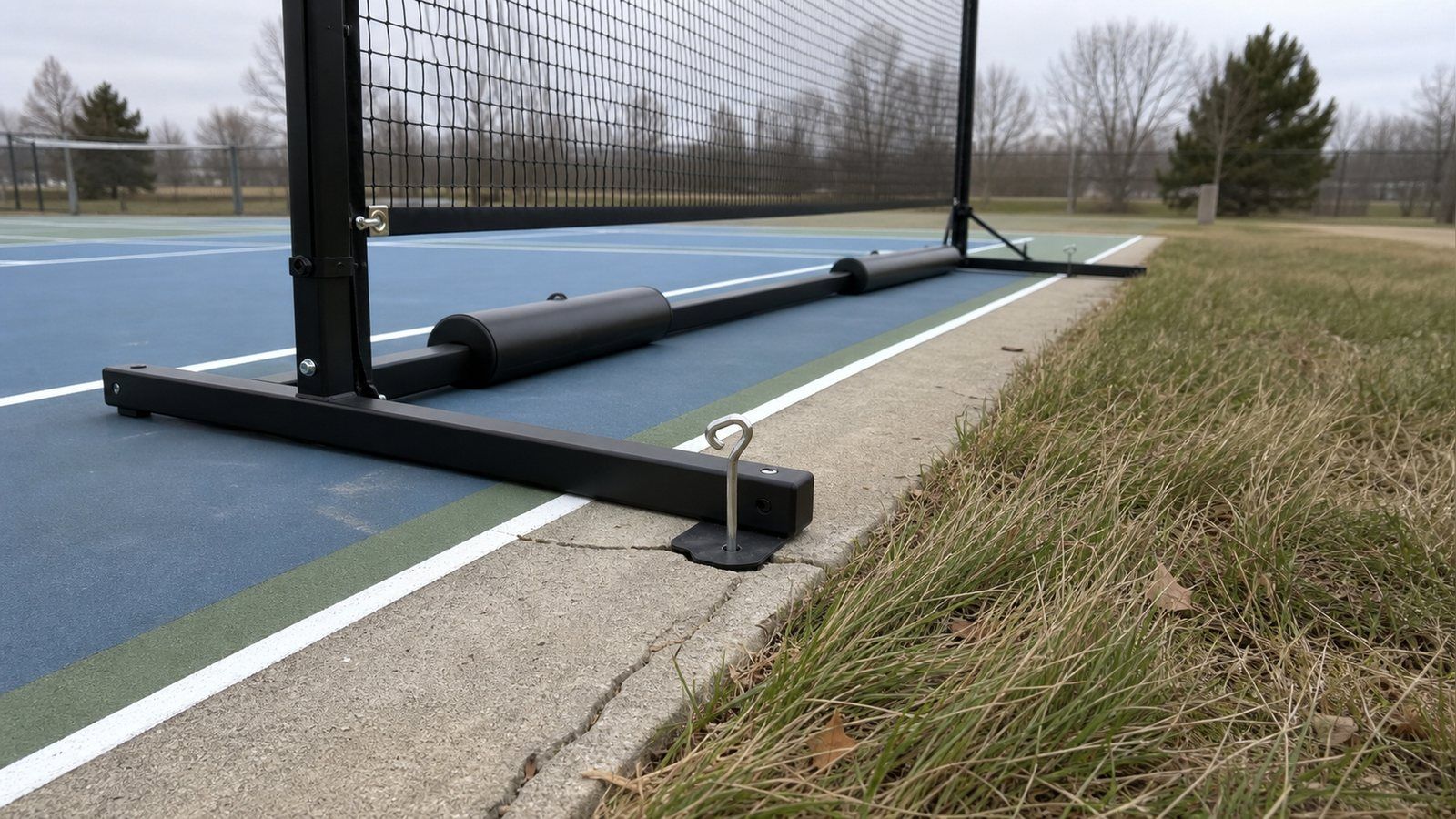
The physics is ordinary lever arithmetic. A net presents a large sail area — roughly 22 feet of mesh standing about three feet tall — and a side gust or a hard body-line drive applies a horizontal force well above the ground. The frame resists that with its own weight acting through the footprint width. Widen the base and you lengthen the resisting arm without adding a pound; add mass at the top and you make it worse. This is why a 24 lb commodity net with a 32-inch-wide base goes over in wind that a heavier frame on wide splayed rails shrugs off, and why the institutional builds quote a base like 48 × 29 × 10 inches as a headline spec rather than an afterthought.
It also explains three field behaviours that look irrational until you do the arithmetic. Sand tubes laid along the base rails work far better than the same weight clipped near the post, because they add mass where the resisting arm is longest. A single stake at the centre does very little, since the centre sits close to the tipping axis. And a net that is stable empty can become unstable once a heavy top cable is tensioned hard, because tension pulls the posts inward and narrows the effective stance.
What this section deliberately does not give you is a tip-over threshold. No credible public test states the force, tilt angle or wind speed at which a given base weight goes over, and inventing one would be worse than useless to a buyer who then quotes it to a supplier. The substitute is a repeatable acceptance test on your own sample, described in the spec-sheet section below: a static pull at tape height with a luggage scale, run at each base configuration you intend to sell, ranking candidates against each other rather than against a number somebody made up.
Finish: what a coating spec has to say to mean anything
"Powder-coated" is not a specification. It is a process family, and it appears on both the frames that last eight seasons outdoors and the ones that bloom rust at every scuff by the second summer. Three things turn it into something you can hold a supplier to.
Film thickness, measured with a coating gauge, is the first, and it is the one that quietly determines whether the coat bridges a tube edge or thins out over it. Adhesion is the second, and it has a real test method: ASTM D3359 scribes a cross-hatch through the coating, pulls pressure-sensitive tape off it, and rates how much coating comes away. It takes about ninety seconds on a sample and tells you immediately whether the pretreatment was done or skipped — because powder over unprepared, oily mill-scale steel looks flawless and lifts off the scribe in sheets.
Corrosion exposure is the third, and it is where claims get inflated. The relevant method is ASTM B117 neutral salt spray, run at 35 °C in a five-parts-salt-to-ninety-five-parts-water fog at pH 6.5–7.2. Two cautions, and the first is the one most buyers get backwards. B117 does not itself specify a test duration — it defines the chamber and the fog, and the applicable product standard or the customer sets the hours. In practice those hours run from roughly 24–72 for thin decorative and standard zinc plating, 120–240 for zinc-nickel, and 480–1000 for hot-dip galvanized fasteners and heavy-duty marine work. So "1000-hour salt spray" is not an invented number outside the ladder; it sits at the top of a recognized heavy-duty band. The question worth asking is not the duration at all — it is what the supplier claims the hours prove.
Which brings up the second caution. The standard itself warns that prediction of performance in natural environments has seldom been correlated with salt spray results used as stand-alone data, and that extrapolating corrosion performance from it should only be considered where corroborating long-term atmospheric exposure has also been done. In other words, B117 ranks coatings against each other; it does not convert into years. So the useful follow-up to a 1000-hour claim is narrow: which product standard set that duration, what was the pass criterion (red rust on the base metal? white rust? a millimetre of creep from the scribe?), and is there a report with a specimen description. A supplier who can answer those is quoting a test. A supplier who offers the hours as a service-life guarantee is doing arithmetic the standard explicitly declines to support — and that, not the size of the number, is the thing to push back on.
For genuinely corrosive placements — coastal clubs, pool decks, anywhere with chloride in the air — the honest answer is often not a better powder coat but hot-dip galvanizing under the coat, and that has a real table behind it. ASTM A123 Table 1 sets the minimum average coating grade for pipe and tubing at 45 microns (1.8 mils) for steel under 1/16 inch, and holds pipe and tubing at 45 microns even in the 1/16-to-1/8-inch band where structural shapes and plate step up to 65 microns (2.6 mils). Note what that means commercially: on thin-wall tube, galvanizing gives you less zinc than buyers assume from the structural-steel numbers they may have seen elsewhere. It is still a large upgrade over bare steel under powder, and it is a specifiable one.
Which frame tier fits your buyers
Frames sort into three tiers, and the sorting is honest — each tier is correct for a buyer and wrong for the others. Published weights are the fastest way to place a quotation, because weight is hard to fake and tracks wall thickness closely.
At the light end sit systems around 24 lb shipping weight on roughly 25 mm tube with a fibreglass centre support and a base near 32 inches wide. These are correct for retail SKUs, e-commerce house brands and consumer bundles — a family setting up on a driveway a dozen times a summer will never load the joints hard enough to matter, and every pound removed is a pound the end customer carries. They are wrong for anything institutional, and the failure is not subtle: staff setting up twice a day will find the detent holes inside a season.
The middle tier is the club and school portable — powder-coated steel ground frame, composite poles, ground stakes, non-marking rubber feet, a rolling case, typically a one-year limited warranty. This is where most facility volume genuinely belongs: it survives daily handling, it moves between courts, and one staff member can put it up alone.
The top tier is institutional: 11-gauge square posts, frames that break into five-foot sections, casters, mass in the hundreds of pounds — 128 lb on one published build, 259 lb before setup on a competition wheeled system carrying a 26-foot-6-inch quarter-inch galvanised polyurethane-coated top cable rated at 2,500 lb break strength. Right for tournament venues and dedicated multi-court facilities that roll nets rather than carry them, with warranties to match (five years limited on the steel frame in one case). Wrong for a rental fleet that needs one person to reposition a net in ninety seconds.
| Tier | Published mass | Best for | Not ideal for |
|---|---|---|---|
| Commodity retail | ≈24 lb shipping | Retail SKUs, consumer bundles, e-commerce house brands, occasional-use gifting | Any daily-setup fleet; sanctioned play; windy open courts |
| Club / school portable | Tens of lb; 1-yr limited warranty typical | Rec centres, schools, rental fleets, shared-use courts, one-person handling | Tournament venues; permanent single-use courts |
| Institutional / tournament | 128 lb to 259 lb; up to 5-yr limited frame warranty | Tournament venues, dedicated multi-court facilities that roll nets on casters | Retail; carried fleets; anything needing a 90-second one-person move |
Specifying a net frame at container volume?
This is aimed at club and facility buyers, distributors and retail programme managers who have picked a tier and now need the wall thickness, footprint and finish written into a quotation rather than described in adjectives. As a source factory for pickleball equipment, we can quote a net programme against the spec fields listed further down this page and consolidate it with paddles and balls so the accessory line does not ship as its own freight problem.
Setup time is a labour cost, not a convenience
Setup time is usually read as a convenience feature. For a facility it is a wage line, and the arithmetic is unforgiving enough to change which frame you buy.
Published claims span an enormous range, and they track frame tier almost perfectly. A composite-pole club portable is advertised at two minutes to set up. A rolling system is quoted at five minutes. The 11-gauge institutional build states 30 to 45 minutes for the first assembly and 15 to 20 minutes for subsequent setups — a genuinely useful disclosure, because it admits the first build is a different job from the daily one. All of these are vendor claims, not measured results, and they were recorded by somebody who had done it before with every component to hand.
Run the numbers anyway. A six-court facility setting up and taking down daily, at even five minutes each way per court, is an hour of staff time a day — around 365 hours a year. Halve that and you have recovered roughly half a full-time month of labour, which on most facility wage lines dwarfs the unit-price gap between the club and commodity tiers. That is a stronger argument than durability, because it shows up every day rather than in year three.
Two cautions when you evaluate a quoted time. Ask whether it assumes one person or two — a 22-foot span is awkward to tension alone, and a system needing a second pair of hands doubles the labour figure without changing the advertised number. And ask for teardown time, which is frequently longer than setup because components have to be matched back into a bag or case. Nobody advertises teardown. It is half your daily cost.
Worked scenario: eight courts, two quotes, one decision
Here is the comparison in the shape it usually arrives, framed as an illustration rather than a specific customer. A municipal facility is fitting out eight shared-use courts where pickleball lines overlay tennis, so nets come on and off daily. Two quotations land. Quote A is a commodity system at roughly a quarter of the unit price, 0.8 mm poles, 24 lb, 32-inch base, no warranty term stated. Quote B is a club-tier portable in the tens of pounds, 1.5 mm wall, wide splayed base rails, rubber feet, rolling case, one-year limited warranty.
The unit-price gap looks decisive until three questions get asked. First, the compliance question: does the spec sheet state a centre height of 34 inches ± 0.25 inch and a sideline height of 36 inches ± 0.25 inch? If a sheet says 31 inches at the middle — and at least one widely sold "regulation size" net publishes exactly that — the SKU is three inches out of tolerance and cannot serve sanctioned play, which removes it from consideration regardless of price. That question alone frequently ends the comparison.
Second, the labour question: eight courts set up and taken down daily is sixteen build cycles a day, which is where the wage arithmetic swamps the unit-price delta. Third, the wear question — those sixteen daily cycles land on punched detent holes in sub-20-gauge wall on Quote A. Nobody publishes the cycle count at which those holes deform, so the buyer reasons about relative risk from wall thickness and joint design and runs a static pull test on both samples before committing.
The decision that usually follows is to buy the club tier for the eight courts and, if retail is also part of the programme, source the commodity tier separately as a consumer SKU with its own positioning. What does not work is buying one frame for both channels: the retail buyer is paying for lightness and the facility is paying for cycle life. If you are also building out the rest of the equipment list, the quantity-per-court logic for a multi-court opening is worked through in our facility opening equipment guide.
What a net frame spec sheet must state
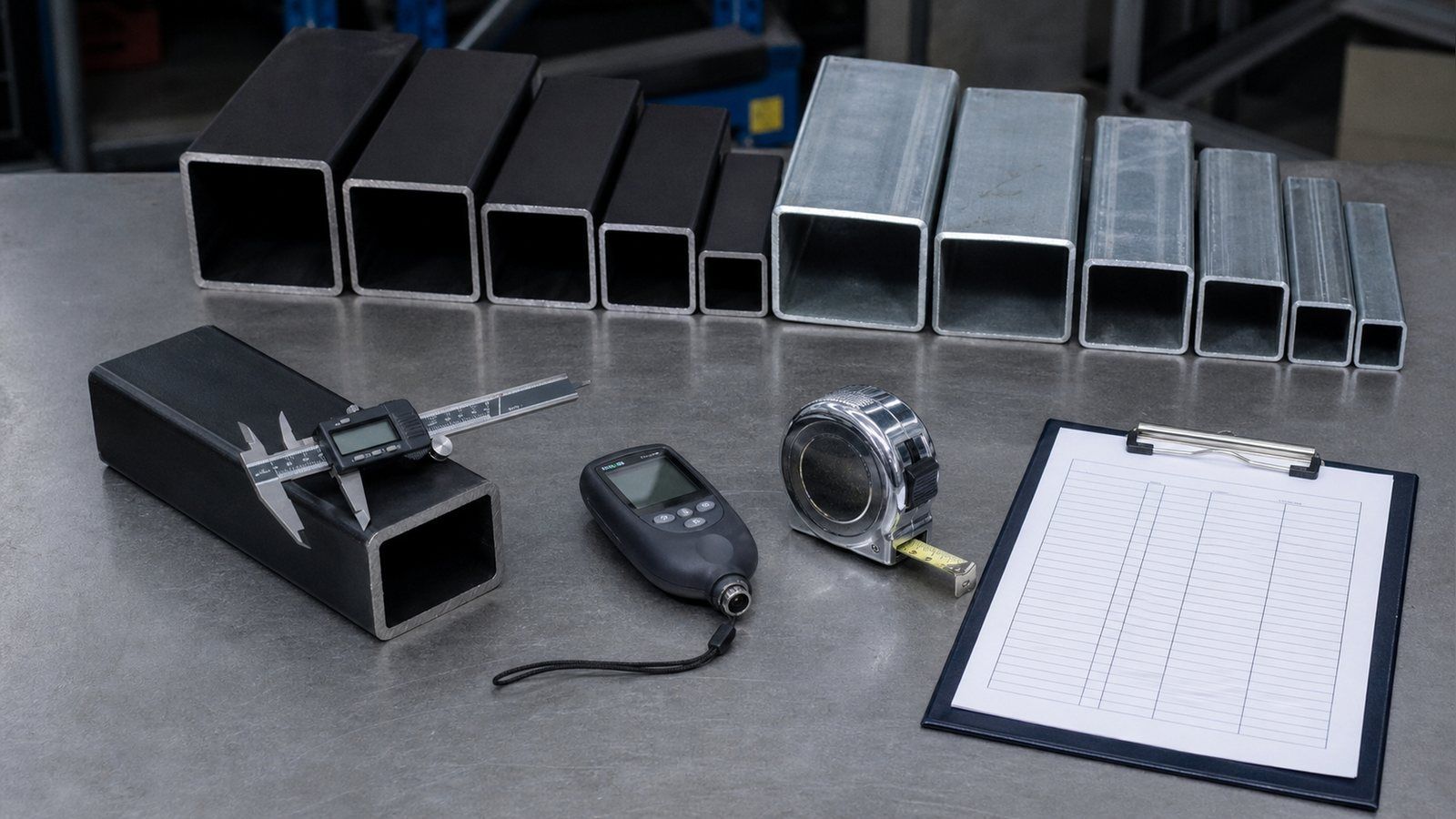
This is the documented procedure a net frame quotation should be put through before a deposit moves. It is written as fields to demand rather than answers to expect, because the answers vary legitimately by tier — what does not vary is that a supplier who cannot fill the fields in has not engineered the frame, they have bought it.
- Tube outside diameter AND wall thickness, with an acceptance limit. Not "1.2 mm" but "1.2 mm nominal, reject below 1.15 mm at any point." Otherwise A500's −10% allowance is yours to absorb.
- Steel grade, named. A500 Grade B and Grade C differ by about a tenth in yield. A supplier who cannot name the grade cannot control it.
- Joint type at every telescoping junction. Internal sleeve, clamp collar, or punched snap-button detent — and whether a shock cord runs through the sections. This is the field most likely to be answered vaguely.
- Base footprint in two dimensions, plus the ballast method. Overall base width and depth, whether ballast is sand tubes along the rails or weights near the post, and whether anchor tabs accept a stake.
- Sideline and centre height as separate numbers with tolerances. 36 in ± 0.25 in at the sidelines, 34 in ± 0.25 in at the centre. Do the arithmetic on the sheet before you order — this is where out-of-spec SKUs are caught.
- Coating: film thickness, pretreatment, and D3359 adhesion result. Plus, for coastal placements, whether the tube is galvanized under the powder and to what A123 coating grade.
- Top cable construction and the tape's relationship to it. Rule 3.B.4 requires the 2-inch binding to rest upon a cord or cable running through it — confirm there is a cable, not just a hem.
- Setup time, stated as one-person or two-person, plus teardown. And separately for first assembly versus routine setup.
- Replacement-part availability and its own minimum order. Net cloth, top tape, centre strap, feet and detent buttons, each with its own MOQ. A frame with a five-year life and no spares programme is a five-year problem.
- Carton dimensions, gross weight and HS heading. Nets typically classify under HS 9506.99, but the ten-digit suffix and duty treatment depend on destination — confirm with your broker rather than reusing a paddle classification.
Two acceptance tests are worth running on the sample yourself, because both are cheap and neither needs a lab. The adhesion test: scribe a cross-hatch through the coating on an inconspicuous section, press tape over it, pull it off, and see what comes away with it. The stability test: with the net at full tension, hook a luggage scale to the top tape near a post and pull horizontally, recording the reading at which a foot lifts — then repeat with each ballast configuration you plan to sell. Neither gives you an absolute figure worth publishing. Both let you rank two candidate frames against each other, which is the actual decision in front of you. Net programmes are usually consolidated with the balls and paddles in our product catalogue, which is what keeps an accessory line from shipping as its own freight problem.
One caveat on all of it. If a net is going into sanctioned play, tournament equipment requirements sit alongside the rulebook and can vary by sanctioning body and event — confirm current requirements with the sanctioning organisation for the events your buyers actually host, rather than treating the rulebook clauses above as the whole compliance picture.
Comparing two net frame quotes right now?
If you are an importer or stocking distributor holding two quotations that both say "powder-coated steel, regulation size," send us the spec sheets and we will tell you which fields are missing and what they usually hide. Useful whether or not you end up buying from us.
Getting the frame spec onto the purchase order
The frame is the part of a portable pickleball net system that nobody specifies and everybody replaces. The rulebook governs the heights, the tape and the post spacing, and leaves the structure entirely to you — so wall thickness with a stated acceptance limit, joint construction, base footprint, and a coating spec with a test method behind it are the four fields that decide whether a net programme runs quietly for five years or generates claims from month nine.
If you are sourcing nets alongside paddles and balls and want the spec fields above filled in rather than described in adjectives, our export desk can quote against them.
Frequently Asked Questions
Is the pickleball net higher at the sidelines or the centre?
The sidelines are higher. The 2026 USA Pickleball Rulebook sets 36 inches ± 0.25 inch at the sidelines and 34 inches ± 0.25 inch at the centre. The two-inch drop is intentional, and the direction is inverted surprisingly often in trade copy.
Does a portable net legally need a centre strap?
No. Rule 3.B.5 says a strap "may" be placed at the centre. What binds is the 34-inch centre height — a strap is one way to hold it, a stiff centre support another. A fitted strap counts inside the measurement.
What mesh size does the rulebook require?
None. Rule 3.B.1 only requires mesh fabric that will not let a ball pass through. Cord diameters like 1.75 mm are market convention, not regulation — useful for durability comparisons, but not something a supplier can cite as a legal requirement.
Can I use a tennis net for pickleball on a shared court?
Not to spec. A tennis net stands taller at the posts than a pickleball net does, so it cannot simply be lowered into compliance across the span. Shared-use courts are the main reason portable pickleball systems exist as a category.
How much should a net frame weigh for club use?
Weight is a proxy for wall thickness rather than a target. Commodity retail systems land near 24 lb shipping weight, while 11-gauge institutional frames run 128 lb to 259 lb. Club fleets generally sit between, trading carryability against cycle life.
Is a 1000-hour salt spray claim meaningful?
ASTM B117 sets no duration; the product standard does, running about 24–240 hours for zinc plating up to 480–1000 for galvanized and marine work. So 1000 hours is a real heavy-duty band, not a red flag. Ask which standard set it and what counted as failure.
What HS code do portable net systems ship under?
Sports equipment of this kind typically classifies under heading 9506.99, but the ten-digit statistical suffix and duty treatment differ by destination country. Confirm the classification with your customs broker for the receiving market rather than reusing a paddle quote's code.
Want to source this quality for your brand?
Contact our factory directly on WhatsApp for an instant MOQ and pricing quote.