Club Pickleball Storage: Heat, Damage and Replacement
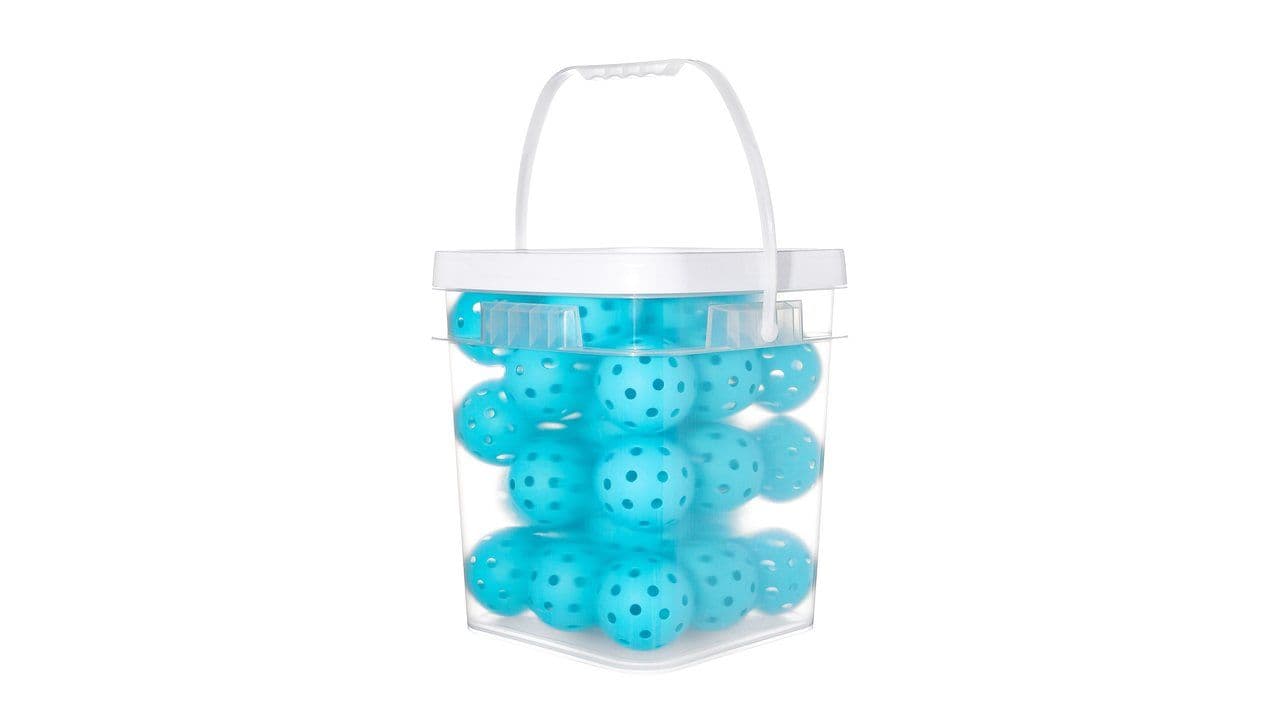
For shared club balls, follow the actual ball maker’s care and replacement instructions first. Where those instructions do not specify otherwise, the general club routine below uses cool, dry storage away from direct sun, ventilated containers and a rotating working set. High temperatures can make a ball play softer, but softer feel does not prove permanent damage or explain why a ball cracked. Remove visibly cracked balls from play; hold unusually soft or inconsistent balls separately for comparable-condition evaluation and replace those that remain unsuitable.
A shared ball basket makes a poor diagnostic record. A cracked ball, a ball that feels different in the afternoon and a fresh ball from another model can all end up in the same pile. Before changing the club’s whole ball choice, separate those observations. The first decision is whether an individual ball belongs in play; the cause of its condition is a separate question.
This independent review compares outdoor ball models. It is context for identifying the model and comparison method, not a test of this club storage routine, a heat-damage threshold or a DJW product. The reviewer uses affiliate links.
Heat can change ball feel without proving why a ball failed
Selkirk’s February 2024 manufacturer article on ball temperature explains that heat can soften the plastic and change a ball’s hardness, shape and bounce. It does not establish a universal storage limit or identify heat as the cause of a particular crack. Follow the instructions for the actual ball model rather than transferring another maker’s product claims.
This is a real club problem, rather than a reason to assign every failure to weather. In its February 6, 2023 board minutes, page 4, Mission Royale Pickleball Club considered changing ball type because its balls were cracking too easily. Those minutes establish the replacement concern; they do not establish its cause or a current failure rate. Players have separately asked whether heat and humidity explain rapid cracking. The question is useful; replies are not controlled tests.
For staff, there are two different findings: “this ball feels unusually soft today” and “this ball has a visible crack.” The second supports removing that ball without settling the first ball’s diagnosis. Do not let a disagreement about the weather delay a straightforward replacement.
A change in feel is a reason to check the ball. It is not a measurement of permanent damage, manufacturing quality or remaining service life. “It cooled down” is also not proof that a previously questionable ball is ready to return.
Keep avoidable heat out of storage
Use the care, cleaning, storage and replacement instructions for your actual model. If the maker’s instructions differ from this editorial club routine, use those instructions. Choose the reserve-ball storage location and container to meet those conditions, and keep the working court basket separate. Convenient access during play does not establish that a location is suitable for leaving balls overnight.
Use the maker’s cleaning method, and let cleaned balls dry before returning them to the working set. In this editorial club routine, rotate the working set rather than repeatedly using one ball. That routine does not promise a specified number of games.
There is no documented universal temperature or waiting time here. Use the actual model’s care instructions when they give a limit. Do not turn the USA Pickleball laboratory temperature into a storage thermostat, and do not heat, reshape or ice a suspect ball as a substitute for checking its condition.
Source and scope
Give reserve balls, working balls and held balls different places
A club does not need a laboratory to stop three different ball populations becoming one. Reserve balls are waiting for use; working balls are in the session’s rotation; held balls have an unresolved condition. Give each population a clearly named place. The labels describe the club’s operating decision, not a new product grade or a promise that every ball in a container is formally compliant.
This distinction is especially useful when several coaches share a basket. A member may put a questionable ball back beside an intact one without intending to conceal a problem. If the next coach only sees a full basket, the question is lost. A separate hold container keeps the condition visible until someone completes the check and records the outcome.
Source and scope
Source and scope
Source and scope
Decide by the ball condition, not a games counter
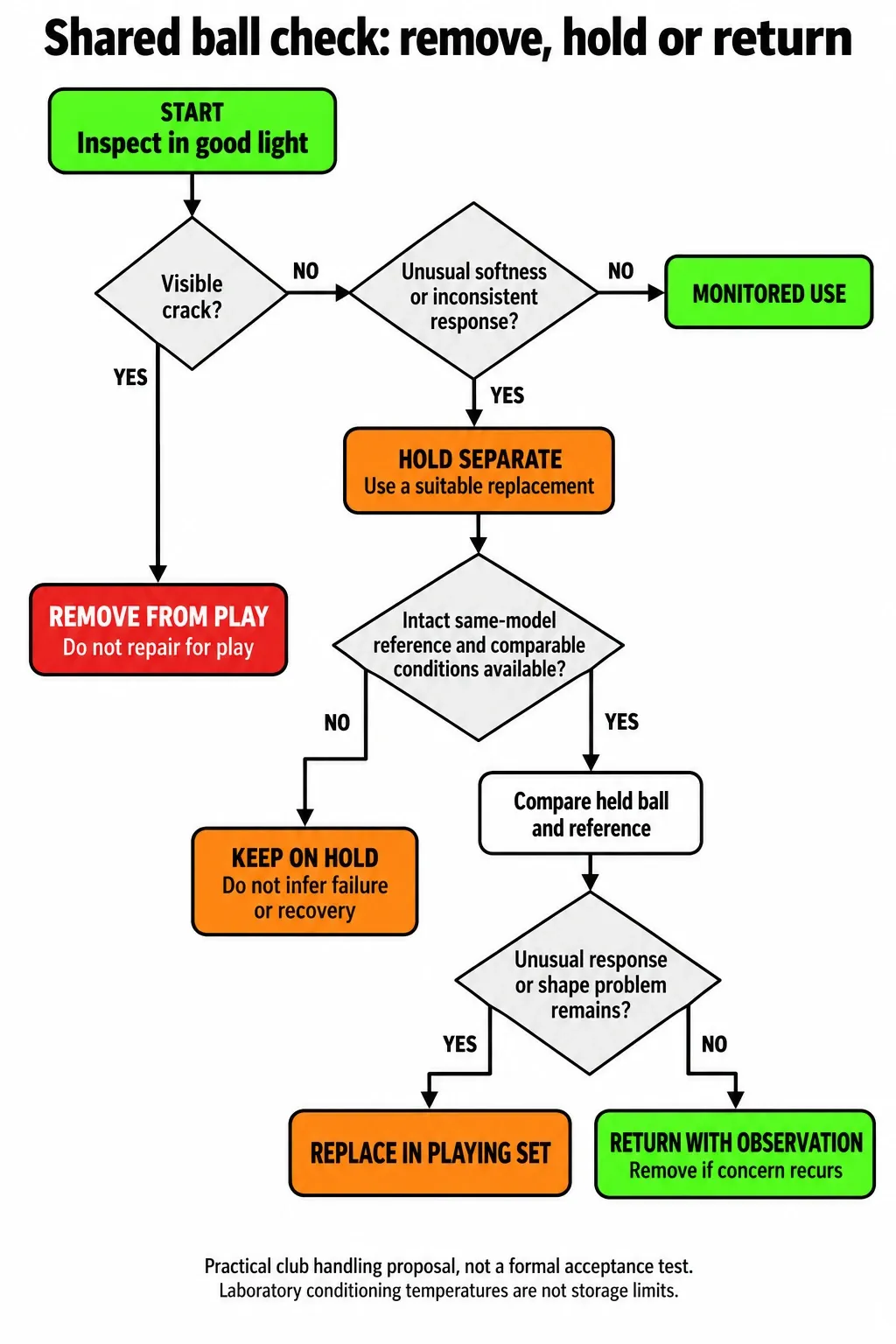
Apply the actual maker’s instructions before this editorial check–isolate–recheck–replace routine. Do not return a ball where its maker requires replacement. The routine is a practical play-quality screen, not a certification test or a way to determine supplier responsibility.
- Inspect the ball in good light. If you see a crack, remove it from the playing set. Stop this routine for that ball; cooling or cleaning does not justify putting a cracked shell back into play.
- Hold a ball with unexplained changed response. If it looks intact but feels unusually soft or bounces inconsistently, keep it separate and use a suitable replacement for the session. Staff do not need to prove the cause before setting a questionable ball aside.
- Compare like with like before returning a held ball. Identify its model and compare with an intact reference of the same model under comparable conditions. Use the same surface and drop method for an informal bounce comparison. A fresh ball of a different model, or one kept under different conditions, leaves the comparison unresolved. Keep the ball on hold until that reference is available.
- Act on the remaining condition. If the held ball still has an unusual response or obvious shape problem, replace it in the playing set. If it remains intact and its response is normal in the comparable check, monitored return is reasonable. Stop and remove it again if the concern recurs; this routine cannot establish how many sessions remain.
| Observation | Club action | What remains unknown |
|---|---|---|
| Visible crack | Remove from play | Cause and commercial remedy |
| Unexpected softness or inconsistent response | Hold; compare under comparable conditions | Temporary change, persistent deterioration or another difference |
| Concern persists in the comparable check | Replace in the playing set | Root cause and remaining life |
| Intact; normal response after the comparable check | Return with continued observation | Future service life; formal compliance |
Source and scope
Make an informal comparison fair enough to be useful
An informal comparison becomes more interpretable when staff change fewer things at once. Use an intact reference of the same model, the same surface and a consistent drop method under comparable conditions. That does not make the procedure a certification test; it simply reduces the chance that a different model, surface or handling method explains the apparent difference.
If the held ball was used during an afternoon session while the reference stayed under different conditions, do not treat their immediate difference as a verdict on permanent damage. Record the condition difference and keep the ball on hold until a comparable check can be made. The missing input is a suitable reference under comparable conditions, not a staff member willing to call the ball good.
Do not choose a return-to-play threshold from a casual bounce on the club floor. The formal USA Pickleball bounce specification below uses an identified surface, drop height, measurement convention and temperature. A staff check with a different setup answers the smaller play-quality question described here. Numbers that look close do not make the setups equivalent.
Why a floor comparison cannot prove approval
The USA Pickleball Equipment Standards Manual, Revision 3.0, January 2025, section 2.D.5 specifies a 30–34 inch bounce, measured to the top of the ball after a 78-inch drop onto a granite plate at least 12 × 12 × 4 inches, at 70°F ±5°F. Those are test conditions. A ball bouncing differently on a hot court has not thereby failed that specified test.
The club’s informal comparison answers a smaller question: whether a held ball behaves suitably against the available reference. It cannot certify a model or establish that a delivered batch was defective. The ball QC guide covers the separate measurement work; the cold-weather specification guide covers cold-season purchasing conditions.
For shared sets, keep a short note with any held ball: model, observed problem, whether it followed play or storage, the comparison conditions and the decision. This makes the next handover useful. It does not turn a staff observation into a test report or require a forecast of the club’s ball consumption.
Source and scope
Record observations separately from suspected causes
A short record should let the next person understand what happened and what action remains. “Bad ball, heat” combines an observation, a diagnosis and a disposal decision without showing which was actually established. Prefer a specific observation such as a visible crack, unusual softness or inconsistent response, followed by the playing-set decision.
Keep any reported heat or storage history in a separate field. A player’s recollection can guide the next question, but it is not a measured exposure record. Likewise, the fact that several balls failed in a busy week does not establish a failure rate unless the number used and the observations were actually tracked. Do not turn an incomplete handover into a supplier-quality statistic.
Source and scope
The proposed record below is deliberately small. It does not require staff to estimate remaining games or decide who is commercially responsible. Those are different questions with different evidence needs. Its purpose is to prevent a ball held by one coach being returned to play by another before the unresolved condition is checked.
| Record field | What to enter | How it changes the next action |
|---|---|---|
| Identity | Known model; batch/order reference if available | Find a same-model reference and preserve traceability. |
| Observed condition | What staff actually saw or felt | Crack removes; unexplained response holds for check. |
| Conditions and history | Play/storage context; note unknowns as unknown | Avoid comparing unlike conditions or guessing a cause. |
| Comparison and decision | Reference/method used; hold, replace or monitored return | Tell the next coach what has been resolved. |
Source and scope
Handle a mixed basket without replacing the whole model on a guess
Prepare a club replenishment enquiry. Use the current ball catalogue to name the ball type/model. Send the quantity, indoor/outdoor playing setting, destination and required arrival date through the factory enquiry route. Ask for current availability and a model-specific care sheet; request an actual quotation rather than assuming the article establishes a heat limit, approval, MOQ or delivery date.
Enquiry fields to copy: ball type/model ______; quantity ______; indoor/outdoor use ______; destination ______; required arrival date ______; maker care instructions needed ______.
Prepare a bulk ball enquiryA three-ball pack is an optional small model-evaluation purchase, not the club bulk-replenishment offer or a heat-damage test.
Conclusion
Storage and rotation reduce avoidable exposure and make handovers easier. They do not establish a universal heat limit, diagnose why a crack occurred or guarantee lifespan. A useful club record preserves those boundaries while making the next session’s condition decisions clear.
Frequently asked questions
How long should a held ball stay out of play?
There is no universal waiting time here. Return only an intact ball with normal response in a comparable same-model check; keep it out if the concern persists.
Can I compare a held ball with a different model?
Use an intact ball of the same model under comparable conditions. If that reference is unavailable, keep the held ball separate.
What should I send the supplier about recurring problems?
Send the model, observed condition, available batch or order reference, and play/storage context with your comparison record. Keep observations separate from suspected causes.
Plan club ball replenishment
For bulk replenishment, send ball model/type, quantity, destination and required arrival date. Confirm product suitability and availability with the factory. A three-pack is an evaluation option, not a bulk-order quantity. Availability, suitability, MOQ, pricing and lead time require confirmation; no response time or shipping service is promised.