SGS vs QIMA vs V-Trust: Picking a Pre-Shipment Inspection Agent for Pickleball Orders
Somewhere between the deposit and the balance payment on a pickleball paddle order is a decision most first-time importers underweight: which third-party inspection company actually shows up at the factory to check the goods before you release the balance. SGS, QIMA, V-Trust, Bureau Veritas, Intertek, Asia Quality Focus, a dozen boutique agencies — every one of them will happily book your inspection. Every one of them produces a report that looks broadly similar. Every one of them charges roughly the same day rate. But the choice between them changes what actually gets checked, what a "pass" means in practice, and how fast a real problem gets escalated. Getting this wrong on a first order teaches an expensive lesson.
This is the practical comparison of the three inspection companies most commonly used for pickleball orders out of China — SGS, QIMA, and V-Trust — plus the pickleball-specific tests that separate a useful inspection from a paper exercise. We regularly host inspectors from all three on our factory floor and see the pattern of what each does well and what each misses. The comparison below is the working knowledge we share with new buyers when they ask "which one should I book?"
Key Takeaways
- SGS is the oldest and most globally-known — best when the buyer's customer requires a recognized-brand report (large retailers, government purchases, EU compliance work); day rate typically the highest of the three at roughly $300–500 per inspector-day.
- QIMA (formerly AsiaInspection) is the tech-forward middle option with the best inspector app, fastest report turnaround (often within 24 hours), and roughly $250–400 per day — the default for e-commerce brands and Amazon FBA sellers.
- V-Trust is China-focused with the lowest day rate at roughly $200–350, generally excellent local inspector coverage, and thin international brand recognition — the value pick for direct-to-consumer brands where the report never leaves the buyer's file.
- All three follow ISO 2859-1 AQL sampling — 2.5 general / 1.5 major / 2.5 minor is the standard configuration for pickleball orders; the AQL numbers you specify matter more than which agency runs the inspection.
- Pickleball-specific tests — bounce test, weight tolerance, roundness gauge, USA Pickleball spec verification, drop tests on paddles, edge-guard adhesion pull — need to be spelled out in the inspection scope; none of the three will infer them from "check the goods."
- The inspection agency's brand matters most when a downstream customer will read the report; for internal QC gating, the specific inspector and the scope you give them matter more than the letterhead.
The three-way comparison
The differences below are the ones we see on the factory floor over months of inspection visits. Costs are indicative FOB-China day rates for a standard pre-shipment inspection; add report translation, expedited scheduling, or lab-testing add-ons for the real invoice.
| Dimension | SGS | QIMA | V-Trust |
|---|---|---|---|
| Day rate (indicative FOB, one inspector-day) | $300–500 | $250–400 | $200–350 |
| Report turnaround | 24–48 hours | Same day to 24 hours (app-driven) | 24–48 hours |
| Booking window | 3–5 business days ideal, 1 day rush possible | 2–3 business days ideal, next-day rush common | 2–4 business days, next-day possible in major hubs |
| Report recognition (downstream customer) | Highest — recognized by major retailers, EU customs, government buyers | Strong — widely accepted, particularly in e-commerce and Amazon supply chains | Moderate — solid within China trade; less internationally recognized than SGS |
| Lab-testing add-ons | Extensive in-house labs (CE, CPSIA, REACH, EN, ASTM) | Broad partner-lab network | Available via partner labs |
| Best-fit buyer | Large retailers, government purchases, compliance-heavy destinations | E-commerce brands, Amazon FBA sellers, DTC retailers | Small-to-mid distributors, direct wholesalers, cost-sensitive first orders |
If a downstream customer will read the report, the agency's brand matters — go SGS or QIMA. If the report is for your internal QC gating and no one else will ever see it, V-Trust delivers essentially the same inspection at a lower rate.
SGS — when the letterhead matters
SGS is the oldest and most globally-recognized of the three. Founded in the 1870s as a grain-trade inspection service, it's now the largest testing-inspection-certification company in the world, with in-house labs across every major category — chemistry, textiles, electronics, sporting goods. For a pickleball order that will land at a major US retailer's distribution center or clear EU customs with attached compliance documents, an SGS report carries the most weight.
The trade-off is cost and rigidity. SGS day rates are the highest of the three; their scheduling window is slightly longer; their inspection scope is the most standardized. That standardization is a feature when you want a report that reads consistent across every shipment — it's a bug when you have unusual pickleball-specific tests you want the inspector to run, because SGS inspectors are trained to a broad checklist rather than a niche product-category expertise. If SGS is the choice, spelling out the pickleball tests explicitly in the inspection scope is more important, not less.
QIMA — the tech-forward middle path
QIMA (formerly AsiaInspection, rebranded around 2018) is the tech-forward middle option. The inspector app they built is genuinely the best in the industry: inspectors upload photos, measurements, and defect classifications from the factory floor in real time, and buyers can see the inspection unfolding on their dashboard while it happens. Report turnaround is faster than SGS or V-Trust — often before the inspector leaves the factory.
QIMA has invested heavily in e-commerce and Amazon FBA supply-chain workflows over the past several years. If the pickleball order is destined for FBA warehouses, QIMA's checklists include the FBA-specific packaging and labeling checks — mapped to Amazon FBA prep requirements — that other agencies don't run without prompting. The Amazon-side compliance is the other side of a broader import compliance story covered in CE, CPSIA & REACH pickleball safety compliance. Their day rate sits between SGS and V-Trust.
V-Trust — the value pick for direct wholesalers
V-Trust is China-focused. They're not a global brand and their reports carry less weight with third parties who don't know them, but their inspector coverage across Chinese manufacturing hubs is excellent, their day rates are the lowest of the three, and the actual inspection work is comparable when the scope is well-defined. For a direct-to-consumer brand or a distributor whose only reader of the QC report is themselves, V-Trust delivers essentially the same audit at 30–40% below SGS pricing.
Two watch-outs. First, if the downstream customer or an insurer might ever request the QC file, ask up front whether V-Trust's brand is accepted — some large retailers and government buyers have preferred-agency lists that don't include V-Trust. Second, V-Trust's inspector English varies more than SGS or QIMA; if you need real-time voice or written communication in English during the inspection, factor that in. For pickleball orders where the buyer is comfortable working through the report in writing after the inspection is complete, this rarely matters.
The AQL sampling that all three run
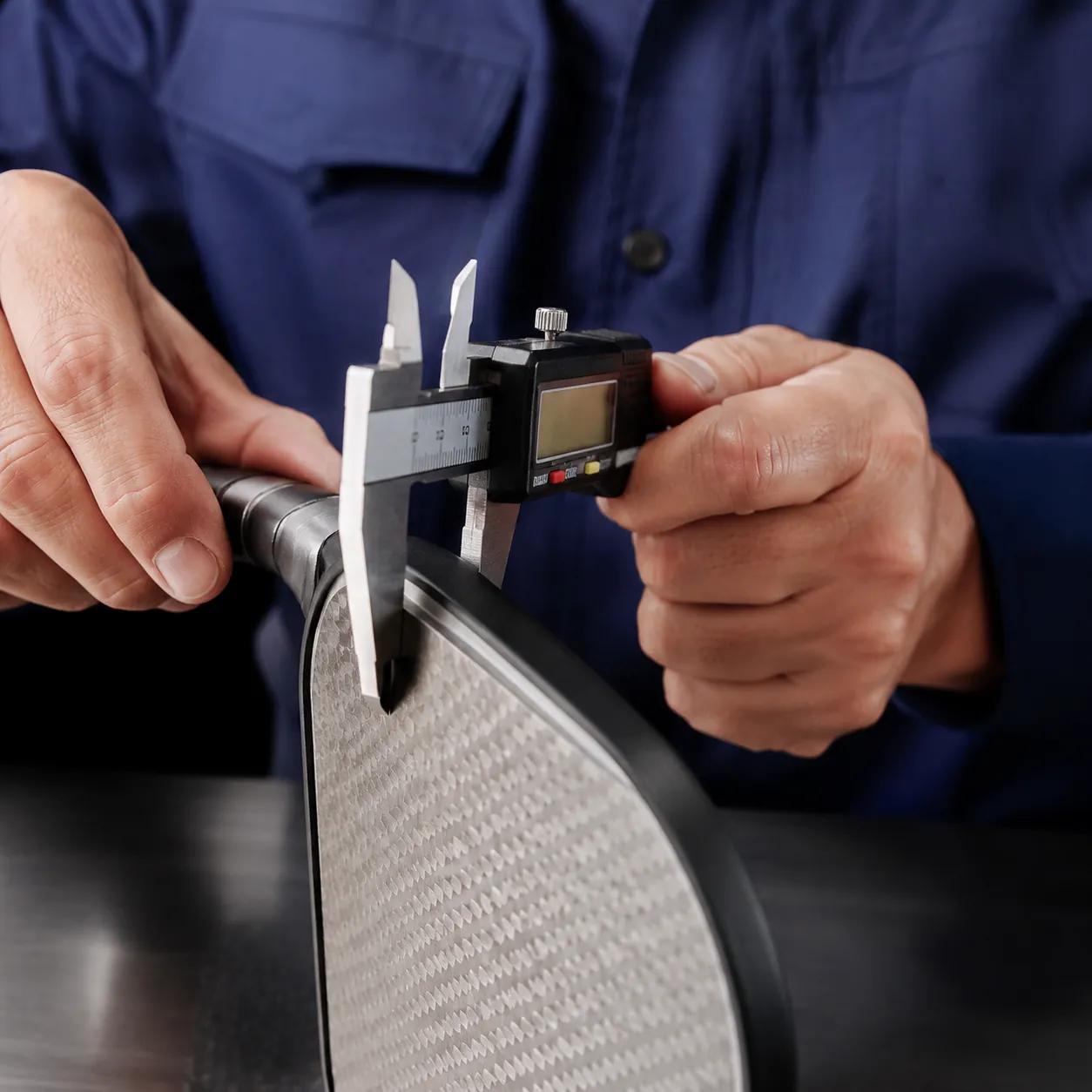
All three agencies run acceptance sampling per ISO 2859-1 — the international standard for sampling procedures for inspection by attributes, equivalent to ANSI/ASQ Z1.4 in the US framework. The AQL numbers you specify in the inspection order are what actually decide whether a batch passes or fails, not the agency you booked.
Standard configuration for pickleball orders is 2.5 general inspection level, 1.5 major defect AQL, 2.5 minor defect AQL. In plain terms: the inspector samples a defined number of units from the lot (per ISO 2859-1 table), classifies defects found as critical / major / minor, and compares the count to the acceptance-rejection numbers for the sample size. A batch with more than the allowed number of major defects is a "fail." A batch that fails at inspection is your leverage to require rework or refuse shipment before releasing the balance payment.
Tightening the AQL to 1.0 major / 1.5 minor is appropriate for high-value paddle orders where a small defect rate is unacceptable. Loosening to 2.5 major / 4.0 minor is a first-order compromise that some buyers accept for pilot runs — but be aware you're accepting more defects into the shipment. The complete AQL workflow specific to pickleball is in our guide to pre-shipment AQL inspection for pickleball.
Pickleball-specific tests to spell out in the inspection scope
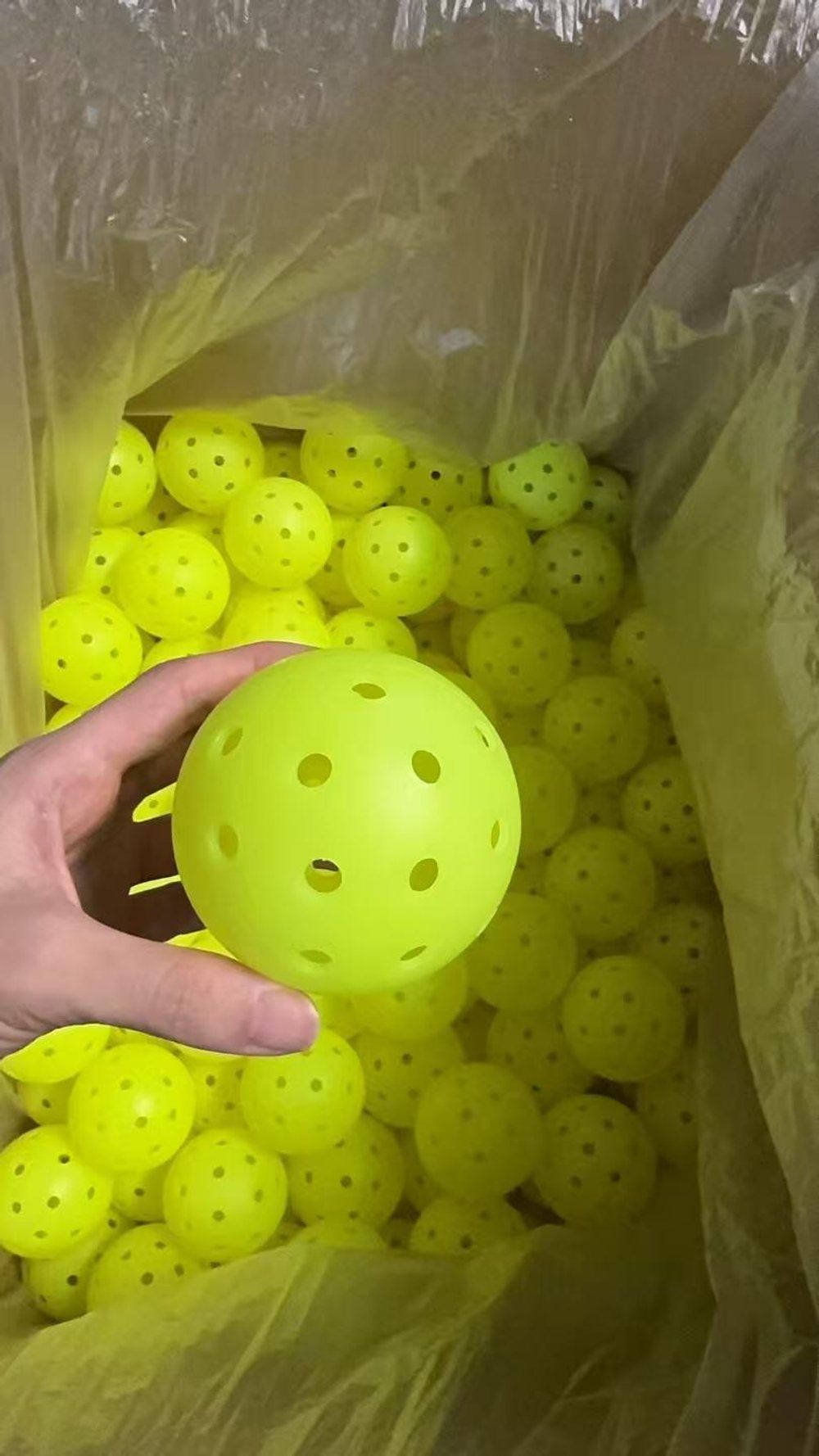
The single biggest difference between a useful pickleball inspection and a generic sporting-goods inspection is the specific tests included in the scope. None of the three agencies will run these by default — they have to be requested and specified.
Ball inspections
- Weight tolerance verification: Every sampled ball weighed on a calibrated scale, checked against the target window (typically 24.3–26.2 g for outdoor balls).
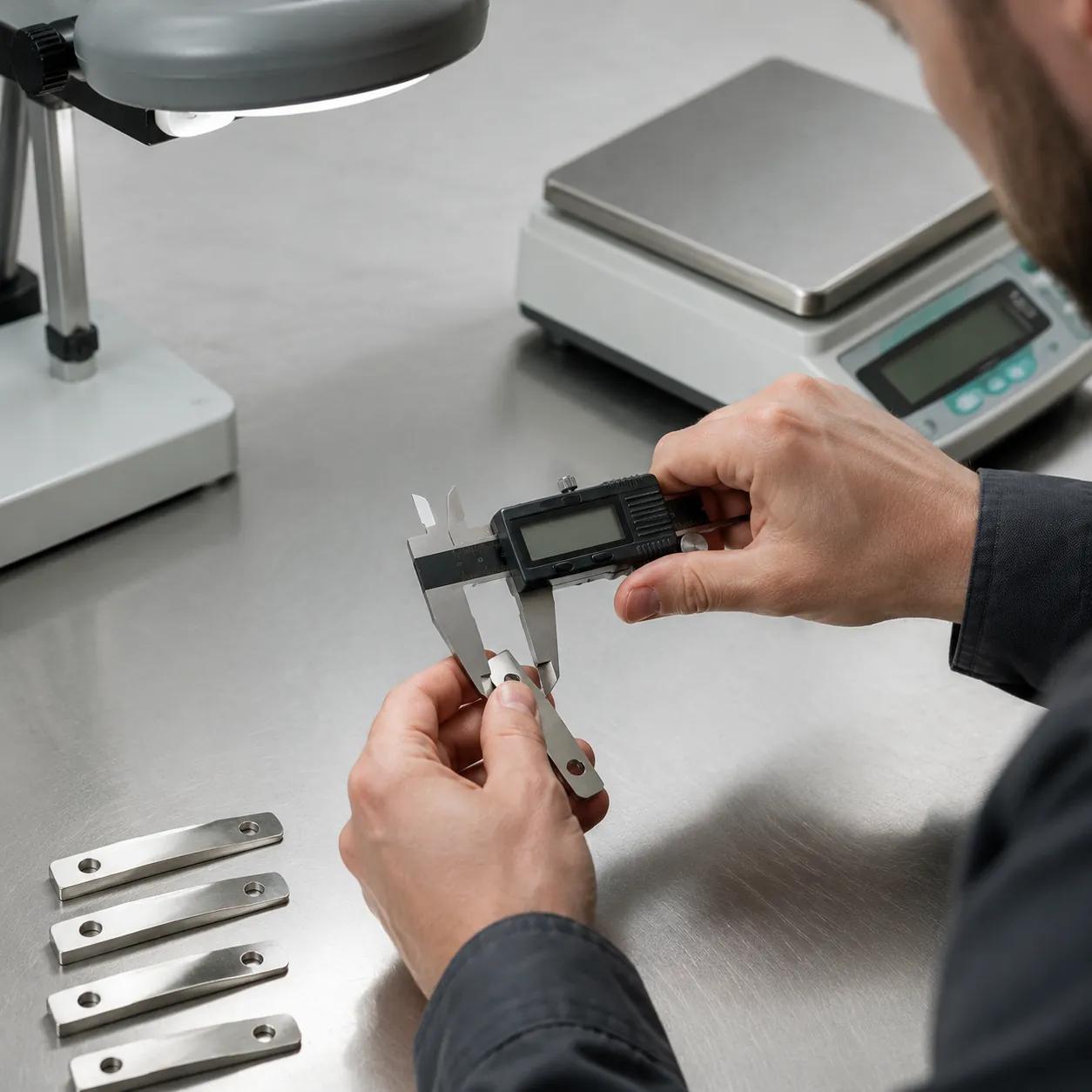
- Diameter and roundness: Digital calipers on three axes per sampled ball, roundness check against the tolerance window.
- Bounce test: Drop from a fixed height (commonly 78 inches per USA Pickleball protocol) onto a hard surface, measure rebound height. Batch consistency matters as much as the absolute number.
- Hole count and pattern verification: 40 holes for outdoor, 26 for indoor, drilled cleanly and consistently spaced.
- Color and print quality: Any custom logo checked for print consistency, positioning, and durability (rub test).
Paddle inspections
- Weight and balance verification: Each sampled paddle weighed and the balance point measured; both matched against the spec sheet.
- Grip circumference tolerance: Digital measurement of grip size, checked against the labelled spec — batches with high variance fail on grip consistency alone.
- Face flatness and surface quality: Visual and straight-edge check for warping, delamination, surface defects.
- Edge guard adhesion: Pull test on the edge guard at multiple points around the perimeter to catch bond failures early.
- Drop test: Controlled drop from a specified height onto a hard surface, checking for edge guard separation, cracking, or core delamination.
- USA Pickleball spec verification: If the paddle is claimed to be tournament-legal, dimensional check against the current USA Pickleball equipment standards (length + width limits, grip stipulations).
Best for / not for: is a third-party pre-shipment inspection the right call?
Not every pickleball order justifies a third-party inspection. The trade-off between inspection cost and the risk it mitigates has a real answer that depends on order size, supplier relationship maturity, and end-market compliance requirements.
| Best for | Not ideal for |
|---|---|
| First order with a new supplier — no track record to fall back on | Sample orders under $2,000 — inspection fees can approach 15–25% of order value |
| Orders over $10,000 FOB where a bad batch is a material financial loss | Trusted repeat supplier with 5+ orders of clean shipments — a random-check cadence beats every-order inspection |
| Retail-destined SKUs where a defect return rate above 2% erodes reseller margin | Direct-consumer orders on Amazon FBA where Amazon's own receiving QC catches most gross defects |
| Facility opening POs — a missing SKU at opening is worse than a delayed one | Emergency reorders with a known supplier when the freight timeline is already tight |
Real scenario: a 5,000-paddle first-order inspection walkthrough
An illustrative walkthrough of the arc a first-order pre-shipment inspection actually runs through, from the buyer's side. The shape below is what we see on real customer orders.
- Day 25 (production ~80% complete). Buyer books the inspection with QIMA — three business days ahead of the target inspection date. AQL specified as 2.5 general / 1.5 major / 2.5 minor; pickleball-specific tests (weight, roundness, grip circumference, edge-guard pull, drop test, USA Pickleball dimension check) added to the standard scope. Approved golden sample details and photos attached to the booking.
- Day 28 (inspection day). Inspector arrives at the factory around 9 AM. Standard AQL sampling table for a 5,000-unit lot at 2.5 general inspection level pulls roughly 200 sampled paddles. Each is weighed, measured, drop-tested; edge-guard pull test on a subset of 20; USA Pickleball dimension check on the whole sample. Photos of every defect uploaded to the QIMA dashboard in real time.
- Day 28 evening. Report drops in the buyer's dashboard. Findings: 3 minor defects (cosmetic edge marks, well within the 2.5 minor AQL), 1 major defect (grip circumference out of tolerance on one paddle — within the 1.5 major AQL). Batch passes. Buyer authorizes balance payment release.
- Alternative fork — batch fails. If the inspection had found 8 major defects (over the AQL limit for 200-piece sample size), the report would flag "reject." The buyer holds the balance, requires the factory to rework the defective units, re-books a follow-up inspection at the factory's cost, and only releases the balance when the re-inspection passes.
- Day 30 (container loading). With the pass in hand, the balance clears and the factory books the container. The report becomes part of the buyer's PO file — reviewed by the internal QC team on receipt as the reference against which any post-arrival defects get compared.
Total inspection cost on a single-day, single-factory 5,000-paddle order at QIMA rates: roughly $250–400. Compared to the cost of a bad batch (rework, returns, freight, brand damage) at 2–5% defect scaling to a 5,000-paddle order, the inspection is one of the cheapest risk mitigations in the sourcing chain.
Which fits whom — the decision framework
| If you are… | Book | Why |
|---|---|---|
| Selling into major US retail chains (Dick's, Academy, Walmart) | SGS | Retailer QC teams recognize and accept SGS reports without pushback |
| Running Amazon FBA with a pickleball SKU line | QIMA | FBA-specific packaging and labeling checks built into the standard scope |
| Direct-to-consumer brand with only internal QC review | V-Trust | Same inspection quality at ~30–40% lower cost |
| Importing to EU with CE / REACH lab-testing required | SGS | In-house labs bundle the lab tests with the inspection |
| First order, budget-sensitive pilot run | V-Trust or QIMA | Adequate coverage without SGS-tier pricing overhead |
| Facility opening PO with mixed SKUs (nets + balls + paddles + accessories) | QIMA | App-based workflow handles multi-SKU counting and cross-checking cleanly |
What we tell buyers to include in every inspection order
Regardless of which agency the buyer chooses, our recommendation on inspection scope is the same. These are the elements we've seen omitted most often when a buyer takes the agency's standard checklist without additions.
- Explicit AQL levels for critical / major / minor defects — usually 0 / 1.5 / 2.5 or tighter.
- The pickleball-specific tests listed above spelled out line by line in the inspection scope document, not left to inspector interpretation.
- Approved golden sample as reference — the inspector compares production units against this specific sample, not a marketing spec sheet. The golden-sample discipline is covered in golden-sample approval for pickleball paddles.
- Photo requirements — minimum photos per sampled unit, close-ups of defects, wide shots of carton counts, packing list vs actual verification.
- Container-loading supervision if the inspection also covers loading (add-on service, extra cost) — witness of the containerization prevents post-inspection swaps.
- Escalation contact — a specific person at the buyer's end who the inspector calls immediately if a critical defect appears, not just the standard report email.
Frequently Asked Questions
How much does a pickleball pre-shipment inspection cost?
Indicative day rates in China at time of writing: SGS runs $300–500 per inspector-day, QIMA $250–400, V-Trust $200–350. Add report translation, expedited booking, or lab-testing add-ons for the real invoice. Most pickleball orders complete inspection in a single day; larger multi-SKU containers may take two.
Which agency is best for pickleball specifically?
None of the three has a dedicated pickleball specialty — they all classify pickleball equipment under general sporting goods. The differentiator is the specific tests you request in the inspection scope, not the agency you book. For an FBA-bound Amazon SKU, QIMA's FBA-specific scope adds value; for a major retail chain, SGS's brand recognition matters; for direct-wholesale distribution, V-Trust delivers equivalent inspection quality at a lower rate.
What AQL should we specify for pickleball paddles?
Standard is 2.5 general inspection level with 1.5 major / 2.5 minor defect AQL. Tighten to 1.0 major / 1.5 minor for high-value orders or when defects are commercially critical. First-order pilot runs sometimes accept 2.5 major / 4.0 minor — that's a real compromise, not a "we'll fix it next time" placeholder; you're accepting more defects into the shipment.
Can the factory book the inspection itself?
Technically yes, but the whole point of a third-party inspection is that it's not paid for by the factory. If the factory books and pays for the inspection, the inspector's client is the factory, not the buyer — the report will be issued to the factory and the buyer has no direct standing. Always book and pay for the inspection through the buyer's own account with the inspection agency.
How long does the inspection report take to arrive?
QIMA typically returns reports the same day the inspector completes the visit, driven by their app-based workflow. SGS and V-Trust typically deliver within 24–48 hours. If a report requires lab-test results (chemical testing, drop-test lab work), the lab timeline (often 5–7 business days) drives the total, not the inspection itself.
What if the inspection fails — can we still ship?
A failed inspection is your leverage to require rework, request a re-inspection, or refuse shipment. It's the reason you're paying for the third-party check in the first place. The factory typically pays for rework and the re-inspection fee; the buyer holds the balance payment until the re-inspection passes. Written inspection-fail terms should be in the PO up front so this workflow doesn't get renegotiated when the fail actually happens.
Do we need lab testing on top of the inspection?
Depends on the destination and the buyer's downstream compliance obligations. For CE-marked EU sales or CPSIA-covered US sales of children's equipment, specific lab tests may be legally required; the CE, CPSIA, and REACH picture for pickleball is in CE, CPSIA & REACH safety compliance. For a general adult sporting-goods import, physical inspection at AQL levels is usually sufficient and lab testing is optional risk management.
Can we use one inspection agency for the whole PO if it covers multiple SKUs?
Yes — all three agencies handle multi-SKU pre-shipment inspections at a single factory in one visit. If the SKUs come from multiple factories (paddles from one, balls from another, nets from a third), each factory usually needs its own inspection visit; consolidation warehouses can sometimes accept a single-inspection pattern but check with the agency in advance.
Want to source this quality for your brand?
Contact our factory directly on WhatsApp for an instant MOQ and pricing quote.