Pickleball Net Height: Regulation Spec Sheet for Buyers
The pickleball net height is 36 inches at the sideline posts and 34 inches at the centre of the court. That answer is on a hundred pages. What almost none of them tell you is that both figures carry a tolerance of plus or minus 0.25 inch, that only those two heights are written as binding requirements, and that nearly every other dimension people quote as "regulation" is drafted as a recommendation you are free to specify around.
That distinction stops being trivia the moment you are writing a purchase order. A parks department tender, a club's capital request, or a distributor's incoming inspection sheet all need to say what is being bought in numbers a supplier can be held to.
Copying "22 ft x 36 in x 34 in" off a marketing page gives you a specification with no tolerance, no measurement datum, and no stated reference edition — which is to say, a specification a supplier can meet with a net that measures wrong on your court. This page takes the 2026 rulebook apart clause by clause and rebuilds it as something you can procure against.
Key Takeaways
- Sideline net height is 36 inches plus or minus 0.25 inch; centre height is 34 inches plus or minus 0.25 inch. Both are drafted with "must" — these are the binding numbers.
- Post spacing of 22 ft plus or minus 1.0 inch, net length of at least 21 ft 9 in, and the 30-inch minimum net drop are all drafted with "should" — recommendations, not requirements.
- The court itself is 20 ft x 44 ft, measured to the outside edge of the lines. Naming that datum is what stops a court-marking dispute.
- A centre strap is permitted, not required. The rulebook says a strap "may" be placed — the obligation is the 34-inch height, however you hold it.
- If a centre strap is fitted, the centre height measurement includes the strap. Measure the top of the strap, not the net beside it.
- No mesh aperture and no cord diameter appear anywhere in the net rules. The only material requirement is that a ball cannot pass through.
- There is no published ASTM standard for pickleball nets to cite in a tender. Your spec block has to carry the numbers itself.
Which edition this page is reading
All clause numbers and figures below come from the 2026 USA Pickleball Official Rulebook, effective 1 January 2026. That matters more than usual this year, because the 2026 edition was reorganised and the rules renumbered. USA Pickleball's own change document tabulates the old and new numbers side by side — the net post rule moved from 11.K to 10.C.5, for instance, and a doubles retirement rule moved from 10.B.2.c to 21.C.9.
The practical consequence lands on anyone maintaining procurement documents. A tender written in 2024 that says "net shall comply with USAP Rule 2.C.4" now points at a clause number that no longer means what it did. The net dimensions did not change for 2026 — the heights, post spacing and net size are the same numbers they have been — but the addresses did.
Write the reference as "2026 USA Pickleball Official Rulebook, Rules 3.B.6 and 3.B.7" with the edition year attached, and restate the actual numbers in your own document so the specification survives the next renumbering on its own.
The two numbers that are actually binding
Rule 3.B.6 governs the sideline height: the top of the net must be 36 inches plus or minus 0.25 inch, that is 91.44 cm plus or minus 0.635 cm, above the playing surface where the net crosses the outer edge of the sidelines. Rule 3.B.7 governs the centre: the top of the net must be 34 inches plus or minus 0.25 inch, 86.36 cm plus or minus 0.635 cm, above the playing surface at the centre point of the court.
Read those two clauses closely and three things fall out that a bare "36 and 34" never conveys. First, the tolerance is a quarter of an inch in either direction — a half-inch total window, roughly 13 mm. That is tight. A net whose centre reads 33.5 inches is out of specification, and 33.5 inches is a very ordinary amount of sag on a cheap system after a fortnight outdoors.
Second, both heights are measured above the playing surface, not above grade and not above the net's own base rail. On a portable system standing on the court, the base plate sits between the surface and the post. If the system was dimensioned from the top of its own base, you inherit an error equal to the base thickness at both ends.
Third, the sideline measurement is taken specifically where the net crosses the outer edge of the sideline — not at the post, which sits further out.
The verb is the part buyers miss. Rules 3.B.6 and 3.B.7 both say the net "must" be at those heights. That word does not appear in the post-spacing rule, the net-length rule, or the edging rule, all of which say "should". Whoever drafted Section 3 was deliberate about it, and the split gives you a clean procurement principle: the two heights are pass/fail criteria you can reject a shipment against, and everything else is a dimension you must specify yourself because the rulebook only recommends it.
What the rulebook recommends but does not require
Rule 3.B.2 says net posts should be 22 feet plus or minus 1.0 inch (6.71 m) from the inside of one post to the inside of the other, with a maximum post diameter of 3 inches (7.62 cm). Note the tolerance is a full inch here, four times looser than the height tolerance, and note that the 22 feet is an inside-face to inside-face dimension.
The court is 20 feet wide, so the posts stand roughly a foot outside each sideline. A supplier quoting "22 ft net" may be describing the post spacing, the netting panel width, or the overall packed length of the frame, and those are three different numbers.
Rule 3.B.3 covers the panel itself: net length should be at least 21 feet 9 inches (6.63 m) extending from one post to the other, and the measurement from the bottom edge of the net to the top should be at least 30 inches (76.2 cm). Both are minima, and both are "should".
Rule 3.B.4 says the top of the net should be edged with a 2-inch (5.08 cm) white tape binding over a cord or cable running through the binding — and then adds, in the only "must" in the clause, that this binding must rest upon the cord or cable.
That last sentence is the one worth putting on an inspection sheet. A headband sewn so that the tape carries load instead of the cable stretches, and a stretched headband is a net that will not hold 34 inches no matter how the strap is adjusted.
Rule 3.B.1 is the shortest and most abused: the net may be made of any mesh fabric material that will not allow a ball to pass through it. That is the entire material requirement. There is no mesh aperture, no cord diameter, no denier, no knotless requirement anywhere in the net rules.
When a listing tells you a 1.8 mm knotless mesh is "regulation", that is a durability convention being sold as a rule. It may well be a good mesh. It is not a rulebook requirement, and it does not belong in the compliance clause of your tender — put it in the durability clause instead, where you can actually defend it.
The court dimensions the net has to sit inside
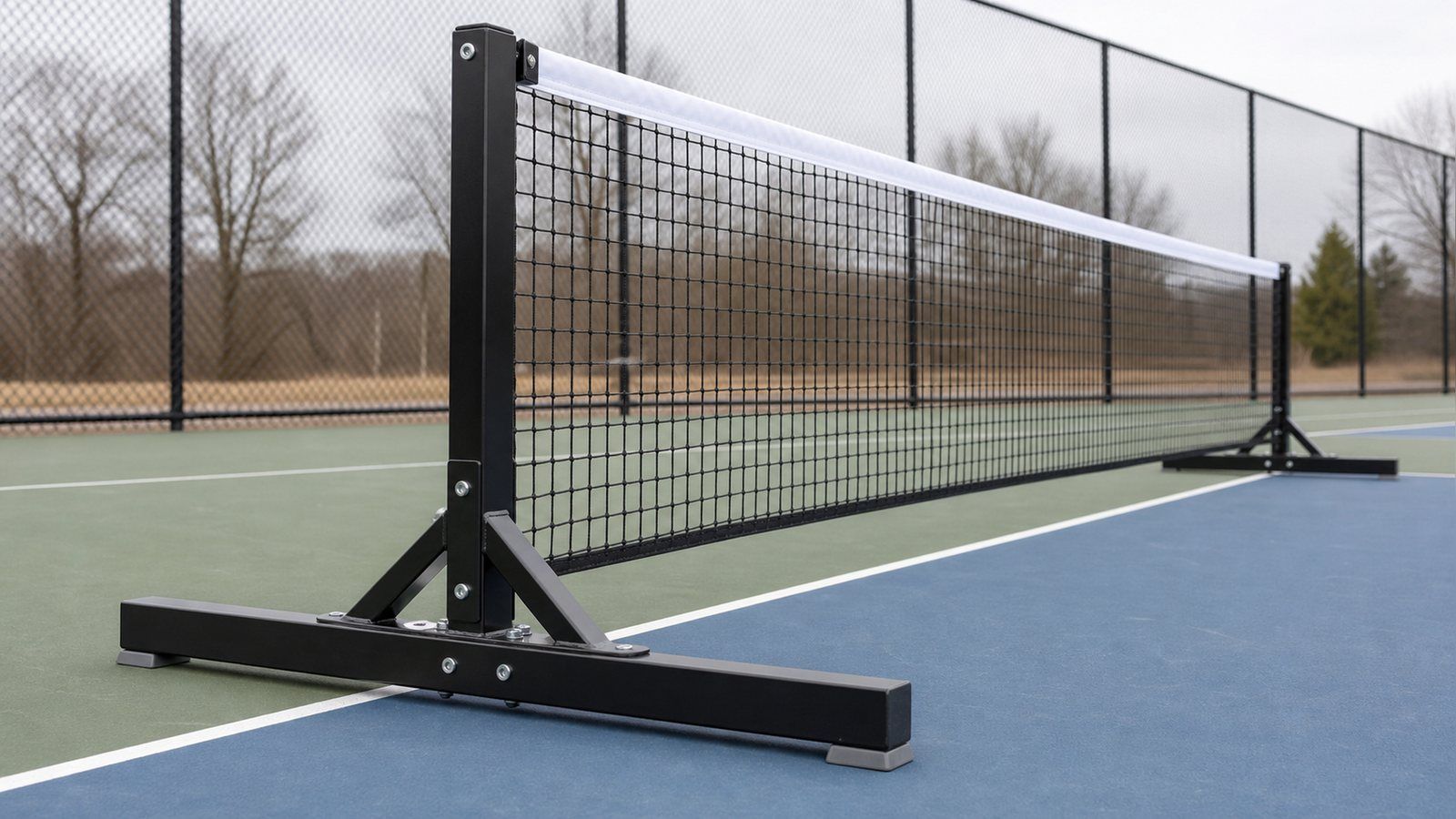
Rule 3.A.1 sets the court as a rectangle measuring 20 feet (6.10 m) wide and 44 feet (13.41 m) long, the same for singles and doubles — and it is drafted "must". Rule 3.A.2 then does something most summaries drop entirely: it fixes the datum. Court measurements must be made to the outside edge of the perimeter and non-volley zone lines.
Lines are 2 inches wide, so measuring to the inside edge of the sidelines instead of the outside costs you 4 inches across the court. On a resurfacing job that is the difference between a court that passes and a court that gets re-striped at the contractor's expense.
The non-volley zone under Rule 3.A.4.c is a 7-foot by 20-foot area at each end of the net, its line running parallel to the net 7 feet from it between the two sidelines. The rulebook adds that the zone is two-dimensional and does not extend above the playing surface.
Worth knowing that the published metric conversion in that clause is imprecise — it renders 20 feet as 6.08 m where 6.096 m is exact — which is one more reason to write imperial figures as the controlling dimension in any document and treat the metric as a convenience.
The surface around the court is separate again. Rule 3.A.3 puts the minimum playing surface area at 30 feet (9.14 m) by 60 feet (18.29 m), and its recommendations table lists 34 ft (10.36 m) by 64 ft (19.5 m) for new construction.
A facility that specifies the 20 x 44 court and forgets the 30 x 60 envelope ends up with courts that measure correctly and are unpleasant to play on, because there is no room behind the baseline. If you are tendering court construction rather than just nets, that pair of numbers belongs in the same clause.
Why the centre sits two inches lower — and why that gap grows
The 36-to-34 difference is not sag that the rulebook tolerates. It is a specified geometry: two different heights, each with its own clause and its own tolerance. A net that has simply been hung between two posts and left to hang will not land on 34 inches at the centre by luck, and a net pulled bar-tight will sit too high there. The centre height is something the hardware has to hold.
Rule 3.B.5 is where the widespread misunderstanding lives. It reads that a strap may be placed at the centre of the net, centred 10 feet from the outside edge of the sidelines, to enable adjustment to the required centre net height. "May". A centre strap is one permitted means of achieving the height, not a compliance requirement in itself.
You will find a great deal of published advice stating flatly that a centre strap is required in regulation play; against the 2026 rulebook text, that is an overstatement. What is required is 34 inches plus or minus a quarter inch. If a system holds that with a rigid centre post or a tensioned cable and no strap, it satisfies 3.B.7.
Rule 3.B.7 carries a second sentence that decides arguments on court: if there is a centre strap, the centre net height measurement includes the centre strap. So on a strapped net you measure to the top of the strap where it crosses the net, not to the net tape a few inches to one side.
Hardware that adds thickness at the centre — a wide strap, a buckle sitting proud, a clamp — eats into a quarter-inch tolerance directly. This is a real reason to ask a supplier what the centre hardware measures through its thickness, and it is a question almost nobody asks.
Sag over time is the failure mode behind most out-of-spec centre readings, and it is worth being straight about what is and is not known here. How far a given net drops over a season is a function of cord construction, headband stitching, tension hardware, temperature and how often it is struck — and there is no published figure that covers it credibly.
We have not run a controlled 30-day sag measurement on our own nets, so no drift number appears on this page. What we can give you instead is the procedure to measure it on yours, below, which is the part that actually protects a purchase.
How to measure a net so the reading means something
A quarter-inch tolerance is smaller than the error most people introduce by measuring carelessly, so the procedure matters as much as the tool. This is the sequence to write into a facility's acceptance check or a distributor's incoming inspection sheet.
- Set the net up as it will be played, then leave it. Tension it, then let it stand at least 30 minutes before measuring. A net measured immediately after tensioning reads high, and it is the settled reading that has to be in specification.
- Measure to the top of the tape, from the surface directly beneath it. Not from the base rail, not from grade beside the court. A rigid rule or a folding rod beats a limp tape, which bows and reads short.
- Take the sideline reading at the outer edge of the sideline, not at the post. Rule 3.B.6 names that point specifically. On a portable frame the net is usually still rising toward the post at that station, so measuring at the post inflates the number.
- At the centre, measure the top of the strap if one is fitted. Rule 3.B.7 includes the strap in the measurement. Measuring the net beside the strap is the single most common way a net that is genuinely out of spec passes an inspection.
- Record five stations, not three. Both sidelines, the centre, and the two quarter points. The quarter points are where a headband that is stretching shows up first, before the centre has moved far enough to fail.
- Repeat the same five stations at 24 hours, 7 days and 30 days, on the same court, at a similar temperature, and keep the sheet. Two nets that both pass on day one and diverge by day 30 have told you which supplier to re-order from — and that record is yours, not something a catalogue can give you.
That last step is the one worth insisting on before a multi-court order. Nets are cheap enough per unit that buyers commonly skip a sample round and order the fleet, then discover the drift across a whole facility at once.
Running the sequence on two or three samples for a month costs a month and tells you more about a net than any published specification will. If you are assembling a full court package rather than nets alone, the same discipline applies to the balls and paddles in the catalogue — sample, measure, record, then commit the volume.
Turning the rulebook into a tender-ready spec block
Here is the whole of Section 3.B and the relevant parts of 3.A expressed the way a purchase order needs them: every dimension, its tolerance, the exact clause it comes from, and — the column that makes the difference — whether the rulebook binds it or merely recommends it.
| Item | Specified value | Tolerance | Clause | Binding? |
|---|---|---|---|---|
| Sideline net height | 36 in (91.44 cm) | ± 0.25 in (± 0.635 cm) | 3.B.6 | Must |
| Centre net height (incl. strap) | 34 in (86.36 cm) | ± 0.25 in (± 0.635 cm) | 3.B.7 | Must |
| Post spacing, inside to inside | 22 ft (6.71 m) | ± 1.0 in | 3.B.2 | Should |
| Max post diameter | 3 in (7.62 cm) | Maximum | 3.B.2 | Should |
| Net length, post to post | 21 ft 9 in (6.63 m) | Minimum | 3.B.3 | Should |
| Net drop, bottom edge to top | 30 in (76.2 cm) | Minimum | 3.B.3 | Should |
| Top tape binding width | 2 in (5.08 cm), white, over cord or cable | Binding must rest on the cord | 3.B.4 | Mixed |
| Centre strap position, if fitted | Centred 10 ft from outside edge of sidelines | Optional component | 3.B.5 | May |
| Mesh material | Any mesh a ball cannot pass through | No aperture or cord size given | 3.B.1 | May |
| Court rectangle | 20 ft x 44 ft (6.10 m x 13.41 m) | To outside edge of lines (3.A.2) | 3.A.1 | Must |
| Non-volley zone | 7 ft x 20 ft each side of the net | Two-dimensional only | 3.A.4.c | Definition |
| Min. playing surface envelope | 30 ft x 60 ft; 34 ft x 64 ft for new build | Minimum / recommended | 3.A.3 | Minimum |
Values and clause numbers from the 2026 USA Pickleball Official Rulebook, Rules 3.A.1–3.A.4 and 3.B.1–3.B.7. "Binding?" reflects the verb the rulebook itself uses in each clause.
Writing this block into a purchase order?
This one is for facility operators, parks departments and distributors specifying a net line at wholesale volume — not for a single home court. If you are pricing a court package rather than one net, the catalogue shows what ships alongside it and in what pack configurations.
See the product rangePre-shipment checks, and where we stop
A specification only protects a buyer if somebody measures against it before the goods move. Four checks catch nearly everything, and each one maps to a clause in the table above rather than to a vendor's house style.
- The headband first. Confirm the top tape is 2 in (5.08 cm) white binding and that the cord or cable runs inside it with the binding resting on the cable, per Rule 3.B.4. A headband where stitching carries the load instead of the cable is the defect that quietly guarantees a later height failure.
- Panel dimensions flat, before assembly. Length against the 21 ft 9 in (6.63 m) minimum and drop against the 30 in (76.2 cm) minimum, with the panel laid flat and unstretched — a hung net reads tension, which is not what Rule 3.B.3 describes.
- Centre hardware thickness, in mm. Rule 3.B.7 counts the strap or buckle inside a ± 0.25 in (6.35 mm) window, so hardware measuring 6 mm through its thickness has consumed almost the entire tolerance on its own. This is the figure no datasheet states.
- Assemble one unit per lot and take the five-station reading. Both sidelines at 36 in, centre at 34 in, plus the two quarter points. A carton count is not an inspection.
Where we stop matters as much. We publish no sag-drift figure and no cord tension value for our nets, because we have not run a controlled long-duration measurement that would support one — and a number without a method behind it is worse than no number in a tender. Ask any supplier quoting you a precise drift figure over what period, at what temperature, and across how many samples it was measured. If that answer does not exist, neither does the number.
Where the international wording differs
Two questions come up whenever a spec crosses a border: does the rest of the world use different numbers, and whose rulebook should a tender name.
On the numbers, the answer is reassuringly dull. The legacy International Federation of Pickleball published its net as 22 feet wide, 36 inches at the ends and 34 inches at the centre — the same controlling heights USA Pickleball specifies. The meaningful difference is not the values but the precision: that published specification carries no tolerance at all.
A supplier working to it can deliver a net that is "34 inches at the centre" in a sense no one can hold them to, because no window was ever stated. If your document references an international specification, borrow the plus or minus 0.25 inch from Rules 3.B.6 and 3.B.7 explicitly rather than assuming it travels.
On which body to name, be careful, because a lot of published guidance is out of date on this. The international governance of pickleball has been through repeated reorganisation over the last few years, including the shutdown of the original IFP and a subsequent merger of the successor federation into the World Pickleball Federation. Pages still describing the IFP as the current world body are describing a structure that has changed.
The safe procurement practice is to name the specific rulebook, edition year and clause numbers you are buying against — as this page does — and separately confirm with the organisation that actually sanctions your events which rulebook they run under. Requirements for sanctioned tournament play can sit alongside the rulebook and vary by body and event, so treat the clauses above as the dimensional baseline rather than the whole compliance picture.
One more thing a tender writer should know before searching for it: there is no published ASTM standard specific to pickleball nets that you can cite as a shortcut. USA Pickleball announced a collaboration with ASTM International in November 2024 under which a pickleball equipment and facilities subcommittee was established, with the early work focused on paddle power and spin testing.
Useful direction, but it does not yet give you a net standard number to drop into a compliance clause. Until one exists, your spec block has to carry the dimensions itself — which is precisely why the table above lists clause numbers rather than a standard reference.
A worked example: eleven courts, two quotations
Take a municipal parks department converting six tennis courts into eleven pickleball courts and putting nets out to tender. Two suppliers respond. Both quote "22 ft regulation pickleball net, 36 in / 34 in". On price they are within a few per cent of each other.
Run both quotes against the table. Supplier A's datasheet gives post spacing as 22 ft measured over the outside of the posts. With 3-inch posts that puts the inside-to-inside dimension at roughly 21 ft 6 in — six inches under the 22 ft in Rule 3.B.2, and outside its plus or minus 1.0 inch window.
Not a rejection on its own, because 3.B.2 is a "should", but it tells you the net panel will be slack at the ends and the sideline height will be difficult to hold. Supplier B states the inside-to-inside dimension explicitly. That single line of drafting is a genuine signal about which supplier has read the rulebook.
Then look at what neither quotation says. Neither states a centre hardware thickness, so neither has told you how much of the quarter-inch centre tolerance the strap or buckle consumes. Neither offers a settled-height figure. The department's move is not to pick on price: it is to order two samples, run the five-station measurement at 24 hours, 7 days and 30 days, and award on the readings.
Across eleven courts the difference between a net that holds 34 inches through a season and one that needs re-tensioning weekly is a recurring labour line in the maintenance budget, and it is invisible in both quotations.
Write the acceptance criterion into the tender as well, in the rulebook's own terms: centre height 34 in ± 0.25 in and sideline height 36 in ± 0.25 in, measured to the top of the tape from the playing surface, centre measured over the strap where fitted, thirty minutes after tensioning. That sentence is enforceable. "Regulation size" is not.
Is a regulation net the right spec for your programme?
Not every court needs to be procured against Section 3.B, and pretending otherwise wastes money.
| Full regulation spec is worth it for | Not worth over-specifying for |
|---|---|
| Facilities hosting sanctioned or league play, where a measured net can decide a match | Driveway, garden and casual family courts, where playability beats a quarter inch |
| Public tenders that must survive an audit and a bid protest | Pop-up demo and taster events where the net is up for a few hours |
| Distributors whose retail listings claim "regulation" and must be able to prove it | School PE programmes running modified games on shortened courts |
| Multi-court fleets where drift becomes a maintenance labour cost | Single-net purchases where sampling costs more than the net |
The honest line for a distributor is this: the word "regulation" on a listing is a claim about two heights and their tolerances, and it is checkable in ninety seconds by anyone with a rule. If a net cannot hold 34 inches at the centre after a month on a court, the listing is making a claim the product does not support — and that is a returns and chargeback exposure long before it is a compliance question.
Specify the numbers, then verify them. The frame and system engineering that determines whether a net holds those numbers is a separate subject, covered in our guide to portable net system frames, and the broader accessory sourcing picture sits in the wholesale nets overview.
For anyone landing this in a shipment rather than on a court: pickleball nets generally classify under HS heading 9506.99 at the six-digit level, with national schedules diverging at the eight or ten-digit statistical suffix. Confirm the national suffix and the duty treatment with your customs broker for the specific destination — the six-digit heading travels, the rest does not.
Watch the video
If you would rather see the measurement taken than read it described, this short neutral demonstration covers taking an accurate net height reading on court.
Video: "Accurate Net Height" by the Pickleball Librarian channel — an independent instructional source, included because it shows the measurement technique rather than selling a net.
Conclusion
Pickleball net height is 36 inches at the sidelines and 34 inches at the centre, each with a quarter-inch tolerance, and those two clauses are the only dimensions in the net rules the 2026 rulebook drafts as binding. Post spacing, net length, drop and edging are recommendations, the centre strap is optional, and no mesh size exists anywhere in the rules — so anything you need enforced has to be written into your own document with the value, the tolerance, the measurement datum and the edition year attached.
If you are specifying nets for a facility, a tender or a wholesale programme rather than buying a single court, the spec block above is written to be lifted straight into a purchase order.
Frequently Asked Questions
Is the pickleball net 34 or 36 inches high?
Both. It is 36 inches at the sideline posts and 34 inches at the centre, each with a tolerance of plus or minus 0.25 inch, under Rules 3.B.6 and 3.B.7 of the 2026 USA Pickleball Official Rulebook.
Is a centre strap required on a pickleball net?
No. Rule 3.B.5 says a strap "may" be placed at the centre to enable adjustment. The binding requirement is the 34-inch centre height itself, achieved by whatever means. If a strap is fitted, the height measurement includes it.
How far apart should pickleball net posts be?
22 feet plus or minus 1.0 inch, measured from the inside face of one post to the inside face of the other, per Rule 3.B.2. Because the court is 20 feet wide, the posts sit about a foot outside each sideline.
What mesh size does the rulebook require?
None. Rule 3.B.1 requires only a mesh fabric a ball cannot pass through. Cord diameter, aperture and knotless construction are durability conventions sold as rules, so keep them out of a compliance clause.
Can you play pickleball on a tennis net?
Only informally. A tennis net sits around 36 inches at its centre, roughly two inches above pickleball's 34-inch centre, so shared-court play is a compromise rather than a regulation setup.
Did the 2026 rulebook change any net dimensions?
No dimensions changed, but the rulebook was reorganised and rules renumbered. Older procurement documents citing pre-2026 clause numbers now point at the wrong addresses, so restate the numbers and name the edition year.
Is there an ASTM standard for pickleball nets?
Not a published one to cite. USA Pickleball announced an ASTM collaboration in November 2024 establishing an equipment and facilities subcommittee, with early work on paddle testing. Your tender must carry the dimensions itself.
Want to source this quality for your brand?
Contact our factory directly on WhatsApp for an instant MOQ and pricing quote.