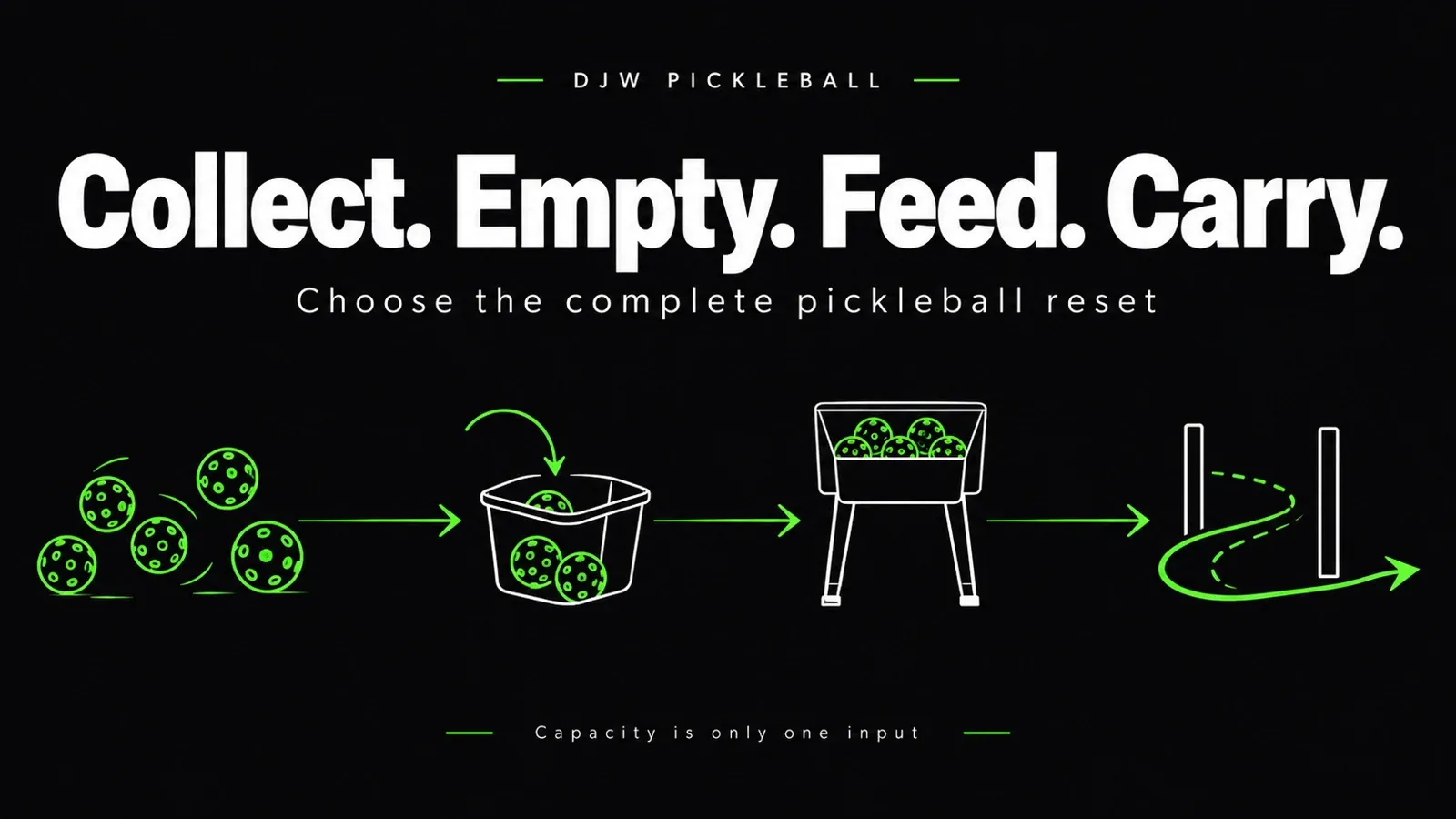
Choose a pickleball pickup system by the whole drill cycle: collect, empty, feed and carry. Start with the missing job. A tube can collect into a separate feed basket. A pickup hopper can combine those jobs if its model instructions provide both positions. A wheeled teaching cart can hold working stock while leaving the ground-collection job to another tool. Identify which functions the exact model performs, then test it with your balls, fence edges and route through the gate. Capacity alone cannot choose the best system for your club.
For a coach or club, the useful output is a record that approves or holds one complete arrangement: identified balls and collector, a receiving point, the required feed setup and a usable transport route. The named manufacturer examples below establish functions and dimensions. The buyer evaluation is a proposed method, not a completed collection-speed trial or a verified DJW pickup-tool offer.
Choose the functions before comparing the capacity
“Hopper”, “caddy” and “cart” do not tell you everything a product does. Read the model's collection mechanism and operating instructions. Ask whether the device picks balls up from the ground, holds them at feeding height, carries them to the court, or combines those tasks. A convenient feed station can still leave the collection job unsolved.
Three published products illustrate the difference. GAMMA's Pickleball Ball Tube, model BPPBT10, stores 12 indoor or outdoor pickleballs and has a shoulder strap and telescopic body. OnCourt OffCourt's Hopper 60 instructions describe interlocked handles above the basket for pickup, then handles underneath and engaged against the supports for standing and feeding. The ONIX 320 teaching cart is described as storage and feeding equipment with swivel wheels and two brakes. Its cited specification does not establish a ground-pickup mechanism.
| Arrangement | Established function | Best for evaluation | Unresolved check |
|---|---|---|---|
| GAMMA tube | Pickup and 12-ball storage | Portable collection with a separate place to empty | Actual collection, carrying and emptying on your route |
| Hopper 60 | Pickup position and standing feed position | One device performing collection and feed tasks | Model instructions, ball compatibility and stable setup |
| ONIX 320 cart | Raised storage/feed access and wheeled movement | A larger court-based feed station | Separate ground-collection method and route clearance |
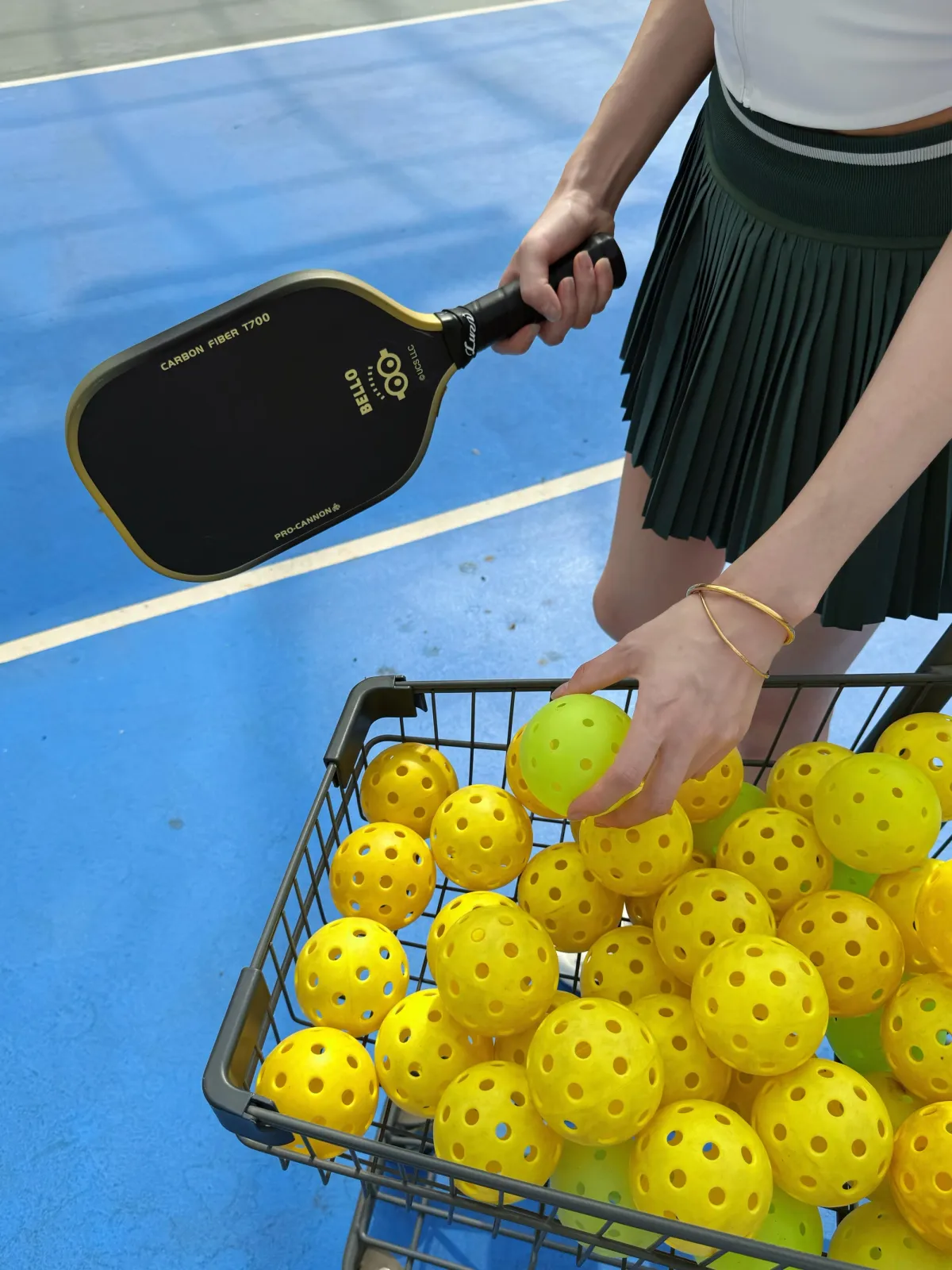
A tube plus a feed basket can therefore be a coherent system, rather than an incomplete alternative to a large cart. One device gathers balls; the other holds them for the next drill. A pickup hopper may combine those functions with a change of operating position. Whether that change is convenient depends on the drill and the person using it, not just the number on the label.
Keep rolling collectors in a separate category from wheeled storage carts. Wheels that move a basket do not necessarily pass balls into it. If a supplier offers a roller, request its actual mechanism, compatible balls, emptying method and operating instructions. Do not apply a tennis-product capacity or pickup demonstration to pickleballs without model-specific support.
Count the loads and transfers in the drill reset
Use the working drill batch as the first input. That is the number of balls you intend to collect before the next feed, not every ball in the club's store. Then establish the usable capacity of the exact collection tool with your chosen balls. The manufacturer's stated capacity is a starting point; an overloaded tool should not be assumed to retain or operate correctly.
For a simple planning estimate, divide the batch by the verified collection capacity and round up. This gives the number of loads needed, assuming the stated capacity can be used for each full load. Emptyings before the final load equal that load count minus one. The last load still has to be placed where the next drill needs it. The calculation is a handling count, not a speed measurement.
| Input or result | Calculation | Decision meaning |
|---|---|---|
| Working batch | 48 balls, an illustrative club choice | Not a recommended batch for every session |
| Collection loads | 48 ÷ 12 = 4 loads | Plan where each load will be emptied |
| Emptyings before final load | 4 − 1 = 3 | Three mid-collection transfers, plus the final unload |
| Changed batch: 60 balls | 60 ÷ 12 = 5 loads | Four mid-collection transfers, plus final unload |
| Assumed working batch | Collection loads |
|---|---|
| 48 balls | 4 |
| 60 balls | 5 |
The location of the receiving basket changes the practical result. If it is near the collected balls and easy to use, several tube loads may fit the routine. If every unload requires crossing the court, walking can dominate the cycle. The load count is unchanged; the route is different. That is why a larger collector can be worth evaluating without assuming it is universally faster.
Do not calculate a tennis-labelled hopper's pickleball capacity from a ratio of ball sizes. Its entry geometry, retention and usable fill level also matter. Request a pickleball-specific capacity or establish the usable quantity with the actual sample. The bulk ball planning guide handles replenishment; this decision concerns the stock handled during one drill cycle.
Include the fence, loaded gate and storage route
Start where the loose balls actually collect. Include open court, the fence line and a corner in your evaluation. A broad basket may be convenient in an open area yet need a separate approach near an obstruction. A narrow tube still needs room for its actual pickup action. Neither shape proves that balls touching your fence can be retrieved without repositioning.
Keep the comparison to permitted use. Follow each maker's instructions rather than forcing a basket over several balls or bending bars to imitate another device. If the proposed model requires staff to move a ball away from a fence, record that extra action. Do not convert the observation into a claim that all tools in the category damage balls, or that all tubes solve fence pickup equally well.
The transport task can reverse the choice. A coach carrying a bag and moving a ball machine has different free hands from staff wheeling equipment out of a nearby store. GAMMA lists its tube length as 19-3/8 inches collapsed and 35-3/8 inches assembled. ONIX lists its cart as 20 inches wide, 43.3 inches high and 25 pounds. Those named specifications help screen storage and carrying, but do not establish clearance for your particular gate, vehicle or route.
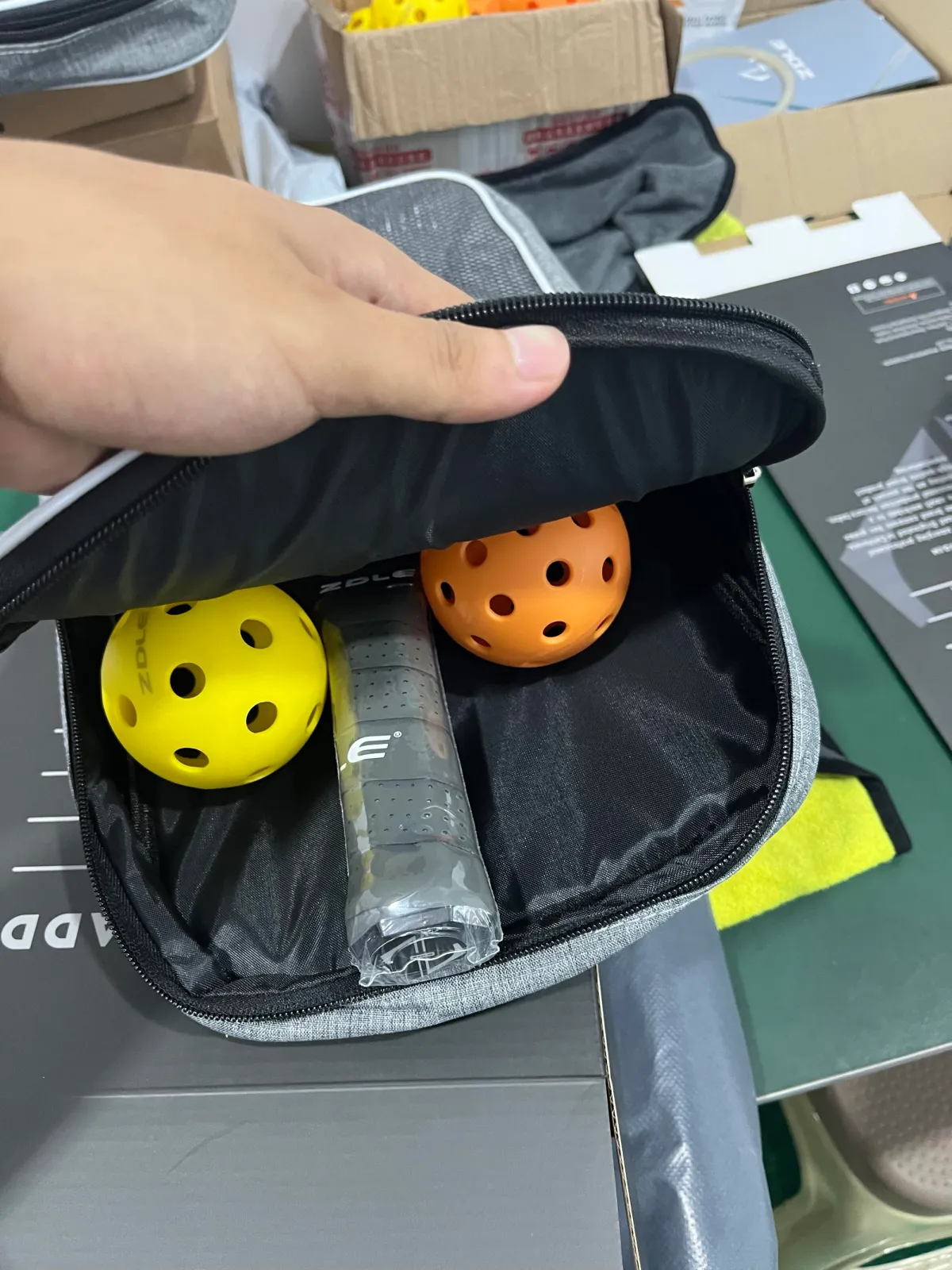
Measure the clear opening, the stored space and any vehicle space you intend to use. Check turns and thresholds as well as the narrowest straight gap. Test the loaded arrangement if that is how staff will move it; an empty frame demonstration leaves the actual job untested. Manufacturer permission still controls loading and operation.
For a feed station, follow the model's standing or braking instructions. The Hopper 60 instructions describe engaging its supports; ONIX specifies two braking wheels. A feature being present is not evidence that staff engaged it or that it suits every court condition. Confirm the setup with the manufacturer and keep equipment out of active play and required access paths under the facility's operating rules.
Approve a sample over the complete reset
Use this proposed buyer evaluation before a fleet purchase. It is an editorial comparison method, not a validated laboratory standard or an ergonomic assessment. Choose candidate models whose instructions permit your intended use. Define the same ball model, batch, court, starting positions and receiving point for each. Record the operator and conditions so a result from one arrangement is not silently transferred to another.
- Confirm the pairing. Identify tool model and revision, balls, operating instructions and allowed capacity. Leave an undocumented compatibility claim unresolved.
- Collect the same distribution. Include the open area and fence/corner positions relevant to your court. Record any balls requiring a separate action.
- Complete every transfer. Empty the collector, reset it and put the entire batch at the feed station. Count spills, uncollected balls and manual handling separately.
- Finish the route. Put the tool into its feed position if applicable, then complete the normal carry or storage task. Follow the maker's assembly and securing instructions.
- Record the decision. Approve the arrangement only against your stated requirements. Stop a trial if operation becomes unsafe or the instructions cannot be followed.
If comparing time, start and stop at the same events: for example, from equipment ready for collection to all balls secured at the agreed feed position. Repeat under comparable conditions and retain every run rather than selecting one favourable pickup. This guide gives no universal pass time or speed advantage. Choose the club's acceptable reset time before seeing the result, and do not describe an unmeasured expectation as a saving.
| Check | Record | Release or hold |
|---|---|---|
| Tool and ball pairing | Models, instructions, capacity and sample ID | Hold unknown compatibility |
| Complete collection cycle | Batch, loads, unloads, fence actions, spills and optional timing | Compare the same start and finish |
| Route and feed setup | Gate, turns, loaded movement, storage and securing method | Hold a route or setup that cannot be completed as intended |
| Observed condition | Tool and ball observations before/after; unresolved changes | Investigate a change without inventing its cause |
| Decision owner | Requirements, result, open items, name and date | Approve only the evaluated arrangement |
Suppose a club's existing raised basket already handles feeding, and a tube completes collection and transfer acceptably. Buying a larger teaching cart may add storage without solving another problem. Change one condition: the coach must carry all equipment through a narrow turn and the proposed arrangement cannot make that trip. A satisfactory court-only collection result no longer approves the complete system. Revise the transport arrangement or evaluate another sample.
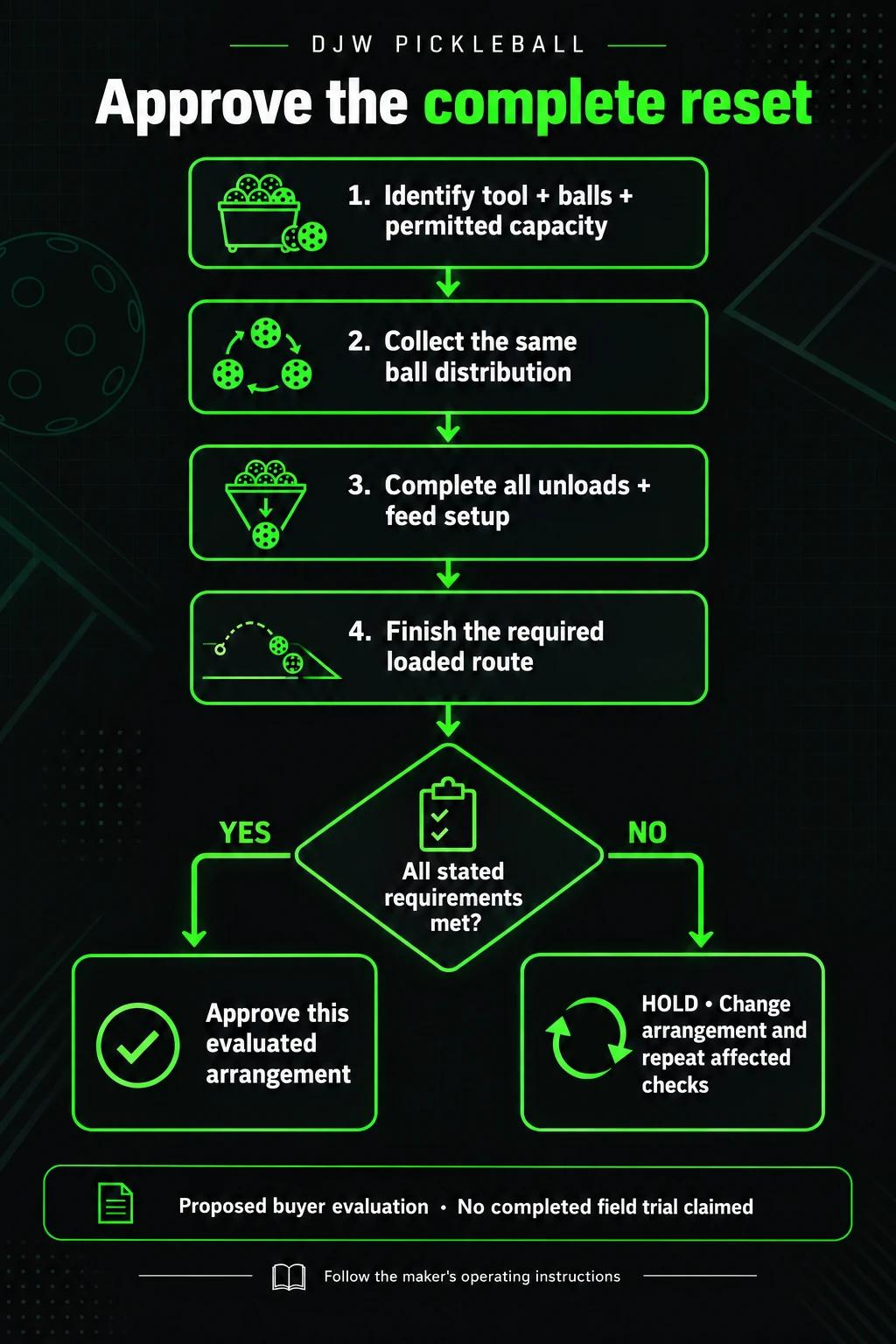
- Identify the tool model, actual balls, operating instructions and permitted working capacity.
- Collect the same relevant ball distribution, recording any separate fence or corner action.
- Complete every unload and put the whole batch at the agreed feed position.
- Finish the required loaded route and setup in permitted use.
- If all stated requirements are met, approve only that evaluated arrangement.
- Otherwise hold the arrangement, change it and repeat the affected checks.
Keep the evaluated pairing in the purchase record
Specify the tool model, ball compatibility, permitted working capacity, delivered components, dimensions in use and storage, operating instructions and agreed sample. Identify replacement parts where the supplier actually offers them; do not assume a cap, retention element, wheel or support can be purchased separately. Ask how a proposed substitution will be reviewed before it enters a repeat order.
Keep procurement claims at the level proved. A successful club evaluation can support choosing that sample arrangement for the observed task. It does not prove long-term durability, injury prevention, a universal collection speed or compatibility with every pickleball. For the wider opening list, use the facility equipment guide without treating its category list as approval of a pickup model.
DJW's OEM page describes paddles and balls. No matching pickup tube, hopper or teaching-cart offer is verified in this guide. For an accessory request, Check pickup-system availability first. Send the required functions, ball model, working batch, quantity, route constraints and destination. Confirm whether the item can be supplied before requesting a sample or quote; no response time, MOQ or delivery date is promised here.
Conclusion
A compact collector can suit an existing feed basket, but its extra unloads remain part of the reset. A pickup hopper may combine collection and feeding, while a teaching cart can add working stock and wheeled transport without establishing ground pickup. Choose the arrangement that completes the whole evaluated job.
If the loaded route fails, hold it. Capacity does not clear that failure.
Frequently asked questions
Does a wheeled ball cart pick balls up?
Only if the named model has that mechanism. A storage cart can need a separate collector.
Can I use a tennis hopper for pickleballs?
Check the maker's model-specific instructions and compatibility. A tennis-ball capacity alone does not establish pickleball pickup, retention or capacity.
Is a pickup tube always faster?
No universal result is established here. Compare the complete collection, emptying and feed cycle under the same conditions.
Prepared by The DJW Pickleball Factory Team. Public manufacturer sources checked 18 October 2026. No hands-on pickup trial, tool supply, measured time saving or ergonomic benefit is claimed.