Portable Pickleball Net System: Sizing Standards, Materials, and OEM Manufacturing Guide
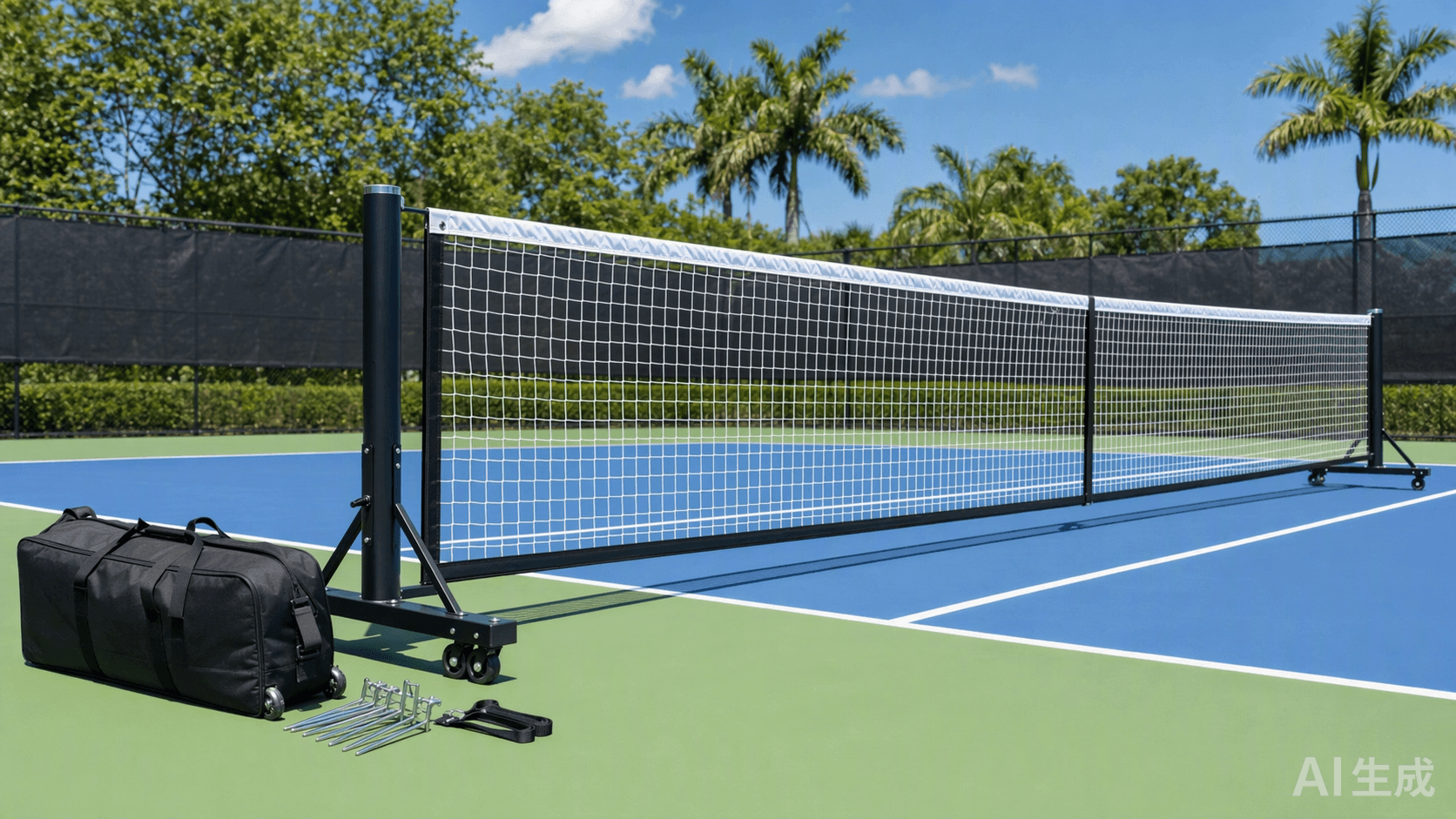
Why Portable Net Systems Drive the Pickleball Equipment Market
If you sell pickleball gear online, the portable net system is the product that turns a casual browser into a buyer. A paddle and ball are impulse buys. A net system is the purchase that commits someone to the sport. It is also the hardest product to get right — it ships as a flat-pack, gets assembled by someone who has never seen one before, and has to survive wind, UV, and repeated take-down for two or three seasons. Get the spec wrong on your OEM order and you eat returns at 25 pounds per unit.
Not every portable net on the market meets USA Pickleball regulation dimensions, and even fewer survive a full season of outdoor use without frame sag, mesh fraying, or powder coat chipping. The difference between a 4-star product and a 2-star product comes down to a handful of specifications that are easy to miss in a factory quotation sheet. This guide covers the regulation sizing standards, the materials that separate a 3-season net from a 1-season net, the manufacturing decisions your factory makes, and the price tiers at wholesale and retail.

USA Pickleball Regulation Net Specifications
Every portable net system you source should be built to USA Pickleball (formerly USAPA) regulation dimensions. Even if your target customer is a backyard player who never enters a tournament, regulation-compliant sizing is the baseline buyers expect. A net that is 21 feet wide instead of 22 feet is instantly flagged in customer reviews, and Amazon listings that say "regulation size" but ship short get returned within a week.
The Core Dimensions
The official USA Pickleball rulebook specifies the following net dimensions:
| Specification | Regulation Value | Notes |
|---|---|---|
| Net height at sidelines (posts) | 36 inches (91.44 cm) | Measured at the post, not the mesh edge |
| Net height at center | 34 inches (86.36 cm) | Maintained by a center strap |
| Post spacing (inside to inside) | 22 feet (6.7 m) | Court width is 20 feet for doubles |
| Minimum net width | 21 feet 9 inches | Net extends beyond the post-to-post span |
| Maximum post diameter | 3 inches | Posts set 12 inches outside each sideline |
| Mesh size | 1.75 inches | Ball is 2.87 to 2.97 inches in diameter |
| Top band | 2-inch white tape over cord or cable | Runs the full width of the net |
| Center strap width | 2 inches, placed 10 feet from each sideline | Adjusts center height to 34 inches |
| Minimum net body height | 30 inches | Before the 2-inch top band is added |
That 2-inch height differential between the sidelines (36 inches) and center (34 inches) is not optional. It is maintained by a center strap that pulls the net down. If your OEM factory skips the center strap or uses a cheap elastic that stretches out after a week of sun exposure, the center of the net drifts up to 35 or 36 inches. Tournament directors check this with a measuring stick before matches. Recreational players notice when balls that should clear the net start clipping the top. Either way, you get a return or a negative review.

Manufacturing checkpoint: Insist that your factory includes a non-elastic center strap with a metal cam buckle, not a plastic clip. The strap should be sewn to the top band on one side and loop through a ring on the other. This is a 40-cent component that determines whether your net stays regulation-compliant after day one.
Why Tennis Net Conversions Fail
Tennis net posts sit at 42 inches with a 36-inch center — a full 6 inches too high for pickleball at the sidelines. Adapter kits exist, but they add lateral tension the tennis net was not designed for, and the post width (33 feet for singles, 42 feet for doubles) does not match the 22-foot pickleball standard. A converted tennis net will never pass a USA Pickleball equipment audit. Do not stock these as a primary product.
Portable Net System Components: What You Are Actually Buying
When you receive a factory quotation for a "portable pickleball net system," that quotation covers five distinct components. Each one has a specification that determines the final product quality. Here is what each component does and what to specify on your OEM order.

1. Vertical Posts (Uprights)
The two vertical posts hold the net at 36 inches. On portable systems, these are telescoping steel or aluminum tubes that break down into 3 or 4 sections for transport. Post diameter must not exceed 3 inches per USA Pickleball rules, but most portable systems use 1.25 to 1.75-inch tubing to keep weight down. The USA Pickleball official portable net uses an oval-shaped powder-coated steel tube at 32 pounds total.
What to specify: tubing outer diameter (32mm to 45mm for portable systems), wall thickness (1.2mm to 2.0mm for steel, 2.0mm to 3.0mm for aluminum), and surface treatment (electrostatic powder coating). Wall thickness below 1.2mm on steel produces a net that wobbles in a light breeze. The Sports Imports competition net uses 11-gauge (approximately 3.0mm) square steel — but at 259 pounds, it is permanent, not portable.
2. Crossbar and Tensioning Mechanism
The crossbar spans the top of the net between the posts. Budget systems use the top cable running through the 2-inch white band. Higher-end systems add a rigid or flexible boom that maintains horizontal tension without relying solely on cable pull. The SwiftNet 2.1 uses a shock-corded carbon fiber tension boom at 14 pounds total.
What to specify: cable-only or boom design. Cable-only is cheaper but sags over time. If cable-only, ask for break strength — the Sports Imports competition net uses a 1/4-inch galvanized steel cable with 2,500-pound break strength. Portable systems do not need that level, but anything below 200 pounds will stretch and sag within the first season.
3. Net Mesh
USA Pickleball rules permit braided nylon, polyethylene (PE), or similar synthetics. Mesh opening should be 1.75 inches or smaller so the ball (2.87 to 2.97 inches) cannot pass through. For outdoor nets, PE is the industry standard — it resists UV better than nylon, holds its knot structure through freeze-thaw, and does not absorb water. Nylon works indoors but degrades faster under direct sun. If your factory quotes "polyester mesh," push back — PET is cheaper than PE but has significantly lower UV resistance.
What to specify: mesh material (PE for outdoor), mesh size (1.75 inches or smaller), yarn thickness (2.5mm to 3.5mm for durability), and knot type (knotted is more durable than knotless outdoors). The China Sport Nets factory lists a 45mm (approximately 1.77-inch) nylon mesh — marginally over the 1.75-inch guideline, so verify actual ball-pass-through performance before ordering.
4. Base and Feet
The base stabilizes the vertical posts, typically as a horizontal bar extending perpendicular to create a T-shape or A-frame footprint. Without adequate base footprint, the net tips forward when a ball hits the top of the mesh. Specify base bar length (minimum 24 inches per side), matching wall thickness, and ground stakes or sandbag loops. If you sell into windy regions, a net without stakes will tip in a 15 mph gust.
5. Carrying Bag
The bag is often the first component to fail. A bag that tears at the zipper seam after three uses turns a $170 net into a product customers regret buying. Specify bag material (600D Oxford or heavier), zipper gauge (YKK #5 or equivalent), and whether wheels are included. Wheeled bags add an estimated $3 to $5 per unit but materially reduce return rates.
Material Specifications That Determine Product Lifespan
The materials your factory selects for each component directly control how long the net lasts. Here are the material decisions that matter most, with the thresholds that separate a sellable product from a return magnet.
Steel Tubing: Gauge and Coating
Most portable net frames use steel tubing. The wall thickness determines rigidity. For portable systems, steel wall thickness typically ranges from 1.2mm to 2.0mm. Anything below 1.2mm flexes visibly under wind load and develops stress fractures at the weld joints within the first season. The Sports Imports competition net uses 11-gauge (approximately 3.0mm) square steel — but at 259 pounds and $1,800, it is a permanent installation, not portable.
The powder coating matters as much as the gauge. Poorly applied powder coat chips at the snap-together joints, exposing bare steel that rusts within weeks. Specify electrostatic spray powder coating (not dip coating), applied after welding, with minimum 60-micron dry film thickness. Ask for a salt spray test report — 500 hours of neutral salt spray without red rust is a reasonable standard for outdoor sports equipment.
Aluminum and Carbon Fiber: Weight Trade-Offs
Aluminum reduces system weight by 30 to 40 percent compared to steel at the same diameter. The SwiftNet 2.1 uses carbon fiber instead, hitting 14 pounds total — but at $299.99 retail. Aluminum tubing for portable nets typically runs 2.0mm to 3.0mm wall to match steel rigidity. The trade-off is cost — aluminum adds an estimated $8 to $15 per unit at OEM pricing, which compounds across a container order.
Mesh Denier and UV Treatment
For PE mesh, a 2.5mm to 3.5mm yarn diameter produces a net that holds its shape through 200-plus hours of direct UV exposure. Thinner yarn (under 2.0mm) frays and slumps within the first outdoor season. UV inhibitor added to the PE resin during extrusion is the difference between a one-season net and a three-season net. If your factory cannot provide a UV additive spec sheet, the mesh is unmodified PE and will degrade in 6 to 8 months of full sun.
Hardware: The Hidden Cost Center
A 304 stainless steel snap pin is estimated at $0.40. A zinc-plated carbon steel pin is estimated at $0.08 — and rusts after the first rain. Specify 304 stainless for all external hardware. You add an estimated $2 to $3 per unit, a fraction of the cost of processing a return for a rusted frame.
Weight and Assembly Time: The Portability Threshold
A portable net system is only "portable" if one person can carry it from a car to a court and set it up without tools. The industry has settled on two thresholds: weight under 35 pounds and assembly under 5 minutes for an experienced user. Systems that miss these thresholds get downgraded in reviews, even when the build quality is excellent.
Here is how the major brands and price tiers stack up:
| Product / Tier | Weight (lbs) | Assembly Time | Retail Price | Frame Material |
|---|---|---|---|---|
| Budget tier (generic) | 18-25 | 10-15 min | $50-80 | Steel |
| Mid-range (A11N, Boulder, Bagail) | 20-30 | 5-10 min | $100-180 | Steel |
| Franklin (USA Pickleball size) | 29.3 | 5-8 min | $129.99 | Steel |
| A11N (regulation size) | 20 | 5 min | $169.99 | Metal (PE net) |
| Travel / aluminum tier | 12-18 | 5-8 min | $120-200 | Aluminum |
| SwiftNet 2.1 | 14 | 2-5 min | $299.99 | Carbon fiber |
| Tournament tier | 30-45 | 5-10 min | $200-350 | Heavy-gauge steel |
| USA Pickleball official net | 32 | Minutes (no tools) | $399.99 | Powder-coated steel (oval) |
For OEM sourcing, the sweet spot is the 20-to-30-pound range with a 5-minute assembly claim. This hits the mid-range retail tier ($100 to $180) where volume is highest and margin is healthiest. The A11N system at 20 pounds and $169.99 is a strong reference point — PE mesh, metal frame, regulation dimensions, and a sub-5-minute tool-free assembly. If your factory can match those specs at a landed cost of $45 to $65 per unit, you have a viable product.
Assembly time reality check: The SwiftNet 2.1 claims 2 to 5 minutes, but that is for an experienced user. A first-time buyer will take 12 to 15 minutes on any system. Factor this into your product photography and instruction manual — clear assembly photos reduce returns more than any spec change.
OEM Manufacturing: What to Specify on Your Purchase Order
Most Chinese factories quote a generic spec — "steel frame, PE net, carry bag" — and leave the critical details to defaults that favor their cost, not your quality. Here are the specifications you must write into your purchase order.
Tubing Diameter and Wall Thickness
Specify the exact outer diameter and wall thickness for every tube. A typical portable net frame uses 32mm to 38mm OD steel tubing with 1.5mm wall for the vertical posts and 1.2mm for the base bars. If the factory uses 1.0mm wall without telling you, the frame will feel flimsy and the first customer who leans on a post will bend it. Write the spec as: "Vertical post: 35mm OD x 1.5mm wall, steel, powder-coated black." Do not accept "similar" or "equivalent" on the quotation sheet.
Weld Quality and Joint Design
Portable net frames use snap-together (spring-button) or bolt-together joints. Snap-together is faster to assemble but requires precise tolerances — too loose and the frame wobbles, too tight and the customer cannot assemble it without a mallet. For weld quality, specify TIG-welded joints, ground smooth before powder coating. Ask for photos of weld joints from a previous production run — if the factory cannot provide them, treat it as a red flag.
Mesh, Coating, and Packaging Specs
Specify PE mesh with minimum 3.0mm yarn diameter, knotted construction, and UV inhibitor added during extrusion. Request a UV test report (QUV accelerated weathering, minimum 500 hours). For powder coating, specify electrostatic spray, applied post-weld, 60-micron minimum dry film, with a salt spray test report showing 500 hours without red rust.
A 22-foot portable net ships in a 38-to-42-inch bag — oversize parcel, not standard package. Specify export carton dimensions, minimum 5-ply corrugated (ECT-32 or higher), and individual polybag packaging per unit. For Amazon FBA, the carton must pass ISTA 3A drop testing. A torn carton in transit means a damaged bag, which means a returned net.
MOQ and Lead Time Expectations
Chinese factories typically quote an estimated 100 to 300 units MOQ for complete net systems, with estimated 35 to 45 day production lead times plus 7 to 14 days for QC and packing. Netting-only orders have lower MOQs — some factories produce 100 square meters at $3.60 to $3.80 per square meter, useful for replacement net accessory SKUs. For a complete system with frame, mesh, hardware, and bag, expect estimated FOB pricing of $28 to $55 per unit depending on specifications and volume.
Price Tiers at Retail and Wholesale
Your retail price point determines your OEM spec sheet. A $79 net cannot use 1.5mm wall steel and PE mesh with UV inhibitor — the math does not work. A $249 net cannot ship with a cable-only tension system and a budget carry bag — customers will return it and buy a SwiftNet instead. Map your target retail price to the spec tier before you send the RFQ to a factory.
| Retail Price Tier | Target FOB Cost | Frame Spec | Mesh Spec | Bag Spec |
|---|---|---|---|---|
| $50-80 (budget) | $18-25 | 1.0-1.2mm steel | Polyester, no UV | 420D, no wheels |
| $100-180 (mid-range) | $35-55 | 1.2-1.5mm steel, powder-coated | PE, basic UV | 600D, optional wheels |
| $200-350 (tournament) | $65-100 | 1.5-2.0mm steel, post-weld coating | PE, 500hr UV, knotted | 600D+, wheels, padded |
| $350+ (premium) | $100-150 | Aluminum or carbon fiber | PE, premium UV, 3.5mm yarn | 900D, wheels, modular |
At the budget tier, your margin is 2.2 to 2.8x FOB — workable but unforgiving if returns exceed 5 percent. At mid-range, you should target a 3x to 3.5x markup, which absorbs a 8 to 10 percent return rate. Tournament tier nets with USA Pickleball approval (or at least regulation-compliant sizing clearly stated in the listing) can sustain 3.5x to 4x markups because the buyer is making a considered purchase, not an impulse buy.
USA Pickleball Approval: Worth It for Your Brand?
USA Pickleball maintains an approved equipment list. Nets that pass their review can display the logo on packaging and marketing. The approval process requires submitting a sample for dimensional testing — the lab verifies 36 inches at posts, 34 inches at center, 22 feet between posts, post diameter under 3 inches, and mesh that will not pass a ball through.
For an e-commerce seller, USA Pickleball approval is a credibility signal, not a volume driver. Most portable net sales go to recreational players who never play in sanctioned tournaments. But the approval badge in your Amazon listing or Shopify product page reduces buyer hesitation, particularly in the $150 to $300 range where customers compare 4 to 5 options. The process is estimated at $500 to $1,500 and takes an estimated 4 to 8 weeks. If your factory has already produced a USA Pickleball-compliant net for another brand, ask whether they can share the dimensional test report — it will shorten your timeline.
Quality Control Checklist for Your First Production Run
Before your first container ships, run a pre-shipment inspection against this checklist. Every item is a failure point that has generated negative reviews for at least one brand.
- Net height at posts: Must read 36 inches (plus or minus 0.25 inches). Tolerance beyond 0.5 inches triggers returns.
- Net height at center: Apply the center strap and measure. Must read 34 inches. If it reads 35 or 36, the strap is too long or the mesh is too stiff.
- Post spacing: Measure inside-to-inside. Must be 22 feet. A 21-foot net fails any regulation check.
- Mesh openings: No opening should exceed 1.75 inches. A regulation ball (2.87 to 2.97 inches) should not pass through any opening.
- Frame rigidity: Push the top of one post forward with 5 pounds of force. The post should flex less than 2 inches and return to vertical.
- Weld inspection: Check every welded joint for cracks, porosity, or incomplete beads. No visible gap between tube and fitting.
- Powder coat adhesion: Cross-hatch test (ASTM D3359). Coating should not flake at the cross-hatch lines.
- Hardware: Every snap pin and bolt should be 304 stainless. Test with a magnet — 304 is non-magnetic or very weakly magnetic.
- Bag durability: Load the bag with the net and drop from waist height onto concrete. No seam separation, no zipper failure.
- Assembly test: Have a first-timer assemble it using only the included instructions. If it exceeds 15 minutes, revise the instructions before shipping.
Pre-shipment inspection rule: Use AQL 2.5 for major defects (height out of tolerance, broken welds, missing components) and AQL 4.0 for minor defects (powder coat chips, bag stitching irregularities). A lot that fails AQL 2.5 on height measurement should not ship — period. Height is the spec customers check, and it is the spec tournament directors check.
Common Sourcing Mistakes and How to Avoid Them
Four failure patterns repeat across brands and price tiers. Each is preventable at the specification stage.
Specifying the Frame, Ignoring the Net
Sellers negotiate tubing wall thickness for hours, then accept whatever mesh the factory defaults to. The mesh is what the customer sees and touches every time they play. A frame that lasts 5 years with a net that frays in 8 months produces a 2-star review. Always specify mesh material, yarn diameter, UV treatment, and knot type as separate line items.
Skipping the Center Strap
Some budget factories omit the center strap to save $0.30 per unit. Without it, the net center sits at 36 inches — the same height as the sidelines — and any ball that should clear by dipping through the center gets caught. This is the most common "the net is wrong" complaint on Amazon. The fix is a 2-cent specification on your PO.
Undersizing the Base and Using Non-Stainless Hardware
A 22-foot net with a 12-inch base bar per side tips forward in wind because the mesh acts as a sail. Specify a minimum 24-inch base bar and include ground stakes — $1.50 per unit that eliminates the "net fell over" complaint. Similarly, zinc-plated hardware costs less and rusts after the first rain; the streaks run down the white mesh and the customer photographs it for their review. Specify 304 stainless for every external fastener — $2 to $3 per unit that saves your rating.
We manufacture USA Pickleball regulation-compliant portable net systems with specified tubing gauge, PE mesh with UV treatment, 304 stainless hardware, and ISTA 3A-tested packaging. Request a factory quotation with your target retail price and we will build the spec sheet to match.
Request OEM QuotationBuilding Your Private-Label Net System Strategy
The portable net category supports a lineup: a regulation tournament net as your flagship ($180 to $250 retail), a mid-range regulation net for volume ($99 to $149), and a compact or youth net as the entry product ($49 to $79). Source all three from the same factory to negotiate better per-unit pricing and offer bundle deals that increase average order value.
Stock replacement nets as an accessory SKU — a customer who bought your net system 18 months ago will need a replacement mesh, and if you sell it, you capture the repeat purchase. Replacement netting has a low MOQ (100 square meters at $3.60 to $3.80 per square meter) and ships as a standard parcel, not oversize.
The net system itself is increasingly commoditized. The accessories — line tape sets, court boundary markers, carry bag upgrades, paddle covers, and ball machines — and the brand story you build around them are where margin lives. Start with the regulation dimensions, build the material spec sheet to match your target retail tier, and inspect the first production run against the checklist above. The difference between a net that sells and a net that gets returned is not the factory you choose — it is the specifications you write.
Browse our OEM pickleball equipment catalog for frame specs, mesh options, and MOQ details — or contact our manufacturing team for a custom quotation built to your retail price target.
View OEM CatalogWant to source this quality for your brand?
Contact our factory directly on WhatsApp for an instant MOQ and pricing quote.