Pickleball Ball Machine OEM Sourcing: Specs, Certs and Spares
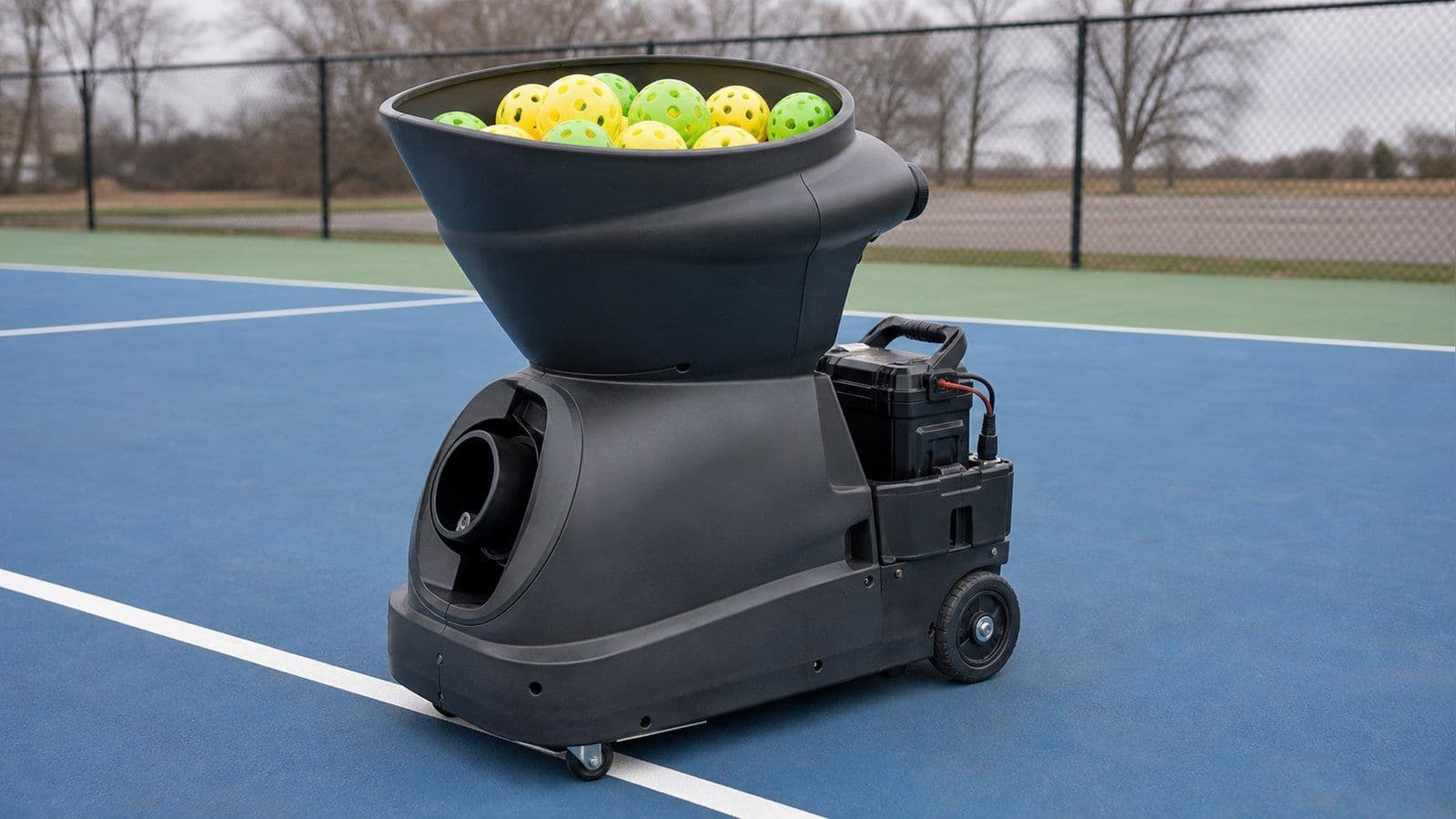
A pickleball ball machine is the one product in the category where the buyer's biggest risk is not the product at all. Paddles fail visibly and slowly — an edge guard lifts, a face delaminates, and you argue about it over photographs. A ball machine fails in front of forty paying members on a Saturday morning, jams twice in ten minutes, and gets wheeled into a storeroom where it stays. The equipment is fine. The reputation of the brand painted on the side is not.
Most of what circulates online about these machines is written for a player deciding which one to buy. This is written for the other reader: the brand owner, importer or facility operator putting their own name on one. That reader needs a completely different set of numbers — the ball tolerance that actually governs whether a feed mechanism jams (published, and tighter than most buyers realise: the maximum out-of-round diameter variance permitted on an approved ball is +/-0.020 inch), the battery specification language that survives a warranty dispute, the certification files that have to exist before a container clears customs, and the spares kit that keeps a fleet running instead of parked.

Key Takeaways
- Almost nobody "OEMs" a ball machine from zero. What you are really buying is a rebadge of an existing platform — housing colour, logo, packaging and firmware limits — because the tooling for a machine housing is an order of magnitude beyond paddle or ball tooling.
- Feed reliability is a ball problem before it is a machine problem. The USA Pickleball Equipment Standards Manual caps out-of-round variance at +/-0.020 inch (0.51 mm) across a 2.87–2.97 inch ball — write that into your ball contract, not just your machine contract.
- Ask any supplier for a jam rate and you will get a number with no test behind it. Run your own feed test at the factory instead — the protocol below takes an afternoon and settles the argument permanently.
- A battery spec that says "1,000 cycles" is unenforceable. A spec that says cycles to 80% of rated capacity, at a stated charge/discharge rate and ambient temperature is a number you can hold someone to.
- For the US, a machine like this is typically a Class B digital device under FCC Part 15, authorised by SDoC or Certification, with radiated emissions limited to 100–500 µV/m at 3 metres depending on frequency.
- Lithium packs need a UN 38.3 test summary with ten mandated elements, and air shipments are capped at a 30% state of charge. Both catch first-time importers who air-freight a fully charged sample.
- The spares that matter for a fleet are throwing wheels, drive and oscillation motors, battery packs, control boards, switches and charge ports — order them with the machines, not after the first failure.
What you are actually buying when you "OEM" a ball machine
Start with an honest statement, because it changes every negotiation that follows. Our factory builds paddles, rotomoulded balls, nets and court accessories — we do not manufacture ball machines, and neither do most of the Chinese pickleball factories a buyer will meet at a trade show. That matters to you because it tells you what the quote in front of you really is.
A ball machine is a moulded housing, a hopper, a pair of counter-rotating throwing wheels, two or three DC motors, a control board, a battery pack and a charger. The plastics alone need large injection tools. The electronics need a firmware team. The battery needs a certified cell supplier and a test file.
Compare that with the equipment we do tool. A paddle mould or a rotomoulded ball tool is a single-part investment, which is why a paddle programme can run at 50 pieces and our own ball line carries an MOQ of 1,000 pieces. A machine housing tool is a different category of spend entirely, and no supplier amortises it over a first order.
So the realistic private-label routes are three, and they are not equally good:
- Rebadge an existing platform. Your logo, your housing colour, your carton and manual, on a machine the factory already builds and already certified. Lowest MOQ, fastest, and the only route that makes sense below a few hundred units. The trade-off: your "differentiator" is paint, and a competitor can order the identical machine next month.
- Configure a platform. Same base machine, but you specify the battery capacity, the speed and feed ranges, the oscillation pattern, the remote, and sometimes a custom top cover from a smaller, cheaper tool. This is where a serious brand should aim. It needs volume in the high hundreds and it needs you to write specs — which is the whole point of this guide.
- Full bespoke tooling. Your own housing, your own board, your own firmware. Realistic only for a brand with a multi-year plan and the cash to carry tooling and certification before a single unit sells.
The failure mode to watch for is a supplier who lets you believe route three while quoting route one. The tell is simple: ask who owns the tool for the housing, and ask to see the tool. A factory that owns it will walk you to it. A trading company will change the subject to lead times.
Feed reliability is a ball tolerance problem first
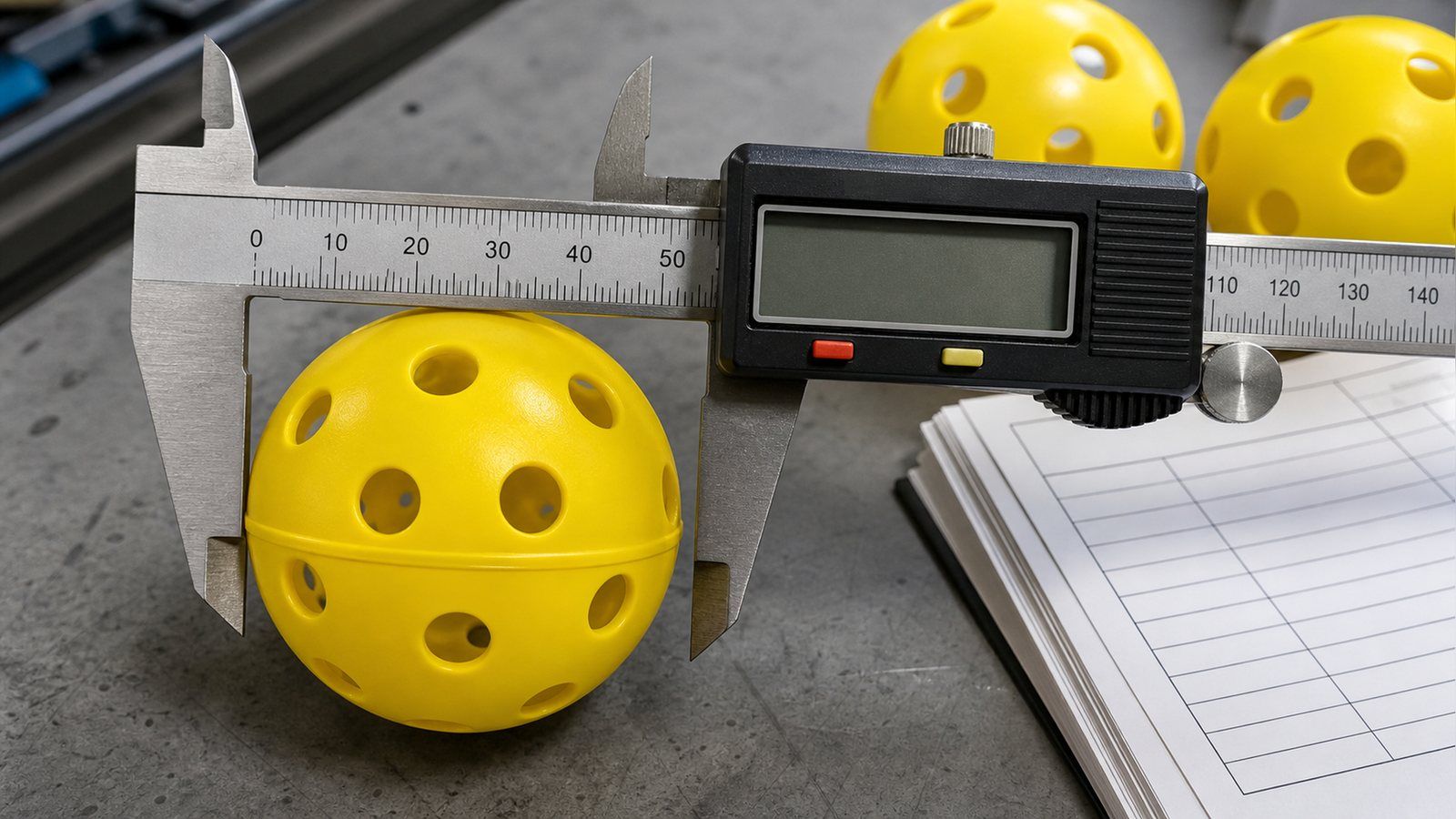
Here is the single most useful thing a machine buyer can know, and it has nothing to do with machines. The feed throat of a ball machine is a fixed aperture. The ball is a hollow moulded sphere with holes in it, made on a tool that wears, in a process with thermal shrinkage. When a ball jams, the usual cause is that the ball was the wrong shape — not that the machine was badly built.
The USA Pickleball Equipment Standards Manual, Revision 3 (January 2025) gives you the numbers to write into a contract. Rule 2.D.3 sets ball diameter at 2.87 inches (7.29 cm) to 2.97 inches (7.54 cm), and — this is the clause that matters for feeding — caps the maximum out-of-round diameter variance at +/-0.020 inch (0.51 mm). Rule 2.D.4 sets weight between 0.78 and 0.935 ounces (22.1 and 26.5 grams). Rule 2.D.8 permits a minimum of 26 to a maximum of 40 circular holes.
Read the size clause carefully, because it contains a trap. The permitted diameter band itself is 0.10 inch wide. Two balls can both be perfectly legal and differ by more than two and a half millimetres in diameter.
Now mix two approved brands in one hopper — which every club does — and you have handed the feed mechanism a size population far wider than any single production run would produce. The out-of-round allowance sits on top of that. A machine tuned on one tight batch at the factory can behave differently on a mixed club bucket, and neither the machine nor the balls are defective.
There is a second, quieter clause worth knowing. Rule 2.D.7 still lists a hardness of 40 to 50 on a Durometer D scale, but the manual now marks it "RECORDED FOR COROLLARY DATA ONLY, this is no longer a compliance requirement."
Buyers still write durometer figures into ball contracts believing they bind an approved ball. They do not. Ball hardness does matter to how your machine grips and launches, because a softer ball deforms more between the wheels. So you have to specify it yourself as a contractual term — the standard has stopped doing it for you.
Manufacturers of machines say the same thing from the other side of the problem. Spinfire's own troubleshooting guidance for regular jamming points at old balls, cheap balls, damp balls and overloaded hoppers before it points at the machine, and caps hopper load at a maximum of 150 balls so the feed wire does not bend under the weight above it. That is a supplier telling you, in writing, that your consumable and your loading habit drive the failure you are about to blame on their product.
The practical consequence for a private-label programme: your ball specification is part of your machine specification. If you are already sourcing balls, tighten the roundness clause and lock the supplier. If you are not, understand that a machine fleet burns through balls faster than any other equipment you own, and that the ball is where your recurring margin lives.
The feed test to run before you approve anything
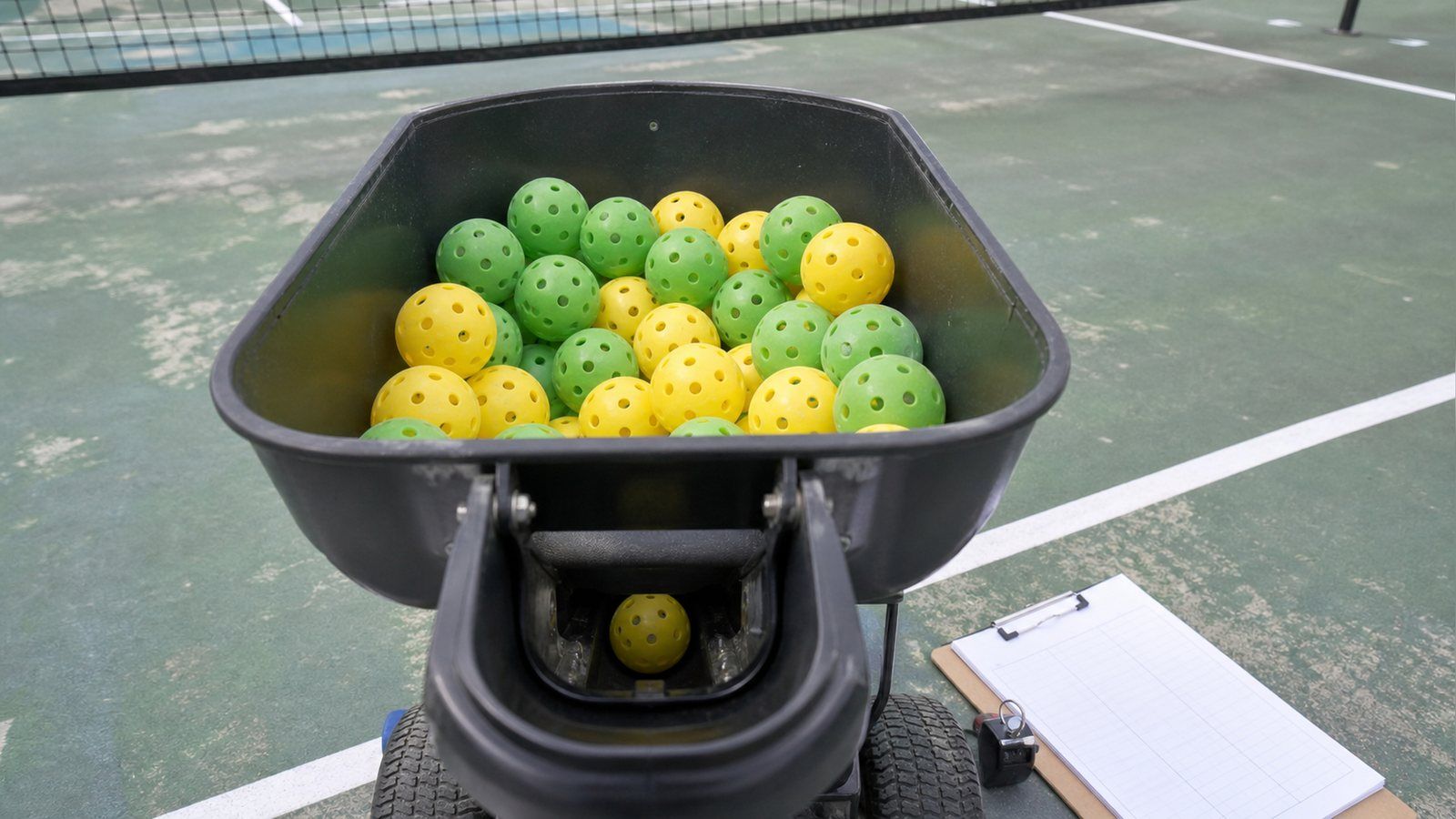
Ask a supplier for a jam rate and you will get one. It will be a good number, it will be quoted with confidence, and there will be no test report behind it — because there is no published industry test method for ball-machine feed reliability, no sample size convention, and no agreed definition of what counts as a jam. A figure with no method is not data. Treat it as marketing and generate your own.
This protocol is deliberately crude, because crude and repeatable beats sophisticated and unrepeatable. It runs in an afternoon at the factory during your golden-sample visit, and it costs nothing but balls.
Define the failure before you count anything
Write the definition down and get the supplier to sign the same sheet. A workable one: a jam is any event where the machine stops delivering balls and requires a human hand inside the hopper or the throat to resume. A double-feed — two balls launched together — is recorded separately, because it has a different cause and a different fix. Anything the machine clears by itself within one cycle is not a jam. Without this paragraph, you will spend the afternoon disagreeing about what you just watched.
Test four ball populations, not one
The point of the test is to separate the machine's contribution from the ball's. Run the same machine, same settings, on four buckets: new balls from a single batch of your intended ball; new balls mixed from two or three approved brands; balls that have been played roughly twenty hours; and the same mixed bucket after being left damp and then wiped. Run several hundred feeds per population and log jams and double-feeds separately for each. You are not chasing a laboratory number. You are looking for which population breaks first, and by how far.
Measure the balls that jammed
This is the step everybody skips and it is the one that pays. Keep every ball that caused a jam in a separate box. At the end, put a caliper across each one in two axes and record the difference.
If the jamming balls cluster near or beyond the +/-0.020 inch out-of-round allowance while the rest of the bucket sits comfortably inside it, your problem is the ball supply and no machine change will fix it. If they are dimensionally unremarkable, the problem is in the feed geometry or the wheel surface, and it belongs to the machine supplier. That single measurement decides who owns the defect — before you have signed anything.
One field observation worth expecting: brand-new balls sometimes feed worse than balls with a few hours on them. Fresh mouldings carry release agent and a slightly glossier skin, which lowers friction against the throwing wheels; the wheels then slip rather than grip. Do not let a supplier explain away a bad new-ball run by telling you to break the balls in — a machine that only works on worn balls is a machine that will fail its first customer demo.
Turn the result into contract language
Whatever number you get, the contract clause is not "jam rate below X%". It is: the machine shall achieve no more than N jams per 500 feeds, tested per the attached protocol, on the ball specified in Annex A, at the settings specified in Annex B, witnessed at pre-shipment inspection. Every one of those qualifiers is doing work. Without the ball annex the supplier will test on the roundest balls in the building; without the settings annex they will test at a slow feed rate no customer uses.
Writing a battery spec a supplier cannot wriggle out of
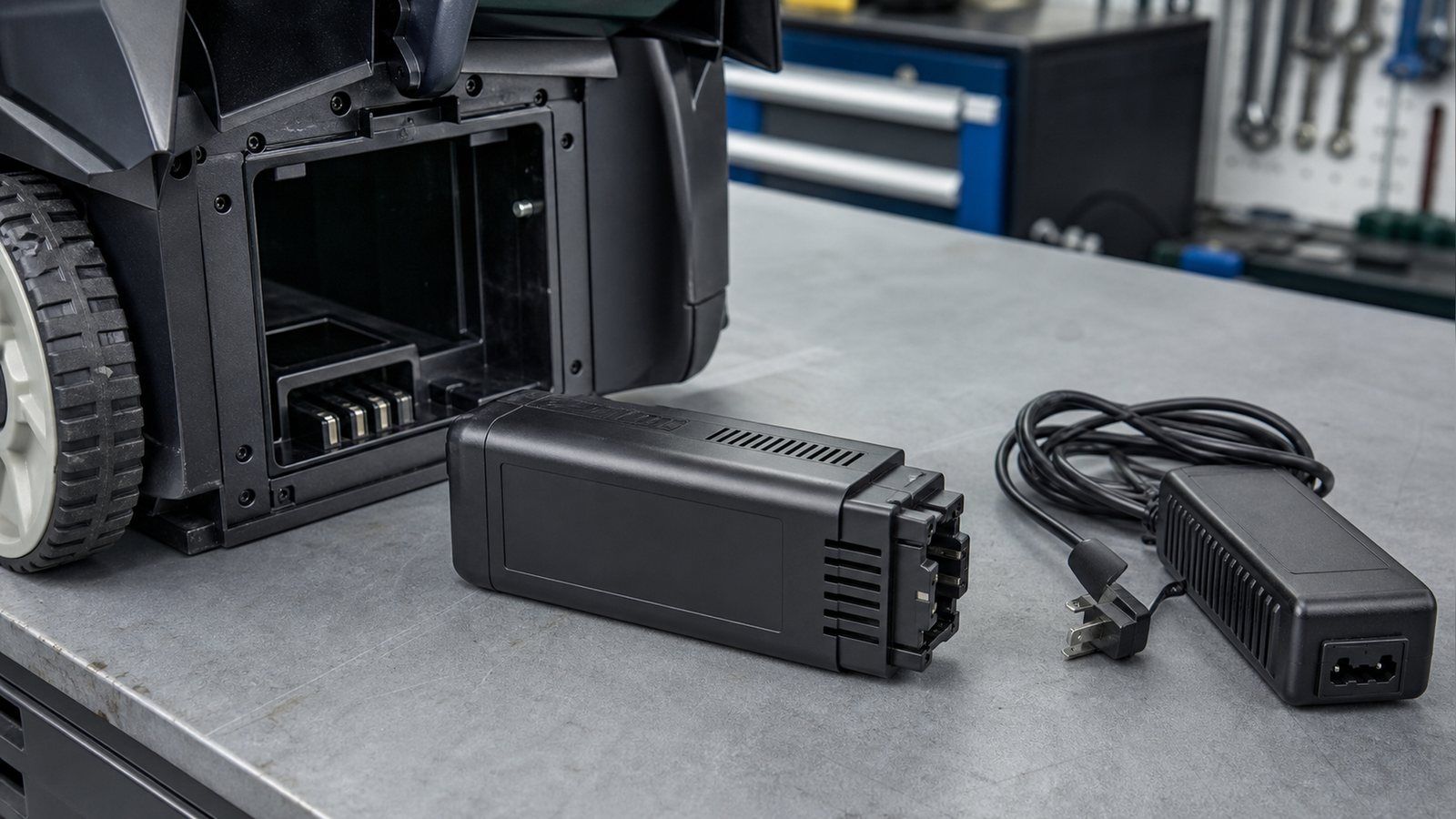
"1,000 cycles" is the most common battery claim in this category and it means nothing at all. A cycle count without a capacity endpoint, a rate and a temperature is not a specification — it is a number chosen to be larger than the last supplier's number. Here is what has to be in the sentence for it to be enforceable.
- Cycles to a stated remaining capacity. "1,000 cycles to 80% of rated capacity" is a claim. "1,000 cycles" alone is not, because a pack at 50% capacity has still technically completed the cycles.
- The charge and discharge rate. Cycle life measured at a gentle 0.2C looks dramatically better than the same pack cycled at the rate your machine's motors actually pull. State the discharge rate as the machine's real operating draw.
- Ambient temperature. Cycle-life figures are quoted at room temperature. Your customer's machine lives in a court-side storeroom in Arizona or a Melbourne shed. Specify the test temperature, and separately specify the operating temperature range the pack must survive without permanent capacity loss.
- Watt-hours, not just amp-hours. Watt-hour rating is what shipping, customs and airline rules are written around, and since May 10, 2024 each lithium ion battery must be marked with the Watt-hour rating on the outside case under 49 CFR 173.185(a)(5). A pack quoted only in Ah is a pack whose paperwork is not ready.
- Runtime at a stated feed rate. "Up to 4 hours" is measured at the slowest setting with oscillation off. Specify runtime at a defined balls-per-minute with oscillation running — the way a club actually uses it.
- Cell provenance and the right to audit it. Name the cell manufacturer and model in the contract, and require notification before any change. A silent cell swap between the golden sample and mass production is a common and expensive substitution.
A frank limitation, stated plainly because the alternative is inventing something: we have not cycle-tested ball-machine battery packs, and no cycle-count figure in this article is presented as measured. What is offered above is the specification language that makes a supplier's own claim testable and enforceable — which is the part a buyer controls. If a supplier will not restate their cycle claim in those terms, that refusal is your data point.
The certification path for the US and the EU
A battery-powered ball machine is three regulatory objects wearing one shell: an electronic device that emits radio noise, an electrical appliance with a mains charger, and a lithium battery in transport. Each has its own file, and the fact that a supplier holds one does not mean they hold the others. Requirements vary by market, product configuration and the importer's role, so treat this as a map of the regimes to confirm with a competent conformity body or your customs broker — not as a determination for your specific machine.
| What it covers | US route | EU route |
|---|---|---|
| Radio noise from the electronics | FCC Part 15, typically Class B; SDoC or Certification | EMC Directive, CE marking |
| Electrical safety of the mains charger | NRTL listing (UL or ETL) to UL 62368-1 | Low Voltage Directive, CE marking |
| Low-voltage machine body itself | Retailer-driven; NRTL listing often demanded commercially | Usually below the LVD voltage floor; EMC still applies |
| The lithium battery in transport | UN 38.3 test summary; 49 CFR packing and marking | UN 38.3 plus EU Battery Regulation CE marking |
United States: FCC Part 15 and the NRTL question
A ball machine with a microcontroller and a motor controller is an unintentional radiator. Because it is marketed to the general public, it is normally a Class B digital device — 47 CFR 15.3 defines Class B as a device "marketed for use in a residential environment notwithstanding use in commercial, business and industrial environments." That definition closes a door some suppliers try to open: a machine sold to clubs and consumers alike cannot claim the looser Class A limits just because clubs buy it.
Class B is the harder target. Under 47 CFR 15.109, radiated emissions measured at 3 metres may not exceed 100 µV/m from 30–88 MHz, 150 µV/m from 88–216 MHz, 200 µV/m from 216–960 MHz, and 500 µV/m above 960 MHz.
The authorisation route for a device like this, per the Part 15 subpart B table, is Supplier's Declaration of Conformity or Certification. SDoC is cheaper, and it puts the responsible-party obligation on a US-based entity — which, for an imported private-label machine, may well be you rather than the factory. Confirm who that party is before the container ships, not after a complaint.
Product safety is separate, and in the US it is largely commercial rather than statutory for a low-voltage device. No federal rule says a ball machine must carry a UL mark. In practice, most retailers, insurers and institutional buyers insist the charger — and often the machine — is listed by a Nationally Recognized Testing Laboratory.
The standard the NRTL evaluates against is UL 62368-1. The current ANSI/UL edition is the Fourth Edition dated July 31, 2025, an adoption of IEC 62368-1, and it superseded the older UL 60950-1 and UL 60065. Ask for the certificate number, then check it in the certifier's own online directory. A PDF emailed by the factory proves nothing. The directory entry proves the listing is live and names the exact model.
Europe: why the charger and the machine split
The European picture confuses buyers because two CE routes run in parallel. Directive 2014/35/EU — the Low Voltage Directive — applies to electrical equipment rated between 50 and 1,000 V AC or between 75 and 1,500 V DC.
A machine running on a 24 V pack sits below that floor, so the machine body typically falls outside the LVD. Its mains charger does not: it plugs into 230 V and lands squarely inside. The EMC Directive catches both. The practical result is that a supplier may hand you a CE certificate covering only the charger, and you may not notice.
Then there is the battery itself. Regulation (EU) 2023/1542 defines a portable battery as one that is sealed, weighs 5 kg or less, is not designed specifically for industrial use, and is neither an electric-vehicle, LMT nor SLI battery. That is where a typical ball-machine pack lands.
The dates get quoted wrongly across the trade press, so take them from the Regulation itself. It applies from 18 February 2024. Article 17 and Chapter VI, which carry the conformity assessment and CE marking obligations, apply from 18 August 2024, and Chapter VIII from 18 August 2025. Article 20 requires the CE marking to be affixed visibly, legibly and indelibly to the battery itself, falling back to the packaging and documents only where the battery's nature does not permit it.
Shipping the battery — where first orders actually get stuck
Under 49 CFR 173.185(a)(1), each cell or battery must be of a type proven to meet sub-section 38.3 of the UN Manual of Tests and Criteria. Types qualified only against Revision 3 are explicitly no longer valid, so an old test file is a dead file.
Paragraph (a)(3) requires every manufacturer and subsequent distributor to make a test summary available, with ten mandated elements. Among them: the test laboratory's name and contact details, a unique test report identification number, the cell or battery description with its Watt-hour rating, the list of tests conducted with results, and the name and title of a responsible person. Ask for the summary by those elements. A one-page "UN38.3 certificate" with a logo and no report number is not what the rule describes.
Two numbers catch first-time importers. Air transport carries special provision A100: lithium ion cells and batteries must be offered for transport at a state of charge not exceeding 30 percent of rated capacity. So the fully charged demo machine you wanted air-freighted for a trade show is a problem before it reaches the airport. The excepted-quantity provisions in 173.185(c)(1)(i) stop at 20 Wh per cell and 100 Wh per battery, and a machine pack will usually exceed the battery figure — which puts it in fully regulated territory.
Whether the shipment moves as UN3480 or UN3481 depends on whether the packs travel alone or installed in the machines. That choice changes the packing, the marking and the documents. Decide it with your freight forwarder while you are still negotiating, because it also changes the cost.
The spares kit a 10-machine fleet actually needs
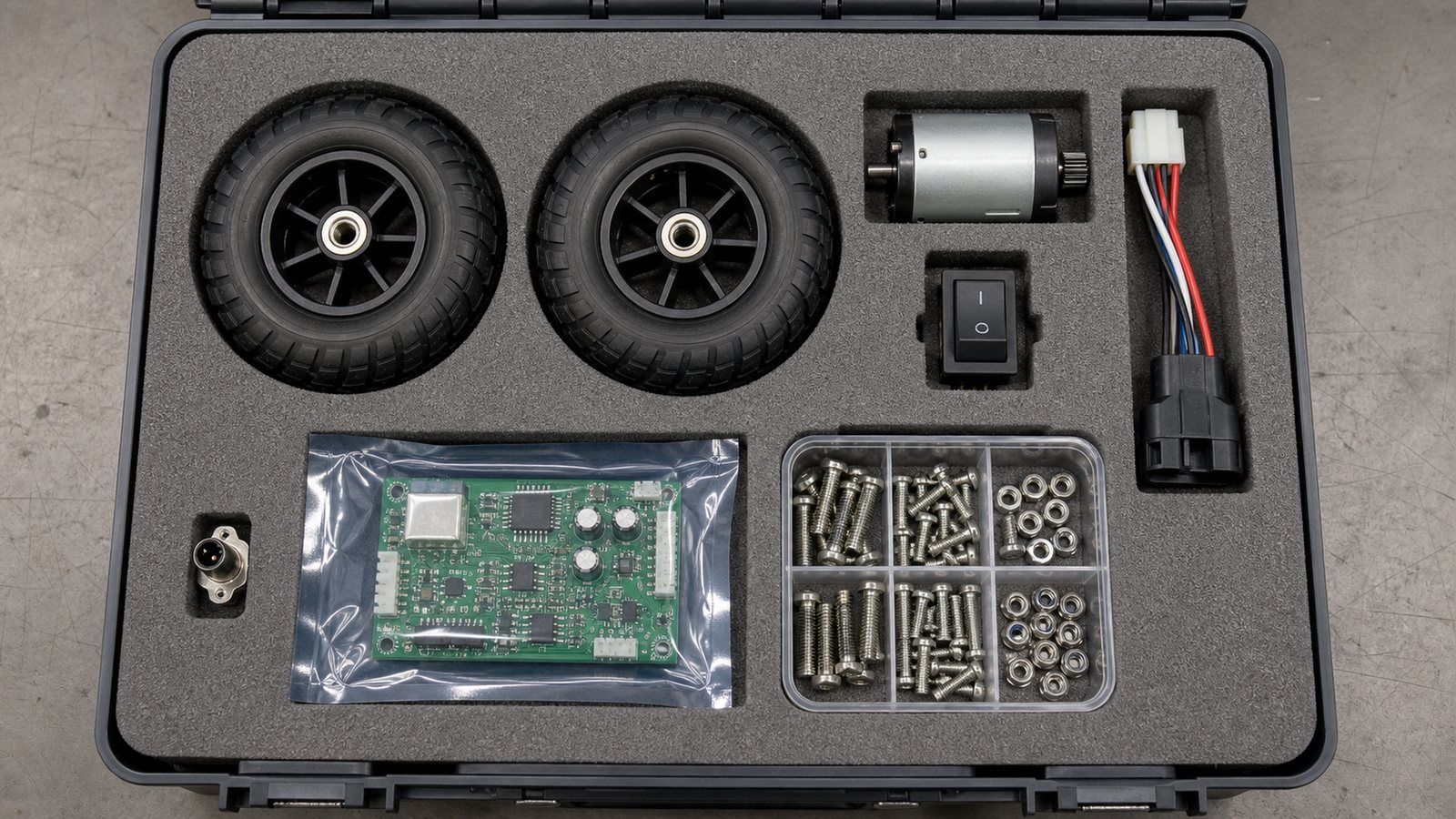
We have not operated a ten-machine fleet, so no failure rate or mean-time-between-failures number appears here — inventing one would be worse than useless to you. What can be established honestly is which subassemblies the industry treats as consumable, and that is visible in what independent service shops and machine makers actually sell and repair. Ball-machine service specialists list battery packs, circuit boards, motors, power switches and plugs as standard repair items, and OEMs sell replacement throwing wheels as a stocked consumable. That is your parts list, derived from the market rather than from a guess.
| Part | Why it goes | Stock stance for 10 machines |
|---|---|---|
| Throwing / service wheels | Rubber glazes and wears; grip loss shows as slipping and inconsistent speed | The one item to over-stock — cheap, fast to change, replace in pairs |
| Battery packs | Capacity fade with cycles, heat and deep discharge in storage | Hold spares, but buy them fresh — packs age on the shelf too |
| Drive and oscillation motors | Duty cycle, bearing wear, jam-induced stall current | One of each type; long lead times make these the fleet-killer |
| Control board | Moisture, vibration, connector fretting | One board, and insist on firmware-version parity with the fleet |
| Switches, charge ports, wiring looms | Mechanical cycling and cable strain at the port | Cheapest parts on the list, most common cause of a dead machine |
The buying rule matters more than the list. Order spares in the same purchase order as the machines, at the same price basis, and get the part numbers written into the contract. Two years later the factory will have revised the board, changed the motor supplier and quietly altered the wheel compound — and the spares you buy then will not be the parts your fleet was built with.
The firmware-parity point is the one people learn the hard way. A replacement board flashed with a newer build can behave differently on identical settings, which turns a single repair into a fleet-wide inconsistency your staff cannot explain to members.
One more contractual term worth the argument: a spares availability commitment, in years, from the date of your last shipment. Ask for it in writing. A supplier who will commit to stocking wheels, motors and boards for a defined period is a supplier planning to be there; one who will not has told you something about the platform's lifespan.
What to lock in the golden sample
The golden sample is the only moment in a private-label programme where the supplier still needs something from you, and most buyers spend it checking the logo. On a machine, the sample has to lock the things that are invisible later and expensive to argue about. This is the same discipline our own paddle and ball programmes run on — a signed, sealed, retained reference unit, photographed and documented before mass production opens, and the reason golden sample approval is a stage rather than a formality.
Lock these, in writing, against the retained unit:
- Cell manufacturer, cell model and pack Watt-hour rating — named, not described. Plus the requirement to notify and re-approve before any change.
- Firmware build identifier, and the settings map it produces: what speed 5 means in balls per minute, what the oscillation sweep covers. Firmware is the easiest thing in the machine to change silently and the hardest to detect on arrival.
- Throwing wheel compound and durometer, recorded from the sample. Wheel material is where a supplier saves money without changing a single drawing.
- The feed-test result recorded against that retained unit, with the ball annex attached, so the pre-shipment test has a baseline to be compared against rather than a target invented later.
- Certification file references — the NRTL certificate number, the FCC responsible party, the UN 38.3 test report number. Attach copies to the retained-unit record so incoming goods can be matched against them.
- Housing colour reference and finish, to a physical chip rather than a screen value, plus the carton, manual and label artwork as approved.
Keep two sealed units, not one — one at your office and one at the factory, both signed and dated across the seal. The single-sample version of this ritual fails the moment there is a dispute, because the only reference unit is in the building belonging to the party you are disputing with. If you are building a wider branded range around the machine, the same reference discipline runs across the paddles and balls, and it is worth setting up once for the whole private-label programme rather than per product.
What we check on our own lines — and where we stop
This guide asks you to demand specifics from a machine supplier, so it is fair to state what we do and do not do on the products we actually make. On our own ball line, approval runs on a documented sequence rather than a promise: a sealed and signed golden sample retained on both sides, a dimensional and weight check written against the published standard, an AQL pre-shipment inspection before the balance is released, and carton marks and packing list matched to the approved artwork.
The numbers those checks are run against are the same ones this article has been quoting at you. Diameter between 7.29 cm and 7.54 cm. Out-of-round variance inside 0.51 mm. Weight between 22.1 and 26.5 grams, on a scale, not by feel.
Then the two that need equipment: a bounce of 76.2 cm to 86.4 cm when dropped from 198.1 cm onto a granite plate with the room held near 21 °C, and compression under 43 LBF tested to ASTM F1888-09, twice per ball, once across the seam and once along it. Our own outdoor ball is a one-piece rotomoulded 74 mm 40-hole PE construction, and the line runs at an MOQ of 1,000 pieces. Those are the bounce, roundness, seam and weight checks that feed directly into the machine question above.
What we do not have is a ball-machine feed rig, a battery cycling chamber or a fleet service history. That is why this article hands you a protocol to run rather than results to trust, and why no jam rate, no cycle count and no defect rate appears anywhere in it. A supplier who quotes you all three without describing the test that produced them is doing precisely what we have declined to do here. Ask them for the method, then decide what the number was worth.
Is private-labelling a ball machine right for you?
This is where an honest supplier costs you a sale and saves you a year. A branded ball machine is a high-ticket, high-support, low-repeat product carrying certification obligations that paddles and balls do not. It suits a narrow set of buyers very well and punishes everyone else.
| Worth doing if you are… | Not worth doing if you are… |
|---|---|
| A facility group buying for your own courts, where the machine is a cost centre and branding is incidental | A new brand with under a few hundred units of demand — you will pay rebadge economics for a commodity machine |
| An established brand with paddles and balls already selling, adding a hero SKU to an existing catalogue | Selling purely online with no service capability — a jammed machine becomes a return, and returns on freight-heavy goods erase the margin |
| A distributor with a service technician and stocked spares in market | Unable or unwilling to be the FCC responsible party or the EU importer of record for a lithium product |
| Already supplying clubs with balls and buckets, where the machine pulls recurring consumable volume | Chasing margin percentage — machines carry service cost that a ball or paddle line does not |
If the right-hand column describes you, there is a better version of the same commercial idea. The machine is the visible product, but the ball is the one that comes back every quarter. A club running four machines several hours a day consumes balls at a rate that no retail pack size was designed for, and that consumption is a supply relationship rather than a one-off sale. Several brands who set out to launch a machine ended up building a far healthier business on the consumable that feeds it.
A worked example: a 6-court club adding four branded machines
An illustrative run-through, so the pieces above connect into one sequence. A six-court club wants four machines carrying its own name, for coaching clinics and paid solo-practice bookings, delivered to the US.
Weeks 1–2, scope honestly. Four units is a rebadge, not a configuration programme. The club stops asking for a custom housing and redirects the budget to a larger battery option and a proper spares kit — the two things that will actually determine whether the machines are running in year two.
Weeks 3–5, the ball annex first. Before machine samples, the club settles which ball it will feed, and writes the roundness clause with the +/-0.020 inch out-of-round limit and a defined inspection sample into the ball purchase order. This inverts the usual order of operations, and it is the single move that changes the most downstream.
Weeks 6–8, sample and feed test. One sample machine, tested on the four ball populations described earlier, with jammed balls kept and measured. Suppose the mixed-brand bucket produces several times the jams of the single-batch bucket, and the caliper shows the offenders clustered at the edge of the out-of-round allowance. The finding is not a machine defect — it is a standing operating rule for the club: never mix brands in a hopper. That rule is worth more than a warranty clause.
Weeks 8–9, the paperwork gate. The club asks for three things and refuses to release the deposit balance without them: the NRTL certificate number for the charger, checked live in the certifier's directory rather than accepted as a PDF; the named FCC responsible party for the SDoC, which for a rebadged import may be the club's own entity; and the UN 38.3 test summary with its report number and Watt-hour rating. Roughly here is where a weak supplier stops replying, which is exactly the outcome you want at deposit stage rather than at the port.
Weeks 9–10, shipping decision. Four machines with installed packs move by sea as UN3481, batteries installed, with the packing and marking the classification requires. The temptation to air-freight one machine early for a launch event runs into special provision A100's 30 percent state-of-charge cap — legal, but it means the demo unit arrives needing a full charge and several hours before anyone can use it. Plan the event around that or ship earlier.
Ongoing. Wheels and a spare motor sit in the club's storeroom from day one. Ball consumption, not machine cost, becomes the recurring line item — and the club negotiates that supply annually against machine hours rather than reordering three-packs in a panic every few weeks.
Conclusion
A private-label ball machine programme succeeds or fails on three things that all sit outside the machine: the tolerance of the ball you feed it, the specificity of the battery and certification language you write, and whether the spares arrived with the fleet or are still being quoted when the first unit dies. None of those require you to trust a supplier's claim, which is the point — each one is something you can specify, test or verify yourself.
If you are weighing this up, the sequence that costs least is to settle the ball first, run the feed test second, and treat the machine decision as the last step rather than the first. That order tends to change what you end up buying.
Written by the DJW / PickleOEM team — a source factory in China producing carbon-fibre pickleball paddles, one-piece rotomoulded 40-hole outdoor balls, nets and court accessories for brand owners, importers and club buyers. We do not build ball machines; this guide is written from the specification and inspection side of the supply chain.
Frequently Asked Questions
Can a tennis ball machine be used for pickleball?
Mechanically it can throw one, but the feed geometry is sized for a solid felt ball, not a hollow perforated one. Expect inconsistent wheel grip and more jams. Machines built for pickleball size the throat and wheels around the lighter ball.
Should a machine fleet use indoor or outdoor balls?
Match the ball to the surface, then keep it consistent within each hopper. The bigger operational rule is never mixing brands or ages in one load, because the diameter spread across two approved brands is wider than most feed mechanisms tolerate comfortably.
Does a ball machine need USA Pickleball approval?
No. The Equipment Standards Manual governs balls, paddles and nets, not training machines. The approval that matters to your machine is the ball you feed it, which must meet the standard if it is used in sanctioned play.
Who is the FCC responsible party on an imported private-label machine?
Under the SDoC route it must be a party located in the United States, which for a rebadged import is frequently the importer rather than the factory. Settle this in the contract, because the obligation follows the name on the product.
Can spare battery packs ship in the same container as the machines?
Often yes by sea, but loose packs and installed packs classify differently — UN3480 versus UN3481 — with different packing and marking. Confirm the arrangement with your forwarder before booking, as it affects both documents and cost.
Is ball durometer still a compliance requirement?
No. Revision 3 of the Equipment Standards Manual marks hardness as recorded for corollary data only. If ball hardness matters to how your machine grips and launches, you must specify it contractually yourself.
Want to source this quality for your brand?
Contact our factory directly on WhatsApp for an instant MOQ and pricing quote.