DDP or Your Own Broker: Who Is the Importer of Record
Page one of Google says the seller is the importer of record on a DDP shipment. The Tariff Act does not say that. 19 U.S.C. 1484(a)(2)(B) limits the role to “the owner or purchaser of the merchandise or, when appropriately designated by the owner, purchaser, or consignee of the merchandise, a person holding a valid license” as a customs broker. An Incoterm is a private contract. It cannot add a party to that list.
So the short answer for a buyer holding a DDP quote: DDP decides who does the clearance work and who funds the duty. It does not decide who is named on the entry. The named party owes reasonable care under 19 U.S.C. 1484(a)(1), exposes its own bond, and is the one U.S. Customs and Border Protection can bill five years later. Settle that in the purchase order, not in a footnote.
One more check before reading on: if the quote says DDU, it names a rule that no longer exists.
Key Takeaways
- DDP is a cost allocation; importer of record is a legal designation. 19 U.S.C. 1484(a)(2)(B) fixes who is eligible, and a supplier’s quote sheet has no authority over it.
- Paying somebody else does not discharge the duty. 19 CFR 141.1(b) makes duty liability “a personal debt due from the importer to the United States” and adds that payment to a broker does not relieve the importer if the broker never pays.
- Negligence is enough to trigger a penalty: 19 U.S.C. 1592(c)(3) caps a negligent violation at two times the duties deprived, and 1592(c)(2) caps gross negligence at four times.
- The clock is five years from the violation for an ordinary error, and five years from discovery only if it was fraud (19 U.S.C. 1621).
- DDU has not been an Incoterms rule since 1 January 2011. ICC withdrew it in the 2010 revision and DAP replaced it.
- The designation follows the goods past the port: 16 CFR 1110.3(b) defines the CPSC “importer” as the importer of record, so it also picks who signs the product certificate.
On this page
- What DDP actually decides, and what it leaves open
- Three routes, side by side
- What the designation costs you when the entry is wrong
- Whether your supplier can legally be the importer
- Four questions that settle it before you sign the PO
- The designation follows you past the port
- Where we stop, and where a licensed broker starts
Before the entry paperwork, the rule itself. This session from ICC Academy — the training arm of the body that writes the Incoterms rules — opens on what the 2020 revision changed and stays on what an Incoterm actually allocates between a seller and a buyer: cost, risk, and which of them does the clearance work. Nothing in it assigns a party’s status under another country’s customs law, and that gap is what the rest of this page fills.

What DDP Actually Decides, And What It Leaves Open
DDP is one of the eleven Incoterms® 2020 rules and one of the seven that work with any mode of transport. Under it the ICC puts the seller in charge of “carrying out and paying all customs formalities, including export, import, and, if applicable, transit procedures.” That answers who books the broker, funds the duty deposit, and absorbs a rate change in transit.
What it does not answer is whose name and importer number appear on the entry. ICC is explicit that its rules meet the destination country’s own law: where a seller “is prevented by local rules in the destination country” from managing import clearance, ICC says DAP is the more suitable rule. In the United States that constraint is 19 U.S.C. 1484(a)(2)(B), and it is a short list.
Page one does not mention that list. A read of the four top-ranked results on 5 September 2026 found none citing 19 U.S.C. 1484, 1592, or 19 CFR 141.1(b); the top result says only that under DDP the task “falls to the seller.”

Three Routes, Side By Side
Three structures are available to a paddle or ball container, and the useful comparison is not by convenience. Score them on liability: who is named on the entry, whose bond is at risk, who owes reasonable care, and who CBP bills when a post-entry review finds an underpayment.
| Routing | Named on the entry | Bond and reasonable-care duty | Sees the declared value | Best for |
|---|---|---|---|---|
| Supplier-arranged DDP | Seller, an agent, or you — often unstated in the quote | Whichever party is named; a nonresident needs a resident corporate surety | Often nobody on your side | Trial orders, once you have the entry paperwork in writing |
| DAP plus your own broker | You, by design | Yours: continuous or single-entry bond, your POA | You, on every entry summary | Repeat container programmes and any private-label brand |
| Hybrid: seller funds, you are named | You, by design | Yours | You, on every entry summary | Buyers wanting duty priced in without losing visibility |
The third column is the one most buyers do not know they can ask for. Nothing in the Incoterms rules stops a seller funding the duty as a line item while the buyer stays the importer of record: the commercial effect of DDP survives and the entry summary still lands on your desk.
What The Designation Costs You When The Entry Is Wrong
Duty liability is not a payable that clears when somebody hands over money. Under 19 CFR 141.1(b) it is “a personal debt due from the importer to the United States which can be discharged only by payment in full.” The same subsection names the failure case: paying a broker does not relieve the importer if the broker never pays it on.
The declared value is where a low DDP price usually shows up. 19 U.S.C. 1401a(b)(1) defines customs value as the price actually paid or payable when the goods are sold for export to the United States, plus buyer-paid packing, selling commissions, assists, royalties and resale proceeds accruing to the seller. Supply the mould for a paddle handle and that tooling is an assist, dutiable whether or not the invoice shows it.
Get that wrong and 19 U.S.C. 1592 sets the exposure, and it reaches merely negligent conduct. No intent is needed, and where an error moved no revenue at all a negligent violation is still capped at 20% of dutiable value.
| Culpability | Ceiling with revenue loss | After a valid prior disclosure |
|---|---|---|
| Negligence | 2x the duties deprived; 20% of dutiable value where no revenue was lost | Interest on the unpaid duties, from liquidation |
| Gross negligence | 4x the duties deprived; 40% of dutiable value where no revenue was lost | Interest on the unpaid duties, from liquidation |
| Fraud | Up to the domestic value of the merchandise | 100% of the duties deprived |
Two periods sit underneath that table. Under 19 U.S.C. 1621 section 1592’s own limitation rule departs from the general customs-penalty default: an action to recover a penalty or duties under 1592(d) must be brought within five years of the violation itself where the error was negligence or gross negligence, and reaches five years from discovery only where the violation arose out of fraud. Section 1592(d) separately requires CBP to restore the duties whether or not a penalty is assessed. 19 CFR 163.4(a) then requires entry records to be kept five years from entry — a problem when the only party holding them is a supplier you stopped buying from in year two.
| Culpability under 19 U.S.C. 1592 | Ceiling if CBP finds it first (%) | Ceiling after a valid prior disclosure (%) |
|---|---|---|
| Negligence | 200 | 0 |
| Gross negligence | 400 | 0 |
| Fraud | — | 100 |
Whether Your Supplier Can Legally Be The Importer
A foreign factory is not barred from the role, but it has to build the structure first. Under 19 CFR 141.18 a nonresident corporation “may not enter merchandise for consumption” unless two things are in place. It needs a resident agent in the state of the port of entry, authorised to accept service of process, and a CBP Form 301 bond with a resident corporate surety. A supplier that names its resident agent and surety is offering something real; one that answers with a forwarder’s name is describing a shipment.
The test underneath is ownership: 19 U.S.C. 1484(a)(2)(B) reaches the owner or purchaser, or a licensed broker they designate. Where title has already passed at the factory gate, the party fitting that description is usually the buyer.
Which brings up the quote sheet. DDU has not been an Incoterms rule for fifteen years: ICC’s rules history records the 2010 revision as “removing DAF, DES, DEQ and DDU” while adding DAT and DAP, and that revision took effect on 1 January 2011. A 2026 quote saying DDU almost always means DAP: delivered to your door, clearance and duties yours. Ask the seller to restate the term and the edition: an earlier edition still binds if the contract names one, and a bare “DDU” names none.
One exit exists if you are named on an entry you never intended to own. 19 CFR 141.20 gives a consignee who is not the actual owner 90 days from entry to file an actual owner’s declaration on CBP Form 3347, or a superseding bond, and be relieved of statutory liability for increased and additional duties. It is a repair with a short fuse, not a plan.
Four Questions That Settle It Before You Sign The PO
Each has a documentary answer, and a supplier who cannot produce one is telling you the arrangement has not been built.
| Ask | Authority | Answer that should stop the order |
|---|---|---|
| Whose importer number is the entry filed under, and who filed the Form 5106? | 19 CFR 24.5 | “Yours” when nobody asked you for an EIN or a 5106 |
| Whose bond secures the release? | 19 CFR 142.4, 141.18 | A forwarder’s name with no surety and no bond number |
| Who holds the power of attorney the broker is acting on? | 19 CFR 141.46 | A POA in your name that you never signed |
| Who receives the entry summary, and who keeps the records? | 19 CFR 163.4 | “The agent keeps everything” with no copy routed to you |
Question three is the sharpest. 19 CFR 141.46 requires a broker to hold a valid power of attorney before transacting customs business in a principal’s name, and does not require it to be filed with CBP — so the only way to learn whether one exists in your name is to ask for the copy. Question four matters years later: the entry summary is where the classification and declared value are visible, and 19 CFR 163.4(a) puts the five-year retention duty on the importer, not on the agent.
For importers and private-label brands booking a full container of paddles, balls or nets: the routing term, the named importer and the document set each shipment produces belong in the build sheet, not in a conversation after the container sails.
The Designation Follows You Past The Port
The decision does not end when the container clears, because other agencies borrow the customs definition. 16 CFR 1110.3(b) defines “importer,” for the Consumer Product Safety Commission’s certificate rule, as “the Importer of Record (IOR) eligible to make entry for imported finished products under the Tariff Act of 1930,” and 1110.7(a) makes that party the finished-product certifier. Under 15 U.S.C. 2052(a)(11) a “manufacturer” is any person who manufactures or imports a consumer product. Pick the importer of record and you have picked who signs the certificate, who answers a CPSIA question on a junior paddle, and who a California Proposition 65 notice lands on.
The small-parcel workaround is gone. A CBP rule published in the Federal Register on 24 June 2026, effective the same day, indefinitely suspends the 800 USD de minimis exemption for every mode other than the international postal network; the same document records that the exemption terminates by statute on 1 July 2027. Splitting a container into parcels no longer removes the entry, the classification or the named importer. The duty numbers live in the Section 301 tariff breakdown and the clearance walkthrough; this page is about who owes them. Naming the structure in the OEM build sheet is cheaper than renegotiating after the first entry summary arrives.
Where We Stop, And Where A Licensed Broker Starts
This page sets out published rules and the questions they make answerable. It is sourcing guidance, not legal advice. How your bond should be sized, how a paddle should be classified and what your declared value must include are facts-and-circumstances questions for a licensed customs broker or a trade attorney, before the first entry. Prior disclosure under 19 U.S.C. 1592(c)(4) is a decision to take with counsel.
Two things change the answer. A change to any rule cited above, including the de minimis position, which changes again on 1 July 2027. And a change in your own structure: a US entity, a foreign parent and a third-party importer-of-record service each sit differently against 19 U.S.C. 1484(a)(2)(B) and 19 CFR 141.18.
Conclusion
The trade-off is not really about money. Supplier-arranged DDP buys one less workflow and costs you sight of the classification and value declared on entries you may still answer for. Your own broker under DAP costs a bond, a POA and an hour per shipment, and buys the entry summary. The hybrid keeps most of the convenience and nearly all of the visibility, for the asking.
Whichever you pick, put it in writing: the Incoterms rule and its edition, the party who will be importer of record, and who receives the entry summary and holds the records for five years. Three lines, no cost at quotation, and the difference between a routing decision you made and one made for you.
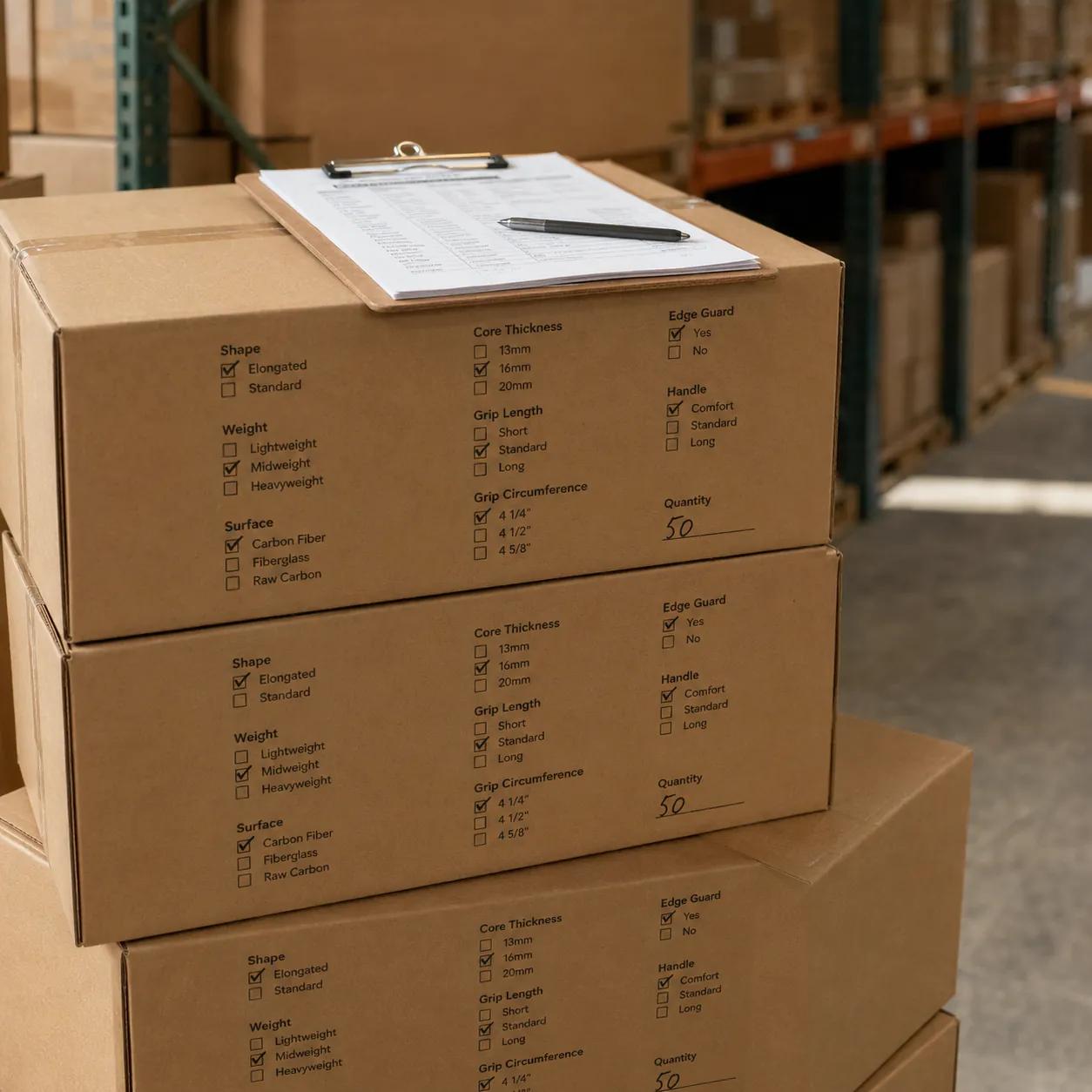
Then take it to the supplier. The four questions above go in the first email, and four more lines belong beside them. Ask for the spec sheet the quote is priced against — the core thickness range, face material options and weight band for the paddles, balls or nets you are actually buying at container volume — because a routing term agreed before the specification is a term agreed against an unknown.
MOQ is set per project against your model, size and colour mix rather than published as one number, so ask for it on the build sheet and not in the price. Lead time is production plus sea transit, and neither DDP nor DAP shortens it; what the term changes is who books the clearance and whose name the entry carries. And on the first shipment, trial order or full container, ask for the entry summary and a copy of the power of attorney the broker is acting on: those two documents say what was declared and in whose name, which no quotation does.
Frequently Asked Questions
Does DDP automatically make my supplier the importer of record?
No. DDP allocates the clearance work and the duty cost; 19 U.S.C. 1484(a)(2)(B) separately limits who may be named on the entry to the owner or purchaser, or a licensed broker they designate. The quote does not say who was named. The entry summary does.
My supplier quoted DDU. Is that still a valid term?
Not as an Incoterms rule. ICC withdrew DDU in the 2010 revision, effective 1 January 2011, and DAP replaced it. A DDU line on a current quote usually means DAP: delivered to your address, import clearance and duties on you. Ask the seller to restate the term and edition in the contract.
Can a Chinese factory be the importer of record in the United States?
It can, if it qualifies as the owner or purchaser and builds what 19 CFR 141.18 requires: a resident agent in the state of the port of entry who can accept service of process, plus a CBP Form 301 bond with a resident corporate surety. Ask for both by name first.
If the supplier underpaid the duty, can CBP still come to me?
If you were the importer of record, yes. Under 19 CFR 141.1(b) duty liability is a personal debt that only payment in full discharges, and paying a broker does not relieve the importer where the broker fails to pay. 19 U.S.C. 1592(d) requires CBP to restore lawful duties whether or not a penalty is assessed.
I was named on an entry I never agreed to. What can I do?
19 CFR 141.20 lets a consignee who is not the actual owner file an actual owner’s declaration on CBP Form 3347, or a superseding bond, within 90 days of entry, to be relieved of statutory liability for increased and additional duties. The actual owner must execute it, and a nonresident owner must also post a resident-surety bond. The 90-day limit makes this a matter for a licensed broker now.
Want to source this quality for your brand?
Contact our factory directly on WhatsApp for an instant MOQ and pricing quote.