Quiet Pickleball Equipment: What Really Cuts Noise
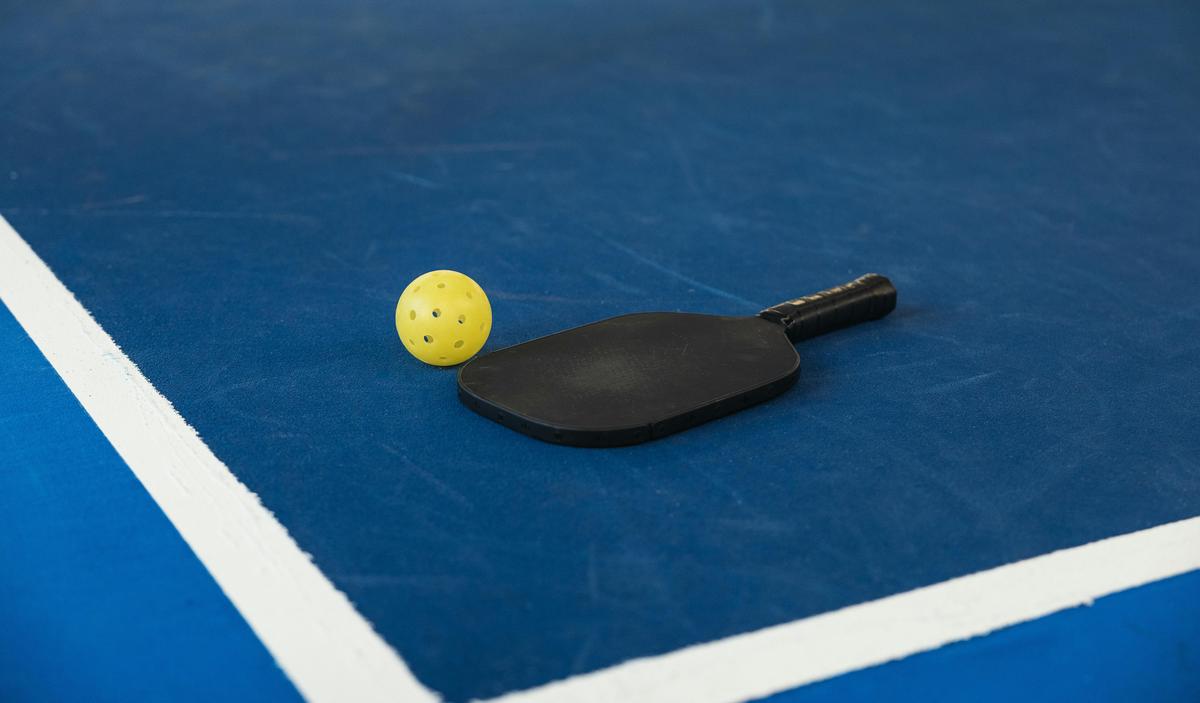
Two objects make the sound, and only one of them is cheap to change across a whole facility. A quieter paddle changes what one player emits. A quieter ball changes what every player on the court emits, including the ones who brought their own paddle. So for a club or an HOA under complaint pressure the order is: change the ball first, then the paddles, then accept that neither change alone will meet the limit an ordinance measures at the property line.
USA Pickleball's Quiet Category certifies a pair of numbers rather than an adjective. A certified product sits below 600 Hz and below 80 dB, against standard equipment the governing body characterises at 1,100 to 1,200 Hz and a decibel range of 85 and above. The frequency half is the half a neighbour reacts to, and it is the half that almost never appears on a product page.
This page covers the ball and the whole-site budget. Paddle construction and the way communities write approved-equipment lists are covered in our quiet paddle sourcing guide. Every figure below carries its source and, where the source publishes one, its method.
Key Takeaways
- The certified threshold is two numbers. Below 600 Hz and below 80 dB (USA Pickleball, November 2023).
- No test method is published. Fixtures and procedures go to manufacturers privately, so listings cannot be ranked.
- The acoustic list is paddle-heavy. On 4 September 2026: 16 paddles, 4 covers, 4 quiet balls.
- Only two entries anywhere carry a value: Onix Fuse 83.3 dBA, Monarch Outdoor 81.6 dBA.
- The governing body points at the ball. "If all players are using the ball, it may not matter what paddle they're using."
- A quiet ball still has to be a ball. 30 to 34 in bounce from 78 in; compression under 43 LBF.
- Equipment does not clear an ordinance. 55 dBA Fast Lmax by day, 5 dBA more for impulsive noise, 800 ft separation.
On this page
Loudness And Pitch Are Two Different Numbers, And Only One Of Them Is Certified
One worked example before the specifications. The clip below is a CBS Boston news report from Dennis, Massachusetts. The town answered a court-noise dispute by mandating the ball rather than the paddles — the same order of operations argued on this page, chosen by a municipality rather than a supplier.

A complaint is rarely about volume alone. Tennis Warehouse University measured 110 paddles on a bench rig, dropping a ball from 72 cm for an impact velocity of 3.8 m/s with the microphone 1 m from the impact and about 45 degrees in front of the face. Peak levels came in between 99 and 106 decibels, and 80 percent of the total power sat below roughly 750 Hz.
That is a laboratory number, not a fence-line number. Quote it in a board meeting without the method and somebody will compare it to a chainsaw. What travels is the shape: a short, repeating, high-contrast impact against a quiet residential background.
Weighting decides how much of that shape a meter reports. A-weighting is calibrated to hearing sensitivity at low amplitude, around 40 dB at 1000 Hz, while C-weighting was proposed to correct spectra for very loud or impact noise. An impulsive source read on the wrong network reads lower than it feels, which is why the 2024 model ordinance sets a dBA limit and a dBC limit side by side.
So the Quiet Category threshold makes sense in a way a single decibel target would not. Pulling peak frequency from 1,100 to 1,200 Hz down below 600 Hz moves the sound out of the band ears are most sensitive to, and low-frequency energy also carries differently across an open site. A product that drops total level while keeping the pitch has changed the meter reading and not the argument with the neighbour.
| Measurement | What it tells a buyer | Quiet Category | Standard equipment |
|---|---|---|---|
| Peak frequency | Where the sound sits in the ear's sensitive band | Below 600 Hz | 1,100 to 1,200 Hz |
| Peak level | How far the impact carries above background | Below 80 dB | 85 dB and above |
Both thresholds come from the certification announcement, not from a published method. The bench figures above them do carry one, which is why the two are kept apart.
What The Quiet Category Certifies, And What Is Actually On The List
USA Pickleball announced the Quiet Category and a Noise-Reduced Category on 25 September 2023, after acoustic studies it describes as running over the previous 15 months. Its stated target is a 50% cut: equipment at "essentially 50 percent or less of the acoustic footprint of equipment commonly sourced and used in community parks". Scope covers paddles, balls, paddle covers and noise mitigation screens.
The acoustics programme page states no threshold, no measurement standard and no microphone distance. The numbers live in the November 2023 certification announcement instead, so the page a facility manager finds first carries no acceptance criterion at all.
There is also no published protocol. USA Pickleball says it will "provide test fixture requirements and procedures to manufacturers during development". Two suppliers can both hold a listing and still have been measured on fixtures nobody outside the programme can compare, so treat a listing as a pass or fail flag, never a ranking.
The list itself is worth reading before you plan a fleet. On 4 September 2026 it held:
- 16 paddles, from OWL, Diadem, NineFour, Gearbox, ProXR, Silent Storm, Stafford and Whisper
- 4 covers and sleeves that retrofit a paddle a player already owns
- 4 quiet balls: two Accel Digital Sports models, the Gamma Librarian foam ball and the Selkirk Q1
Sixteen paddles against four balls shows where manufacturers have spent their development money. It is the opposite of where a facility gets the most coverage per dollar.
Below the main list sits a separate "Lower Acoustic Profile" line carrying the only per-item values published anywhere in the programme: Onix Fuse at 83.3 dBA and Monarch Outdoor at 81.6 dBA. USA Pickleball does not explain how that designation differs from the Quiet Category, or under what conditions those two values were taken. Use them as the only published reference points in the category and say so when you quote them.
| Stated criterion, then the only two per-item values published | Stated criterion (dB) | Published per-item value (dBA) |
|---|---|---|
| Quiet Category ceiling | 80 | — |
| Standard equipment, stated | 85 | — |
| Monarch Outdoor ball | — | 81.6 |
| Onix Fuse ball | — | 83.3 |
The Ball Side: Cheaper To Change, Harder To Specify
Carl Schmits, USA Pickleball's managing director of equipment standards, put the case plainly in November 2023: "If all players are using the ball, it may not matter what paddle they're using." A facility controls the ball. It does not control what walks through the gate in a bag.
The mechanism supports him. Tennis Warehouse University describes the paddle as a soundboard radiating an impact that lasts about 2 ms, and concludes that "the simplest way to reduce the noise is to use a softer ball or a softer paddle". Either half of the pair can be softened. Only one half is bought 300 at a time by the person taking the complaint.
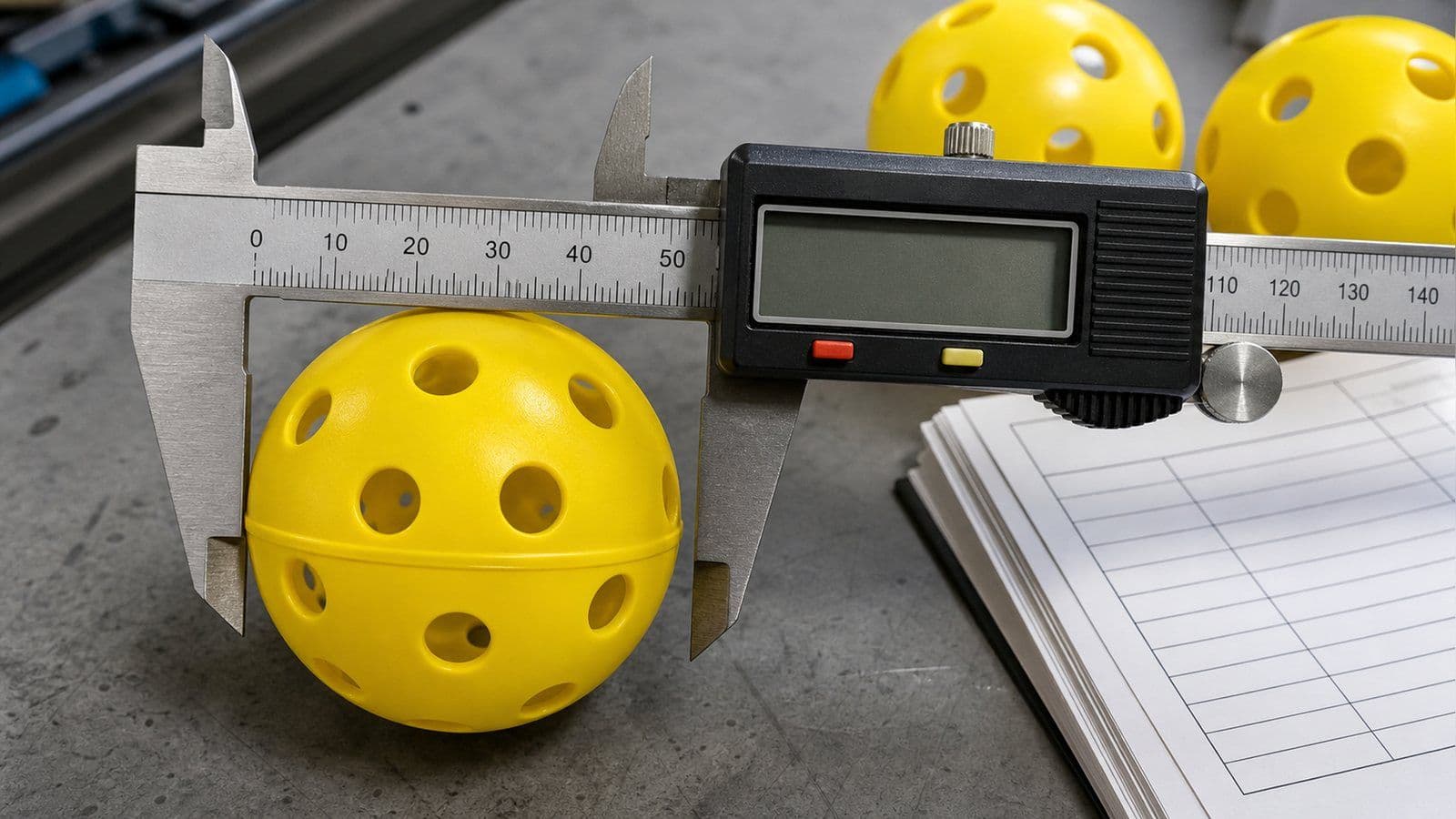
A quiet ball still has to behave like a ball. A softer or foam-cored build is being asked to hold a 30 to 34 in bounce window, a 43 LBF compression ceiling and a 22.1 to 26.5 g weight band, all of which were written around rigid moulded plastic. Push the material soft enough to drop the pitch and the bounce falls out of the window; keep the bounce and the acoustic gain shrinks.
| Property | Requirement in the manual | Why a quieter build strains it |
|---|---|---|
| Bounce | 30 to 34 in when dropped from 78 in | Softer material absorbs the rebound energy |
| Compression | Average under 43 LBF per ASTM F1888-09 | Lower stiffness is exactly what quiets the impact |
| Weight | 0.78 to 0.935 oz, or 22.1 to 26.5 g | Foam cores usually land under the floor |
| Diameter | 2.87 to 2.97 in, roundness within 0.020 in | Moulded foam holds tolerance less predictably |
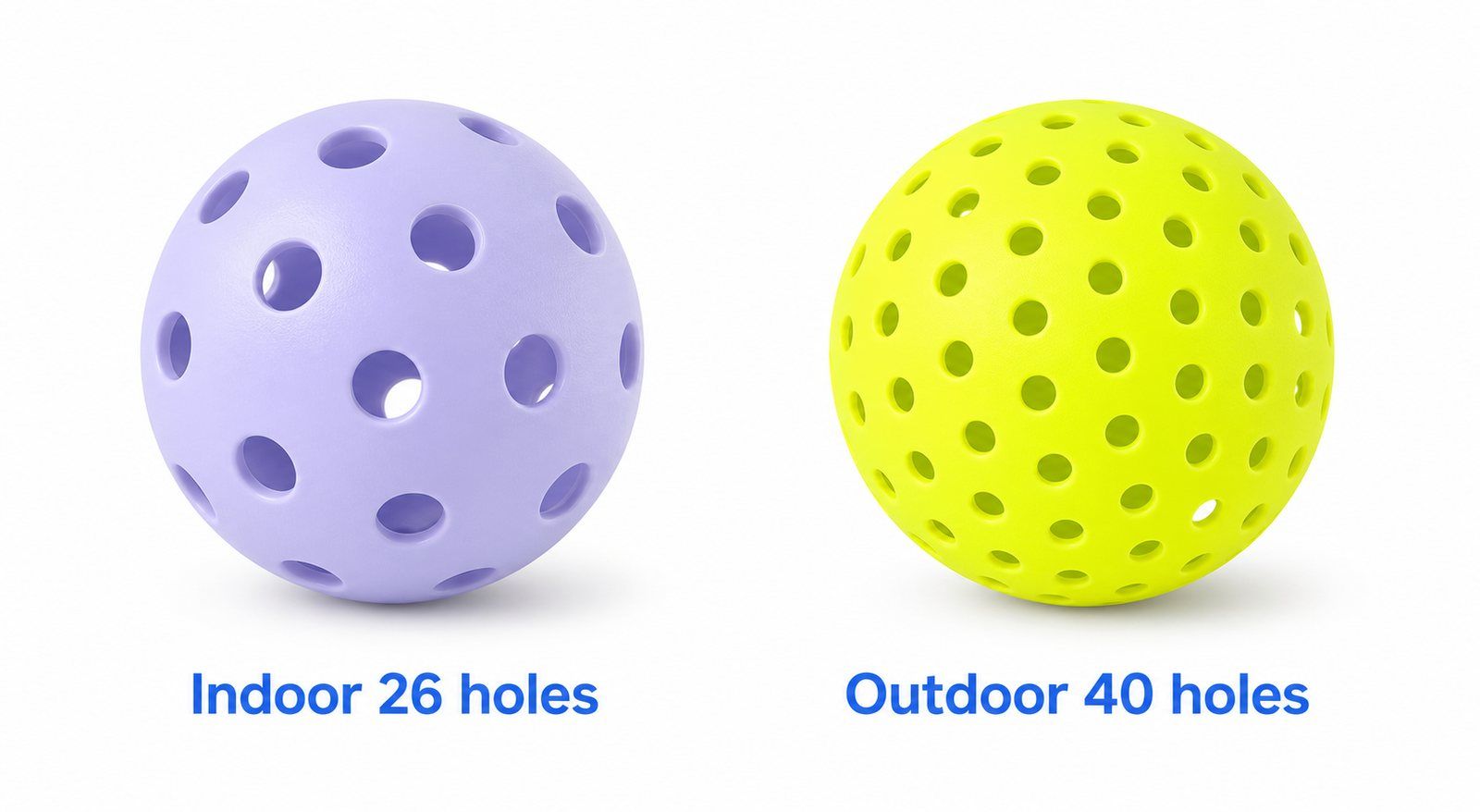
| Holes and surface | 26 to 40 circular holes, smooth and untextured | Damping coatings and textures are out of spec |
One distinction then decides whether any of this is a problem for you. The acoustic list and the approved-ball list are two databases on two pages. Section 2.D.2 says a sanctioned tournament ball "must be named on the official list of approved balls posted on the USA Pickleball website". That list held 386 balls on 4 September 2026, and a Quiet Category listing does not put a ball on it. The paddle programme shows the same split in the open: OWL was certified in the Quiet Category in November 2023, then announced tournament-play certification in February 2024.
The club decision then splits cleanly. Open play, rentals, lessons and league nights can run a quiet ball with no sanctioning consequence. Sanctioned events need a ball from the approved list, which is where a conventional tournament-grade outdoor ball stays in the inventory. Plan two SKUs, not one substitution; our approval spec decoder walks the tests behind those numbers.
For club, HOA and municipal procurement teams running open play and sanctioned events on the same courts: the tournament-grade outdoor ball is the approved-list half of that pair, moulded in house on our own tooling.
Four Questions That Kill Most Quiet Claims
Search the category and page one is product pages. The result ranking first for "quiet pickleball balls" on 4 September 2026 markets "reduced noise" and foam density engineered to replicate a standard bounce, with no decibel figure, no percentage, no method and no approval status. Further down the same page, one supplier claims a 70 percent sound reduction and a 60 percent noise cut in two different titles, neither attached to a test.
A percentage with no test behind it is unfalsifiable, and it survives because buyers have no standard question to ask. Four do the job, and they work better written into an enquiry than argued on a call.
The four questions, written as an acceptance clause
What was the method? A bench drop rig, a robot, or players on a court are three different experiments. Ask which, and ask for the impact velocity. Without it a number cannot be repeated by anyone.
At what distance, and on which weighting? A level means nothing without both. The published bench work uses 1 m; a facility cares about the property line. A supplier quoting dBA on an impulsive source should say why, and produce the dBC figure beside it.
Against which comparison item? Quieter than what ball, from what production run? USA Pickleball had to define its own reference as equipment commonly used in community parks, a loose baseline the governing body at least states out loud.
Which list, and which line on it? Ask for the Quiet Category entry and the approved-ball entry separately. A supplier who cannot say which of the two they hold has answered the question. If none of the four returns anything, treat the acoustic claim as copy and specify on the properties you can measure yourself, which is also the honest place to open an acoustic and specification conversation with a factory.
Where Equipment Stops And The Site Takes Over
Equipment is the cheapest lever and the smallest one. The model pickleball noise ordinance published by the Noise Pollution Clearinghouse on 26 September 2024 sets 55 dBA Fast Lmax from 8 a.m. to 6 p.m. and 50 dBA overnight, with parallel limits of 65 dBC and 60 dBC. It then cuts every one of those by a further 5 dBA and 5 dBC for impulsive noise. That last clause is what catches courts.
The same document is blunt about the two things facilities usually buy. On barriers: they "have no impact if neighbors have a direct line of sight to the court". On equipment: "until they are universally adopted ... they will not change the maximum noise level experienced by neighbors". The limit is a maximum, and one player with an old paddle sets it.
Barrier arithmetic backs that up. A screen rated STC 25 blocks about 25 dB through the panel, but sound diffracts over the top. In one worked case a 3 m barrier stands 3 m from the paddle and 57 m from the house, and takes the receiver from 84 dB to 69 dB. The same analysis notes that acoustical engineers conservatively credit a court barrier with about 10 dB. Useful. Not decisive alone.
What the ordinance treats as the actual control is geometry: no outdoor court within 800 ft, roughly 244 m, of a residential dwelling. Few existing facilities can buy that, which is the real reason equipment matters. It is the lever still available on a court that is already built.
| Lever | What it changes | Evidence | Verdict: where it stops |
|---|---|---|---|
| Quiet ball | Both the pitch and the level for every player | 4 balls listed; 83.3 and 81.6 dBA published | Not on the approved-ball list |
| Quiet paddle | One player's emission at a time | Certified below 600 Hz and below 80 dB | Players bring their own paddles |
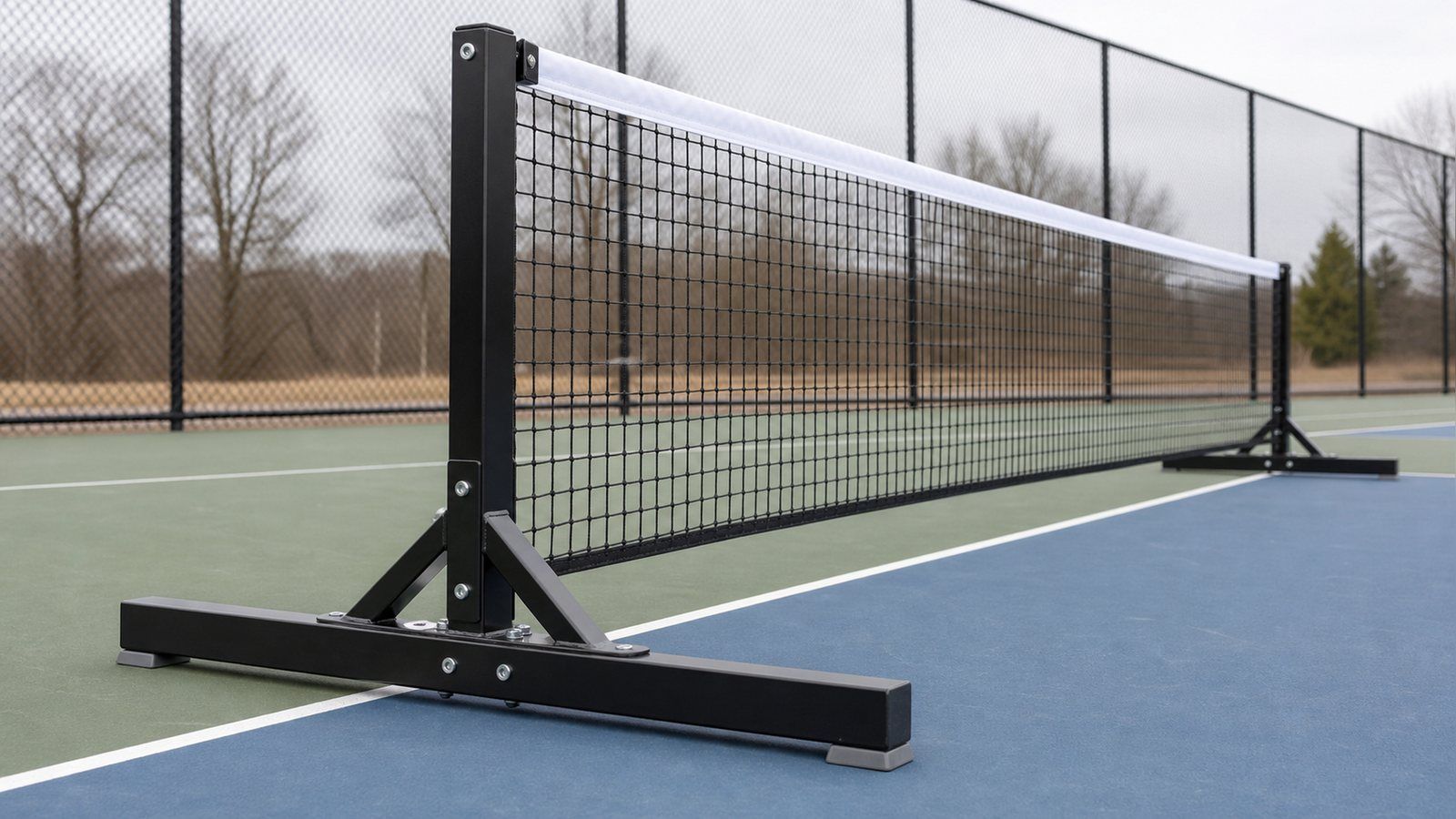
| Barrier or screen | Transmitted level along one sight line | About 10 dB credited conservatively | Void where line of sight remains |
| Separation | Level at the receiving property | Model ordinance asks for 800 ft, about 244 m | Fixed once the court is built |
| Hours of play | When the lower night limit applies | 50 dBA Fast Lmax from 6 p.m. to 8 a.m. | Policy, not procurement |
What We Check On A Quiet-Ball Sample Before A Run
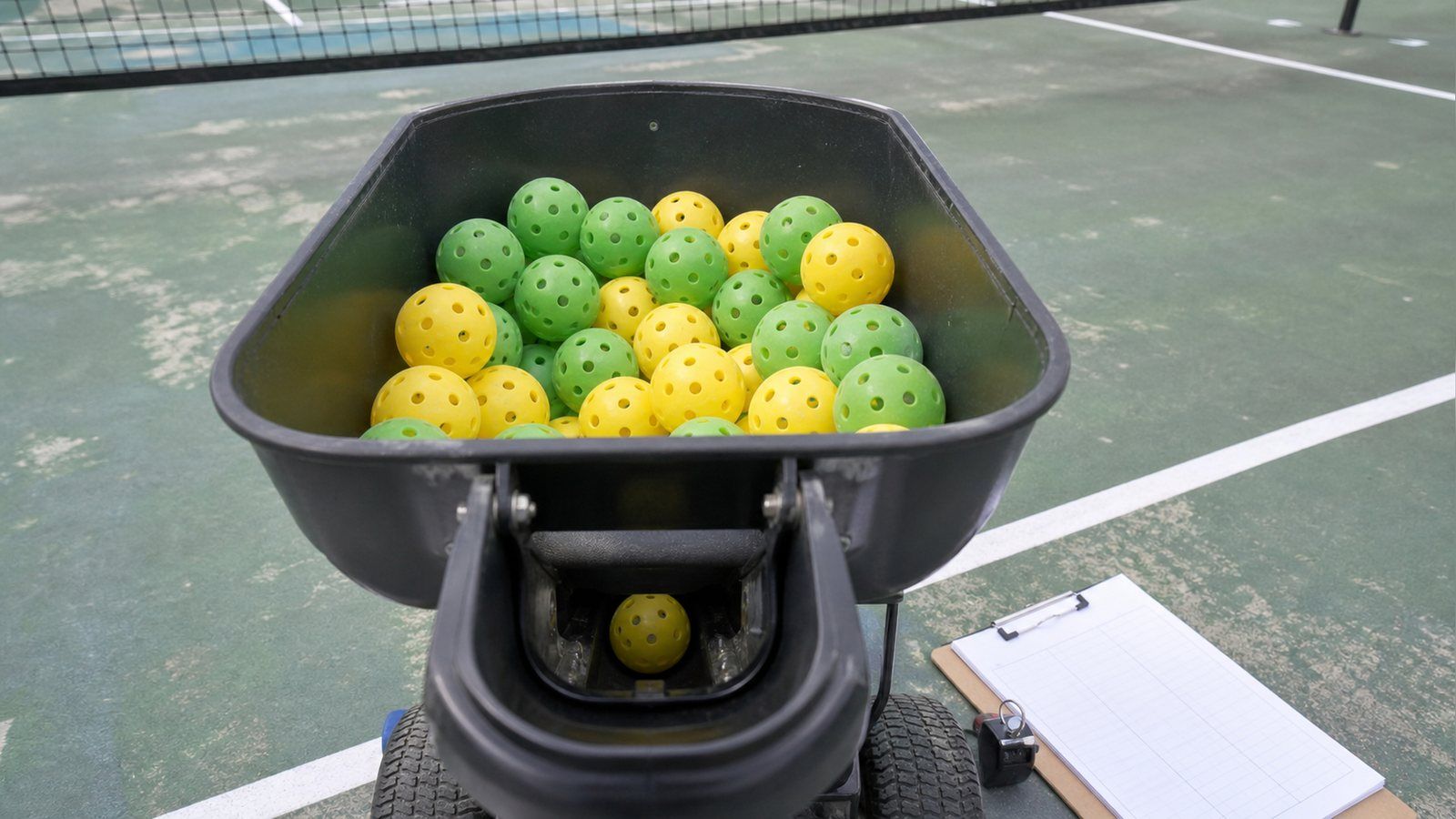
We rotomould outdoor balls in house at Jinhua Lidu Sports Goods and assemble paddles on 13 mm and 16 mm polypropylene honeycomb cores, so a quieter ball is a materials and tooling question on our own line. The bench sequence maps onto the published specification, the part anyone can verify.
The bench sequence, and the number we will not give you
Bounce, on granite, at controlled temperature. Dropped from 78 in onto a granite plate at 70 degrees F plus or minus 5, the rebound has to land between 30 and 34 in. Softer compounds fail here first, and a batch that passes at the top of the window in a warm workshop can fall out of it on a cold morning.
Compression and weight together. Compression runs per ASTM F1888-09, perpendicular and parallel to the seam; weight has to hold 22.1 to 26.5 g. A softer wall that keeps the weight usually did it with more material, which puts compression back up and gives the acoustic gain away.
Roundness, hole count and surface. Diameter 2.87 to 2.97 in, out-of-round within 0.020 in, 26 to 40 circular holes, smooth and untextured. Damping coatings and surface texture are out of specification whatever they do to the sound.
Cold and seam behaviour, before a rental fleet buys it. A softer compound changes how a ball cracks as much as how it sounds, the same failure mode covered in our cold-weather cracking spec. A quiet ball that lasts half as long costs a club more than the noise did.
Then the stop. We publish no decibel figure for anything we make, because none has been measured in an accredited acoustic laboratory. A factory can confirm the bill of materials, the bench results and the batch. The acoustic number needs a laboratory and a stated method; a supplier who hands you one without those has handed you a sentence.
Conclusion
Change the ball first: it changes the sound for every player on the court, and it is the one item a facility fully controls. Buy the paddles second, knowing they govern only the fleet you own. Treat both as a way to lower the number, never as a way to meet a limit, because the model ordinance cuts an impulsive source a further 5 dBA and no listed product is measured at a property line.
Before the next order, write four lines into the enquiry: the method and impact velocity behind any acoustic claim, the distance and weighting it was measured on, the ball it was compared against, and which USA Pickleball list the product sits on. Then hold the ball to the bounce, compression, weight and roundness figures in the January 2025 manual whatever the listing says. What a supplier cannot answer in those four lines is copy, and copy has never quieted a court.
Frequently Asked Questions
Do quiet pickleball balls actually work, or is it marketing?
Both, depending on the product. USA Pickleball lists four quiet balls in its Quiet Category, and the criteria behind that programme are real: below 600 Hz and below 80 dB. What is usually marketing is the percentage on a product page. The rank-one result for the term on 4 September 2026 states no decibel figure, no method and no comparison ball.
Is a Quiet Category ball approved for tournament play?
Not automatically. They are two separate lists. Section 2.D.2 of the January 2025 Equipment Standards Manual requires a sanctioned tournament ball to be named on the official approved-ball list, which is a different database from the acoustic-equipment page. Check both entries before a facility standardises on one ball.
Should a club change the ball or the paddles first?
The ball. USA Pickleball's managing director of equipment standards, Carl Schmits, has said that "if all players are using the ball, it may not matter what paddle they're using." A facility controls the ball on every court; it cannot control the paddle a member brings.
How loud is a pickleball impact?
On a bench rig, Tennis Warehouse University measured peak levels of 99 to 106 decibels across 110 paddles with the microphone 1 m from impact. That is a laboratory reference, not a level at a neighbour's fence, and it should never be quoted without the distance and the method.
Will a fence screen or acoustic barrier fix the complaints?
Rarely on its own. Acoustical engineers conservatively credit a court barrier with about 10 dB, and the 2024 model ordinance states that barriers "have no impact if neighbors have a direct line of sight to the court". The same document treats 800 ft of separation as the real control.
What acceptance criteria should go into a purchase order?
Four: the test method and impact velocity, the measurement distance and weighting network, the comparison item, and which USA Pickleball list the product is on. Then the measurable ball properties, which are bounce of 30 to 34 in from 78 in, compression under 43 LBF, and weight of 22.1 to 26.5 g.
Want to source this quality for your brand?
Contact our factory directly on WhatsApp for an instant MOQ and pricing quote.