3K vs 12K Carbon Paddle Faces: What the Datasheets Say
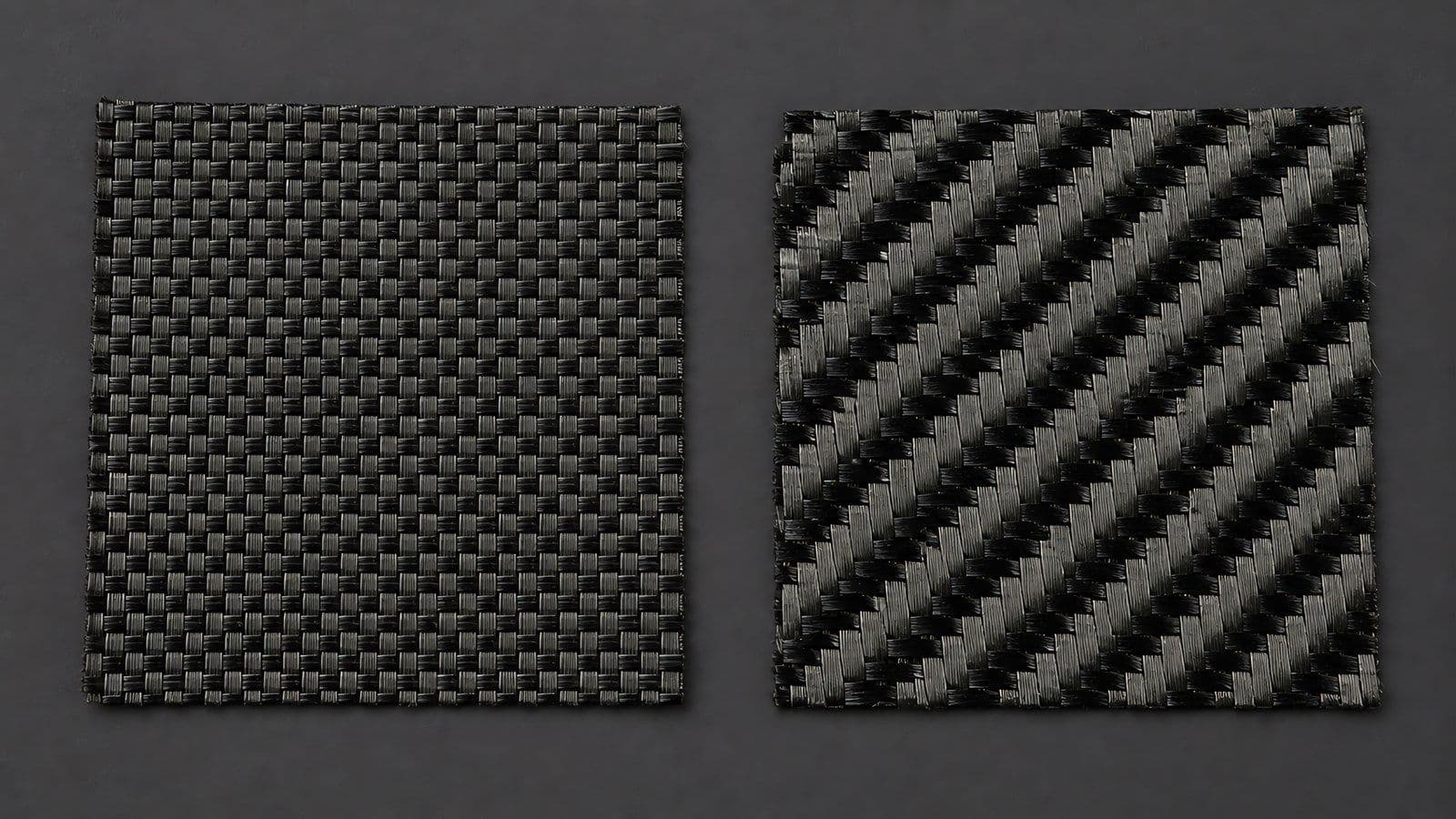
Teijin publishes both fabrics on the same datasheet line. Tenax-E HTS45 E23 in a 3K tow tests at 245 GPa tensile modulus. The same fibre in a 12K tow tests at 240 GPa. Same product family, same 4,500 MPa tensile strength, same 7.0 µm filament diameter — and the 12K, the one your supplier is quoting as the upgrade, comes back five gigapascals lower.
That single row of a manufacturer's own table settles an argument that page one of Google cannot settle for you. Search this question today and the two loudest results contradict each other outright: one tells you 12K is stiffer and delivers more power, the other tells you 3K has measurably better impact resistance. Neither cites a source. Both cannot be right, and if you are choosing a face for a private-label paddle order, a coin flip is what you are currently working from.
- The K number counts filaments per tow — 3,000 or 12,000. It is a fabric-construction count, not a grade, not a strength rating and not a quality tier.
- Within one fibre family, moving from 3K to 12K does not raise stiffness. Teijin lists 245 GPa at 3K and 240 GPa at 12K for the same product.
- What tow size genuinely predicts is areal weight and drape. Real products: 203–204 gsm at 3K against 600–650 gsm at 12K.
- USA Pickleball regulates surface roughness and PBCoR. Weave pattern and tow size appear nowhere in the equipment standards.
- A face spec that says only "12K carbon" is underspecified. Four lines pin it down: fibre grade, tow size, fabric areal weight in gsm, and weave pattern with ply count.
- What the K number actually counts
- The stiffness claim, tested against the datasheets
- What the weave choice really costs you: grams on the face
- Where the weave sits in the rulebook, and where it does not
- 18K, 24K and the numbers that keep climbing
- How to write the face specification on your purchase order
- The verdict: which weave for which build
- Frequently asked questions
What the K number actually counts
A tow is a bundle of continuous carbon filaments. The K number counts them: 3K is 3,000 filaments in each bundle, 12K is 12,000. Weavers take those bundles and cross them into fabric, which is why the number shows up on a fabric spec at all. It describes how the cloth was built, in the same way a thread count describes a bedsheet.
Because filaments are the unit being counted, tow weight tracks the count almost exactly. Teijin's Tenax filament yarn datasheet makes the pattern plain across its range: HTA40 E13 runs 200tex at 3K and 400tex at 6K; HTS40 F13 runs 800tex at 12K and 1600tex at 24K. Tex is grams per 1,000 metres, so a 12K tow carries four times the fibre of a 3K tow over the same length. Toray's numbers march in step — T300 yields 66 g/1000m at 1K, 198 g/1000m at 3K and 396 g/1000m at 6K.
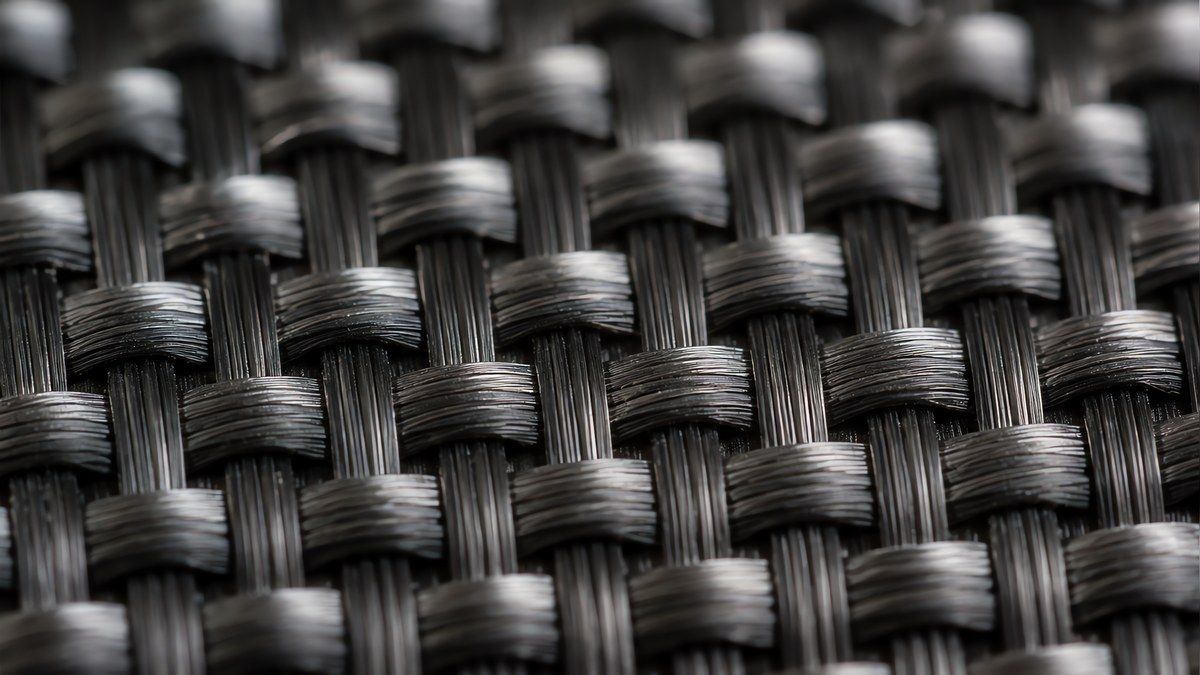
Two consequences follow from that arithmetic and nothing else does automatically. A bigger tow is physically wider, so the checkerboard it weaves is visually bigger — this is why 12K faces photograph dramatically and sell well on a product page. And a bigger tow puts more fibre into every square metre, so the fabric is heavier. Appearance and weight. Those are the two properties the K number genuinely predicts.
What the number does not tell you
It does not tell you the fibre grade, which is a separate axis entirely and the one that actually moves strength. It does not tell you the resin system, the fibre volume fraction, how many plies are in the laminate or which way they are oriented. A supplier who answers "12K" when you ask what the face is made of has told you how the cloth looks and roughly what it weighs, and has not answered the question.
The stiffness claim, tested against the datasheets
Here is the cleanest possible test of the claim, and it takes one table. Hold the fibre grade constant, change only the tow size, and read what the manufacturer publishes.
| Teijin product | Tow | Linear density | Tensile strength | Tensile modulus |
|---|---|---|---|---|
| Tenax-E HTS45 E23 | 3K | 200tex | 4,500 MPa | 245 GPa |
| Tenax-E HTS45 E23 | 12K | 800tex | 4,500 MPa | 240 GPa |
Identical strength. Five gigapascals of difference in modulus, in favour of the smaller tow, which is inside the scatter you would expect between lots and not a performance gap anyone can feel through a paddle. The correct reading is not that 3K wins. It is that tow size does not predict stiffness at all, and any page that ranks one above the other on those grounds — in either direction — is reasoning from something other than the datasheet.
The spread hiding inside a single tow size
Stay at 12K and change only the grade, and the picture gets starker. Teijin lists HTS45 E23 at 240 GPa, UTS50 F13 at 245 GPa and UMS45 F22 at 425 GPa — all of them 12K. That is a 77% modulus spread inside one tow size. If "12K" predicted stiffness, that spread could not exist.
Toray's range makes the mirror-image point about strength. T300 and T700S both test at 230 GPa modulus, yet T300 comes in at 3,530 MPa tensile strength and T700S at 4,900 MPa — 38.8% apart. Grade moved strength while modulus sat still. These are the axes that carry the performance information, and neither of them is the K number.
- Fibre modulus and grade — set by the fibre, published on its datasheet, wholly independent of tow size.
- Fabric areal weight and ply count — how much fibre is actually in the laminate.
- Fibre volume fraction and resin system — how well the fibre that is there is being used.
- Layup orientation — which direction the stiffness points, which for a paddle face is the whole game.
What to do with a "12K is stronger" quote. Ask which fibre, from which manufacturer, at what published modulus. A supplier who can answer is selling you a specification. A supplier who repeats the K number louder is selling you a photograph of a weave.
What the weave choice really costs you: grams on the face
If tow size is not buying stiffness, it is worth knowing what it is buying. Published product data from named fabric suppliers gives the answer in one column, and it is a large number.
| Fabric | Tow / weave | Areal weight | Roll width | Listed price |
|---|---|---|---|---|
| Toray T300 (Rock West) | 3K plain | 204 gsm | 50 in | not per m² |
| Toray T300 (Composite Envisions) | 3K plain | 203 gsm (6 oz) | 50 in / 60 in | not per m² |
| Tenax HTS45 E23 (Castro) | 12K 2/2 twill | 600 g/m² | 1 m | €45.30/m² ex tax |
| Mitsubishi Pyrofil TR50S (Easy Composites) | 12K 2x2 twill | 650 g/m² | 1000 mm | £32.00/m² ex VAT |
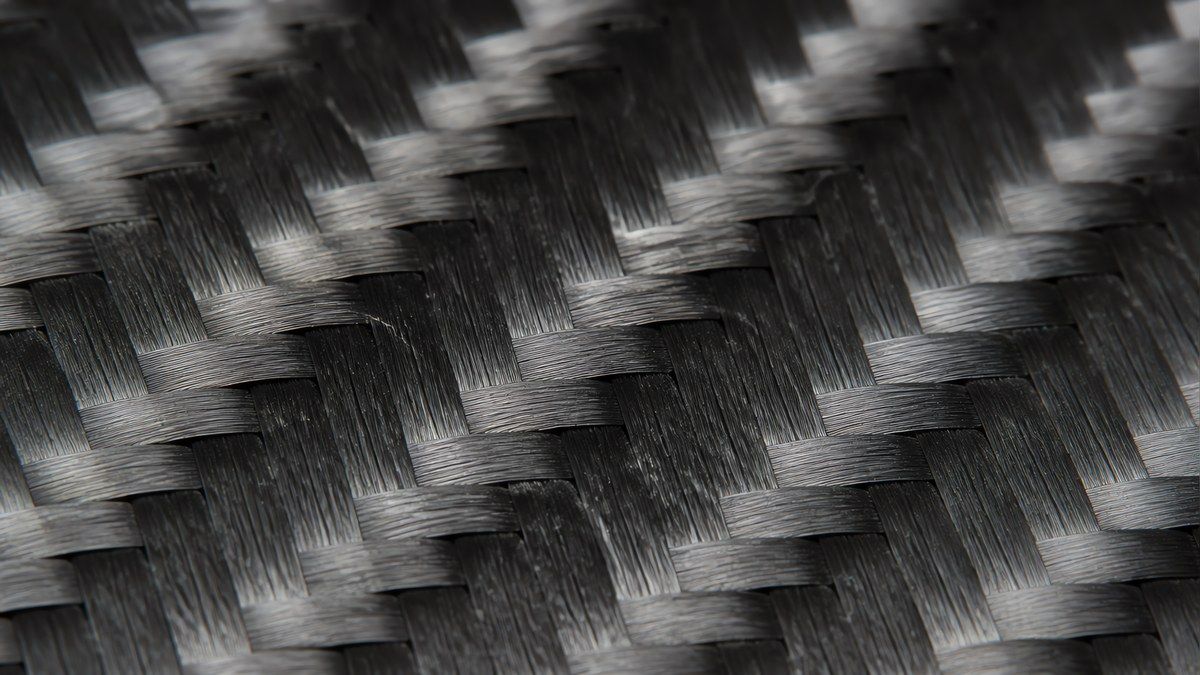
Read the third column and the tow question changes shape. A 12K fabric in these listings weighs roughly three times what a 3K fabric weighs per square metre. That is not a marginal difference in a product light enough to be held all match at arm's length, and where players argue over the few grams a strip of lead tape adds.
Running the number on a paddle face
You can size the effect yourself, and it is worth doing because it is the part your customers will actually notice. USA Pickleball caps combined length and width at 24 inches, so a face is on the order of 0.06 m² per side, and the gap between the fabrics above is 396 g/m².
Swap one ply per side from 3K to 12K and you have added roughly 48 grams of dry fabric across the two faces before any resin goes in; at two plies per side it is nearer 95 grams. Treat those as order-of-magnitude calculations from the cited gsm figures rather than measured paddle weights — your blank dimensions, ply count and resin uptake will all move them — but the size of the number is the point.
That mass lands mostly at the head, furthest from the hand, so it hits swing weight harder than it hits static weight. A builder who wants the coarse 12K look and the balance of a 3K build has to buy the grams back somewhere: a thinner core, less paint, a lighter edge guard. This is the real trade-off, and it is a design decision rather than a performance upgrade. If you are specifying a 3K carbon paddle build, the fine weave is not the economy option you settle for — it is the lighter face, and on a contoured mould it is also the easier one.
Drape, and why heavy fabric fights a contoured tool
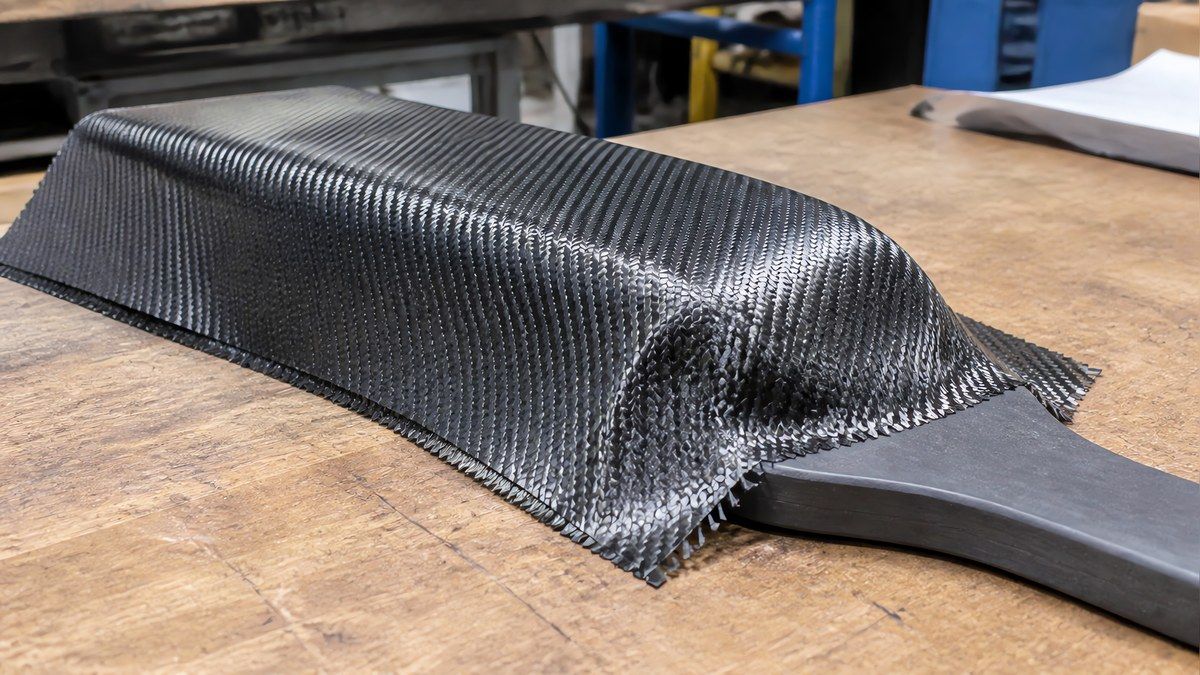
Thin tows bend around a radius; thick ones resist. A fine 3K cloth settles into a contoured throat and around a shaped edge without bridging, while a 650 g/m² 12K twill has to be persuaded. Easy Composites publishes its heavyweight 12K at 0.9 mm unconsolidated, compressing to 0.65 mm under vacuum — a third of the thickness squeezed out, which is exactly the bulk that has to go somewhere when the fabric is forced around a curve. On a flat panel none of this matters. On a thermoformed paddle with a contoured perimeter, it decides whether you are fighting wrinkles at the throat radius.
Where the weave sits in the rulebook, and where it does not
Buyers routinely ask whether a weave choice can get a paddle rejected. Read the USA Pickleball Equipment Standards Manual, Revision 3.0 of January 2025, and the answer is that neither tow size nor weave pattern appears in it. What appears is what sits on top.
| Clause | What it limits | The figure |
|---|---|---|
| 2.E.2.a.1 | Surface roughness | Average no greater than 30 µm Rz and 40 µm Rt, six directions, Starrett SR160 or SR300. No single reading above 33 µm Rz or 44 µm Rt |
| 2.E.6 (following 2.E.6.f) | Paddle/ball coefficient of restitution | Not to exceed 0.44 from Nov 1 2024; reduced to 0.43 from Nov 1 2025 |
| 2.E.3 | Size | Combined length and width max 24 in (60.96 cm); length max 17 in (43.18 cm); no thickness restriction |
| 2.E.4 | Weight | No restriction |
Two things follow for a sourcing decision. First, the certification risk on a carbon face lives in the finish — the peel-ply texture, the grit, the coating — because that is what a roughness tester reads. The weave underneath is not what gets measured. Second, because clauses 2.E.3 and 2.E.4 impose no limit on weight or thickness, the added face mass from the previous section will never fail a test. It will only ever be felt by a player, which makes it a product decision rather than a compliance one.
The practical consequence is that a weave change is not a re-certification event, but a finish change is. If you switch a face from 3K to 12K and keep the same coating and the same peel-ply texture, you have not touched the two properties the standard measures. Change the surface treatment to chase more spin on either weave and you are back at the 30 µm Rz ceiling with a paddle that may need retesting. Buyers routinely have this backwards, and it matters on a timeline: the specification argument they spend a week on carries no certification risk, while the finish decision they wave through in an email is the one that does.
One detail in that clause is worth carrying into your own incoming inspection, because it is where a finish quietly fails. The 30 µm Rz limit is an average of six readings taken in six directions on each face, but the same clause also caps any single reading at 33 µm Rz and 44 µm Rt. A face can average comfortably under the limit and still be rejected on one directional outlier — which is exactly what a directional peel-ply or a sanding pass that follows the weave produces.
So if you are asking a supplier for roughness data, ask for all six readings per face, not the average. An average is the number that passes; the outlier is the number that fails.
Treat all of this as a description of the published standard as it stood at Revision 3.0, and confirm the current revision before you commit a production run — the PBCoR limit alone has already stepped down once on a published schedule, and equipment standards in this sport have been revised more than once in recent years. Certification questions are settled by the certifying body's current document, never by a supplier's summary of it or by this page.
18K, 24K and the numbers that keep climbing
Once a market learns that a bigger number sells, the numbers keep going up. Paddle and racket listings now offer 18K faces as a premium tier, and it is fair to ask what the spec means.
Here is the honest finding, including its limits. Searching named fibre and fabric manufacturers for a published 18K fabric datasheet did not produce one. Teijin's filament yarn programme runs 1K, 3K, 6K, 12K, 24K and 48K; Toray publishes 1K, 3K and 6K for T300 and 6K, 12K and 24K for T700S. Even a general fabric selection guide covering the range steps 1K, 3K, 6K, 12K, 24K and omits 18K entirely. That absence is not proof that no 18K fabric exists anywhere — it is a statement about what the major producers publish, which is the standard a specification should be written against.
Offered an 18K face? Do not argue about the number. Ask two questions instead: which fibre and grade is it, and what is the fabric's areal weight in gsm? If neither answer arrives in writing, you are being quoted a marketing term, and the two specs that would have let you compare it to anything are the ones you still do not have.
The reason large tows exist at all has nothing to do with sporting goods. A 24K or 48K tow lays down far more fibre per pass, so it builds thickness quickly and costs less per kilogram — which is why it goes into wind blades and large structural panels where nobody is looking at the surface. It is a manufacturing-economics ladder that the consumer market has read upside down as a quality ladder.
How to write the face specification on your purchase order
Everything above collapses into four lines. Write these and two suppliers are quoting the same thing; leave any of them out and you are comparing prices on different products.
For a paddle face, the areal-weight line lands around 203 to 204 g/m² on the 3K fabrics cited above, and 600 to 650 g/m² on the 12K ones — those are the figures the named products actually publish, so write your tolerance around them rather than around a round number. Ply count is normally 1 to 2 plies per face. Lead time is not a fabric question and is set per project against your artwork, tooling status and order size, so ask for it against your own quantity rather than against the face spec; the same applies to fabric cost, which no supplier quotes per square metre on a finished-paddle order.
| Spec line | Why it has to be there | Example |
|---|---|---|
| Fibre grade and manufacturer | The only line that carries strength and modulus | Toray T700S, or equivalent at ≥230 GPa |
| Tow size | Fixes the visual weave your artwork was approved against | 3K |
| Fabric areal weight | Controls face mass and swing weight; the line most often missing | 204 g/m² ±5% (your tolerance) |
| Weave and ply count | Decides drape, surface and laminate thickness | 2/2 twill, 2 plies per face |
What the published prices do and do not tell you
The two 12K prices in the table earlier — €45.30/m² and £32.00/m², both excluding tax — are European distributor list prices for single-metre quantities of two different fibres. They are not what a paddle factory pays. Treat them as a sanity ceiling: a quote that implies fabric costing several times these numbers deserves a question, and so does one that treats the fabric line as free. This site does not publish its own fabric cost per square metre at any tow size, and no figure is offered here in place of one.
The roll-yield calculation, run with your numbers
Faces per roll is the number that actually decides fabric cost per paddle, and it cannot be quoted generically because it depends on your blank. Run it yourself: take the roll width from the fabric spec, divide by the width of your face blank plus trim allowance to get blanks across the roll, then divide the roll length by the blank length plus allowance. Multiply, then subtract your scrap rate.
The roll widths in play are not the same across tow sizes — 1 m and 1000 mm on the 12K listings above, against 50 in and 60 in on the 3K. That difference is real in the arithmetic, and it moves cost per unit more quietly than the price per square metre does.
What to check when the sample arrives
You can verify most of the face spec yourself without a lab, and it is worth doing before tooling rather than after a production run.
- Weigh it. A kitchen scale accurate to a gram is enough. Compare the sample against the same model in the other weave — if a supplier claims the 12K and 3K builds weigh the same, one of the other specs quietly changed to absorb the difference, and you want to know which one.
- Measure the weave repeat. Photograph the face flat under raking light and put a ruler across it. A 12K twill's diagonal rib is visibly wider than a 3K checkerboard, so the picture tells you whether the fabric matches what was quoted.
- Hold it against the artwork proof. A coarse weave reads through a printed graphic and a fine one usually does not — this is the check most often skipped and most expensive to discover after tooling.
- Ask for the fabric TDS by name. A supplier buying real fabric can forward the manufacturer's sheet. It takes one email.
- If no TDS is available, ask for the fibre manufacturer, the grade designation and the areal weight in writing on the pro forma — those three make the quote comparable.
- Ask for a face swatch or a single sample paddle before tooling, and confirm the weave scale against your approved artwork. The 12K checkerboard is large enough to interact visibly with a printed graphic.
For private-label brands and importers writing a paddle spec — not for players buying a single paddle. Our paddle catalogue lists 3K carbon faces in both 13mm and 16mm cores and T700 Frosted faces in 16mm only, and states MOQ 50 pcs on paddles, so you can see which face and core combinations are already tooled before you write the specification. It does not publish fabric areal weight or tow size, so bring those two lines to the conversation.
See the paddle variants and MOQThe verdict: which weave for which build
Neither tow size is better. They are different fabrics with different consequences, and the choice is decided by what the paddle has to be.
The reason this question has no winner is that tow size is the only variable in the whole face specification that changes appearance and weight without changing mechanical performance. Grade moves strength — 3,530 MPa against 4,900 MPa between T300 and T700S. Ply count and areal weight move stiffness and mass together. Orientation decides which direction the stiffness points. Tow size moves the look, and it moves grams. That is a real trade-off and it deserves a decision, but it is a decision about the product your brand is selling, not about how good the paddle is.
| Choose | Best for | Not for |
|---|---|---|
| 3K | Contoured or thermoformed shapes, weight-sensitive builds, fine printed artwork, any face where a light head balance matters | Brands whose product photography relies on a bold visible weave |
| 12K | Flatter faces, a deliberately dramatic raw-carbon look, builds with weight budget to spare at the head | Tight radii, light head-balance targets, anyone buying it expecting extra stiffness |
If a supplier's answer to "why is this face better" is the K number and nothing else, the honest conclusion is that you are choosing between two appearances at two weights, and the specs that decide how the paddle plays — grade, areal weight, ply count, orientation, core — are still unwritten on your purchase order. Related reading on the axis this article deliberately does not cover: how T700, T300 and fiberglass faces actually differ, and why graphite and carbon fibre are not two materials. On the other side of the laminate, honeycomb cell size moves feel more than either weave does.
A neutral walkthrough of the full tow ladder from a composites supplier, covering the same construction logic applied outside sporting goods.
For importers, distributors and private-label procurement teams holding a supplier quote — not for players buying a single paddle. Send the face line as written and we will tell you which of the four specs above it is missing.
Send the spec line on WhatsAppFrequently asked questions
No. Teijin publishes its Tenax-E HTS45 E23 at 4,500 MPa in both 3K and 12K, with modulus of 245 GPa at 3K and 240 GPa at 12K. Tow size counts filaments per bundle; it is not a strength rating.
Thousands of filaments in each tow. A 3K tow holds 3,000 filaments, a 12K tow holds 12,000. It describes how the fabric was constructed, not the quality of the fibre in it.
Usually yes. Listed 12K fabrics run 600–650 g/m² against 203–204 g/m² for 3K, roughly three times the fibre per square metre. On a paddle-sized face that difference is measured in tens of grams, mostly at the head.
Weave pattern and tow size are not named in the Equipment Standards Manual, Revision 3.0 of January 2025. What is measured is surface roughness and PBCoR, so the finish applied over the weave carries the risk. Confirm the current revision before a production run.
No published 18K fabric datasheet from a major fibre manufacturer turned up in this research. Teijin and Toray publish 1K through 48K without an 18K step. Ask for the fibre grade and the areal weight in gsm instead.
Four lines: fibre grade and manufacturer, tow size, fabric areal weight in g/m², and weave pattern with ply count per face. Any quote missing the areal weight is not comparable to one that has it.
Want to source this quality for your brand?
Contact our factory directly on WhatsApp for an instant MOQ and pricing quote.