Graphite vs Carbon Fiber Pickleball Paddle Faces: What the Datasheets Say
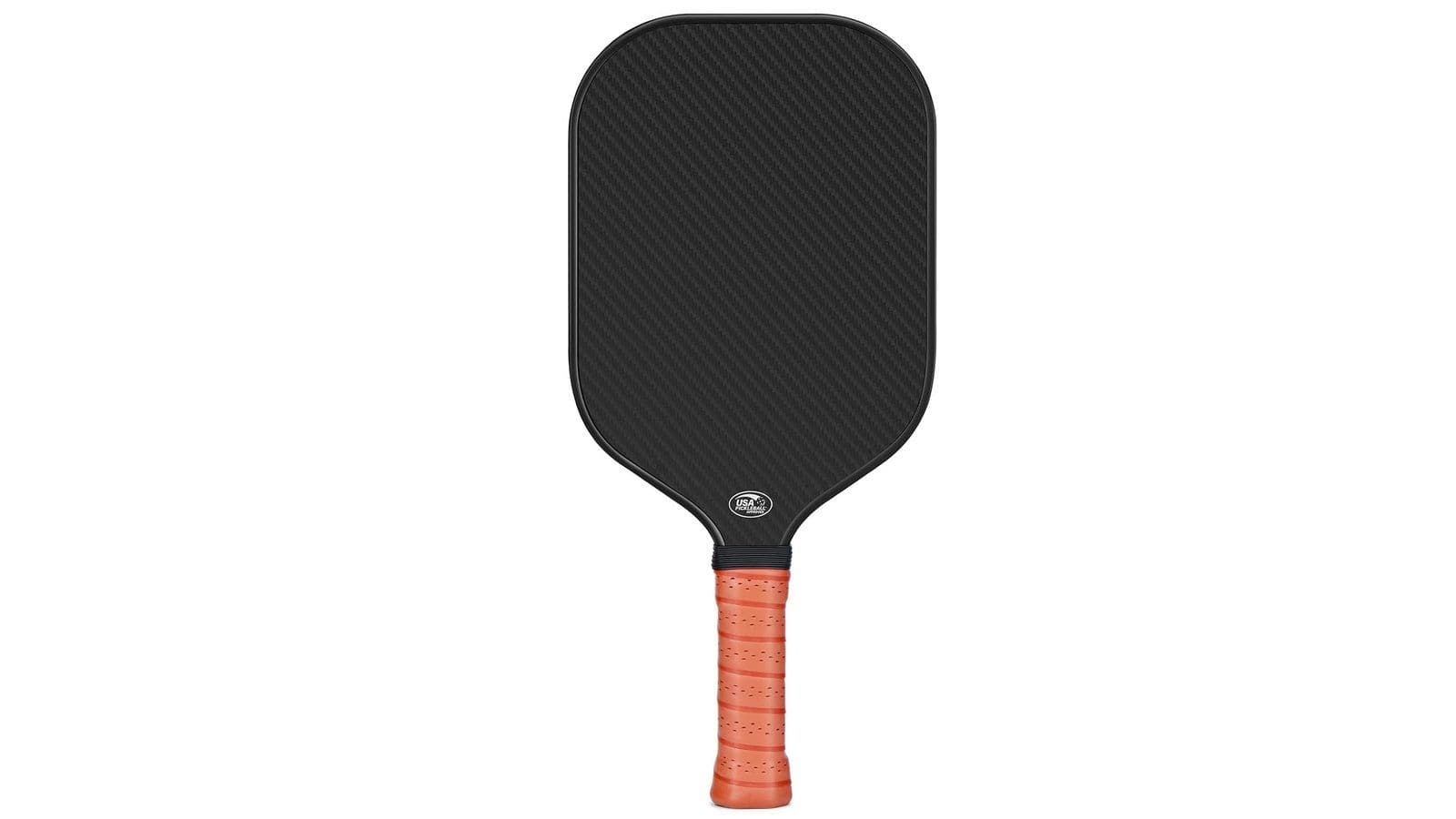
Ask ten paddle suppliers what the difference is between a graphite and a carbon fiber pickleball paddle face and you will get ten confident answers that contradict each other. Graphite is lighter. Carbon fiber is stiffer. Graphite is more brittle. Carbon fiber has more spin. Every one of those sentences is repeated across the first page of Google, and not one of them is a material property you can put on a purchase order and hold a factory to.
Here is the part the consumer blogs leave out. On a pickleball paddle, "graphite" and "carbon fiber" are not two materials. They are two marketing words for the same class of material, applied at different points in the sport's history, and the real difference between two paddles sold under those labels is almost never the fiber. It is the finish on top of the fiber, the resin system underneath it, and the core behind it. This guide separates the words from the specification — and gives you the five fields that actually belong in a paddle contract.

Key Takeaways
- Chemically there is no contest to settle. Toray's own datasheets put both T300 and T700S at over 93% carbon. A "graphite" face and a "carbon fiber" face are the same element in the same fabric form.
- The stiffness myth dies on the datasheet: T300 and T700S both test at 230 GPa tensile modulus. They are equally rigid. T700S's advantage is about 39% more strength (4,900 vs 3,530 MPa) — durability, not feel.
- Strictly speaking, neither face is graphite. Peer-reviewed x-ray diffraction work shows PAN-based carbon fiber is turbostratic carbon — a disordered form of graphite, with crystallites under 4 nm.
- "3K" is a tow count, not a grade. A 3K tow of T300 weighs 198 g per 1,000 m. It says nothing about strength, and a 3K paddle can be either grade.
- The rule that actually decides painted-vs-raw: USA Pickleball prohibits anti-skid or texture-loaded paint (2.E.6.a), and paddles must stay legal over their entire useful life (2.F.2.a).
- The legal texture ceiling is 30 µm average Rz and 40 µm Rt, measured in six directions, with no single reading over 33 µm Rz.
- In our own catalogue the face-grade step costs RMB 4 at domestic list price, while moving 13 mm to 16 mm core costs nothing. You are usually buying the wrong upgrade.
- Changing face material forces a new model designation under 2.E.7 — and therefore a fresh approval. Decide before you certify, not after.
Why the two words are not two materials
The cleanest evidence that "graphite" and "carbon fiber" describe one category rather than two comes from an awkward place: our own catalogue. The Chinese product title on our paddle listing translates literally as "3K full-carbon-fiber pickleball paddle, carbon-graphite honeycomb board." One SKU, one physical object, both words in the same sentence. That is not sloppiness unique to one factory — it is how the entire supply base names this product, because the two terms have never been separated by a specification anyone enforces.
The historical reason is simple. When the first non-wood paddles arrived, "graphite" was the prestige word borrowed from tennis rackets and golf shafts, and it meant a thin composite skin bonded over a core. Around the time raw, unpainted weaves became the premium look, the industry's vocabulary shifted to "carbon fiber" — same fabric, newer word. Paddles built a decade apart get different labels for the same construction. Nothing in the material changed; the fashion in nomenclature did.
So when a spec sheet says "graphite face," it is telling you the manufacturer's marketing vintage, not a property. You cannot test a paddle for "graphite-ness." You can test it for fiber grade, areal weight, weave, resin, finish and surface roughness — and none of those six fields is populated by choosing between the two words.
What the words cost you in practice
This matters because buyers pay for the word. A distributor comparing two quotes — one "graphite," one "carbon fiber" — will read a quality gap into the labels and accept a price gap to match. Meanwhile the two paddles may come off adjacent lines using the same roll of fabric. The only way to know is to stop specifying by adjective and start specifying by number, which is what the rest of this guide sets up.
What the fiber datasheets actually say
Toray is the reference producer for the fiber grades this industry quotes, and it publishes its properties openly. Reading the T300 and T700S sheets side by side dismantles most of what the comparison blogs assert.
Start with chemistry. Both sheets print the same composition line: carbon greater than 93%, sodium plus potassium under 50 ppm. Both list a 7 µm filament diameter. If graphite and carbon fiber were genuinely different materials, this is exactly where the difference would appear, and it does not.
Now the claim you have read a dozen times — that one material is stiffer than the other. Stiffness is tensile modulus, and both grades print 230 GPa (33.4 Msi). Identical. Anyone telling you a carbon face is stiffer than a graphite face, or vice versa, is describing a difference that the fiber datasheets say does not exist. What genuinely differs is tensile strength: 4,900 MPa for T700S against 3,530 MPa for T300, which works out to roughly 39% more strength for the higher grade. Strength is not stiffness. A stronger fiber does not feel firmer at the moment of contact; it survives more contacts before it fails.
The second differing number explains why. Strain at failure is 2.1% for T700S and 1.5% for T300 — the higher grade bends noticeably further before it fractures. That, not rigidity, is the durability mechanism a club buyer is actually purchasing when they step up a grade. Density barely moves the needle at skin scale: 1.80 g/cm³ against 1.76 g/cm³, a difference too small to explain any "graphite is lighter" claim once you account for the resin and core that make up most of a paddle's mass.
| Published property | T300 | T700S | What it means for a paddle |
|---|---|---|---|
| Chemical composition | Carbon > 93% | Carbon > 93% | Same material — the label debate has no chemistry behind it |
| Tensile modulus (stiffness) | 230 GPa | 230 GPa | Identical rigidity — kills the "stiffer face" claim outright |
| Tensile strength | 3,530 MPa | 4,900 MPa | About 39% more — the real, and only, performance gap |
| Strain at failure | 1.5% | 2.1% | Bends further before fracturing — the durability mechanism |
| Density | 1.76 g/cm³ | 1.80 g/cm³ | Negligible at skin scale — neither grade is "the light one" |
| Filament diameter | 7 µm | 7 µm | Same fineness; weave appearance comes from tow count, not this |
Figures as printed on the Toray Composite Materials America datasheets for T300 and T700S.
The K-number trap
"3K carbon" appears on nearly every paddle listing, and buyers routinely read it as a quality tier above some imagined 1K or below a superior 12K. It is neither. The K-number counts filaments in a tow — 3,000 of them in a 3K tow — and Toray publishes the resulting yields: a 3K tow of T300 weighs 198 g per 1,000 m, a 1K tow 66 g, and a 12K tow of T700S 800 g. These are fabric-construction numbers. They govern how fine the visible checkerboard looks and how the fabric drapes into a mould. They carry no strength information at all.
The practical consequence: a 3K face can be woven from either grade, and they look identical. A supplier quoting "3K carbon" has told you about the weave and nothing about the fiber. The grade is a separate field, and if it is not written down separately, it has not been promised.
Technically, neither one is graphite
There is a final twist that inverts the usual internet answer. The common formulation is that "graphite is a type of carbon fiber" or that carbon fiber is a refined graphite. Materials science says close to the opposite. Work by researchers at the University of Virginia and Oak Ridge National Laboratory, using wide-angle x-ray diffraction on PAN-based fibers — the precursor behind essentially all paddle-grade fabric — describes the crystal structure as turbostratic carbon, "a disordered form of graphite." The carbon sheets are present but crumpled and misaligned rather than stacked in the neat parallel registry that makes real graphite graphite. The study measured these crystallites at under 4 nm.
So the accurate statement is that a paddle face is neither graphite nor a purer form of it — it is a disordered relative. Which is another way of saying the debate you came here to settle was never a material question in the first place.
The real variable: what sits on top of the weave
If the fiber is not the difference, something clearly is — two paddles labelled "graphite" and "raw carbon" genuinely do not play the same. The difference is the surface, and this is where the money and the risk both sit.
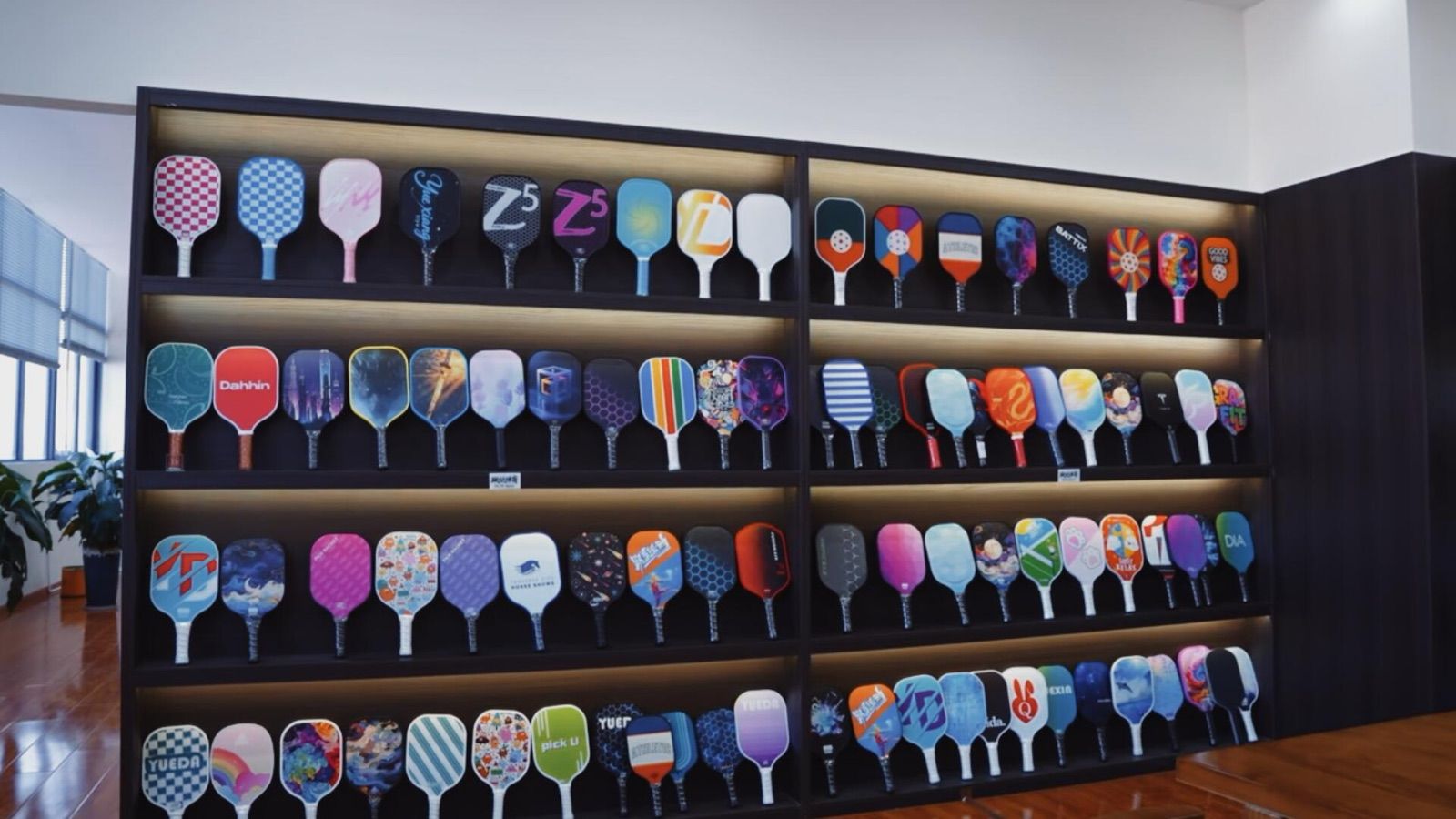
A traditional "graphite" face is painted. The weave is a structural skin, and the playing surface is a coating on top of it — pigment, clear coat, sometimes a texture additive to generate bite. A "raw carbon" face leaves the weave itself as the playing surface, usually with a peel-ply finish that imprints texture into the resin as it cures. Same fabric underneath; completely different interface with the ball.
That distinction drives the property buyers actually complain about, which is not spin on day one but spin in month six. A texture that lives in a coating wears as the coating wears. A texture cured into the resin degrades far more slowly because there is no discrete layer to shed. When a club operator reports that a fleet "stopped gripping," they are almost always describing a coating that has polished smooth, not a fiber that has changed grade. We covered how the two texturing methods differ, and how each is measured, in our guide to paddle surface grit and spin.
The moulding process compounds this. A face bonded under heat and pressure in a thermoformed unibody behaves differently at the edges than one cold-pressed and then edge-guarded, independent of which fiber went into it — a separate decision we break down in thermoformed versus cold-pressed construction. If your question is specifically about fiber grades rather than finishes, the companion piece on raw T700, T300 and fiberglass faces goes deeper on tier-by-tier grade selection.
The comparison that matters
| Field on the spec sheet | Painted face (sold as "graphite") | Raw face (sold as "carbon fiber") |
|---|---|---|
| Fiber underneath | Carbon fabric — often the same roll | Carbon fabric — often the same roll |
| Playing surface | Coating over the weave | The cured resin and weave itself |
| How texture is created | Applied in the finish | Imprinted during cure (peel ply) |
| Texture over service life | Falls as the coating polishes or sheds | Falls gradually with the surface itself |
| Colour and branding freedom | Full — any colour, full-face artwork | Limited — the weave is the look |
| Main compliance exposure | Texture additives and life-cycle drift | Initial roughness at the ceiling |
| Governing clause to read first | 2.E.6.a (prohibited paint) and 2.F.2.a (whole-life compliance) | 2.E.2.a.1 (30 µm Rz ceiling on delivery) |
| Typical failure complaint | "It stopped gripping" after a season of play | "It scuffs and shows wear" while still gripping |
Read that table as a trade-off, not a ranking. The painted face is not the inferior choice — it is the only choice if your brand needs full-face artwork, and for a rental fleet where paddles are replaced on a cycle anyway, coating wear may never become the binding constraint. What you cannot do is buy a painted face while expecting raw-carbon texture retention, then treat the gap as a defect.
Why the rulebook settles the argument
The painted-versus-raw question stops being a preference the moment a paddle needs to be tournament-legal, because the USA Pickleball Equipment Standards Manual regulates the surface directly and says nothing whatsoever about fiber grade.
Section 2.E.2.a.1 sets the texture ceiling: an average of no more than 30 µm on Rz readings and 40 µm on Rt, taken in six different directions and averaged per face, with no single data point above 33 µm Rz or 44 µm Rt. The measurement instrument is named — a Starrett SR160 or SR300 tester, or equivalent. Section 2.E.2.a.2 adds a friction limit of 0.1875 maximum kinetic coefficient, tested to the ASTM D1894-14 method. Worth being precise about what that means: D1894-14 is a test method, not a certificate. No factory "holds" it, and any supplier who presents it as a certification they possess is misrepresenting a procedure as a credential.
Then comes the clause that decides the whole painted-face question. Section 2.E.6.a prohibits "anti-skid paint or any paint textured with sand, rubber or vinyl compounds or any material that causes additional spin." The most direct way to make a painted face grip as well as a raw one is precisely the method the rulebook forbids. That is not a quality opinion; it is a compliance boundary.
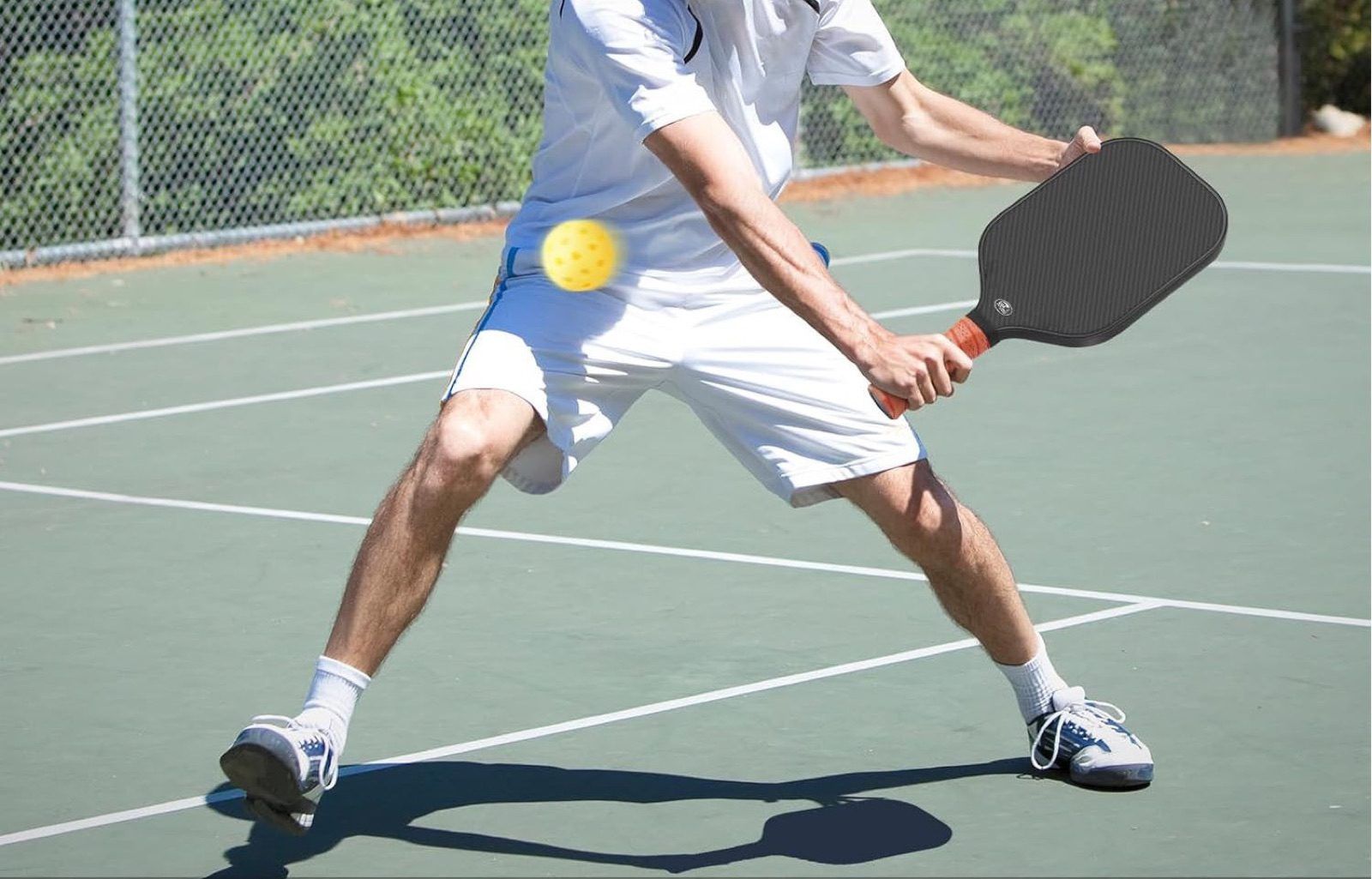
And section 2.F.2.a closes the exit: paddles "will be required to be compliant to all requirements over the entire useful life of the paddle," explicitly including "any degradation to benefit." A paddle that passes at the factory and drifts as it wears is not grandfathered by its approval. For a coating-dependent surface, that turns wear from a customer-satisfaction issue into a certification-exposure issue.
Two more clauses buyers get caught by
- Dimensions (2.E.3): combined length and width, including edge guard and butt cap, must not exceed 24 inches, and length alone must not exceed 17 inches. Notably, there is no restriction on thickness — and section 2.E.4 sets no weight limit at all. The specs buyers argue hardest about are the two the rulebook declines to regulate.
- Model designation (2.E.7): paddles with a different core material or surface material "must have a unique name or number." Switching face material is not a running change you slip into the next production run. It creates a different model, and the approval does not travel with it.
One current figure to keep in view while you are planning: the PBCoR ceiling in the January 2025 manual reads 0.44 effective 1 November 2024, reducing to 0.43 effective 1 November 2025. Power ceilings in this sport are tightening, not loosening, and the face is not where that headroom is won or lost. If any of this decides your programme, verify the current clause against the manual on the day you specify — the standards revise.
Which face belongs in which product line
Here is where the abstract argument becomes a purchase order. The honest answer is that the face is a small lever, and buyers habitually spend on it instead of on the two levers that move play more.
Our own catalogue makes the point with unusual clarity because the price list is public. Across the nineteen SKUs in our paddle listing, the 3K carbon variants list at RMB 48 and the T700 frosted variants at RMB 52 — a RMB 4 step for the face upgrade. Meanwhile the 13 mm and 16 mm 3K variants both list at RMB 48: changing core thickness, which alters feel far more than the face grade does, costs nothing at all. Two clarifications so this number is not misread: these are Chinese domestic list prices for single paddles, not export FOB quotes and not OEM programme pricing, and they are useful here only as a ratio — the relative size of the face premium against the core premium. Your quoted unit cost will differ.
That ratio is the whole lesson. Buyers arrive convinced the face grade is the decision, and the market prices it as a rounding error next to a core change that is free.
Best for / not for
- A painted face is right for brands whose identity is visual — full-face artwork, colour-matched ranges, licensed designs — and for rental and club fleets replaced on a fixed cycle, where coating wear lands outside the service window. It is wrong for a premium spin-marketed SKU that has to feel the same in month twelve.
- A raw face is right for tournament and premium lines where texture retention is the promise, and for programmes where warranty claims about "lost grip" would be expensive. It is wrong for a brand whose whole positioning is bold graphics, because the weave is the aesthetic and you cannot have both.
- Stepping up the fiber grade is right for fleets that take heavy repeat impact, where the ~39% strength margin and higher strain-to-failure genuinely extend service life. It is wrong as a way to buy a firmer feel or more spin — the modulus is identical and the texture is a separate spec.
A worked example
A distributor plans a three-tier range and asks for "T700 across all three, because customers know the name." Priced against our list, that adds the RMB 4 face step to every unit including the entry SKU, where buyers are not comparing fiber grades at all. The better structure spends the same money differently: keep the entry tier on a 3K painted face where artwork sells the SKU, put the free core change to work differentiating feel between the mid and premium tiers, and reserve the grade step for the top SKU where texture retention is the actual claim being made. Same budget, three tiers that feel different instead of three tiers that read different on a spec sheet.
Specifying a paddle line and want the face decided on evidence?
For brand owners, importers and club buyers who need a face, core and finish combination matched to a price band rather than to a marketing word — we build raw T700 carbon and fiberglass faces on 13 mm and 16 mm polypropylene honeycomb cores, thermoformed or cold-pressed, from 50 pcs.
Talk through an OEM paddle specHow we build and verify a paddle face
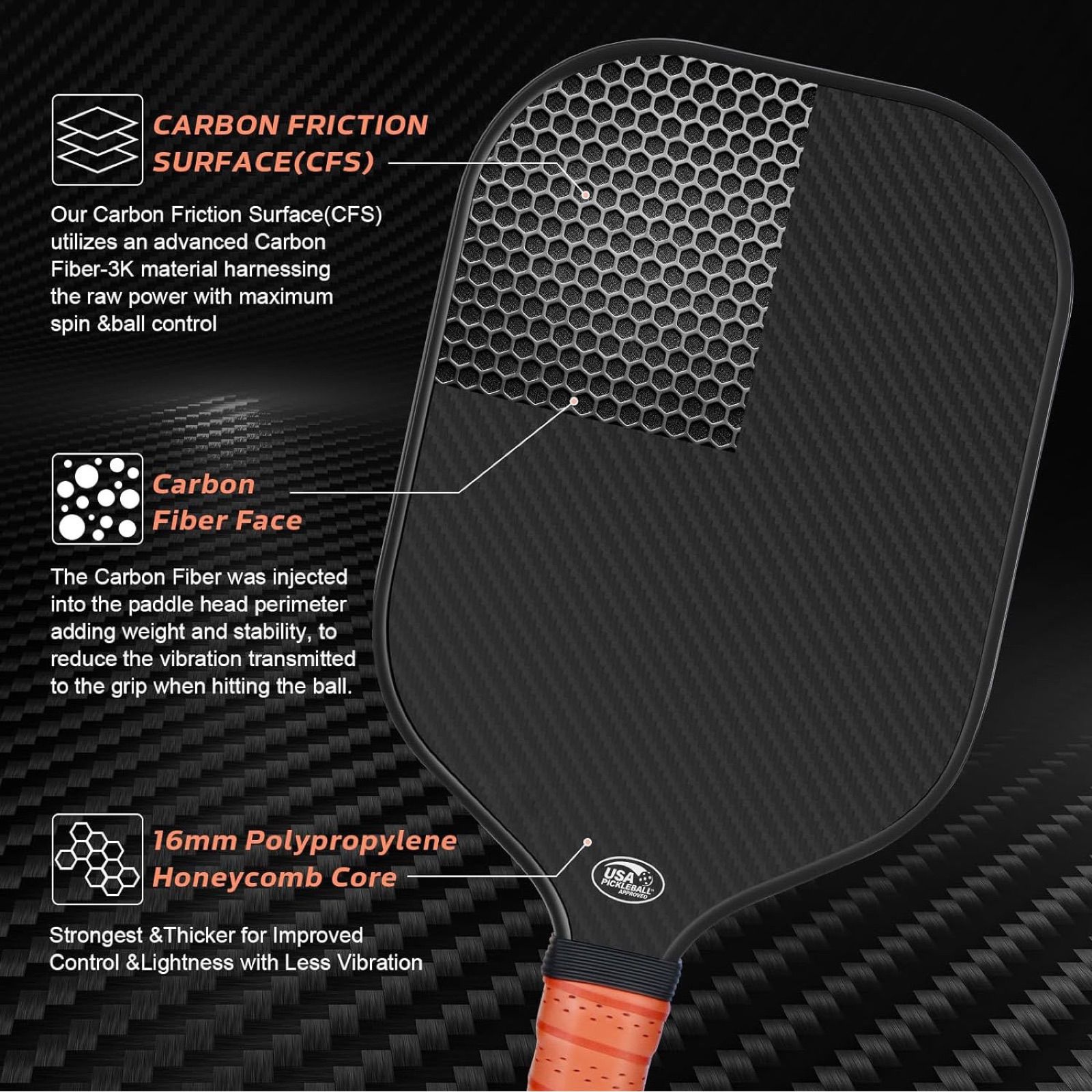
Because we manufacture the faces rather than resell finished paddles, the specification above is the one we work to internally. Our standard build runs a 3K carbon face with a Carbon Friction Surface over a 16 mm polypropylene honeycomb core, and the catalogue also carries a 13 mm core and a T700 frosted face. The 3K carbon paddle in our catalogue is built to exactly that spec.
What we check, and why each check exists:
- Fiber grade documented to source. Because a 3K T300 face and a 3K T700S face are visually identical, grade is confirmed on paper rather than by eye. This is the single most common substitution in the category, and it is undetectable in a photograph.
- Surface roughness measured against the published ceiling. Checked in the six directions the standard specifies rather than at one convenient spot, because a face can pass on one axis and fail on another — the weave is directional.
- Finish integrity on textured faces. A texture you can mark with a fingernail is a coating that will not survive a season, and under 2.F.2.a a surface that changes as it wears is a compliance problem rather than merely a satisfaction problem.
- Face-to-core bond. Delamination ends a paddle's life well before the fiber is anywhere near its strength limit, which is why the bond matters more to real-world durability than the grade printed on the quote.
- Weave and layup consistency. Resin-rich patches create dead spots that players feel as inconsistency across the face, and no fiber grade compensates for an uneven face.
- Weight banding across the batch. The rulebook sets no weight limit, so consistency here is a product decision rather than a compliance one — but a fleet that varies noticeably paddle to paddle generates complaints regardless of what the standard permits.
The sequencing matters as much as the checks themselves. Grade and roughness are confirmed on production units rather than on the reference paddle that won the order, because the gap between those two is exactly where face substitution hides. Pre-shipment QC sits before the balance is released, which is the only point of leverage a buyer still has.
The specification that goes on the purchase order
Everything above reduces to a short list. If these fields are filled in, the graphite-versus-carbon argument never has to be had, because none of these fields accepts either word as an answer.
- Fiber grade, named. "T700S" or "T300," documented to source — not "premium carbon," not "aerospace grade," and never inferred from the K-number.
- Weave and tow count, separately. 3K, 12K or otherwise, recorded as a construction and appearance spec that carries no strength meaning.
- Finish method, explicitly. Peel-ply texture, painted with clear coat, or painted with texture — the last of which runs directly into 2.E.6.a if the additive is doing the gripping.
- Surface roughness on delivery, with the measurement protocol. Against the 30 µm Rz / 40 µm Rt ceiling, six directions, no single reading over 33 µm Rz.
- Core material and thickness. Usually the field with the largest effect on feel per unit of cost — and in our catalogue, the one that costs nothing to change.
A supplier who can populate all five is describing a paddle. A supplier who answers "graphite" or "carbon fiber" and stops has described a category that, as the datasheets show, contains both of their competitors' products and their own.
If you are building a range across price bands, the sequence that avoids expensive rework is: decide the finish method first, because it constrains your branding and your compliance exposure; then set core thickness per tier, because it is the cheapest feel lever you have; and only then decide where the fiber grade step earns its cost. Face material also determines model designation under 2.E.7, so settle it before anything goes for approval rather than after.
Frequently Asked Questions
Is a carbon fiber paddle better than a graphite paddle?
The question has no material answer, because both labels describe carbon fabric faces. Toray's datasheets put T300 and T700S both above 93% carbon at an identical 230 GPa modulus. Compare the finish, the core and the documented fiber grade instead.
Is graphite lighter than carbon fiber?
Not meaningfully. Fiber density is 1.76 g/cm³ for T300 against 1.80 g/cm³ for T700S, and the skin is a small fraction of paddle mass. Differences in finished weight come from core, edge guard and total layup, not the label.
Does a raw carbon face generate more spin than a painted one?
Not inherently — both are capped by the same legal ceiling of 30 µm average Rz. Raw faces tend to retain texture longer because the grip is cured into the surface rather than carried in a coating that can polish smooth.
Does "3K" mean better carbon?
No. It counts filaments per tow: a 3K T300 tow yields 198 g per 1,000 m. It governs the visible weave pattern and drape, not strength. A 3K face may be woven from either grade.
Is T700 stiffer than T300?
No — both print 230 GPa tensile modulus. T700S carries roughly 39% more tensile strength (4,900 vs 3,530 MPa) and a higher strain at failure (2.1% vs 1.5%), which buys durability rather than a firmer feel.
Can I switch face material without re-certifying?
No. Section 2.E.7 requires a unique name or number for paddles differing in surface material, so a face change creates a different model rather than a running change to an approved one.
Why do some suppliers use both words for one paddle?
Because the market never separated them. Our own listing title carries both "carbon fiber" and "carbon-graphite" for a single SKU — evidence that the terms are one commercial category rather than two specifications.
Settling the face question with numbers instead of adjectives
The graphite-versus-carbon-fiber debate survives because it is easy to have and impossible to lose. Both sides are describing the same fabric, so any claim sounds plausible and none can be checked. The datasheets end it quickly: same element above 93% carbon, same 230 GPa modulus, a 39% strength gap between grades that buys durability rather than feel, and a fiber that is not strictly graphite in either case.
What genuinely separates two paddles is the finish on the weave, the core behind it, and whether the surface still measures inside 30 µm Rz after a season. Those are testable, they belong in a contract, and they are the fields a serious supplier can answer without reaching for an adjective. Specify those and the marketing word on the box stops mattering — which is exactly where you want it.
One last practical note: settle the finish method and the core before you go anywhere near an approval submission, because under 2.E.7 a face change downstream is a new model rather than an amendment. The suppliers worth working with will put all five fields in writing without being pushed.
Want to source this quality for your brand?
Contact our factory directly on WhatsApp for an instant MOQ and pricing quote.