AQL Inspection Standard: How To Read The Table Before You Sign
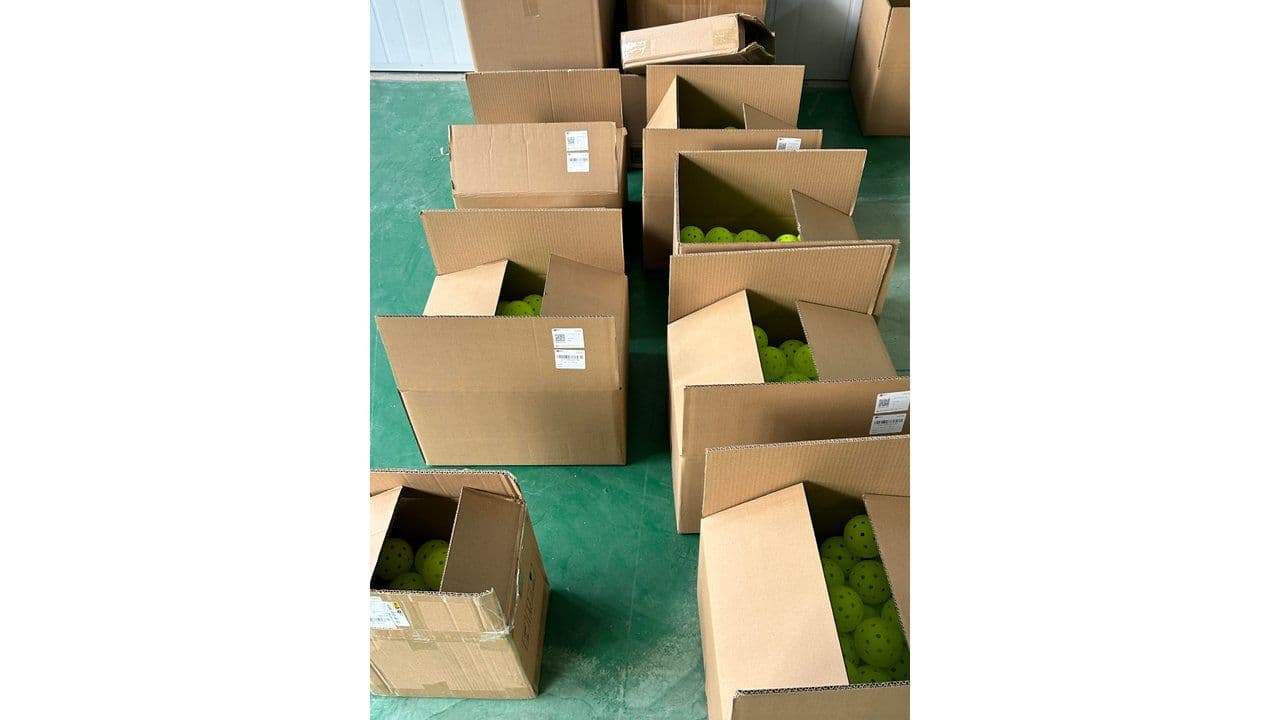
You signed a purchase order that says "inspection to AQL 2.5 major / 4.0 minor, general level II." Three months later an inspection report lands in your inbox with the word ACCEPTED on it, the container sails, and forty of your retail customers open a box that looks nothing like the golden sample. Nobody lied to you. The inspector applied the standard correctly. The problem is that the clause you signed does not mean what almost everyone selling you inspection services says it means.
This page is the lookup itself: how a lot size becomes a sample size, how a sample size becomes a pass-fail number, and what that number physically permits inside a passing lot of pickleball paddles. Every table value below was read off the standard document rather than copied from another summary, and every clause is cited so you can check it. If you want the inspection run rather than decoded, the companion piece on pre-shipment AQL inspection for pickleball orders walks the process end to end.
Key takeaways
- AQL is not a permitted defect rate. ISO 2859-1 defines it as the worst tolerable process average across a continuing series of lots — a property of your supplier's production over time, not an allowance you granted for one container.
- A 3,000-paddle lot at general level II means 125 paddles inspected — code letter K. Not 10%, not 300. Sample size is driven by a band, not a percentage.
- At AQL 2.5 major / 4.0 minor, that lot passes with up to 7 major plus 10 minor defective paddles among the 125 units examined — 17 defective paddles, and the container still leaves the factory. That is the number nobody puts on a slide.
- Order 3,201 paddles instead of 3,000 and your sample jumps from 125 to 200. One unit over a band boundary costs 60% more inspection time.
- Tightened inspection does not cost you a bigger sample. At code letter K it stays at 125 paddles; what falls is the acceptance number, from 7 to 5. "We can't afford tightened inspection" is not a sampling-cost argument.
- The switching rules fire automatically — two non-accepted lots out of five moves you to tightened; five non-accepted lots on tightened stops acceptance sampling altogether until the supplier fixes something.
On this page
- What AQL actually is — and the sentence in the standard that ends the argument
- The four inputs that decide your sample size
- Reading the table: a 3,000-paddle lot, step by step
- The number nobody puts on a slide: 17 defective paddles in a passing lot
- Tightened, normal, reduced: the rules that fire without anyone deciding
- ISO 2859-1 or ANSI/ASQ Z1.4: which one belongs in your PO
- Watch: acceptance sampling and the Z1.4 procedure
- Conclusion: the checklist before you sign
- Frequently asked questions
What AQL Actually Is — And The Sentence In The Standard That Ends The Argument
Search for AQL and you will be told, on page after page, that it is the maximum percentage of defective items considered acceptable in a batch. That definition is wrong, and it is wrong in a direction that costs importers money.
Here is what ISO 2859-1 actually says, in clause 3.1.26, defining the term it exists to define:
"acceptance quality limit, AQL: quality level that is the worst tolerable process average when a continuing series of lots is submitted for acceptance sampling."
Read the two phrases that do the work. Process average — a property of the production process, measured over time. Continuing series of lots — plural, over months, not the one container sitting on the quay. AQL 2.5 is a statement about what your supplier's factory should be capable of averaging across everything it makes for you. It is not a coupon that entitles that supplier to 2.5% rubbish in any given shipment.

AQL describes the average quality of everything a factory makes for you over time. That is why the definition talks about a continuing series of lots and not about the container in front of you.
The standard is unusually blunt about the misreading
Standards bodies do not normally editorialise. This one does, in NOTE 2 attached to that same definition, and the note reads like it was written by someone who had watched buyers make this exact mistake:
"Although individual lots with quality as bad as the acceptance quality limit may be accepted with fairly high probability, the designation of an acceptance quality limit does not suggest that this is a desirable quality level."
The note goes on to explain the mechanism: the scheme is built to encourage suppliers to have process averages consistently better than the AQL, because a factory that merely hits the AQL will keep tripping the switching rules, land on tightened inspection, and eventually have acceptance sampling withdrawn from it entirely. The number in your PO is a tripwire, not a budget.
This distinction is not academic once a defect argument starts. A supplier who has internalised "AQL 2.5 means 2.5% is fine" will argue that a lot with 2% defects is compliant and you are being unreasonable. A supplier who has read clause 3.1.26 knows that his process average is being watched across every lot he ships you, and that a run of marginal lots has a mechanical consequence he cannot negotiate away.
The Four Inputs That Decide Your Sample Size
Nobody can tell you how many paddles get inspected until four things are fixed. Buyers routinely specify one of them, assume the rest, and then find the inspector using defaults they never agreed to.
| Input | What it controls | What happens if you leave it blank |
|---|---|---|
| Lot size | Which row of the code-letter table you land on | The inspector decides whether your four SKUs are one lot or four — and four small lots draw a far smaller total sample than one big one |
| Inspection level | How much discrimination you buy at that lot size | Level II is applied by default — which the standard explicitly sanctions, so you have no complaint |
| AQL per defect class | The acceptance number in each class | The agency applies its house convention, typically zero critical with looser major and minor values |
| Defect classification | Which bucket a real paddle flaw falls into | An edge-guard gap gets called minor by the factory and major by you, after the container has sailed |
The fourth input is upstream of this article and deserves its own document: a written list saying that, for example, a delaminated face is critical, a 4-gram weight deviation is major, and a printing registration shift under one millimetre is minor. Without it the first three inputs are arithmetic applied to a disagreement.

The four inputs decide how many paddles reach this bench. Only the fourth — the written defect classification — decides what the inspector is allowed to call a defect when he gets there.
Level II is the default, and the standard says so
ISO 2859-1 clause 10.1 gives three general levels and settles the default explicitly: "Three inspection levels, I, II and III, are given in Table 1 for general use. Unless otherwise specified, level II shall be used." Level I is for when less discrimination is acceptable; level III when you want more. The same clause adds four special levels, S-1 to S-4, which exist "where relatively small sample sizes are necessary and larger sampling risks can be tolerated" — the destructive-test case. If you want break-strength or drop testing on a paddle order, that is an S-level job, because you are destroying every unit you sample and cannot afford 125 of them.
The dial most buyers turn is the wrong one
When a buyer feels an inspection was too lax, the instinct is to demand level III next time. Often the AQL was the problem, not the level, and the standard is clear that these are independent controls: "The choice of inspection level is quite separate from these three severities of inspection." The level governs how much you look; the AQL governs how strict the verdict is; the severity — normal, tightened, reduced — moves on its own according to rules covered further down. Changing the level to fix a strictness complaint enlarges your inspection bill without necessarily changing a single accept-reject decision.
One more counterintuitive point from the same clause, worth knowing before you argue about percentages: "The amount of information about the quality of a lot gained from examining samples drawn from the lot depends upon the absolute size of the samples, not upon the relative size of the sample to the lot size." A 125-paddle sample tells you almost exactly as much about a 3,000-unit lot as it does about a 30,000-unit lot. This is why the tables move in bands rather than percentages, and why "we inspect 10% of every order" is a claim from someone who has not read the standard they are citing.
Reading The Table: A 3,000-Paddle Lot, Step By Step
Take a real order: 3,000 paddles, one SKU, one production run, ready for pre-shipment inspection. You specified general inspection level II, AQL 2.5 for major defects and 4.0 for minor. Here is the lookup, with the row and column named at every step so you can repeat it on your own numbers.
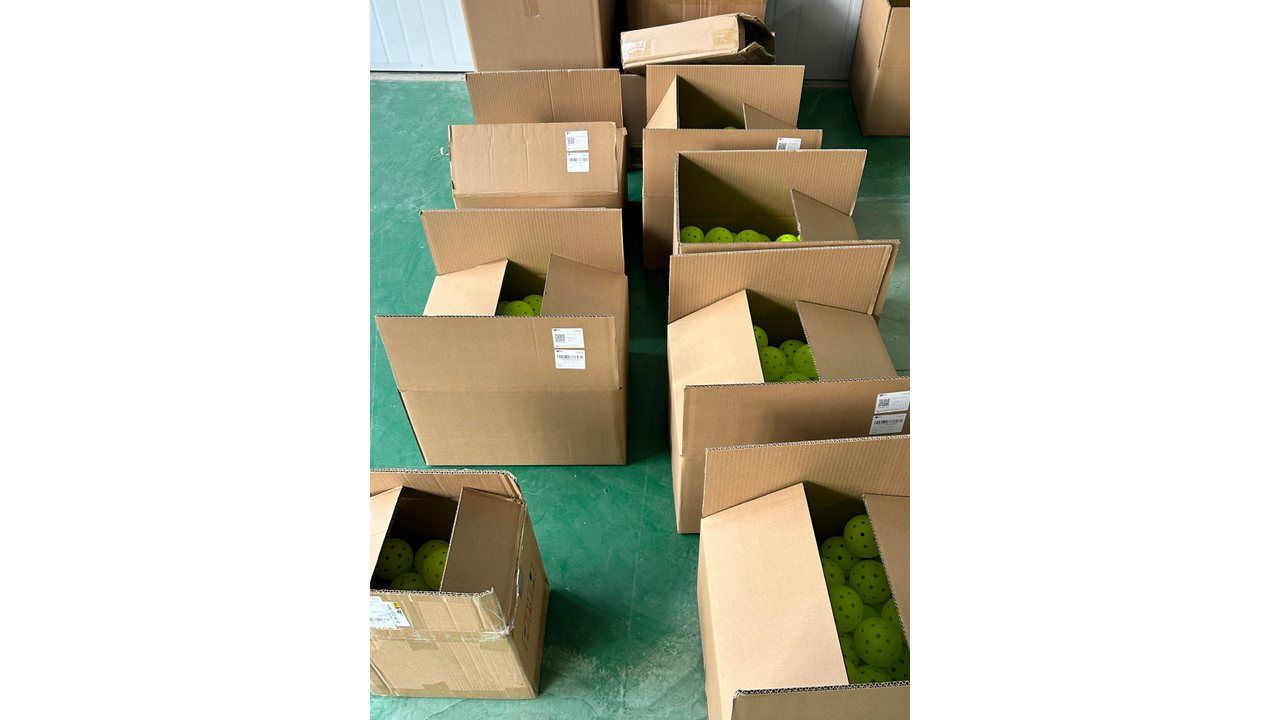
A 3,000-paddle lot is what the standard calls a lot only if it was presented as one. Split it across four cartons of mixed SKUs and you have changed the arithmetic before the inspector opens anything.
Step 1 — Lot size to code letter (Table 1)
Table 1 of ISO 2859-1 maps lot size against inspection level to produce a single letter. The bands are fixed. 3,000 units falls in the band 1 201 to 3 200, and reading across to the general level II column gives code letter K.
Notice what the band does at its edges. Order 3,200 paddles and you are still on K. Order 3,201 and you cross into the 3 201 to 10 000 band, which gives code letter L. That single extra unit is the difference between inspecting 125 paddles and inspecting 200 — a 60% increase in inspection labour for one paddle more. If your order quantity is floating near a band edge and your inspection is charged by the man-day, this is worth knowing before you round the PO up.
| Lot size band | Code letter (general level II) | Sample size |
|---|---|---|
| 501 to 1 200 | J | 80 |
| 1 201 to 3 200 | K | 125 |
| 3 201 to 10 000 | L | 200 |
| 10 001 to 35 000 | M | 315 |
Code letters from ISO 2859-1 Table 1; sample sizes from Table 2-A, single sampling plans for normal inspection.
Step 2 — Code letter to sample size and acceptance numbers (Table 2-A)
Table 2-A is the master table for single sampling plans under normal inspection. Find row K. The sample size column reads 125. Now read across to your AQL columns:
- Column AQL 2,5 (your major-defect class) gives Ac 7 / Re 8
- Column AQL 4,0 (your minor-defect class) gives Ac 10 / Re 11
Ac is the acceptance number and Re the rejection number. Clause 11.1.1 states the rule without ambiguity: "If the number of nonconforming items found in the sample is equal to or less than the acceptance number, the lot shall be considered acceptable. If the number of nonconforming items is equal to or greater than the rejection number, the lot shall be considered not acceptable." For a single sampling plan Re is always Ac plus one, so there is no gap and no inspector discretion — 7 major defects accepts, 8 rejects.
Step 3 — What to do when the table sends you somewhere else
Some cells of the master table hold an arrow rather than a pair of numbers, which means no plan exists for that combination of code letter and AQL. The standard's instruction here catches people out, because it changes your sample size, not just your acceptance number: "the tables direct the user to a different letter. The sample size to be used is given by the new sample size code letter, not by the original letter." Follow the arrow and take the whole row, sample size included.
There is also a floor. If the plan you land on calls for a sample equal to or larger than the lot itself, the table's own footnote applies — carry out 100% inspection. On a 200-unit trial order with a tight AQL this happens more often than buyers expect, and it is the correct outcome, not a mistake.
The Number Nobody Puts On A Slide: 17 Defective Paddles In A Passing Lot
Now put the two acceptance numbers together, because that is what a two-class inspection actually does. Your inspector draws 125 paddles from the 3,000-unit lot. He classifies every defect he finds. The lot is accepted if the major count is at or below 7 and the minor count is at or below 10.
So the worst passing inspection looks like this: 7 major defects plus 10 minor defects — a worst case of 17 nonconformities, on anywhere from 10 to 17 separate paddles out of the 125 he examined — and the lot is ACCEPTED. (One paddle can carry both a major and a minor defect, so the count of distinct nonconforming paddles can be as low as 10 even though the defect tally reaches 17.) That is up to 13.6% of the inspected sample carrying a defect of some kind, under a clause that a buyer reads as "2.5%".
Where that figure comes from — check it yourself
It is addition, not a claim from the standard. ISO 2859-1 prints Ac 7 at AQL 2,5 and Ac 10 at AQL 4,0 for code letter K. A two-class plan applies both criteria to the same 125-unit sample, so a lot sitting exactly on both limits carries 7 + 10 = 17 nonconformities and still satisfies clause 11.1.1 on both counts. The 17 is a defect tally, not a count of discrete paddles — because a single paddle can fail on both a major and a minor characteristic, the number of distinct nonconforming units this represents is anywhere from 10 to 17. The standard nowhere says "17 defects are permitted" — it says what accepts and what rejects, and 17 is what that arithmetic allows at these settings.
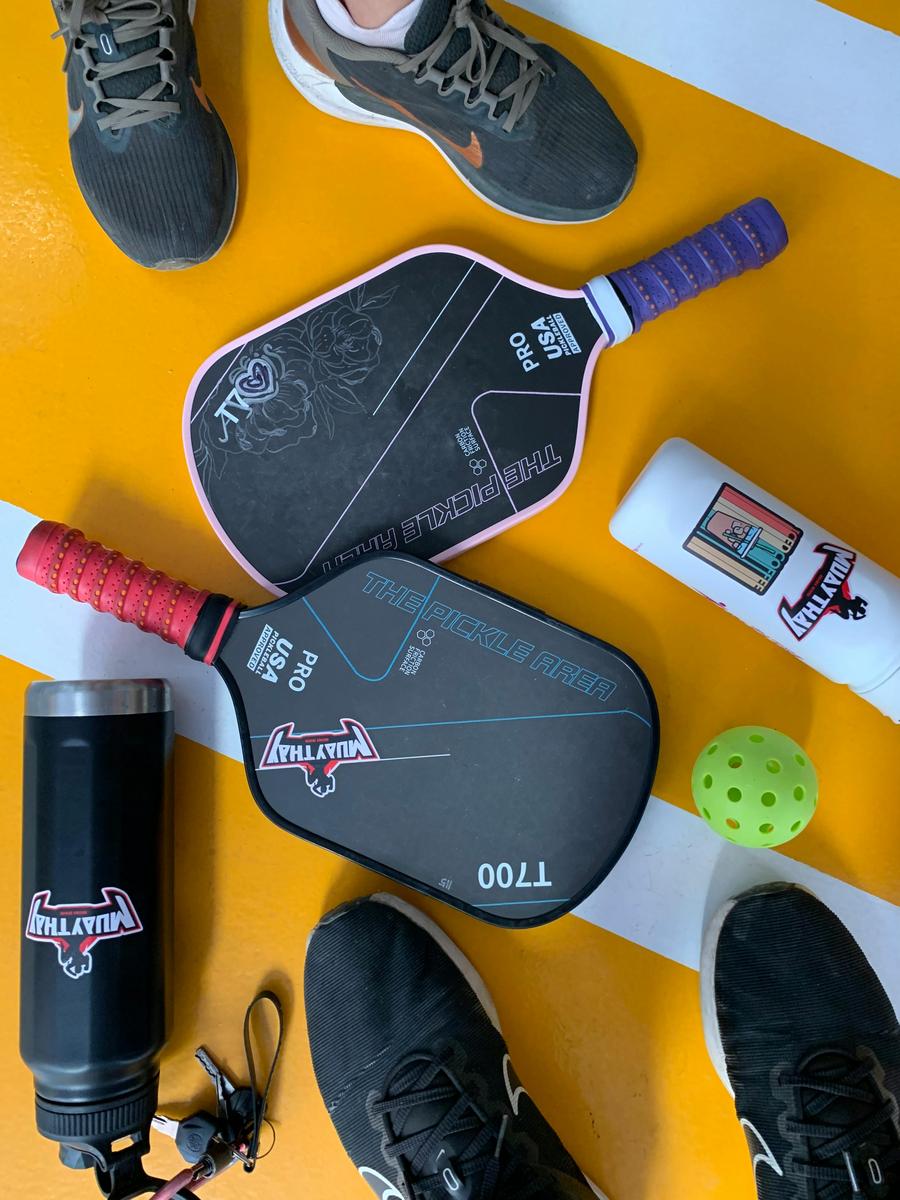
Seventeen units like these can sit inside a 125-paddle draw and the lot is still recorded as ACCEPTED at AQL 2.5 major / 4.0 minor. The arithmetic is correct; the surprise is what it looks like on a bench.
What this does and does not tell you about the container
Be careful with the number in the other direction too, because overstating it is how buyers lose credibility in a claim negotiation. 13.6% is the share of the sample, not a measured defect rate for the 3,000 units in the container. A lot sitting exactly on both acceptance limits is the worst case the plan permits, not the expected case — most accepted lots are considerably cleaner, which is the entire statistical point of sampling. What the figure establishes is the ceiling: the quality floor you have contractually agreed to tolerate on a single shipment while everyone involved describes the order as compliant.
Whether that ceiling is acceptable depends on who receives the paddles. A rental fleet or a club buying 3,000 paddles for member use can absorb a proportion of cosmetic minors; the units get beaten up in a season anyway.
A brand launching into specialty retail cannot, because the defective units do not distribute themselves evenly across forgiving customers — they land in individual boxes, and each one becomes a review. If your channel is retail, the answer is not to argue with the arithmetic afterwards but to specify a tighter major AQL, or to move a class of defect from minor to major, before the PO is signed. Both of those are decisions you make in the clause, not in an email after inspection.
Tightened, Normal, Reduced: The Rules That Fire Without Anyone Deciding
Everything above describes one lot in isolation. The part of ISO 2859-1 with real commercial force is what happens across a series of lots — and it is the part almost no inspection-agency explainer shows you, because it constrains the agency as much as the factory.
Inspection starts at normal severity: "Normal inspection shall be carried out at the start of inspection, unless otherwise directed by the responsible authority." From there the severity moves by rule, not by negotiation.
| Transition | Trigger | Clause |
|---|---|---|
| Normal to tightened | 2 out of 5 (or fewer) consecutive lots non-accepted on original inspection | 9.3.1 |
| Tightened back to normal | 5 consecutive lots accepted on original inspection | 9.3.2 |
| Normal to reduced | Switching score at least 30, production at a steady rate, and the responsible authority agrees | 9.3.3.1 |
| Reduced back to normal | Any lot not accepted, production irregular or delayed, or other conditions warrant it | 9.3.4 |
| Stop sampling altogether | 5 non-accepted lots accumulated on original tightened inspection | 9.4 |
Put dates on it. Say you ship monthly and lots 3 and 5 are both rejected. At lot 5 the count reaches 2 non-accepted within 5 consecutive lots, so lot 6 is inspected to tightened rules whether or not anyone emails about it. To get back to normal your supplier needs lots 6, 7, 8, 9 and 10 all accepted on original inspection — 5 clean months. If instead the rejections keep coming and 5 lots are non-accepted while on tightened, clause 9.4 stops acceptance sampling entirely. That is the sequence buyers discover late, usually in the middle of a peak-season order.
Tightened inspection costs you nothing in sample size
This is the most useful thing on this page for anyone negotiating with a factory that resists escalation. Moving from normal to tightened at code letter K does not enlarge the sample. It stays at 125 paddles. What changes is the verdict: the acceptance number at AQL 2.5 falls from 7 to 5, and at AQL 4.0 from 10 to 8. Same inspector, same day rate, same 125 units pulled off the line — a stricter pass mark.
| Sample size code letter (general inspection level II) | Normal inspection (Table 2-A) | Tightened inspection (Table 2-B) |
|---|---|---|
| J (n=80) | 5 | 3 |
| K (n=125) | 7 | 5 |
| L (n=200) | 10 | 8 |
| M (n=315) | 14 | 12 |
So when a supplier says tightened inspection is too expensive, the honest translation is that he expects to fail it. The inspection bill is identical. What has changed is that the two extra defective paddles he was relying on no longer fit inside the acceptance number.

The switching rules are read off a history, not off one report. Which is why the accept/reject verdict for every lot has to be recorded against the production run it came from.
The clause with real teeth is 9.4
Clause 9.4 is the one to quote when a supplier treats a failed inspection as a re-negotiation. If non-accepted lots accumulate to five on original tightened inspection, the standard says acceptance sampling "shall not be resumed until action has been taken by the supplier to improve the quality of the submitted product or service, and the responsible authority has agreed that this action is likely to be effective."
That is not a fine or a penalty clause you have to have drafted. It is the standard your own PO invoked, withdrawing the privilege of being judged on a sample at all. The supplier's route back is a documented corrective action that you — as the responsible authority, which in a commercial order means the buyer unless you assigned the role elsewhere — have to accept as credible. If your PO names ISO 2859-1 and does not say who the responsible authority is, fix that; it is the role that chooses the level, approves reduced inspection, and signs off the recovery.
Two traps in the switching rules
Resubmitted lots do not count. Clause 9.3.1 counts non-acceptance "on original inspection (that is, ignoring resubmitted lots or batches for this procedure)". A factory that fails, sorts, and resubmits has not erased the failure from the switching count — a common misunderstanding that lets a supplier believe he is still on normal inspection when the rules have already moved him.
Each defect class switches independently. Clause 9.2 requires that "the switching procedures shall be applied to each class of nonconformities or nonconforming items independently." You can be on tightened inspection for major defects while remaining on normal for minor. Most spreadsheet-based inspection trackers get this wrong and carry one severity for the whole order — which is why the tracker should be maintained against a lot and batch coding scheme that identifies which production run each verdict belongs to.
Reduced inspection deserves one caution. It looks like a reward and it is genuinely cheaper, but the standard notes plainly that "the discriminatory ability under reduced inspection is less than under normal inspection." If you are moving into a peak season with new tooling or a new core supplier, that is the wrong quarter to take it, whatever the switching score says.
ISO 2859-1 Or ANSI/ASQ Z1.4: Which One Belongs In Your PO
Your contract says ISO 2859-1. Your inspector's report cites ANSI/ASQ Z1.4. Your factory's QC manager has a laminated card that says MIL-STD-105E. Everybody is looking at tables that mostly agree, and the question is whether "mostly" is a problem.
The lineage explains the overlap. MIL-STD-105E was the US defence standard for attribute sampling, cancelled in 1995, with ANSI/ASQ Z1.4 recommended as its civilian replacement. ISO 2859-1 came from the same root: both ANSI/ASQC Z1.4 and ISO 2859-1 were originally created as commercial equivalents to MIL-STD-105E (the lineage is documented in the ISO 2859-1 standard record and the ANSI/ASQ Z1.4 replacement note for the cancelled MIL-STD-105E). That shared origin is why the lookup you learned above transfers between them — the code letters, the lot-size bands and the sample sizes line up across all three books.
Where "mostly the same" stops being good enough
Two places. First, the standards are not word-for-word identical — the 1999 ISO revision adjusted some accept-reject pairs relative to the older military tables, so citing the family rather than the document leaves room for two defensible readings of the same lot. Second, and more practically today: editions move.
ISO 2859-1 was revised. The current edition is the third, ISO 2859-1:2026, published on 22 January 2026, superseding the 1999 edition. The substantive changes are the formal addition of skip-lot sampling procedures into Part 1 and the replacement of the printed operating-characteristic and average-sample-number tables with generation methods in an annex; the AQL values, inspection levels, sample size tables and acceptance/rejection numbers carry across. In North America the corresponding document is ANSI/ASQ Z1.4-2003 (R2018).
Sourcing note on the table values above. Every code letter and every Ac/Re pair on this page was read from the ISO 2859-1:1999(E) document — Table 1 for the code letters, Table 2-A for normal inspection, Table 2-B for tightened, with the clause numbers quoted as they appear. They are presented as second-edition values because that is the text they were read from. The current-edition status and the summary of what the 2026 revision changed come from the British Standards Institution catalogue record for BS ISO 2859-1:2026.
If a decision turns on a single cell, buy the current edition and read that cell — an article is a guide to the lookup, never a substitute for the standard your contract names.
The clause is the only part of this that survives a dispute. Everything above is how to write six lines that an inspector can execute without phoning you.
The clause to write, and what to have ready
"Inspection to AQL 2.5" is not a specification. A clause that an inspector can execute without asking you anything names six things:
- The standard and the edition — e.g. ISO 2859-1:2026, or ANSI/ASQ Z1.4-2003 (R2018). Not "AQL standard".
- The inspection level — general level II unless you have a reason, and an S-level for any destructive test.
- The AQL per defect class — typically zero tolerated for critical, with separate values for major and minor.
- The defect classification document — referenced by name and version, so "major" means the same thing on both sides of the ocean.
- The starting severity and who the responsible authority is — normal unless stated, and name the party who approves reduced inspection and any recovery under clause 9.4.
- How a lot is defined — per SKU, per production run, or per consignment. This decides the sample size before anything else does.
On the commercial facts a first inquiry needs, three of them are honest gaps rather than published numbers, and it is worth saying which and why. Minimum order quantity for a private-label paddle programme is set per project rather than published as one figure, because it moves with the face material, the core thickness and how many colourways you are running — a single-SKU run and a four-colourway launch at the same total volume are different tooling problems.
Price structure works the same way: the quotation is driven by construction rather than by a per-unit list. On the spec side, private-label paddles here are available in raw T700 carbon or fibreglass faces, on polypropylene honeycomb cores of 13 to 16 mm, in either thermoformed unibody or cold-pressed construction — which matters to this article because each of those combinations fails differently, and a defect classification written for a cold-pressed paddle will not describe the delamination modes of a thermoformed one.
Lead time depends on whether tooling already exists and on golden-sample approval, which is the gate the inspection clause above ultimately measures against. Ask for all three against your actual size mix and colourway count; a supplier who quotes them without asking those questions is quoting a different order.
For a factory to accept a clause like this it has to be able to run to it, which is a question about the OEM production and golden-sample process rather than about the inspection itself. And once the clause exists, someone has to execute it — the trade-off between your own staff, the factory's QC and a third-party agency is set out in the comparison of pickleball inspection agents.
For importers and private-label brands about to write an inspection clause into a paddle PO. Our OEM programme runs on golden-sample approval together with QC before dispatch, so the inspection plan you specify is checked against the build before production starts rather than argued about after it. Send your lot definition, defect classification and target AQL per class and we will tell you plainly whether we will sign to it.
See the OEM build and QC processWhat to check on the inspection report when it lands
The report is where a wrong clause becomes visible, and it is checkable in about ninety seconds. Five things, in order:
- The lot size the inspector used — not the quantity you ordered. If they differ, the sample size was drawn from a different row of the table than you were expecting.
- The stated sample size against the code letter. Code letter K must show 125 units inspected. A report naming K and showing 80 or 200 has an internal contradiction, and it is nearly always the lot definition that moved.
- The severity. Normal, tightened or reduced should be printed. If it is absent, assume normal was applied — and check that against your own count of recent non-accepted lots, because clause 9.3.1 may already have moved you.
- The acceptance number against your AQL. At K and AQL 2.5 it reads Ac 7. If the report shows a different number for the same letter and AQL, either the severity is not what you think or the AQL applied is not the one you specified.
- Defect counts by class, not one total. A single "12 defects found" line cannot be judged against a two-class plan at all, because 12 minors accepts and 12 majors rejects.
None of this requires the standard in front of you — the lookup on this page covers the code letters most paddle orders land on. Where it stops is defect classification: no reading of the report can tell you whether the inspector put a 3 mm edge-guard gap in the right bucket. That is decided by the document you attached to the PO, which is why it is the input worth writing first.
Watch: Acceptance Sampling And The Z1.4 Procedure
If you would rather see the lookup performed than read it, this walkthrough from CQE Academy — a quality-engineering education channel rather than an inspection vendor — runs the acceptance sampling procedure through the ANSI/ASQ Z1.4 tables. The mechanics are the ones described above — same code letters, same lot-size bands, same two-step lookup — because Z1.4 and ISO 2859-1 were both built as commercial equivalents of MIL-STD-105E. Watch the procedure, not the individual cells: the 1999 ISO revision moved some accept-reject pairs, so a number read off a Z1.4 table is not automatically the number your ISO 2859-1 clause obliges your supplier to meet.
Two things to watch for while it plays, because they are where the video and your purchase order meet. First, note that the presenter fixes the lot size before anything else happens — that single decision is what selects between the 80-unit, 125-unit and 200-unit sample plans, and it is the input buyers most often leave to the inspector. Second, note that the acceptance number is read from a column, not calculated from a percentage: at no point does anyone multiply a lot size by 2.5%. If you have ever been told your AQL means a percentage of the shipment, watching the lookup happen is the fastest way to see why that is not what the table does.


Every decision on this page is cheap while both parties are still looking at the same document. After the container sails, all of them are expensive.
Conclusion: The Checklist Before You Sign
The table is not difficult. What makes AQL clauses fail is that the arithmetic gets specified and the definitions do not. Run this list before the next PO goes out:
- Write the standard and the edition, not the acronym. ISO 2859-1:2026 or ANSI/ASQ Z1.4-2003 (R2018).
- Define what a lot is. Per SKU, per run, or per consignment — this fixes the sample size before any other choice does.
- Check where your quantity sits against the band edges. 3,200 units is code letter K at 125 inspected; 3,201 is L at 200.
- Attach a versioned defect classification. Without it, "major" is an opinion.
- Do the addition for your own AQL pair and decide whether the worst passing lot is one your sales channel can survive. At 2.5/4.0 on code letter K, that is up to 17 nonconformities — on 10 to 17 actual paddles — in a 125-paddle sample.
- Name the responsible authority and state the starting severity, so clause 9.3.3 and clause 9.4 have someone to point at.
- Track severity per defect class, not per order — the rules switch independently.
If you have a lot size and a defect classification already, the sampling plan takes about two minutes to check against them — run the three lookups above in order and you will have the sample size and both acceptance numbers before the next call with your supplier. If the defect classification does not exist yet, that document is the thing to write first; everything on this page is arithmetic applied to it, and no acceptance number means anything until both sides agree what counts as a major defect.
Frequently Asked Questions
What the number actually means
Does AQL 2.5 mean 2.5% of my paddles can be defective?
No. ISO 2859-1 clause 3.1.26 defines AQL as the worst tolerable process average across a continuing series of lots, not an allowance for one shipment. It indexes which acceptance number your inspector uses; it is not a defect quota you granted.
How many paddles get inspected in a 3,000-unit order?
125. A 3,000-unit lot falls in the 1 201 to 3 200 band, which at general inspection level II gives sample size code letter K, and Table 2-A puts code letter K at a sample size of 125 units.
What are Ac and Re on an inspection report?
Ac is the acceptance number and Re the rejection number. Defects at or below Ac accept the lot; defects at or equal to Re reject it. In single sampling plans Re is always Ac plus one, so there is no middle ground.
Choosing level, and reading the report
Which inspection level should I specify?
General level II unless you have a reason to move. The standard makes it the default in clause 10.1. Use a special level S-1 to S-4 for destructive testing, where you cannot afford to consume a full sample.
When does inspection switch to tightened?
When 2 out of 5 or fewer consecutive lots are non-accepted on original inspection, per clause 9.3.1. Resubmitted lots do not reset that count. Five consecutive accepted lots return you to normal.
Does tightened inspection mean a bigger sample?
Not at code letter K. The sample stays at 125 paddles; the AQL 2.5 acceptance number falls from 7 to 5 and the AQL 4.0 number from 10 to 8. The inspection costs the same and the pass mark is stricter.
Which standard and which edition
Is ANSI/ASQ Z1.4 the same as ISO 2859-1?
Close, not identical. Both descend from MIL-STD-105E and share their central table entries, but wording and some accept-reject pairs differ. Name the standard and the edition in your PO rather than citing the family.
Which edition of ISO 2859-1 is current?
The third edition, ISO 2859-1:2026, published 22 January 2026, superseding the 1999 edition. It adds skip-lot procedures and moves the OC and ASN tables to generation methods; the sampling tables themselves carry over.
Want to source this quality for your brand?
Contact our factory directly on WhatsApp for an instant MOQ and pricing quote.