Paddle Batch Traceability: What to Require in the PO (and How to Verify It)

Most sourcing guides open by telling you that batch traceability is a legal requirement and your supplier must comply. For an adult pickleball paddle sold in the United States, that is wrong. There is no federal mandate that forces your factory to put a lot code on anything.
The rule people are thinking of is the CPSIA tracking-label requirement, and it applies to children's products. An adult-sized paddle is not one. Which means the entire question changes shape: traceability is not something you verify your supplier already does. It is something you specify, pay for, and test — or something you silently go without until the day you need it and discover you cannot answer the only question anyone is asking.
Key takeaways
- No US law forces a lot code onto an adult paddle. 16 CFR 1200.2 classes adult-sized sporting equipment as a general use product, so the tracking-label mandate at 15 U.S.C. 2063(a)(5) does not reach it. If your PO is silent, you have no traceability.
- Specify the code backwards from the recall form, not forwards from the factory. 16 CFR 1115.13(d) lists 15 things a regulator will ask. At least five of them are pure traceability questions.
- The clock is 24 hours. 16 CFR 1115.14(e) requires reporting within 24 hours of obtaining reportable information, with an investigation window that "should not exceed 10 days."
- A bare lot code is not a valid GS1 batch identifier. Application Identifier 10 formally requires an item key such as a GTIN alongside it, and caps the batch string at 20 alphanumeric characters.
- Selling into the EU changes where the mark goes. GPSR puts the identifier on the product, with packaging only as a size-based fallback a paddle does not qualify for.
- ISO 9001 does not answer this question. Clause 8.5.2 requires unique identification only "when traceability is a requirement" — a valid certificate can sit on top of no lot control at all.


Why No US Law Forces Your Paddle Supplier to Lot-Code Anything
The Consumer Product Safety Improvement Act does contain exactly the rule buyers imagine. Under 15 U.S.C. 2063(a)(5), a manufacturer "shall place permanent, distinguishing marks on the product and its packaging" so that both the manufacturer and the ultimate purchaser can ascertain the location and date of production plus "cohort information (including the batch, run number, or other identifying characteristic)."
Read that clause and you have a complete traceability specification handed to you by Congress. It is precise about permanence, about covering product and packaging, and about naming the batch as required content. There is only one problem.
It opens with the words "the manufacturer of a children's product."
Where an adult paddle falls
16 CFR 1200.2 defines a children's product as "a consumer product designed or intended primarily for children 12 years of age or younger," and a general use product as one that is not. The regulation then addresses your category by name: "Sporting equipment, sized for adults, are general use items even though some children 12 years of age or younger will use them."
A standard 8-ounce, full-length paddle is adult-sized sporting equipment. The tracking-label mandate does not reach it. Neither does the third-party testing and Children's Product Certificate regime that buyers often assume travels with it.
This is not a loophole to celebrate. It is a gap you inherit. Your supplier is not withholding traceability out of obstinacy — nobody has ever required it of them, most competing buyers have never asked, and the marking step costs money and cycle time that a quoted unit price does not include.
The junior SKU is a different analysis
If any part of your range is a junior or youth paddle — shorter handle, reduced weight, marketed to under-13s — the four factors in 16 CFR 1200.2 come back into play: the manufacturer's own statement of intended use, how the product is represented in packaging and advertising, whether consumers commonly recognise it as intended for that age, and the CPSC age-determination guidelines. A paddle whose packaging shows children and whose listing says "ages 8-12" is not obviously a general use product any more.
Buyers routinely get this wrong in the same direction: they run one compliance posture across the whole catalogue. If you carry a junior SKU, split it out and treat it as the regulated line, because on that line the marking requirement is not a contract term you negotiate. It is statute.
The practical consequence. For your adult range, batch traceability exists only if it appears in the purchase order. Not in the quotation, not in a factory's capability deck, not implied by a certificate. In the PO, as a specified field list with a marking location and a retention period — the way you already treat weight tolerance on a paddle spec sheet.
The Recall Questions Your Lot Code Has to Answer
Here is the part that surprises buyers who have concluded, correctly, that no marking law applies to them: the reporting duty still does. 16 CFR part 1115 covers consumer products generally, not children's products, and it obliges manufacturers, importers, distributors and retailers alike. As the importer of record, that is you.
So the design question is not "what does a lot code usually look like." It is: what will I be asked, and can this code answer it? The answer list is published. 16 CFR 1115.13(d) enumerates fifteen items a full report must contain, and several are nothing but traceability questions wearing regulatory clothing.
| Full-report item (16 CFR 1115.13(d)) | What it actually demands of your records |
|---|---|
| (3) identification and description of the products, giving "model numbers, serial numbers, and date codes" | A date code has to exist and has to be readable off a unit already in a customer's hands. |
| (7) "the total number of products and units involved" | You must be able to convert a code into a unit count. This is the number that decides whether you are recalling 400 paddles or 40,000. |
| (8) "the dates when products and units were manufactured, imported, distributed, and sold at retail" | Four dates per batch, spanning the factory record, your import file and your sales system. The code is the join key between all three. |
| (9) units held by manufacturer, private labeler, distributors, retailers and consumers | Batch-to-channel allocation. If you shipped one batch to five accounts and never recorded which, this line is unanswerable. |
| (14) on request, "the names and addresses of all distributors, retailers, and purchasers" | Downstream traceability. Your side of the chain, not the factory's — but only usable if the batch identifier survived into your order records. |
The window is measured in hours, not weeks
16 CFR 1115.14(e) requires a firm to report "immediately, that is, within 24 hours, after a subject firm has obtained information which reasonably supports the conclusion" that its product fails to comply or presents a hazard. Where the picture is genuinely unclear, 1115.14(d) allows an investigation, but states that it "should not exceed 10 days unless a firm can demonstrate that a longer period is reasonable."
That timing is what converts traceability from a filing exercise into an operational one. Nobody is going to email a factory, wait out a time-zone gap, and reconcile a spreadsheet inside that window. Either the batch identifier is on the unit and the record already exists, or you file an incomplete report and spend the next fortnight amending it.
Volume is not your protection
Buyers with small orders often assume the regime is aimed at somebody else. It is not. 16 CFR 1115.12(g)(1)(ii) is explicit that "even one defective product can present a substantial risk of injury and provide a basis for a substantial product hazard determination… if the injury which might occur is serious and/or if the injury is likely to occur."
A delaminating paddle face that exposes a hard edge at head height is exactly the kind of failure where severity, not unit count, drives the analysis. If you are already mapping those risks through defect and replacement handling, batch identification is the missing field that turns a defect report into a bounded population.
Where the join actually breaks
Read items (8) and (9) together and you can see the structural weakness in most private-label operations, which is not the factory end at all. The factory typically knows what it made and when. Your side is where the identifier evaporates.
The break happens at a specific, predictable moment: goods-in. A container arrives, units are counted against the packing list, stock is received as a SKU quantity, and the batch identifier — which was on the paddle the whole time — is never captured into the inventory record. From that point forward your system knows you hold 3,000 units of one SKU and nothing about which runs they came from. When a distributor allocation goes out, it inherits that same blindness.
The consequence is worth stating plainly, because it is counter-intuitive: you can buy perfect factory-side traceability and still be unable to answer item (9). The factory can tell you which runs it shipped you. It cannot tell you which of your five accounts received which of them, and that is precisely what determines whether you pull one distributor's stock or everybody's.
Closing this costs one field. Record the batch identifier against the receipt line at goods-in, and again on the outbound allocation. It is a data-entry step, not a system purchase, and it is the difference between a targeted withdrawal and a total one. Suppliers cannot fix this for you — it is downstream of them, and it is the half of the chain that item (14) makes explicitly yours.
What a Paddle Batch Code Should Actually Contain
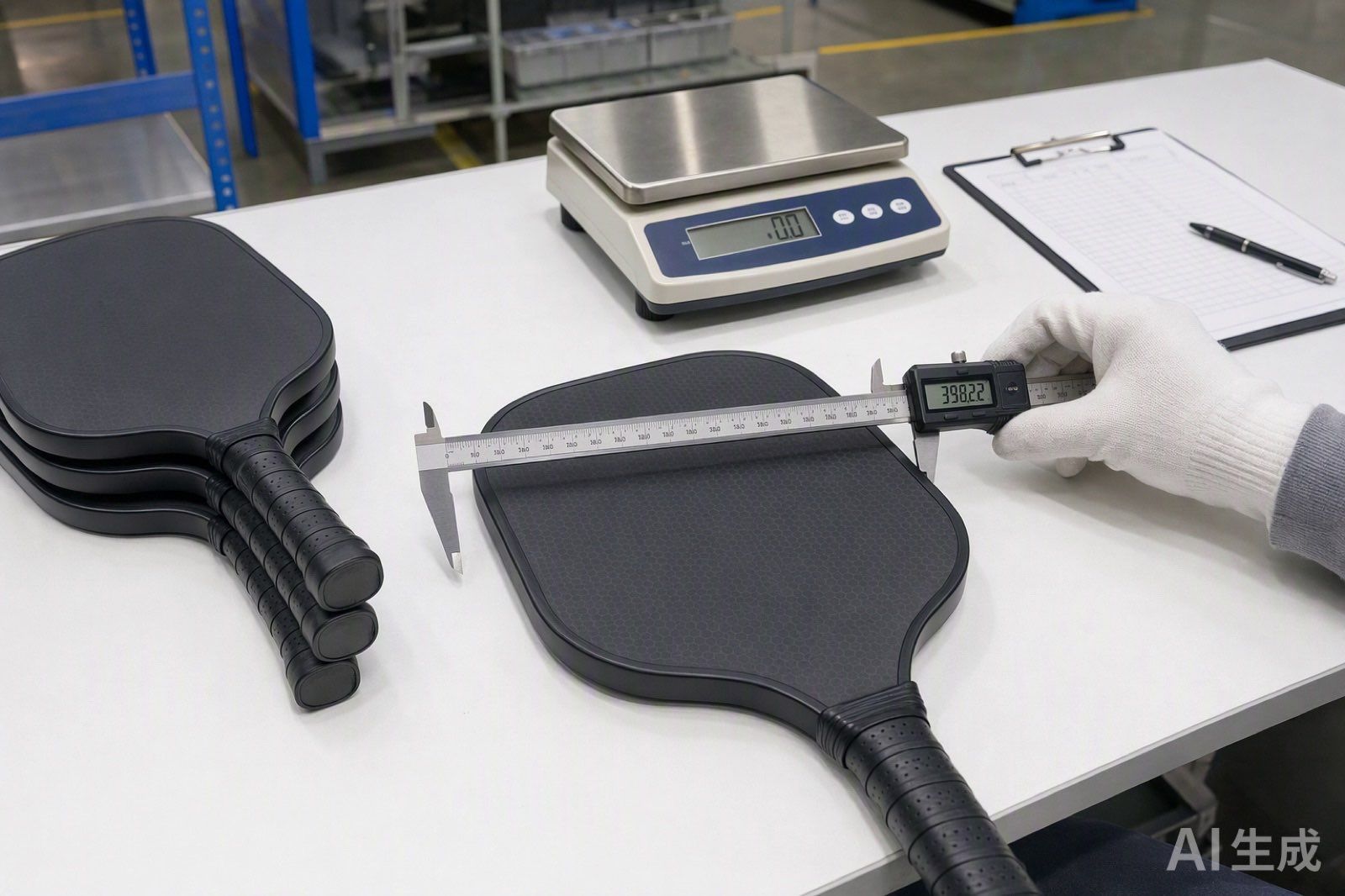
Work backwards from the table above and the required fields fall out on their own. You are not designing a code that describes the paddle — the SKU already does that. You are designing a code that resolves to a production record.
That distinction is where most buyer-drafted clauses go wrong. A clause that says "each paddle shall be marked with a batch number" specifies a string. It does not specify that the string must resolve to anything, who holds the resolving record, or how long they hold it. All three belong in the same sentence, or you have bought a printed character sequence rather than traceability.
| Field | Why it earns its characters | Priority |
|---|---|---|
| Production date or ISO week | Directly answers full-report item (8) and bounds the batch in time without any lookup at all. | Essential |
| Run or batch sequence within that period | Two runs in one week are two different populations. Without this, a one-run problem contaminates the whole week's count under item (7). | Essential |
| Core and face material lot reference | Most paddle failures originate in an input, not an assembly step. This field is what lets you contain by material lot across several production runs instead of by date. | High |
| Press, mould or line identifier | Isolates a tooling-driven defect to one press instead of an entire day's output. This is usually the difference between a partial and a total containment. | High |
| Factory or site code | Matters the moment your supplier subcontracts overflow, which you may not be told about. | Situational |
| Spec or revision marker | Separates units built before and after an engineering change. Without it, a mid-order revision is invisible in the field. | Situational |
The 20-character ceiling, and the dependency nobody mentions
If you intend the code to be machine-readable rather than merely printed, it has a formal home. In the GS1 Application Identifier registry, AI 10 carries the data title BATCH/LOT and the format string N2+X..20 — the two-digit identifier followed by up to 20 alphanumeric characters. AI 11 is PROD DATE at N2+N6, fixed six digits in YYMMDD. AI 21 is SERIAL, again up to 20 characters.
Twenty characters is generous until you try to fit six fields, human-readable separators and a factory prefix into it. Something gets dropped, and the field to drop is whichever one you can reconstruct from the record rather than from the mark.
The more consequential detail is one that generic traceability articles skip entirely. In the GS1 registry, AI 10 carries a requires constraint listing AI 01, 02, 03, 8006 and 8026 — the GTIN and its relatives. A batch number is not a standalone identifier in GS1 terms. It qualifies an item key; it does not replace one. A supplier who prints a lot code on the paddle and no GTIN anywhere in the data carrier has not produced a compliant GS1 batch identification, whatever the label looks like.
This matters commercially the moment a chain retailer audits your barcodes, and it is trivially cheap to specify up front — you already have the GTIN.
Batch granularity: the decision that sets your containment cost
Before the fields, settle what one batch is. Suppliers default to whatever is administratively convenient, which is usually a purchase order or a calendar day, and both are the wrong unit for a technical failure.
The test is straightforward: a batch should be the smallest group of units within which a defect is likely to be common. If a resin drum, a carbon roll, a mould or a press setting changes, that is a boundary — because those are the things that go wrong together. Define a batch as "one PO" and a single bad material lot inside a 5,000-unit order contaminates the entire order in your records, even though it physically touched 800 paddles.
Granularity is not free, and the trade is real rather than rhetorical. Finer batches mean more code changeovers, more record lines and more chances for an operator to mark a run wrong. Coarser batches mean one cheap process and an expensive containment on the day it matters. The sensible resolution for most private-label programmes is to bound a batch by material lot and press, and let the date fall out of that — because material and tooling are what defects actually follow, while dates are merely what calendars do.
Human-readable or encoded?
Specify both, and specify which one governs. The encoded form serves your warehouse and your retail partners. The human-readable form serves the only scenario that actually matters under a 24-hour clock: a customer service agent reading characters off a returned paddle over the phone, at speed, without a scanner. If the two ever disagree — a reprint, a relabel, a repacked return — the PO should say which one is authoritative.
One further caution on encoding schemes that look clever and are not. A code that embeds a plain production date in an obvious format tells anyone holding the paddle how old it is, which invites arguments about shelf age at the retail counter that have nothing to do with quality. A code that is fully opaque avoids that but makes the human fallback useless, because nothing can be interpreted without a lookup that your customer service desk may not have at 9pm. The usable middle is an encoded date component paired with a plainly readable run sequence — enough to bound the population by eye, not enough to invite a conversation about age.
Where the Code Goes on the Paddle, and Why Packaging Is Not Enough
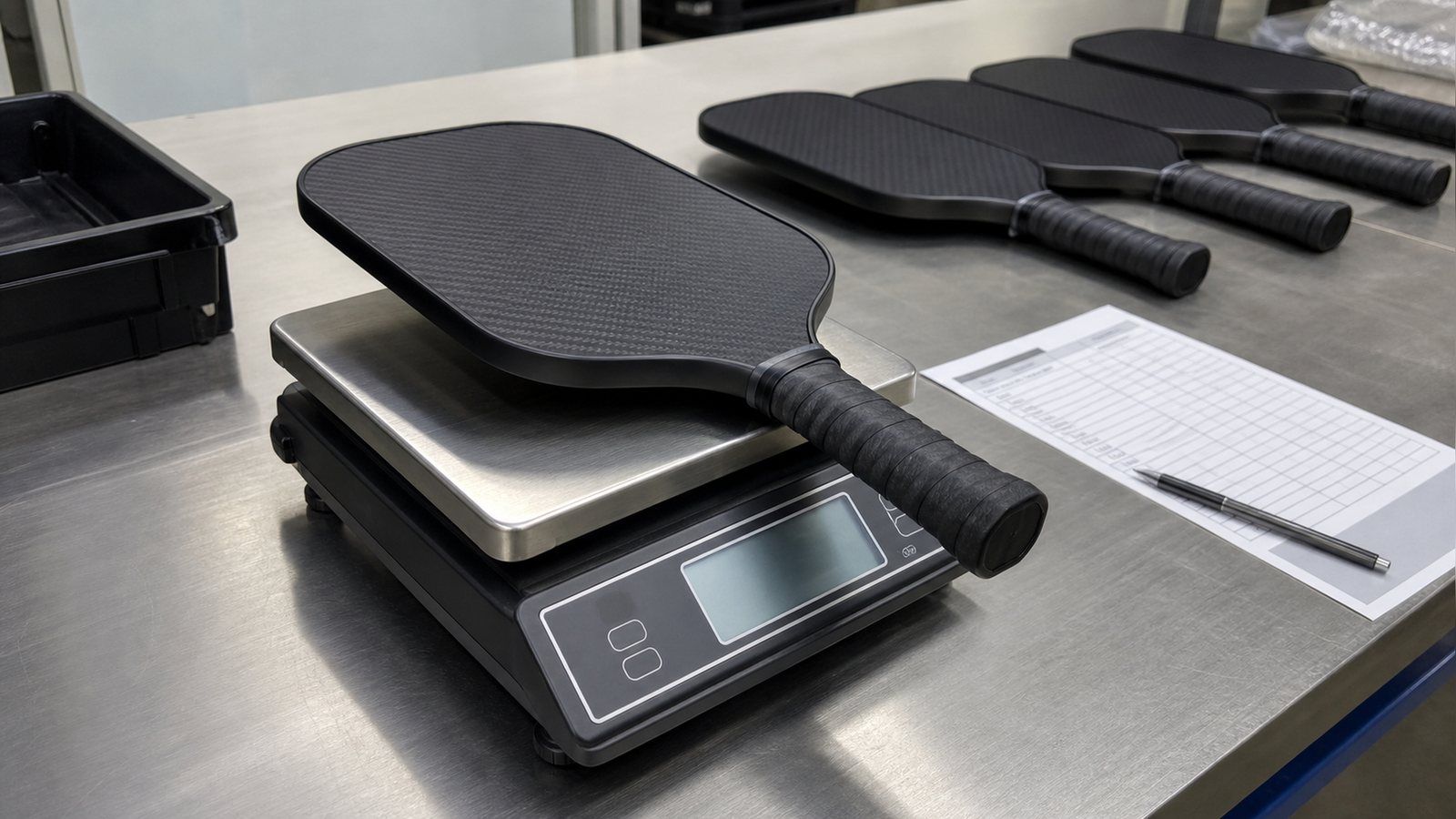
Marking the carton is easy and it is where most suppliers will propose to stop. It fails for a simple reason: the paddle outlives the box by two or three years, and every unit that will ever be the subject of a complaint has long since been separated from its packaging.
If you sell into the European Union, this is not a judgement call. The General Product Safety Regulation (EU) 2023/988, which has applied since 13 December 2024, states in Article 9(5) that manufacturers "shall ensure that their products bear a type, batch or serial number or other element enabling the identification of the product and which is easily visible and legible for consumers, or, where the size or nature of the product does not allow it, that the required information is provided on the packaging or in a document accompanying the product."
Note the structure. On the product is the default. Packaging is a fallback, and the fallback unlocks only when size or nature makes on-product marking impracticable. That exemption exists for a hearing-aid battery. It does not exist for an object roughly the size of a dinner plate. Article 9(6) separately requires the manufacturer's name or trade mark plus postal and electronic address, with the same on-product-first logic.
GPSR also sets what happens next. An operator running a recall must "offer consumers at least two options between repair, replacement, or adequate refund" of the value, and the recall notice must be "clear, transparent and clearly describe the risk at stake, avoiding any terms, expressions or other elements that may decrease consumers' perception of the risk." Two remedies across an unbounded population is a materially different bill from two remedies across one press-week. That difference is bought at the marking station, months earlier, for pennies.
Making the mark survive the product
A paddle is not a benign substrate. The handle is wrapped, and the wrap is replaced by the owner. The face is textured and abrades. The whole object is repeatedly soaked in sweat and wiped down. Any of the usual marking locations can be defeated:
- Under the grip wrap — protected from wear, invisible for exactly the same reason. A customer service agent cannot talk a consumer through unwrapping a handle.
- On a butt-cap sticker — legible and cheap, and the first thing to peel off in a damp bag.
- Printed on the face or throat — visible for life, but it sits inside the cosmetic design and inside the certified surface, which is a constraint discussed below.
- Laser-etched or pad-printed on the edge guard or throat — durable and out of the play surface, and the option that most often survives a real-world return.
Specify the location and the method, not just the content. "Batch code applied" is a term a supplier can satisfy with a sticker that will not be there when you need it.
Which surfaces are actually available on your build
Markable area is a function of construction, so settle it against the spec you are ordering rather than in the abstract. Private-label paddle programmes are typically available in 13mm and 16mm polypropylene honeycomb core thicknesses, with raw T700 carbon or fiberglass faces, in thermoformed unibody or cold-pressed construction, and with a choice of surface texture, edge guard, grip and branding. Against that range, the practical picture is this:
- Edge guard — present on cold-pressed builds and on most thermoformed ones, and the best available surface: durable, out of the play area, and outside the certified face.
- Throat and handle collar — available across the range, and unaffected by grip replacement if the mark sits below the wrap line rather than under it.
- Butt cap — available on every build, but it is a component that can be replaced, so treat a butt-cap mark as secondary rather than primary.
- Face — technically markable, and the one place to think twice. A raw carbon face is a certified surface, and adding a printed element to it is a change to the thing that was tested.
That last point connects back to the delisting discussed below: any marking method that alters the play surface is a specification change, not a labelling detail, and it belongs in the same conversation as the surface texture itself.
Scope note. This article covers the identifier on the paddle itself. Outer-carton shipping marks and country-of-origin marking are a separate specification with different legal drivers, and they do not substitute for on-product identification in either direction. For the wider destination-market picture, see the EU and UK import compliance guide and the overview of CE, CPSIA and REACH obligations for pickleball goods.
What a Real Containment Looks Like: the Facolos Delisting

For pickleball, the event that behaves like a recall usually is not a recall. It is a delisting — and there is a documented, recent one that turns on precisely this issue.
On 28 May 2026, USA Pickleball published a statement on the Facolos Pro Series Elite X. The governing body's own wording:
"Following additional review and testing, the Facolos Pro Series Elite X paddle was found to exceed USA Pickleball's allowable surface roughness standards. During the review process, Facolos acknowledged that the production version of the paddle differed from the version originally submitted for certification testing. Based on these findings, the Facolos Pro Series Elite X paddle has been removed from the USA Pickleball approved paddle list."
Read the middle sentence again, because it is the whole lesson. The paddle did not fail because the design was wrong. It failed because what shipped was not what was certified — the exact divergence that batch identification exists to detect early and bound late.
Why a delisting hits a brand harder than a defect
A defect affects units that are defective. A delisting affects every unit of that model, everywhere, instantly: it cannot be used in sanctioned play, retailers field returns from customers who bought it specifically for tournaments, and the brand damage lands on the name on the paddle — which, for a private-label buyer, is yours and not the factory's.
The question you should be able to answer about your own stock
Put yourself on the receiving end of that announcement with your own brand in the headline. Within the working day, someone will ask you:
- Which production runs used the surface treatment that drifted, and when did the drift start?
- How many units from those runs exist, and where are they — our warehouse, distributors, retail shelves, consumers?
- Which runs are demonstrably unaffected, so we can keep selling them?
- Is there a retained sample from each run we can re-test to prove where the line falls?
With a batch code that resolves to a production record and a retained sample, those are four lookups. Without one, every answer is "the whole model," because you cannot prove otherwise — and "we do not know which units" is functionally identical to "all units" for a retailer deciding what to pull. The scope of your containment is decided by your record structure, not by the size of the actual problem.
This is also why the containment question belongs beside your PBCoR compliance clauses rather than in a separate quality folder. A certification threshold you passed on a submitted sample is a claim about one sample until your records can extend it to a run.
For private-label brand owners and importers at the specification stage. Run this article's own reverse-lookup test on us first — our catalogue is public, so you can check the answer while you read. Our paddle listing carries 19 variants. Sixteen show a code (TX16-001 through TX16-055, plus BQ116); three of the 13mm variants show none at all; and one of the sixteen, TX16-0017, breaks the three-digit pattern the other fifteen follow. Those are SKU and colourway identifiers. They tell you which product, never which run.
The words "batch", "lot", "serial" and "trace" appear zero times on our own OEM page; what it does commit to is approval of a golden reference unit, plus a QC pass run before despatch. That is the honest starting point, not a finished system — so send the field list you are drafting and we will answer it against that, field by field.
Talk through the specHow to Verify a Supplier Can Actually Run It Before You Order

Every supplier will say yes to batch traceability. It costs nothing to agree to in an email. The useful question is not whether they will do it but whether they already can, and there is a test that separates the two in about ten minutes.
The reverse-lookup test
Do this before the PO, not after.
- Take a unit they already made. A sample on your desk, or a paddle from a previous order. Not a unit they select.
- Read the code off it and send only that. No SKU, no order number, no date. Just the characters on the paddle. This is the exact information you would have in a real event.
- Ask four questions. What date was this run produced? Which core and face material lots went into it? How many units were in the run? What QC records exist for it?
- Time the response and read what comes back. A supplier running real lot control answers within a working day from a system. A supplier who is not will ask you for the order number first — which is the tell, because it means the code does not resolve to anything on its own.
The failure mode is specific and worth naming: a code that encodes a date and nothing else, printed for appearance, backed by no lookup table. It passes visual inspection on a sample. It answers none of the questions in 16 CFR 1115.13(d).
Why the ISO 9001 certificate does not answer this
Buyers frequently treat a valid ISO 9001 certificate as settling the question. It does not, and the reason is in the clause itself. ISO 9001:2015 clause 8.5.2 requires an organisation to control the unique identification of outputs when traceability is a requirement, and to retain the documented information needed to enable it.
That conditional is doing heavy lifting. Where lot-level traceability is not a stated requirement of the customer, the standard or the QMS scope, an organisation can hold an entirely valid certificate while operating no lot control whatsoever. The certificate proves a system exists. It does not prove this particular capability is inside it. The question to ask an auditor — or to put on your own factory audit checklist — is whether traceability is defined as a requirement within the certified scope, and to see the procedure that implements it.
What to lock at the golden-sample stage
The sample approval round is your leverage point, because it is the last moment before tooling and process are frozen. Three things belong there:
- The mark on the sample itself. Approve a golden sample carrying a real batch mark in the real location by the real method. An approved sample with no mark silently approves a paddle with no mark.
- The retention agreement in writing. Who keeps a physical retained unit from each run, where, and for how long. A retained sample is what lets you re-test and prove a run is clean instead of writing it off.
- The record retention period, stated in years. Warranty exposure outlives production. Records that expire before your warranty does are records you do not have. Set the number against the warranty term you are actually offering — the reasoning is worked through in the guide on designing a paddle warranty you can honour.
Then check it survived the run
Specifying a mark and receiving one are different events. Add batch-mark presence, legibility and correctness to the inspection scope so it is checked against the shipment rather than against the approved reference unit — the same lot-sampling logic already governing your pre-shipment AQL inspection. Two failure modes are worth calling out to the inspector explicitly: a mark that is present but identical across cartons that came from different runs, and a mark that is present but illegible after the finishing step. Both pass a careless check and both destroy the code's usefulness entirely.
What this does and does not cost
Be direct with your supplier about commercial effects, because vagueness here is where the term quietly disappears. Marking adds a station or an operation, and its cost per unit falls with run size — which means the honest answer to "what does traceability cost" is a function of your order profile, not a number anyone can quote you cold.
The same applies to minimum order quantity and lead time: neither is set by traceability as such, but a new marking method may add a tooling or setup step to the first run, and that lands on lead time once. Ask for all three quoted against your actual size and colourway mix rather than accepting a general assurance. A supplier who cannot break the cost out is telling you the step is not yet real.
Also fix the failure remedy before you need it. If a batch cannot be identified when it matters, the contract should say what follows — because otherwise the population in dispute defaults to the largest one anyone can argue for, and that argument happens after the fact, in a hurry, against your money. The construction of the specific paddle line you are ordering determines which fields are even markable, so settle the two together rather than in sequence.
The Questions to Put to Your Supplier
Traceability on an adult paddle is a purchased capability, not a compliance baseline. Nothing puts it into your order except you — which means the whole of the above reduces to a short list of things to ask, in an order that stops a supplier answering the easy questions and skipping the hard one.
Before you write, split your catalogue. Junior and youth SKUs may be children's products under 16 CFR 1200.2, where marking is statutory rather than negotiable. Everything below is for the adult range, where it is yours to specify.
| Ask this | A good answer looks like | A bad answer looks like |
|---|---|---|
| Here is a code off a paddle you made. What run is it, what materials, how many units, what QC records? | Four specifics inside a working day, from a system. | "Can you send the order number?" — the code resolves to nothing on its own. |
| What defines one batch on your line — a PO, a day, a material lot, a press? | A boundary tied to material and tooling, because that is what defects follow. | "One order is one batch" — a single bad lot then contaminates your whole order in the records. |
| Which surfaces can you mark, by what method, without touching the certified face? | A named surface and a named process, with edge guard or throat offered first. | "We can put a sticker on it" — it will not be there when you need it. |
| How long do you retain the production record, and do you keep a physical unit per run? | A number in years that outlasts your warranty term, and yes. | "As long as needed" — records that expire before your warranty are records you do not have. |
| What does the marking step add per unit at my volume, and does it change the first-run schedule? | A cost broken out against your size mix, and an honest one-off setup note. | "No problem, no charge" — the step is not yet real. |
Send the field list with it, so the conversation is about a specification rather than a concept: production date or ISO week, run sequence, core and face material lot, press or mould identifier, plus site and revision markers if your supplier subcontracts or your spec is still moving. If the mark will be machine-readable, say the GTIN goes alongside it — GS1 AI 10 requires an item key and caps the batch string at 20 characters, and that budget is easier to design within than to retrofit. If you sell into the EU, state that the mark goes on the paddle, because the packaging fallback in GPSR Article 9(5) does not open at this product size.
The comparison worth carrying into that conversation is the one the Facolos statement makes for you. The cost of marking is known, small, and paid up front. The cost of not marking is unknown, unbounded, and paid on the day a governing body publishes your brand name. A buyer who can say "runs 14 through 17, 2,000 units, here is where they went" is negotiating the scope of a problem. A buyer who can only say "we are not sure" has already conceded it.
Frequently Asked Questions
Is batch traceability legally required on pickleball paddles sold in the US?
Not for adult paddles. 16 CFR 1200.2 classes adult-sized sporting equipment as a general use product, so the CPSIA tracking-label mandate does not apply. The separate duty to report a substantial product hazard does still apply to you as importer.
How long do I have to report a problem to the CPSC?
16 CFR 1115.14(e) sets 24 hours from obtaining information that reasonably supports the conclusion. Where the picture is unclear, 1115.14(d) allows an investigation that "should not exceed 10 days" absent a demonstrated reason.
Can the batch code go on the box instead of the paddle?
Not if you sell into the EU. GPSR Article 9(5) puts the identifier on the product and allows packaging only where size or nature prevents on-product marking — an exemption a paddle does not qualify for.
Does an ISO 9001 certificate mean my supplier has lot traceability?
No. Clause 8.5.2 requires unique identification only when traceability is a requirement. A valid certificate can sit above no lot control at all. Ask whether traceability is defined inside the certified scope, and to see the procedure.
How many characters can a batch code have?
For an encoded GS1 batch identifier, AI 10 allows up to 20 alphanumeric characters and formally requires an item key such as a GTIN alongside it. A human-readable code has no such limit, but shorter codes are read back correctly more often.
What does adding batch coding do to unit price, MOQ and lead time?
Marking adds an operation whose per-unit cost falls with run size, so it is quoted against your size mix rather than as a flat figure. MOQ is not driven by traceability. A new marking method can add a one-off setup step to the first run.
Want to source this quality for your brand?
Contact our factory directly on WhatsApp for an instant MOQ and pricing quote.