Pickleball Factory Audit Checklist: ISO 9001, BSCI & the Stations Auditors Miss
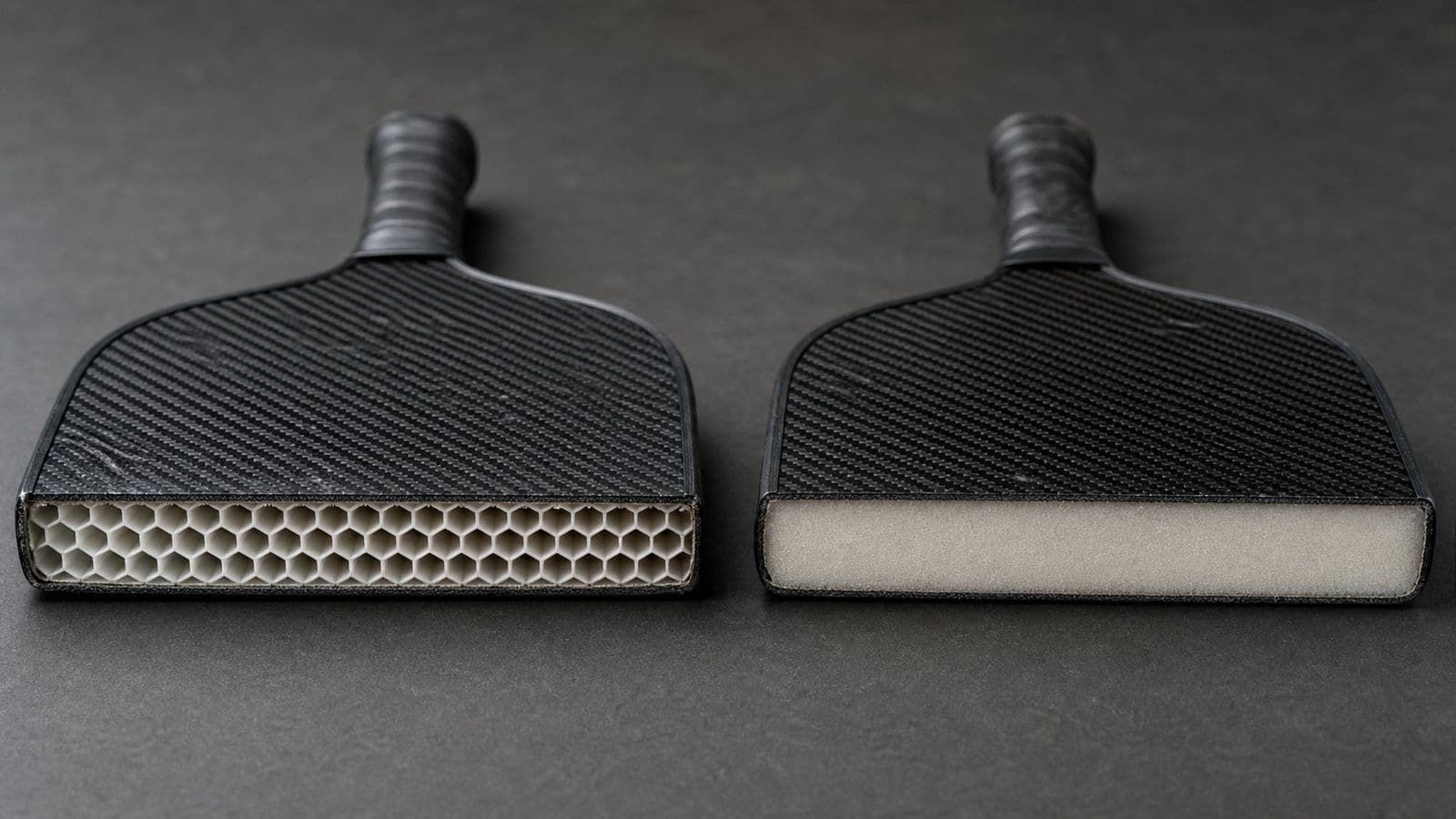
You have a quote for a "factory audit" sitting in your inbox. It is a fixed price, it names a scheme — ISO 9001, amfori BSCI, maybe SMETA — and it does not tell you what the auditor will actually stand in front of for the eight hours he is inside the building. That is the problem. A pickleball paddle is a bonded composite assembly built on a press, and a pickleball is an injection-moulded or rotomoulded shell with holes drilled or moulded into it. Neither of those processes appears anywhere on a generic audit checklist.
So the auditor walks the floor, photographs the fire exits, reads the payroll file, and leaves without ever asking the one question that predicts whether your first container arrives with delaminated faces: can this shop prove what temperature and pressure its press was running when my paddles cured?
This guide is the document-request list plus the station list. The first half is the paperwork any competent auditor asks for, mapped to the clause numbers that give you leverage when a factory says "we don't have that". The second half is the part no generic checklist carries — the specific stations in a paddle-and-ball plant that a non-specialist auditor walks straight past, and what a failure looks like at each one.
- A system audit (ISO 9001, amfori BSCI, SMETA) and a goods audit (AQL pre-shipment inspection) answer different questions. Buying one expecting the other is the most common and most expensive mistake on this list.
- An amfori BSCI audit is 81 questions — 20 crucial, 61 normal — split across 13 Performance Areas. Occupational Health and Safety alone holds 25 of the 81.
- The rating letter sets your clock: a site rated A or B is re-audited in two years; C or below in one year, with a follow-up audit considered.
- SMETA assesses every requirement against both local law and the ETI Base Code, and the higher standard prevails. That is why the same finding can be a legal non-compliance in one country and a code non-conformance in another.
- Nine pickleball-specific stations — prepreg storage, lay-up, core bonding, face moulding, environment control, ball moulding, drilling, weight banding, roughness bench — carry the defects that actually reach your customer. Put them in the audit scope in writing or they will not be looked at.
- ISO 9001 is weeks from a new edition. The FDIS was approved and the committee has scheduled the sixth edition for publication on 16 September 2026. Check which edition your supplier's certificate names before you sign a 2026 supply agreement.
- System Audit or Goods Audit? Get This Wrong and You Buy the Wrong Service
- The Document Request List: What the Auditor Asks For Before He Arrives
- How amfori BSCI Actually Scores Your Factory (81 Questions, 13 Areas, One Letter)
- SMETA, Two Pillars or Four: Choosing the Scope You Actually Need
- The Pickleball Stations a Generic Audit Walks Straight Past
- Findings, CAPs and the Re-Audit Clock: What Happens After the Closing Meeting
- Certificates in 2026: Which ISO 9001 Edition Should Be on the Paper
- Your Audit Decision Checklist
- Frequently Asked Questions
System Audit or Goods Audit? Get This Wrong and You Buy the Wrong Service
Two completely different services get sold under the word "audit", and buyers conflate them constantly. A system audit asks whether the organisation is capable and lawful. A goods audit asks whether one specific lot of paddles is acceptable. Neither substitutes for the other, and a factory that passes one can fail the other badly.
The distinction matters commercially because the failure modes land at different times. A system failure shows up in month six, when the factory that passed your inspection on order one has grown from 40 workers to 90, hired through an agency, and lost control of its press logs. A goods failure shows up in the container you already paid for. You buy the system audit to prevent the first; you buy the pre-shipment inspection to catch the second.
| Audit type | What it examines | What it can never tell you |
|---|---|---|
| ISO 9001 quality management system | Whether documented processes exist, are followed, and are corrected when they fail — including supplier control (clause 8.4), production control (8.5.1) and calibration (7.1.5) | Whether your paddle is any good. ISO 9001 audits conformity to the factory's own stated process, not the fitness of your product |
| amfori BSCI social audit | Working conditions, wages, hours, safety, child and forced labour, environment and business ethics across 13 Performance Areas | Anything about product quality or process capability. A site can hold a rating A and still produce warped paddles |
| SMETA (Sedex) | Labour Standards and Health & Safety (2-pillar), plus Environment and Business Ethics (4-pillar), assessed against both local law and the ETI Base Code | Product conformity. SMETA is explicitly an ethical trade audit, not a technical one |
| Pre-shipment AQL inspection | A statistically sized subset drawn from a finished lot, classified against your defect list before the balance is paid | Whether the factory can repeat the result next month, whether workers are paid, or whether the press is under control |
If you are placing a first order with a Chinese paddle plant, the sequence that wastes the least money is: system audit before you commit tooling, then goods inspection on every early shipment until the process proves stable. Reversing that order means you discover the systemic problem after you have paid for three moulds. For the goods half of that sequence, the mechanics of lot sizing, defect classification and the pass-fail decision are covered separately in our guide to pre-shipment AQL inspection for pickleball orders — this article does not repeat them.
Best for: a system audit is the right first spend if you are committing tooling, signing an annual supply agreement, selling into a retailer that requires social compliance evidence, or moving from a trading company to a direct factory relationship. Not for: a one-off 500-paddle promotional order from a supplier you will never use again. There, a goods inspection alone is proportionate, and if you need to choose an inspection provider, our comparison of third-party inspection agencies covers that decision.
The Document Request List: What the Auditor Asks For Before He Arrives
Every audit begins with a document request sent days before anyone travels. This is the single most useful artifact for you as a buyer, because you can send it yourself, before you spend anything on an auditor, and learn a great deal from how the factory responds. A supplier who returns a complete calibration register in two days is a different organisation from one who asks what a calibration register is.
The ISO 9001 clause numbers below are worth quoting verbatim in your request. They convert a vague ask into a specific obligation the factory's own certificate already commits it to, which removes the "we don't do that here" answer.
| Document | Anchor | What a bad answer looks like |
|---|---|---|
| Approved supplier list with evaluation records for the carbon, core and adhesive vendors | ISO 9001 clause 8.4 | A list with no evaluation dates, or a "we buy from the market" answer for prepreg |
| Work instructions and process parameter sheets for the press and moulding stations | ISO 9001 clause 8.5.1 | Parameters that exist only in an operator's head, or a sheet with no revision control |
| Calibration register and certificates for scales, calipers, durometers, roughness testers and press thermocouples | ISO 9001 clause 7.1.5 | Expired certificates, or a scale on the weight-banding station that appears nowhere in the register |
| Payroll records, time records and employment contracts for a named recent period | amfori BSCI PA 5, PA 6 | Records that are impossibly tidy, or a refusal to release anything before the auditor arrives |
| Age verification records and the young-worker register | amfori BSCI PA 8, PA 9 | No register at all in a plant that employs anyone under the local adult threshold |
| Grievance mechanism records and worker training attendance | amfori BSCI PA 2 | A suggestion box with zero recorded submissions in twelve months |
| Chemical inventory, safety data sheets and storage arrangements for resins, adhesives and solvents | amfori BSCI PA 7, PA 12 | SDSs in a language no worker on the line reads, or none for the adhesive system |
| Fire licence, building safety certificate, evacuation plan and drill records | amfori BSCI PA 7 | Drill records with identical handwriting and no photographs |
| Prepreg and adhesive receiving records, batch numbers and storage logs | Pickleball-specific — ISO 9001 clause 8.4 gives you the hook | No batch traceability from a finished paddle back to a roll |
| Press cure profile records and mould temperature logs for a named production date | Pickleball-specific — ISO 9001 clause 8.5.1 | A single setpoint sheet with no actual recorded values |
| Finished-weight distribution data by band for a recent order | Pickleball-specific — ISO 9001 clause 8.5.1 | Weight sorting that exists as a person with a scale and no recorded output |
Send the list, then read the shape of the reply rather than its contents. Three responses tell you more than any certificate. A factory that returns partial records with a note explaining which ones it does not keep is being honest and is auditable. A factory that returns everything instantly and immaculately, including twelve months of fire drills in one handwriting, has prepared a file rather than run a system. A factory that says the documents will be available on the day is buying time to build them.

How amfori BSCI Actually Scores Your Factory (81 Questions, 13 Areas, One Letter)
Most pages that explain BSCI tell you it produces a rating from A to E and stop there. That is not enough to act on, because the letter is an aggregate of an aggregate, and knowing how it is built tells you which factory weaknesses are survivable and which are not.
The mechanics, from amfori's own audit rating overview guide: an audit consists of 81 questions, of which 20 are crucial questions that "represent the most significant risk of harm to workers" and carry greater weight, with the remaining 61 scored as normal. The auditor answers each one Yes, No, Partial or Not applicable, gathering evidence from interviews, document review and the site tour. Those answers roll up into 13 Performance Areas, each rated A to E, and the 13 Performance Area ratings then combine into the single overall letter you see on the report cover.
The distribution of questions across those 13 areas is where the practical insight sits, and it is lopsided in a way that should change how you brief your auditor.
- PA 7, Occupational Health and Safety, holds 25 of the 81 questions — nearly a third of the entire audit — of which 5 are crucial. Nothing else comes close; the next largest is PA 1 at 7 questions.
- PA 6, Decent Working Hours, is the densest area by risk: only 4 questions, but 3 of them are crucial. Its baseline question 6.1 asks whether the site requires no more than 48 standard working hours per week, without prejudice to the exceptions recognised by the ILO.
- PA 5, Fair Remuneration, carries 6 questions with 2 crucial, covering minimum wage compliance and the legality of deductions.
- PA 1 and PA 12 carry zero crucial questions — 7 and 5 questions respectively. A weak management-system score hurts, but it cannot sink you the way an OHS or hours failure can.
For a composite paddle plant, the concentration in PA 7 is not a statistical curiosity — it is where your risk actually lives. Resin and adhesive handling, solvent storage, dust extraction at the sanding and trimming stations, PPE enforcement at the press, guarding on the drilling station, and chemical exposure controls all sit inside that one Performance Area. A plant that runs composites casually will bleed across those 25 questions and there is no other area large enough to compensate.
The rating thresholds themselves are published, and they are strict in a way most buyers underestimate:
| Overall rating | Published threshold | What it means for your timetable |
|---|---|---|
| A | Minimum 7 Performance Areas rated A, and no PA rated C, D or E | Next full audit in two years |
| B | Maximum 3 PAs rated C, and no PA rated D or E | Next full audit in two years |
| C | Maximum 2 PAs rated D, and no PA rated E | Next full audit in one year; a follow-up audit is considered |
| D | Maximum 6 PAs rated E | Next full audit in one year; a follow-up audit is considered |
| E | Maximum 7 PAs rated E | Next full audit in one year; a follow-up audit is considered |
Read the A row again. A single Performance Area rated C — one area out of thirteen — caps the site at B no matter how good the other twelve are. And the B row means a site can hold a B while carrying three separate areas rated C. If a supplier waves a B rating at you, the useful question is not "what is your rating" but "which Performance Areas came back C, and what was in them". A B built on three C-rated areas including PA 7 is a different supplier from a B built on one C in PA 12.
Check the count before you trust the source. Several widely-read audit-services guides currently describe the BSCI Code of Conduct as having eleven core principles. amfori's own documentation states thirteen — one Performance Area per principle — and its published rating guide enumerates all thirteen by name with their individual question counts. The eleven-principle figure appears to be carried over from an earlier version of the code. It is a small error, but it tells you something useful about the genre: if a page cannot get the headline number right on the most-cited fact of the topic, treat its interpretation of your report with the same caution.
One more thing worth knowing before you try to interpret a report too finely: amfori deliberately does not publish the algorithm that converts the 81 answers into the Performance Area ratings. Their stated reason is to prevent gaming — a factory or auditor targeting a rating by scoring specific questions Yes for maximum arithmetic effect rather than improving actual working conditions. The practical consequence for you is that you cannot reverse-engineer a report to predict a re-audit outcome, and any consultant who claims he can is selling you something.
SMETA, Two Pillars or Four: Choosing the Scope You Actually Need
If your buyer is a European or UK retailer, the request will often name SMETA rather than BSCI. SMETA is not a certification and there is no SMETA pass mark — it is an audit methodology, currently at version 7.0, released June 2024, whose output is a report and a corrective action plan that you upload to the Sedex platform for your customers to read.
The scope decision is binary and it costs real money, so make it deliberately rather than accepting whatever the audit firm quotes by default.
| Scope | Pillars covered | Illustrative on-site time |
|---|---|---|
| 2-pillar | Labour Standards; Health & Safety — plus a basic environment assessment | 2 days |
| 4-pillar | Labour Standards; Health & Safety; Environment; Business Ethics | 3 days |
Those day counts are published by Sedex as illustrative, not contractual — a large multi-building site will take longer. For a paddle plant, the extra day of a 4-pillar audit buys you the full Environment pillar, which covers chemicals, waste management, air emissions, energy and water. In a shop running epoxy systems, solvent wipes and resin waste, that is not a box-tick; it is the pillar most likely to surface something a Western retailer would refuse to accept. If your customer has not specified, and you are sourcing composite goods, 4-pillar is the defensible choice.
Two structural features of SMETA matter more than the pillar count, and neither is well explained on the pages currently ranking for this topic.
First, every workplace requirement is assessed against both local legislation and the ETI Base Code, and the higher standard always prevails. This is why an identical practice can pass in one jurisdiction and fail in another, and why "but it is legal in China" is not an answer to a SMETA finding. Second, and following directly from that, SMETA distinguishes non-compliances (breaches of local law) from non-conformances (breaches of the Base Code). When you read a report, that distinction tells you whether you are looking at a legal exposure that could close the factory or a code gap you have time to remediate. Auditors record them differently; buyers routinely read them as the same thing.
The deliverable to demand by name is the CAPR — the Corrective Action Plan Report. Sedex specifies what it contains: a summary of audit findings, the agreed corrective and preventative actions, the timescales and verification methods for each, and the Management Systems Assessment (MSA) grades. The MSA is SMETA's distinguishing feature, assessing the site's management systems against four factors — in other words, whether the site can prevent a recurrence rather than merely fix the instance. A supplier who sends you a findings list without the CAPR has sent you half the audit.
For importers, distributors and procurement buyers who have decided on a scheme and now need a paddle or ball supplier willing to be audited against it. Our OEM page sets out what we build — OEM and ODM custom paddles and rotomoulded balls, with the construction options, MOQ position, pre-shipment QC and DDP shipping terms stated — so you can judge the fit before you spend anything on an auditor.
See what we manufactureThe Pickleball Stations a Generic Audit Walks Straight Past
This is the section that does not exist on any generic audit checklist, and it is the reason a competent auditor can spend a full day in a paddle plant and hand you a clean report on a shop that is about to ship you delaminated goods. Auditors are trained on schemes, not on composites. Unless your scope document names these stations, they will not be examined.
Two ground rules before the list. First, the audit test at every station below is whether the shop can produce a record, not whether a manager can describe the process well. A confident verbal answer is worth nothing; a logged value with a name and a timestamp on it is worth everything.
Second, where a parameter has a correct value — cure temperature, storage temperature, out-life — that value is defined by the material supplier's own technical datasheet for the specific product in use, not by any figure you can look up on a blog including this one. The audit question always takes the same shape: show me the datasheet, then show me the log, then let me compare them.
Prepreg receiving and cold storage
Carbon prepreg is a perishable material. It arrives frozen, it has a defined out-life at shop temperature, and it degrades if that budget is exceeded. Ask to see the freezer, then ask for the temperature log for the freezer, then ask for the out-life tracking that shows cumulative time each roll has spent out of it. The failure mode is a shop with a freezer and no log, or a log with no link to individual roll batch numbers.
Ask one further question that separates real traceability from theatre: pick a finished paddle from the packing area and ask which prepreg roll it came from. If nobody can answer, batch traceability does not exist regardless of what the quality manual says.
Carbon lay-up and ply orientation
Ply count and fibre orientation determine face stiffness and how the paddle breaks in. Both are set by hand at this station and are invisible in the finished product without destructive testing. Ask for the lay-up schedule for your specific model, then watch the station and count.
Ask how orientation is controlled — a template, a marked table, an operator's judgement — and ask what happens to a part when an operator gets it wrong. A shop that cannot tell you how a mis-laid part is identified and removed is a shop where mis-laid parts ship. If you are comparing weave specifications during this exercise, our breakdown of pickleball paddle quality control checks covers what the finished-goods side of the same question looks like.
Honeycomb core bonding and the press
This is the station that produces delamination, the single most damaging warranty failure in this product category, and it is the station a generic auditor is least equipped to examine. The bond between face and core is made under heat and pressure over time, and all three variables must be recorded, not merely set.
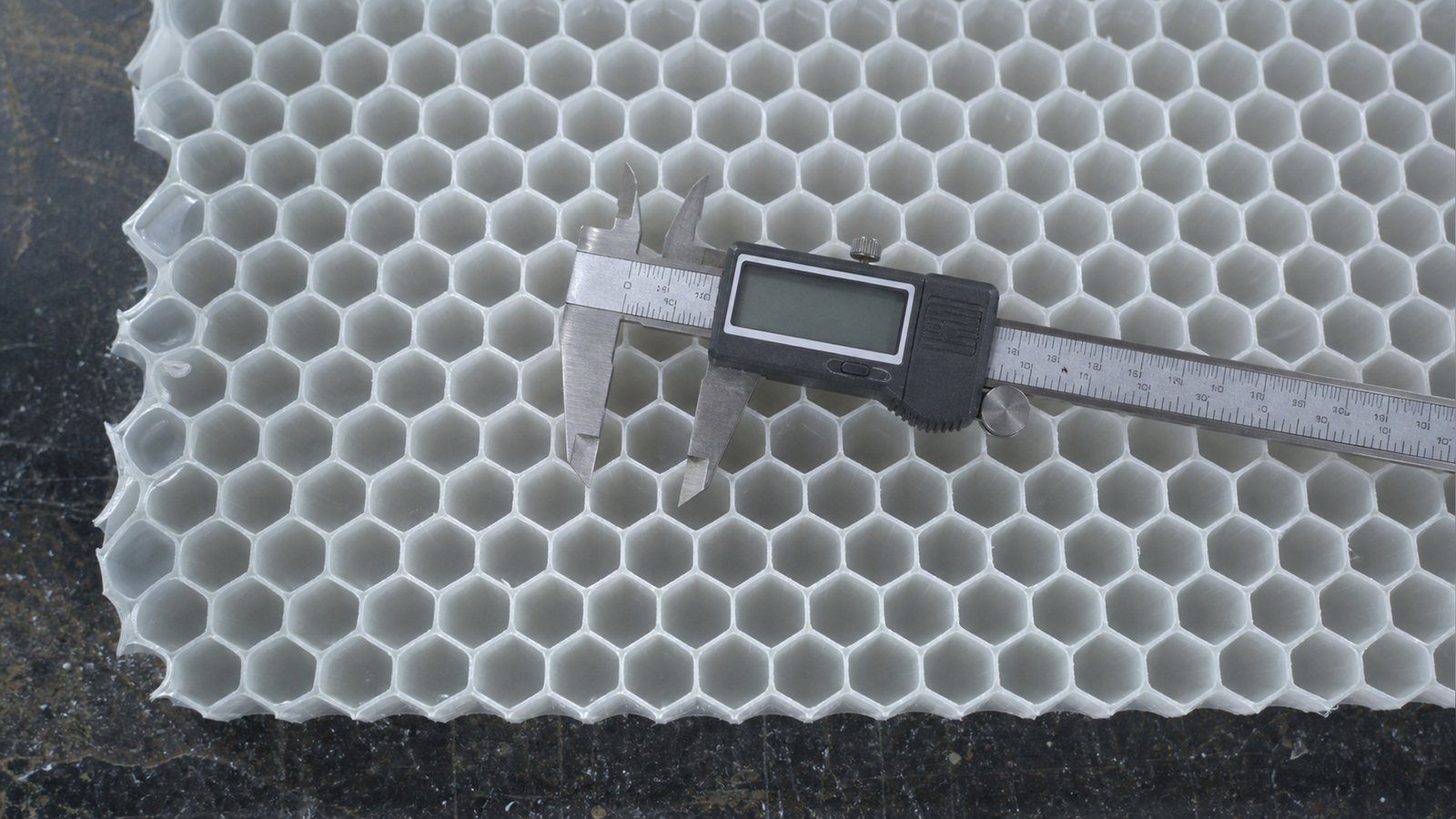
Demand the cure profile record for a named production date — not the setpoint sheet, the actual recorded values. Ask where the thermocouple sits and whether it reads the platen or the part; a platen reading tells you what the machine did, not what the laminate experienced. Ask when the press was last calibrated and cross-check that against the calibration register you requested earlier. The clean failure signature here is a press with a digital controller, a setpoint sheet in a binder, and no stored traces at all — the shop knows what it intended, and has no evidence of what happened.
Face moulding and shot records
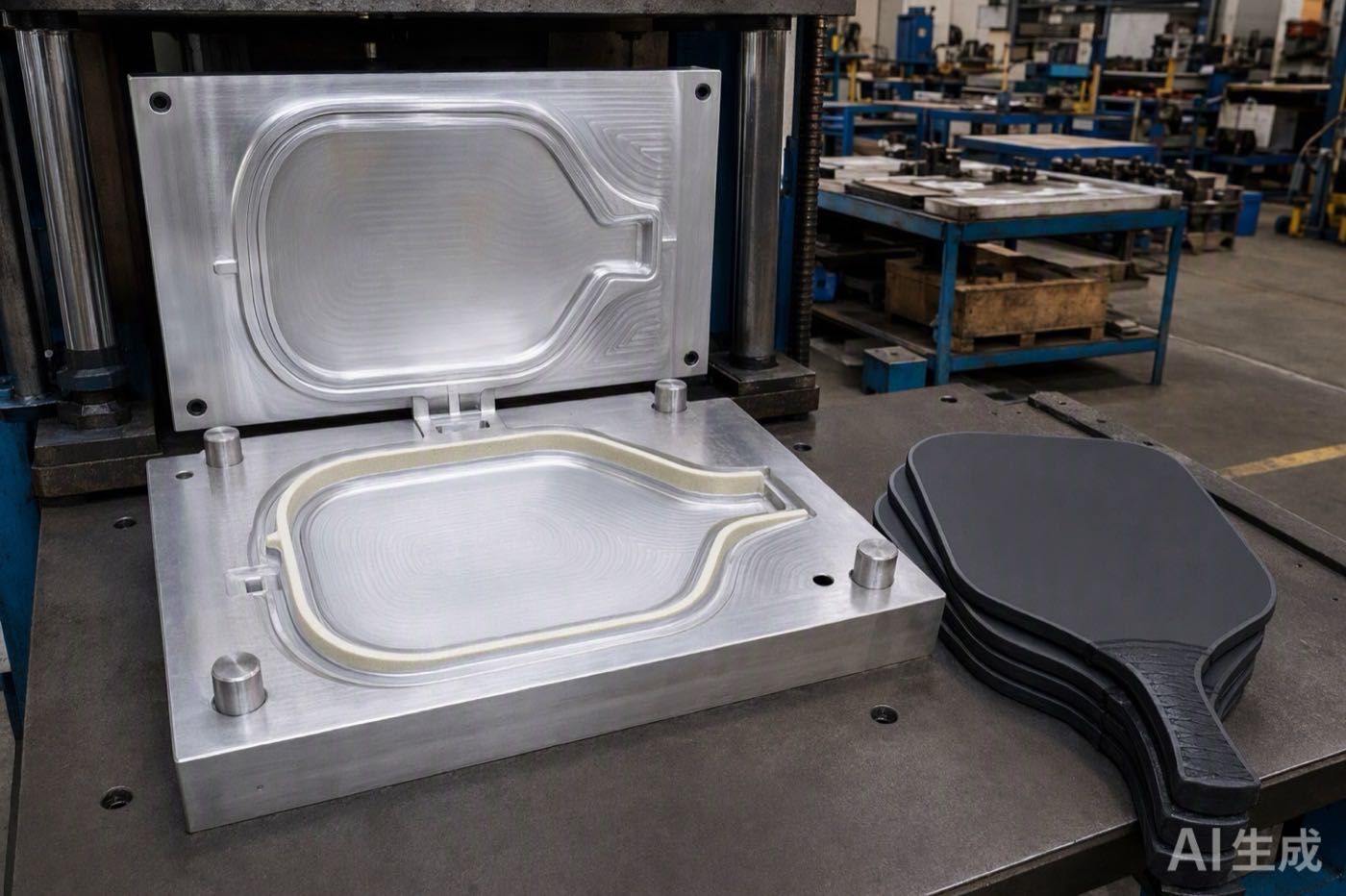
Where faces are moulded rather than pressed flat, each shot has its own temperature and pressure history and its own tool condition. Ask for shot-level records, ask how tool wear is monitored, and ask to see the mould maintenance log. Ask specifically what triggers a tool being taken out of service — a shot count, a dimensional check, or a complaint. If the answer is a complaint, tool wear is being managed by your customers.
Environment control: humidity, temperature and UV
Adhesive and resin systems have stated environmental windows for handling and cure, and prepreg is light-sensitive as well as heat-sensitive. In a shop with the roller door open in August, ambient conditions at the lay-up bench are whatever the weather is doing. Ask whether the lay-up and bonding areas are environmentally controlled, and if the factory says yes, ask for the log. Ask where prepreg and adhesive film sit while waiting to be used and whether they are exposed to direct sunlight through a skylight or open door.
This is also a legitimate PA 12 environment question under BSCI and a natural fit inside the SMETA Environment pillar, which is one practical reason to buy the 4-pillar scope for a composites plant — the environment auditor is already looking at chemical handling, so extending the question to storage conditions costs you nothing.
Ball moulding and the drilling station
Balls fail differently from paddles and get audited even less. USA Pickleball's equipment standard specifies that a ball shall have a minimum of 26 to a maximum of 40 circular holes, with hole spacing and overall design conforming to flight characteristics. Where holes are drilled rather than moulded in, that is a station with a fixture, a drill and a wear pattern. Ask for the fixture check frequency, the burr and flash inspection method, and the scrap rate by cause at that station. Ask what happens to a ball with an out-of-position hole — reworked, scrapped, or blended into the lot.
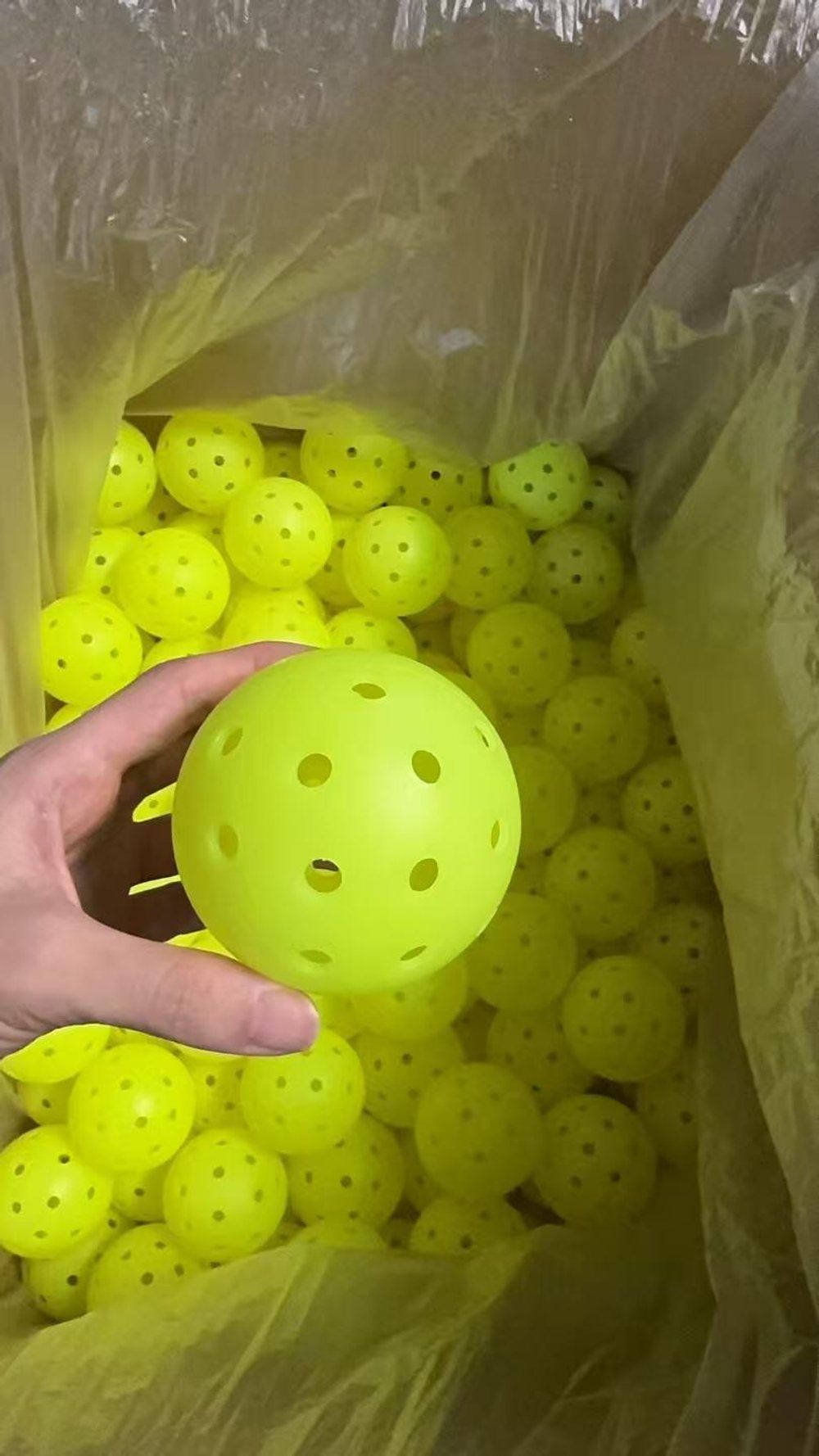
There is a trap here worth flagging, because third-party checklists still copy it. Older guidance lists ball hardness as 40 to 50 on a Durometer D scale at 70°F ± 5°F. The current USA Pickleball manual still records that figure — but explicitly marks it "RECORDED FOR COROLLARY DATA ONLY, this is no longer a compliance requirement". If your auditor or your inspection agency writes up a ball as failing on Shore D, they are working from a superseded requirement, and you will have paid for a finding that is not a finding. The related ball characteristics that do still carry compliance weight, along with bounce and roundness checking, are covered in our guide to wholesale pickleball ball QC.
The finished-weight banding station
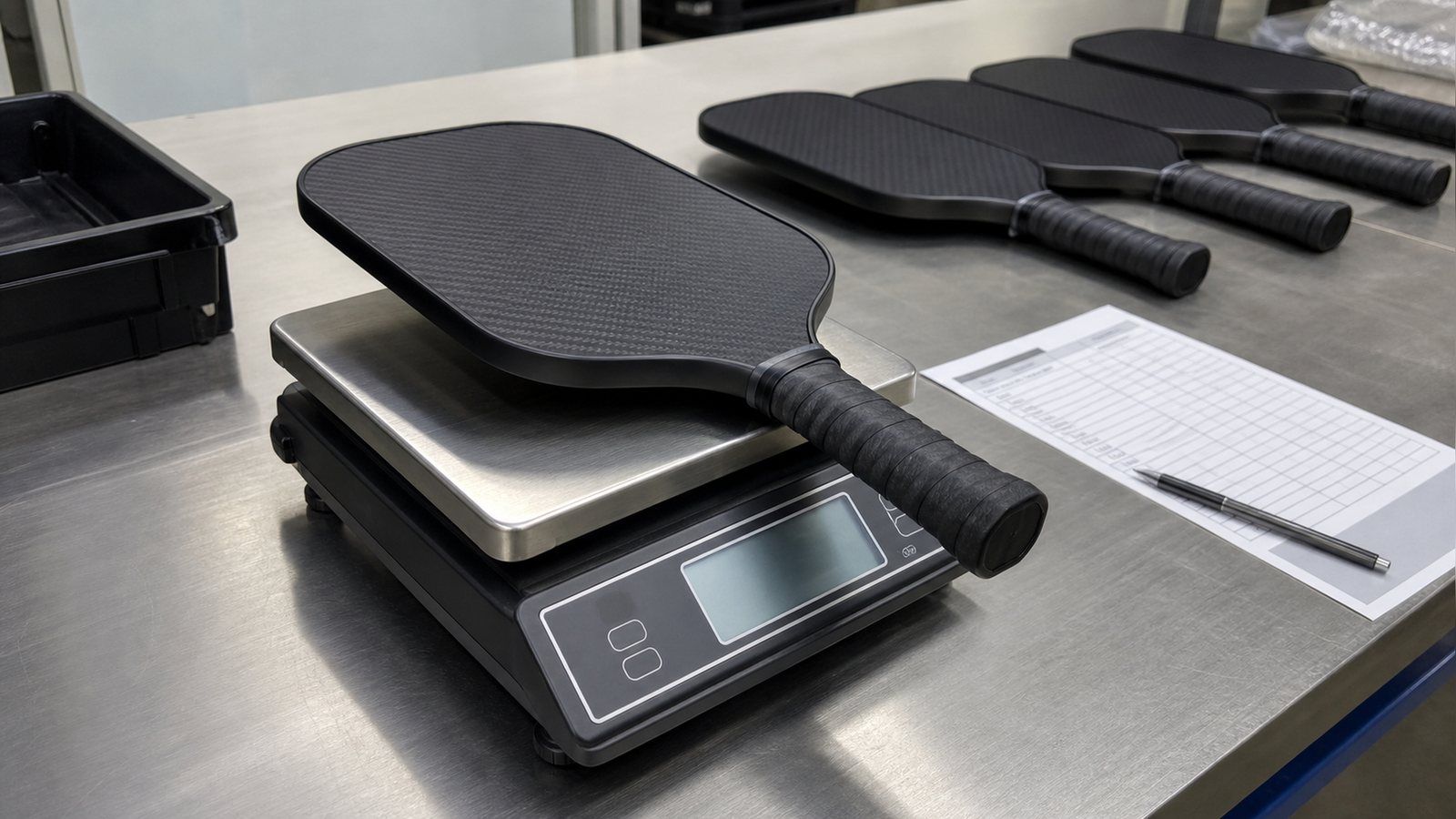
Weight banding is where a factory converts natural process variation into a product promise, and it is almost never audited because it looks like a person with a scale. Whether your PO specifies a tight band or a loose one, the audit question is identical: can this station prove it holds the band you bought?
Be specific in the scope document about which spec range you are auditing against, because "in tolerance" means nothing without a stated band.
Published limits versus your own PO
Write down the characteristics that carry a published limit and the ones that are purely contractual.
The published ones are fixed and checkable by anyone: paddle surface roughness at an average no greater than 30 µm Rz and 40 µm Rt across six directions per face, and ball hole count between 26 and 40 circular holes.
The contractual ones have no external authority behind them at all. Core thickness carries no published limit — it is whatever your purchase order specifies — and the same is true of finished weight bands, grip circumference and grip length, which are set model by model. Not one of those figures is imposed by any standards body, which means none of them can be verified by pointing at a standard.
They are whatever your purchase order says, which is exactly why the auditor needs your PO in hand and not just the standard, and why you should state your own thickness range and weight band in the scope document rather than assuming a shared industry default exists. A factory audited against a standard it does not need to meet, while your own band goes unexamined, is an audit you paid for and did not receive.
Ask for the weight distribution data for a completed order, not a summary — the actual spread. Ask what happens to parts that fall outside every band you buy, because that answer tells you the real economics of the station: if out-of-band paddles have nowhere to go, they have somewhere to go, and it is your carton. Ask whether the scale on that station appears in the calibration register, and check. A scale that weighs every paddle you sell and is not in the register is a genuine ISO 9001 clause 7.1.5 finding your auditor can write up on the spot.
The surface roughness bench
If you sell into tournament channels, surface texture is a compliance characteristic and the factory should be checking it in-house rather than discovering problems at the certification lab. USA Pickleball's manual sets the limits as an average of no greater than 30 micrometres on the Rz readings and no greater than 40 micrometres on the Rt readings, using a Starrett SR160 or SR300 surface roughness tester or equivalent, with readings taken in six different directions on each face and averaged per face.
Three audit questions follow directly. Does the shop own a roughness tester at all, or does it send parts out? Is that tester in the calibration register? And does the operator take readings in six directions per face as the method requires, or two directions to save time — because an average built from the wrong sample is a number that will not reproduce at the certification lab. For context on how the wider certification process consumes these measurements, see our comparison of USAP, UPA-A and IFP paddle certification routes.
A worked scope document you can reuse
Here is how the above converts into something you can paste into an email to an audit firm. Assume a 5,000-paddle first order from a new supplier, 4-pillar SMETA plus a technical add-on.
- State the scheme and scope explicitly: "SMETA 7.0, 4-pillar" — not "a social audit".
- Attach the document request list above, and require it to be returned complete before the on-site date is confirmed.
- Name the nine stations in a technical add-on clause: prepreg storage, lay-up, core bonding and press, face moulding, environment control at lay-up and bonding, ball moulding, drilling, weight banding, roughness bench.
- For each station, require the auditor to record the datasheet, the log, and whether they agree — rather than a subjective observation.
- Require photographs of the calibration labels on the press thermocouple, the weight-banding scale and the roughness tester, and the register entries for all three.
- Require batch traceability to be demonstrated live: one finished paddle chosen by the auditor, traced back to a prepreg roll and a press cure record.
- Require the CAPR with MSA grades as a named deliverable, with timescales and verification methods for every finding.
Step 6 alone is worth the add-on. Traceability either exists or it does not, it takes twenty minutes to test, and no amount of document preparation can fake it on the day.
Findings, CAPs and the Re-Audit Clock: What Happens After the Closing Meeting
An audit that produces no findings is not a good audit; it is usually a shallow one. What separates a supplier worth developing from one worth leaving is entirely what happens in the eight weeks afterwards.
The corrective action plan is the instrument, and Sedex is specific about what a usable one contains: the findings, the agreed corrective and preventative actions, the timescales, and the verification methods. Hold the plan to all four. A plan that lists findings and actions but no verification method is a promise with no test attached, and it is the most common thing suppliers send.
The distinction that decides whether a CAP is real is between correction and corrective action:
- Correction fixes the instance. The blocked fire exit was cleared.
- Corrective action addresses why it was blocked. Nobody owned the aisle, so finished cartons accumulated there every time the packing line ran ahead of the truck — so the fix is an owner and a rule, not a broom.
A CAP full of corrections and empty of root causes will produce the same findings at the next audit, which you will pay for again.
Planning the calendar
Plan the calendar backwards from your production window rather than forwards from today, because the audit is not the long pole — the remediation is. On-site time itself is short and published: Sedex gives 2 days illustrative for a 2-pillar SMETA and 3 days for a 4-pillar.
What is not publishable as a general number is the total elapsed lead time from booking to a closed-out CAP, because it is set by three things nobody can quote in advance: the audit firm's scheduling queue in that province, how complete the document pack was when it arrived, and how many findings need physical work rather than paperwork.
Ask your audit firm for its current booking lead time in writing when you request the quote, and ask the factory for its proposed closure date per finding rather than an overall promise. Treat any supplier who commits to closing every finding in the same round number of days as having not read them.
That next audit is not a matter of preference. Under amfori BSCI the rating sets the interval directly: two years for a site rated A or B, one year for a site rated C or below, with a follow-up audit considered whenever a site comes in at C or below. Build that into your supply agreement — if you are signing an annual contract with a C-rated site, you are signing up to an annual audit cycle whether or not you budgeted for one.
What we publish, what we check, and where we stop
What we are not publishing here, and why. This guide deliberately contains no audit findings, defect rates, corrective action records or certificate numbers from our own operations or our customers' orders — audit reports and CAPs belong to the parties who commissioned them, and a supplier who publishes another buyer's findings will publish yours. What you get instead is the standards-based answer to what an auditor should look at and what counts as a failure at each station: the part that is portable to any factory you are evaluating, including ours.
- What you can check about us before you call. Apply step 1 of this article to us. The registered entity behind this site is Jinhua Lidu Sports Goods Co., Ltd., registered capital 1,000,000 RMB, business scope covering sports equipment manufacturing, at Building 4, Bailongqiao Town Linjiang Industrial Zone, Wucheng District, Jinhua City, Zhejiang. That is the name to run through the National Enterprise Credit Information Publicity System yourself, and the address the business licence must match — the exact test step 1 tells you to run on any supplier. Our published order floors are 50 pcs for paddles and 1,000 pcs for balls, and our OEM manufacturing page states what we tool for: raw T700 carbon and fiberglass faces on 13 mm and 16 mm polypropylene honeycomb cores, thermoformed unibody or cold-pressed. Put those numbers in the scope document if you audit us — and demand the equivalent in writing from anyone else.
- Where we stop. We do not sell audits, inspections or certification consulting — if you audit us, you engage the audit firm directly and the findings are yours. What we will do is hand over the records this article tells you to ask for: press cure profiles, the calibration register, prepreg receiving and storage logs, and weight distribution data for a completed order.
- Two caveats we would rather state than have you discover. We hold no BSCI or SMETA rating letter to show you, because no customer has yet commissioned one at this site — if your retailer requires it, that audit is a project we would be starting with you, not a certificate we can email. And the 360° tour and production-floor gallery on our factory page are marketing footage we chose; they are not a substitute for the unannounced walk this article argues for.
If a supplier, including us, hesitates at that unannounced-visit request, you have learned the thing the audit was going to tell you anyway.
Certificates in 2026: Which ISO 9001 Edition Should Be on the Paper
If you are signing a supply agreement this quarter, there is a timing issue worth thirty seconds of your attention. ISO 9001 is mid-revision, and the certificate your supplier emails you may be about to name a superseded edition.
The verifiable position as of 26 August 2026, from the ISO/TC 176/SC 2 committee's own news page: the revision passed the Draft International Standard stage, reached Final Draft International Standard (FDIS), and the ISO/FDIS 9001 ballot closed on 9 July 2026. In its 7 August 2026 update the same committee confirmed the result and the date: "ISO/FDIS 9001 has been approved with overwhelming international support. The sixth edition of ISO 9001 is scheduled for publication on 16 September 2026." That date now comes from the standards committee itself rather than from certification-body guidance — so if you are signing a supply agreement this quarter, treat a new edition as weeks away, not as a rumour.
The transition arrangements follow the same caution. Certification bodies consistently describe an expected three-year transition period from publication, which would run to roughly September 2029 — but they themselves flag that the transition timetable is subject to formal confirmation by the International Accreditation Forum (IAF). Nobody, including your supplier's certification body, can give you a binding date yet.
Separately, and already in force, ISO 9001:2015 carries Amendment 1:2024, "Climate action changes", which added climate-change wording to clauses 4.1 and 4.2 — the organisation must determine whether climate change is a relevant issue in its context. It is a small amendment with a practical consequence at audit: a supplier whose context analysis has not been touched since 2019 is now demonstrably out of date, and a competent auditor will say so.
What to do with this, concretely — three things to read off the certificate PDF before you file it:
- The exact standard designation including the year. "ISO 9001" with no year on a certificate is a drafting failure by the certification body and worth querying on its own.
- The certification body and its accreditation mark. An unaccredited certificate is a commercial document, not an assurance one.
- The expiry date against your contract term. A certificate expiring inside your supply agreement means a recertification audit you have no visibility of.
Then write the supply agreement so it survives the edition change — require the supplier to "maintain accredited certification to the current published edition of ISO 9001, and to complete transition to any superseding edition within the transition period set by the accreditation body". That sentence holds regardless of what date ISO actually publishes on, which is exactly why it is worth using while the date is still uncertain. Buyers shipping into Europe should read this alongside the separate marking and documentation obligations covered in our guide to EU and UK import compliance for pickleball goods.
Your Audit Decision Checklist
Work through these in order. Each one is answerable before you spend money, and together they are the difference between an audit that produces a report and an audit that produces leverage.
- Decide which audit you are buying. System audit for capability and lawfulness; AQL goods inspection for one specific lot. If you are committing tooling or signing annually, the system audit comes first.
- Send the document request list yourself, before you hire anyone. The shape of the reply is free intelligence.
- If a BSCI report already exists, ask which Performance Areas came back C — not just what the overall letter is. One C caps a site at B; three C's still permit a B.
- For a composites plant, choose SMETA 4-pillar unless your customer has specified otherwise. The Environment pillar is where chemical and waste handling gets examined.
- Name the nine pickleball stations in the scope document in writing. Nothing outside the scope gets looked at, and no generic checklist contains them.
- Test batch traceability live. One finished paddle, chosen by the auditor, traced back to a prepreg roll and a press cure record. Twenty minutes, unfakeable.
- Demand the CAPR with MSA grades, and reject any plan without verification methods and timescales.
- Check the edition year on the ISO 9001 certificate and write the supply agreement to survive the pending revision.
One closing note on proportion. Not every order justifies this. A 500-paddle promotional run from a supplier you will not use again does not need a 4-pillar SMETA and a nine-station technical add-on — it needs a goods inspection and a realistic view of the risk. The full exercise above earns its cost when you are committing tooling, signing annual volume, or putting your own brand name on the product, because in all three cases you are buying the factory's process rather than a carton of paddles.
For importers, distributors and procurement buyers who want to talk through which stations belong in the scope document for a paddle or ball order before they commission an auditor. Message us on WhatsApp and we will go through the station list against what you are actually ordering. This is a scope conversation only — nothing is sent, booked or downloaded.
Talk through your audit scopeFrequently Asked Questions
How many questions is an amfori BSCI audit?
81 questions in total: 20 crucial questions carrying greater weight, and 61 normal questions. They are divided across 13 Performance Areas, each rated A to E, which combine into the single overall rating letter.
How long is an amfori BSCI audit valid?
The rating sets the interval. A site rated A or B is scheduled for its next full audit in two years; a site rated C or below in one year, with a follow-up audit considered.
What is the difference between a SMETA non-compliance and a non-conformance?
A non-compliance is a breach of local law; a non-conformance is a breach of the ETI Base Code. SMETA assesses against both and the higher standard prevails, so the label tells you whether you face a legal exposure or a code gap.
Should I book a 2-pillar or 4-pillar SMETA audit for a paddle factory?
4-pillar, unless your customer specifies otherwise. The extra pillars cover Environment and Business Ethics, and a plant running epoxy systems and solvent waste is exactly where the Environment pillar earns its extra illustrative day on site.
Does a factory audit check my paddles for defects?
No. A system audit examines process, records and working conditions. Checking a finished lot against a defect list is a separate pre-shipment AQL inspection, and passing one does not predict the other.
Is pickleball hardness of 40-50 Shore D still a compliance requirement?
No. The USA Pickleball manual still records the 40 to 50 Durometer D figure but marks it as recorded for corollary data only and no longer a compliance requirement. Checklists that still fail balls on it are using superseded guidance.
Which ISO 9001 edition should my supplier's certificate show in 2026?
ISO 9001:2015 remains the published edition today. The FDIS was approved and ISO/TC 176/SC 2 has scheduled the sixth edition for publication on 16 September 2026, followed by a transition period still subject to IAF confirmation.
What single test best exposes a factory that prepared a file instead of running a system?
Live batch traceability. Have the auditor pick one finished paddle from packing and trace it back to a prepreg roll and a press cure record. It takes about twenty minutes and cannot be prepared in advance.
Want to source this quality for your brand?
Contact our factory directly on WhatsApp for an instant MOQ and pricing quote.