PBCoR Testing: Writing Compliance Into Your Paddle Spec
PBCoR testing is a laboratory measurement of how much energy your paddle gives back to the ball. USA Pickleball caps it, and since 1 November 2025 the not-to-exceed limit has been 0.43 — down from the 0.44 that took effect on 1 November 2024. Both figures, and both dates, are written into clause 2.E.6.f of the USA Pickleball Equipment Standards Manual. If you are commissioning a private-label paddle in 2026, 0.43 is the number your build has to live under, and a spec sheet still quoting 0.44 is nine months out of date.
That single fact is where most sourcing conversations go wrong. The test itself is not complicated to understand, and it is not the hard part. The hard part is that PBCoR compliance is not a one-time gate you pass at sampling — the manual obliges a paddle to stay compliant across its entire useful life, including any change that makes it more powerful as it wears. That clause, not the test protocol, is what puts a private-label brand at risk.
Key takeaways
- The PBCoR not-to-exceed limit is 0.43, effective 1 November 2025. The earlier 0.44 limit applied from 1 November 2024 (Equipment Standards Manual, clause 2.E.6.f).
- PBCoR is one of five published pass/fail measurements. Surface roughness, friction, gloss and dimensions are tested alongside it — passing PBCoR alone does not make a paddle approved.
- Clause 2.F.2.a requires compliance over the paddle's entire useful life, "inclusive of any degradation to benefit". A paddle that gets hotter as its core breaks in is non-compliant even though it passed on day one.
- Changing core material, surface material or any other significant feature forces a new model designation under clause 2.E.7 — which means a new submission, not a spec tweak riding an existing approval.
- USA Pickleball does not publish a fee schedule this article could verify from a primary source. No cost figure appears below, on purpose.
- You may not market a paddle as USA Pickleball Approved before testing is complete and the model is listed on the public database.
What PBCoR Testing Actually Measures on Your Paddle
PBCoR stands for Paddle/Ball Coefficient of Restitution. In the laboratory it is a rebound measurement: a ball is fired at a secured paddle and the inbound and outbound speeds are compared. The ratio that comes out is a number between zero and one describing how much of the ball's speed survives the collision. A dead paddle returns very little. A springy one returns more. The limit sets a ceiling on how much is allowed.
What matters for a manufacturing programme is not the physics but where the number lives in the rulebook. PBCoR is not a standalone standard with its own document. It sits inside clause 2.E.6.f of the Equipment Standards Manual, under the heading "Prohibited Surface Features and Mechanical Features" — the same clause that bans "springs or spring-like material, flexible membranes or any compressible material that creates a trampoline effect."
Read that placement carefully, because it changes what the test means. PBCoR is the instrument that decides whether a construction has crossed into prohibited territory. The rule is not "your paddle may score up to 0.43." The rule is "compressible, trampoline-effect construction is prohibited, and this is how we measure whether yours is." A build that clears the number is legal; a build that exceeds it is not merely too powerful, it falls under a prohibition.
The limits are measured by the USA Pickleball PBCoR Test Protocol, which the manual states is published by Element U.S. Space & Defense — the independent laboratory USA Pickleball works with. The test arrived with Revision 3 of the manual in January 2025, introduced specifically "to characterize the level of power for a pickleball paddle." Before that revision, the approved-paddle test suite had no direct power measurement at all; roughness and friction governed spin, and nothing governed pop.
One point worth settling early with any factory: PBCoR is a power test, not a spin test and not a texture test. Factories sometimes conflate them, because surface roughness had been the headline compliance issue for years. They are separate measurements with separate limits and a paddle can comfortably pass one and fail the other.
The 0.43 Deadline Has Already Passed: What Changed and When
The manual sets out the schedule in two lines. PBCoR limits are not to exceed 0.44 effective 1 November 2024, "and will be reduced to 0.43 effective 1 November 2025." As of August 2026, the tighter limit has been in force for nine months.
This is the single most common source of stale information in paddle sourcing right now. USA Pickleball's own announcement page, which still ranks well for PBCoR queries, describes the standard as launching in Q4 2024 and frames the discussion around the introduction rather than the current ceiling. Technical analyses published during the roll-out quote 0.44. Neither is wrong for its date; both are wrong for an order placed today.
| Date | What applied | Source |
|---|---|---|
| Q4 2024 | PBCoR announced as an enhanced testing standard to limit the trampoline effect | USA Pickleball equipment news |
| 1 November 2024 | Not-to-exceed limit of 0.44 | ESM clause 2.E.6.f |
| January 2025 | PBCoR formally written into the manual at Revision 3 | ESM, Revision 3 update note |
| 1 July 2025 | A named set of previously approved models sunset for sanctioned tournament play | USA Pickleball certification updates |
| 1 November 2025 | Limit reduced to 0.43 — the figure in force today | ESM clause 2.E.6.f |
The July 2025 sunset deserves attention from anyone treating certification as permanent. Several paddle models that had been through approval — including specific Joola Perseus, Gearbox and ProKennex variants named by USA Pickleball — were withdrawn from sanctioned tournament play on a published date. Those were established brands with resourced compliance functions. The lesson for a private-label buyer is not that those companies did something unusual; it is that an approval already granted is not a permanent asset.
There is also a standing mechanism for further change. The manual closes with a note that USA Pickleball "reviews equipment testing standards periodically and, with proper notification (via Notice of Proposed Rulemaking – NPRM process) to Manufacturers, reserves the right to modify equipment specifications as needed." A paddle programme planned over a two- or three-year horizon should assume the specification will move again, and should be structured so that a move does not strand inventory.
The Other Four Tests a Paddle Must Pass Alongside PBCoR
PBCoR gets the attention because it is new. It is not the only thing your paddle is measured against, and in production the older tests fail more paddles than the new one does. A useful habit when reading a factory's test claims: ask which of the five they actually ran.
| Measurement | Published limit | Clause |
|---|---|---|
| Power (PBCoR) | 0.43 not to exceed (from 1 Nov 2025) | 2.E.6.f |
| Surface roughness | Average no greater than 30 µm Rz and 40 µm Rt; no single reading above 33 µm Rz or 44 µm Rt, six directions per face | 2.E.2.a.1 |
| Coefficient of friction | Maximum kinetic coefficient of friction ≤ 0.1875, per ASTM D1894-14 | 2.E.2.a.2 |
| Gloss / reflection | No measurement above 80 GU at the 60° universal angle — edge guards included | 2.E.2.b |
| Dimensions | Combined length + width ≤ 24 in (60.96 cm) including edge guard and butt cap; length ≤ 17 in (43.18 cm); no thickness restriction | 2.E.3 |
Three practical consequences follow from that table, and each one has cost somebody a production run.
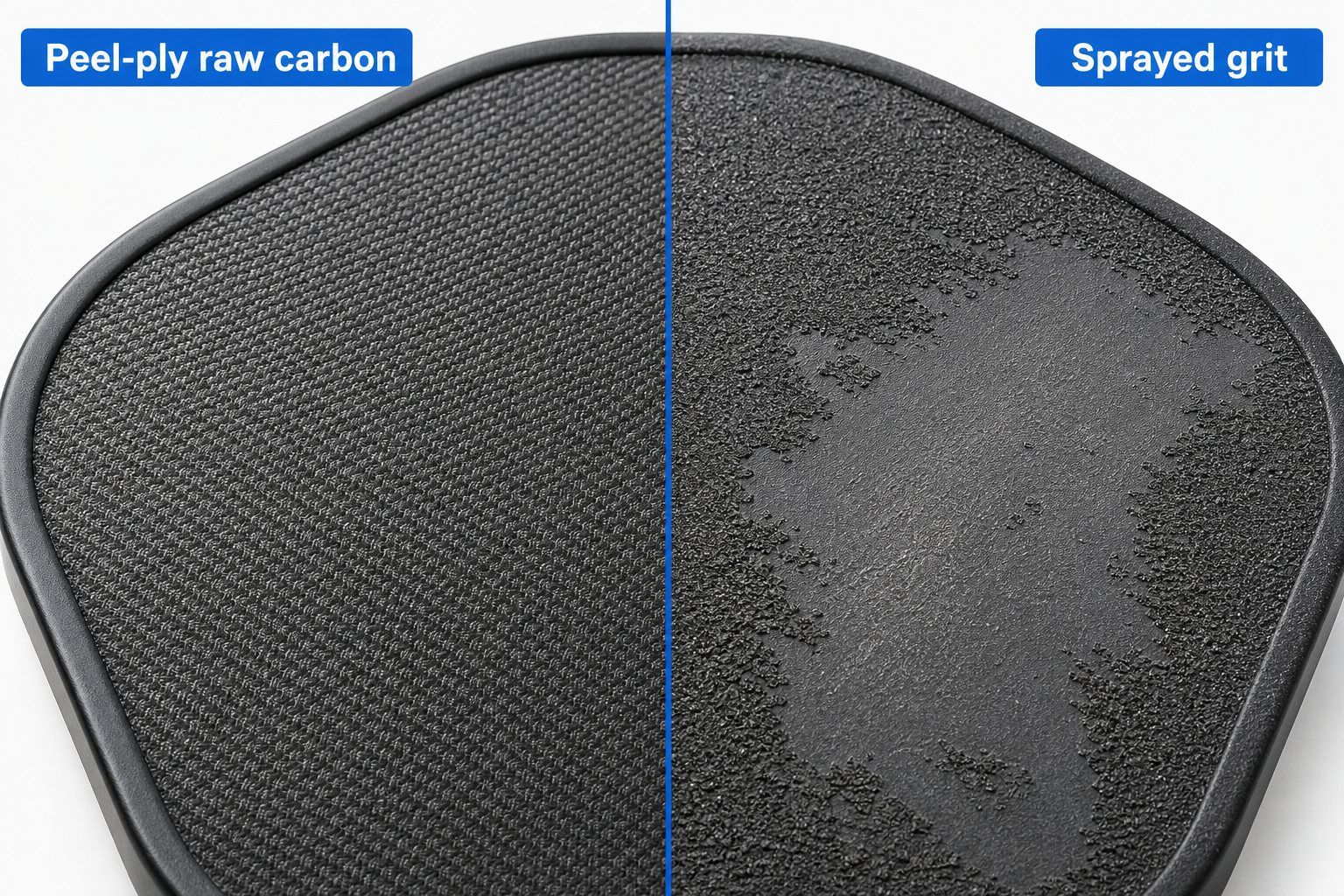
The roughness rule has a single-point cap, not just an average. A face can average 28 µm Rz across six directions and still fail because one reading came back at 35 µm. Texture that is slightly uneven across the face — a common outcome when a peel-ply or spray texture is applied inconsistently — fails on the outlier, not the mean. If your factory reports only an average, they have reported half the test.
The gloss limit applies to the edge guard. This catches brands that specify a restrained matte face and then a high-shine edge guard for shelf appeal. The 80 GU ceiling covers "paddles & edge guards" as one requirement. A cosmetic decision made by a packaging designer can fail a compliance test.
Thickness and weight are unrestricted; the combined dimension is not. The manual explicitly states there is no restriction on paddle thickness and no restriction on paddle weight. So a 16 mm core is not inherently a dimensional problem. What is constrained is the 24-inch combined length-plus-width envelope, measured including the edge guard and butt cap — which is where elongated shapes get tight, because the edge guard counts.
Which Build Decisions Move PBCoR — and Where the Headroom Question Really Sits
The question every private-label buyer eventually asks is: what in my paddle actually drives this number, and how close to 0.43 is it safe to be?
The first half has a defensible answer. The clause PBCoR sits under names the mechanism directly — compressible material and flexible membranes that create a trampoline effect. Anything in the build that lets the hitting surface deflect and spring back is what the test is looking at. In practice that points at a short list of decisions you control at spec time:
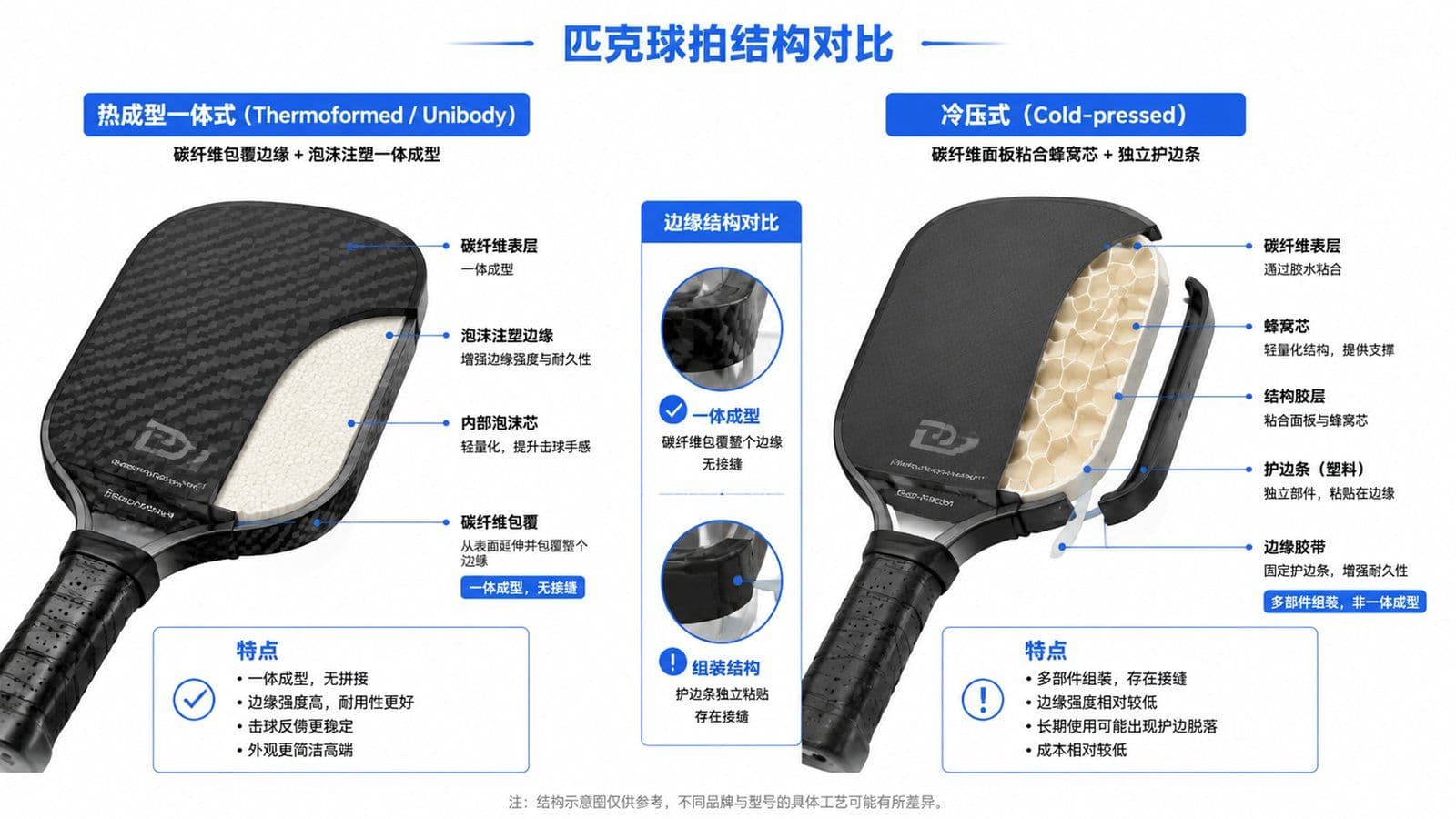
- Construction method. Thermoformed unibody construction and cold-pressed construction produce different stiffness at the perimeter and behave differently under the test. This is a build decision, not a finish decision.
- Core thickness. A 13 mm and a 16 mm core in the same shape are not the same paddle under a rebound measurement. Thicker cores are typically less lively; that is a large part of why they exist as a control option.
- Face layup and stiffness. How the face skin is built governs how much the hitting surface deflects on impact.
- Internal structures. Foam walls and other perimeter fill change how the frame deflects. These are exactly the constructions that drew scrutiny when the power question arose.
The second half of the question — how much headroom to hold — is where this article stops short of a number, and it is worth being explicit about why.
What this page will not tell you. There is no verified public dataset showing how much margin below 0.43 a given construction needs. Any specific figure — "target 0.41", "hold two points of margin" — that you see quoted without a test report behind it is somebody's estimate presented as a rule. We have no measured readings of our own to publish, and we are not going to invent any. What follows is the reasoning that decides margin, not a number.
Margin matters because of a timing problem written into the rules. A submitted paddle is measured once, at one point in its life, in one laboratory, on samples the factory selected. The obligation it creates is continuous — clause 2.F.2.a requires compliance "over the entire useful life of the paddle." Anything that raises the number after the test is your exposure: unit-to-unit variation across a production run, the difference between a hand-finished sample and a line-built unit, and the possibility that the construction gets livelier as it is played in.
So the practical rule is directional rather than numeric: a paddle designed to sit exactly at the limit is designed to fail somewhere in its life. The margin you need is a function of how tightly the factory can hold the build, and the only honest way to size it is to measure your own construction rather than adopt someone else's number. If a supplier tells you a design is "right at the line and fine," that is not reassurance — it is the description of a programme with no tolerance for its own process variation.
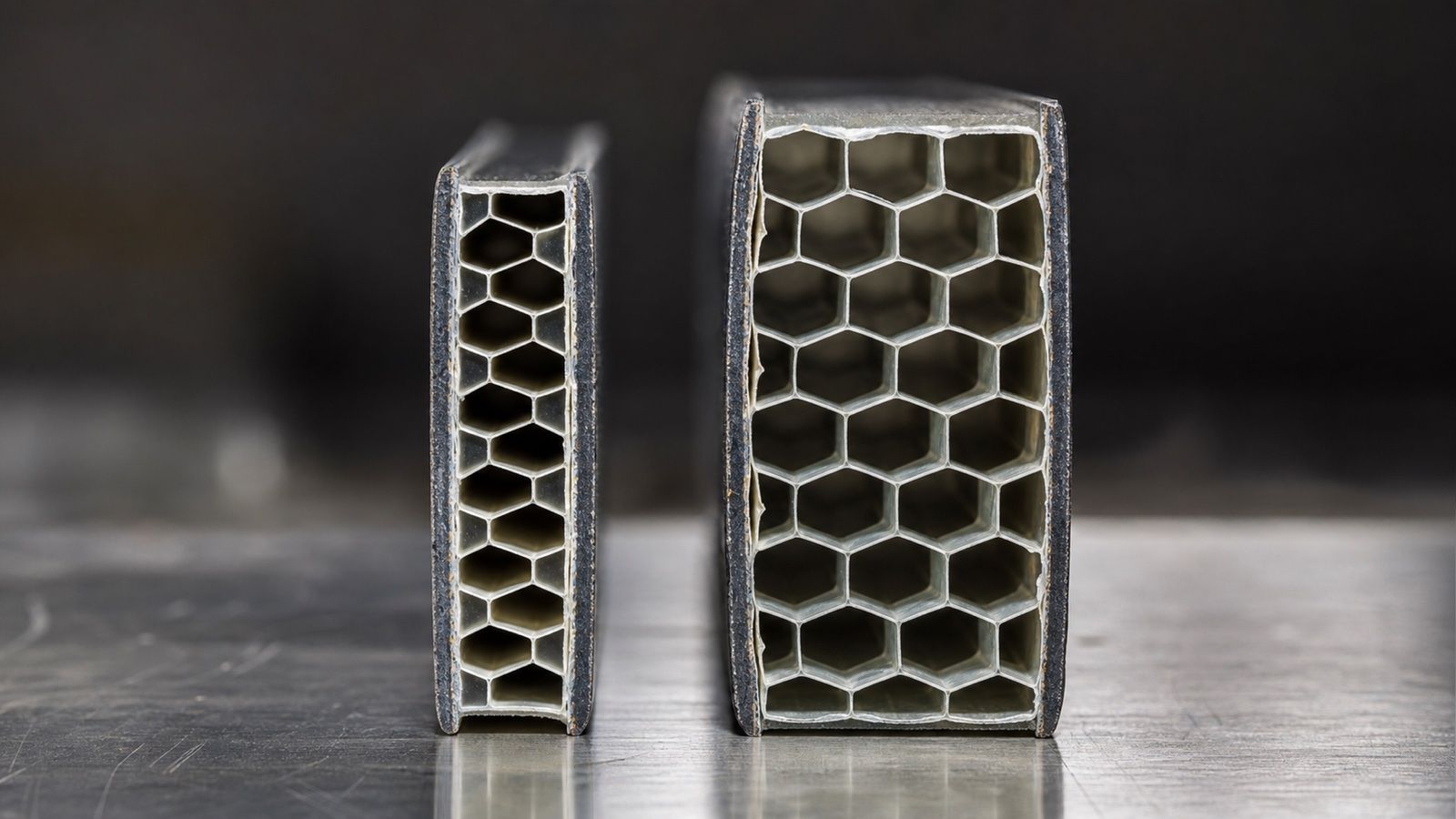
For background on how construction method changes paddle behaviour before you get to compliance, our guide to Gen 3 foam-wall paddle construction covers the build class that brought the power question to a head, and the honeycomb core cell size guide explains what actually varies inside a core.
Approval Is Not Permanent: Ongoing Compliance and Degrade to Benefit
This is the section most buyers have never been shown, and it is the reason PBCoR is a sourcing problem rather than a testing problem.
Clause 2.F.2 states that manufacturers "are subject to ongoing compliance testing to ensure that all products as produced and sold are identical to the paddle that has been tested/certified and is compliant with all requirements." The certified paddle is a reference, and every unit you ship is measured against it — not against the specification in the abstract.
Clause 2.F.2.a goes considerably further. Headed "Ongoing Compliance and Degrade to Benefit", it requires that paddles "be compliant to all requirements over the entire useful life of the paddle", and spells out the case that matters:
If a paddle design and/or construction has failure modes, break-in periods, degradation or other gradual changes that affect paddle performance, then paddle must remain compliant to all requirements — inclusive of any degradation to benefit over the entire useful life of the paddle.
"Degradation to benefit" is the term of art to take away from this page. It describes a paddle that gets better — in the sense of more powerful — as it wears. A core that softens with use, a bond that loosens, a face that begins to delaminate: each can raise rebound. The manual treats that as non-compliance regardless of the day-one test result. A paddle that passed at 0.42 and drifts upward in the field is out of compliance, and the approval does not protect it.
Alongside that, clause 2.F.1 gives USA Pickleball's Board of Directors the power to revoke approval "upon 18 months' notice" where equipment "is found to have been materially changed by the manufacturer or if the equipment materially degrades or changes under ordinary use so as to significantly alter the nature of the sport."
Put those three clauses next to a private-label business model and the exposure is obvious. You commission a paddle. The factory submits it and it passes. You buy your brand's name on the approved list, print it on the packaging, and sell through a distributor. If units drift out of compliance in the field, the model on the list is yours. The consequence lands on your brand and your inventory, not on the factory that pressed it — unless your contract says otherwise, which is a matter of what you wrote down before the first order.
Two things follow for how you buy. First, durability testing stops being a warranty question and becomes a compliance question: how a core behaves after months of play is now a regulatory characteristic, not just a returns-rate characteristic. Our notes on what actually causes paddle cracking and on handling defect replacement cover the failure modes worth building into an acceptance plan. Second, the approved sample has to be a physical reference you can go back to — which is what a golden-sample process exists to give you.
When a Spec Change Forces a New Submission
A brand that has one approved model usually wants a second. This is where approvals get accidentally voided.
Clause 2.E.7 requires a clearly marked brand and model name or number on the paddle, plus the USA Pickleball Approved seal or text treatment. Then it sets the boundary: "Paddles with different core material, surface material, or other significant differences must have a unique name or number."
A different model designation means a different product for certification purposes. So the changes buyers most often treat as minor are exactly the ones that fall outside an existing approval:
- Switching the face from one material to another — a fiberglass face to a carbon face, or a different carbon weave
- Changing the core material, including a move between honeycomb and any filled or foam construction
- Moving between thermoformed unibody and cold-pressed construction, which is a construction change rather than a cosmetic one
- Anything the manual would read as an "other significant difference" — a category deliberately left broad
Colourway, graphics and grip changes are a different matter and are normally cosmetic. The line sits at material and construction. If you are unsure which side of it a change falls on, the safe assumption is the expensive one.
There is a second trap in the same area, and it is a marketing one. The manual states plainly that use of the USAP Approved logo "is a declaration that the product is compliant to all USAP requirements", and that products "may not be marketed as USAP Approved prior to completion of any/all testing and must be listed on the USAP public Database in order to be legal for use in sanctioned events (no pro prototypes or unreleased special editions)."
In private-label practice this bites in two ways. Packaging and listing copy get finalised months before an approval completes, so a launch date that assumes approval can put a non-compliant claim on a box. And a factory offering a paddle "built on an approved platform" is not offering you an approval — the listing belongs to the model designation that was tested, under the name it was tested as. Before you rely on any approval claim, check the model against the public list; our walkthrough on how to verify a USAPA-approved paddle covers doing that properly.
What USA Pickleball Does Not Publish — and How to Budget Around It
Here is where this article deliberately refuses to give you a number.
We could not verify USA Pickleball's paddle submission fee, or the required sample count, or the testing turnaround, from any primary source. The equipment portal that would carry a fee schedule is not retrievable — the page is client-rendered and the host refuses programmatic access. Figures do circulate: different secondary sources quote materially different amounts, and the ones we found disagree with each other by a wide margin. Two conflicting unverified numbers are not a range; they are an absence.
So the fee is not stated on this page, and you should be sceptical of any sourcing article that states one confidently without saying where it came from. Get it from USA Pickleball directly before you build a budget on it. When you write to them, ask for four things: the fee for a new paddle model submission, the fee for a similarity submission on a related model, the number of physical samples required, and the current turnaround from receipt to listing.
What you can decide without the fee is the structure of the deal, and that matters more than the amount:
- Who submits. If the factory submits under its own name, the listing carries the factory's model designation. If you want the listing in your brand's name, that has to be agreed before submission, not after.
- Who pays. Certification cost is normally amortised across a programme. At a first-order volume it can be a significant share of the landed cost per unit, which is an argument for settling it before sampling rather than discovering it at PO stage.
- Who owns the approval. This is the one that decides whether you can move factories later. An approval attached to a supplier's model designation does not travel with you.
- What happens on a re-test. If a specification changes — and the NPRM mechanism means it can — who pays for resubmission should be written down at the start.
There is one more reason to pin this down early. Testing capacity is finite and shared across the industry, so lead time for certification is not a number you control, and it is generally not compressible by paying more. A launch calendar that assumes certification fits inside a normal production lead time is a calendar built on an assumption nobody has confirmed.
Writing PBCoR Into Your Spec and Your PO — and Where We Stop
Everything above turns into three paragraphs of contract language. This is the part that survives a change of contact at the factory, and it is the only section of this page about how we work.
In the specification, name the limit and the date. "USA Pickleball Equipment Standards Manual compliant" is not a specification — it is an aspiration with no version attached. Write the actual requirement: PBCoR not to exceed 0.43 per clause 2.E.6.f effective 1 November 2025, plus the roughness, friction, gloss and dimensional limits from the table above, each with its clause reference. A clause reference is unambiguous in a way an adjective is not, and it survives translation.
In the purchase order, tie production to the approved sample. The compliance obligation under clause 2.F.2 is that shipped units are identical to what was certified. That obligation only means something if there is a physical, retained, signed-off reference to compare against — which is what golden-sample approval provides. Name the golden sample in the PO, state that it is the acceptance reference, and state what happens if a production lot deviates from it.
Decide up front who owns the approval. Model designation, submitting party, and what happens if you change core or face material later. Under clause 2.E.7 a material change requires a new model designation, so the answer determines whether your second SKU is a spec revision or a fresh certification.
Five questions worth asking any supplier before a first order, in this order:
- Which of the five published measurements have you actually run on this construction, and can you show the reports?
- Whose name goes on the model designation if this is submitted?
- What is your process for holding production units to the golden sample, and what happens when a lot drifts?
- What changes between a hand-finished approval unit and a line-built production unit?
- If the specification tightens again, who pays for resubmission?
For our own part, the spec range is published. Paddles are available in core thicknesses of 13 mm and 16 mm in polypropylene honeycomb, face materials raw T700 carbon and fiberglass, construction thermoformed unibody or cold-pressed — the full build envelope offered, within the dimensional limits in the table above. Golden-sample approval is documented as a process step. Pre-shipment QC is documented alongside it. Paddle minimum order quantity is 50 pieces. We do not publish PBCoR readings, because we hold no test data we could stand behind publicly — and a supplier quoting you a rebound figure without a laboratory report behind it is telling you something they cannot support either.
Where we stop. We build to a spec and hold production to an approved sample; we do not run PBCoR testing in-house, we do not manage a USA Pickleball submission on your behalf, and we do not certify a paddle. Certification is a laboratory process run by Element U.S. Space & Defense under USA Pickleball's protocol, and the submission is made by whoever is named on the model designation.
Any factory telling you it can guarantee an approval outcome is describing something it does not control. What a manufacturer can be held to is narrower and more useful: the build matches the spec, the production units match the approved reference unit, and a material change gets flagged as a new model rather than shipped quietly under the old one.
For brand owners and importers writing a private-label paddle spec: our OEM page sets out the build envelope we work within — 13 mm and 16 mm polypropylene honeycomb cores, raw T700 carbon and fiberglass faces, thermoformed unibody or cold-pressed construction — together with the golden-sample approval and outgoing-inspection steps this article recommends writing into your PO. It is not a fit if you need certification handled end-to-end on your behalf, or if you want a rebound figure quoted before anything has been built and measured.
See the OEM build envelope and QC processWatch: Inside the Labs That Run PBCoR Testing
Reading a clause tells you what the limit is. Seeing the rig tells you why a number moves. This independent walkthrough visits both laboratories running paddle power testing and shows the setup — how a paddle is clamped, how the ball is fired, and where the inbound and outbound speeds are captured. It is produced by a media channel, not by a paddle manufacturer, which is why it is worth ten minutes.
Two things are worth watching for, because they explain most of the variation a factory will tell you about. The first is the clamping arrangement: how a paddle is held during the test affects how the handle and throat contribute to the collision, and it is the part of the protocol most often argued about publicly. The second is ball conditioning. The projectile is a consumable with its own tolerances, and laboratories apply correction factors to account for it — which is a reminder that a rebound figure is a measurement with an uncertainty band around it, not a fixed property of your paddle.
That is the practical reason margin exists as a concept. If you take one thing from the footage into your own programme, take this: the number you receive is a measurement taken under a specific procedure, and procedures have tolerances. Designing to sit inside one is a different exercise from designing to hit a target.

Where This Leaves a Paddle Programme
PBCoR is a straightforward measurement wrapped around an awkward obligation. The measurement is a rebound ratio with a published ceiling of 0.43 since 1 November 2025, sitting inside a prohibition on trampoline-effect construction, tested alongside four other published limits that fail more paddles than it does. None of that is hard to specify once you have the clause numbers.
The obligation is the part worth planning around. Compliance runs across the paddle's useful life and includes degradation that makes it more powerful, the approval can be revoked on notice, and a material change forces a new model designation. Those three facts move certification out of the sampling stage and into your contract — which is why the useful work happens when you write the spec, not when the test is run.
The trade-off is real and worth naming. Designing close to the limit buys performance a player can feel and leaves nothing for process variation or break-in. Designing with margin gives up some of that and buys a programme that survives its own production tolerances and a specification that may tighten again. Neither is universally correct — but only one of them is a decision you can make deliberately, and it has to be made before tooling, not after a failed test.
Frequently Asked Questions
What is the current PBCoR limit for pickleball paddles?
0.43. The Equipment Standards Manual sets the not-to-exceed limit at 0.44 effective 1 November 2024, reduced to 0.43 effective 1 November 2025 under clause 2.E.6.f.
Does passing PBCoR mean my paddle is USA Pickleball approved?
No. PBCoR is one of five published measurements. Surface roughness, coefficient of friction, gloss and dimensional limits are assessed as well, and a paddle must clear all of them.
What does "degradation to benefit" mean?
It is clause 2.F.2.a's term for a paddle that becomes more powerful as it wears — through core softening, break-in or delamination. The manual requires compliance across the paddle's entire useful life, so this counts as non-compliance.
How much does USA Pickleball paddle certification cost?
We could not verify a fee from a primary source, so no figure is published here. The circulating secondary numbers disagree with each other significantly. Request the current fee schedule from USA Pickleball directly.
If I change my paddle's core or face material, do I need to resubmit?
Yes. Clause 2.E.7 requires a unique model name or number for paddles with different core material, surface material or other significant differences — which makes it a separate product for certification.
Can I market my paddle as USA Pickleball Approved while testing is underway?
No. The manual states products may not be marketed as USAP Approved before all testing completes, and the model must appear on the public database to be legal in sanctioned events.
Is there a paddle weight or thickness limit?
No. The manual states there is no restriction on paddle weight and no restriction on thickness. The dimensional limit is 24 inches combined length plus width, and 17 inches maximum length, including edge guard and butt cap.
Can an approved paddle lose its approval?
Yes. Clause 2.F.1 allows revocation on 18 months' notice where equipment has been materially changed or materially degrades under ordinary use. A named set of approved models was sunset for sanctioned play on 1 July 2025.
Want to source this quality for your brand?
Contact our factory directly on WhatsApp for an instant MOQ and pricing quote.