Paddle Warranty Policy Design: What It Costs You to Honour
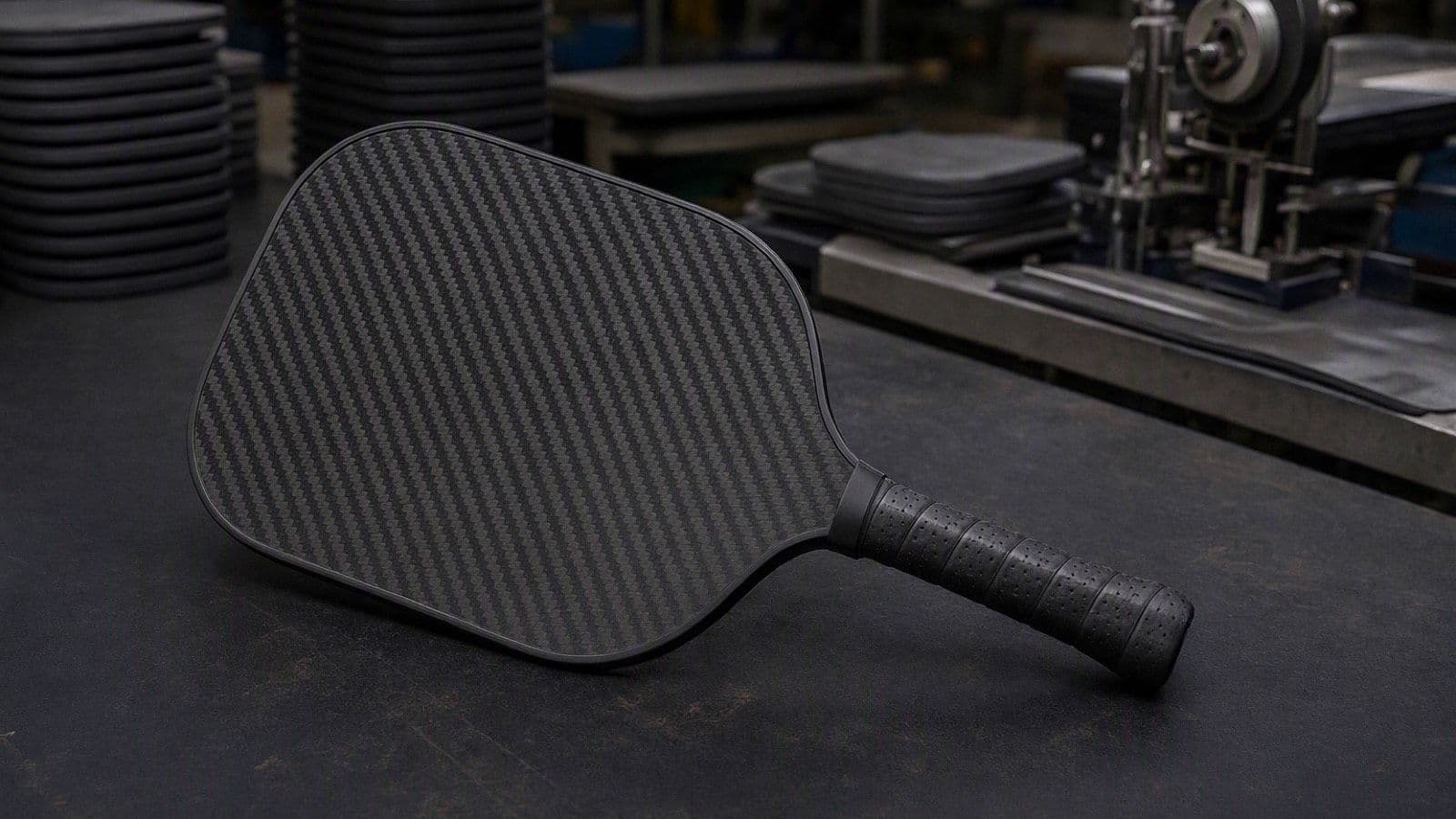
Seven pickleball brands hold the front page for paddle warranty policy. Every one of them is a warranty page — the finished document, live on the brand's own store, between 175 and 1,089 words. Not one is an explanation of how the document was built.
That is a strange thing to find on a query that thousands of private-label brand owners run every year, and it has a predictable consequence. When you launch a paddle line and need a warranty before first shipment, the only available research is seven finished policies. So you copy the one that looks most professional. And in doing that you have copied a risk posture that was calibrated to somebody else's factory, somebody else's core supplier, somebody else's freight lane and somebody else's margin.
The promise you publish and the liability you fund are two different objects. Every page currently ranking documents the first one. This article is about the second.
Key takeaways
- You do not get to skip the label. 15 U.S.C. 2303(a) requires a written consumer warranty to be conspicuously designated "full (statement of duration)" or "limited". There is no unlabelled third option.
- Two dollar thresholds, not one. The designation duty bites above $10 (15 U.S.C. 2303(d)); the disclosure duties in 16 CFR 701 and 702 bite above $15.00. Summaries collapse these into one number and get it wrong.
- Selling to clubs almost certainly does not exempt you. 16 CFR 700.1(a) tests the type of product, says the use by any individual buyer "is not determinative", and resolves ambiguity in favour of coverage.
- "Normal wear" can be a measurement instead of an adjective. The equipment standard sets a 30 µm Rz average with a 33 µm single-reading ceiling, and requires compliance "over the entire useful life of the paddle".
- The burden of proving wear is yours. 15 U.S.C. 2304(c) excuses the warrantor only where it can show consumer-side damage or unreasonable use.
- A one-year policy does not cap EU exposure. Directive (EU) 2019/771 Art. 10 gives two years of statutory conformity liability, and Art. 11 reverses the burden of proof for the first of them.
- Price the promise before you publish it. On a 3,000-unit order the reserve swings four-fold across plausible claim-rate scenarios — which is why the assumption, not the arithmetic, is what to go and get evidence for.
A note on scope. This article is about the warranty you publish downstream to your dealers and end users, and what it costs you to honour. If what you need is the other direction — how to read and negotiate the warranty terms a supplier offers you on a bulk order — that is a different document and we have written it separately: bulk paddle warranty terms and the exclusions to watch. The two meet in the last section here, where the gap between them turns into money.
General framing follows, not legal advice for your situation. Warranty law is jurisdictional and fact-specific; have counsel in your selling markets review the final wording before you publish it.
What is in this guide
- Why every paddle warranty page looks the same
- The two dollar thresholds and the label you do not get to skip
- Selling to clubs does not get you out of it
- Drawing the defect line where it can be measured
- Clause language you can put in front of a factory
- What a two-year EU liability does to a one-year policy
- Costing the promise: a reserve model on 3,000 units
- Closing the gap between what you promise and what your supplier backs
- What we check on our own line, and where we stop
Why Every Paddle Warranty Page Looks The Same
Pull the seven pages that rank and read them side by side. The convergence is not a coincidence and it is not laziness. It is what happens when every author is writing the same artefact for the same reason: a store needs a warranty page, so somebody writes a warranty page, and the fastest way to write one is to look at what the brand down the road published.
The result is a genre with fixed furniture. A duration, usually one year, occasionally lifetime on the handle or the edge guard. A short list of covered defects — delamination, core failure, handle separation. A longer list of exclusions in which "normal wear and tear" always appears and is never defined. A claim procedure requiring proof of purchase and photographs. None of it is wrong. All of it is downstream of decisions nobody shows you making.
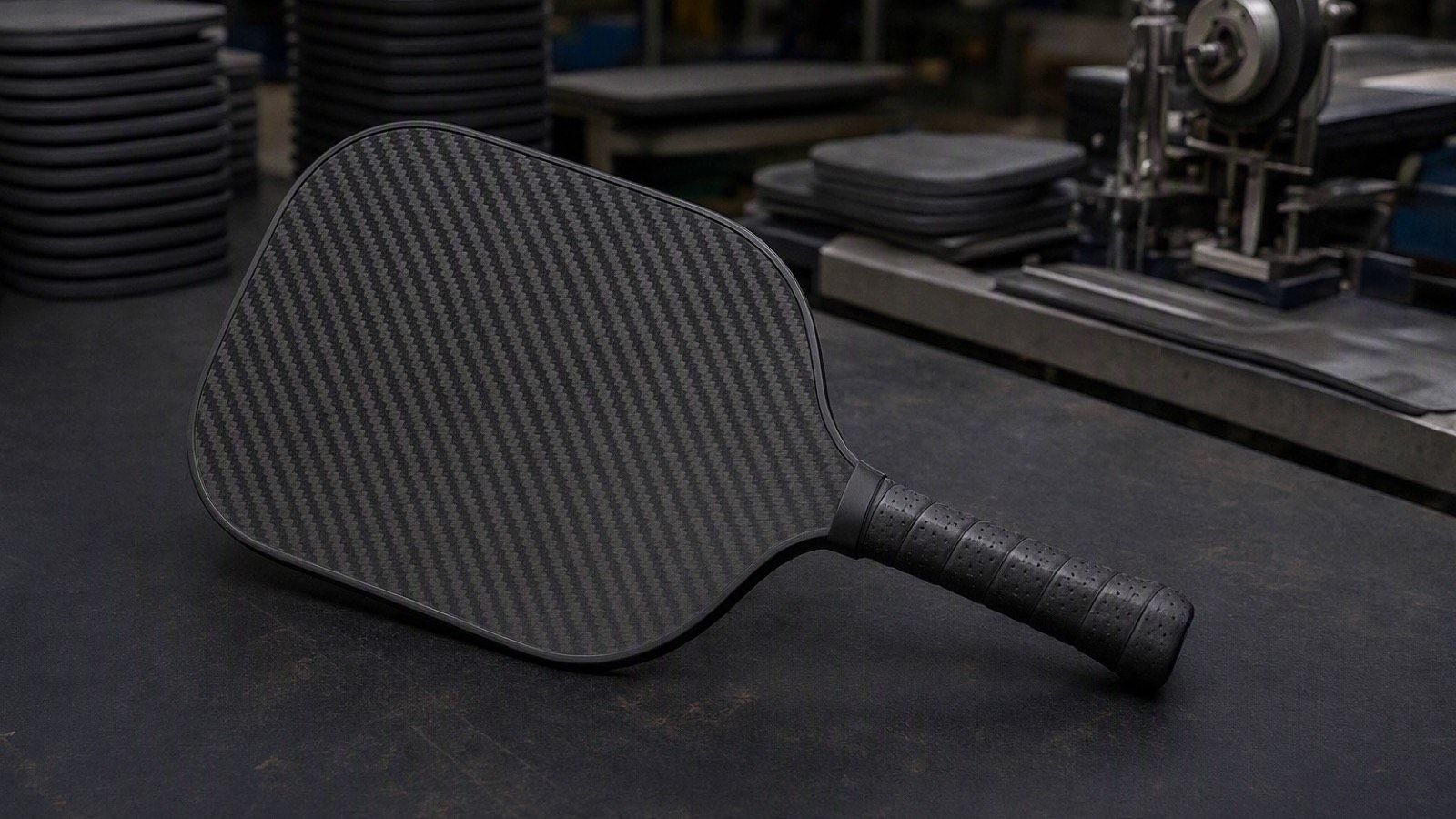
Here is the decision that is missing. A warranty is a priced financial instrument. You are selling a paddle and simultaneously writing an option that the buyer can exercise against you, for free, for as long as your stated term runs. The option has a cost. That cost is a function of three things: how many units you sell, what fraction of them come back, and what each returned unit costs you to settle. Publish the term without doing that arithmetic and you have not made a decision — you have made a guess and printed it.
Why the copied policy is the risky one
The specific danger in copying is that warranty exposure is not a property of the product category. It is a property of your build. Two paddles that look identical on a spec sheet — same face material, same core thickness, same weight band — can carry materially different failure behaviour depending on press cycle, adhesive system, edge-guard bonding and how the units were stowed on the water. A brand running a mature thermoformed line with a stable core supplier can afford a promise that would be expensive for a first-run programme from a factory you have not audited.
So when a brand publishes a two-year structural warranty, that is not a benchmark you should match. It is a number they can afford, or think they can. You have no visibility into which.
The rest of this article works the other direction: start from what the law forces you to say, decide where the defect line sits and write it in language that survives an argument, then price the promise before you publish it. Two of those steps are free. The third is the one that changes the quote.
The Two Dollar Thresholds And The Label You Do Not Get To Skip
Start with the constraint most brand owners do not know exists. Under the Magnuson-Moss Warranty Act, if you offer a written warranty on a consumer product you do not get to invent your own category name for it. 15 U.S.C. 2303(a) requires that a warranty meeting the federal minimum standards "shall be conspicuously designated a 'full (statement of duration) warranty'", and one that does not meet them "shall be conspicuously designated a 'limited warranty'". Two boxes. You are in one of them whether or not you have thought about it.
Now the part that trips people up: there are two different dollar thresholds in this area of law and most summaries fuse them into one. The designation duty in 15 U.S.C. 2303(d) applies to consumer products "actually costing the consumer more than $10". The disclosure duties are separate and sit higher — 16 CFR 701.2 applies its requirements to products "actually costing the consumer more than $15.00", and 16 CFR 702.3 uses the same $15.00 floor for making terms available before sale.
Every paddle in a private-label programme clears both, so in practice both sets of duties apply to you. The distinction matters when you extend a written warranty to accessories: a $12 grip wrap and a $9 ball tube sit in different places relative to those two lines.
What "full" actually commits you to
The reason nearly every paddle warranty on the market is designated "limited" is not modesty. It is 15 U.S.C. 2304(a), which sets four minimum standards you must meet all of to call a warranty full:
- Remedy the product within a reasonable time and without charge in the case of a defect, malfunction or failure to conform.
- Impose no limitation on the duration of any implied warranty on the product. This is the expensive one — it is what makes a "full 1-year warranty" a much larger commitment than it sounds, because your implied warranty of merchantability cannot be cut off at the same time.
- Do not exclude or limit consequential damages unless that exclusion "conspicuously appears on the face of the warranty".
- After a reasonable number of failed repair attempts, let the consumer elect a refund or a replacement. The choice becomes theirs, not yours.
"Without charge" is defined tightly in 15 U.S.C. 2304(d): the warrantor "may not assess the consumer for any costs the warrantor or his representatives incur in connection with the required remedy". That forecloses the handling-fee and inspection-fee dodges on a full warranty. If your economics need a return-shipping contribution from the customer, you are writing a limited warranty and you should say so on the face of it.
The disclosure checklist most policies half-satisfy
16 CFR 701.3(a) requires a written warranty on a product over $15.00 to disclose, "in a single document in simple and readily understood language", a specific set of items. Read your draft against these before it goes live:
| Required disclosure (16 CFR 701.3(a)) | Where paddle policies typically fall short |
|---|---|
| Who the warranty extends to, if it is limited to the original purchaser | Silent — which invites a second-hand buyer to claim, and you have no clean basis to refuse |
| Clear identification of what is covered and, where needed for clarity, excluded | "Manufacturing defects" with no definition, against "normal wear" with no definition |
| What the warrantor will do, including what it will and will not pay for | Repair-or-replace stated, but freight direction left unsaid in both directions |
| When the term commences, if not the purchase date, and its duration | Ambiguous between invoice date and end-user purchase date — a real gap when stock sits |
| A step-by-step claim procedure, with a contact route | A support email address, no stated response window, no stated evidence standard |
| Any limitation on the duration of implied warranties, with the prescribed state-law caveat | Frequently omitted entirely, which is the single most common defect in a paddle warranty page |
The right-hand column is not a criticism of other brands. It is a list of the places where a copied policy leaves you without a defensible answer on the day somebody argues with you.
Selling To Clubs Does Not Get You Out Of It
If most of your volume goes to clubs, facilities and rental fleets rather than to individuals, there is an obvious-looking escape hatch, and it is worth understanding precisely because the intuitive reading of it is backwards.
The hatch is real on its face. Both 16 CFR 701.1(b) and 702.1(b) define consumer product for their parts and then carve out: "Products which are purchased solely for commercial or industrial use are excluded solely for purposes of this part." Read that alone and a club sale looks exempt.
It is not, and 16 CFR 700.1(a) explains why. The test is not who bought this unit. It is whether the type of product is one whose personal use is common:
"This means that a product is a 'consumer product' if the use of that type of product is not uncommon. The percentage of sales or the use to which a product is put by any individual buyer is not determinative. […] Where it is unclear whether a particular product is covered under the definition of consumer product, any ambiguity will be resolved in favor of coverage."
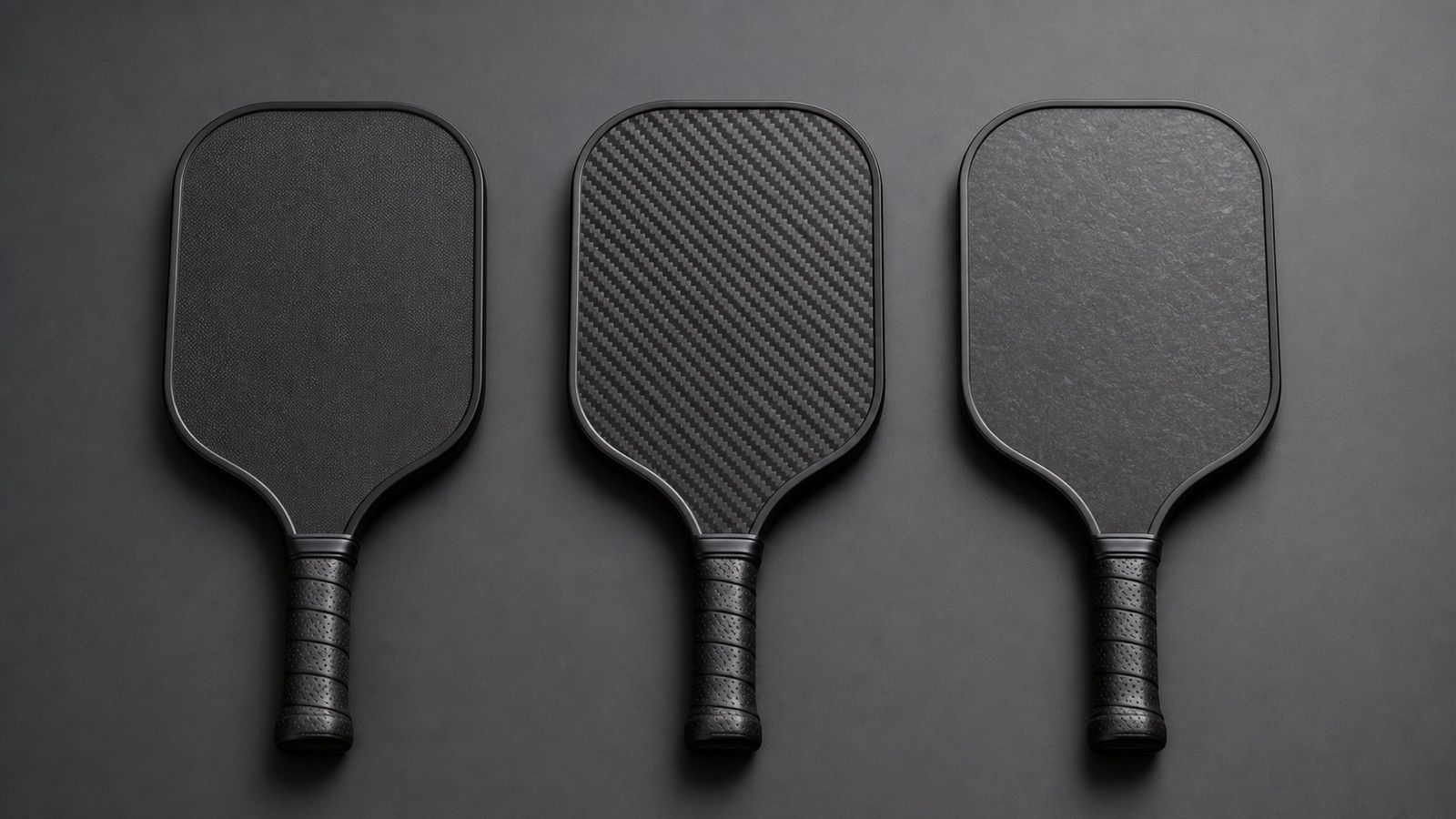
A pickleball paddle is about as clearly a commonly-personal product as exists. The regulation's own worked example makes the point with automobiles, which are bought by fleets constantly and remain consumer products. So the practical answer for a paddle brand is: assume the Act reaches your product, write the warranty as a consumer warranty, and treat any commercial-only carve-out as something to raise with counsel about a specific SKU sold on specific terms — not as a design assumption you build the policy on.
This matters commercially, not just legally. A club that buys forty paddles for a rental fleet is buying them so that individuals can use them. If a batch delaminates in month four, the club is going to make a claim, and "you bought commercially so the Act does not apply" is a position that costs you the account whether or not it would survive scrutiny. Design the policy so you never have to argue it.
Drawing The Defect Line Where It Can Be Measured
This is the section that decides whether your warranty costs what you modelled. Every policy on the market draws a line between covered defects and excluded wear. Almost none of them draws it anywhere you could point to during a disagreement.
Start with who has to prove what, because most brand owners have this the wrong way round. 15 U.S.C. 2304(c) waives the warrantor's duties where it "can show that the defect, malfunction, or failure […] was caused by damage (not resulting from defect or malfunction) while in the possession of the consumer, or unreasonable use (including failure to provide reasonable and necessary maintenance)."
Read the verb. Can show. The exclusion is not self-executing. Writing "normal wear and tear is excluded" in your policy does not shift anything onto the customer; when you decline a claim on wear grounds, you are the one who has to be able to demonstrate it. A policy that excludes wear without defining it has given you a clause you cannot operate.
The threshold that turns an argument into a reading
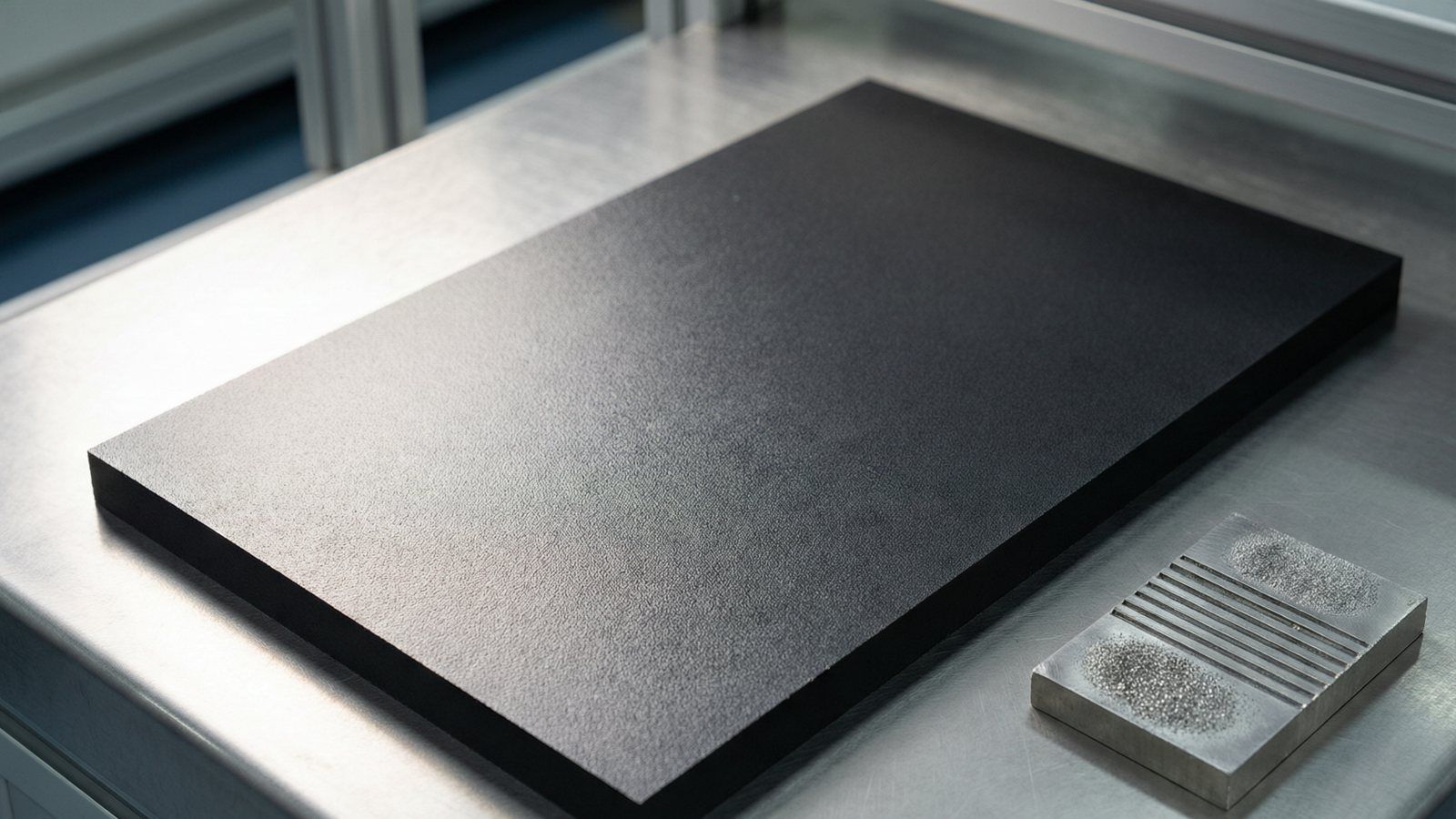
Pickleball has something most product categories do not: a published equipment standard with numeric surface criteria. The USA Pickleball Equipment Standards Manual, Revision 3.0 (January 2025), sets the roughness limits in clause 2.E.2.a.1 — an average no greater than 30 micrometres on Rz and no greater than 40 micrometres on Rt, taken in six different directions per face, with no single data point in the set above 33 micrometres Rz or 44 micrometres Rt. Clause 2.E.2.a.2 adds a friction ceiling: a maximum kinetic coefficient of friction of 0.1875, on a test based on protocol ASTM D1894-14.
These are equipment-approval criteria. USA Pickleball uses them to decide what may be played in sanctioned competition; the standard does not tell you how to run your warranty and does not oblige you to honour anything. But nothing stops you from adopting a published, instrumented threshold as your own contractual criterion — and once you do, "the face is worn out" stops being an aesthetic judgement and becomes a number somebody can take with a roughness tester.
Why progressive drift is not automatically wear
There is one more clause in that manual that changes the shape of this argument, and it is the single most useful sentence in the document for a warranty drafter. Clause 2.F.2.a, headed "Ongoing Compliance and Degrade to Benefit":
"Paddles will be required to be compliant to all requirements over the entire useful life of the paddle. If a paddle design and/or construction has failure modes, break-in periods, degradation or other gradual changes that affect paddle performance, then paddle must remain compliant to all requirements — inclusive of any degradation to benefit over the entire useful life of the paddle."
The standard's own position is that a design which drifts out of specification during ordinary use is a design problem, not an ageing problem. That is a powerful frame for your policy, because it separates two things that look identical to a customer: a face that has become cosmetically marked, and a face whose measured characteristics have moved outside the window the model was certified in. The first is wear. The second is a build that did not hold its specification, and calling it wear is the move that erodes your brand.
Mode by mode: which side of the line
Below is the mapping to draft against. It is a classification of failure modes against the criterion that separates them — not a claim about how often each occurs, which is a figure no honest source can give you for your own build.
| What the customer reports | Side of the line | The criterion that decides it |
|---|---|---|
| Face-to-core separation, soft or hollow response | Defect | A bond that has released is a construction failure. It also engages clause 2.E.6.f, which prohibits compressible material creating a trampoline effect — so the unit is not merely degraded, it is outside the specification it was certified against |
| Core collapse under the sweet spot, localised dead area | Defect | Cell structure failing under design load is a materials or press-cycle problem, not use. Judge it on rebound behaviour against a retained reference unit from the same lot |
| Edge guard lifting or peeling away from the perimeter | Defect, with one exception | Adhesive release is a bond failure. The exception is impact damage — a guard struck against a post or court surface is consumer-side damage under 2304(c), and it usually shows a strike mark you can photograph |
| Face has lost grip, ball no longer bites | Depends — and this is where you measure | Texture loss through abrasion is wear. A face that measured near the ceiling when new and drifted outside it early is a specification problem. The 30 µm Rz average and 33 µm single-reading limits are what make this answerable rather than arguable |
| Cosmetic scuffing, ball marks, scratches on the face graphic | Wear | No dimensional, roughness or structural consequence. Say so explicitly in the policy so it never becomes a discussion |
| Grip worn smooth, grip discoloured or absorbing odour | Wear, and name it as a consumable | The overgrip is a replaceable item. Clause 2.E.5.a treats grip wraps and grip-size inserts as permitted alterations, which confirms it is expected to be changed by the user |
| Handle rattle, loose butt cap | Defect | An internal component that has come loose is an assembly failure and is audible on a shake test at incoming inspection |
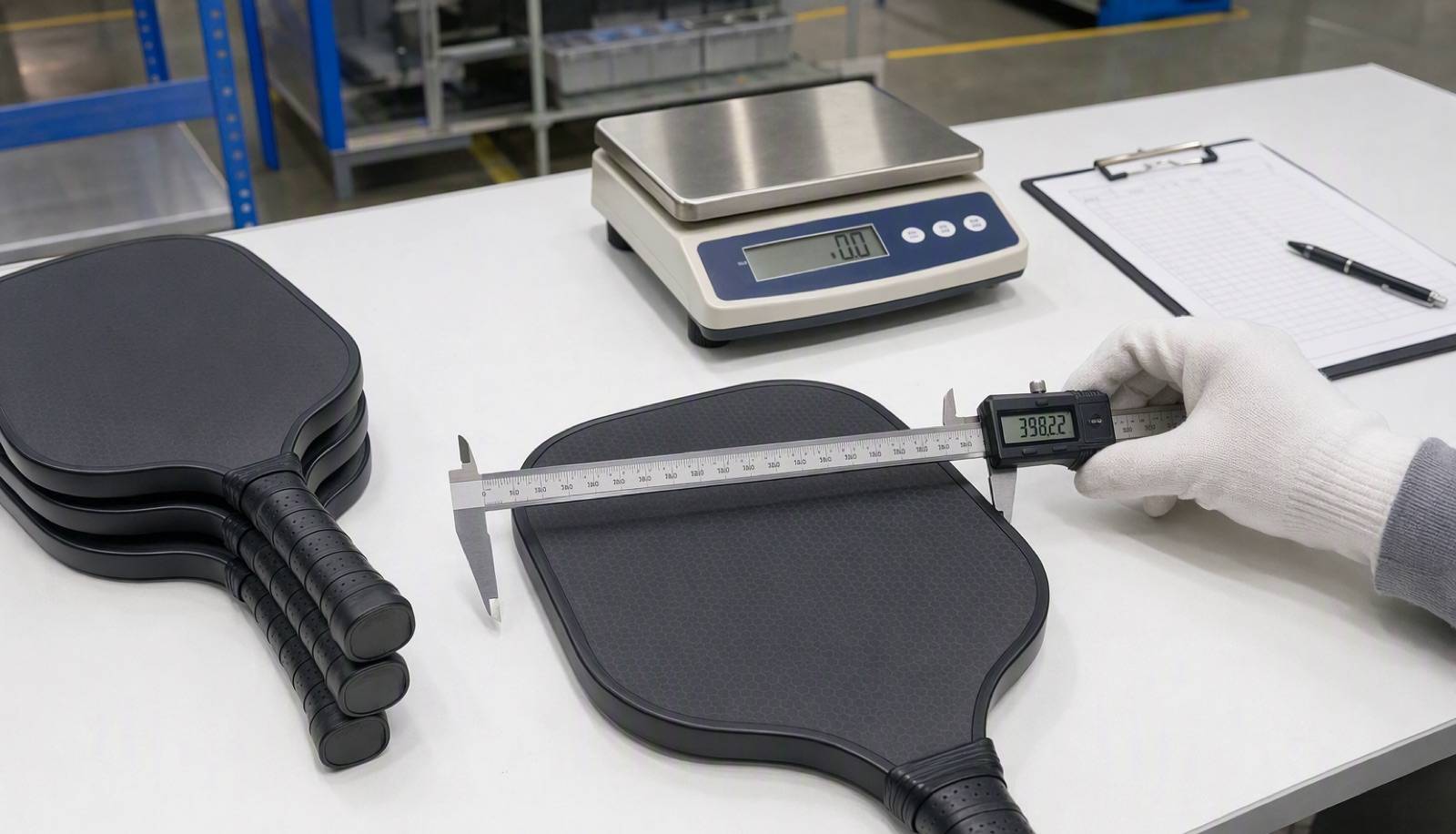
One boundary condition worth writing into the policy: the standard caps combined length and width, including edge guard and butt cap, at 24 inches (60.96 cm), with length not exceeding 17 inches (43.18 cm). Clauses 2.E.3 and 2.E.4 impose no restriction on thickness and none on weight. A swollen delaminated edge or a heavily built-up aftermarket guard can push a unit past the dimensional limit — which is a useful, objective way to describe a failure that has gone beyond cosmetic.
If you want the underlying mechanics of each mode rather than their contractual treatment, we covered the teardown separately: the six ways a pickleball paddle actually fails.
What to check when a claim arrives
The mapping above is only useful if it is applied the same way every time. Work a claim in this order — the sequence matters, because each step can close the file before you spend money on the next one.
- Establish the date and the channel first. Purchase date against your stated commencement point, and which market the unit was sold into. That single answer decides whether you are inside a US limited-warranty term, an EU statutory window, or both — and in the EU case, whether the first-year presumption is running against you.
- Ask for the paddle before you ask for photographs. Photographs settle cosmetic questions and nothing else. Face condition, core response and bond integrity are all physical assessments, and a claim declined on a photograph is the one most likely to come back at you publicly.
- Compare against the retained unit from the same lot. Not against a new paddle, and not against your memory of how the model behaved. Lot-to-lot variation is the thing you are trying to detect, and a same-lot reference is the only comparison that isolates it.
- Take the measurement before forming a view. Six roughness readings per face, both faces, against the 30 µm Rz average and the 33 µm single-reading ceiling. Do this even when the outcome looks obvious — a file with a number in it is a decision, and a file without one is an opinion.
- Check the dimensional envelope where the edge is involved. Combined length and width against the 24 inch (60.96 cm) limit catches a swollen or debonded edge that has gone past cosmetic.
- Separate impact evidence from bond failure. A strike mark, a compression witness or a gouge points to consumer-side damage under 2304(c). Its absence, on a unit that has otherwise been used normally, points the other way — and remember the statute puts the burden of showing damage on you.
- Record the outcome against the lot, not just the customer. One claim is an event. Three from the same lot is a production signal, and it is the trigger to look upstream before the rest of that lot reaches the field.
That last step is the one most brands skip, and it is the one that pays. Claims handled purely as customer-service transactions never aggregate into the evidence you need for the next reserve calculation — which is exactly the number the following sections show you cannot currently substantiate.
Clause Language You Can Put In Front Of A Factory
Definitions are only worth having if they survive contact with a claim. This section turns the boundary above into drafting language, and then names two clauses that appear in real paddle warranties on the open web and that federal law will not enforce.
A coverage and exclusion clause built on the measurable line
Adapt the wording, keep the structure — the point is that every term in it resolves to something observable:
Covered. Separation of the hitting surface from the core; collapse or crushing of the core structure under normal play loading; release of the edge guard from the paddle perimeter other than at a point of external impact; loosening of internal handle components; and any condition in which the paddle, in ordinary use and within the warranty period, ceases to conform to the surface-roughness and friction criteria published in the USA Pickleball Equipment Standards Manual current at the date of manufacture.
Not covered. Cosmetic marking, scuffing, scratching or graphic wear having no dimensional, roughness or structural effect; wear of the grip or overgrip, which is a consumable replaceable by the user; damage arising from impact against a surface, structure or another paddle; damage arising from storage at temperatures or humidity outside the stated range; and any condition arising after alteration of the paddle beyond those alterations permitted by the Equipment Standards Manual.
Determination. Where a claim turns on surface condition, the paddle will be assessed against the roughness criteria above, measured in six directions per face. The assessment result will be provided to the claimant.
Three things that clause does which a copied one does not. It names an external, published, instrumented criterion instead of "normal wear". It ties the criterion to the manual current at the date of manufacture, so a later revision of the standard does not retroactively change what you promised. And it commits to giving the claimant the measurement — which sounds like a concession and is actually your best protection, because a declined claim with a number attached is a decision, while a declined claim without one is an opinion the customer will dispute in public.
Two clauses federal law will not let you have
These are worth checking your draft for specifically, because both are common and both look reasonable.
The registration-card condition. Requiring the customer to register the product within thirty days or lose coverage is a familiar device. On a warranty designated full, it does not work: 16 CFR 700.7(a) records that under section 104(b)(1) a warrantor offering a full warranty "may not impose on consumers any duty other than notification of a defect as a condition of securing remedy", unless the additional duty can be demonstrated to be reasonable — and the regulation addresses precisely the practice of stipulating return of a warranty registration card. Registration as a way to capture customers is fine. Registration as a condition precedent to coverage is a clause you should not be relying on.
The branded-consumables condition. This one bites paddle brands specifically. 16 CFR 700.10(a) states that section 102(c) "prohibits tying arrangements that condition coverage under a written warranty on the consumer's use of an article or service identified by brand, trade, or corporate name unless that article or service is provided without charge to the consumer." So a clause voiding the warranty if the customer fits a third-party overgrip, applies non-branded edge-guard tape, or has a replacement face fitted by someone other than you is not enforceable unless you are supplying those items free.
The equipment standard points the same way. Clause 2.E.5.a explicitly permits player alterations including "edge guard tape/replacements, weighted tape, weights for an Original Equipment Manufacturer (OEM) integrated weight system, changes to the grip size via inserts, grip wraps, OEM interchangeable grips, OEM replacement paddle faces, and name decals".
Clause 2.E.5.b bounds decals and tape to no farther than 1.0 inch (2.54 cm) above the top of the grip and no more than 0.5 inch (1.27 cm) inside the outer edge or edge guard. Write your alteration exclusion to bite on things outside that permitted set — structural modification, refinishing the face, drilling the handle — and it will hold. Write it as "any modification voids this warranty" and you have written something both unenforceable and hostile to a customer doing something the sport expressly allows.
What the end user is actually protected from
It helps to remember what a claim is really about. Under clause 2.F.3.a, a player found using a non-conforming paddle after a match has started "forfeits only the match being played"; if it is caught before the match starts they may simply switch without penalty, and if it is discovered afterwards the result stands. That is the concrete harm sitting behind an out-of-spec paddle — not an inconvenience, a forfeited match in an event somebody paid to enter. A policy that resolves those claims quickly is worth more in retention than the unit cost you saved by arguing.
What A Two-Year EU Liability Does To A One-Year Policy
If any of your volume lands in the European Union, the warranty you publish is not the outer boundary of what you owe. It sits on top of a statutory floor that your terms cannot contract away, and the mismatch between the two is a funding gap most brand owners have never priced.
Directive (EU) 2019/771 Article 10(1) is the base: "The seller shall be liable to the consumer for any lack of conformity which exists at the time when the goods were delivered and which becomes apparent within two years of that time." Article 10(3) lets Member States keep or introduce longer periods, so two years is a floor and not a ceiling — check your actual selling markets rather than assuming the minimum.
Publish a one-year warranty and sell into the EU and you have a second year in which a conformity claim can still land. It does not land on your policy; it lands on the seller in the chain. If that seller is your distributor, they will look upstream to you, and whether they reach you depends on the contract you signed rather than on the warranty you published.
The first year, where the burden runs against you
Article 11(1) is the provision with the sharpest cost consequence. Any lack of conformity that becomes apparent within one year of delivery "shall be presumed to have existed at the time when the goods were delivered, unless proved otherwise". Article 11(2) allows Member States to extend that presumption to two years.
Translate that into claims handling. In your home market you can decline a marginal claim and leave the customer to make the case. Inside the EU presumption window the default runs the other way: unless you can show otherwise, the fault is treated as having been there on delivery. This is exactly why the measurable defect line in the previous section is worth building. "Proved otherwise" is achievable when your criterion is a roughness reading against a retained reference unit. It is not achievable when your criterion is the word "normal".
The sentence Article 17 makes mandatory
Article 17(2) sets out what a commercial guarantee statement must contain, on a durable medium, at the latest at delivery, in plain intelligible language. Most paddle warranty pages carry the guarantor name, the procedure, the goods and the terms. The item that is routinely missing is Article 17(2)(a): a clear statement that the consumer is entitled by law to remedies from the seller free of charge in the event of a lack of conformity, "and that those remedies are not affected by the commercial guarantee".
Add that sentence. It costs you nothing you did not already owe, and its absence is the most visible sign that a policy was copied from a US-market template.
Two further provisions worth knowing before you write marketing copy around the warranty. Under Article 17(1), if the conditions in your guarantee statement are less advantageous than those in the associated advertising, the advertising binds unless it was corrected before the contract was concluded — so a campaign promising "lifetime durability" can override the one-year term in your own document. And the same article provides that where a producer offers a commercial guarantee of durability, the producer is liable directly to the consumer for repair or replacement across that whole period, bypassing the retailer entirely. A durability guarantee is a materially different instrument from a defects warranty; do not reach for the word casually.
| Provision | What it does to your cost base |
|---|---|
| Art. 10(1) — two-year conformity liability | A one-year published term leaves a second year of exposure in the chain that your reserve did not fund |
| Art. 11(1)–(2) — one-year presumption, extendable to two | Marginal early claims resolve against you by default, so your settle rate inside the window is higher than at home |
| Art. 12 — notification window | Member States may require notice within "at least 2 months" of detection; you cannot impose a shorter one |
| Art. 17(1) — advertising overrides less favourable terms | Marketing language becomes a warranty term; brief your campaign team on the published wording |
| Art. 17(1) — producer durability guarantee | Creates direct producer liability to the end user for the whole period, bypassing your distributor |
| Art. 10(6) — second-hand floor | B-grade, refurbished and ex-demo resale can be shortened by agreement but never below one year |
Costing The Promise: A Reserve Model On 3,000 Units
Now price it. This is the step that separates a warranty you decided on from a warranty you inherited, and it is ordinary arithmetic — the difficulty is not the maths, it is being honest about the inputs.
The accounting logic is standard: a warranty reserve is a liability recognised in the same period as the sale, so that the revenue and the expected cost of honouring the promise land together rather than the cost ambushing a later quarter. You debit warranty expense and credit a warranty liability at the point of sale, then draw actual claims against that liability as they arrive. The estimate is built from three numbers: units sold, expected claim rate, and average settled cost per claim.

The three inputs, all of which are yours
Be very clear about what follows. The claim rate and the per-claim cost used below are scenario inputs chosen to bracket a decision. They are not our observed claim rates, they are not an industry benchmark, and you should replace both with your own numbers before you rely on the output. They are here because the shape of the answer is more useful than any single figure, and because anyone quoting you a specific paddle claim rate without telling you their sample is guessing too.
- Units. 3,000 — one mid-size private-label production order.
- Claim rate (scenario input). Modelled at 1%, 2% and 4% of units sold, deliberately spanning a wide range because the true figure for a first run from a new factory is unknown to you at the moment you must publish the policy.
- Settled cost per claim (scenario input). $22, built as replacement unit at factory cost, plus outbound parcel freight to the end user, plus the labour minutes to process the claim. Rebuild this from your own landed cost and your own freight table — it is the input most sensitive to where your customers are.
Three scenarios on one order
| Scenario (assumed claim rate — replace with your own) | Claims on 3,000 units | Reserve at $22/claim (assumed cost) | Per unit shipped |
|---|---|---|---|
| Low — 1% | 30 | $660 | $0.22 |
| Mid — 2% | 60 | $1,320 | $0.44 |
| High — 4% | 120 | $2,640 | $0.88 |
What the spread is telling you
The finding is not $0.44. The finding is $0.22 to $0.88 — a four-fold swing on the same order, driven entirely by an assumption you cannot currently evidence. Everything else in the model is arithmetic you can check in your head.
That reframes what to do next. Refining the per-claim cost is easy and moves the answer a little. Getting evidence for the claim rate is hard and moves the answer a lot. So the productive conversation with a factory is not "what will you charge me" — it is "what do you know about how this construction behaves in the field, and what will you put behind it". A supplier who has run the same core and adhesive system across many programmes has information you do not, and that information is worth more to your reserve than a few cents on the unit price.
Two practical notes on using the number. First, it belongs in the quote as a line, not in your head — if the reserve is $0.44 a unit and your margin calculation does not contain it, your margin is overstated by $0.44 a unit. Second, model the EU separately if you sell there: the second year of statutory exposure and the first-year presumption both push the effective claim rate up inside that channel, so a single blended figure will understate it.
For brand owners and importers pricing a private-label paddle programme — not for players filing a claim on a paddle they already own. Your claim rate is decided at the press, so here is what this factory publishes and will put in a PO: paddles weighed to ±3 g with the weight printed on the unit (against an ±8–10 g norm by its own reckoning), edge-guard adhesive rated to 45 °C over six months of outdoor Manila use, and hot-press thermoforming rather than foam-filled cold press. Three lines, three rows of the defect table above.
See the OEM build optionsClosing The Gap Between What You Promise And What Your Supplier Backs
You now have a published term, a defect line you can measure, and a reserve. The last question is how much of that reserve somebody else carries — because a defect that originated in the build is not, in substance, your cost.
The legal frame for this in the EU is Article 18 of Directive (EU) 2019/771, the right of redress. Where the seller is liable to the consumer for a lack of conformity "resulting from an act or omission […] by a person in previous links of the chain of transactions, the seller shall be entitled to pursue remedies against the person or persons liable in the chain of transactions."
The persons, actions and conditions are left to national law — which is the important qualifier. The right exists, but how far it reaches and on what terms depends on the jurisdiction and, in practice, on your contract. It is a reason to negotiate a back-to-back term, not a substitute for having one.
What to ask a factory for, and why they can say yes
Two facts from the equipment standard make a back-to-back conversation reasonable rather than adversarial, because they describe obligations the manufacturer already carries.
Clause 2.F.2 provides that "Manufacturers are subject to ongoing compliance testing to ensure that all products as produced and sold are identical to the paddle that has been tested/certified and is compliant with all requirements."
Production conformity to the certified configuration is not something you are inventing as a commercial demand — it is already the standard's expectation. And clause 2.F.1 provides that approval may be revoked "upon 18 months' notice" where equipment "is found to have been materially changed by the manufacturer or if the equipment materially degrades or changes under ordinary use so as to significantly alter the nature of the sport." A model losing approval is a shared catastrophe, which is precisely why a factory has its own reason to keep production matching the certified unit.
So the asks that tend to land:
- A retained reference unit from every production lot, held by both parties. This is the single most useful thing you can arrange, because almost every defect-versus-wear argument resolves against a same-lot baseline.
- A defect definition in the purchase order that matches your published policy. If your downstream policy covers face-to-core separation and your PO does not define it, you have written yourself into the gap deliberately.
- A stated position on the second year, if you sell into the EU. You do not need the supplier to mirror your consumer term — you need to know whether they will engage on a claim in month eighteen, so you can price the answer either way.
- Written confirmation that production units match the certified configuration, tied to the specific model designation rather than to the factory generally.
Notice what is not on that list: a demand for a specific warranty percentage or allowance. Ask for evidence and mechanism first. A factory that will retain reference units and define defects in writing is worth more to your reserve than one that offers a headline allowance and no baseline to argue against.
What to have in hand before the first email
A warranty conversation goes faster when the build is already described, because almost every question a factory will ask back is a specification question. Have these settled, or be explicit that they are open:
- Specification range. Settle the thickness options, face material and construction method before you ask any supplier for a warranty position, because each one moves the failure behaviour the warranty has to absorb — nobody can price a promise against an undecided build. What is not negotiable with any factory is the dimensional envelope, which the standard fixes rather than the manufacturer: combined length and width no more than 24 inches (60.96 cm), length no more than 17 inches (43.18 cm), with no restriction on thickness or weight. Surface finish has to land inside the 30 µm Rz average and 0.1875 friction ceiling discussed above, and that constraint is what mostly decides which texturing processes are open to you.
- MOQ, and what it does to your reserve. Published paddle minimums in this category currently start around 50 units, and that matters to the warranty rather than only to the invoice: the reserve model above spreads claim cost across the run, so a 50-unit first order carries the same per-unit exposure as a 3,000-unit one but has no volume to absorb a bad lot. Bring your size-and-colour mix rather than a bare total, because a minimum quoted against six SKUs is a different number from the same total in one finish.
- Price structure. Expect the unit price to move with core thickness, face material and construction method, and remember to carry your own reserve figure as a separate line rather than folding it into the unit cost, so that the two can be renegotiated independently.
- Lead time. Quoted per programme, and the variable that moves it most is tooling — a first run with new face graphics and a new edge-guard colour sits behind a sampling round that a repeat order does not. Ask for it to be quoted in two parts, sampling and production, so a delay in one is visible rather than absorbed.
- Compliance. Name the model designation you intend to certify and confirm production units will match it, per the ongoing-compliance obligation above.
- Verification. The retained reference unit per lot, described earlier, is the item to insist on.
Settle the build at the same time as the warranty question, because the build sets the claim rate you are reserving against. Our own OEM build and specification options make that point against us as much as for us: the same page sells thermoformed unibody and cold-pressed construction on 13 mm and 16 mm polypropylene honeycomb cores with raw T700 carbon or fiberglass faces. Those two routes do not carry the same delamination exposure. Pick the cheaper one and your reserve should go up, not stay flat — so ask for the trade-off quoted both ways before you publish a term.
One limit on how far any answer can reach. The pickleball line here dates to 2019, thermoformed production to 2021, the tropical edge adhesive to 2022 — a few seasons of field history on the newest of them, and any supplier claiming a settled long-run failure rate on a 2022 adhesive is guessing. Read the inspection side too: pre-shipment AQL inspection for pickleball orders and durability testing protocols before you ship both cover checks that happen before the warranty is ever tested in the field.
What We Check On Our Own Line, And Where We Stop
Every ask in the previous section points at a supplier, so it is only fair to answer them from this side of the bench. Checked and documented: every paddle individually weighed to ±3 g, against an industry norm this factory itself puts at ±8–10 g, with the measured weight printed on the unit rather than only on the carton; a signed-off reference unit before the run opens; a QC pass on the finished lot before despatch.
USAPA conformity comes with test documentation, which in practice means the numbers this article has used throughout: the 30 µm Rz average and 33 µm single-reading ceiling, and combined length and width inside 24 inches (60.96 cm). Ask to see them measured on your lot rather than asserted on a page.
On construction — 13 mm and 16 mm polypropylene honeycomb cores, raw T700 carbon or fiberglass faces — the published position is hot-press thermoforming with temperature-controlled dies rather than foam-filled cold press — face-to-core separation being the mode that becomes a defect claim instead of a wear argument. The edge-guard adhesive is a tropical-grade system rated to 45 °C and qualified over 6 months of outdoor use in Manila, which exists because edge-guard peel in humid heat is the complaint that drove it.
Where we stop matters more, because the gaps are what you have to price. No claim rate and no defect rate by mode: there is no return-stream dataset behind this site, and a supplier quoting you one without that is quoting a feeling. No warranty duration and no claim-handling process either — that is negotiated per programme, not read off a page.
Two more. Certificates for ISO 9001:2015, SGS and REACH are stated rather than posted, so ask for the documents and check the dates yourself. And cold press stays on our menu at a lower price, which means the delamination argument above cuts against half our own catalogue. The construction decision moves your exposure further than the allowance negotiation will.
Your next four moves
In order, because each one depends on the previous:
- Decide full or limited, and label it. If your economics need any customer contribution to freight or handling, you are writing a limited warranty — designate it and stop worrying about the rest of §2304.
- Write the defect line against a criterion, not an adjective. Use the roughness thresholds, tie them to the manual current at date of manufacture, and commit to sharing the measurement with claimants.
- Run the reserve on your own three inputs and put the per-unit figure in the quote as a line. If your selling footprint includes the EU, run that channel separately.
- Take the reserve to the factory as a question, not a demand. Retained lot samples and a written defect definition first; allowances second.
The whole point of doing it in that order is that by the time you are negotiating, you know what the promise costs. Every brand that copied a policy is negotiating without that number, which is why they concede on price and hold firm on things that do not matter.
For a brand owner, importer or stocking distributor who now has a reserve number — not for anyone still deciding whether to launch. An Article 18 redress term is only worth the legal person who signs it, so start with ours: Jinhua Lidu Sports Goods Co., Ltd., registered capital 1,000,000 RMB, Building 4, Bailongqiao Town Linjiang Industrial Zone, Wucheng District, Jinhua, Zhejiang. Check that name against your own PO before you negotiate an allowance with anybody, us included. Paddle minimums here are 50 pcs — a category floor, not a selling point, and too small to absorb a bad lot.
Talk through a paddle programmeFrequently Asked Questions
What should a private-label pickleball paddle warranty period be?
There is no correct number — the term is an output of your reserve, not an input. Decide what a claim costs you and what rate you can defend, then choose a duration you can fund.
Does a paddle warranty have to say "full" or "limited"?
Yes, for written warranties on consumer products. 15 U.S.C. 2303(a) requires conspicuous designation as one or the other, and the duty applies to products costing the consumer more than $10 under 2303(d).
Can I exclude normal wear and tear from a paddle warranty?
You can, but the exclusion is not self-executing. 15 U.S.C. 2304(c) relieves the warrantor only where it can show the failure came from consumer-side damage or unreasonable use, so define wear against something measurable rather than leaving it as an adjective.
Is a worn paddle face a defect or normal wear?
It depends on measurement. The Equipment Standards Manual sets a 30 µm Rz average with a 33 µm single-reading ceiling. Texture loss through abrasion is wear; a face that drifts outside the window early is a specification problem.
Do I owe a consumer warranty on paddles sold to clubs and rental fleets?
Very likely yes. 16 CFR 700.1(a) tests whether the type of product is commonly used personally, states that use by any individual buyer is not determinative, and resolves ambiguity in favour of coverage.
Can I void the warranty if a customer changes the grip or edge guard tape?
Generally no. 16 CFR 700.10(a) prohibits conditioning coverage on the use of brand-identified articles unless supplied free, and clause 2.E.5.a of the Equipment Standards Manual treats grip wraps and edge-guard tape as permitted alterations.
How much should I reserve per paddle for warranty claims?
Run it yourself: units × claim rate × settled cost per claim. On 3,000 units at an assumed $22 per claim, scenario rates of 1%, 2% and 4% give $0.22, $0.44 and $0.88 per unit.
Does a one-year warranty limit my liability in the EU?
No. Directive (EU) 2019/771 Art. 10(1) gives two years of statutory conformity liability regardless of your commercial term, Member States may set longer, and Art. 17(2)(a) requires your guarantee statement to say those statutory remedies are unaffected.
Want to source this quality for your brand?
Contact our factory directly on WhatsApp for an instant MOQ and pricing quote.