Why Pickleball Paddles Fail: 6 Modes and How to Tell Them Apart
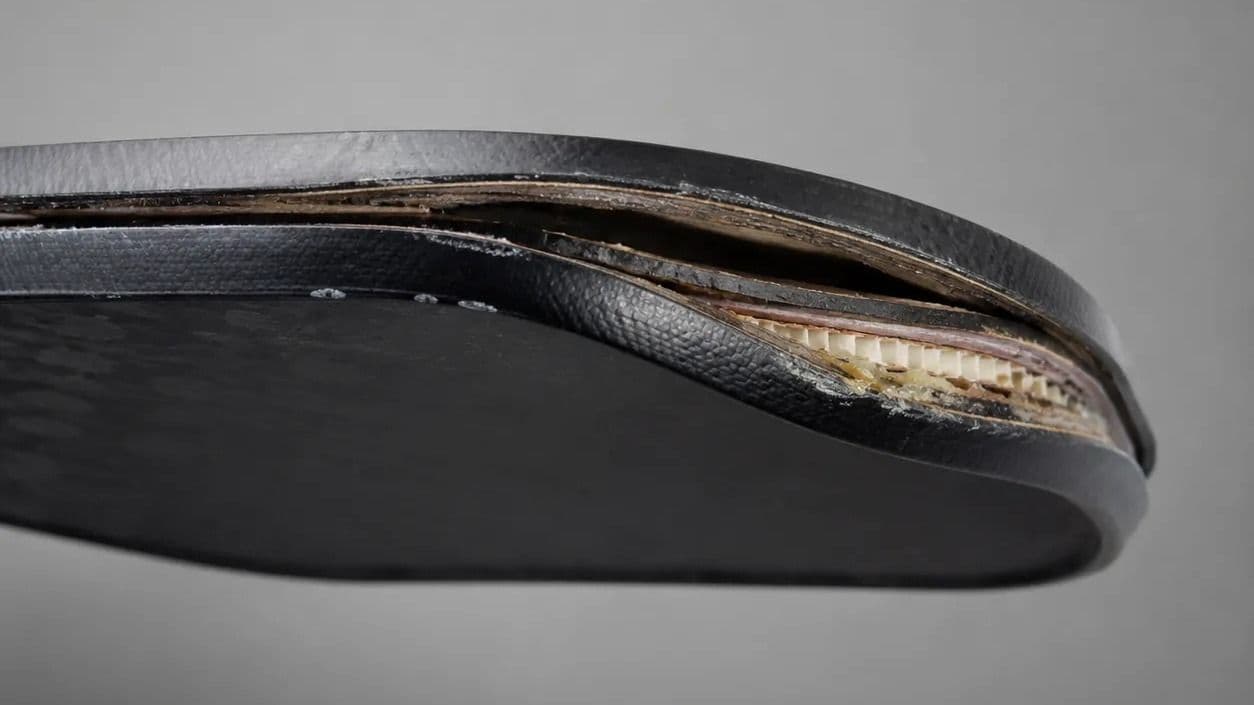
The carton comes back from the club with thirty paddles and one line on the paperwork: "defective, please replace." You tip them onto a table and start turning them over. Four have cracked faces, six have edge guards lifting, and the remaining twenty look completely fine.
Those twenty are the problem. Some are genuinely fine. Some have failed in a way that leaves no mark at all, and if they go back to stock they bounce a second time with an angrier email attached. Meanwhile the visibly damaged ones your eye went to first are mostly the ones the factory will refuse, because impact damage is the easiest thing in the world to attribute to the player. The sort is backwards from how it feels: what decides whether this carton becomes a credit or a write-off is not how bad each paddle looks, but which of six distinct mechanisms failed and whether that mechanism originates on the build side or the use side.
- Six modes, not one problem. Face separation, core crush, grit loss, edge impact, fatigue cracking and environmental ageing are distinct failures with distinct causes. "The paddle broke" is not a diagnosis.
- Only one mode has a number you can fail on. Grit loss is measurable against a published threshold — 30 µm Rz average, 33 µm single reading. The other five are judged on mechanism and evidence.
- Two modes are build-side, two are use-side, two are ambiguous. That split, not the severity of the damage, is what decides whether a claim is winnable.
- A certificate covers a submitted model, not the unit in your box. USA Pickleball has documented in its own rulemaking why the older static test could not detect the trampoline behaviour that separation produces.
- Who this is for: distributors, brand owners and club buyers triaging returned stock. Players wanting to repair one paddle should follow the links in each section instead.
- The Six Ways a Pickleball Paddle Actually Fails
- Face-to-Core Separation: Delamination and Debonding Are Not the Same Failure
- Core Crush: Why Dead Spots Appear Without Any Visible Damage
- Grit Loss: The Only Failure With a Number You Can Fail On
- Edge Impact and Edge-Guard Lift: The Failure That Changes the Paddle's Legal Dimensions
- Fatigue Cracking and Environmental Ageing: The Two Slow Modes
- Sorting a Returned Carton: Which Mode, in What Order

What this article deliberately does not cover
This is a classification piece. It tells you what each mode is, how it presents and how to tell it from the mode it gets confused with. It does not tell you how to repair anything — each of the six mode sections ends by handing off to the relevant procedure, or, for the two modes that cannot be repaired at all, by saying so and pointing at the sourcing decision that prevents them. Nor does it rank the modes by frequency, because doing so honestly would require return-stream data we are not going to invent for you. Where a number would be guesswork, this article says so rather than filling the gap.
The Six Ways a Pickleball Paddle Actually Fails
A modern composite paddle is a sandwich: two skins bonded to a thermoplastic honeycomb core, wrapped in an edge guard, with a handle bonded or moulded to the throat. Every failure is a failure of one of those elements or of one of the joints between them. That gives a closed set — six modes, not an open-ended list of complaints.
The reason the set matters more than any individual entry is that two of these modes are effectively invisible. A buyer inspecting returns by eye will find the cracked faces and the lifted edge guards and will miss the two that leave no mark, which are also the two most likely to be genuine manufacturing defects.
| Mode | Where it happens | Visible? | Usually originates |
|---|---|---|---|
| Face-to-core separation | Adhesive line between skin and core | Rarely | Build side |
| Core crush | Honeycomb cells, localised | No | Ambiguous |
| Grit loss | Face texture layer | Yes, by feel | Ambiguous |
| Edge impact / guard lift | Perimeter and guard bond | Yes | Use side |
| Fatigue cracking | Throat, corners, stress risers | Eventually | Build side |
| Environmental ageing | Adhesive and polymer systems | No | Use side |
The "originates" column is the commercially loaded one. Build-side failures are defects and belong to the factory. Use-side failures are wear and belong to the end user. The two ambiguous modes are where warranty arguments actually happen, and they are the two this article spends the most time on.
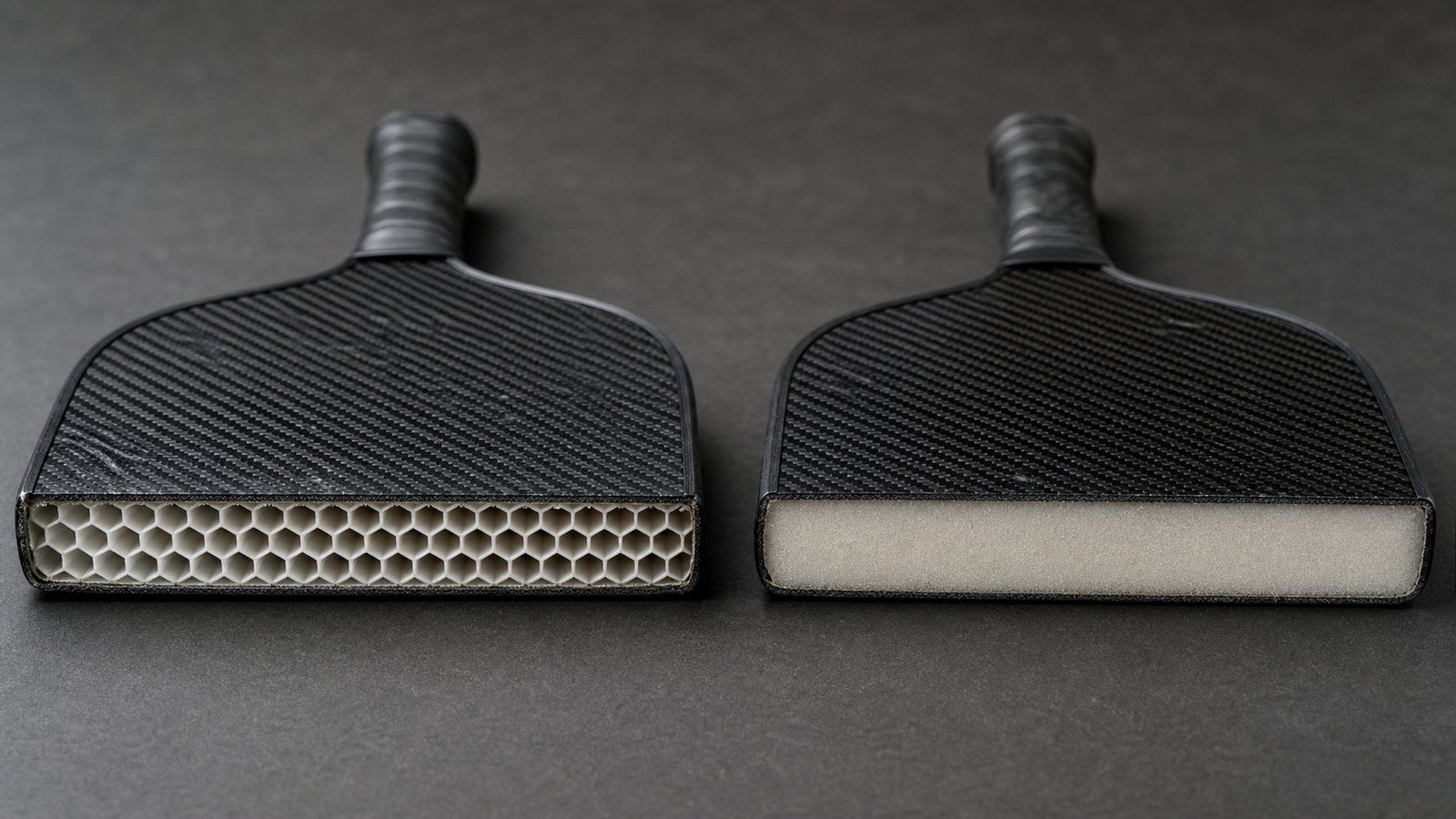
The sandwich construction that defines the failure set: two skins, a honeycomb core, and the adhesive joints between them. Five of the six modes are failures of one of these interfaces.
Face-to-Core Separation: Delamination and Debonding Are Not the Same Failure
The entire consumer internet uses "delamination" for any paddle where the face has come away from the core. That imprecision costs money on a warranty claim, because the two failures underneath the word have different causes and different owners.
Debonding is failure at the adhesive line: the glue that holds the skin to the honeycomb lets go, and the skin and core separate as intact pieces. Delamination proper is failure inside the laminate itself — the plies of the composite skin separate from each other, and the skin loses its own internal integrity. A debonded paddle has a skin that is still a good skin, sitting loose. A delaminated paddle has a skin that has come apart.
Why the distinction changes the argument
Debonding points at the bonding process — surface preparation, adhesive coverage, press pressure, cure schedule. Those are factory-controlled variables. Delamination within the laminate points at the face material and its lay-up. Also factory-controlled, but a different factory decision, and often a different supplier. Telling a factory "your paddles are delaminating" when the units are debonded sends the corrective action to the wrong department, and you get a revised laminate spec that fixes nothing.
The consequence both share
A separated face flexes independently of the core, and the paddle acquires a trampoline response it was never certified with. This is not a grey area in the rules. Clause 2.E.1 of the Equipment Standards Manual requires the paddle to be made of "rigid, non-compressible material", and clause 2.E.6.f prohibits "springs or spring-like material, flexible membranes or any compressible material that creates a trampoline effect". A paddle exhibiting that behaviour is outside the standard regardless of how it got there.
USA Pickleball now measures that behaviour directly. The paddle-ball coefficient of restitution test fires a ball from an air cannon at the paddle at typical test speeds of 60 mph and derives PBCoR from the inbound and outbound speeds — a method adapted from ASTM F2219-14, the high-speed bat performance standard. The not-to-exceed limit was 0.44 from 1 November 2024 and dropped to 0.43 from 1 November 2025. Both dates are in force now.
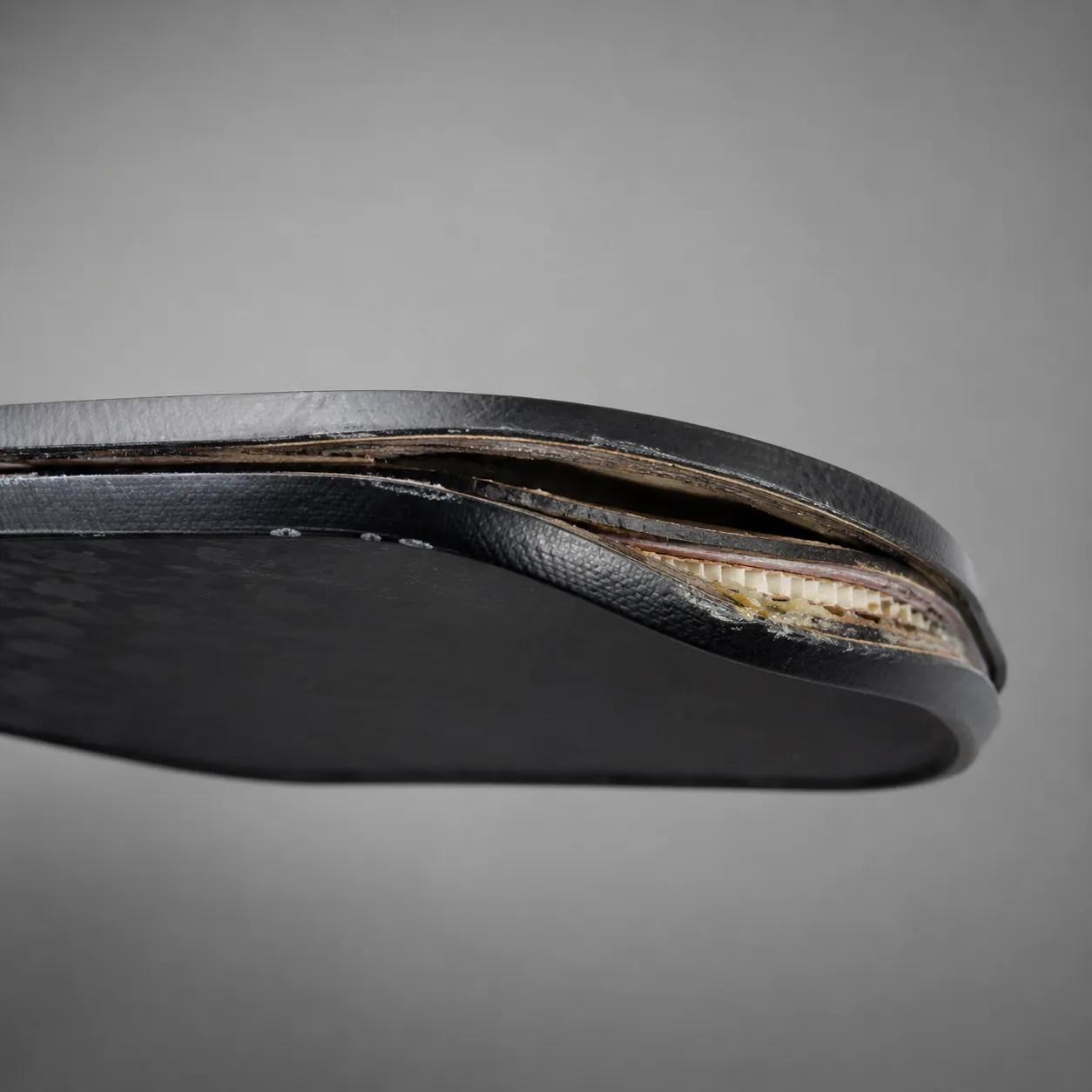
Separation viewed edge-on. Whether this is debonding or true delamination depends on where the failure surface sits — at the glue line, or between plies of the skin itself.
For the repair side of this mode, which is out of scope here, see our existing walkthrough on repairing a delaminated pickleball paddle.
Core Crush: Why Dead Spots Appear Without Any Visible Damage
This is the mode that generates the most confused warranty correspondence, because there is nothing to photograph. The paddle looks new. The player reports that one area plays dead — the ball comes off flat from a spot that used to be lively — and the buyer, seeing no damage, assumes the complaint is subjective.
It is not. Inside a localised area the honeycomb cell walls have buckled and stayed buckled. The core in that patch is now shorter and softer than the core around it, so the skin above it sits on a compliant foundation and the ball loses energy into permanent deformation instead of returning it. The face skin, being thin and stiff, spans the collapsed region and hides it.
The property that governs it, and the test that measures it
The relevant material property is flatwise compressive strength — the load the core carries perpendicular to the face skins before the cells collapse. It has a dedicated test method: ASTM C365/C365M-22, "Standard Test Method for Flatwise Compressive Properties of Sandwich Cores", whose scope explicitly covers cores with discontinuous bonding surfaces such as honeycomb. If a supplier tells you a core is crush-resistant, this is the designation the claim should be traceable to.
How much resistance that buys is set mostly by density. Published datasheet figures for commercial polypropylene honeycomb panel cores show the scale: Nidaplast 8DB at 65 kg/m³ is rated 1.2 MPa in compression, while 8HP at 100 kg/m³ is rated 2.6 MPa — roughly a factor of two in strength for roughly a factor of 1.5 in density. EconCore's ThermHex PP honeycomb range spans 60 to 80 kg/m³ standard densities with cell sizes from 3 mm to 9.6 mm.
Read those figures carefully. They are panel-core products, not paddle cores, and they are quoted here only to show how steeply compressive strength tracks density and cell geometry. Do not put 1.2 MPa in a paddle specification on the strength of this paragraph. The transferable point is the relationship, not the value — and the correct way to pin a value is to require a C365 result on the core your supplier is actually using.
Cell size works the same way from the other direction: a larger cell spans more unsupported skin between walls, so the same impact concentrates on fewer walls. We cover that trade-off in detail in how honeycomb cell size affects paddle feel and durability, and the thickness side of it in 14 mm versus 16 mm cores.
Why this mode is ambiguous rather than clearly defective
Core crush is genuinely caused by both sides. An under-specified core crushes under normal play; a correctly specified core crushes under abnormal play. Nobody can publish an honest impact count at which crush begins, because it depends on core grade, skin stiffness, impact location and how hard the player hits — and any single number you see quoted for it has been made up. What you can do is fix the variable you control: state the core grade and require a compression figure at the specification stage rather than arguing about it at the claim stage. If you are choosing a core density and construction for a new build, our OEM paddle build page lists the core and face options that decision sits between.
On repair, be clear-eyed: crushed cells do not un-buckle, so nothing restores a dead spot. The paddle is a credit decision, not a repair job. The one adjacent symptom that is fixable is a paddle that rattles rather than plays dead — loose debris, not crushed core — and our rattling paddle fix covers both the procedure and how to tell the two apart before writing either one off.
Core crush and face separation are decided at the build, not at the claim. Our OEM page sets out the choices that govern both: T700 carbon or fiberglass faces, 13 mm and 16 mm polypropylene honeycomb cores, and thermoformed unibody or cold-pressed construction. The page also sets out the approval and pre-shipment QC steps that run before a production lot ships.
Who this is for: brand owners and distributors specifying a new programme. If you are trying to rescue paddles you already own, the repair links in each section above are the useful path — this one will not help you.
See the OEM build optionsGrit Loss: The Only Failure With a Number You Can Fail On
Every other mode in this article is argued qualitatively. This one has a published threshold, an instrument named in the standard, and a pass-fail line — which makes it the easiest mode to settle and, for the same reason, the one worth understanding precisely.
Face texture is what generates spin, and it is a controlled specification rather than a styling choice. Clause 2.E.2.a.1 of the Equipment Standards Manual sets the limits: roughness must average no greater than 30 micrometres on the Rz readings (average maximum height, peak to valley) and no greater than 40 micrometres on Rt (maximum height, peak to valley). Measurement is taken with a Starrett SR160 or SR300 surface roughness tester, or equivalent, in six different directions on each face, and each face is averaged separately.
The averaging rule that catches people out
There is a second ceiling underneath the average, and it is the one that produces surprising results. No single data point in the set may exceed 33 micrometres on Rz, and none may exceed 44 micrometres on Rt. So a face can average comfortably inside the limit across its six directions and still fail on one directional reading — which happens when a texture is directional, as moulded or brushed textures often are.
There is a parallel friction requirement too: a coefficient of friction test run to ASTM D1894-14, which a paddle passes with a maximum kinetic coefficient of friction of 0.1875 or below.
Specification checklist — texture. Require the Rz average and the maximum single reading, both, in six directions per face and both faces reported separately. Require the instrument model. Require the ASTM D1894-14 kinetic friction figure alongside it. A supplier reporting one averaged number for one face has answered a different question from the one the standard asks.
Grit loss itself is ambiguous in origin, for a blunt reason: a sprayed or coated texture and an integrally moulded or raw-woven texture wear at completely different rates, and the difference is invisible on arrival. A face whose texture is a surface coating loses it as the coating abrades. A face whose texture is the weave itself cannot lose texture without losing material. The failure looks the same to the end user and is a totally different manufacturing decision.
Which is why the hand-off here is not a repair procedure — a worn face cannot be re-textured back inside the Rz limits, and anything that adds texture to a finished face is an alteration the standard does not contemplate. It is a sourcing question instead. Our comparison of sprayed versus peel-ply paddle surfaces sets out which construction you are actually buying, which is what determines whether you see this failure at all.
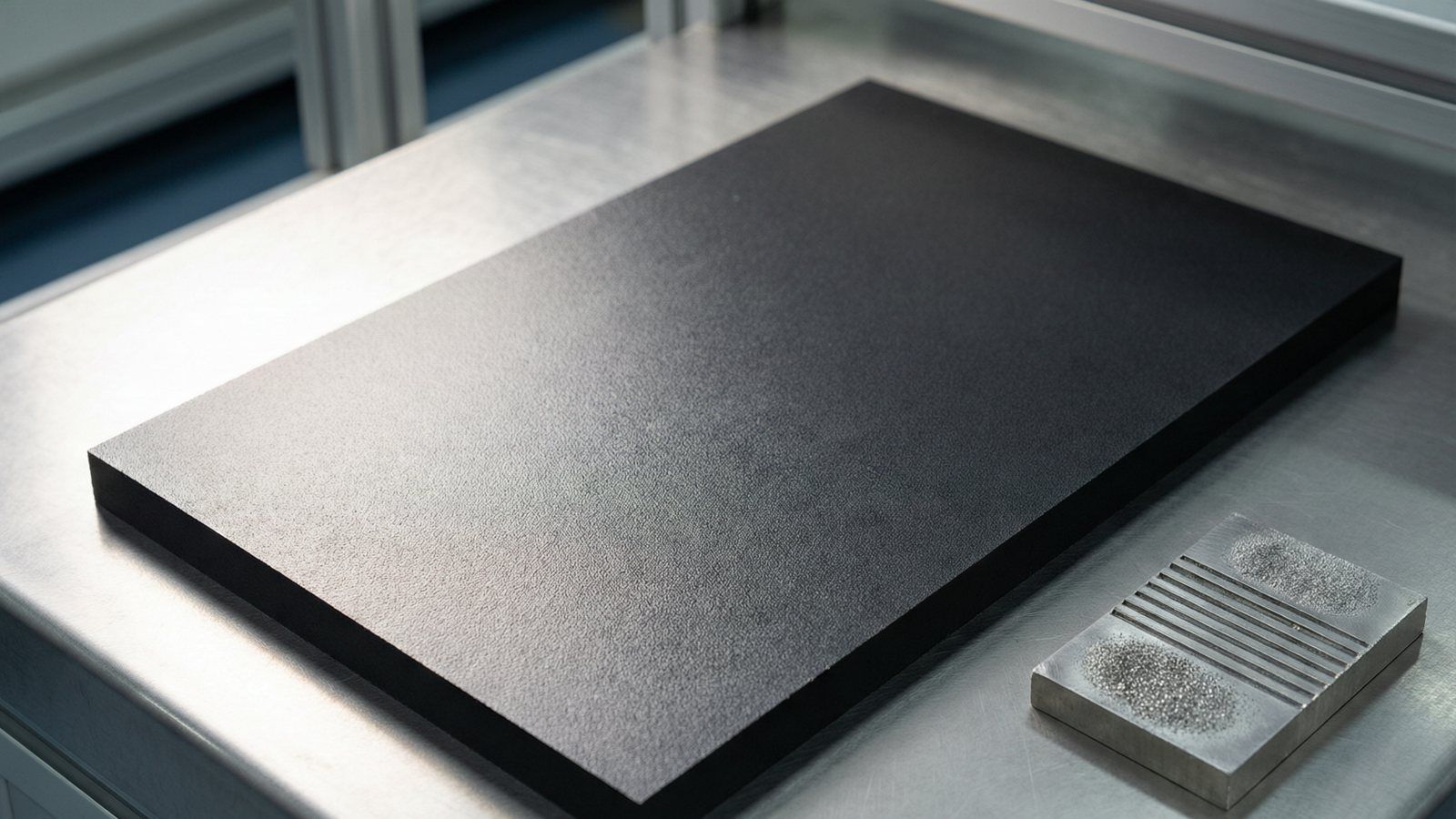
Face texture inspection. Because the standard measures in six directions and applies a single-reading ceiling as well as an average, directional textures need reporting per direction rather than as one figure.
Edge Impact and Edge-Guard Lift: The Failure That Changes the Paddle's Legal Dimensions
Edge damage is the most-reported and least-diagnostic complaint in a returns pile. It is usually the clearest use-side failure in the set — a paddle scraped on court, clashed with a partner's, or dropped edge-first — which is why it belongs in a taxonomy even though it is rarely a claim.
What makes it worth a section is the second-order consequence. The edge guard is not trim. It is a structural closure over the exposed core cells at the perimeter, and it is the perimeter that takes the concentrated out-of-plane loads. Damage resistance of sandwich constructions has its own ASTM practice — D7766/D7766M-16, "Standard Practice for Damage Resistance Testing of Sandwich Constructions" — which offers quasi-static indentation rigidly backed (Procedure A), quasi-static indentation edge supported (Procedure B), and drop-weight impact (Procedure C). The standard itself notes Procedure A is "considered to be the most suitable procedure for comparative damage resistance assessments", because flexural stiffness influences the result less.
The dimensional trap
Once a guard has lifted or been replaced, the paddle's measured envelope can change, and the envelope is regulated. Clause 2.E.3 caps combined length and width — including any edge guard and butt cap — at 24 inches (60.96 cm), and paddle length at 17 inches (43.18 cm). There is no restriction on thickness and none on weight. Clause 2.E.2.b applies a reflectivity limit of 80 GU at a 60-degree measurement angle to edge guards as well as faces.
The standard does permit field replacement: clause 2.E.5.a lists edge guard tape and replacements among the alterations a player may make, alongside weighted tape, grip wraps and OEM interchangeable grips. But clause 2.E.5 requires that altered paddles still meet all specifications, and clause 2.E.5.b bounds where tape and decals may sit — no farther than 1.0 inch (2.54 cm) above the top of the grip, and no more than 0.5 inch (1.27 cm) inside the outer edge or inside the edge guard. A bulky aftermarket guard on an already full-size paddle is how a legal paddle quietly becomes an illegal one.
The repair procedure is covered separately in our guide to refitting a loose edge guard.
Fatigue Cracking and Environmental Ageing: The Two Slow Modes
The four modes above announce themselves. These two arrive late, and their timing is their defining commercial characteristic: they tend to surface after the claim window has closed, which is why they are the modes most likely to end up as goodwill credits rather than warranty claims.
Fatigue cracking initiates at stress concentrations rather than at the point of hardest impact. The throat, where the handle meets the head, is the classic site: it carries the highest bending moment and it is where two differently-behaving structures are joined. Corners, moulding witness lines and any abrupt change in section do the same job. A crack that starts there grows slowly under normal load and becomes visible long after the flaw that seeded it was created — which is precisely what makes it a build-side failure presenting on a use-side timeline.
Environmental ageing is the adhesive and polymer systems losing properties over time under heat, humidity and UV. The mechanism is not controversial: an adhesive that approaches its glass transition softens, and bond strength falls with it, so a joint that was adequate when new can become marginal after enough thermal cycling. That is where a paddle stored hot for long periods, or shipped through a hot leg, arrives already partway to a separation failure.
What we are not going to tell you about these two
This is the section where competing articles reach for numbers, and it is worth being explicit about why this one does not. You will see a specific hour-count quoted as paddle lifespan, a specific percentage of complaints attributed to delamination, and a specific container interior temperature — usually 70 °C — offered as the reason adhesives fail in transit.
We could not ground any of them. The lifespan figures trace to marketing copy. The complaint percentages trace to brand blogs with no stated methodology and a commercial interest in the answer. And on container temperature, the studies we found measured different cargo in different shipping lanes, and none establishes an ambient bound you could carry into a paddle argument in either direction. Note the distinction: we are not claiming transit interiors stay cool — a container sitting in sun plainly gets hot, and the ageing mechanism above is real. We are saying nobody repeating a specific figure at you has shown where it came from. So this article states no lifespan, no failure-rate split and no container temperature.
That is not evasion, it is the useful answer. A number you cannot defend is worse than no number in a warranty dispute, because the other side only has to discredit it once. What replaces it is a testable requirement: if thermal exposure matters to your programme, put a conditioning-and-test requirement in the specification rather than a temperature claim in an argument. Our paddle drop-test and durability protocol sets out how to write those pass criteria into a purchase order — that is the next step from this page if you are building a programme rather than sorting a carton.
Where each of these two goes next. Whether a crack is worth acting on depends on where it sits and how it started; our guide to what causes paddle cracking takes it from diagnosis to disposition. A paddle that has aged rather than cracked usually shows distortion instead of fracture, and the heat-based straightening method for that is in fixing a warped paddle.
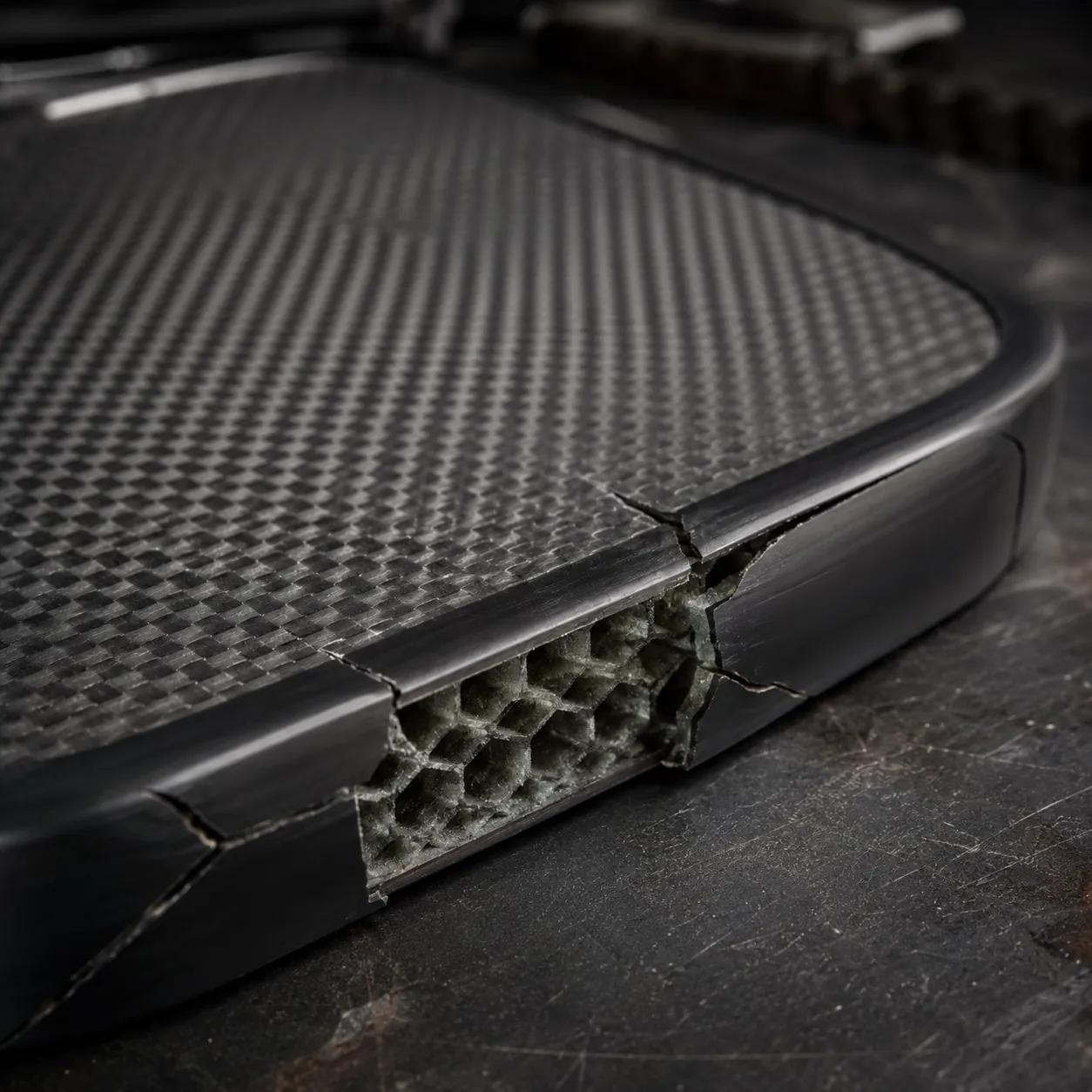
Fatigue cracks start where stress concentrates — throat, corners, section changes — not where the ball hits hardest. Location is the main evidence for whether a crack is fatigue or impact.
Sorting a Returned Carton: Which Mode, in What Order
Here is the procedure end to end. It is written for someone with a carton of returns, a flat table and no instruments — because the sort has to happen before anyone commissions a test, and because the sequence matters more than the equipment.
The discrimination table
| What you observe | Mistaken for | Test that separates them |
|---|---|---|
| A patch that sounds different when tapped | Core crush vs face separation | Press the patch with a thumb. Separation gives compliant, springy travel that returns; crush gives a firm but low, dull response with no spring. |
| Face feels smooth | Grit loss vs contamination | Clean with isopropyl and re-feel. Texture that returns was never lost; texture that does not is worn or was a coating. |
| A crack at the throat | Fatigue vs impact | Look for a strike mark. Impact leaves one at the crack; fatigue leaves an unmarked surface and often a crack that follows a moulding line. |
| Edge guard lifting | Impact vs bond failure | Check whether lift starts at a scuff or at a corner with no damage. Lift with no local damage points at the bond, not the player. |
| Paddle plays "hot" | Separation vs perception | Bounce a ball off the centre from a fixed height and compare with a known-good unit of the same model. A separated face returns noticeably more. |
| Guard replaced by the user | Legal alteration vs out-of-spec | Measure it. Combined length plus width must stay within 24 in, length within 17 in, guard included. |
The order to work in
- Measure before you touch anything else. Length, and length plus width including guard and butt cap. Out-of-envelope units are settled immediately and leave the pile.
- Tap the whole face on a grid. You are listening for a change in note, not a specific note. Mark every patch that differs from the surrounding face.
- Thumb-press every marked patch. This is the single test that splits the two invisible modes, and it is the highest-value minute in the whole sort.
- Clean and re-feel the face before recording any texture complaint. A meaningful share of "grit is gone" reports are court dust and skin oil.
- Inspect the perimeter for a strike mark at every lift or crack, and photograph the absence as carefully as the presence — absence of impact damage is the evidence that carries a build-side claim.
- Group by mode, not by severity, and file one claim per mode with a photographed example set. Six units of one mode is a pattern the factory has to answer; twenty assorted units is a complaint it can absorb.
What a certificate does and does not tell you
The most common misconception in this whole area is that a certified model means a sound unit. Certification is granted against one submitted unit of a model. It does not travel with each unit produced afterwards, and it does not testify to lot-to-lot consistency.
USA Pickleball has effectively documented this limitation itself. Explaining why it introduced the PBCoR test, the governing body wrote that the older static deflection test "has been used as a surrogate to characterize the power of a paddle. However, it is a static test and has limitations related to the boundary conditions of the test... and does not include any contributions for the way the forces are reacted at an outer frame for the paddle." In other words, the historic certification test was, by the issuing body's own account, not able to fully characterise the behaviour that face separation produces.
For completeness on version: the figures throughout this article are from Equipment Standards Manual Revision 3.0 (January 2025), the revision published as of this writing, retrieved on 26 August 2026. Check the current revision before quoting any threshold into a contract.
On MOQ and commercial terms: this article deliberately quotes none. Minimum order quantities for paddle programmes are set per project against the model count, core and face combinations and packaging you specify, so any single figure quoted here would be wrong for most readers. It is a question to ask against your actual model mix, not one to read off a page.
Conclusion
The failure worth guarding against is not any of the six modes — it is the sort going wrong, and it goes wrong in one direction every time. Attention follows visible damage, so the cracked faces get the photographs while the unmarked paddles go back to stock, and those unmarked units hold most of your genuine defects. The cost compounds from there: returned stock bounces a second time, a pile of thirty undifferentiated units gets absorbed as goodwill rather than answered as a defect pattern, the build problem is never corrected, and the two slow modes quietly outlive the claim window.
Run the sort in this order and you get through a carton with a defensible position:
- Measure the envelope first — 24 in combined, 17 in length, guard included. Fast, objective, removes units from the argument.
- Tap, then thumb-press. Springy travel means separation; dull and low means crush. This one test does most of the diagnostic work.
- Clean before you judge texture, and require the Rz average and the 33 µm single-reading ceiling in six directions per face when you specify.
- Photograph the absence of impact marks on every crack and lift you intend to claim.
- File by mode, one claim each, with an example set. Patterns get answered; assortments get absorbed.
- Treat a certificate as a model statement, not a unit guarantee, and put the test requirements you actually care about into the purchase order instead.
If you are on the specification side of this rather than the returns side, the next document to read is the drop-test and durability protocol, which turns these modes into pass criteria you can write into a PO, and the pre-shipment AQL inspection guide, which decides how many units get looked at before they ship. The warranty language that all of this eventually lands in is covered in our note on bulk paddle warranty terms.
Sources
- USA Pickleball Equipment Standards Manual, Revision 3.0 (January 2025) — clauses 2.E.1 to 2.E.6.f
- USA Pickleball NPRM 24-002, PBCoR Testing (1 October 2024)
- ASTM C365/C365M-22, Flatwise Compressive Properties of Sandwich Cores
- ASTM D7766/D7766M-16, Damage Resistance Testing of Sandwich Constructions
- EconCore ThermHex polypropylene honeycomb core range
Frequently Asked Questions
Why do pickleball paddles fail?
Through six distinct mechanisms: face-to-core separation, core crush, grit loss, edge impact, fatigue cracking and environmental ageing. Each has a different cause and a different owner, which is why "it broke" cannot be diagnosed or claimed as a single problem.
What is the difference between delamination and debonding?
Debonding is failure at the adhesive line, leaving skin and core intact but separated. Delamination is separation between plies inside the skin itself. They point at different manufacturing steps, so naming them correctly sends corrective action to the right place.
How can I tell core crush from face separation?
Press the patch with a thumb. Face separation feels springy, with travel that returns. Core crush feels firm but low and dull, with no spring. Both sound different when tapped, so sound alone cannot separate them.
What is the USA Pickleball surface roughness limit?
Faces must average no more than 30 micrometres Rz and 40 micrometres Rt, measured in six directions per face. No single reading may exceed 33 micrometres Rz or 44 micrometres Rt, so a directional texture can pass on average yet fail once.
Is a delaminated paddle illegal to play with?
A paddle showing trampoline behaviour falls outside clause 2.E.6.f, which prohibits compressible material creating a trampoline effect, and clause 2.E.1's rigid non-compressible material requirement. PBCoR limits have been 0.44 since 1 November 2024 and 0.43 since 1 November 2025.
How long does a pickleball paddle last?
We publish no hour figure, because we could not ground one — quoted lifespans trace to marketing copy, not test data. Lifespan depends on core grade, face construction, impact rate and storage, so a specification-side answer beats an average.
Does a USA Pickleball certificate cover the paddle I received?
Certification is granted against one submitted unit of a model, not against each unit produced later, and it does not testify to lot-to-lot consistency. Unit-level assurance comes from your own inspection and from test requirements written into the purchase order.
Which ASTM standards apply to paddle failure modes?
ASTM C365/C365M-22 covers flatwise compressive properties of sandwich cores, which governs core crush resistance. ASTM D7766/D7766M-16 covers damage resistance testing of sandwich constructions, relevant to edge and face impact. Surface friction runs to ASTM D1894-14.
Want to source this quality for your brand?
Contact our factory directly on WhatsApp for an instant MOQ and pricing quote.