Custom Logo Pickleballs: Pad-Printing, Colors & MOQ
A branded pickleball feels like a small ask — put your logo on a hollow plastic sphere — but the moment you talk to a factory, the questions multiply. Pad-print or laser? One color or two? Does the yellow ball dull the ink? Why is the sample logo crisp and the production run smudged? And why can that supplier take 500 pieces while this one demands 2,000? None of this is arbitrary. Every answer traces to a specific step on the line, and knowing which step drives which cost is what separates a first-time brand launch that lands from one that ships a bucket of returns.
This guide walks through what "custom logo" actually means on a rotomolded outdoor ball — the two printing methods worth considering, the color and ball-color combinations that print cleanly, realistic MOQ tiers with and without color-matching, and the sample workflow that catches problems before a full run. We rotomold and print in-house, so the numbers and constraints below are the ones we operate against on real orders, not brochure figures.
Key Takeaways
- Pad-printing is the industry default for logos on pickleballs — it wraps a slightly curved surface, holds up to court abrasion, and costs a fraction of laser once tooling is amortized.
- Real MOQ for a single-color logo on stock-color balls typically starts at 500–1,000 pieces at a source factory; adding a custom Pantone-matched ball color usually pushes you to 3,000–5,000 because it locks a full rotomolding batch.
- Fluorescent yellow, orange, and white are the only ball colors that behave predictably in a photo — deep colors like navy and green mute logo ink and hide drilled holes buyers use to verify authenticity.
- Each ink color is a separate print pass with its own setup fee and a shift in registration; keeping a logo to one or two colors is the single biggest lever on unit cost at low volumes.
- Vector artwork with 0.5 mm minimum stroke width is the practical floor for a legible pad-print — anything thinner or rasterized fills in on the ball's curved surface and looks blurred on the shelf.
- A pre-production sample with your final artwork, on your final ball color, checked against a printed hard-copy proof is the one QC gate that stops the "sample looked great, production smudged" failure that kills first-time launches.
What "custom logo pickleballs" really means in production
On a source-factory line, "custom logo" covers three distinct customizations that are often bundled in a single quote but cost very differently. Understanding which ones you're actually paying for is the first step to a sensible order.
1. Logo print on a stock-color ball
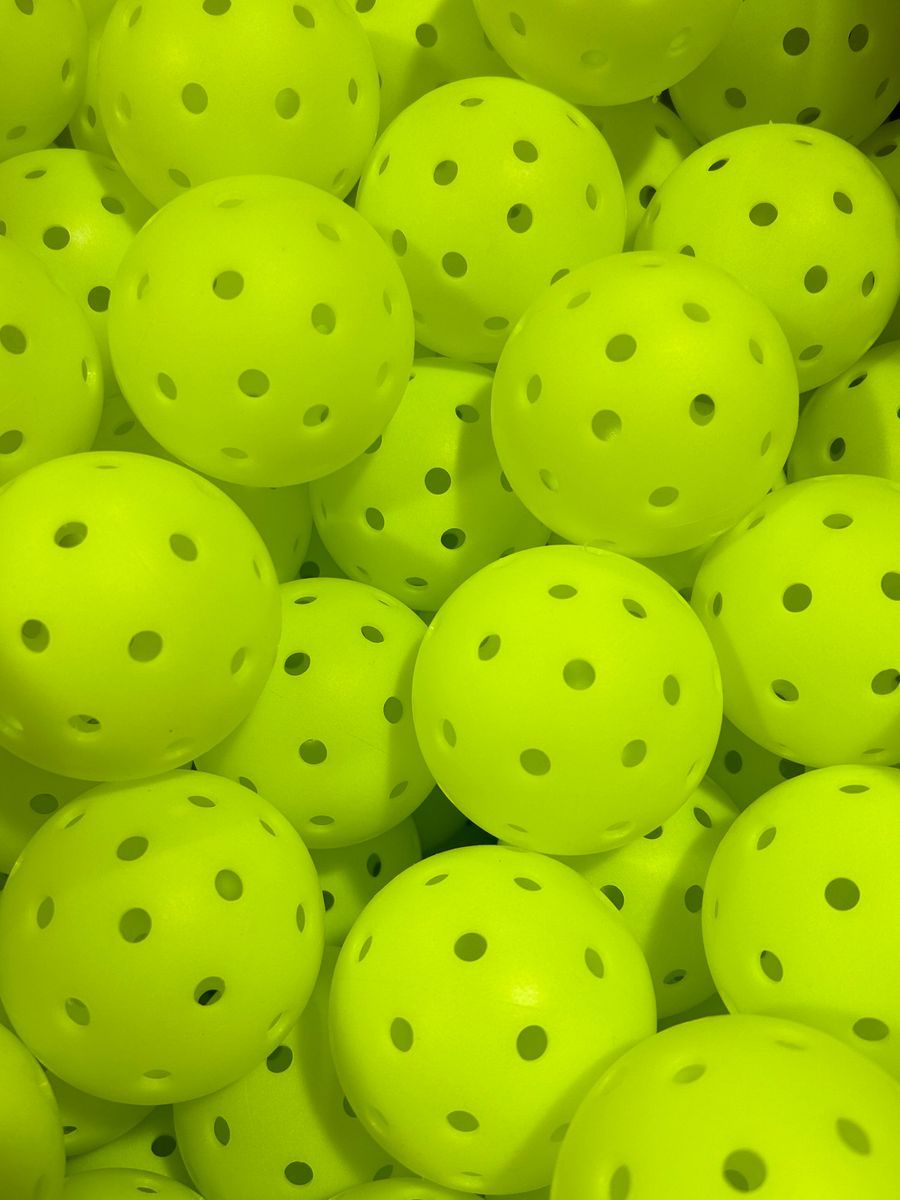
This is the cheapest and by far the most common path: order balls in a color the factory already rotomolds every week — usually fluorescent yellow, sometimes fluorescent orange or white — and add a pad-printed logo on top. Ball color is off the shelf, so the factory is just adding printing time and a small setup charge to an existing run. MOQ stays low, lead time stays short.
2. Logo print on a custom-color ball
The moment you specify a Pantone-matched ball color that isn't in the factory's rotation, the economics change. A rotomolding batch has to be dedicated to that color:inherit's why "just make them royal blue" quietly triggers a 3,000–5,000-piece minimum even when the print MOQ is a fraction of that.
3. Full private-label package (ball + printed retail box)
The third layer is the box the ball ships in — printed hangtag, retail carton, or a 3- or 6-pack sleeve with your barcode and country-of-origin block. Packaging is often the visible half of what a buyer sees on the shelf, and it runs on its own MOQ tied to the print run of the carton itself. If retail is the endgame, plan and quote the printed packaging separately from the ball — the sequencing is covered in our guide to private-label pickleball packaging.
Pad-printing vs laser marking: how logos actually go on the ball
Two methods realistically compete for logo application on a pickleball. They aren't interchangeable — each has a physical reason for existing and a specific failure mode.
Pad-printing (the default)
Pad-printing uses a silicone pad to lift ink from an engraved plate and transfer it onto the ball's curved surface. The pad deforms around the sphere, which is why it works on a shape a flat screen never could. Setup makes a printing plate for each color; the ball is fixtured hole-side-down so the drilled top face stays clean, and the pad presses once per ink. Print area is typically 25–35 mm across — enough for a wordmark plus a small icon, not enough for a full brand lockup with tagline. Modern UV-cure inks bond well to polyethylene and survive court abrasion for the useful life of the ball. When brands say "the logo wore off," it's almost always because they specified a cheap solvent ink to save a few cents per unit, or the ball wasn't flame-treated before printing — a step some suppliers skip because it's easy to hide.
Laser marking (specialty case)
Laser marking scorches the plastic surface directly, producing a monochrome mark that literally cannot rub off. It sounds ideal until you look at the trade-offs: it's slow (each ball is loaded and marked individually), it's monochrome only (usually a dark burn on a light ball), and on a rotomolded PE surface the contrast is subtle at best — the mark reads more as an embossed shadow than a printed logo. It exists in the pickleball world mostly for balls that need a tamper-evident mark (tournament-controlled inventory, for example), not for consumer branding. If your goal is a logo that looks printed on the shelf and reads from arm's length, pad-printing is what you want.
A "no logo wear" quote is a red flag if the price is normal — the only way to promise that on a pad-printed ball is proper flame treatment plus UV-cure ink. If nobody mentions either, the durability claim is marketing.
Colors: what prints cleanly and what silently fails
Two color decisions matter: the ball color and the ink color. They interact, and the wrong pairing turns a crisp digital proof into a muddy production print.
Ball color trade-offs
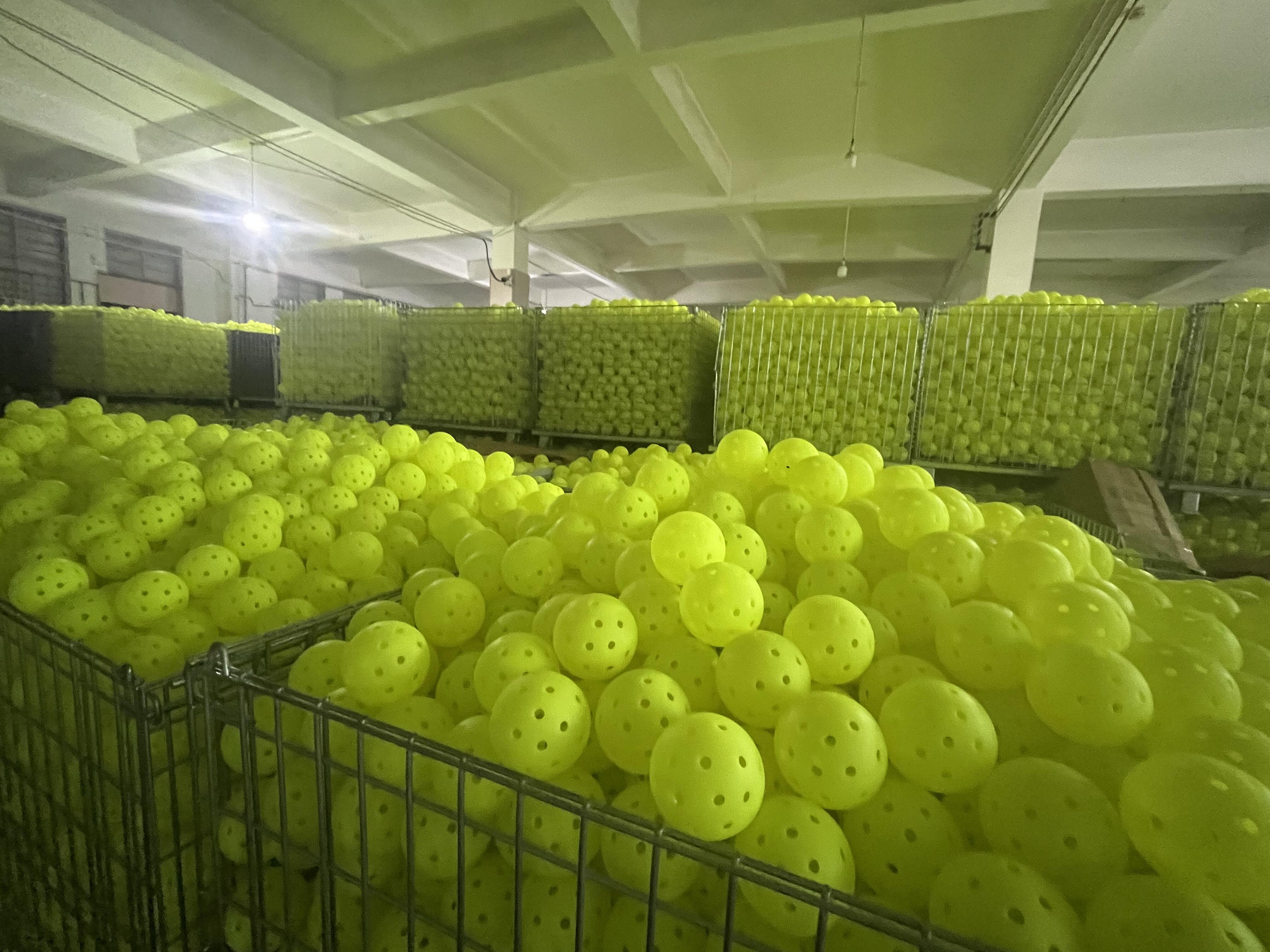
- Fluorescent yellow, orange, white: the workhorse colors. High contrast against most ink, low MOQ (stock), and — critically — they photograph well for e-commerce, where 80% of the buyer's decision happens.
- Neon pink, lime green: attention-getting on the shelf but restrict ink choice to very dark colors (usually black) to keep the logo readable. Adds cost from custom powder compounding.
- Navy, black, deep red, forest green: look premium in renderings and fail on court. The drilled holes visually disappear against the dark base, which reads as "cheap" to informed buyers, and only white or metallic inks stay legible — both of which cost more and abrade faster.
Ink color trade-offs
Each additional ink color is a separate pad-print pass, with its own plate, its own setup, and its own registration tolerance. One-color logos are the low-cost, high-consistency default. Two colors — say a black wordmark with a red accent — are doable at reasonable MOQ but expect a small extra fee per unit and a slight visible shift between the two impressions on some pieces. Three colors are rare on pickleballs; the sphere is too small and the cumulative registration drift makes a clean three-color print unreliable at production speed. If your logo needs three colors, redesign for the ball or accept it will look inconsistent.
MOQ tiers: what a source factory will actually accept
MOQ on custom-logo balls isn't a policy — it's a math problem the factory solved for itself. Each customization step has a setup cost that has to be amortized, and the MOQ is whatever quantity spreads it thin enough that the factory can still hit its normal margin at a competitive unit price. That's why quoted MOQs cluster around specific numbers.
| Order type | Realistic MOQ | Why |
|---|---|---|
| Stock ball, 1-color pad-print | 500–1,000 | Ball comes from a running batch; only cost added is one print plate + setup. |
| Stock ball, 2-color pad-print | 1,000–2,000 | Two plates, two passes, longer per-ball print cycle to amortize. |
| Custom Pantone ball color, 1-color print | 3,000–5,000 | A dedicated rotomolding batch has to be economically justified. |
| Custom color + printed retail 3-pack sleeve | 5,000+ | Add the packaging print run's own MOQ on top of the ball batch. |
| Sample run (paid) | 10–50 | Below production efficiency but priced accordingly; essential before a first order. |
If a supplier quotes 100 MOQ on a custom-color ball with a two-color print, one of three things is true: they're a trading company drop-shipping from a warehouse of already-printed inventory, they're bulking small orders together and delaying yours, or the "custom color" is a paint dip rather than a compounded ball color — which will chip within weeks. On paddle MOQ, the same logic in more depth is in custom paddle MOQ: why 300 units beats 50.
Artwork requirements: what your designer needs to know
The single most common cause of an ugly production print is artwork that was fine for a website and unsuitable for a pad. Give the factory the wrong file and they'll either send it back or, worse, print it. Give them the right file and the print looks like the mockup.
- Vector, not raster. Send AI, EPS, or PDF with live vectors. A high-res PNG is not vector — it will be re-drawn by the plate-maker with unpredictable results on thin strokes.
- Minimum stroke width 0.5 mm on the ball. Below that, ink bridges gaps on the curved surface and thin strokes disappear or blob together.
- Spot colors, called out by Pantone. Do not send CMYK and expect an exact match — pad-print inks are premixed spot colors. If Pantone matching matters, name the color explicitly.
- Convert type to outlines. The factory won't have your font. Outline it before you send or the plate-maker will substitute the closest thing on their machine.
- Max 30 mm across. The pad has a working area, and a logo pushed to the edge distorts as the pad wraps the curve. Stay inside the safe zone the factory specifies.
USA Pickleball approval and custom-color balls
If you're selling into the US club and tournament market, an unapproved ball is a hard ceiling on where your brand can be used. USA Pickleball approval is granted on the specific ball construction — the mold, resin, and manufacturing process — not the color of the plastic or the logo printed on top. In practice, that means adding your logo to an already-approved ball does not require re-approval. Ordering a custom-color ball from a rotomolder whose approved model is only in fluorescent yellow, however, means the colored version isn't automatically approved — you'll be selling a ball marketed as branded but not tournament-legal. The full explanation of what approval actually covers is in sourcing USA Pickleball approved balls, and the category-by-market picture is in USAPA vs UPA-A vs IFP certification.
If tournament approval is part of your positioning, keep custom logos on the factory's already-approved base ball. Chasing a custom color usually costs you the approval you were selling on.
The pre-production sample workflow that stops disasters
Almost every "sample was perfect, production was junk" story on a first-time branded order traces to a sample workflow that skipped one specific step. The workflow that catches it isn't complicated, but it has to happen before the balance payment.
- Digital proof (day 1): factory sends an artwork mockup showing logo size, position, and colors on the exact ball color you're ordering. Approve in writing.
- Hard-copy printed proof (day 3–5): the actual pad-print plate is made and a physical sheet is printed with the logo at scale. Not on a ball yet — on paper — so registration and stroke fidelity can be checked flat.
- Paid pre-production sample (day 7–14): 10–50 balls off the actual line, with the actual plate, in the actual ball color and box. This is the sample you keep and photograph. If mass production drifts, this is your reference.
- Sign-off in writing: approve the sample by email with photos attached. This becomes the specification the QC team measures the full run against.
- Golden sample retained at factory: a matched pair of the approved sample stays with the factory QC bench for the whole run. When an inspector flags a batch, this is the reference on the desk.
The mechanics of a proper sample sign-off — including the language to put in writing — are covered end-to-end in our guide to golden-sample approval for pickleball orders. Skip this and the only leverage you have when production drifts is refusing shipment, which is a fight you don't want on your first order.
Cost structure: where your unit price goes
Roughly speaking, on a 1,000-piece order of stock-color balls with a one-color pad-print, the ball itself dominates the FOB cost — the printing overlay is a modest per-unit add plus a one-time setup that shows up whether you order 1,000 or 10,000. The setup is what makes small orders feel expensive per unit: on 500 pieces it's a meaningful percentage of the total; on 5,000 pieces it disappears into the noise.
Two levers move total delivered cost more than any negotiation on unit price. First, keep ink to one color unless the brand identity truly requires two — every additional color adds a per-unit cost and a setup. Second, order the ball color the factory already runs; switching to a custom color moves you into a different MOQ tier that often means holding inventory longer than a first-time launch can afford. For the total landed picture including freight and tariffs, our guide to importing pickleball equipment cost lays out the categories that quietly compound.
Frequently Asked Questions
What is the smallest order of custom logo pickleballs a factory will actually accept?
A real source factory will typically accept 500–1,000 pieces for a one-color pad-print on stock fluorescent yellow balls. Below that, you're either paying trading-company premiums on drop-shipped stock or being bundled with another buyer's order at unpredictable timing. Paid sample runs of 10–50 exist, but they're a pre-production step, not a production order.
Will a custom logo affect USA Pickleball approval on the ball?
Adding a pad-printed logo to an already-approved base ball does not require re-approval — the approval is on construction, not surface graphics. Ordering the same ball construction in a custom Pantone color that wasn't submitted for approval, however, produces a ball that is not tournament-legal even though the approved model exists in a different color. If tournament positioning matters, keep the logo on the approved color.
How many colors can you print on a pickleball logo?
One color is the industry default and costs the least. Two colors are common at moderate MOQ, with a small per-unit premium and a visible registration tolerance. Three colors on the curved surface of a pickleball are rare because cumulative registration drift makes a clean three-color print unreliable at production speed — most brands redesign for one or two rather than accept the inconsistency.
Does a printed logo wear off during play?
A properly executed pad-print — flame-treated ball surface plus UV-cure ink — will typically outlast the ball's playable life on outdoor courts. Logos that visibly wear off in weeks are almost always the result of a supplier substituting a cheap solvent ink or skipping the flame-treatment step to save cycle time. Ask any quote what ink chemistry and what pre-treatment they use.
What artwork file format should we send the factory?
Vector — AI, EPS, or vector PDF — with type converted to outlines and spot colors called out by Pantone. Raster images (PNG, JPG) will be re-traced by the plate-maker, which introduces variance you can't inspect until the printed proof arrives. Keep minimum stroke width at or above 0.5 mm and the overall logo inside a 30 mm bounding box.
Can you match a specific Pantone color for both the ball and the ink?
Yes, but they're two separate cost drivers. Pantone-matching the ink is essentially free once specified — it's a premix step in normal pad-print work. Pantone-matching the ball plastic requires a dedicated rotomolding batch of that compounded color, which is what pushes the MOQ to the 3,000–5,000-piece tier described above.
How long does a custom-logo pickleball order take from artwork to shipment?
On stock-color balls with an approved one-color logo, factory lead time from deposit to ready-for-shipment is typically 25–35 days: about a week for artwork approval and plate-making, one to two weeks for the balls and printing, and a few days for QC and packing. Custom-color ball batches add a week for the compounded color to be produced. Peak-season and Chinese New Year timing can shift both windows significantly — plan around them, not through them.
Want to source this quality for your brand?
Contact our factory directly on WhatsApp for an instant MOQ and pricing quote.