Custom Pickleball Paddle Sourcing: Specs, MOQ and Timeline
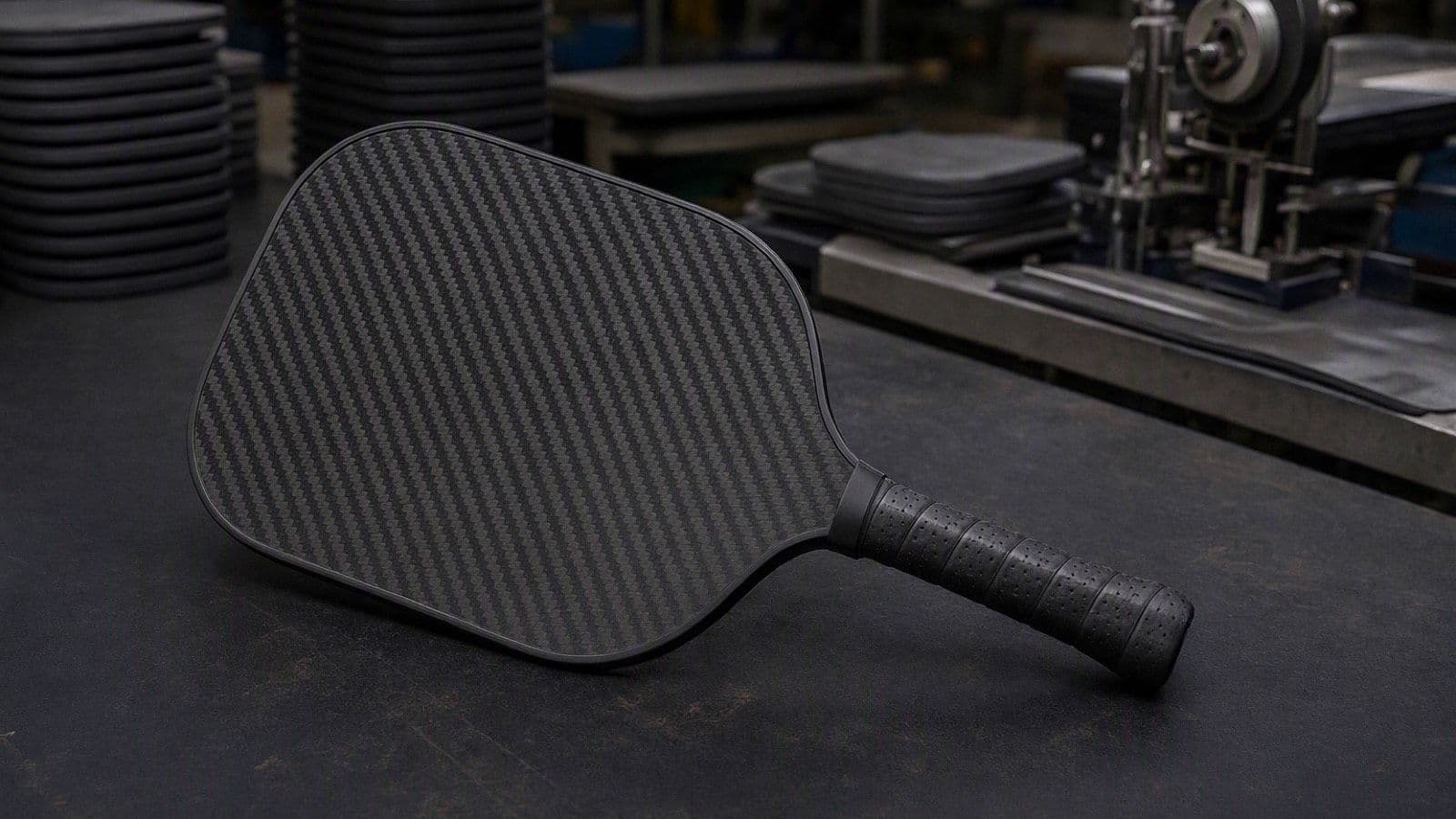
Ask five factories what a custom pickleball paddle costs and you get five answers, because the word "custom" hides three different orders. One buyer wants a stock paddle with their logo. Another wants a new handle length on an existing shape. A third wants a proprietary mold for a hero SKU. Only one of those three needs tooling, and the gap between them runs from zero to more than twenty thousand dollars before a single paddle ships. That gap is where most first-time brand launches lose money.
This guide walks the factory side of custom paddle sourcing. It covers what a manufacturer can actually change, the USA Pickleball limits that bound every spec, the tooling tiers behind the price, and the realistic timeline. It also gives you the six facts to put in your first RFQ email. If you are a brand launcher, importer, or retailer building a house brand, this is the decision framework to read before you request a quote.
Key Takeaways
- "Custom" is three different orders. Stock shape plus graphics costs no tooling. A modified stock shape runs roughly $500 to $2,500, and a proprietary mold starts around $3,000 and can pass $20,000.
- The 2026 USA Pickleball rulebook caps a paddle at 17 inches of length and 24 inches of combined length plus width. Thickness and weight have no rulebook limit.
- Changing the core or face material creates a new model that needs its own name and its own approval. It is not a running change.
- A first custom order runs 8 to 12 weeks door to door. Sampling eats 2 to 4 weeks of that, and every design revision adds 7 to 14 days.
- Repeat orders with a locked golden sample drop to 4 to 6 weeks. The sample approval is what makes that speed possible.
- Proprietary tooling amortizes at roughly 3,000 to 5,000 units. Below that volume, a stock shape with your graphics usually wins on money.
What Custom Pickleball Paddle Means
Search "custom pickleball paddle" and half the results are shops that print your name on a stock paddle. That is personalization, not customization. For a brand, a custom order changes the product itself: your face material, your core thickness, your shape, your grip, your packaging. The factory builds to your spec sheet, not a blank with a decal.
The difference matters because the cost structure is different. A consumer print shop charges per paddle and ships in days. A factory custom program charges for development, tooling, and minimums, and ships in weeks. That distinction is the core of what a pickleball OEM manufacturer does. If you only want your logo on a paddle you can buy anywhere, you do not need an OEM conversation. If you want a product line with a defensible spec, you do.
Three delivery levels cover most brand programs:
- Stock shape, custom graphics. The factory's existing mold, your face art, edge-guard color, and handle wrap. Zero tooling cost.
- Modified stock shape. A small mold change such as handle length, throat contour, or taper. Low thousands in tooling.
- Fully proprietary mold. A new outline and hitting-surface geometry built for your SKU. This is the tier that carries tooling into five figures.
Most first orders should start at level one. Most brands who regret their first order skipped a level they did not need yet.
What a Factory Can Customize
A factory can change almost everything about a paddle, but only some changes move the price. Sorting those two groups is the fastest way to read a quotation. The full spec vocabulary lives in our custom paddle spec checklist; here is the short version.
Face Material Sets Your Price Tier
Face material is a price tier, not a quality ladder. Fiberglass is the entry build. T300 carbon sits mid-range. Raw T700 carbon is the premium face, the one players recognize by the unpainted weave. The same shape and core can ship at three different costs depending on which face you name. A supplier who quotes one price for "carbon" is leaving the decision to you by default.

Core and Thickness Set the Feel
The core determines how the paddle plays. Polypropylene honeycomb is the workhorse build, and foam cores are the newer performance tier. Thickness is the lever buyers feel first: a 13 to 14 mm core plays punchier, while 16 mm plays softer and more forgiving. None of this is regulated. The rulebook does not limit thickness, so your choice is about your target player, not compliance.

Everything Else Is a Line Item
Shape, weight, swing weight, grip circumference, surface texture, and handle length are all specifiable. Branding and packaging are separate decisions that often carry their own minimums. Treat each of these as a named line on the spec sheet. Any line left as "supplier standard" tends to default to the lowest-cost option, and that is how a "custom" order quietly becomes a stock product with a logo.
Shape is the second spec buyers name, because it changes reach and swing weight. An elongated head gives reach and a higher swing weight; a widebody head gives a larger sweet spot and more forgiveness. Neither is better, and your choice should track the player you sell to, not the trend you saw on Instagram. Weight works the same way. Name a target band, not a single gram. The QC bench checks weight spread across the run, and a three-gram drift between units becomes a customer complaint even when every paddle is legal.
USA Pickleball Limits That Bound Your Spec
Customization is bounded by the rulebook. The 2026 USA Pickleball Official Rulebook (official source, usapickleball.org) sets the geometry every compliant paddle must fit, and the clauses matter at the drawing stage, not at the inspection stage. Design a paddle that fails these and you pay for a tool you cannot use. If the official domain is slow from your region, a mirror of the same edition is hosted by Pickleball Canada.
| Rule | Limit | What it means for your spec |
|---|---|---|
| 3.D.2 Size | Combined length plus width 24 in (60.96 cm); length 17 in (43.18 cm); no thickness cap | The butt cap and edge guard count inside the envelope. A long handle plus a wide face can exceed 24 in combined even when neither dimension looks extreme. |
| 3.D.3 Weight | No restriction on paddle weight | Weight is primarily a feel and swing-weight decision; USA Pickleball sets no weight limit. |
| 3.D.1 Identification | Brand and model mark required, plus the USA Pickleball Approved seal for sanctioned play | Your model name is a rulebook requirement, not a marketing extra. |
| 3.D.5 Surface | No holes, cracks, delamination, rough texturing, anti-skid paint, or rubber on the hitting surface | A textured "spin" face must stay inside the roughness test, not just the visual look. |
| 3.D.7 Decals | Decals max 1.0 in above the grip top, 0.5 in inside the outer edge or edge guard | A logo band that creeps up the throat can fail a compliance check. |
| Equipment Standards Manual 2.E.7 | Different core or surface material requires a unique model name | A core swap is a new SKU and a new approval event, not a running change. |
One more ceiling matters even though it is not a dimension. The PBCoR test caps how much energy a paddle face can return to the ball, and the limit tightened to 0.43 on November 1, 2025. A custom core tuned only for pop can fail it. If your design brief says "maximum power," plan the PBCoR pass into the development budget from the start.
The model-designation rule carries a direct cost consequence that most first-time buyers miss. Every core or face change means a new model name, a new approval event, and a new line on your catalog. Plan three thicknesses of the same face and you are planning three approval cycles, not one. Budget your compliance work the same way you budget tooling, because both are development events, not production events.
Manufacturer's warning: If a supplier approves your custom drawing without once mentioning the 24-inch envelope or the model-designation rule, they have not built for the approval market. Every custom paddle bound for sanctioned play needs the brand mark, the model mark, and the USA Pickleball Approved seal on the paddle itself. For the full approval rules across markets, see our USAPA vs UPA-A vs IFP certification guide.
Tooling Tiers and Development Cost
Tooling is the number nobody volunteers. It is also the line that separates a brand ordering paddles from a brand launching a product line. The honest tiers below are the ones we quote against real orders as a source factory. A trading company marks the same numbers up before you see them.
| Tier | What changes | Tooling cost (USD) | When it fits |
|---|---|---|---|
| 1 | Stock shape, custom graphics | $0, pad-print or sublimation setup only | First brand launch under 1,000 units |
| 2 | Stock shape, minor mold mod | $500 to $2,500 | Repeat brands adding a differentiator on the second SKU |
| 3 | Proprietary cold-press mold | $3,000 to $6,000 | Brand running 3,000+ units on the SKU, where the mold amortizes |
| 4 | Proprietary thermoformed or unibody mold | $8,000 to $20,000+ | A hero SKU that carries the line |
The tooling stack is not one object. A quote for "the tooling" should name the face mold, the edge-foam or edge-guard tool, the drilling and grip fixtures, and the packaging dies. Each has its own cost and its own timeline. A thermoformed unibody paddle costs two to four times the tooling of a cold-pressed paddle, because the mold forms the entire perimeter foam wall in one shot.

When a Custom Mold Pays Off
Proprietary tooling amortizes at roughly 3,000 to 5,000 units for most brands. Below that, a stock shape with your graphics, materials, and story beats a custom mold on money almost every time. Above it, the mold stops being a cost and starts being the asset that makes your SKU yours. Run the math on your first two years of forecast before you ask for a tier 3 or 4 quote. If the answer is under 3,000 units, spend the tooling budget on packaging and marketing instead.
Tool ownership belongs in the contract, in writing. If the agreement does not say who owns the mold, the factory owns it no matter who paid. When you get to this point, ask for a tooling breakdown by tier before you sign anything. That single clause decides whether you can move the shape to a second factory later. The full breakdown of what tooling covers and how amortization schemes change your first cash outlay is in our custom paddle tooling cost guide.
Factories also quote tooling three different ways: a pure setup fee, a per-unit surcharge spread across the first order, or a hybrid of both. The three change your first cash outlay by thousands of dollars, and they change your per-unit cost on the first run. Pick the scheme that matches your funding runway, not the one the factory quotes first. A factory that only offers one scheme is usually protecting its own cash flow, not optimizing yours.
Order Process and Realistic Timeline
The quoted "lead time" usually means production only. It quietly leaves out sampling rounds, approval loops, packaging proofs, and the inspection window. That is how a promised 30-day order becomes a 90-day wait and a missed launch date. A realistic first custom order runs 8 to 12 weeks door to door, and most of the variance sits before production starts.
| Stage | Typical duration | What stretches it |
|---|---|---|
| Spec sheet and quote | 3 to 10 days | Vague specs, back-and-forth on materials |
| Sampling and revisions | 2 to 4 weeks | Each revision adds 7 to 14 days |
| Golden sample sign-off and deposit | 2 to 5 days | Late payment delays the production slot |
| Materials and production | 3 to 5 weeks | Carbon supply, seasonal peak load |
| Inspection and freight | 1 to 6 weeks depending on mode | Sea mode: 25 to 40 days; air mode: 5 to 10 days |
Based on our typical 2025–2026 OEM orders; actual timing varies by construction, certification and freight mode.
Sampling is the stage buyers underestimate most. Three sloppy revision loops cost more calendar time than production itself, because each round trips a 7 to 14 day cycle. The fix is a complete spec sheet before the first sample, a named approver on your side, and logo files delivered in the first email rather than the fourth.
Repeat orders change the picture completely. With the golden sample locked, the sampling and tooling stages drop out, and a reorder runs 4 to 6 weeks. That is why the sample approval is not a formality; it is the asset that makes your second order fast. The stage-by-stage detail, including how freight mode changes the whole launch plan, is in our custom paddle production timeline guide.
The calendar matters as much as the clock. Chinese New Year 2027 falls on February 6, and the factory-effective closure runs from roughly late January through early March, a six-week window with no new production starts. A first custom order placed after early December 2026 will not sail before the holiday. If you need spring delivery, place the order early and confirm the holiday schedule when you book the production slot.
What Determines MOQ and Pricing
There is no honest one-line answer to "what is your MOQ," because the number moves with the configuration. Face material, core type, construction method, packaging, and whether this is your first or fifth order all change the minimum and the unit price. A supplier who quotes a fixed MOQ before seeing your spec is quoting their default build, not your build.
Public OEM pages in this category quote stock-build minimums from 100 to 200 units, and those figures are dated context from August 2026, not our terms. Your real number comes from a defined spec sheet: the same blank in fiberglass versus raw T700 has different material cost and different setup economics. A thermoformed build carries tooling and per-shot costs a cold-pressed build does not. Packaging is its own minimum, and it can exceed the paddle minimum on a first order.
| Customization tier | MOQ | What changes | Tooling reality |
|---|---|---|---|
| Stock mold with your logo | 50 units | Existing stock shape with your face art, edge-guard color, and handle wrap | $0; pad-print or sublimation setup only |
| Material and packaging customization | 300 to 500 units | Core or face material changes and custom packaging on a stock blank | $0 to $2,500 depending on the mold change; packaging dies separate |
| Deep customization | 1,000+ units | Core, face, thickness, grip, and shape changes with new model approval | $500 to $2,500 minor mold mods; $3,000 to $6,000 proprietary cold-press mold |
| Proprietary mold or amortization | 3,000+ units | Fully proprietary mold, or tooling amortized across the first runs | $3,000 to $6,000 cold-press; $8,000 to $20,000+ thermoformed or unibody |
What we can tell you without a spec: the program tiers by customization depth. A stock shape with your graphics starts at 50 units. Material and packaging customization runs from 300 to 500 units. Deep customization of core, face, and shape starts at 1,000 units. A proprietary mold order is priced from 3,000 units up, where the tool can amortize. If your first order is under the amortization range, the honest advice is the stock-mold or material tier, not a mold.
How to get the figure: send the seven specs with a target quantity. Ask for the MOQ and price sheet line by line, covering tooling, per-unit price by tier, packaging, and freight. A quote that only names a unit price is not yet a quote you can budget against.
Sampling and the Approval Loop
The sample is where a custom program lives or dies. A perfect sample with a vague approval process produces a mass-production batch that drifts. A golden sample with a written approval record produces the repeat-order speed you want. Treat the sample round as a specification event, not a look-and-feel check.
Check five things on every sample. Measure overall length and width against the 24-inch envelope, weight, swing weight, face and edge finish, grip circumference, and logo placement against the decal rules. Write the numbers down with a caliper and a scale, then compare them to the same numbers from the production batch. The golden sample approval workflow covers the locking procedure in detail.

Mass production is a different inspection. Before the balance payment and the freight booking, run a pre-shipment inspection with AQL sampling. It catches batch-level failures a single sample cannot: weight spread across the run, edge-guard seating, and surface defects. Plan it into the timeline as its own stage, and name the inspection standard in the contract.

For brand launchers and importers: send your spec list with a target quantity and ask for the development quote, including sample-round pricing and the per-configuration MOQ together. One email with your seven specs gets you the full picture, not a brochure.
Request a Custom Paddle QuotationHow to Send Your First RFQ
A good first RFQ takes ten minutes to write and saves three weeks of email tennis. Factories quote faster when the spec is complete, and buyers who send a complete first email get better numbers because the factory is not guessing. Here is the kit to copy.
Include six things. One, the spec range you need: face material, core, thickness, shape, weight band, grip size. Two, the quantity you are planning for this order and the next twelve months. Three, the packaging requirement: retail box, hangtag, or bulk. Four, the compliance target: USA Pickleball approval, or your market's equivalent. Five, the target date and the freight mode you are assuming. Six, the sample request: how many units, and what you will check on them.
- Name your seven specs, from the spec checklist: core thickness, face material, surface, construction, shape, weight, grip.
- Say "please quote tooling separately." A stock, modified, or proprietary answer tells you which tier you are in before money moves.
- Ask for the full clock, not the production slot: sample, approval, production, inspection, freight as separate lines.
- Attach your logo files in vector format with the decal area marked, so the decal-placement rules are not discovered on sample round two.
If you are early and do not have a spec yet, send what you know and say what is open. A factory that responds with questions instead of a generic quote is reading your email. A factory that responds with a one-line price and no questions is selling you their default build.
We are a source factory for OEM and private-label pickleball paddles. The line covers fiberglass, T300, and raw T700 faces, honeycomb and foam cores, and thermoformed or cold-press builds, with full branding and retail packaging. For distributors and brand launchers planning 50 units or more, send your spec list to the OEM desk and get a per-configuration MOQ and price sheet back.
Request an OEM QuotationPrinting Methods: Screen vs. Sublimation vs. Debossing
Screen printing delivers the lowest unit cost above 300–500 pieces. Sublimation lets you start with 50 paddles and full-wrap graphics. Debossing adds a premium tactile logo but requires a $200–500 mold investment.
Here is the breakdown of the three printing methods you need to weigh when building a branded paddle line. Each serves a different retail scenario, and picking the wrong one will either lock you into excess inventory or leave margin on the table.
- Screen printing (1–2 colors): Best for simple logos on the paddle face. MOQ is typically 300–500 units. Setup is cheap (~$50–100), so per-unit cost at 500 pieces runs $8–12 FOB. The limitation: only solid colors, no gradients, and the ink adds a slight texture that some players notice. Works well for club paddles or event giveaways where brand recognition matters more than aesthetics.
- Sublimation (full‑wrap graphics): Dyes the graphic into the outer layer, so it never peels or chips. MOQ can drop as low as 50 units, perfect for testing a design or seasonal runs. The trade-off: it adds $2–3 per paddle over screen printing, bringing the landed cost to $12–18 FOB. Unlimited colors, photographic images, edge‑to‑edge coverage. Most DTC brands (Salted City, etc.) use sublimation because it looks premium on a retail shelf. If you want to match a specific Pantone, the factory will run a pre‑production color sample – request this or risk a shade mismatch.
- Debossing (tactile logo): A metal die presses your logo into the paddle face or handle. Setup runs $200–500 for the mold, but there is no per-unit printing cost. MOQ is usually 200+ because the mold is a fixed expense. The result is a clean, recessed logo that feels high‑end and won’t wear off. Downside: only a single‑color impression (no fine details), and the process cannot be applied to carbon‑fiber faces without cracking the surface. Use debossing for a flagship model or pro‑line paddle where you want to signal durability.
Here is the real‑world decision matrix: If your initial order is under 200 units and you want full‑color branding, go sublimation – the lower MOQ offsets the $2–3 per‑paddle premium. If you are ordering 500+ units and your logo fits two colors, screen printing saves roughly 25% per unit. If you need a premium look and your paddle face is fiberglass or polymer, debossing can justify a $5–10 retail price bump.
One more insider tip: colored edge tape is a cheap way to boost perceived quality. Most factories offer it in 8–10 standard colors at no extra cost beyond the material (~$0.30 per paddle). A black paddle with a red edge tape looks intentionally designed, not generic. Avoid ignoring this detail – it is the difference between a stock paddle and a store‑brand product that commands a premium.
Packaging That Sells at Retail
Most novice retailers over‑invest in fancy boxes. A smart polybag with a header card does the job at 1–3% of unit cost—spend your budget on the paddle, not the cardboard.
Custom packaging is where many first‑time buyers either waste money or miss an opportunity. You have three standard options, and the right choice depends on your retail channel and price point. Here’s the breakdown with the actual cost ranges you should expect from a factory.
- Individual polybag with header card: Budget 1–3% of your unit cost. This is the workhorse for mid‑priced paddles ($40–$60 retail). The bag protects from scratches during shipping, and the header card holds your logo, barcode, and a few selling points. Most factories include this at no extra charge if you order 200+ units. It’s the standard choice for custom printed pickleball paddles wholesale.
- Full‑color gift box: Budget 5–8% of unit cost. Use this only if you’re retailing above $80. A rigid, printed box with foam insert adds perceived value, but it also adds freight weight and storage volume. I’ve seen retailers spend $4 per box on a $12 paddle—that math never works. Reserve this for premium lines where the unboxing experience is part of the brand story.
- Multi‑pack display cartons: Ideal for club orders or tournament giveaways. You pack 4, 6, or 12 paddles in a single unprinted corrugated carton with a branded sleeve. Per‑unit packaging cost drops to under 0.5%, but you need a minimum order of 500 units per SKU to justify the setup. Great for bulk custom pickleball paddles for retail planned as floor displays.
A word of warning: many novice buyers ask for full‑color gift boxes because they think it makes them look like a “real brand.” In practice, a clean header card with a barcode and a QR code linking to a care video converts just as well. The factories that produce private label pickleball paddle production runs will tell you the same—I’ve watched retailers save 4% per paddle simply by choosing polybag over box, and that margin difference is what pays for your next marketing campaign.
Quality Control Gates Every Buyer Must Verify
Here's where pickleball paddle quality control checklist items become your best friend. Most factories batch-test only 2–3 paddles per 1,000 units—that's 0.2% of production. Top-tier OEMs test at least 5% of every production run. That difference means you catch an off-spec batch before it ships, not after your customers start complaining.
There are three QC gates you must verify with any potential OEM partner:
- Raw material inspection: Carbon fiber weave uniformity, core cell size consistency, and face sheet thickness. Ask for incoming inspection reports—factories that skip this gate are accepting variance before the paddle is even made.
- In-process checks: Weight measurement (±2g target), thickness verification (14–16mm range), and face flatness measurement (≤0.2mm deviation). These checks happen after lamination and after CNC trimming.
- Final play testing: Ball response consistency, edge guard bond strength, and durability testing. Industry standard defect allowance is 2%—top partners target <1% with rigorous final inspection.
For a deeper dive into pickleball paddle defect rate standards, request sample paddles from any factory you're evaluating. Test them for weight variance, face flatness, and edge guard bond strength. A factory confident in its QC will happily provide this data—one that hides it is giving you a warning.
Custom Paddle Questions Buyers Ask Most
What Does Custom Paddle Mean for a Brand?
For a brand it means OEM or private-label production: your spec, your logo, and your packaging built by a factory. It is different from consumer personalization, which prints a name on a stock paddle.
What Are the USA Pickleball Size Limits?
Combined length and width, including the edge guard and butt cap, must not exceed 24 inches. Length must not exceed 17 inches. There is no rulebook limit on thickness or weight.
How Much Does Custom Paddle Tooling Cost?
Factory-stated tiers: stock shape with your graphics costs no tooling. A minor mold modification runs roughly $500 to $2,500, a proprietary cold-press mold $3,000 to $6,000, and a thermoformed unibody mold $8,000 to $20,000 or more.
How Long Does a Custom Paddle Order Take?
A first custom order realistically runs 8 to 12 weeks door to door. Repeat orders with a locked golden sample drop to 4 to 6 weeks because sampling and tooling are skipped.
Can My Custom Paddle Be USA Pickleball Approved?
Yes, if the design meets the rulebook and the Equipment Standards Manual tests. Each model must carry a brand and model mark plus the USA Pickleball Approved seal, and a core or surface change is a new model requiring its own approval.
What Is the Minimum Order for Custom Paddles?
MOQ tiers by customization depth. A stock mold with your logo starts at 50 units. Material and packaging customization runs 300 to 500 units. Deep customization starts at 1,000 units. A proprietary mold or tooling amortization fits 3,000 units and up. The exact figure still moves with face material, construction, packaging, and order history; public supplier pages quote stock-build minimums from 100 to 200 units.
For importers, distributors, and brand launchers: bring your spec list, target quantity, and launch date. We will return a per-configuration MOQ, a tooling breakdown by tier, and a full production clock. Browse the OEM catalog first if you want to compare stock builds before you write the email.
Request a Custom Paddle QuotationConclusion
Customizing a pickleball paddle is a development project, not a purchase. The rulebook bounds the geometry at 24 inches combined and 17 inches of length. The tooling tiers decide how much you spend before the first unit. The approved golden sample decides how fast every later order repeats.
Before you send the RFQ, have these ready: your seven specs, your first-order and twelve-month quantities, your packaging requirement, your compliance target, and your target date with freight mode. Attach the logo files and ask for tooling quoted separately.
Start at the tier your volume supports. If you are under 3,000 units on the SKU, a stock shape with your graphics is the honest first move. If you are building a hero product above that, the mold is the asset that makes it yours. Either way, the next step is the same: send the spec list and get the per-configuration MOQ and price sheet. Our OEM desk answers with numbers, and our raw T700 carbon paddle line shows what a production build looks like before it carries your brand.
Want to source this quality for your brand?
Contact our factory directly on WhatsApp for an instant MOQ and pricing quote.