Classifying Sporting Goods Yourself: How to Read the HTS and Defend a Code
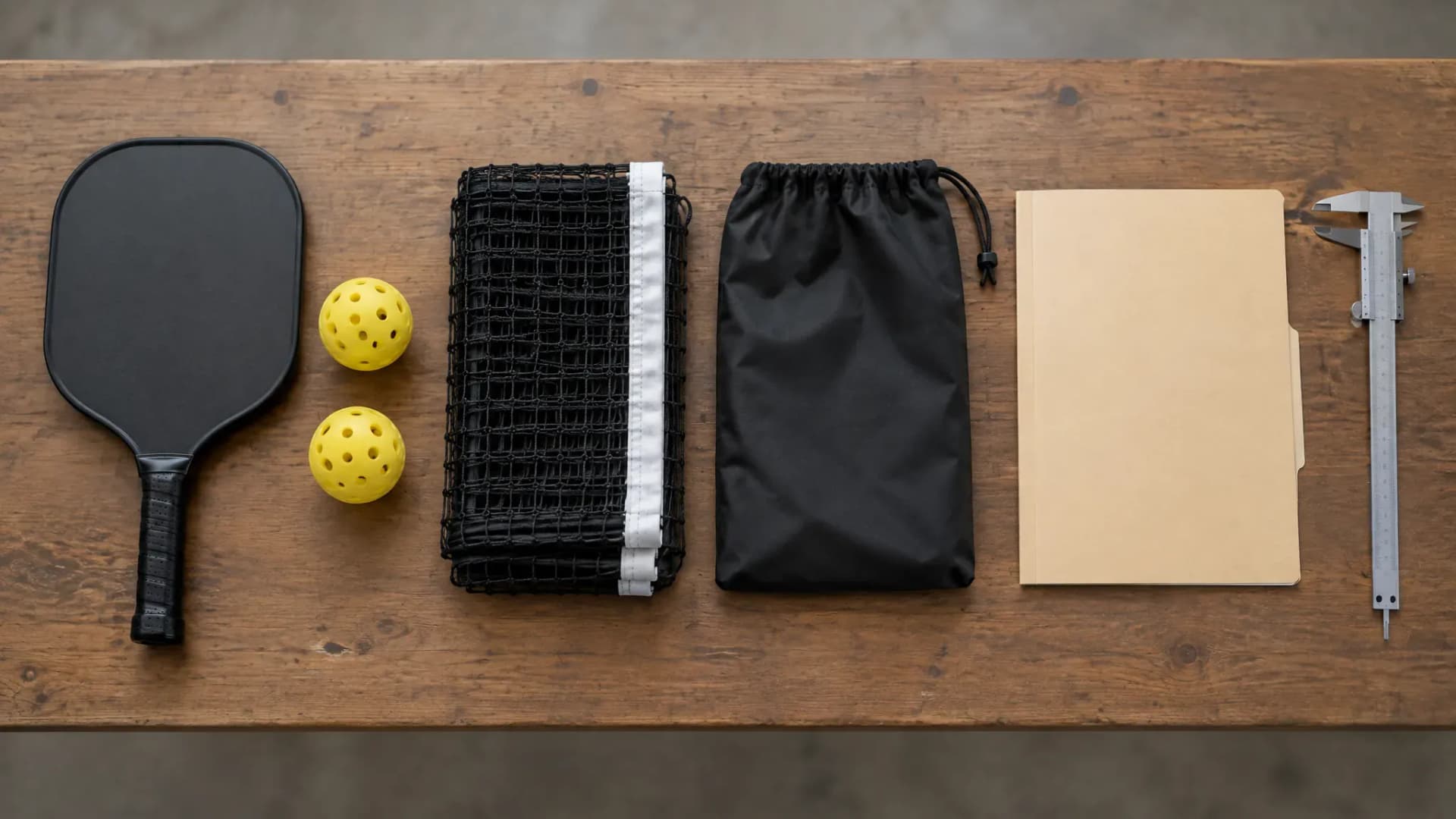
Four CBP ruling letters on CROSS name pickleball. Three of them, NY N315307 (2020), NY N334905 (2023) and NY N347450 (2025), put the goods in 9506.99.60. The fourth, NY N338416 (2024), sent two oversized paddles, two balls and an 11-foot net to heading 9503 as toys. None of the four classifies a paddle entered on its own. The split does not track the name of the sport. It tracks what each requester put in the file.
The method is short. Read the heading text and the Chapter 95 notes before any code list (GRI 1). Describe the article by material, use and value as it will arrive. Apply GRI 3(b) essential character only to a retail set. Compare subheadings at the same level (GRI 6). Write the reasoning into a file that answers CBP’s reasonable-care questions, and if two answers survive, request a binding ruling under 19 CFR Part 177 before the goods ship. The steps below do that for paddles, balls, nets, bags and boxed sets, using CBP’s own pickleball letters as the evidence.
Key Takeaways
- Only heading text and notes have legal force. GRI 1 makes the index and titles reference material.
- The facts decide, not the sport. NY N338416 sent a flimsy junior set to toys; NY N354273 refused the toy heading.
- A retail set is classified as one component. NY N347450 put a paddle, ball, net and bag set at 9506.99.6080.
- A bag alone leaves Chapter 95. Note 1(d) sends containers of heading 4202 out of the chapter.
- The importer of record signs. 19 U.S.C. 1484 puts reasonable care on you, not the broker.
- Ask before the goods ship. A ruling is prospective only and generally arrives within 30 calendar days; a protest must be filed within 180 days of liquidation.
On this page
Read the Rules in Order, Not the Code List
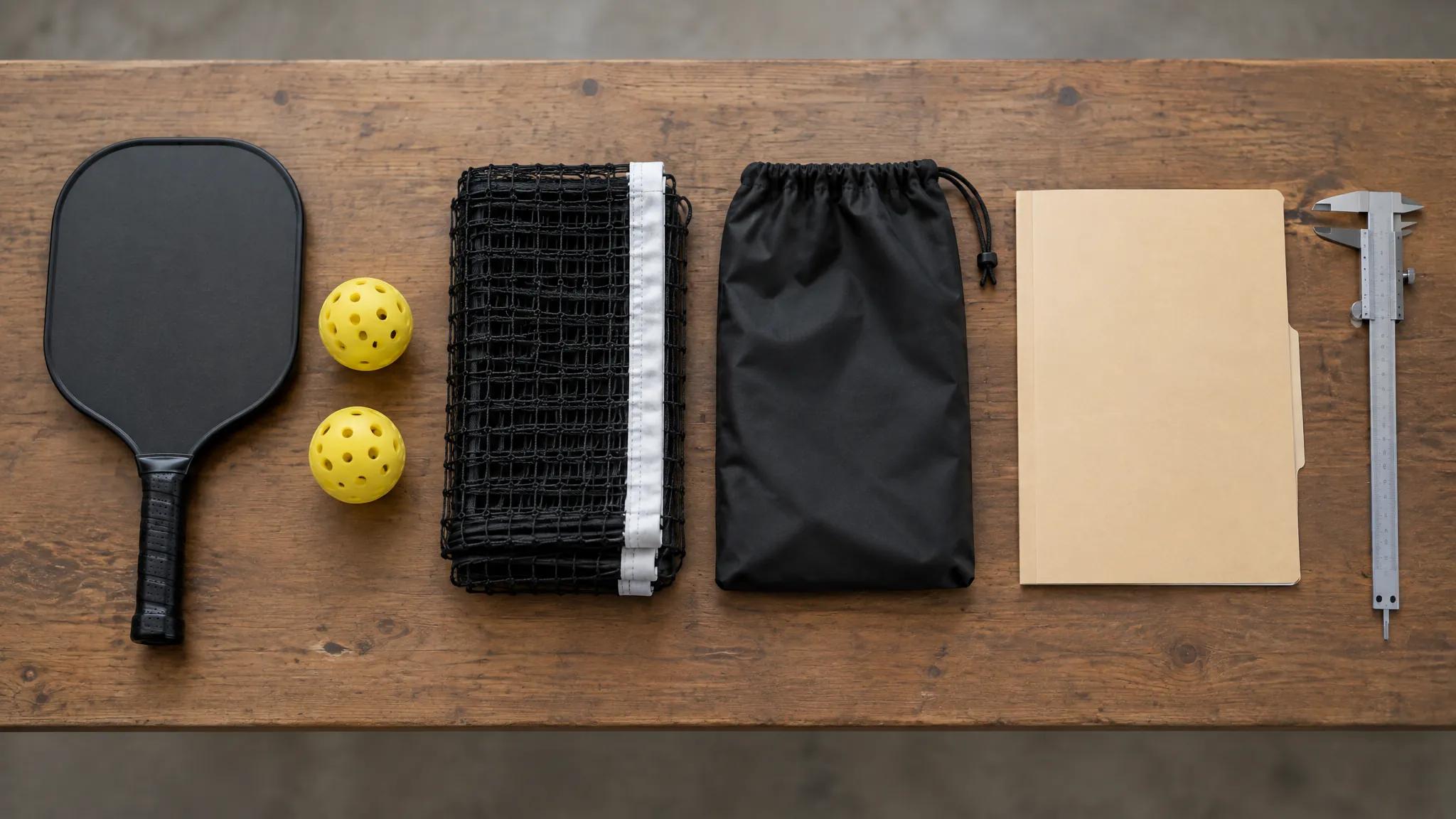
The first failure is procedural. A broker types “paddle” into a code search and lands in the rackets group; a supplier copies last year’s invoice line. Neither has read heading 9506 or the Chapter 95 notes. Under GRI 1 those are the only texts with legal force; the index and section titles are “provided for ease of reference only.” The rules themselves run to two pages in the General Rules of Interpretation published with the current schedule.
Two notes settle most sporting-goods arguments before a code is read. Note 1(d) excludes “sports bags or other containers of heading 4202” from the chapter, so a paddle bag shipped alone is a Chapter 42 bag whatever its logo says. Note 3 keeps accessories “suitable for use solely or principally” with Chapter 95 articles inside it, which is how an empty ball retriever tube reached 9506.99.6080 in NY N334905. The WCO Explanatory Notes sit one level down: CBP’s own classification publication calls them persuasive authority, “neither legally binding” nor dispositive.
| Rule | What it decides | Sporting-goods trigger |
|---|---|---|
| GRI 1 | Heading terms plus section and chapter notes; titles and index carry no legal weight | Every article; Chapter 95 Notes 1(d) and 3 first |
| GRI 2(a) | Incomplete or unassembled articles with the essential character of the finished one | Net systems shipped as posts, base and net in one carton |
| GRI 3(a) | Most specific heading wins; headings that each cover part of a set are equally specific | Paddle, ball and net in one retail box |
| GRI 3(b) | Sets and composite goods follow the component giving essential character | Starter sets; paddle with fitted cover |
| GRI 3(c) | Tie-break: the heading occurring last in numerical order among those meriting consideration | Rare; usually means the description was too thin |
| GRI 5(a) | Fitted, long-term cases entered with the article go with the article | Paddle covers and set bags entered with the set |
| GRI 6 | Subheadings by their own terms; only same-level subheadings are compared | Rackets group against balls group against other, inside 9506 |
| Additional U.S. Rule 1(a) | Use-controlled provisions follow the principal use in the United States of that class of goods | Toy versus sports equipment; not one buyer’s intent |
Source: General Rules of Interpretation, Additional U.S. Rules of Interpretation and Chapter 95 Notes, HTSUS Revision 18 (2026), U.S. International Trade Commission; read 12 September 2026.
Step 1: Describe the Article as It Will Be Imported
The second failure is describing goods by their catalogue name. CBP’s ruling regulation, 19 CFR 177.2(b)(2)(ii)(A) , lists what a classification decision needs. It wants a full description of the article, its chief use in the United States, its commercial designation and, for anything made of two or more materials, “the relative quantity (by weight and by volume) and value of each.”
Two CBP letters show why. In NY N338416 (15 March 2024) two oversized paddles, two balls and an 11-foot miniature net were a toy of 9503.00.0073. The components, “by their non-regulation and flimsy design, are meant to be imitations of the real thing.” In NY N354273 (10 October 2025), a racquet paddle set CBP itself never labels pickleball, two wooden paddles and a rubber ball were “of the same class or kind” as heading 9506 equipment, and the toy proposal was refused.
NY D85048 drew the line in 1998: flimsy imitations are playthings; “reasonable, junior editions of more expensive adult models” are sport equipment. Regulation weight, face material and core construction are facts to record, not marketing copy.
Those facts come from the factory: a bill of materials with the value of each component, finished weight and dimensions, the intended player level and photographs of the packed retail unit. When a build sheet is prepared with the factory, as on this site’s private-label build page , the value split by component is the line to insist on, because GRI 3(b) will ask for it and a supplier’s invoice rarely shows it.
Step 2: Choose the Heading With GRI 1, Then Walk GRI 2 and 3 Only If You Must
The third failure is skipping ahead. GRI 3(b) is the rule everyone has heard of, so it gets applied to goods GRI 1 already classifies. NY D85048 states the discipline: the rules are “taken in order,” and the later ones apply only when the heading and the notes do not settle the question. A single paddle, a carton of balls or a bare net never reaches rule 3.
GRI 2(a) covers the portable net that ships as two posts, a base and a rolled net in one carton: a heading includes its article “entered unassembled or disassembled,” so three parts in one box are one net. GRI 3(a) applies when two headings could each describe the goods; the most specific wins, except that headings which each cover only part of a retail set “are to be regarded as equally specific,” which sends a starter set straight to 3(b). Reaching the 3(c) tie-break on sporting goods usually means the Step 1 description was too thin.
Step 3: Classify a Starter Set With GRI 3(b)
The fourth failure is treating a retail set as four invoice lines. CBP’s Classification of Sets publication reproduces the two Explanatory Notes that govern it. EN (X) sets three tests for a retail set: at least two articles prima facie classifiable in different headings, put up together “to meet a particular need or carry out a specific activity,” and packed for sale to the user without repacking. EN (VIII) lists what decides essential character: the nature of the component, “its bulk, quantity, weight or value,” or its role in the use of the goods.
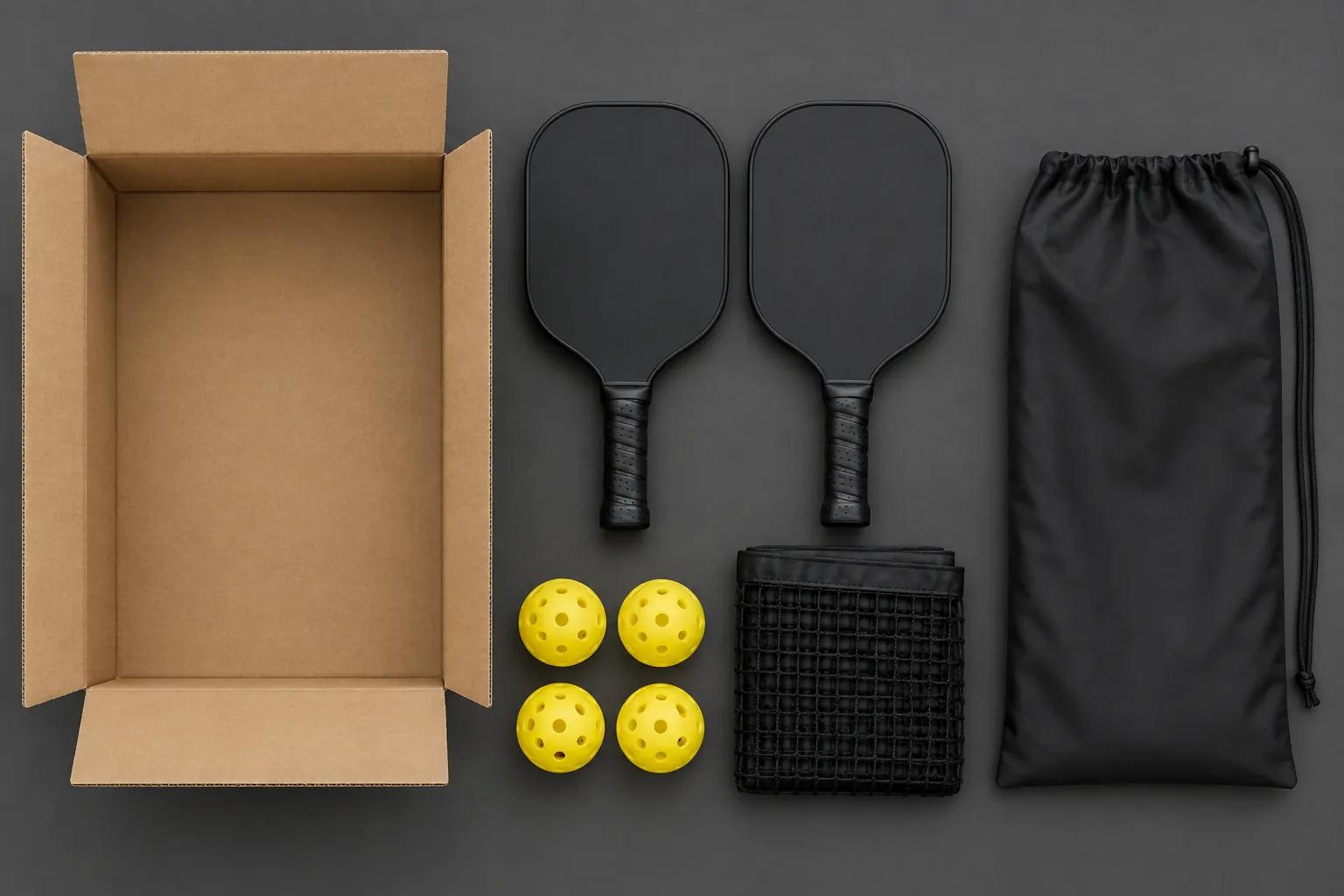
Two paddles, two balls, a net and a bag in one printed box pass all three tests, so the box is classified as one of its components.
Which component is a judgement CBP has made on the record. In NY D85048 a badminton set was classified “as if it consisted of the rackets only” after CBP weighed “the relationship of the components, their value, and their significance.” In NY N347450 (29 April 2025) a set of two wooden paddles, two plastic balls, a 10-foot mesh net with iron tubes and a drawstring polyester bag was classified at 9506.99.6080. That letter records the result but not a written weighing, which is why the value split from Step 1 belongs in your file even when a precedent exists.
The bag is the wrinkle: entered with the set, a fitted long-term case follows the set under GRI 5(a) unless it “gives the whole its essential character”; shipped alone, Note 1(d) sends it to heading 4202. The starter-set assembly page on this site covers how the box is built; this is the tariff consequence of what goes into it.
| Component | Provision text that describes it when entered alone | Role in a retail set |
|---|---|---|
| Paddle | Heading 9506; rackets group 9506.51/59 or residual 9506.99 (the GRI 6 question in Step 4) | Candidate for essential character; record value and weight share |
| Ball | Balls group 9506.61 to 9506.69, including “noninflatable hollow balls not over 19 cm” | Consumable; usually a small value share |
| Net system | Residual 9506.99.60; statistical suffix 40 reads “nets not elsewhere specified or included” | Often the heaviest item; GRI 2(a) if unassembled |
| Bag | Heading 4202 under Chapter 95 Note 1(d) | Follows the set under GRI 5(a) when fitted and entered with it |
| Whole set | NY N347450 (2025): 9506.99.6080 | One line for the box; three Chapter 99 headings reported alongside it |
Source: HTSUS Revision 18 (2026), Chapter 95; CBP rulings NY N347450 (29 April 2025), NY D85048 (1 December 1998); CBP Informed Compliance Publication “Classification of Sets” (March 2004). Provision texts quoted; no duty rates stated.
Step 4: Go Down the Subheadings With GRI 6
The fifth failure is comparing an eight-digit line against a six-digit group. GRI 6 allows comparison only between subheadings “at the same level.” Inside heading 9506 the first level is a set of one-dash groups. Among them are the rackets group headed “tennis, badminton or similar rackets, whether or not strung,” the balls group and a residual “other.” Pick the group first, then compare 9506.51 with 9506.59, or 9506.62 with 9506.69. The legal text stops at eight digits; the tenth digit is a statistical suffix, which for 9506.99.60 is 40 for nets and 80 for everything else.
For a stand-alone paddle the same-level question is whether it is a “similar racket” of the rackets group or an article of the residual group, and no CBP letter on CROSS decides it directly. Searches for “pickleball” and “pickle ball” on 13 September 2026 return four letters that name the sport, none of them for a paddle entered alone: N315307 (2020), N334905 (2023), N338416 (2024) and N347450 (2025). Three put the goods in 9506.99.60, including a two-paddle, one-ball game with no net; the fourth, N338416, went to toys.
For the rackets side of that comparison, the paddle-specific code page on this site lists the current claim for the rackets subheading and the Section 301 stacking. Read it as one side of the GRI 6 comparison to test against your own file, not as a ruling, and confirm the line with a licensed broker before entry.
Step 5: Build the File That Answers a CBP Form 28
The sixth failure is a classification that exists only in the broker’s head. Since the Customs Modernization Act, 19 U.S.C. 1484(a)(1) requires the importer of record, “using reasonable care,” to file the declared value, classification and rate of duty. The broker transmits; the importer answers for it. CBP’s Reasonable Care publication (September 2017) turns that duty into numbered questions an importer must answer when a Form 28 request for information arrives. A file built to answer them has six parts:
- Description: the Step 1 facts, photographs and the factory’s value split (questions 1 and 4).
- Reasoning: the GRI walk in order, with the provision text of the line chosen and the line rejected (questions 2 and 5).
- Precedent: each CROSS letter relied on, checked that day for a “revoked by” or “modified by” entry (questions 3 and 5).
- Expert concurrence: the licensed broker’s or attorney’s written agreement (question 6).
- Test data: a laboratory report where material composition decides the line (question 8).
- Review date: the last check against a new HTS revision (question 9).
Two defences importers assume they hold mostly do not exist. “The broker chose it” is not reasonable care, because 1484 names the importer of record. “CBP always accepted it” becomes a protected treatment under 19 CFR 177.12(c) only after 2 years of consistent national application to substantially all of that importer’s identical entries.
For distributors and importers placing a private-label run of paddles, balls, nets or boxed sets at container or MOQ volume: the build sheet can carry the bill of materials, the value split by component, finished weights and packed-unit photographs in the form Steps 1 and 3 need. Send the SKU list and the destination market.
Step 6: Ask CBP for a Binding Ruling When the File Still Has Two Answers
The seventh failure is asking too late. Under 19 CFR 177.1(a)(1) a ruling is generally available only for prospective transactions, not goods “already pending before a Customs Service office by reason of arrival, entry, or otherwise.” Timing is then fixed. Through CBP’s eRulings template an acknowledgement with a control number arrives within 1 business day and the ruling “generally” within 30 calendar days of receipt, or within 90 days if referred to Headquarters. One request covers no more than 5 items of the same class or kind. A sample can be sent; NY N347450 was decided on one.
What the letter buys is narrower than most importers expect and stronger in one respect. It is “binding on all Customs Service personnel” until modified or revoked (19 CFR 177.9(a)), but only for articles identical to the sample or description (177.9(b)(2)), so a new face material or changed set contents needs a new request, and the holder must attach the letter or its number to the entry documents (177.8(a)(2)).
The strength is procedural: once a ruling has been in effect for 60 days, 19 U.S.C. 1625(c) requires CBP to publish any proposed modification in the Customs Bulletin and take comments for at least 30 days; a ruling under 60 days old can be withdrawn by letter.
The Clocks That Decide When to Ask and When to Protest
The eighth failure is treating the calendar as the broker’s problem. Three timers decide a classification action. The ruling timer runs forward from the request: acknowledgement within 1 business day, a letter generally within 30 calendar days, 90 if referred to Headquarters, and only for goods not yet entered. Filed after the container sails, the request is answered as an information letter at best, so the ruling decision belongs at purchase-order time.
The modification timer protects a ruling you hold. Once it has been in effect for 60 days, CBP can change it only after publication in the Customs Bulletin and a comment period of at least 30 days; inside those first 60 days a letter is enough. The protest timer runs the other way: CBP’s classification on an entry becomes “final and conclusive upon all persons” unless a protest is filed within 180 days after liquidation (19 U.S.C. 1514(c)(3)), so an overpaid code is refundable inside that window and gone after it.
The fourth clock is the government’s, and it is long: under 19 U.S.C. 1621(1) a penalty action for a negligent misclassification can be brought within 5 years of the date of the alleged violation, with the clock starting at discovery only where the violation arises out of fraud. The penalty tiers, the prior-disclosure cap and the entry-level arithmetic are set out on the first-order risk ladder and are not repeated on this page. This is a compliance summary, not legal advice; confirm current requirements with a licensed customs broker or trade counsel.
| Clock | Length (days) | Starts when | What it decides |
|---|---|---|---|
| eRuling response | 30 (90 if referred to Headquarters) | Receipt of the request; prospective goods only | File the request at purchase-order time, not at arrival |
| Ruling modification notice | 60 in effect, then 30 for comment | Issuance of the original ruling | A ruling older than 60 days cannot be reversed by letter |
| Protest of classification | 180 | Date of liquidation or reliquidation | Last day to recover an overpaid code |
| Penalty action | 1,825 (5 years) | Date of the violation; discovery only for fraud | How long the file must be producible |
Source: 19 U.S.C. 1514, 1621 and 1625 (U.S. Code, 2024 edition, govinfo.gov); 19 CFR 177.1 and 177.12 (eCFR, current to 10 September 2026); CBP eRulings requirements page; all read 12 September 2026. Five years shown as 1,825 days for scale.
Conclusion
The code is rarely what fails. The file behind it is. Every line below is something CBP can ask for on a Form 28, and a SKU that reaches entry without it is defending a number whose reasoning nobody wrote down.
- Without the bill of materials, the value split by component, finished weights and packed photographs, the essential-character question has no evidence behind it and the factory’s guess becomes your declaration.
- An unwritten GRI walk against heading 9506 and Chapter 95 Notes 1(d) and 3 leaves nothing to show an auditor eighteen months later.
- On a boxed set, skipping the EN (X) tests and the named essential-character component with its value share leaves the one judgement CBP is most likely to probe undocumented.
- Comparing subheadings across levels, instead of recording the line chosen and the line rejected at the same level, is the GRI 6 error that survives to liquidation.
- A CROSS letter relied on without its status noted that day can be modified or revoked while your entries keep running against it.
- Leaving two answers alive past the point where the goods stop being prospective closes the eRuling door, and the port decides instead.
If your file is thinner than that, the cheapest fix is the value split and the photographs, and only the factory has them. Ask for both with the next build sheet.
Frequently Asked Questions
How do I classify an HS code for sporting goods myself?
Read the heading text and the Chapter 95 notes first, as GRI 1 requires, then describe the article by material, use and value. Apply GRI 3(b) only to retail sets, compare subheadings at the same level under GRI 6, and write the reasoning down.
Is the code my customs broker chose binding on CBP?
No. Only a ruling letter issued under 19 CFR Part 177 binds CBP, and only for identical goods. Under 19 U.S.C. 1484 the importer of record is the party that must classify with reasonable care, whoever transmitted the entry.
Is a pickleball starter set classified as paddles, balls or a net?
As one component under GRI 3(b), the one giving the set its essential character by nature, bulk, quantity, weight, value or role. In NY N347450 (2025) a paddle, ball, net and bag set was classified at 9506.99.6080; record your own value split, because the letter does not show its weighing.
When is a pickleball set a toy instead of sports equipment?
When the components are, in CBP’s words in NY N338416, non-regulation, flimsy imitations of the real thing meant exclusively as playthings for children. Junior editions of adult equipment stay in heading 9506, the distinction CBP drew in NY D85048.
Can I request a binding ruling for goods already on the water?
Generally no. Under 19 CFR 177.1(a)(1) rulings are issued for prospective transactions, not goods already pending before a port by arrival or entry. A classification question on an arrived shipment is handled by the port, so file the eRuling at purchase-order time.
Want to source this quality for your brand?
Contact our factory directly on WhatsApp for an instant MOQ and pricing quote.