Private-Label Pickleball Set: Kitting, Cartons and GTINs
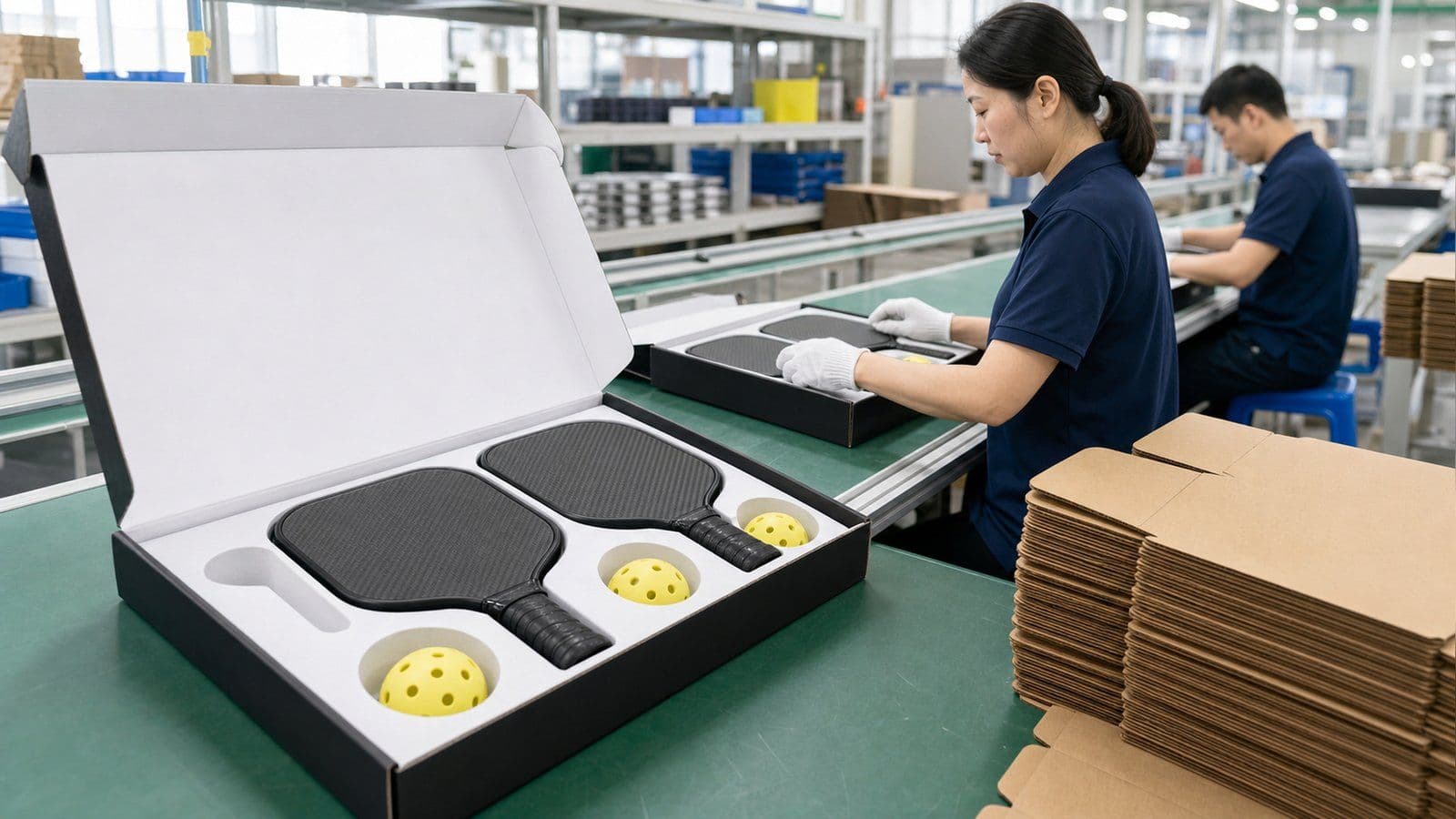
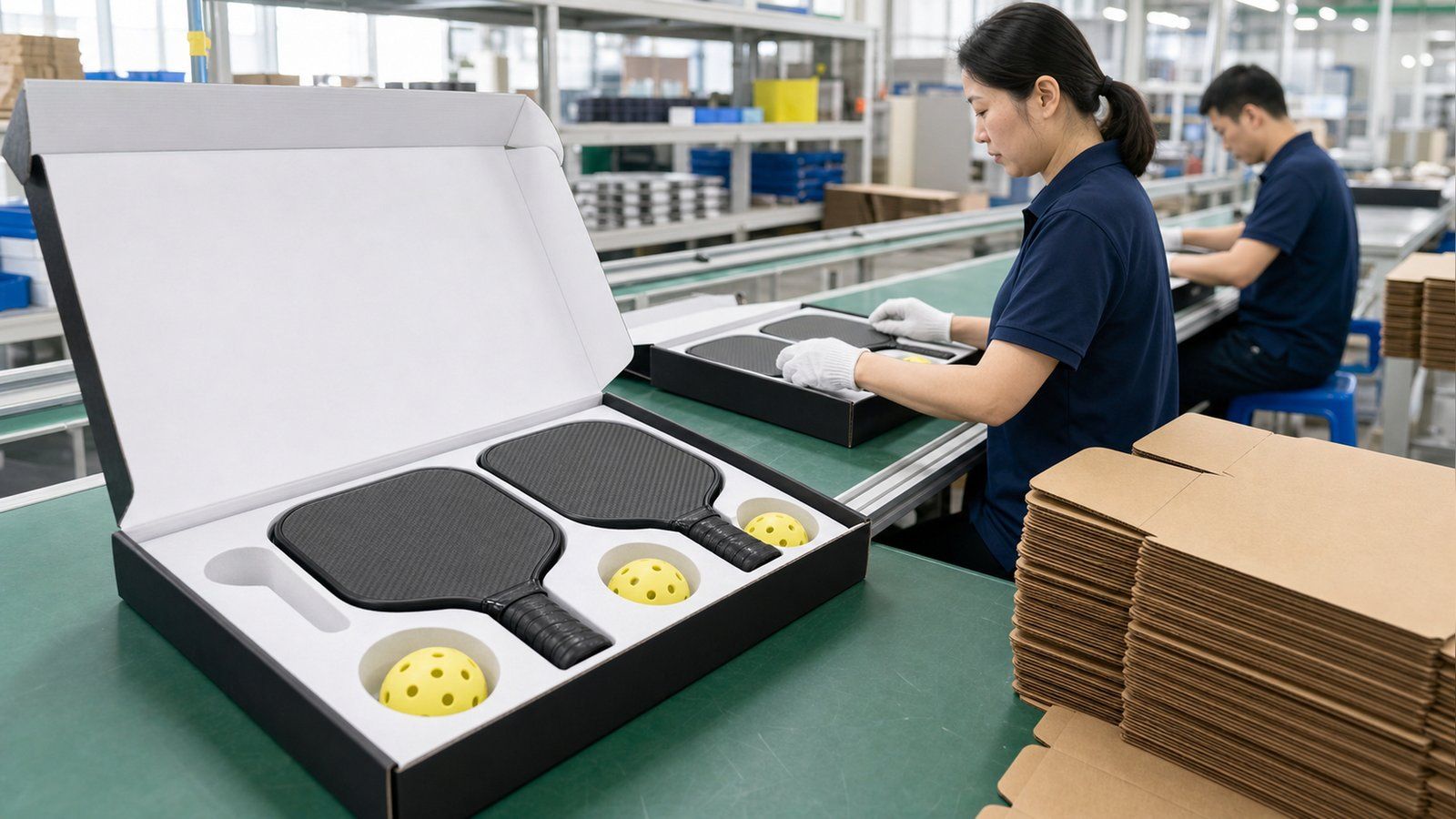
A starter set looks like the easiest SKU in a private-label pickleball range. It is two paddles you already source, two balls you already source, and a bag. In practice it is the SKU that most often arrives late, cubes badly, and quietly eats the margin the paddles earned — because a set is not three products in a box. It is one new trade item, with its own barcode, its own carton maths, its own compliance surface and its own assembly labour, and every one of those is invisible on a paddle-only quote.
This guide covers what changes the moment you kit. Where the identification rules actually bite, how to choose between a 2-paddle and a 4-paddle configuration, how to work out what fits in a carton and a container before you commit, and what to put on the purchase order so the first run is not a rework. It assumes you are an importer, a private-label brand or a retail buyer specifying a set for the first time — not a consumer shopping for one.

Key Takeaways
- A fixed-composition set is a predefined assortment under the GS1 GTIN Management Standard: it needs its own GTIN, and every component keeps its own separate GTIN as well.
- Swapping one component inside the set — a different ball, a different bag colour — forces a new GTIN on the whole set. So does changing how many sets go in a case.
- Amazon raised the maximum inbound FBA box length from 25 in to 36 in on 20 June 2025; width and height stayed at 25 in and weight at 50 lb. Amazon Warehousing and Distribution kept the old 25 × 25 × 25 in limit.
- A paddle can be up to 17 in long with combined length and width up to 24 in under the USA Pickleball standard — that ceiling, not your box design, sets the minimum footprint of any set carton.
- LCL freight is billed on the greater of cube or weight at 1 cbm = 1,000 kg. A set is light and bulky, so cube almost always decides the bill — a rigid gift box can cost more to ship than the paddles inside it.
- A set marketed to children 12 and under can pull an importer into Children's Product Certificate territory that the same paddle sold alone never touches.
- The component with the highest individual MOQ sets the floor for the whole set — usually the printed retail carton, not the paddle.
Why a set behaves like a new product, not a bundle of old ones
The instinct on a first set SKU is to treat it as an assembly job: the components already exist, so the set is just labour. That instinct is what produces the late shipment. The moment two or more items are combined and sold together as a single physical unit, the identification standards treat the result as a distinct trade item with its own identity, and everything downstream — your ERP, the retailer's receiving system, the customs entry, the Amazon listing — follows that identity rather than the components'.
GS1 has a specific name for this. A predefined assortment is, in the standard's own words, "a type of physical trade item assortment/bundle that comprises a fixed composition of two or more trade items that are combined and sold together as a single physical trade item." Your 2-paddle set is exactly that. And the standard is explicit that this does not replace the component identities: "the individual trade items included in the assortment are explicitly defined by the trading partners and carry their own, unique GTIN separate from the GTIN assigned to the assortment."
Read that twice, because it is where the first-set-SKU mistakes cluster. You are not converting three GTINs into one. You are creating a fourth. If you were previously selling those paddles and balls individually, you now maintain four consumer-level identities where you maintained three, plus a case-level identity above them, and each one is a row somebody has to keep accurate for the life of the product.
What makes this expensive rather than merely tedious is the change rule. Per the GS1 GTIN Management Standard, "a change, addition or replacement of one or more trade items included in a predefined assortment, requires assignment of a new GTIN."
The scenarios GS1 gives are consumer goods, but the logic transfers cleanly: replace a blue shirt in a multipack with a yellow one and the multipack is a new product. Replace the indoor ball in your set with an outdoor ball for a different market and the set is a new product too — new GTIN at consumer level and, the standard adds, "a unique GTIN is assigned at every existing level of the packaging hierarchy above the retail consumer trade item/base unit level," so the case changes as well.
That is the trap. A supplier who is out of the specified ball and substitutes a visually identical one is not doing you a favour, they are creating an unlabelled new product inside your existing barcode. It will scan correctly and it will be wrong.
The Identification Layer: What Gets a Barcode and When It Changes
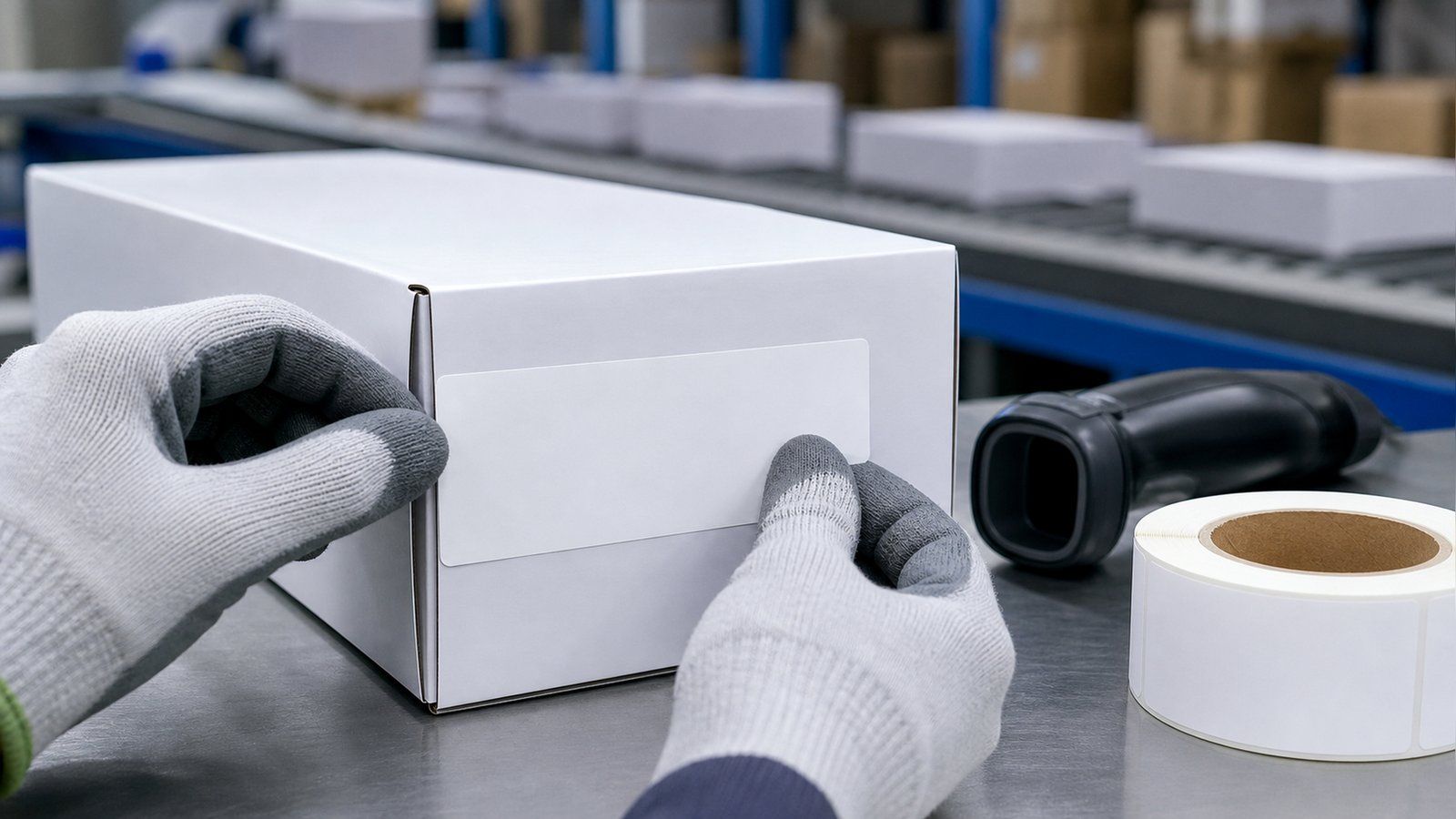
Set the hierarchy out before you brief anybody, because it is cheap on paper and expensive after tooling. For a typical 2-paddle retail set going into both wholesale and marketplace channels, the identification stack looks like this.
| Level | Needs its own GTIN? | What forces a new one |
|---|---|---|
| Paddle (component) | Yes — keeps its own, separate from the set | Any change to the paddle itself |
| Ball (component) | Yes — keeps its own | Any change to the ball itself |
| The set (predefined assortment) | Yes — a new, distinct GTIN | Change, addition or replacement of any component |
| Inner / master carton | Yes — one at every level above base unit | Change to the number of sets per case |
| Pallet configuration | Yes, where a predefined pallet is used | Change to the number of cases per pallet |
The case-level rule catches people who did everything else right. GS1's pack/case quantity rule states that "a change to the number of trade items in a case or a change to the quantity of cases in a predefined pallet configuration, requires assignment of a new GTIN," and gives the plain example of a case going from 8 items to 12. Nothing about the consumer unit changed. The case is still a new trade item.
Why this matters commercially: carton counts are exactly the thing that gets renegotiated late. A forwarder tells you the cube works out better at 8 sets per carton than 6. A retailer asks for a 4-pack inner. Both are reasonable requests and both mean a new case GTIN, updated carton artwork, and a data update at every trading partner who already received the old spec. Decide the case quantity before you print, and treat later changes as a versioned change with a lead time, not a phone call.
One more layer catches marketplace sellers specifically. For Amazon FBA, a set is handled as a single sellable unit: the guidance repeated across fulfilment specialists is that units sold as a set must be marked on the package with wording such as "Sold as Set, Do Not Separate," the package must be sealed, the barcodes on the individual units must not be visible, and the bundle carries its own unique FNSKU.
Note the third of those — component barcodes must be covered. If your paddles are already printed with their own retail barcodes for your wholesale channel, somebody has to hide them inside the set, and that is a labour operation you must specify rather than discover. Confirm the current wording in Seller Central before you brief it, because marketplace prep rules change more often than the GS1 standard does.
Two Paddles or Four? Choosing the Configuration You Can Actually Sell
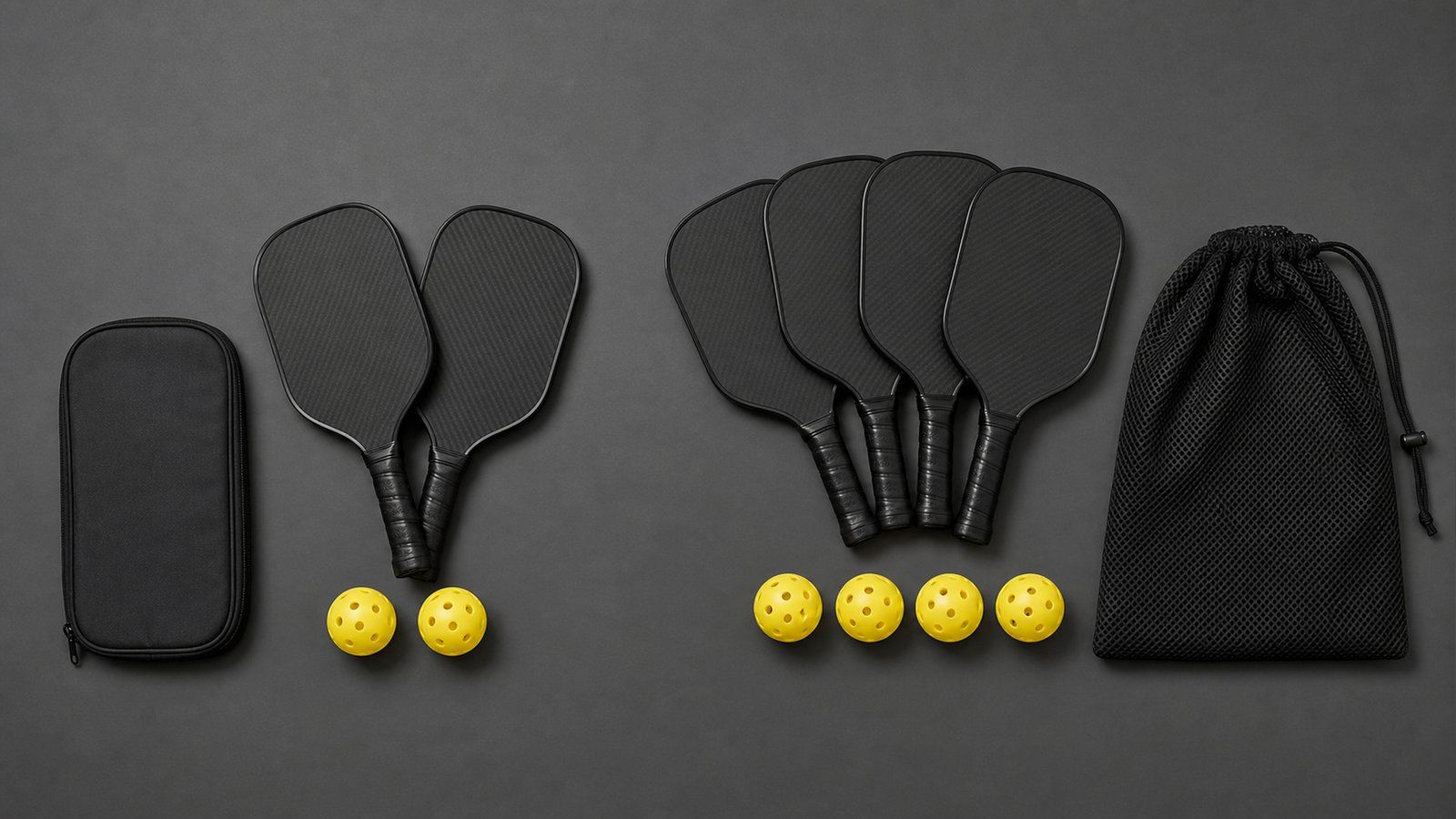
This is the decision that fixes everything downstream — the bill of materials, the carton, the number of GTINs you maintain, the landed cost per unit and the shelf you can sell into. It deserves more thought than it usually gets, because the two configurations are not the same product at different sizes. They serve different buyers through different channels.
A 2-paddle set is a gift and a couples purchase. It sells through gift channels, marketplace, and the front of a sporting-goods aisle, it survives in a rigid printed box, and its price point tolerates a decent carton because presentation is doing commercial work. A 4-paddle set is a household or a group purchase. It is bought to get four people on a court, presentation matters far less, and the buyer is markedly more price-sensitive per paddle — which is why the 4-paddle configuration so often ships in a mesh or nylon duffel rather than a box.
| Configuration | Best for | Not ideal for |
|---|---|---|
| 2-paddle, rigid printed box | Gift and seasonal channels, marketplace listings where the hero image sells, retail shelf presence, higher-price carbon paddles that justify the packaging | Price-led volume programmes; anything shipped LCL where cube is the binding cost; club and rental buyers who discard the box |
| 4-paddle, bag or sleeve | Family and group buyers, warehouse-club and value channels, entry-level composite paddles, programmes where landed cost per paddle is the whole argument | Premium positioning, gift-led seasonal pushes, any shelf where the set must present face-out |
| Both, as one range | Brands with an established paddle SKU and enough volume to carry two carton specs and two sets of tooling | A first order — two configurations doubles the packaging minimums before you know which one sells |
The honest recommendation for a first set SKU is to pick one. Not because the other is wrong, but because packaging is where the minimums live. Paddles and balls scale down reasonably well; a printed rigid box with a moulded insert has its own tooling and its own print minimum, and running two of them on a first order means committing to a split you have no sales data to justify. Launch one configuration, learn which channel actually pulls, and add the second against real numbers.
Whichever configuration you choose, the bill of materials is assembled from ordinary catalogue items rather than bespoke parts — the paddle grade, the ball type and the bag are all specified independently, which is why it pays to price the component range a set is built from before you design the box around it. A set is only as cheap as the most expensive decision you made without checking.
There is a third option worth naming because it is under-used: sell the components as a set at the listing level without physically kitting them. GS1's guidance on bundles distinguishes physical from virtual — if the items are not physically attached, it is a virtual bundle and does not need its own GTIN. That removes the assembly labour, the set carton and the fourth identity entirely. What it does not do is give you a giftable object or a marketplace-compliant sealed set, so it fits wholesale and direct channels far better than retail or FBA. It is a legitimate way to test demand before you pay for tooling.
For importers and private-label brands pricing a first set SKU: our published minimums are 50 pcs on paddles and 1,000 pcs on balls, in 13mm and 16mm polypropylene honeycomb cores with 3K carbon or T700 faces. That 20:1 gap is usually what decides your real set MOQ — worth checking against your configuration before you design a carton around it.
See the component rangeCarton and Container Maths: Doing It Before You Commit
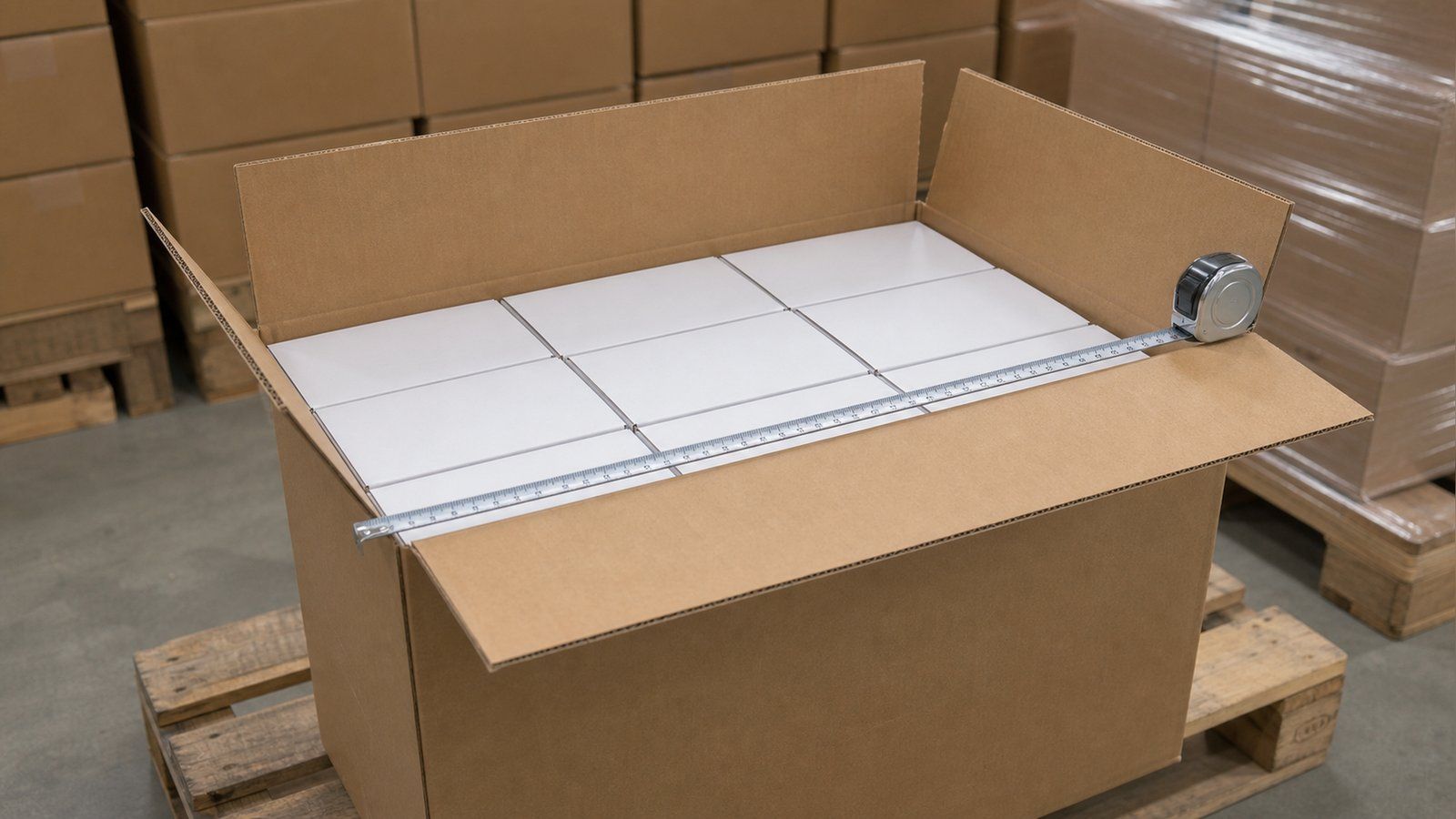
Set SKUs fail on cube more often than on price. A paddle is flat and stacks efficiently; a set is a box of air around some paddles, and air is what you pay to ship. Work the geometry from the outside in, and start from the one dimension you do not control.
The USA Pickleball Equipment Standards Manual caps paddle geometry: "the combined length and width, including any edge guard and butt cap, shall not exceed 24 inches (60.96 cm). The paddle length cannot exceed 17 inches (43.18 cm)." That 17 in ceiling is the floor of your carton's long dimension. There is no packaging design that makes a compliant paddle shorter. If your paddle runs near the limit — elongated shapes usually do — your retail box is a 17-plus-inch object before you have added a wall, and every carton decision after that inherits it.
Then apply the channel's limit. Amazon changed this recently and the change is easy to miss: as of 20 June 2025 the maximum box length for inbound FBA shipments in the US increased from 25 in to 36 in, with width and height remaining at 25 in and weight at 50 lb. Amazon Warehousing and Distribution did not change — AWD boxes must still stay within 25 × 25 × 25 in and 50 lb.
If you route through AWD, or if you are reading a guide written before mid-2025, you are working to the old number. For a 4-paddle set that is the difference between a workable master carton and one you have to re-engineer.
The freight side is where the money actually moves. LCL ocean freight is billed on chargeable weight — the greater of volume in cbm or weight in metric tonnes, with 1 cbm treated as 1,000 kg. Break-even density is therefore 1,000 kg per cbm, and typical consumer goods run somewhere around 200–500 kg/m³.
A pickleball set is far below even that: paddles are a few hundred grams of foam and composite, balls are between 22.1 and 26.5 grams each under the USA Pickleball weight spec, and the rest is packaging. Cube wins the billing calculation every single time. Which produces the counter-intuitive result worth internalising — on a set SKU, the packaging can genuinely cost more to ship than the product inside it.
For FCL, the denominator is public. Evergreen Line's published container specification puts a 40 ft hi-cube steel dry cargo container at 2,700 cu ft / 76.4 cbm, on internal dimensions of 12.032 × 2.352 × 2.69 m. Carriers round the internal height slightly differently — ONE publishes the same box at 76.2 cbm on a 2,695 mm internal height — so work to roughly 76 cbm and confirm the exact figure on the spec sheet of the carrier you are actually booking.
Divide that by your master carton cube, take about 85–90% as a realistic stow factor for hand-loaded cartons, and you have your ceiling in sets per container. That figure is what tells you whether the programme is a container or a pallet — and it should be produced during design, not after.
A Worked Example: Costing Two Carton Specs Against Each Other
Here is the calculation end to end, using placeholder dimensions so you can substitute your own. The arithmetic is the reusable part; the inputs must be your real measured components.
Take a 2-paddle set. Measure the assembled retail box — suppose it comes out at 45 × 25 × 7 cm. That is 0.007875 cbm per set. Put 8 sets in a master carton in a 4 × 2 arrangement and, adding roughly 1 cm of corrugate wall on each dimension, the carton is about 92 × 51 × 29 cm, or 0.136 cbm. Against the 76.4 cbm of a 40 ft HC at a 90% stow factor, that is roughly 505 cartons, or about 4,000 sets.
Now run the same set in a soft sleeve instead of a rigid box. Suppose the packed sleeve measures 45 × 22 × 5 cm — 0.00495 cbm, about 37% less cube per set. The same 8-set carton comes out near 92 × 45 × 21 cm, or 0.087 cbm, and the container now takes roughly 790 cartons or 6,300 sets. You have moved 57% more sellable units in the same container without changing the product at all.
That gap is the whole argument for interrogating packaging on a set SKU. Whether it is the right call depends on what the box is doing commercially — on a gift SKU the rigid box may be earning its cube back at retail — but the point is that the decision should be made against a number rather than an aesthetic. Run both specs before you tool either. And note what this example is: illustrative arithmetic on placeholder dimensions. Your real numbers depend on your paddle's actual footprint, your insert design and your corrugate grade, and no supplier's generic figure substitutes for measuring your own approved sample.
Costing the Set: Where a Kit SKU Quietly Loses Its Margin
A set quote that reads as "paddles + balls + bag + a bit for assembly" is missing at least four cost lines. They are individually small and collectively decisive on a value-channel SKU.
- Kitting labour. Real, per-set, and driven by things you specify: how many components are placed by hand, whether each ball is separately bagged, whether the paddle carries a protective sleeve, whether a warranty or instruction card is inserted, and whether the marketplace label is applied at the factory or later by a 3PL. Ask for the figure per configuration, not as a blended rate — a 4-paddle set is not twice a 2-paddle set, because the carton is handled once either way.
- Packaging tooling and its own minimum. A printed rigid box with a moulded insert carries a die and a print minimum that is frequently higher than the paddle MOQ. This is usually the component that sets the floor for the entire programme.
- The cube penalty. Quantified in the section above. On a light, bulky SKU billed on volume, this is not a rounding error.
- Identity maintenance. Four GTINs instead of three, plus case level, plus the marketplace identifiers — a real administrative cost that recurs every time a component changes.
On MOQ, the structural rule is simple and worth stating plainly because suppliers rarely volunteer it: the component with the highest individual minimum sets the floor for the whole set. Component minimums are rarely on the same scale as each other.
Our own published catalogue minimums are a fair illustration — 50 pcs on paddles against 1,000 pcs on balls. A 2-paddle/2-ball set built on those numbers is paddle-limited at 50 sets but ball-limited at 500. The cheaper component sets the floor ten times higher than the expensive one does, and the printed retail carton then usually sits above both. Any quote that shows you a low paddle MOQ beside a set price is describing two different order sizes. Ask for the minimum of every component in the bill of materials separately, and identify which one is binding. That single question reprices most first set programmes.
The same logic governs price structure. A set price is not a discount off the component prices; it is the components plus packaging, plus labour, plus the cube difference, minus whatever volume the larger order unlocks on the components themselves. Which of those dominates depends entirely on your configuration, so the useful thing to ask a supplier for is not a set price but a broken-out set price — components, packaging, labour, separately — because only then can you see which lever to pull.
For how the component-level numbers behave, our breakdown of custom paddle MOQ and what actually drives it covers the paddle side, and private-label packaging formats and artwork requirements covers what the carton decision involves.
If you already have a component list and want the kitting and carton figures run against it — this is aimed at distributors and procurement buyers with a real bill of materials, not at general enquiries — send the list over on WhatsApp. Our catalogue minimums are published — 50 pcs on paddles, 1,000 pcs on balls — so the useful question against a real component list is which line, or the printed carton, binds your set first.
The Compliance Surface a Set Creates
Kitting can change your regulatory position even when every component was already compliant on its own. This is the least intuitive part of a set SKU and the one with the largest downside.
The most important case is age marketing. Under section 14 of the Consumer Product Safety Act, codified in 16 CFR part 1110, domestic manufacturers and importers of children's products must certify in a written Children's Product Certificate, based on testing by a third-party CPSC-accepted laboratory, that the product complies with all applicable children's product safety rules. For goods manufactured overseas, that obligation sits with the importer — you, not the factory — and the certificate must be available to CPSC and Customs on request.
The boundary depends on how the product is presented. CPSC's guidance indicates that sporting and camping goods designed or intended primarily for children 12 and under are specifically excluded from the toy standard ASTM F963-17, while still needing to meet certain other mandatory children's product safety requirements; testing and certification requirements generally attach to products designed or intended primarily for children 12 or younger.
So a paddle sold to adults typically sits outside this. A "family fun set" with cartoon artwork, a junior-length paddle and a box that shows children playing may not — and the thing that moved it is your marketing, not your manufacturing. Age grading is assessed on how a product is presented and intended, which means the packaging designer can change the compliance position of the SKU without anyone telling procurement.
Treat this as a live question rather than a settled one, and confirm the current position for your specific age grading and destination market with CPSC or a compliance lab before artwork is approved. Requirements vary by product, channel and the importer's role, and getting a written read early costs far less than a hold at the border.
Two smaller compliance points follow from the components themselves. If you market the set as tournament-capable, the balls must actually meet the published standard — diameter between 2.87 in (7.29 cm) and 2.97 in (7.54 cm) with out-of-round variance no greater than ±0.020 in (0.51 mm), weight between 0.78 and 0.935 ounces (22.1 and 26.5 grams), and between 26 and 40 circular holes.
The standard also requires that a ball "must have a Manufacturers or supplier's name or logo printed or embossed on the surface" — a detail that catches private-label programmes assuming an unbranded ball is acceptable. Whether a specific paddle or ball model appears on the approved list is a separate check; our guide to verifying an approved paddle covers how to confirm it rather than take a claim on trust.
What to Verify on the First Assembled Sample

Component approval and set approval are different gates, and the second is the one that gets skipped. You approved a paddle; you have not approved the set. Documented procedure on a kit SKU is to hold a separate sign-off on a fully assembled unit, checked against the following:
- Fit in the insert, cold and warm. Moulded inserts are cut to a nominal paddle thickness. Confirm the actual production paddle seats without forcing, and that the box closes flat without bowing — a lid that bows is a lid that scuffs the face in transit.
- Every barcode that should be hidden is hidden. Specifically check that component retail barcodes are not visible through a window or under a mesh panel if the set is marketplace-bound.
- The set label matches what is inside. Scan the set barcode, open the box, verify component for component. A set barcode that describes a slightly different bill of materials is the defect that survives inspection and fails at the retailer.
- Measured cube of the sealed retail unit and the master carton. Take the tape to the finished article rather than the drawing, and recompute sets per container from the measured number. Design drawings and packed reality diverge by more than people expect once a bag is inside a box.
- Transit behaviour of the assembled unit. For e-commerce channels, ISTA 6-Amazon.com Over Boxing covers packaged products up to 70 lb (32 kg) prepared for e-commerce by being over-boxed and shipped by parcel carrier, using two sequences of drop-shock testing and one of random vibration. Whether or not you commission the formal test, it names the failure modes to look for — a set that rattles in the insert is a set that arrives with a scuffed face.
- Ball spec on the balls that are actually in the box. Not on the ball the supplier quoted. Diameter and weight are quick to check against the numbers above and are precisely where a substituted component shows up.
Run this as a golden-sample gate with the components sealed and retained, so a later dispute is a comparison rather than an argument — the procedure is the same one described in our note on golden sample approval, applied to the assembled set instead of the component. Then keep the assembled set inside the pre-shipment inspection scope; an AQL inspection written against paddles alone will not catch a wrong ball in a sealed box.
A Pre-Production Checklist for a Kit SKU
Everything above condenses into a set of things that must be settled and written into the purchase order before tooling is cut. If a line here is blank, the first run will resolve it for you, expensively.
| Decide before tooling | Why it is expensive later |
|---|---|
| Exact bill of materials, component by component, with each component's own MOQ | The highest single MOQ is your real order floor; discovering it after quoting means repricing |
| Set GTIN, component GTINs, case GTIN — allocated and recorded | Artwork cannot be finalised without them; retailers reject on data mismatch |
| Sets per inner and per master carton, fixed | Changing the count later forces a new case GTIN and new carton artwork |
| Whether component barcodes must be covered, and who covers them | It is a per-unit labour operation; unspecified means unpriced |
| Age grading and the marketing that implies it | Artwork can move the SKU into children's-product certification territory |
| Who applies marketplace labels — factory or 3PL | Changes the labour quote and the lead time; also changes who owns the error |
| Substitution policy: written, explicit, no silent swaps | A substituted component is a new product under an old barcode |
The substitution clause is the one to insist on, because it is the failure the identification rules make expensive and the one a factory is most likely to treat as helpfulness. Write it as: no component may be substituted without written approval, and any approved substitution triggers a new set GTIN and revised artwork at the supplier's cost where the substitution was supplier-initiated. That sentence prevents most of what goes wrong on a second production run.
On lead time, expect a set to run longer than its slowest component rather than in parallel with it — packaging print and die-cutting usually sit on the critical path, assembly is sequential after all components land, and marketplace labelling adds a step. Build the schedule from the packaging date backwards; our note on pickleball sourcing lead times covers how the component stages stack. Ask any supplier for a set lead time explicitly, and ask what governs it, because a paddle lead time quoted against a kit order is not an answer.
For brands and stocking distributors with a component list and a target retail price. Our own minimums — 50 pcs paddles, 1,000 pcs balls — mean a 2-paddle/2-ball set built from stock components is paddle-limited at 50 sets but ball-limited at 500, before the printed carton's own minimum is added on top. Bring the configuration and we will tell you which of the three is binding for yours.
Discuss an OEM set programmeConclusion
A starter set is a genuinely good first private-label SKU — it raises order value, it gives a new brand a giftable hero product, and it sells through channels a bare paddle cannot reach. It is only a trap when it is treated as an assembly of things you already buy rather than as the new trade item that the identification, freight and compliance systems all consider it to be. Settle the configuration first, allocate the identity stack before artwork, measure the cube on a real assembled sample, and write the substitution policy into the PO.
If you are specifying a set at volume and want the numbers broken out rather than blended, that is a conversation worth having before the tooling is cut rather than after.
Frequently Asked Questions
Does a pickleball paddle set need its own barcode if the paddles already have one?
Yes. A fixed-composition set is a predefined assortment under the GS1 GTIN Management Standard and takes its own GTIN, while each component keeps its own separate GTIN. You end up maintaining more identities, not fewer.
What is the MOQ for a private-label pickleball starter set?
It is set per project, by whichever component carries the highest individual minimum — usually the printed retail carton rather than the paddle. Ask for each component's MOQ separately and identify which one is binding before accepting a set price.
Can the factory substitute a ball if the specified one is out of stock?
Not without a new set GTIN. GS1 rules require a new GTIN when any component in a predefined assortment is changed, added or replaced. Write a no-silent-substitution clause into the purchase order.
How many sets fit in a 40ft container?
Divide the 76.4 cbm internal capacity of a 40 ft high cube by your measured master carton cube, then take roughly 85–90% for stow loss. The answer swings enormously on packaging format, so measure a real assembled sample.
What is the maximum carton size for sending sets into Amazon FBA?
Since 20 June 2025 the US FBA inbound limit is 36 in long by 25 in wide by 25 in high at 50 lb. Amazon Warehousing and Distribution kept the older 25 × 25 × 25 in limit. Confirm current rules in Seller Central before briefing.
Does a kids pickleball set need extra safety certification?
It may. A set marketed primarily to children 12 and under can pull the importer into Children's Product Certificate obligations under 16 CFR part 1110 that an adult paddle does not trigger. Confirm your specific age grading with CPSC or a compliance lab.
Want to source this quality for your brand?
Contact our factory directly on WhatsApp for an instant MOQ and pricing quote.