Tennis and Pickleball Court Crack Repair: Filler, Resurfacer, Membrane or Rebuild
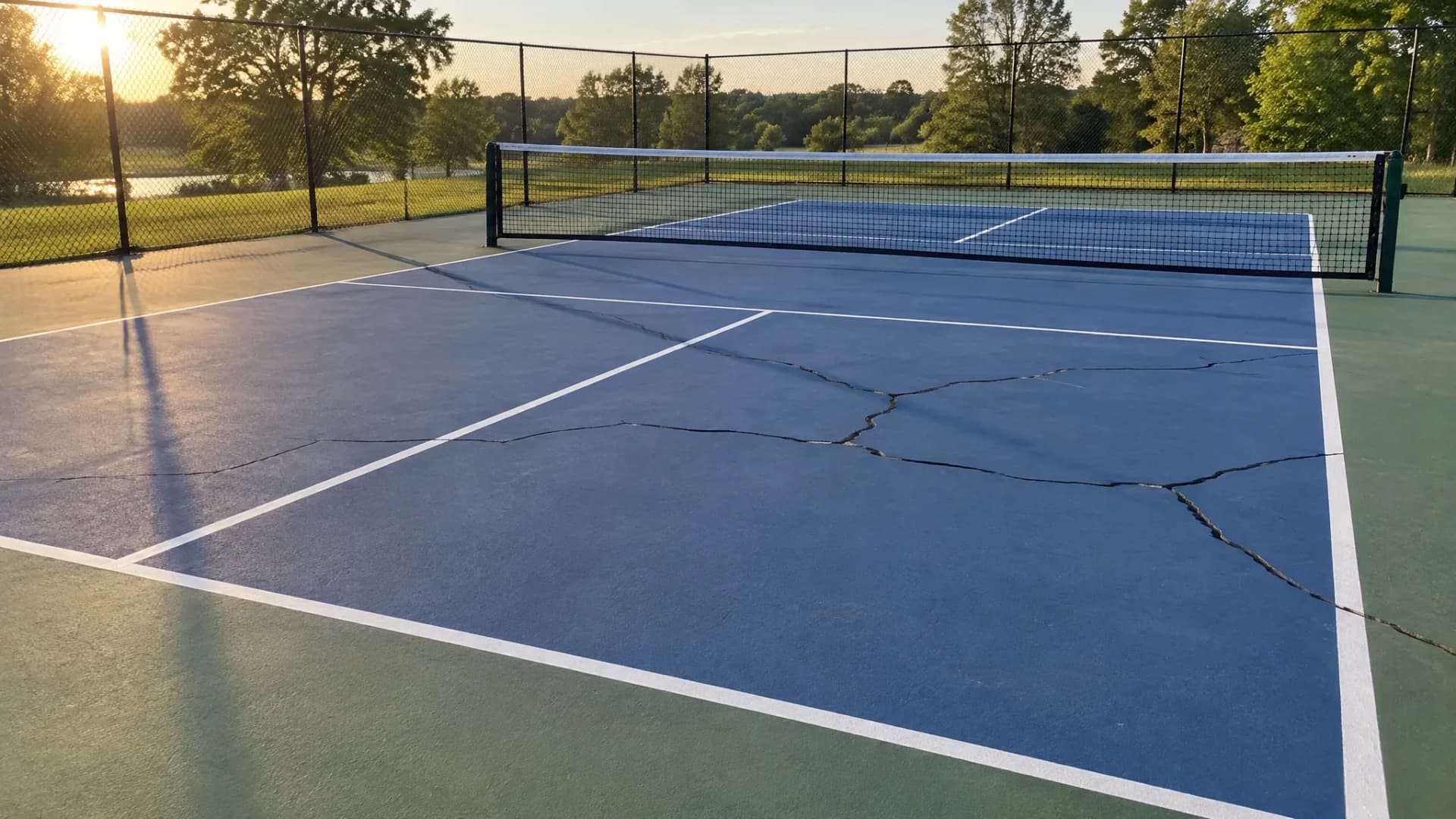
You paid to have the cracks on court two filled in May, and by March the same line is back through the kitchen. That happens on well-run courts too. The ASBA / USA Pickleball construction manual says all courts will crack eventually, and once cracks appear and are repaired, they will eventually reappear. So the useful question for a club operator is which repair the crack calls for, and what each one actually buys.
Here’s the short version. Very fine cracks may be covered by recoating the court. Small non-structural cracks take a court-grade acrylic crack filler, which one coating maker’s data sheet calls not a permanent crack repair and rules out for structural cracks greater than 1/2 in. Linear cracks that keep opening need a fabric or membrane bridge over the filled crack, and a court covered in them is a candidate for a composite overlay. Settlement from a failed base means reconstruction: the ASBA’s own fact sheet says that if the owner is seeking a long term solution, the court should be reconstructed. Work at 50°F and rising, and before winter.
Key Takeaways
- ASBA / USA Pickleball manual: once cracks appear and are repaired, they will eventually reappear.
- Shrinkage cracks are generally 1/16 in or less; structural cracks run as straight parallel lines near the paving joints.
- One maker’s acrylic crack filler is not a permanent crack repair and is not for structural cracks greater than 1/2 in; another maker’s crack patch is rated for cracks up to 1 in wide.
- Per one maker’s data sheet, apply filler only at 50°F and rising, with no rain within 4 hours; the manual then allows at least 72 hours for a fully coated acrylic surface to cure before play.
- No authoritative source gives a service life in years for any crack repair, so judge a repair on cause, movement, joints and warranty terms.
An instructional walk-through of tennis court crack repair, from the Mark Montemayor channel:

Step 1: Name the crack before anyone prices a fix
Start with a walk and a notebook, not a quote. The manual lists why courts crack. Its causes are poor sub-base conditions, improper asphalt or concrete design or placement, and poor drainage. It adds improper net and fence post placement and/or tension, lack of maintenance and age of the courts.
Asphalt also shrinks as it weathers, ages and oxidizes, and it becomes more brittle as it ages, so an old asphalt court cracks even when it was built well. Some crack types name their own cause (shrinkage, radial, reflection, settlement), and the cause matters more to the repair than the width does. On asphalt, the one type the manual gives a size for, shrinkage cracking, is generally 1/16 in or less, and the ASBA fact sheet says surface cracks like it usually don’t affect play but will develop into more serious cracks if untreated.
| Crack type | What you see | Cause or depth | Repair to price | Verdict |
|---|---|---|---|---|
| Hairline | Small irregular cracks over a large area | Cause not stated by the manual | Recoat with resurfacer and color | Treat early; untreated, they can become serious cracks |
| Shrinkage (stress) | Random, interconnected; 1/16 in or less | Asphalt shrinking as it ages | Filler, then recoat | Rarely affects play; untreated, it spreads |
| Alligator | Interlocking pattern, faint to full depth | Depth varies, faint to full depth | Probe depth; full depth repair if deep | Depth decides: coat or cut out |
| Structural | Straight parallel lines near the paving joints | Crack penetrates the asphalt pavement | Fabric or membrane bridge over filler | Filler is only a temporary fix here |
| Radial | Cracks where asphalt meets post footings | Asphalt and concrete moving at different rates | Filler plus bridge | Fix the footing detail at rebuild |
| Reflection | Old crack pattern showing through an overlay | Cracks in the pavement underneath | Bridge or composite overlay | Returns until the old pavement is dealt with |
| Settlement | Cracking over a poorly compacted or drained base | Base failure | Full depth repair or reconstruction | Surface repairs only buy time |
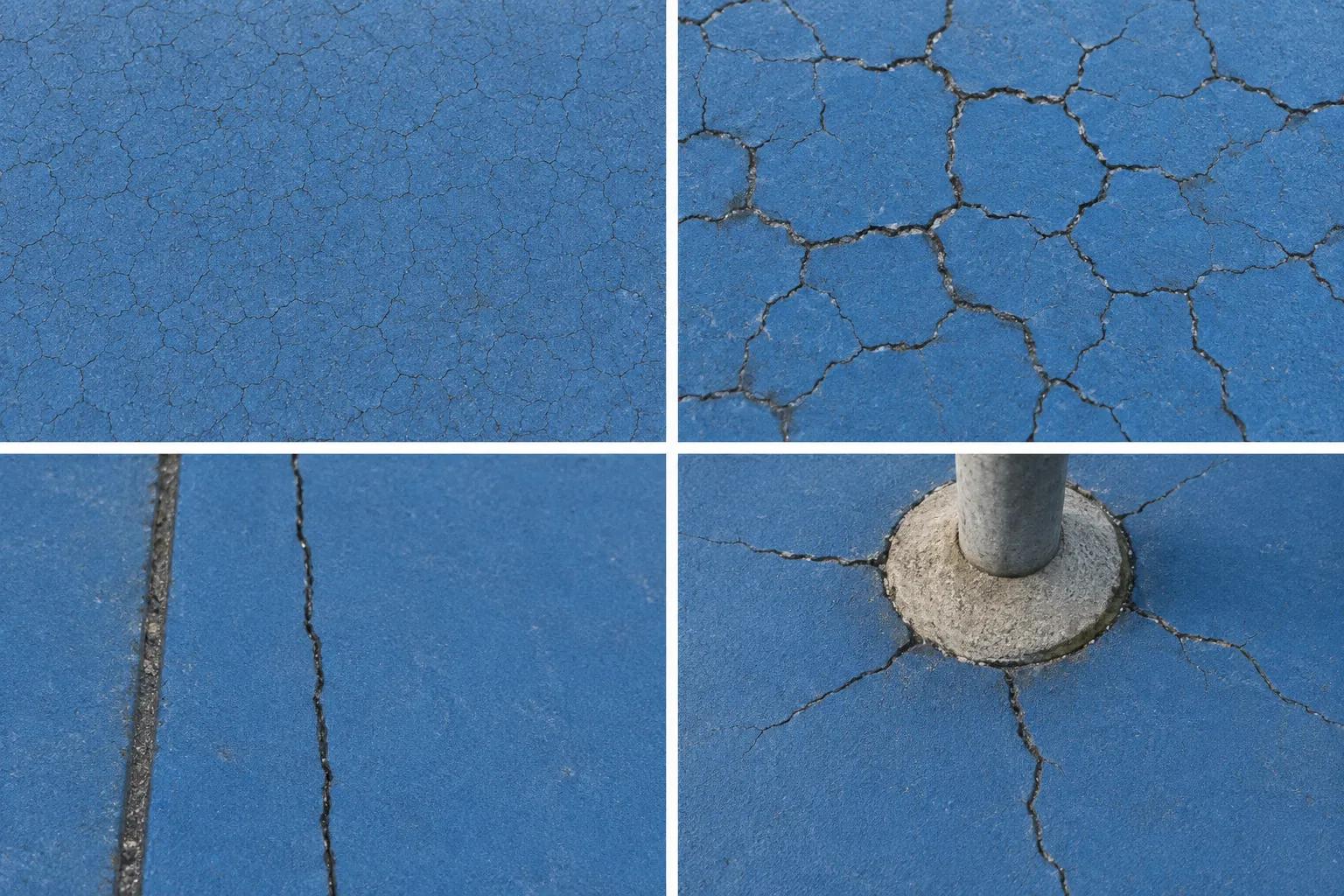
Concrete courts crack differently. The manual says most concrete cracks will be structural, running through the vertical profile of the slab, and that this is more common on reinforced than on post-tensioned courts, where the tension on the tendons will hold the cracks together.
The manual also says the methods for repairing concrete court cracks are similar to those of repairing asphalt cracks, and names pressure-injection of epoxies and urethanes for small cracks. Check that the product label lists concrete before it goes into a slab.
Step 2: Measure the width and watch it move
The manual’s instruction for any new crack is to keep track of its size and note any changes, then call in a court contractor to assess it. That record is worth more than any product claim, because it shows whether the crack is still moving. Mark both ends with a paint pen, pick three points along it, and measure the width at each in the cold months and again in summer. Write the dates down. A contractor looking at a year of numbers has a much harder time selling you the wrong fix.
Width matters a second time at the product. One coating maker’s acrylic crack filler is not for structural cracks greater than 1/2 in, while another maker’s crack patch is rated for cracks up to 1 in wide. Those are limits for each product, not a rule for your court, so read the label of whatever your contractor plans to use. Shrinkage cracks, which the manual puts at 1/16 in or less, sit well under both.
While you’re out there, flood the court. The manual defines a birdbath as standing water at least 1/16 in thick, the thickness of a nickel. Poor drainage is on its list of crack causes, and water that enters a crack and freezes will enlarge it, so a crack running through a birdbath is a drainage question as much as a crack question.
Step 3: Match the repair to the crack
The ASBA fact sheet was written for asphalt tennis courts (Rev. 01/04), and a pickleball court uses the same pavement and acrylic systems. It names at least four methods of crack repair: crack filler, infrared patching, a proprietary fabric repair system and full depth repair with either crack filler or hot mix asphalt. The pickleball manual adds recoating for very fine cracks and a composite overlay across the whole court.
None of them removes the crack. The fact sheet’s own summary is the most honest line on the subject. All methods of repair will provide some additional life for the court and some methods will extend the useful life of the court by many years. But if the owner is seeking a long term solution, the court should be reconstructed.
| Repair | What it does | What the documents say | Best for | Verdict |
|---|---|---|---|---|
| Recoat (resurfacer and color) | New acrylic coats over the whole surface | Very fine cracks may be covered by recoating | Hairline cracks; the freckled look after patching | First choice for cosmetic cracking |
| Acrylic crack filler | Fills the crack flush before coating | Not a permanent crack repair (maker data sheet) | Non-structural cracks inside the label limit | Cheap and temporary; budget to redo it |
| Fabric or membrane bridge | Flexing layer over a filled crack | Crack remains; fabric designed to flex and stretch | Linear structural and radial cracks | Pay for it where cracks move |
| Composite overlay | New layer over the whole court, then color | Cracks cleaned and filled first | Many cracks across one court | Price it before a third round of patching |
| Full depth repair or reconstruction | Cuts out or rebuilds the pavement | Reconstruction is the long term solution (ASBA fact sheet) | Settlement, failed base, deep alligator cracking | The only answer when the base is the cause |
If you’re pricing a resurface anyway, fold the crack work into it. The fact sheet notes that repairing many cracks may leave an unattractive, freckled appearance, and that resurfacing will correct it. The coat schedule for a full acrylic resurface, and what it commits you to, is in our court surface comparison, so it isn’t repeated here.
For clubs and facility operators who reorder private-label paddles or rotomolded balls at wholesale volume, from MOQ 1,000 pcs (Balls) / 50 pcs (Paddles).
See OEM paddles and ballsStep 4: Fill it the way the manual describes
The manual’s method: the crack is first routed and cleaned, then a tack coat may be applied, following the maker’s mixing and drying instructions. The filler is worked into the crack with a putty knife or similar tool, and the manual’s warning is to fill, not just cover, the crack. Press it in from every direction, strip the excess, let it dry, smooth it, then touch up or fully color coat the playing surface. One maker’s data sheet adds that cracks should be blown clean with an air compressor or high-pressure water, and must be dry before application.
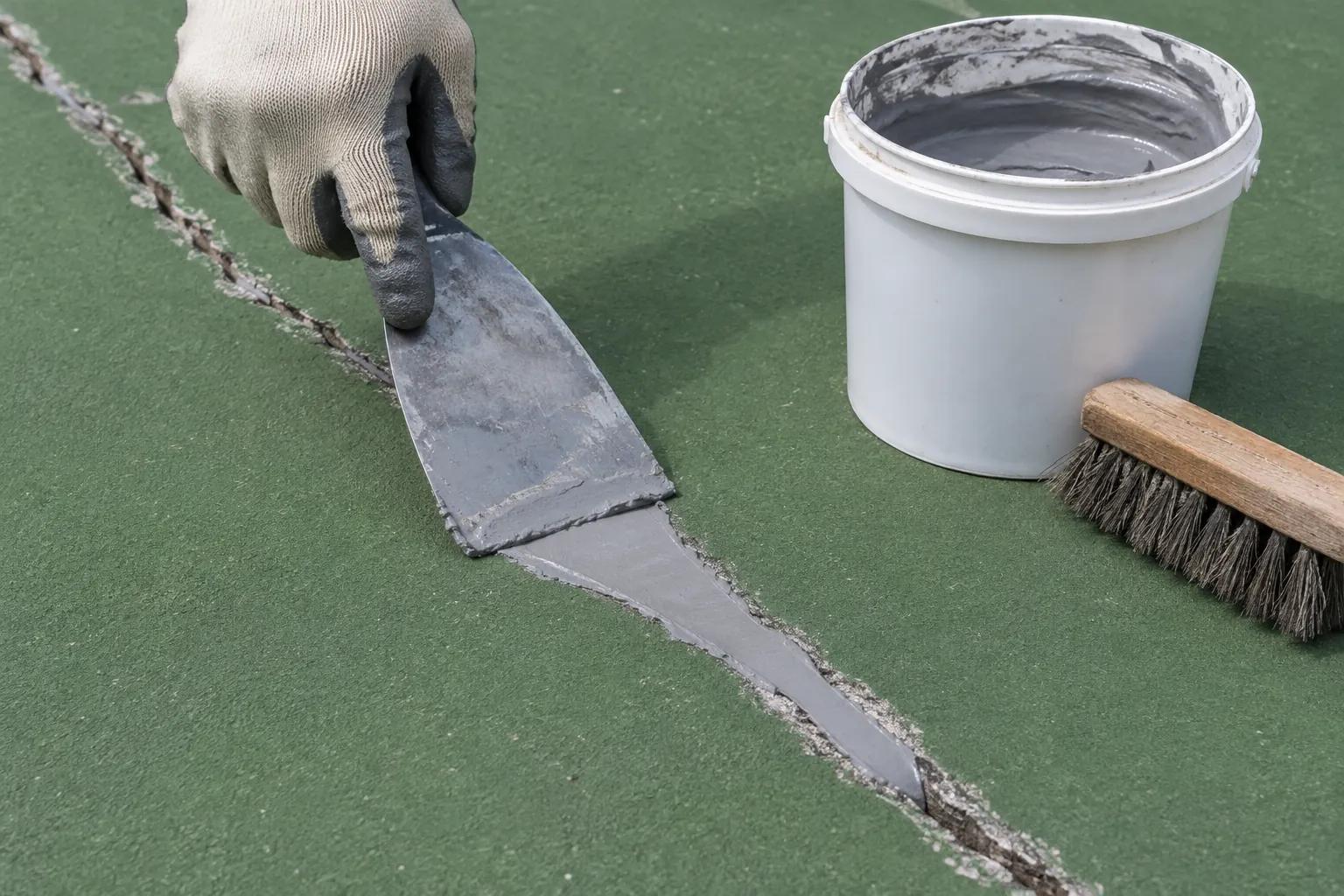
Material is where the do-it-yourself job goes wrong. The manual says crack repair materials used for driveways and parking lots generally are not recommended because they tend to have performance issues and long-term risks, and that any filler must be compatible with the coating system. Ask your contractor for the product name and check that it’s sold for acrylic court systems.
Quantity is easy to check against a quote. At one data sheet’s yield, 1 gallon fills a crack 1/4 in wide x 2 in deep x 40 ft long, so 120 ft of such cracks takes 3 gallons. The other maker quotes 75-150 ft per gallon depending on depth and width, which is 0.8 to 1.6 gallons for the same 120 ft. A quote far off both deserves a question. And pull the weeds before anyone fills anything: the manual says they’ll only accelerate the expansion.
| Yield basis | Filler for 120 ft of cracks (gal) |
|---|---|
| Maker A, 40 ft/gal | 3 |
| Maker B, 150 ft/gal | 0.8 |
| Maker B, 75 ft/gal | 1.6 |
Step 5: Schedule inside the weather window
For crack repair, the weather sets the lead time. The labels and the manual define the window, and the court stays closed from the first fill to the last cure.
| Stage | Limit (°F / hours) | Source |
|---|---|---|
| Crack filler, maker A | 50°F and rising; no rain within 4 hours; surface under 140°F | Maker data sheet |
| Crack patch, maker B | Above 50°F during application and for 24 hours after | Maker product page |
| Filler drying | Up to 24 hours, depending on thickness | Maker data sheet |
| Patching low areas | At least 55°F, no precipitation forecast | ASBA / USA Pickleball manual |
| Acrylic color-coat surface before play | At least 72 hours to cure | ASBA / USA Pickleball manual |
| Time of year | Before winter; frozen water enlarges cracks | ASBA / USA Pickleball manual |
Ask the contractor for three dates in writing: when the court closes, when the filler goes in, and when play resumes with the cure counted. Ask what happens if the forecast breaks the window, and how long the resurfacer or color coat waits on the filler’s drying time. Those answers are your real lead time, and they’re the numbers to give members.
Your supply lead time is a separate line. If the reopening also needs new club paddles or balls, our OEM paddle and ball factory quotes them at MOQ 1,000 pcs (Balls) / 50 pcs (Paddles). We don’t publish a production lead time, so ask for production and freight as separate lines and place the order early enough that the stock lands before the court reopens. That’s also where we stop: we make paddles and balls, not court coatings, so the crack work itself is always the contractor’s quote.
What decides whether the repair holds
Everyone asks how long it will last. No construction manual or data sheet checked for this page gives a service life in years for any crack repair. The manual’s answer is that no matter how well it is repaired, a crack will reappear over time. One coating maker is franker about its own product: acrylic crack filler should buy you time (maybe 6 months, maybe a couple of years), but the cracks will eventually come back. So judge a repair on four things you can check.
- Was the cause fixed? Poor drainage, a weak sub-base and post placement are all on the manual’s cause list. Fill a crack that runs out of a birdbath and you’ve treated the symptom.
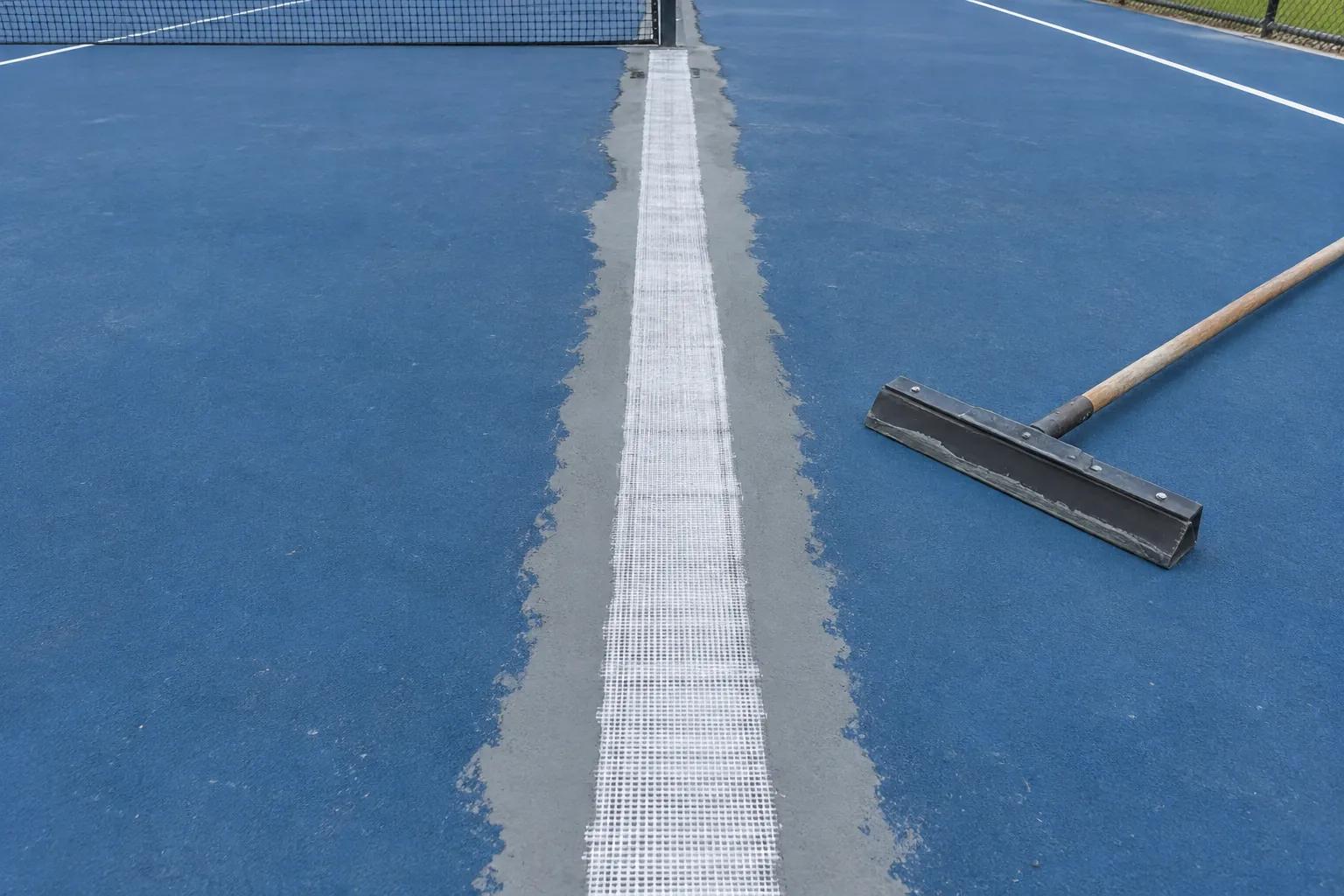
- Does the repair move with the crack? Filler sits in the gap. A fabric or membrane bridge is designed to flex and stretch as the pavement moves, and one maker rates its fabric at 300% elongation.
- Are the joints doing their job? On a battery of courts the manual describes control joints, saw-cut two-thirds to three-quarters of the pavement thickness under the net and between courts and filled with an elastomeric sealant, as one way to delay cracks; that sealant will require supplemental work every few years. The multi-court layout plan covers where those courts sit. At the posts, round footings recessed below the asphalt courses may help to minimize radial cracks, which belongs in the net post installation spec at the next rebuild.
- What does the warranty cover? One bridging-system brochure states a 2-year warranty on repaired cracks and calls it conditional. Ask whether reappearance is covered, for how long, and on what conditions. Treat the warranty as the contractor’s promise and read its conditions before you compare prices.
The manual’s current edition is the 2023 one, listed on USA Pickleball’s construction manual page; its care chapter keeps the same crack-repair sections, with Crack Repair on p.128. The quotes here come from the 2020 edition because its full text is public.
Frequently asked questions
What is the best tennis court crack filler?
One sold for acrylic court systems and compatible with the court's coating, used within its label width limit. The ASBA / USA Pickleball manual says driveway and parking-lot crack materials generally are not recommended because they tend to have performance issues and long-term risks.
How do you fill cracks on a tennis or pickleball court?
Route and clean the crack, apply a tack coat if the maker calls for one, then work the filler in with a putty knife. Fill, not just cover, the crack. Strip the excess, let it dry, smooth it, and color coat.
How long does crack filler last on a court?
No authoritative source gives a figure in years. The ASBA / USA Pickleball manual says a repaired crack will reappear over time, and one coating maker says its filler should buy you time (maybe 6 months, maybe a couple of years).
Can you resurface over cracks?
Only the finest ones. The ASBA / USA Pickleball manual says very fine cracks may be covered by recoating the courts, but most cracks require the attention of an approved court installer before the resurfacer and color coats go on.
What fills cracks in a concrete court?
The ASBA / USA Pickleball manual says epoxies and urethanes are often used, and pressure-injection can effectively fill small cracks. On post-tensioned courts the tension on the tendons will hold the cracks together.
Conclusion: what to send the contractor before the quote
A crack repair quote is only comparable when every contractor is pricing the same cracks. Send these with the request, and ask for each method as its own line with the product named:
- A crack map with each crack labelled by the manual’s type names and the total length in feet.
- Width at three marked points, measured in winter and again in summer.
- The flood-test result, with any birdbath of 1/16 in or deeper marked.
- The court build (asphalt, reinforced or post-tensioned concrete) and its age.
- Closure, fill and reopening dates, with cure time counted, plus the warranty terms in writing.
Want to source this quality for your brand?
Contact our factory directly on WhatsApp for an instant MOQ and pricing quote.