Permanent Pickleball Net Posts: Ground Sleeves, Footing Depth, Post Spacing and the Center-Strap Anchor Spec a Court Builder Should Send
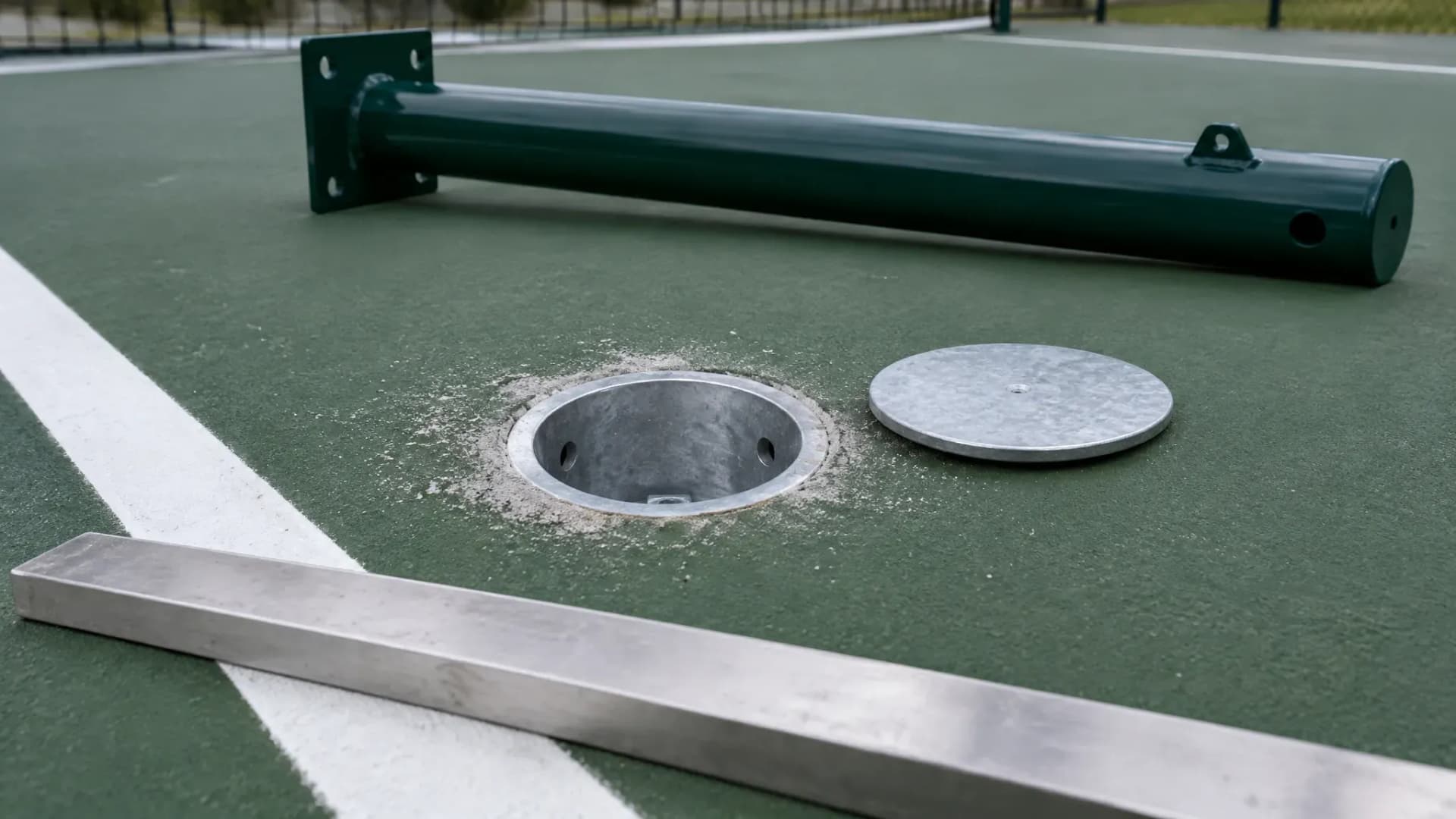
Three quotes for the same pair of permanent net posts came back with three different footing depths, and not one said where its number came from. The dimensions that are actually fixed are few. The 2026 USA Pickleball Rulebook requires the top of the net to sit 36 in (±0.25 in) above the playing surface where the net crosses the outer edge of the sidelines, and 34 in (±0.25 in) at the centre point of the court. It recommends posts 22 ft (±1.0 in) apart, inside face to inside face, at a maximum diameter of 3 in. Sleeve, footing, depth and concrete the rulebook does not address at all.
A spec a builder can work from labels every line with its source. Each dimension below is tagged rulebook requirement, rulebook recommendation, manufacturer sheet or local building department, with the condition that moves it attached.
Key Takeaways
- Two numbers are mandatory. Rules 3.B.6 and 3.B.7 fix 36 in and 34 in, each within 0.25 in.
- The 36 in is read at the sideline, not at the post. Rule 3.B.6 names the outer edge of the sidelines as the location.
- Post spacing is a “should”. Rule 3.B.2: 22 ft ±1.0 in (6.71 m) inside to inside, post diameter 3 in maximum.
- 22 ft inside-to-inside is 22 ft 3 in centre-to-centre on a 3 in post, which is how sleeve drawings dimension it.
- No sports standard sets footing depth. Minnesota publishes 60 in and 42 in by zone; New York City 48 in.
- A centre strap is optional. Rule 3.B.5 says one may be fitted; if it is, the 34 in reading includes it.
On this page
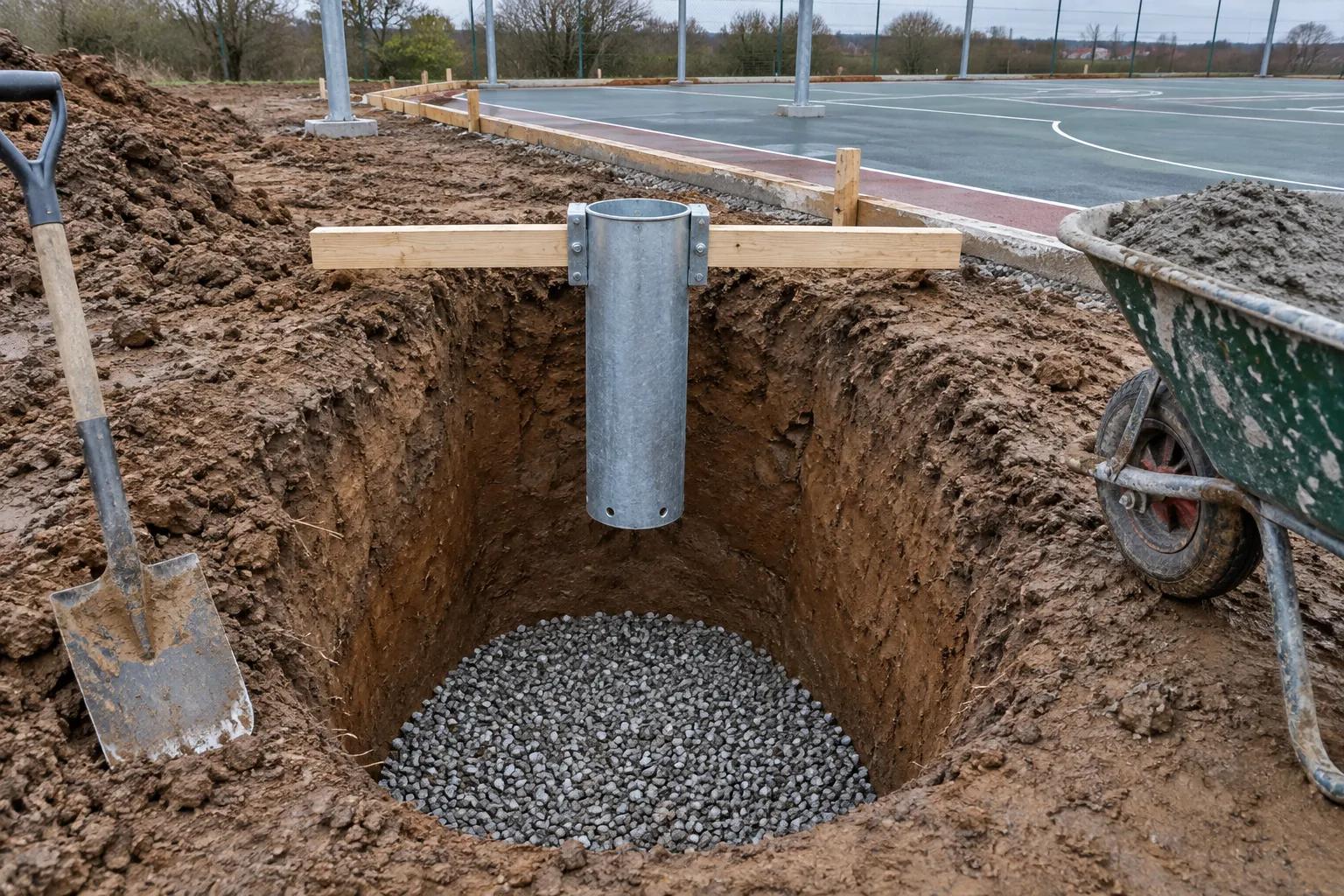
If you have never watched a set of posts go in, the sequence below is the one this page specifies: the holes are dug and the sleeves braced and poured first, the court is surfaced over them, and the posts and net go on last. It is a general court build rather than a spec document, so take the method from it and the dimensions from the tables here.

Which Numbers Are Requirements and Which Are Recommendations
The 2026 rulebook uses three different verbs, and which verb a line carries is the whole question. Rules 3.B.6 and 3.B.7 say the top of the net must be 36 in (±0.25 in) at the sideline crossing and 34 in (±0.25 in) at the centre point. Rule 3.B.2 says net posts should be 22 ft (±1.0 in) from the inside of one post to the inside of the other, at 3 in maximum diameter. Rule 3.B.5 says a centre strap may be placed at the centre of the net, centred 10 ft from the outside edge of the sidelines.
That difference decides what a referee can hold a facility to. A net reading 35.5 in at the sideline fails a clause written with the word must; sleeves poured 22 ft 1 in apart sit inside both the tolerance and the softer register. USA Pickleball’s own court-construction guidance puts it the same way: 36 inches tall at the sidelines, 34 inches tall in the center.
| Dimension | Published value (in / ft / m) | 2026 Rulebook clause | Register |
|---|---|---|---|
| Net top at the sideline crossing | 36 in ±0.25 in (91.44 cm) | Rule 3.B.6 | Requirement (must) |
| Net top at the centre point | 34 in ±0.25 in (86.36 cm) | Rule 3.B.7 | Requirement (must) |
| Post spacing, inside face to inside face | 22 ft ±1.0 in (6.71 m) | Rule 3.B.2 | Recommendation (should) |
| Maximum net post diameter | 3 in (7.62 cm) | Rule 3.B.2 | Recommendation (should) |
| Minimum net length, post to post | 21 ft 9 in (6.63 m) | Rule 3.B.3 | Recommendation (should) |
| Minimum net depth, bottom to top | 30 in (76.2 cm) | Rule 3.B.3 | Recommendation (should) |
| Centre strap position | Centred 10 ft from sideline outer edges | Rule 3.B.5 | Permitted (may) |
| Sleeve, footing, depth, concrete | No value published | None | Outside the rulebook |
22 Feet Inside-to-Inside, 22 Feet 3 Inches on the Setting-Out Drawing
Both spacing numbers a builder meets are correct, and mixing them puts the sleeves 3 in out. Rule 3.B.2 measures from the inside of one post to the inside of the other: 22 ft, an inch of tolerance either way. Gared’s instruction sheet for its 3 in in-ground system says something that looks different — post sleeves spaced 22 ft 3 in from sleeve centre to sleeve centre. Add one 3 in post diameter to 22 ft 0 in and the two drawings agree exactly. Douglas states the rule convention on its surface-mount sheet instead: posts 22 ft apart, measured inside-to-inside. Write on the drawing which face the dimension runs to.
Spacing also fixes a geometry most installers never work out. The court is 20 ft wide between the outer edges of the sidelines, and the posts stand 22 ft apart inside face to inside face, so each post’s inside face is exactly 12 in outside its sideline. The net crosses the sideline a foot in from the post. That foot is why the height the rulebook cares about is not the height at the post, as the regulation net-height spec sheet shows on the net side.
Footing Depth Is a Building-Department Number, Not a Sports Number
The most honest document here is the manufacturer’s. Step 1 of the Gared in-ground sheet says the sleeves must be set in a concrete foundation and that the size of the foundation may need to vary with local codes. It gives a shape and no depth: a bell hole roughly 2 ft 0 in across the top and 2 ft 6 in at the bottom, over about a foot of gravel.
The depth comes from the frost line, and the frost line is jurisdictional. Minnesota Rules part 1303.1600 sets the minimum footing depth due to freezing at five feet in its 34 northern Zone I counties and three and a half feet in Zone II, absent an engineer’s determination. New York City’s Building Code puts frost protection at four feet below the lowest adjacent exposed grade. Both clauses are written for buildings and structures; whether your official applies one to a net post is a question for that office, asked in writing before the excavator is booked.
No sports standard supplies it either. ASTM F1953, the guide that sits in the tennis-court family, is the Standard Guide for Construction and Maintenance of Grass Tennis Courts. It governs turf.
| Published geometry, by source | Hole top / base (in) | Depth (in) | Gross concrete per post (ft³) | Condition that sets the depth |
|---|---|---|---|---|
| Manufacturer bell hole, Minnesota Zone II depth | 24 / 30 | 42 | 14.0 | MN Rules 1303.1600: Zone II, 3 ft 6 in |
| Manufacturer bell hole, New York City depth | 24 / 30 | 48 | 16.0 | NYC Building Code 1809.3.1: 4 ft |
| Manufacturer bell hole, Minnesota Zone I depth | 24 / 30 | 60 | 20.0 | MN Rules 1303.1600: Zone I, 5 ft |
| Supplier-recommended bell footer | 18 / 30 | 42 | 11.2 | Vendor minimum, or 6 in below local frost depth |
Ground Sleeve or Surface Mount: What Each One Commits You To
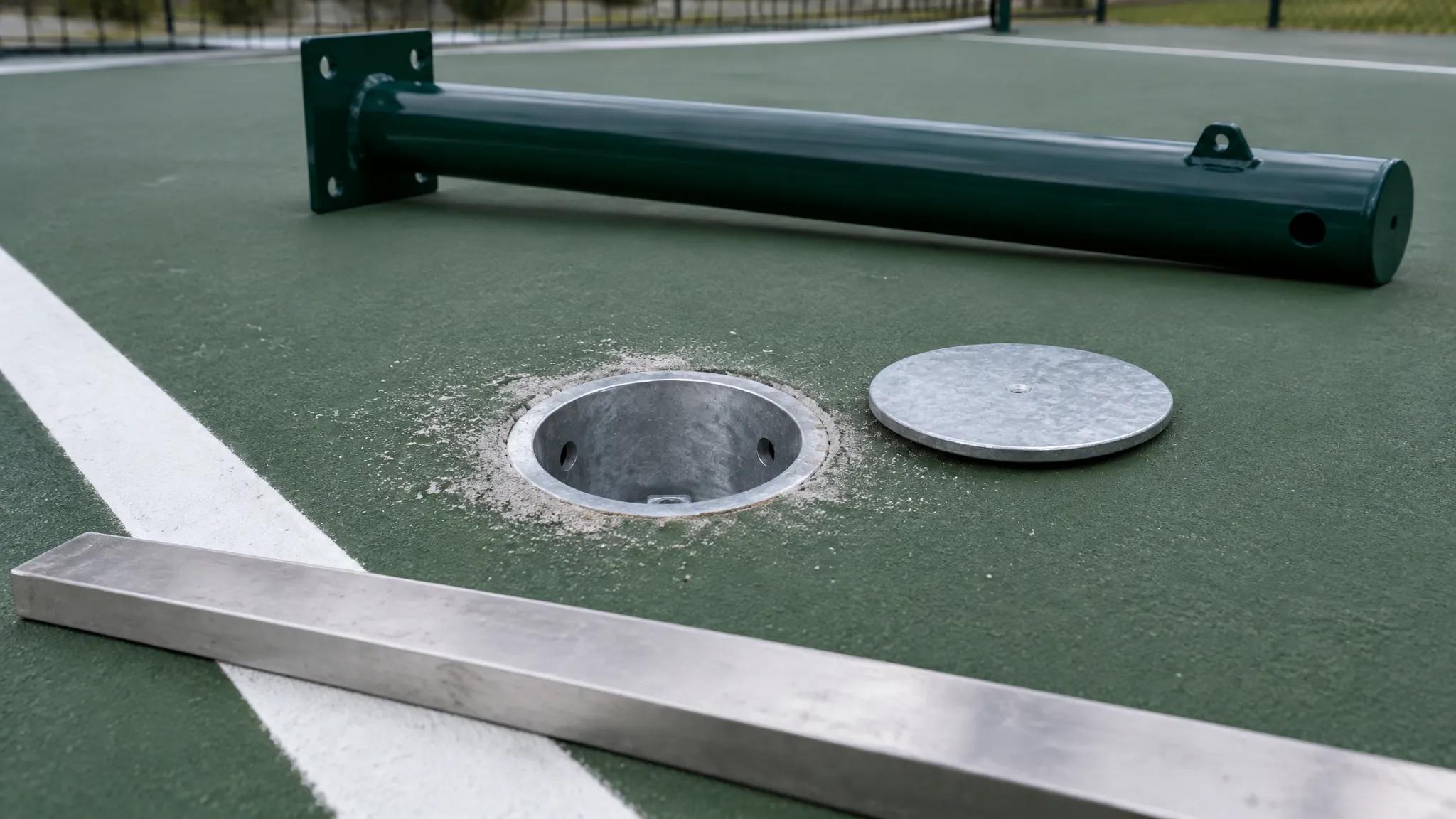
A sleeve buys removability at the price of getting one dimension right on the day of the pour. Gared’s sheet sets the sleeve top 3/16 in below the finished playing surface and calls for a 3/16 in by 4-1/4 in recess formed around it so the cap finishes flush. The surfacing contractor has to know the sleeve height before the topcoat goes down, or the cap stands proud on a surface players slide across.
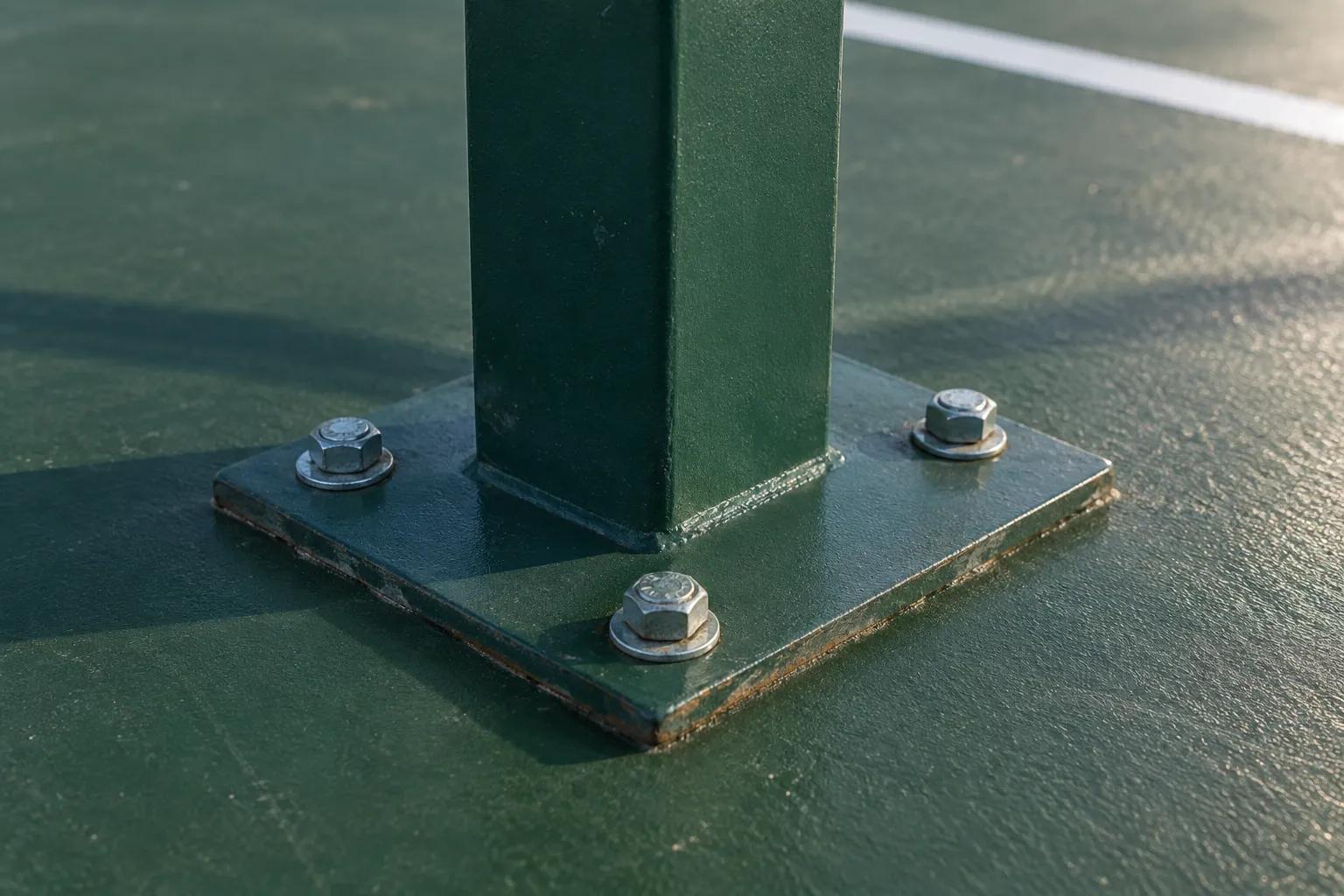
Surface mount moves the commitment into the slab. The Douglas Premier SQ plate is 7 in by 7 in with 9/16 in holes on a 5 in by 5 in pattern, fixed with half-inch bolts at least 2-3/4 in long. Nothing is buried, so nothing is excavated when a post is replaced; the trade-off is four bolt heads in the surface for the life of the court.
The centre anchor is a separate pour. Rule 3.B.5 places the strap centred 10 ft from the outside edge of the sidelines, which puts its anchor on the court centreline rather than wherever the net happens to sag. The nets, posts and line kits we supply are built to that same 22 ft span, which is the figure a club fit-out order should state.
| Mounting method | Fixed at the pour | If a post is damaged | Off-season and resurfacing | Best for |
|---|---|---|---|---|
| Ground sleeve in a concrete footing | Sleeve top 3/16 in below finished surface, 4-1/4 in recess | Pull the post, keep the footing | Posts lift out, caps sit flush for other sports | Multi-use courts and freeze-thaw climates |
| Surface-mount base plate on the slab | 7 in by 7 in plate, 9/16 in holes, 5 in by 5 in pattern | Unbolt and swap the post | Posts unbolt, bolt heads stay in the slab | Existing slabs and retrofits with no excavation |
| Direct-buried post in concrete | Post and footing become one unit | Break out the footing | Post stays up year round | Single-purpose courts on the tightest budget |
The Handover Measurement: Where the 36 Inches Is Actually Read
Four readings decide whether the installation meets the rulebook, and the handover sheet should carry all four:
- Net top at each sideline crossing: 36 in (±0.25 in), taken where the net passes the outer edge of the sideline, a foot inboard of the post (Rule 3.B.6).
- Net top at the centre point: 34 in (±0.25 in), including the centre strap where one is fitted (Rule 3.B.7).
- Span, inside face to inside face: 22 ft (±1.0 in), taken at the posts, not off the sleeve centres (Rule 3.B.2).
- Both posts plumb, both sleeve caps flush with the finished surface.
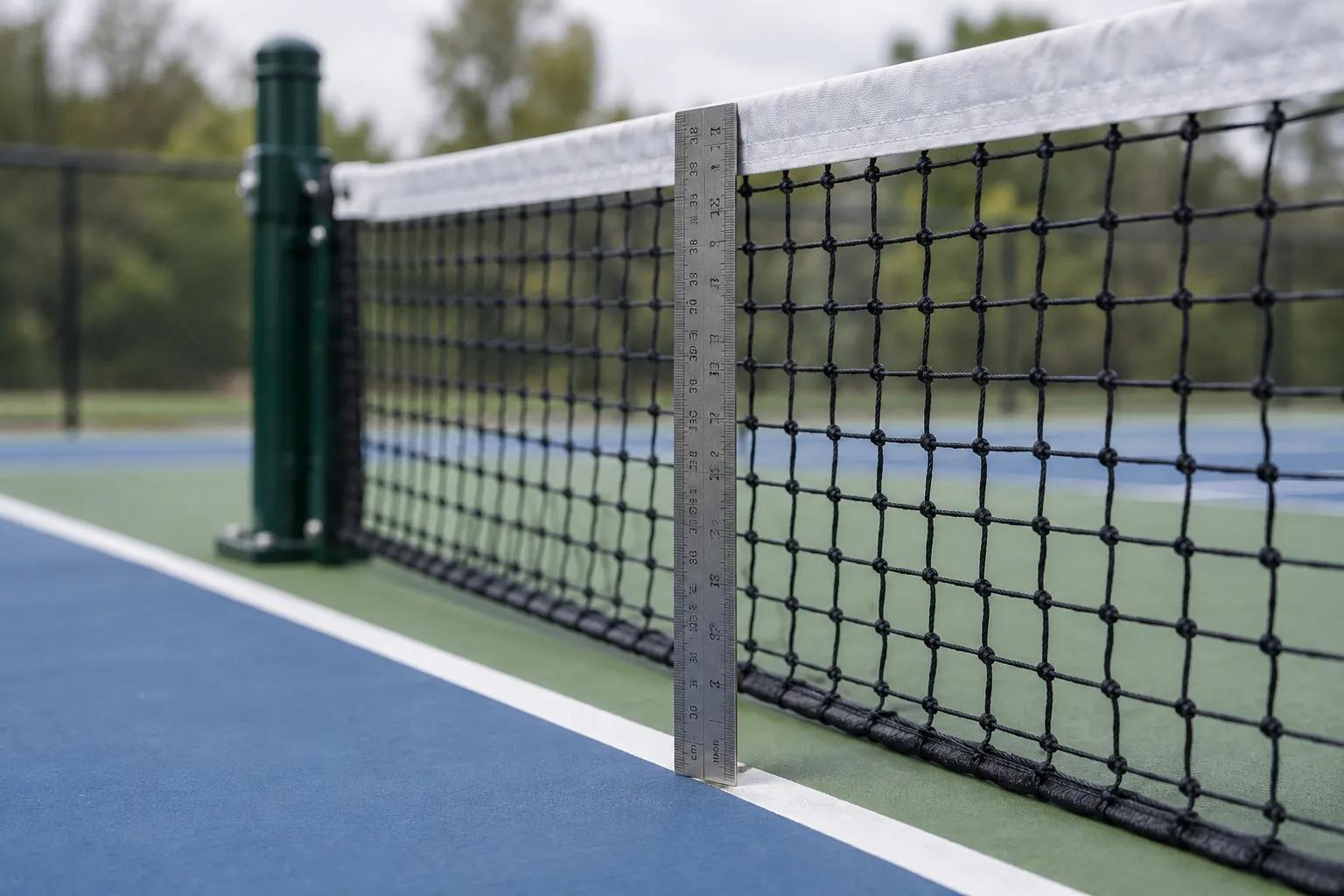
Setting the post top to exactly 36 in is the usual way to get the first reading wrong, and the manufacturer is careful where the trade blogs are not. Gared’s sheet says the top of the post should be approximately 36 in above the playing surface, then tells the installer to tension the net until it measures 34 in at the centre. The post height is a starting position for the cable; the two readings named in 3.B.6 and 3.B.7 are the specification, and both are taken after tensioning.
For club and facility procurement teams briefing a court contractor: we will put the 22 ft span, the net size and the centre-strap line on one page your installer can build and measure against.
Ask for the net and post spec pageConclusion
Four decisions separate a court that measures from a court that argues. Choose sleeve, surface mount or direct bury before the slab is designed, because two of the three change the pour. Get the frost depth from the building department in writing. Dimension the drawing in one convention and say which on the sheet. Then measure the net at the sidelines and the centre before anyone signs off. A first build has more to specify than the net; the facility opening kit lists the rest.
Frequently Asked Questions
How far apart should pickleball net posts be?
22 ft ±1.0 in (6.71 m), measured from the inside of one post to the inside of the other, under rule 3.B.2 of the 2026 USA Pickleball Rulebook. On a 3 in post that is 22 ft 3 in centre to centre, which is how sleeve drawings usually dimension it.
How deep should permanent pickleball net post footings be?
No pickleball rule sets a depth. The Gared in-ground instruction sheet says the size of the foundation may need to vary with local codes, so the frost depth published by your building department governs: Minnesota sets 5 ft and 3 ft 6 in by zone, New York City 4 ft.
Is a pickleball net 36 inches high at the post?
No. Rule 3.B.6 fixes 36 in (±0.25 in) where the net crosses the outer edge of the sidelines, which on a 22 ft span sits 12 in inboard of each post. A manufacturer’s own sheet calls the post top approximately 36 in.
Does a permanent pickleball net need a centre strap?
Not under the rules. Rule 3.B.5 says a strap may be placed at the centre of the net, centred 10 ft from the outside edge of the sidelines. What is required is the 34 in (±0.25 in) centre height in rule 3.B.7, and where a strap is fitted the measurement includes it.
Want to source this quality for your brand?
Contact our factory directly on WhatsApp for an instant MOQ and pricing quote.