Pickleball Court Dimensions: The Official Spec Sheet, Decoded for Builders and Buyers
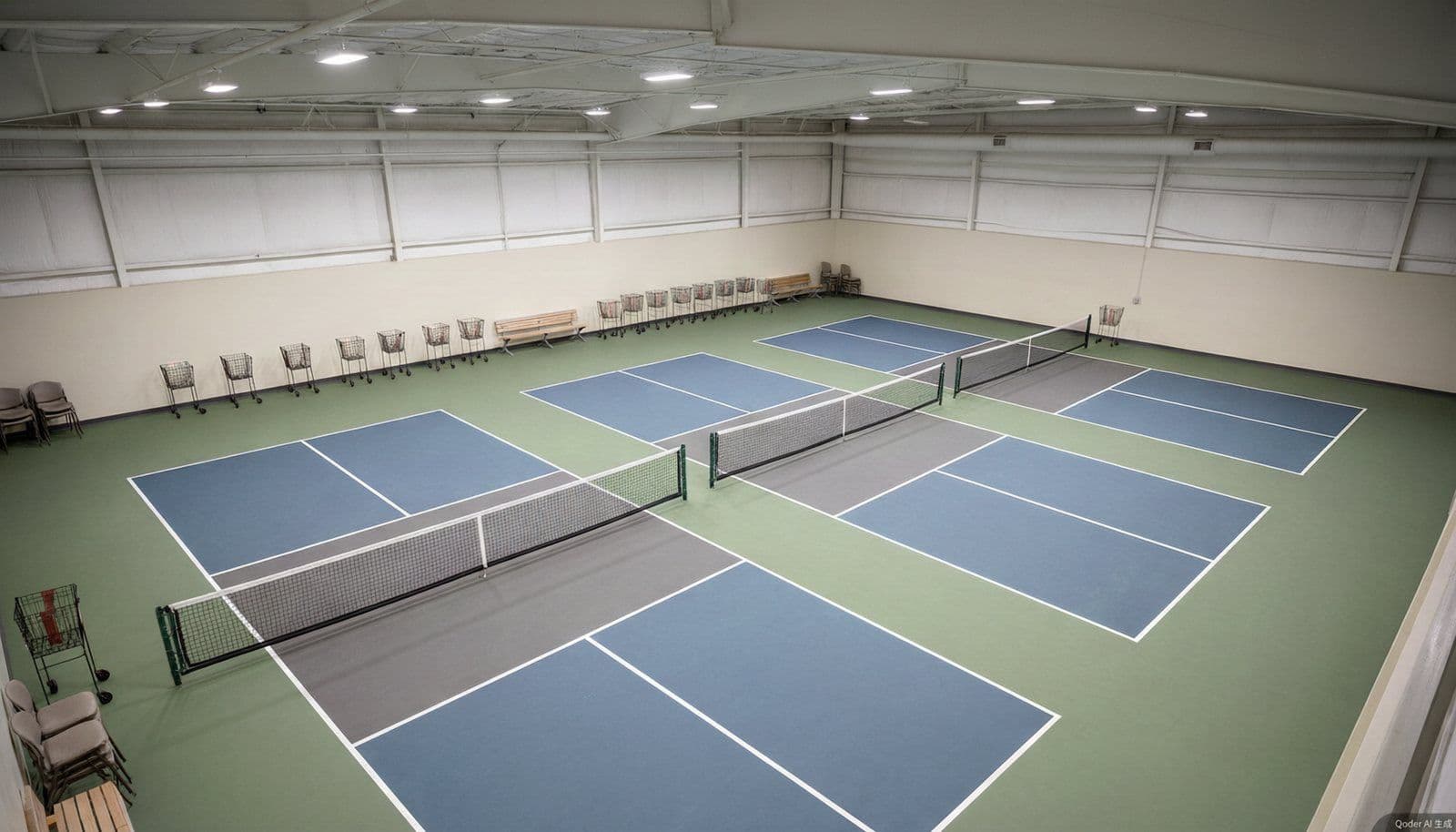
A regulation pickleball court is 20 feet wide and 44 feet long. That single sentence is where almost every "pickleball court dimensions" page stops — and it is also where the expensive mistakes begin. The 20-by-44 rectangle is only the painted playing surface.
Around it sits a second, larger number, the recommended total playing area, that decides how much concrete you pour, where the fence posts land, and whether a net system you already own will actually fit. This guide walks the official USA Pickleball measurements end to end, then does what the player-facing pages never do: it tells a builder, club operator, or facility buyer which number to hand to which contractor.
Every figure on this page is quoted from the official 2026 USA Pickleball Official Rulebook (clauses 3.A.1, 3.A.3 and 3.B.2–3.B.7) and the USA Pickleball Construction and Maintenance Manual for fencing and clearance guidance.
- The court itself is 20 ft x 44 ft; the recommended total playing area is 30 ft x 60 ft (minimum) or 34 ft x 64 ft (preferred).
- The non-volley zone runs 7 ft from the net on each side; all lines are 2 in wide.
- The net is 36 in at the posts and 34 in at the center, suspended between posts 22 ft apart.
- Plan run-out and fencing from the outer number, not the 20x44 — a court with no buffer is legal but dangerous.
- When you order equipment, the net-post spacing (22 ft) and net height (36/34 in) are the figures your supplier needs, not the court length.
On this page:
- 1. Court vs. Recommended Playing Surface
- 2. Line-by-Line: Every Measurement USA Pickleball Sets
- 3. Why the Net Is Two Heights
- 4. Run-Out, Fencing and Clearance
- 5. What We Supply for This Court
- 6. A Builder's Ordering Checklist
- 7. Frequently Asked Questions
1. The Two Numbers Every Builder Confuses: Court vs. Recommended Playing Surface
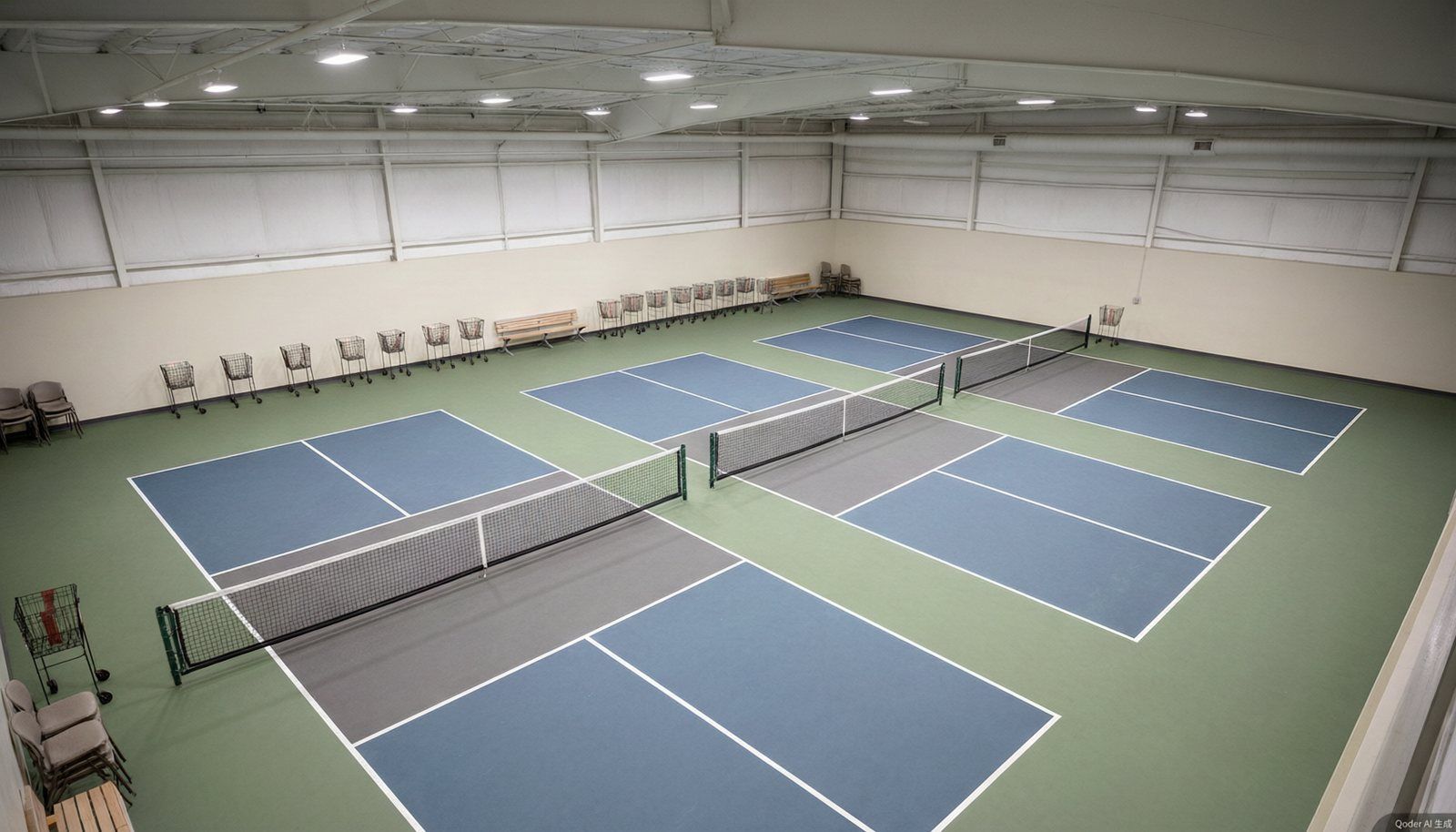
The single most common error on a court build is treating the 20-by-44 figure as the only thing that matters. USA Pickleball actually publishes two distinct measurements, and they answer two different questions.
The court is the 20 ft x 44 ft rectangle whose lines you paint, defined in the 2026 USA Pickleball Rulebook, clause 3.A.1. The recommended playing surface is the larger footprint the same rulebook lists in clause 3.A.3: a minimum of 30 ft x 60 ft, with 34 ft x 64 ft preferred for new construction and 40 ft x 64 ft common for tournament play.
Why two numbers? The painted court is where the ball is in play. The larger area is the run-out zone players need to chase lobs, the space a server needs behind the baseline, and the buffer that keeps a backpedaling player from slamming into a fence.
A court built with exactly 20 ft of width and 44 ft of length, hard up against a wall on every side, meets the letter of the rule but fails the reality of the game. USA Pickleball's construction guidance is explicit that the surrounding margin is not decoration.
The practical takeaway for anyone ordering: the 20 x 44 number tells your line-kit supplier what to paint. The 34 x 64 number tells your concrete contractor and your fence installer what to build around it. Hand the small number to the wrong trade and you will pour a slab that cannot legally host a sanctioned match, or set posts so close that play is unsafe.
2. Line-by-Line: Every Measurement USA Pickleball Sets
Beyond the two footprint numbers, the rulebook fixes every internal dimension of the 20 x 44 court. These are the figures your line painter works from, and they are identical for singles and doubles.
The non-volley zone — the "kitchen" — extends 7 ft from the net on each side across the full 20 ft width. Each baseline sits 15 ft from its kitchen line, and the two service boxes on either side of the centerline measure 10 ft wide by 15 ft long.
All court lines are 2 in wide, measured to the outside edge, and must be a single color that contrasts with the playing surface. Note that the lines themselves count as in-bounds, so a ball clipping the kitchen line is a fault if you volley — a detail that matters the moment you set the 7 ft measurement.
| Measurement | Value (imperial) | Metric |
|---|---|---|
| Playing court (W x L) | 20 ft x 44 ft | 6.10 m x 13.41 m |
| Non-volley zone depth (each side) | 7 ft | 2.13 m |
| Service box (W x L) | 10 ft x 15 ft | 3.05 m x 4.57 m |
| Baseline to kitchen line | 15 ft | 4.57 m |
| Line width | 2 in | 5.08 cm |
| Minimum total playing surface | 30 ft x 60 ft | 9.14 m x 18.29 m |
| Preferred total playing surface | 34 ft x 64 ft | 10.36 m x 19.51 m |
For the net specifics, see our full breakdown in Pickleball Net Height: The Regulation Spec Sheet, which decodes the 36/34 in rule line by line.
3. Why the Net Is Two Heights: 36 Inches at the Posts, 34 at Center
The net is the one dimension newcomers mis-measure most often, because it is not a single number. Rulebook clauses 3.B.6–3.B.7 set the top of the net at 36 in above the playing surface where it crosses the sidelines, and 34 in at the center, each within a 0.25 in tolerance.
That 2-inch dip is deliberate: it mirrors the engineering of a tennis net and rewards angle play down the middle, the same geometry that shapes shot selection at every skill level.
The posts that hold it are set 22 ft apart from inside face to inside face (plus or minus 1 in), which places each post exactly 1 ft outside the 20 ft court on either side.
The net body itself must span at least 21 ft 9 in post to post, stand at least 30 in tall from bottom edge to top, and carry a 2 in white tape binding over a cord or cable along the top. The maximum post diameter is 3 in — a detail that matters when you specify a portable system with an oversized base, because the 22 ft post-to-post span must hold regardless of base footprint.
A center strap anchors the midpoint down to the regulation 34 in. Permanent installs tension the cable; portable systems rely on the same strap plus frame rigidity. Either way, the 36/34 pair is what a tournament director measures, and it is the pair your net supplier is responsible for hitting.
4. Run-Out, Fencing and Clearance: The Space Around the Court
This is the section player-facing pages skip and builders pay for. The 30 x 60 minimum playing surface gives you roughly 5 ft of side buffer and 8 ft of run-out behind each baseline. Step up to the 34 x 64 preferred size and that becomes 7 ft on the sides and 10 ft behind. Competitive play benefits from the extra run-out because defensive lobs push players 4 to 6 ft behind the baseline.
Fencing guidance from the USA Pickleball construction guide calls for a 10 ft minimum backstop height behind each baseline, with side fencing at 3 ft minimum or matching the backstop height for the first 30 ft. The point is containment without turning the court into a box a player crashes into.
For indoor facilities, plan a ceiling clearance of 18 to 20 ft minimum, with 20 to 24 ft preferred, so a hard lob does not meet a light fixture. Outdoors, orient the court north-south so neither player stares into a low sun during morning or late-afternoon play.
If you are scoping a full site rather than a single court, our Pickleball Facility Opening Equipment Kit lays out what to source before day one, including how the fencing and clearance numbers above flow into a materials list.
5. What We Supply for This Court: Nets, Posts and Line Kits
As a pickleball equipment supplier, the dimensions above are not trivia to us — they are the spec our pickleball nets and posts are built to. Every net system we ship is manufactured to the 2026 Rulebook 3.B net envelope: a 22 ft (6.7 m) post spacing, a 36 in / 34 in (91.4 cm / 86.4 cm) sideline-to-center height profile, a 21 ft 9 in minimum net body, and a 2 in (50.8 mm) white top tape over a tensioned cord.
Posts are held to the 3 in (76.2 mm) maximum diameter so they seat inside the court's 1 ft sideline offset without intruding on play. For private-label programs, our OEM and private-label production page covers tooling, MOQ and branding.
The mistake we see most from first-time buyers is ordering "a net for a 44 ft court." The court length is irrelevant to the net; the net hangs across the 20 ft width and the posts sit 22 ft apart.
What you actually specify is the post spacing and the two net heights, plus whether you need a permanent in-ground system or a portable frame for a multi-use space. Our wholesale portable net system frames are built to the same 22 ft span so they drop into any regulation court without re-pouring footings.
Line kits follow the 20 x 44 court with 2 in lines and the 7 ft non-volley zone, and we supply them pre-spaced to the rulebook so a contractor is not doing arithmetic on the slab. The takeaway for a buyer: source the net and lines against the court number, but confirm the posts clear the outer footprint you picked in Section 1.
6. A Builder's Ordering Checklist
Pulling it together, here is the dimension each trade actually needs from you. Give the wrong number to the wrong contractor and the court comes back non-compliant:
- Concrete / slab contractor: the outer footprint — 34 ft x 64 ft preferred (30 ft x 60 ft minimum). Not the 20 x 44.
- Fence installer: 10 ft backstop behind each baseline; side fencing 3 ft minimum or matching the backstop for the first 30 ft. Confirm clearance against your chosen outer footprint.
- Net supplier: 22 ft post spacing and the 36 in / 34 in height pair, plus portable vs. permanent. The 44 ft court length is not their spec.
- Line-kit supplier: 20 ft x 44 ft court, 2 in lines, 7 ft non-volley zone, 15 ft baseline-to-kitchen, 10 ft x 15 ft service boxes.
- Indoor build: 20 to 24 ft ceiling clearance and north-south orientation for any outdoor bank.
Order against those five numbers and the 20 x 44 rectangle takes care of itself. The confusion only appears when the painted-court measurement and the total-playing-surface measurement get treated as one figure.
7. Frequently Asked Questions
What are the official pickleball court dimensions?
A regulation court is 20 feet wide by 44 feet long for both singles and doubles, per the 2026 USA Pickleball Rulebook, clause 3.A.1. The recommended total playing surface around it is 30 ft x 60 ft minimum, or 34 ft x 64 ft preferred.
Why is a pickleball net 36 inches at the posts but 34 in the center?
The 2-inch center dip is deliberate, mirroring tennis-net engineering. It lowers the crossing point down the middle of the court, rewarding angle play and drops. Both heights carry a 0.25 in tolerance under Rulebook 2.C.
How far apart are pickleball net posts?
Net posts are set 22 feet apart from inside face to inside face (plus or minus 1 inch), placing each post 1 foot outside the 20-foot court width. The net body must span at least 21 feet 9 inches.
How big should the space around a pickleball court be?
Plan for the recommended total playing surface: 30 ft x 60 ft at minimum, 34 ft x 64 ft preferred for new construction. That gives 5 to 7 feet of side buffer and 8 to 10 feet of run-out behind each baseline.
What size is the non-volley zone?
The non-volley zone (kitchen) extends 7 feet from the net on each side across the full 20-foot court width. All court lines, including the kitchen line, are 2 inches wide.
Want to source this quality for your brand?
Contact our factory directly on WhatsApp for an instant MOQ and pricing quote.