Pickleball Court Surface: Two Decisions, Not Four Options
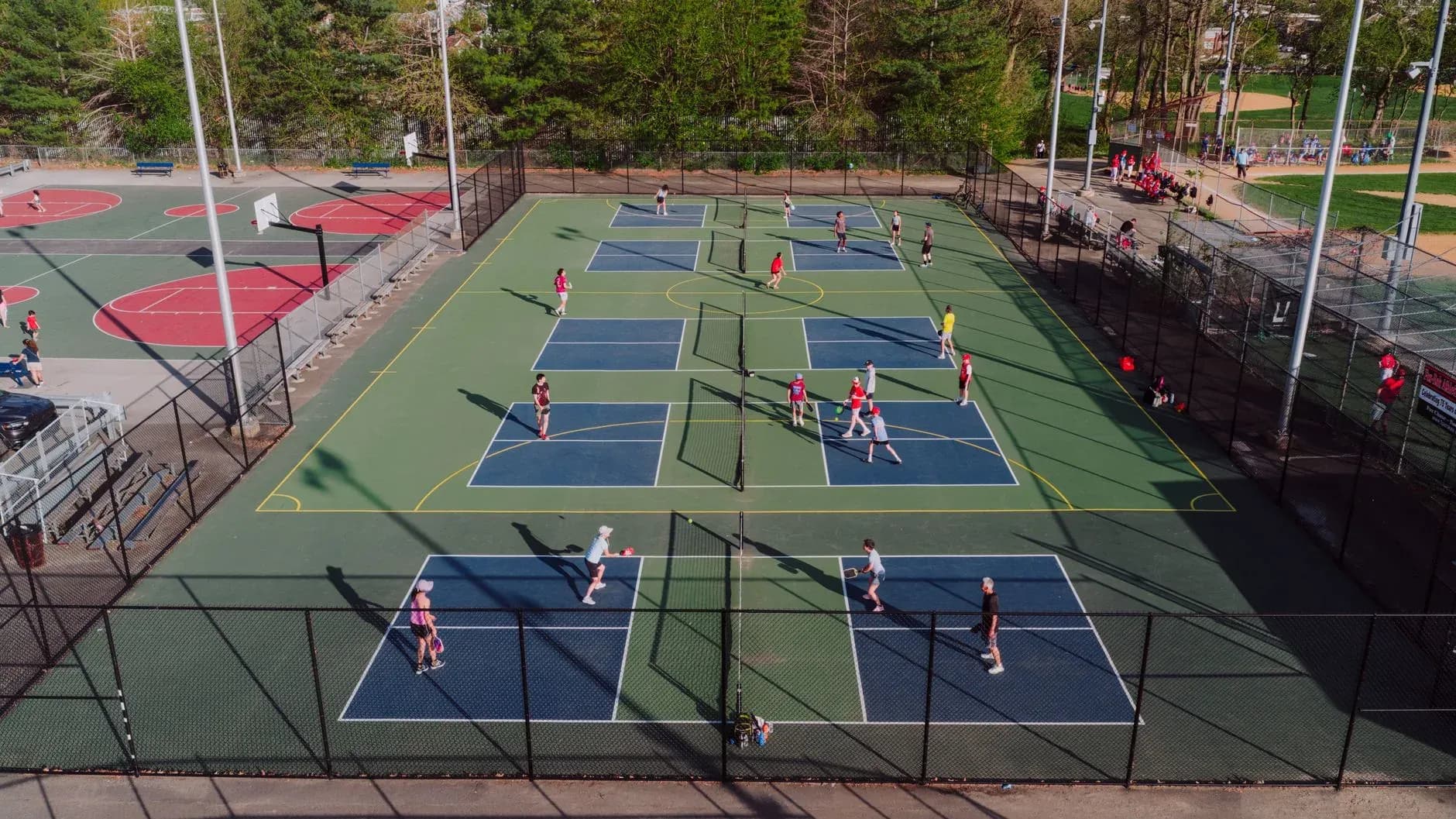
Choosing a pickleball court surface is two decisions signed at different times, not one product picked off a list. The first is the structural base, post-tensioned concrete or asphalt. The second is the wear layer over it: an acrylic coating system, or modular tile clipped down on the slab. Page one puts all four in one table. They do not belong in one, because two are structure and two are finish, and the first narrows the second.
The short answer for a club operator. Pour post-tensioned concrete when the court must survive more than one resurfacing cycle, and absorb the 28-day cure before any coating goes down. Choose asphalt when the budget calendar outranks long-term crack risk; it takes coating after 14 to 28 days. On top of either, an acrylic system is a countable schedule of coats you can write into a scope of work and audit on site. Modular tile is bought largely on a supplier's word.
One disclosure first. We do not sell court surfacing; we manufacture nets, net posts and line-marking kits. That is why the final section exists: the surface you sign for has already decided things about the equipment you buy next.
Key Takeaways
- Base first, wear layer second. The ASBA / USA Pickleball manual uses that order in its own chapter 3.
- Cure windows are contract dates: 28 days for new concrete, 14 to 28 for new asphalt, before any acrylic is applied.
- A steel-trowelled slab cannot be fixed later. The finish required under an acrylic system is a medium broom finish.
- An acrylic system is countable: one resurfacer coat plus two colour coats on a 20 ft x 44 ft court, at 0.09 to 0.11 gal/sq yd per coat.
- No USA Pickleball court-surface specification exists, so no surface can be certified for pace or bounce. Partner status is commercial.
- Write methods, not adjectives: ASTM D2697-22, C136/C136M-25, E1155/E1155M-23 and E303-22 turn "non-slip" and "flat" into numbers.
On this page
- Two decisions, not four options
- Base layer: concrete or asphalt
- Wear layer: coating or tile
- What to put in the bid
- Which combination to sign
- What it commits your equipment spec to
- FAQ
The ASBA, co-publisher of the manual above, filmed a worn acrylic system being ground off a hard court.

Two decisions, not four options
The document that settles the sequence is Pickleball Courts: A Construction & Maintenance Manual, the 182-page 2023 edition from the American Sports Builders Association and USA Pickleball. Chapter 3 runs in a fixed order: site grading, slope and drainage on page 33, asphalt on page 38, post-tensioned concrete on page 44, reinforced concrete on page 50. Surfacing systems begin only on page 50. A three-year cycle puts the next edition in 2026, so a specification written this year should name its edition.
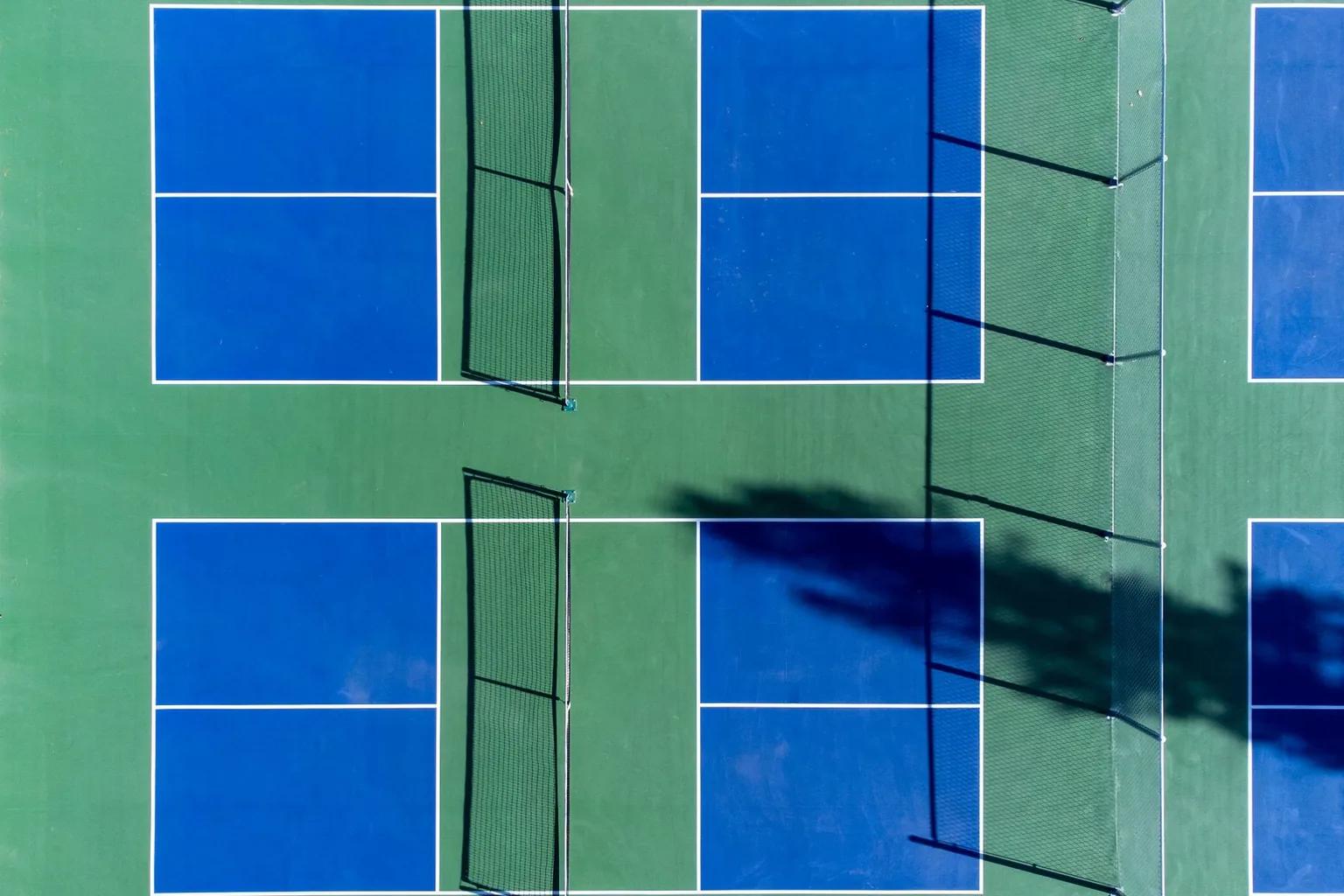
Footprint is the second thing page one blurs. A regulation court measures 20 ft by 44 ft (6.10 m by 13.41 m) with a 7 ft non-volley zone each side, and USA Pickleball recommends orienting outdoor courts north-south. The playing area is not the area you surface. If the facility will host wheelchair play, the 2026 Rulebook recommends a playing surface of 44 ft by 74 ft, and 50 ft by 80 ft for a stadium court.
Measured on the live page-1 set, the governing body's construction hub runs 235 words and routes visitors to partners. The top result is a manufacturer's category page at 1,445 words. The third is a paddle brand writing for players. None publishes a coat count, a gradation method or a tolerance you could put in a contract.
The base layer: post-tensioned concrete or asphalt
Both bases accept an acrylic system. What separates them is what they commit you to afterwards, and both commitments are dated: new concrete must cure 28 days before coating, new asphalt 14 to 28 days. Those windows come from the manufacturer's published preparation instructions, and they are why a court promised for a spring opening gets signed the previous autumn.
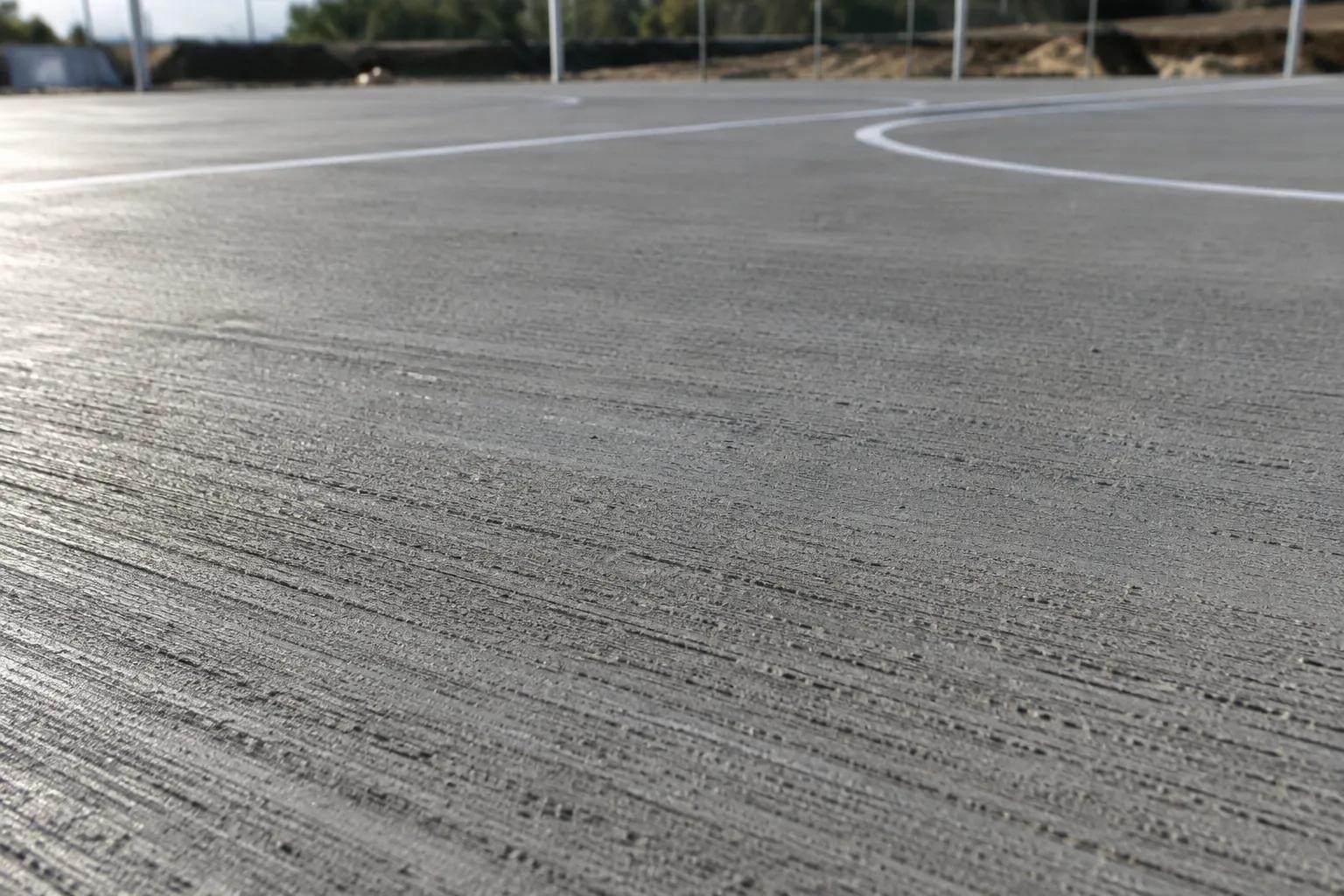
The finish is where avoidable failures are designed in. Under an acrylic system, concrete has to carry a medium broom finish and must never be steel-trowelled; the slab is then acid-etched and primed with an adhesion promoter. A smooth, steel-trowelled slab is a coating-adhesion problem nothing later will undo, poured by a crew nobody told what was going on top.
Flatness is the requirement people describe instead of specifying. Slope and drainage figures live inside chapter 3 of the paid ASBA manual, which is where your designer should read them; what belongs in your own documents is the method. ASTM E1155/E1155M-23 is the current active version of the test method producing FF flatness and FL levelness numbers. Writing the method into the spec makes a disputed slab measurable rather than arguable.
| Base | Cure before coating (days) | What it commits you to | Best for | Verdict |
|---|---|---|---|---|
| Post-tensioned concrete | 28 | Tendon layout fixed early; penetrations planned, never cored later | Clubs keeping the court past one resurfacing cycle | Default choice where the programme allows 28 days |
| Asphalt | 14 to 28 | Double resurfacer; porosity raises coating consumption | Budget cycles that must open a court this season | Acceptable with a written crack-repair plan |
| Reinforced concrete | 28 | Joint layout becomes a playing-surface decision, not only structural | Sites where post-tensioning is unavailable locally | Fine if joints are kept out of play areas |
The wear layer: acrylic coating system or modular tile
An acrylic system can be counted, which is the practical reason to prefer it in a competitive bid. For an existing court the published material list runs to two or three 5-gallon pails of resurfacer with sand for one coat, plus five pails of colour coating for two coats in one colour. Add one gallon of anti-bleed line primer and one gallon of textured white line paint. New asphalt doubles the resurfacer. Coverage is published at 0.09 to 0.11 gallons per square yard, roughly 9.3 m² per gallon per coat.
Cushioned versions add layers: one to two resurfacer coats, three of coarse-rubber cushion, two of fine-rubber cushion and two to three colour coats, with a premium build raising the coarse layer to five. Texture comes from aggregate blended in at the factory, described by the manufacturer as non-slip "without excessive wear on the balls" — a qualitative claim with no published number behind it.
| Layer in the build-up | Standard (coats) | Cushioned (coats) | Cushioned premium (coats) |
|---|---|---|---|
| Acrylic resurfacer | 1 | 2 | 2 |
| Coarse rubber cushion | 0 | 3 | 5 |
| Fine rubber cushion | 0 | 2 | 2 |
| Colour coat | 2 | 3 | 3 |
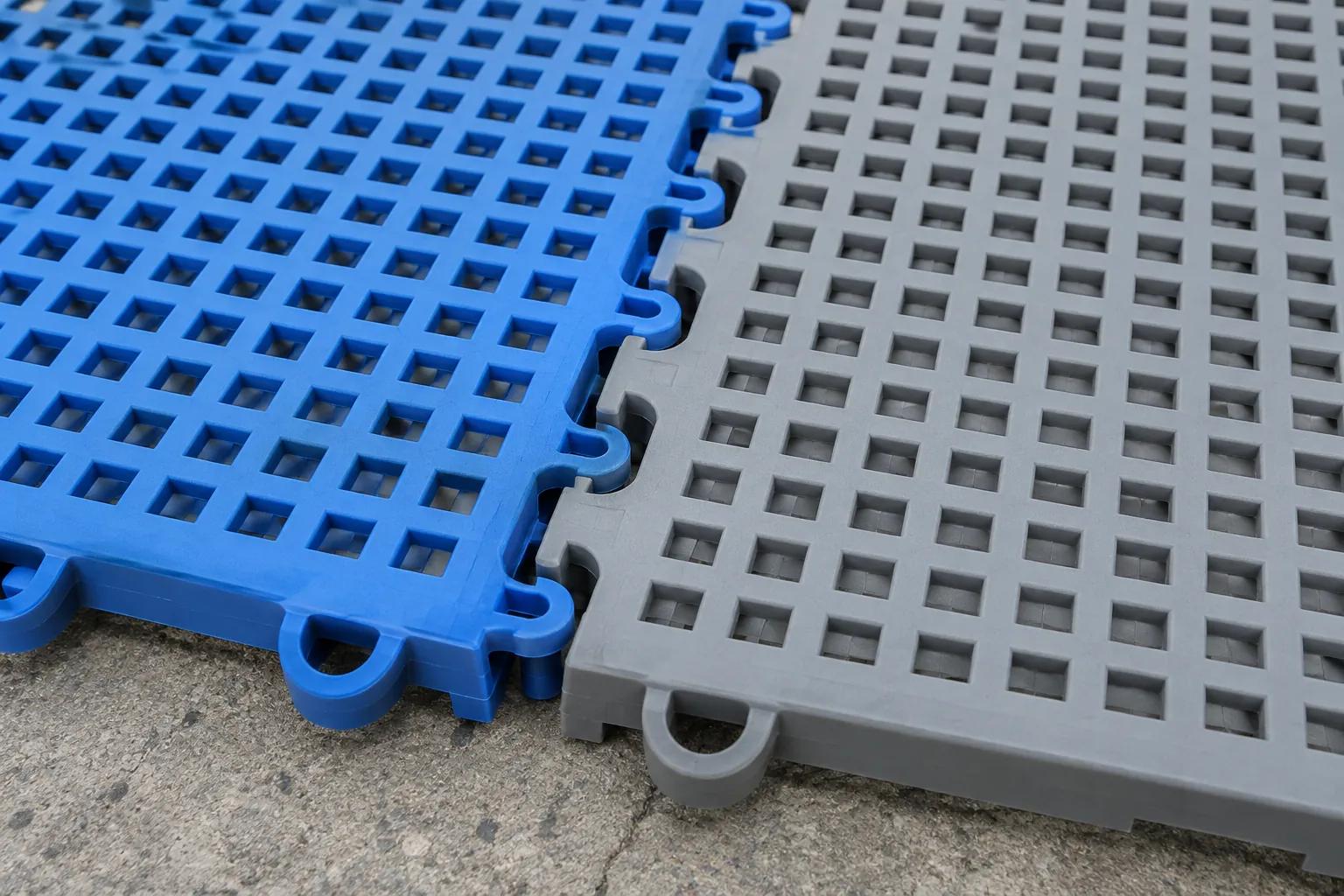
Tile is where the evidence thins out. Checking the pages of USA Pickleball's own official modular tile partner on 22 September 2026 returned no open-area percentage, no drainage rate, no interlock geometry and no tile dimension. That is not an argument that tile performs worse. But a tile bid cannot be compared with a coating bid on published data, so the numbers must be demanded in writing before the order.
Both wear layers carry a USA Pickleball partner designation, one as official court surface and one as official modular tile surface. Neither is a performance certification: a full-text search of the Equipment Standards Manual, Revision 3.0 of January 2025, returns zero occurrences of "court surface", "court pace" or "pace rating". The governing body specifies paddles, balls and nets, never the ground.
| Wear layer | Published coats (count) | What you can verify before ordering | Best for | Verdict |
|---|---|---|---|---|
| Acrylic coating, standard | 3 | Coat schedule, coverage rate, material quantities per court | Outdoor clubs comparing several contractor bids | Pick this when bids must be auditable |
| Acrylic coating, cushioned | 8 to 12 | Same, plus the rubber layer count driving labour days | Member clubs selling comfort and long sessions | Worth it only if the extra coats are itemised |
| Modular tile | 0 | Little published; open area and drainage must be requested | Sites needing fast install or a removable surface | Only with written specs and a sample on site |
The numbers that belong in the bid document
A bid becomes comparable the moment every requirement carries a named method and a named party who must produce the evidence. That means three things: what you want, the standard defining how it is measured, and who owes the document.
Two applicability boundaries matter, and both are easy to get wrong. ASTM F2772-24 sets athletic performance properties for multi-purpose indoor sports floor systems, and its scope excludes turf and materials specific to running tracks and tennis courts. Fair to require of an indoor gym floor; the wrong document to wave at an outdoor acrylic court. Separately, the ball bounce specification of 30 to 34 inches from a 78-inch drop is measured on a granite plate at 70 degrees F plus or minus 5: a ball, on granite, in a lab.
Currency of documents is the last trap. The Equipment Standards Manual in force is Revision 3.0 of January 2025, which states that it flows requirements down from the 2025 Rulebook, while the current rulebook is the 2026 edition. A clause saying "per USA Pickleball" must name the document and edition, or it means whichever version suits the party being asked.
| Requirement | Named method (active version) | Who owes you the evidence |
|---|---|---|
| Coating volume solids (%) | ASTM D2697-22 | Coating manufacturer, on the technical data sheet |
| Aggregate gradation | ASTM C136/C136M-25 | Coating manufacturer |
| Slab flatness and levelness | ASTM E1155/E1155M-23 | Concrete contractor, before handover |
| Slip resistance of the finish | ASTM E303-22 | Surfacing contractor, on the finished court |
| Indoor floor performance | ASTM F2772-24, indoor only | Flooring or tile manufacturer |
| Slope and drainage fall | ASBA/USAP manual 2023, chapter 3 | Designer or engineer of record |
For a tile quotation the missing data becomes four written questions. Ask for open area as a percentage of the tile face, drainage rate with the test behind it, interlock type with the thermal movement allowance across the field, and tile dimension with its tolerance.
Which combination should you sign?
Four pairings cover almost every real project, and they separate by who you are, not by which product is better. A parks department building courts meant to last two resurfacing cycles should pair post-tensioned concrete with a standard acrylic system: both halves are auditable and the 28 days of cure fit a procurement calendar. A member club selling long sessions should pair the same base with a cushioned system, but only once the coarse and fine rubber coats are itemised separately.
An operator opening on a fixed date inside one budget year should pair asphalt with a standard acrylic system and a written crack-repair plan. Take the trade knowingly rather than meet it in year three. A site needing a court that can be lifted or laid over a sound existing slab should pair concrete with tile, and should not order until those four answers are on file.
Avoid asphalt under modular tile on a site with known movement: neither half gives a measurable acceptance criterion. What cannot be reversed is the slab, with its finish, its flatness, its tendon layout and every penetration through it. The colour coat is a consumable.
For club operators, parks procurement teams and contractors who have fixed the base and wear layer and now need nets, permanent posts and line-marking kits specified against that surface.
See the net, post and line-marking rangeWhat the surface decision commits your equipment spec to, and where we stop
The same manual puts nets, posts and centre straps in chapter 7 on page 95, and playing lines in its appendix on page 143.
Post fixing is decided before the pour
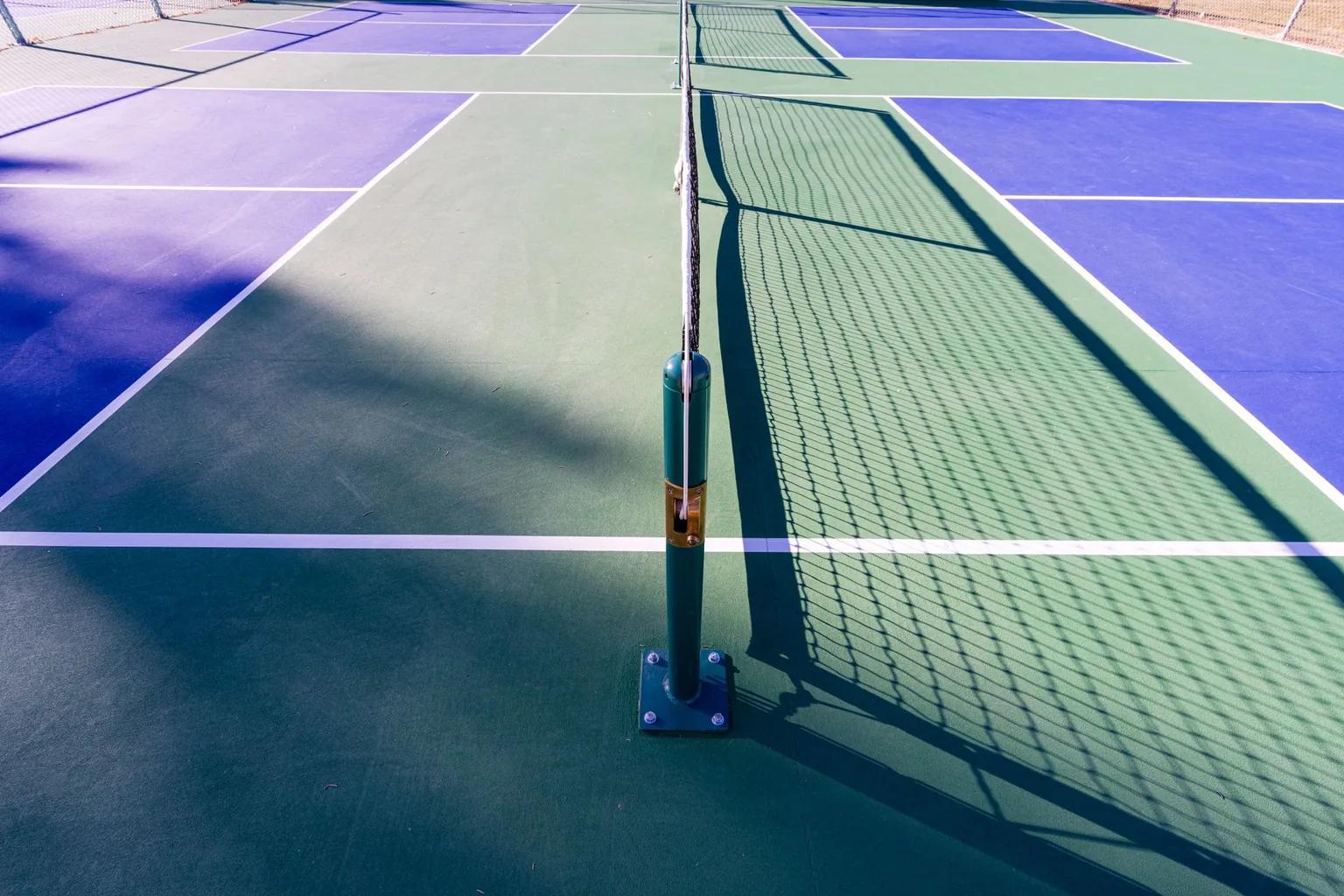
A post-tensioned slab carries tendons under load, and drilling into one is not a decision a court contractor makes on site with a core rig. Ask the structural engineer, in writing and before the pour, whether net-post sleeves are cast in before stressing and where. Then ask your post supplier for the sleeve outside diameter, embedment depth and base-plate pattern, so the answer you hand the engineer is a real number. Our permanent net post installation spec covers that exchange.
Line marking is a different trade on each wear layer
On an acrylic court the lines belong to the coating trade: one gallon of anti-bleed primer and one gallon of textured white line paint per court, applied after the colour coats. On a tile field, lines are usually formed from differently coloured tiles, so the layout is ordered with the tile and cannot be adjusted later with a squeegee. Dual marking is decided at order time too. The court dimensions spec sheet holds the numbers behind that layout.
What we check before quoting a net and post package against a surface
- Which base was poured, and whether sleeves were cast in or must be surface-mounted.
- The finished build-up, because tile raises the level and changes post height at the sleeve.
- Court count and spacing, since posts shared between adjacent courts change the fabrication list.
- Whether wheelchair play is planned, which moves the surfaced area to 44 ft x 74 ft.
- How much window is left: the 28 days of concrete cure, or 14 to 28 days on asphalt, is the time you have to settle sleeves and posts.
- Where we stop: we do not quote, specify or recommend the surfacing itself.
Two commercial numbers belong here, and we would rather hand you the question than a figure we have not measured for your case. On lead time, ask any net and post supplier which part of the quote is fabrication, which is powder coating or galvanising, and which is sea freight. Only the first shrinks when you pay for priority. On minimum order quantity, ask per SKU and again per mixed container: a four-court club rarely hits a single-SKU minimum but usually clears a mixed one. Both answers should arrive inside the 28 days the slab is curing anyway. See our nets, posts and line-marking kits and our guide to club fit-out equipment sourcing.
For club operators, parks procurement teams and contractors who know the base and wear layer and want the net, post and line-marking specification matched to it before the slab is poured.
Message us the surface build-upFrequently asked questions
What is the best surface for a pickleball court?
There is no single best surface, because the question hides two decisions. For most outdoor clubs the defensible answer is post-tensioned concrete under a standard acrylic coating system: the base outlasts a resurfacing cycle, and the coating is the only wear layer whose coat count, coverage rate and material quantities are published and therefore auditable across competing bids.
Which is better for a pickleball court, concrete or asphalt?
Concrete where the court must last, asphalt where the opening date must hold. Concrete needs 28 days of cure before coating, asphalt 14 to 28, and asphalt's porosity means roughly double the acrylic resurfacer. Asphalt is a reasonable choice taken deliberately with a written crack-repair plan, and a poor one taken because it looked cheaper on the first page of the quotation.
Can a court surface be USA Pickleball certified?
No. The USA Pickleball Equipment Standards Manual, Revision 3.0 of January 2025, specifies paddles, balls and nets, and contains no court-surface specification of any kind. Products described as official court surface or official modular tile surface hold a partner designation, which is a commercial relationship rather than a tested performance grade.
Does the surface change how the ball bounces?
Players report that it does, and no governing-body number exists to describe it. The published bounce figure of 30 to 34 inches from a 78-inch drop is measured on a granite plate at 70 degrees F plus or minus 5, which makes it a ball specification tested in a lab. Any pace or bounce claim made for a surface is a manufacturer's claim, so ask which test produced it.
How much does a pickleball court surface cost?
We do not publish court surfacing prices, because we do not supply surfacing. What moves the number is visible in the specification: the coat count in the system, whether the base is new or being resurfaced, asphalt porosity raising resurfacer consumption, and the labour days implied by eight to twelve cushioned coats against three standard ones. Ask every bidder to itemise coats and material quantities, and the quotations become comparable.
Conclusion
The base buys permanence and costs calendar time and irreversibility: 28 days of cure, a finish that must be right at the pour, penetrations planned before tendons are stressed. A wear layer buys either auditability or speed, since acrylic publishes coats, coverage and quantities, while tile installs faster and lifts out again but gives you less to check.
Write methods into the bid rather than adjectives, name the edition of every document you cite, and settle net post fixing before the concrete crew arrives. The court you can still specify is the one nobody has poured.
Want to source this quality for your brand?
Contact our factory directly on WhatsApp for an instant MOQ and pricing quote.