Pickleball Court Lighting: The Spec Lines a Club Buyer Should Demand From a Fixture Quote
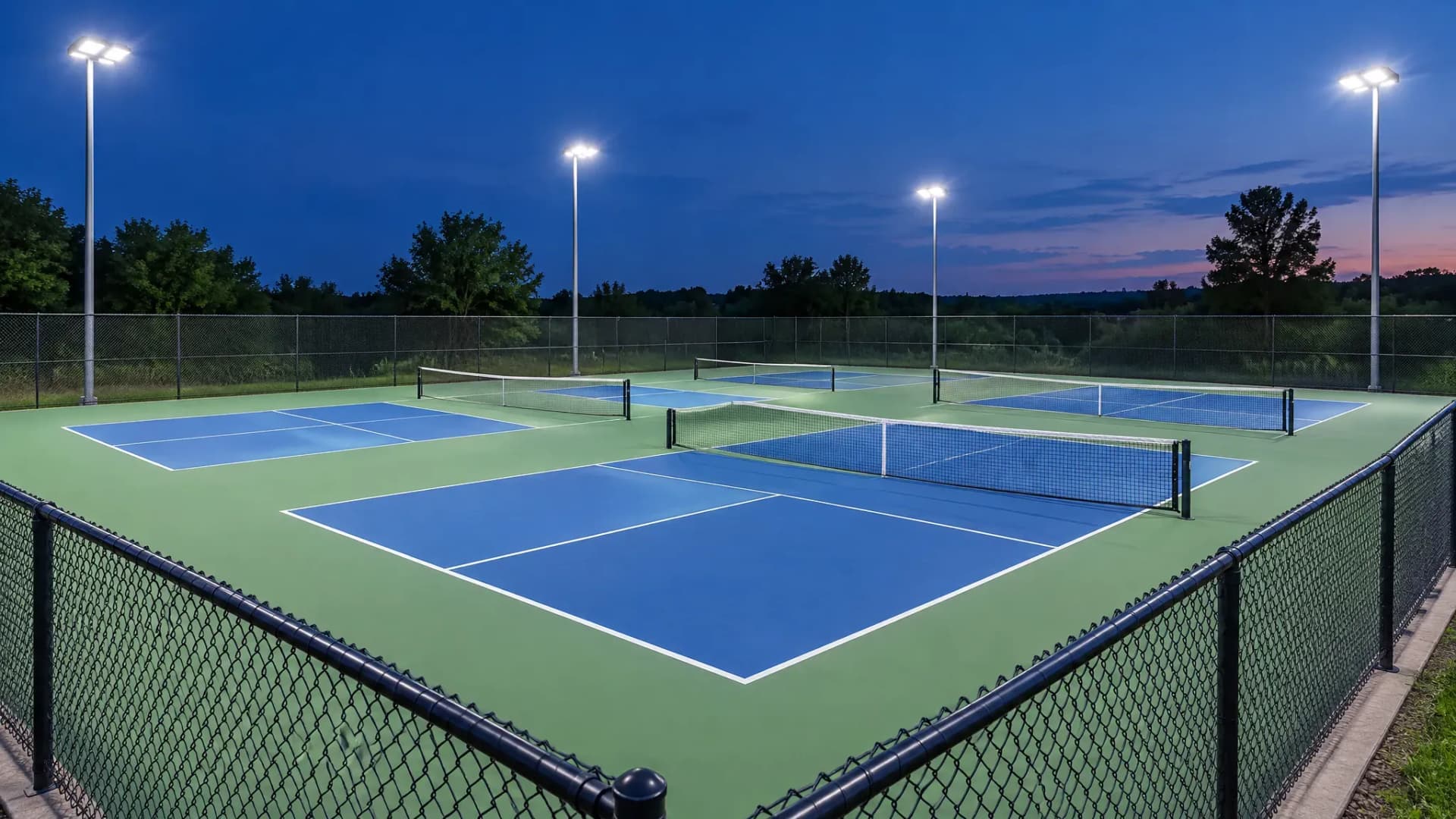
The ASBA and USA Pickleball construction manual recommends 30 fc (300 lux) of average maintained light for a Category III court, 50 fc (500 lux) for Category II and 75 fc (750 lux) for Category I, measured 3 ft above the court. The numbers are easy to quote and hard to check unless the quote also states how they were calculated.
The short answer: ask every fixture supplier for a point-by-point layout. It should state the category, the maintained (not initial) average and minimum over the Primary Playing Area, and the max:min uniformity ratio. Then add colour temperature and CRI, mounting height and pole position, the IP and IK codes, a lifetime claim inside the TM-21 6x limit, and lead time split by stage. A quote missing one of those lines cannot be compared with the next.
We make paddles, balls and nets, not lights, and we sell no fixtures. This is the sheet we would hand a club before it opens lit courts.
Key Takeaways
- Average maintained horizontal light: 30 fc (300 lux) Category III, 50 fc (500 lux) Category II, 75 fc (750 lux) Category I, per the 2020 edition table of the ASBA and USA Pickleball manual.
- Maintained equals initial times a light loss factor that normally varies between 0.6 and 0.9, so an initial-value layout can read up to 67% higher.
- Calculate over the Primary Playing Area: 2 ft beyond the sidelines and 2 ft behind the baseline, or 24 ft by 48 ft per court.
- Keep colour temperature between 3800K and 5000K.
- A 100,000-hour claim needs at least 16,667 hours of LM-80 data.
- Ask for lead time split into design, fixtures, poles, freight and installation.
This 96-second local news report shows Central Oregon courts switching from construction lights to LED.

On this page
- Spec lines
- Illuminance
- Documents
- Uniformity and glare
- Colour and CRI
- Poles and wiring
- IP, IK, lifetime
- Lead time
- FAQ
The eight lines to put on a fixture quote
Put these eight lines in the request for quotation and ask each supplier to answer them on one page, in this order. A fixed order lets you lay three quotes side by side instead of reading three brochures. The first five lines come from the ASBA and USA Pickleball construction manual; enclosure and lifetime come from IEC and IES documents; lead time is a scheduling question. Ask for the layout as a point grid over the playing area and for the light loss factor behind it, so the illuminance line can be checked rather than trusted.
| Spec line | The quote must state | Reject the quote if |
|---|---|---|
| Illuminance | Category (I, II or III); average and minimum maintained, in fc or lux | Only initial values or lumen totals |
| Calculation area | Primary Playing Area, 2 ft beyond sidelines and baseline | Grid stops at the court lines |
| Uniformity | Max:min ratio within the PPA | No ratio given |
| Colour | CCT in kelvin and CRI | CCT above 5000K |
| Mounting | Fixture height, pole position, distance to sideline | Pole inside 5 ft of a sideline |
| Enclosure | IP code and IK code, with test reports | Codes with no report |
| Lifetime | LM-80 test hours behind any TM-21 figure | Claim above 6x the LM-80 hours |
| Lead time (weeks) | Split by design, fixtures, poles, freight, installation | One number, no split |
If the lights are for new courts, the ball needs the same scrutiny; our 40-hole outdoor tournament balls are sold in bulk for club stock.
Illuminance: name the category and insist on maintained values
The Pickleball Courts Construction & Maintenance Manual, published jointly by the American Sports Builders Association (ASBA) and USA Pickleball, sets out three categories. The table below is the 2020 edition, chapter 6. These are recommendations, not rules.
| Category | Avg horizontal, fc (lux) | Min horizontal, fc (lux) | Max:min (ratio of fc) | Avg vertical, fc (lux) |
|---|---|---|---|---|
| I | 75 (750) | 60 (600) | 1.7 | 50 (500) |
| II | 50 (500) | 40 (400) | 2.0 | 30 (300) |
| III | 30 (300) | 20 (200) | 2.0 | 20 (200) |
Pick the category by the highest level of play the courts will host, not the average night. The manual lists indoor clubs under Categories I and II and tournament venues under Category I, and says facilities with older average player ages should be designed for higher levels of light. Broadcast venues generally run 125 fc (1,250 lux) or more.
| Category | Avg (fc) | Min (fc) |
|---|---|---|
| Category I | 75 | 60 |
| Category II | 50 | 40 |
| Category III | 30 | 20 |
Then check the word maintained. The manual defines it as initial foot-candles multiplied by a light loss factor (LLF), which normally varies between 0.6 and 0.9 with lamp, dirt, voltage and fixture maintenance. A layout drawn at 50 fc initial with an LLF of 0.7 delivers 35 fc maintained: above the Category III average, well short of Category II. At an LLF of 0.6, an initial-value layout reads up to 67% higher than what the court will get. Ask which LLF was used and why.
| Light loss factor (LLF) | Maintained, 50 fc initial (fc) | Category II average (50 fc) | Category III average (30 fc) |
|---|---|---|---|
| 0.6 | 30 | 50 | 30 |
| 0.7 | 35 | 50 | 30 |
| 0.8 | 40 | 50 | 30 |
| 0.9 | 45 | 50 | 30 |
Two more traps sit in the small print. Averages and minimums are calculated within the Primary Playing Area (PPA), 2 ft beyond the sidelines and 2 ft behind the baseline, and measured 3 ft above the surface. On a 20 ft by 44 ft court (court dimensions) that is 24 ft by 48 ft, or 1,152 sq ft per court. And the manual rounds 1 fc to 10 lux, while the exact factor is 10.764. A European quote at 300 lux is 27.9 fc, just under the 30 fc Category III average.
Which document the design is drawn to
Ask the quote to name the document and edition it was designed against. Three are in play, and they do not share a class system.
| Document | Current edition | Use it when | Verdict |
|---|---|---|---|
| ASBA / USA Pickleball construction manual | 2023 edition; next due 2026 | US club, park or residential courts | Name the category from it |
| ANSI/IES RP-6-24 | 2024 edition; replaced RP-6-22 | Designer works to IES classes | Ask for the class and its values |
| EN 12193:2018 | Valid | European project | Ask for the class and its values |
ANSI/IES RP-6-24 lists an enhancement for pickleball among its changes. EN 12193:2018 gives illuminance, uniformity, glare restriction and colour values for the sports most practised in Europe. Both sit behind a paywall, so we quote none of their numbers here. A supplier who cites either should put the class and target values on the quote. The manual table above comes from the 2020 edition; the 2023 edition is current, so ask the designer to confirm the figures against it.
Uniformity, glare and where fixtures hang
Uniformity is the brightest point divided by the darkest within the PPA. At 2:1 the brightest spot is twice the darkest; the manual warns that a large difference makes the ball harder to follow. The manual recommends 1.7 for Category I and 2.0 for Categories II and III on the horizontal plane.
Glare is mostly geometry. USA Pickleball and ASBA recommend that fixtures do not extend over the court lines; they may extend over the PPA. Outdoors, cut-off (low-mast) fixtures most commonly sit 22 ft to 30 ft above the court, and floodlights go on poles of 35 ft to 60 ft. Indoors, the manual recommends fixtures 30 ft above the court, 20 ft at minimum, and a direct/indirect mix with 30% to 40% of the light from the indirect component. Ask for an aiming drawing that shows each fixture against the court lines.
Colour temperature and CRI
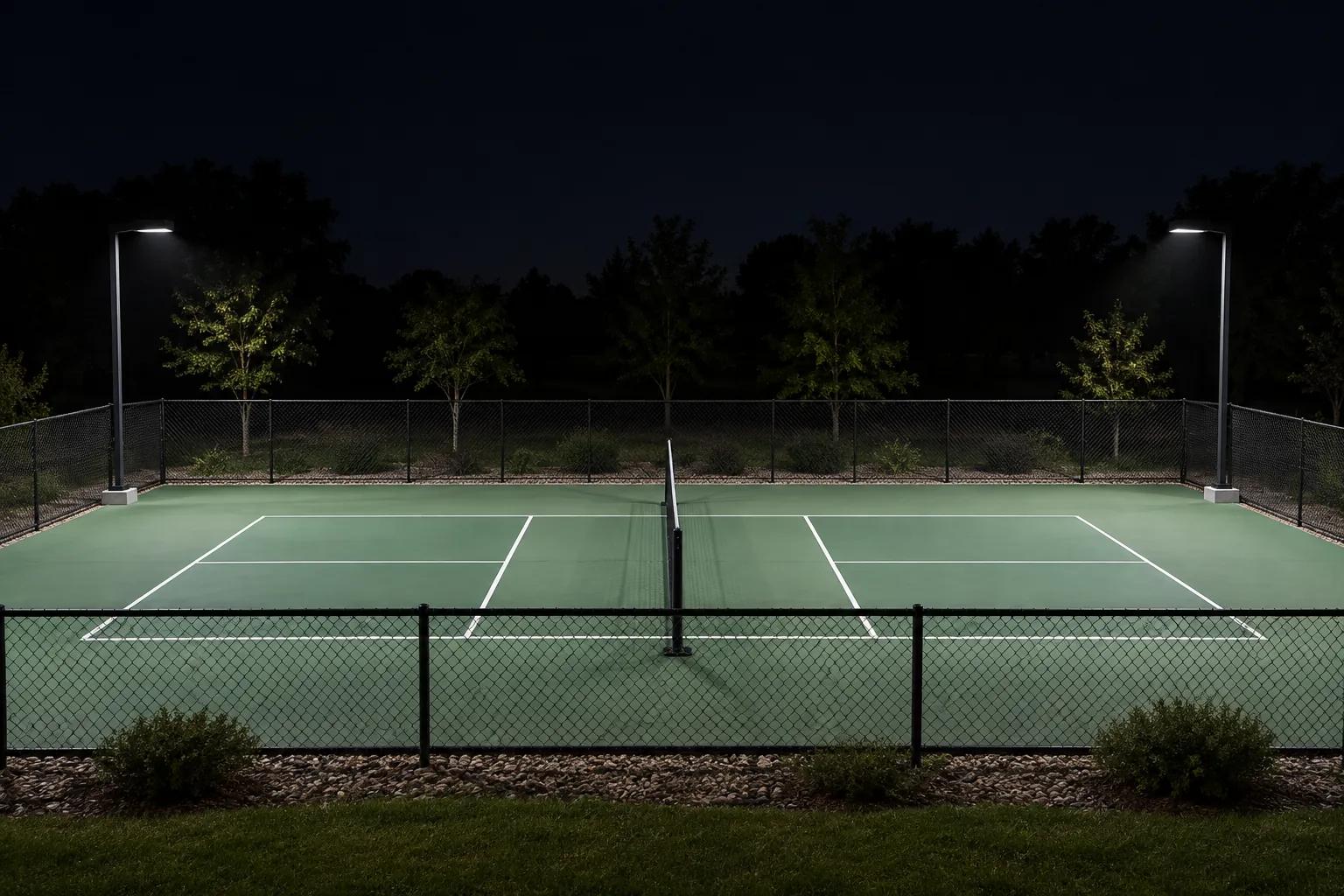
The manual says the majority of new court lighting will be LED. It recommends a colour temperature of 3800K to 5000K and warns that sources above 5000K have a bluish tint and should not be used. The 2020 edition recommends a CRI between 65 and 80. Put both numbers on the quote line. A quote that says only "cool white" or "daylight" has not answered it; ask for the kelvin value and CRI of the complete fixture as shipped. Ball colour interacts with the light; our ball colour and visibility guide covers which colours stay visible as light drops.
Poles, footings and wiring
The manual treats light poles as fixed objects and recommends at least 5 ft from the sideline, with poles centred on or just outside the fence. Poles between adjacent courts should be flanked by fencing, and light poles should not double as fence posts. Wind loads come from local codes, so the pole line on the quote should name the code and wind speed used.
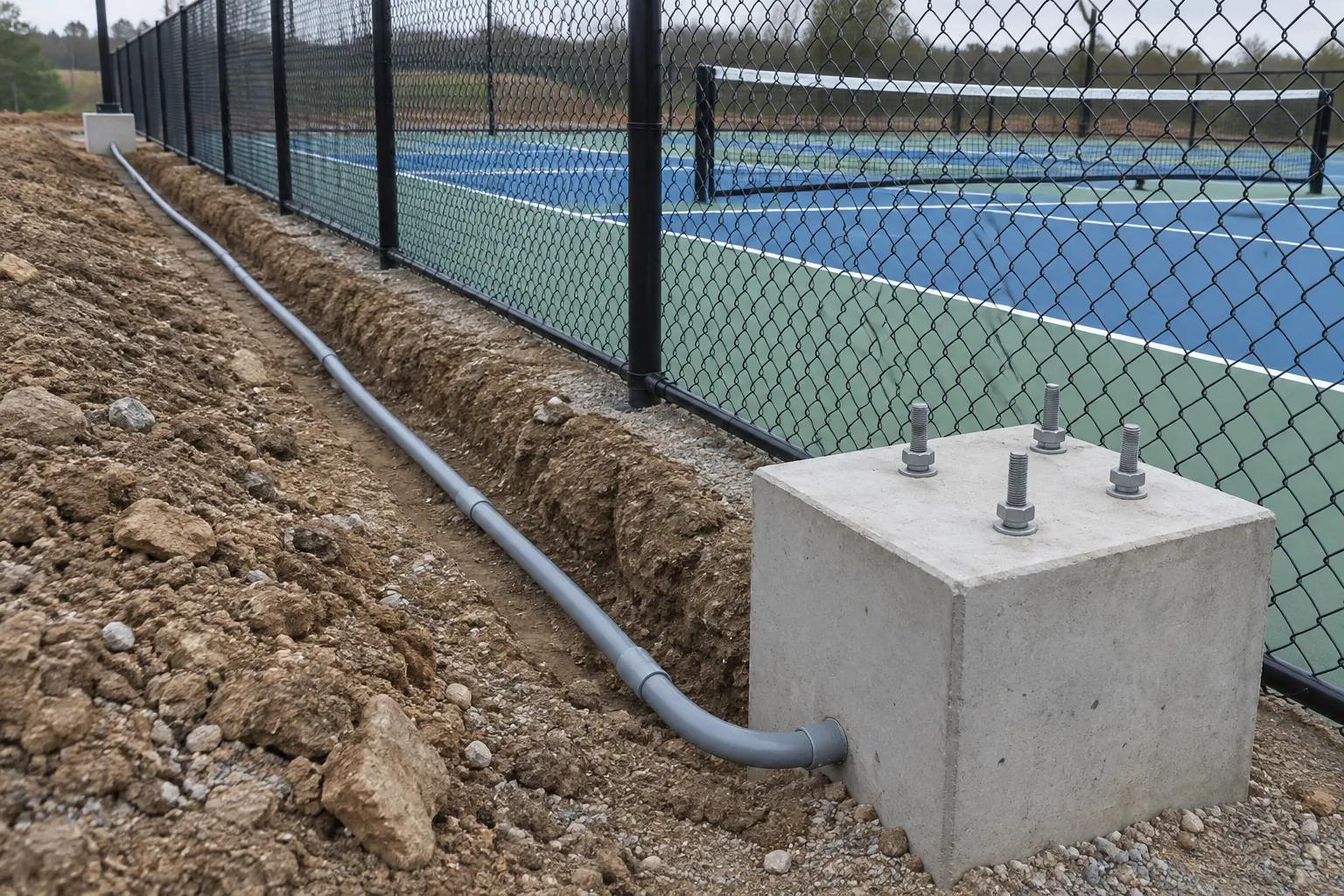
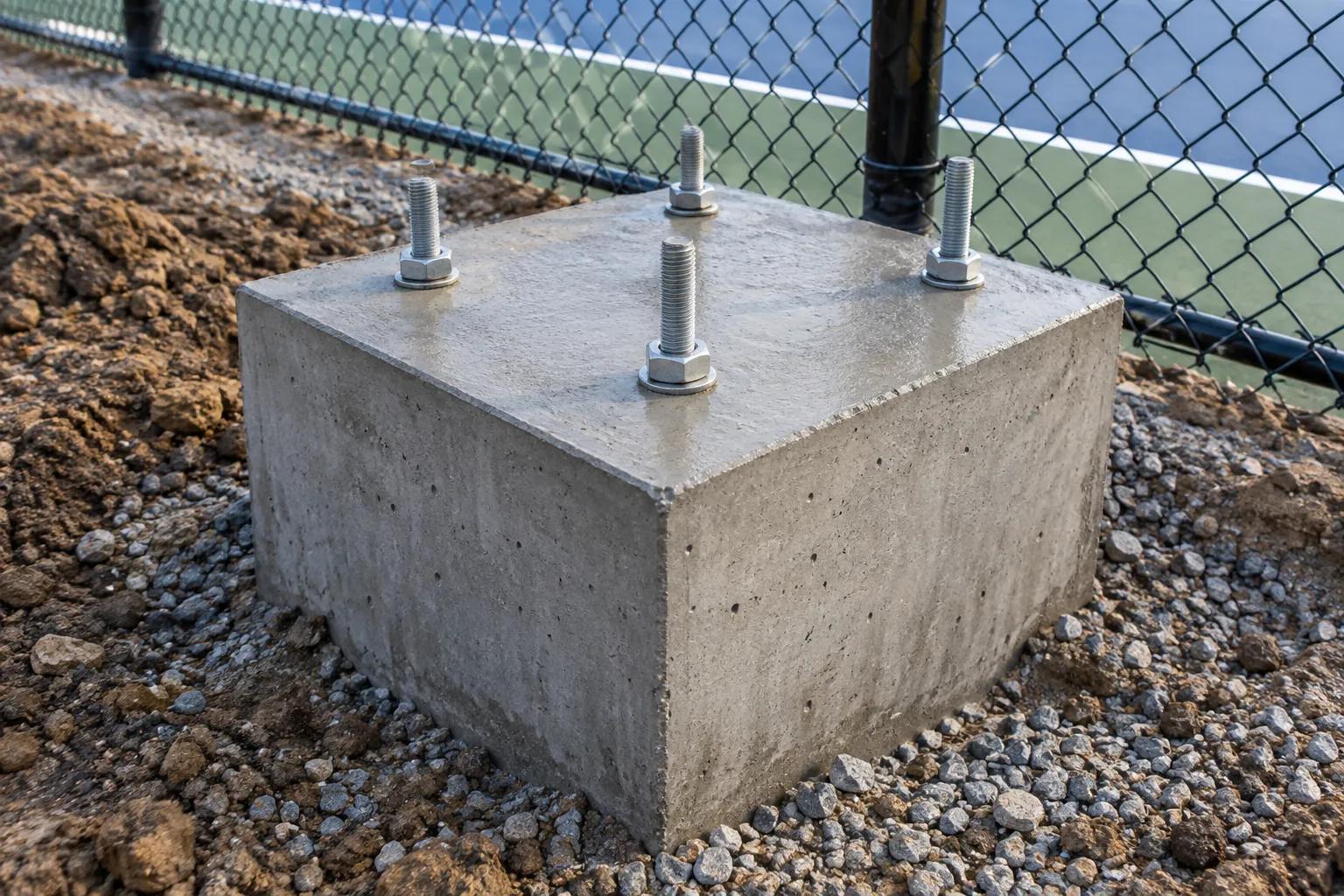
Ask whether poles are anchor-bolt or direct burial. Direct burial might cost less. Anchor-bolt base plates let poles be straightened or replaced without new foundations, and footings can go in before poles and fixtures arrive. For wiring, the manual notes 120/208 V single-phase for smaller installations and 277/480 V three-phase for larger ones, run underground outside the court. Ask for each court or bank on its own switch, so a club lights only the courts that are booked.
IP, IK and the 100,000-hour claim
Test labs summarise IEC 60529 this way: IP66 means dust-tight and protected against powerful jets from a 12.5 mm nozzle at 100 L/min. The water digits are not cumulative past 6: an IP67 fixture passed an immersion test and is not automatically rated for jets. Impact is a separate code. Under IEC 62262:2002+AMD1:2021, test labs list IK08 at 5 J, IK09 at 10 J and IK10 at 20 J. The manual lists fixture protection among indoor lighting variables. Ask for both codes with the test reports.
Lifetime is where quotes stretch most. IES Position Statement PS-10-18 (9 October 2018) limits TM-21 projections to 6 times the LM-80 test hours: 10,000 hours of data never supports more than 60,000 hours. A 100,000-hour claim therefore needs at least 16,667 hours of LM-80 data. The statement also says TM-21 covers the LEDs, not the whole luminaire, so the driver and housing need their own warranty terms in writing. Ask for the LM-80 report hours and the ANSI/IES TM-21-21 calculation.
Lead time: what sets it and what to ask
A single lead-time figure hides the stage that slips. Ask for weeks per stage: photometric design and approval, fixture production, pole fabrication, freight, and installation. Pole design follows the local wind-load code, so it depends on the site. Anchor-bolt footings let the civil work proceed while poles are still in production, which is the one schedule lever the manual names.
The same rule applies to the court equipment we make. We have not published standard lead times for balls or nets here. Ask us, or any supplier, for production and freight as separate lines and for the MOQ per SKU. Quantities per court are worked through in our club fit-out sourcing guide.
For clubs and facility buyers ordering outdoor 40-hole tournament balls in bulk, with MOQ and lead time quoted per SKU.
See the outdoor tournament ballFrequently asked questions
What are the lighting requirements for a pickleball court?
The ASBA and USA Pickleball construction manual recommends an average maintained horizontal level of 30 fc (300 lux) for Category III, 50 fc (500 lux) for Category II and 75 fc (750 lux) for Category I, with max:min uniformity of 2.0, 2.0 and 1.7. Those figures are from the 2020 edition table; the 2023 edition is current, so have your designer confirm them.
How many lumens does a pickleball court need?
Lumens measure what a fixture emits, not what lands on the court, so a lumen total cannot be checked against any recommendation. Specify maintained foot-candles or lux over the Primary Playing Area, which is 24 ft by 48 ft for one court, and compare the suppliers' point-by-point layouts.
What is the best type of lighting for a pickleball court?
LED, which the ASBA and USA Pickleball manual expects the majority of new lighting to be. Keep the colour temperature between 3800K and 5000K, since sources above 5000K have a bluish tint, and keep fixtures off the court lines.
How long do LED pickleball court lights last?
Only as long as the test data supports. Under IES Position Statement PS-10-18, a TM-21 projection may not exceed 6 times the LM-80 test hours, so a 100,000-hour claim needs at least 16,667 hours of LM-80 data. The projection covers the LEDs, not the driver or the housing.
Conclusion: the order to work in
- Pick the category from the highest level of play and the age of your players.
- Send every supplier the eight-line sheet and ask for a point-by-point layout over the PPA.
- Reject initial-only figures; ask which LLF was used.
- Check the lifetime claim against the LM-80 hours.
- Get lead time in weeks per stage before comparing prices.
Want to source this quality for your brand?
Contact our factory directly on WhatsApp for an instant MOQ and pricing quote.