What Is PBCoR? USA Pickleball's 0.43 Paddle Power Limit
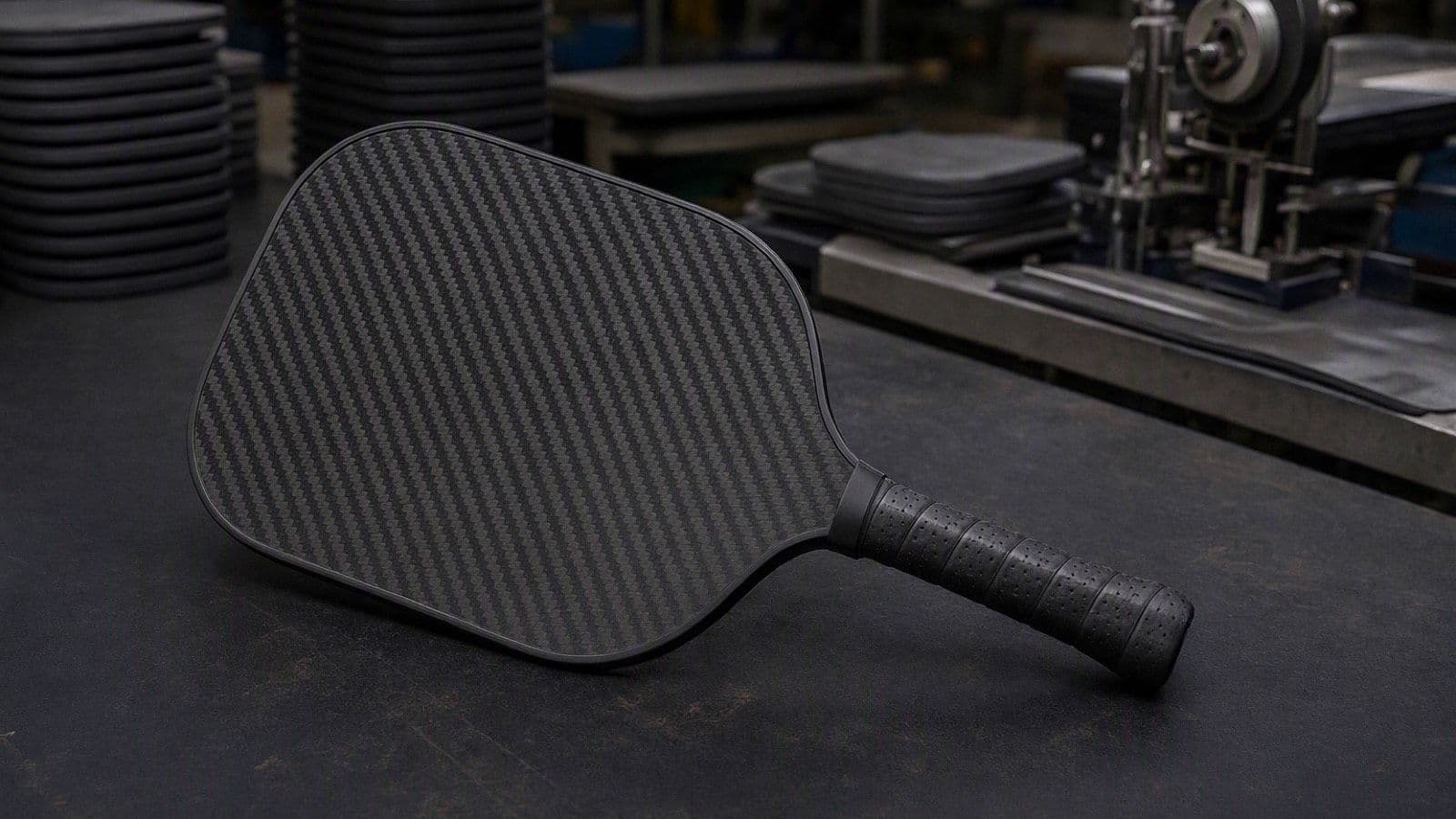
PBCoR stands for Paddle-Ball Coefficient of Restitution, and it is the dynamic test USA Pickleball uses to put a number on how much a paddle springs the ball back. The limit you have to build under right now is 0.43, and it took effect on November 1, 2025. Anything above it fails, and a paddle that fails does not get a lesser grade — it is not approved for sanctioned play.
If you are reading this because a factory has told you your design "will not pass PBCoR," the useful thing to understand is that the test replaced a much older, much simpler one, and it replaced it for a reason that says a lot about how paddles are now built. This page covers what the number measures, how the measurement is physically taken, why USA Pickleball moved off the deflection test, and what the standard changed about paddle construction. Test readings, headroom margins and pre-screening costs are a separate subject and are not covered here.
Key takeaways
- The current limit is 0.43, effective November 1, 2025. It replaced a 0.44 limit that ran from November 1, 2024.
- The test is dynamic, not static. A ball is fired at the paddle at 60 MPH from an air cannon and PBCoR is derived from its inbound and outbound speeds.
- 0.43 does not mean "the paddle returns 43% of ball speed." That shortcut is repeated widely and it is wrong.
- The old deflection test was a static 3-point beam stiffness test whose boundary conditions ignored the paddle's outer frame — which is exactly where modern constructions get their power.
- A sample passing is not an order passing. There is a public case of beta samples clearing the test and production paddles failing it.
- A spin rate test is scheduled for October 1, 2026, with a limit under 2,100 RPM for paddles certified after that date.
On this page
- What PBCoR Actually Measures
- How the PBCoR Test Is Run
- Why 0.43 Is Not the Same as 43% of Ball Speed
- Why USA Pickleball Retired the Deflection Test
- What the Step From 0.44 to 0.43 Changed
- How PBCoR Changed the Way Paddles Are Built
- When a Sample Passes and Production Does Not
- What Comes After PBCoR: The Spin Rate Test
- The Short Version

What PBCoR Actually Measures
A coefficient of restitution describes how much speed survives a collision. Drop a ball on concrete and it comes back up lower than it started; the fraction that survives is the coefficient. PBCoR applies that idea to the specific collision that matters in pickleball — a ball meeting a paddle face — and returns a single number for how lively that particular paddle is.
USA Pickleball introduced the test to enforce a rule that already existed. Rule 2.E.6.f prohibits "Springs or spring-like material, flexible membranes or any compressible material that creates a trampoline effect." That wording had been on the books for years, but it described an effect without providing any way to measure it. Manufacturers confirmed their paddles did not create a trampoline effect, and that confirmation was largely what the rule rested on. PBCoR turned a qualitative prohibition into a threshold with a decimal point.
That matters more than it sounds. A rule you cannot measure is a rule that gets argued about. A rule expressed as 0.43 either passes or does not, and USA Pickleball has been explicit that paddles exceeding the threshold are in violation of 2.E.6.f and are decertified.
How the PBCoR Test Is Run
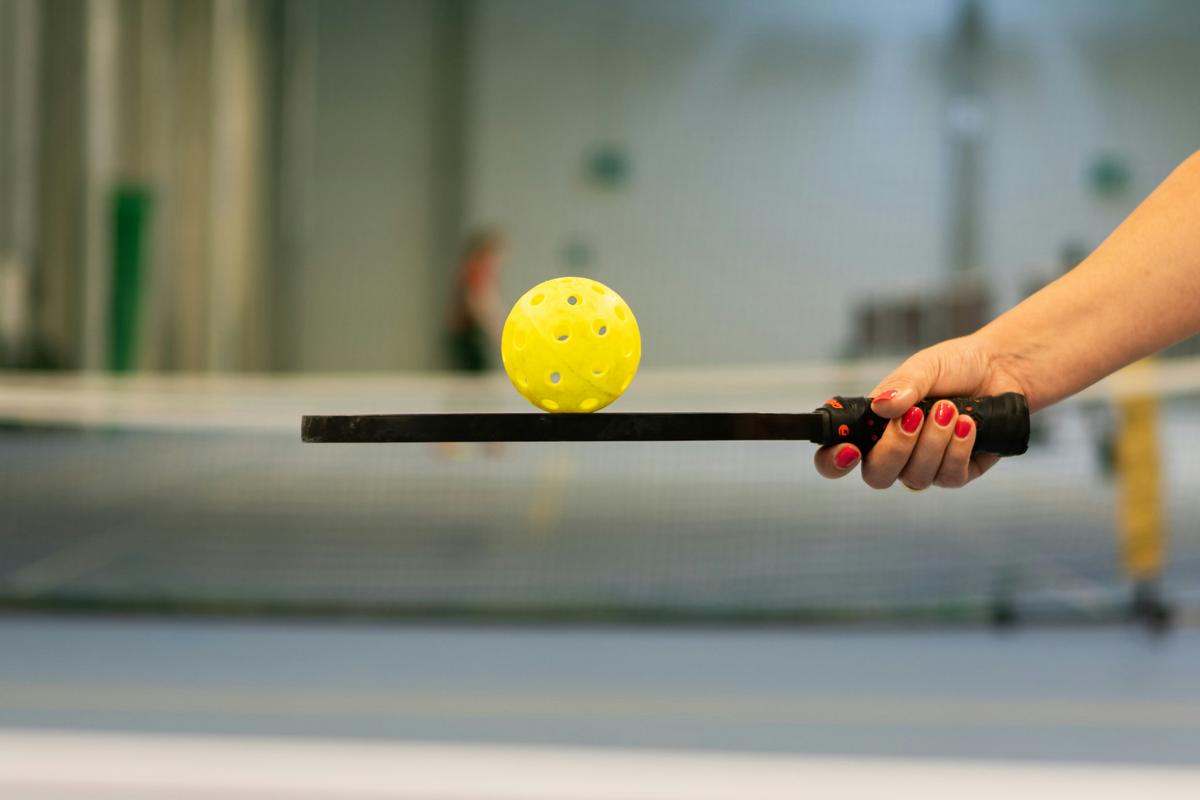
The paddle is clamped in a rig and held firmly during the shot, with the grip and end cap removed first. Asked at a January 2025 media day how the paddle is secured, USA Pickleball's chief technology officer answered bluntly that they "just clamp the shit out of it." The fixture is held rigid so the paddle absorbs the impact instead of moving away from it — a reading should describe the paddle, not how far the mount gave.
The same session produced the detail worth carrying into a spec review: no formal study has set an optimal clamping force, and no torque value is specified. USA Pickleball has conceded that handle materials compress differently under a clamp and that this could affect a measurement, without quantifying by how much. For a paddle landing near the limit, that is a reason a result can move between submissions with nothing about the paddle having changed.
An air cannon then fires a ball at the paddle face at 60 MPH. Optical sensors capture the ball's speed on the way in and on the way out, and PBCoR is derived from those two numbers, along with the ball exit speed ratio. Contact lasts on the order of four milliseconds — an engineering estimate rather than a published USA Pickleball figure — and that is the entire window in which a paddle's construction gets to do anything at all.
Two facts about the test are worth knowing before you argue with a result. The method is not homemade: the USAP testing notice states it "is based on a similar test currently used for baseball/softball bats ASTM F2219-14 — Standard Test Methods for Measuring High-Speed Bat Performance." And the testing is not done in-house by the governing body — USA Pickleball has stated that certification testing is performed at Element U.S. Space and Defense, a third-party independent testing site.
What the rig controls for — and what it does not
- A rigid mount, minus the grip and end cap — the paddle is held hard so the fixture does not absorb energy the paddle should be returning.
- A repeatable impact speed — 60 MPH from a cannon rather than a human swing, which no two of are alike.
- Optical speed capture — inbound and outbound measured the same way, so the ratio is not contaminated by a second instrument.
- An established parent standard — the bat-testing method that already survived decades of dispute in another sport.
- Not controlled: the clamping force itself — no torque value is specified and no study has fixed one, which is the method's own acknowledged loose end.
Why 0.43 Is Not the Same as 43% of Ball Speed
Here is a claim you will find on retailer blogs, in paddle reviews, and in more than one otherwise-credible explainer: a paddle at 0.43 returns 43% of the incoming ball speed, so a ball arriving at 60 mph leaves at about 25.8 mph. It is a tidy sentence and it is not correct.
A coefficient of restitution is the ratio of separation velocity to approach velocity for the two objects in the collision — it describes the closing and separating of a pair, not a percentage of one object's speed handed back in the court's frame of reference. The paddle is not a wall. It is a massive object with its own mass and balance properties, and in a real rally it is swinging toward the ball rather than waiting for it. Ball speed off the face in a game is dominated by how fast the paddle is travelling, and the coefficient governs how efficiently that closing speed is converted, not what fraction of the ball's arrival speed is refunded.
So what is the number good for? Comparison. A 0.44 paddle is livelier than a 0.42 paddle under identical conditions, and that is precisely what a governing body needs — a repeatable index that ranks paddles against each other and against a ceiling. Read it as an index of liveliness under a controlled impact, and you will read it correctly. Read it as a speed refund and you will end up predicting exit velocities that no radar gun agrees with.
Worth flagging: if a supplier explains your test result using the "43% of ball speed" shortcut, it is a reasonable signal they are working from secondhand summaries rather than the test protocol. It is a small thing, but on a compliance question it tells you where their information comes from.
Why USA Pickleball Retired the Deflection Test
Before PBCoR, paddle power was policed with a static deflection test that measured the stiffness of the paddle face. Stiffness was used as a stand-in for power on a sensible assumption: a face that flexes less springs the ball less. For years, that assumption held well enough.
It stopped holding, and USA Pickleball's own account of why is unusually specific. Per the USAP testing notice that introduced PBCoR, the deflection test "is based on a static 3-point beam stiffness test, and is best suited for paddles with uniform construction, and does not include any contributions for the way the forces are reacted at an outer frame for the paddle" — its boundary conditions being, in the notice's terms, how the paddle is supported during the measurement. In plain terms: it presses on the middle of the face and reads how much the middle gives. Whatever happens at the edges, in the frame, or in how the face is bonded into that frame is invisible to it.
That blind spot became the entire game. As constructions moved toward thermoformed unibody shells, foam-injected perimeters and stiff edge close-outs, more and more of a paddle's liveliness came from structure the deflection test was not looking at. A paddle could read as perfectly stiff in the middle and still behave like a trampoline in play. The USAP notice concluded that trampoline effects "must be measured inclusive of all structural design details of the paddle face, paddle frame, boundary conditions and edge close-outs, and all non-uniformities in the construction" — which is a list of everything a static midpoint press ignores.
The replacement was not rushed. PBCoR had been in development since December 2023 and was demonstrated to manufacturers at an Industry Day Open House in May 2024 before it took effect that November.
What the Step From 0.44 to 0.43 Changed
PBCoR did not arrive at its current value. It arrived with a schedule, published in the same notice that introduced it.
| Effective date | PBCoR limit | What it applied to |
|---|---|---|
| November 1, 2024 | 0.44 | All paddles submitted for testing after this date |
| November 1, 2025 | 0.43 | The limit in force today |
One hundredth of a point sounds like nothing. It is not nothing when it is a ceiling, because designs cluster underneath ceilings rather than spreading evenly below them. A paddle engineered to sit comfortably under 0.44 is not automatically comfortable under 0.43 — the gap it was designed around just got smaller by the same amount the limit moved, and any unit-to-unit spread it always had is now eating a larger share of what is left.
The date that governs you is the submission date. The requirement as written applied to all paddles submitted for testing after the incorporation point, which is why the calendar matters as much as the number when you are planning a launch. It is also why the two figures still circulate together: paddles certified under the earlier limit and paddles certified under the current one both exist in the market, and a page quoting 0.44 as the live limit is describing the rule as it stood before November 2025.
What players noticed was feel. Lowering a power ceiling compresses the top of the range, which narrows the gap between the hottest paddle available and an ordinary one, and shifts the advantage back toward placement and control. Whether that is good for the sport is an argument with sincere people on both sides. Whether it constrains what a factory can build for you is not an argument at all.
How PBCoR Changed the Way Paddles Are Built
The practical consequence of a test that sees the whole structure is that the paddle can no longer be specified as a stack of independent parts. Under deflection, a brief could reasonably name a face material, a core thickness and an edge treatment as three separate line items, because only one of them was really being measured. Under PBCoR, they are one system, and the number that comes back is a property of the assembly.
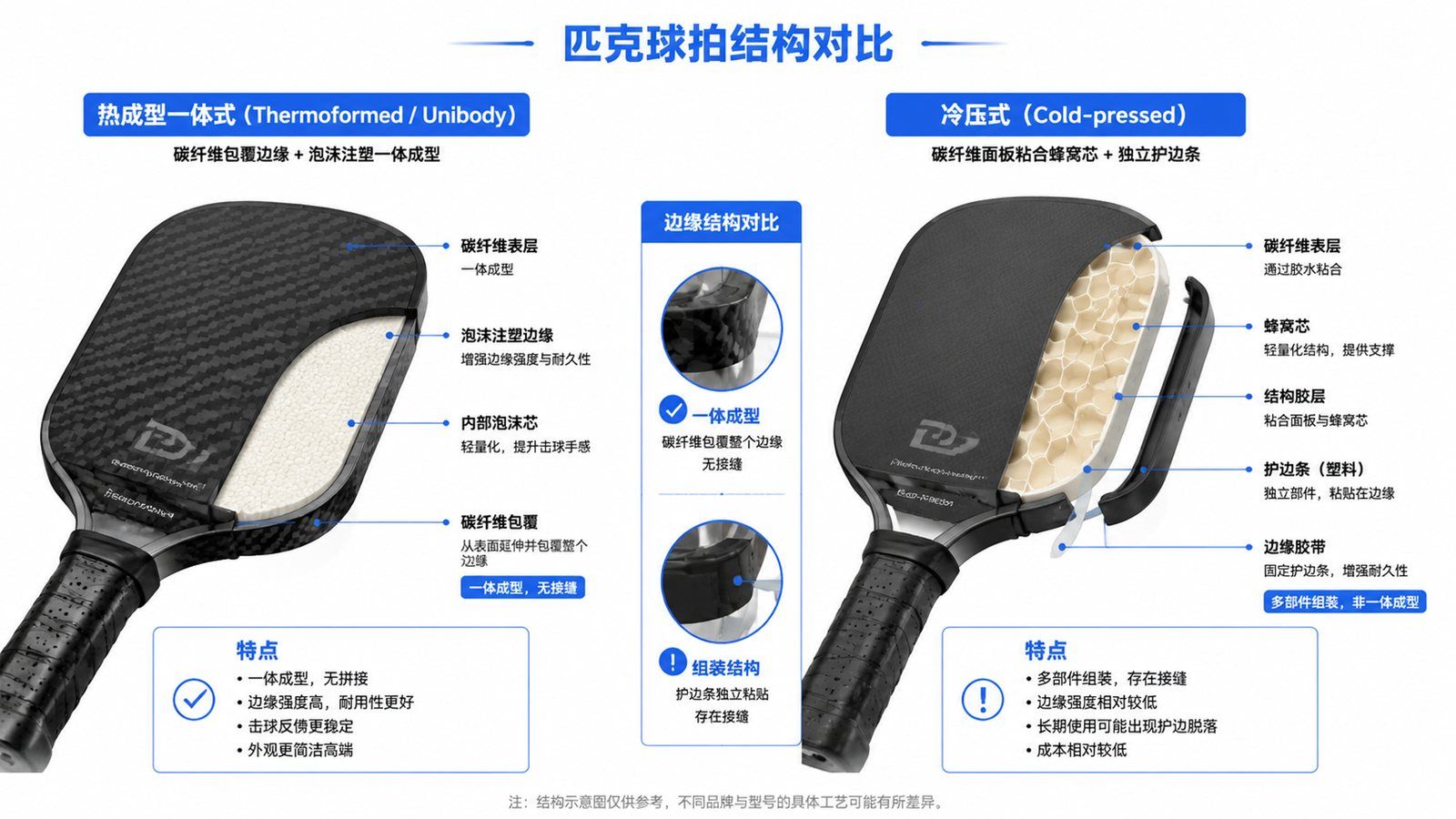
The edge close-out is the clearest example. It used to be treated as trim — the thing that protects the perimeter and carries your logo. In a test that explicitly accounts for how forces are reacted at the outer frame, the close-out is a structural member. Change how the face is bonded into the perimeter, or how much the perimeter is allowed to flex, and you have changed the measured liveliness of the paddle without touching the face or the core at all.
What a PBCoR-aware spec review looks at
Because the test reads the assembly, a spec review that only lists materials will miss the variables that move the number. These are the items worth pinning down in writing before tooling is cut — not because any of them has a published threshold, but because each one changes how the perimeter and the face behave together under impact:
- Construction method — thermoformed unibody or cold-pressed, stated explicitly rather than left to the factory's default.
- Edge close-out — how the face is bonded into the perimeter, treated as a structural decision rather than as trim.
- Core thickness and cell structure — which govern stiffness distribution across the whole panel, not just the feel at the centre.
- Face laminate and layup — the material and how it is laid up, since both change the panel's response.
- What was actually approved — a reference unit that came off the production process, not a hand-built prototype.
Note what is not on that list: a target PBCoR figure. Nobody outside the certifying lab can tell you what a given build will read, and any supplier who quotes you a number before a test has been run is guessing.
This is why a brief written from face and core alone tends to produce surprises. Two builds with an identical raw carbon face on an identical honeycomb core can land in different places, because the thing separating them is the perimeter construction and the bond line, and neither of those usually appears on a spec sheet. The same logic applies to core thickness: it changes stiffness distribution across the whole panel, not just the feel in the middle. If you are choosing between constructions, our comparison of thermoformed and cold-pressed paddle construction covers where those two routes actually diverge, and honeycomb cell size covers the core variable most briefs leave blank. On the factory side, this is why an OEM paddle programme works from face, core and construction method together rather than treating them as separable choices.
For brand-side buyers and procurement leads specifying a build rather than picking one off a shelf: our OEM page sets out the face options (raw T700 carbon and fiberglass), the 13mm and 16mm polypropylene honeycomb cores, and the choice between thermoformed unibody and cold-pressed construction — the three decisions that together determine how a paddle behaves under impact.
See the construction optionsWhen a Sample Passes and Production Does Not
The failure mode that costs brands the most money is not a design that misses the limit. It is a design that clears it on the bench and misses it in the factory.
There is a well-documented public case. Ronbus submitted paddles for initial PBCoR testing that were beta samples rather than final production units. When production paddles were tested for final certification, they did not pass, and all previous versions of that model were removed from the USA Pickleball approved database effective July 1, 2025. The design was not the problem in the sense a designer would recognise — the problem was that the thing tested and the thing manufactured were not the same object.
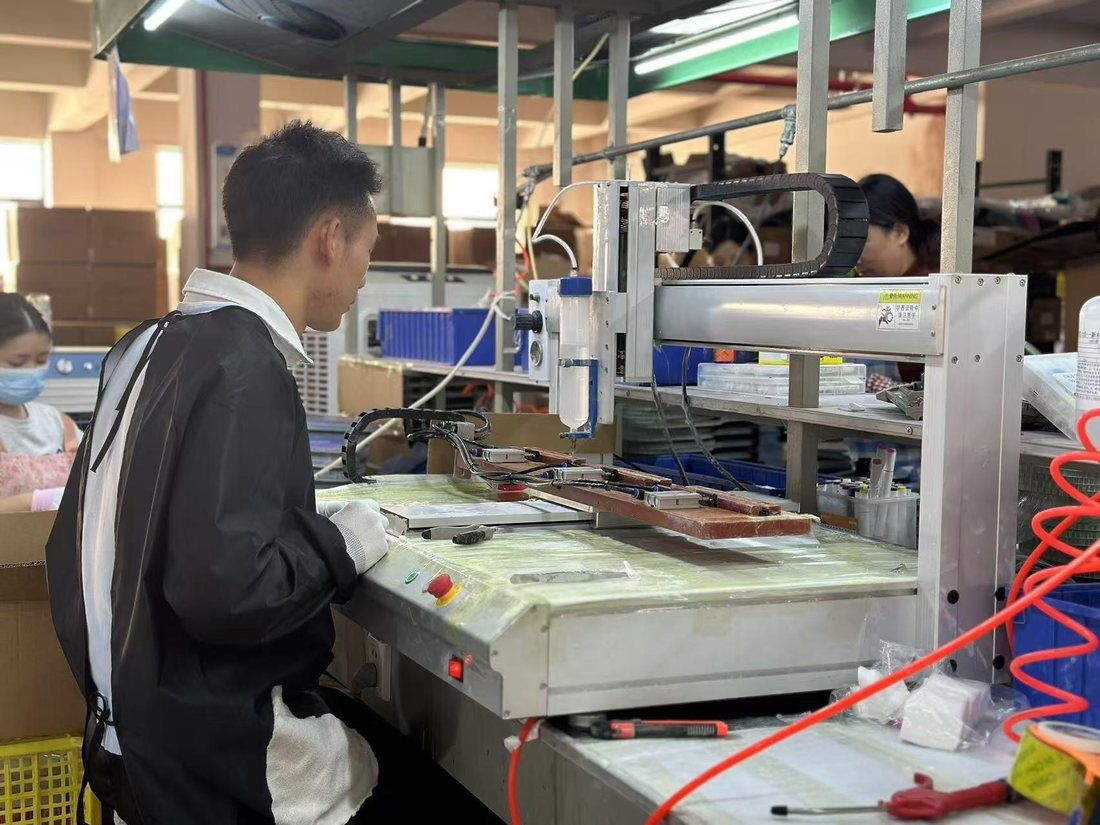
That gap is easy to open without anyone acting in bad faith. Hand lay-up on a prototype is not the same process as a production press. Resin content drifts. A bond line that a technician made carefully once gets made a thousand times on a schedule. Every one of those variations touches exactly the structural details PBCoR was designed to notice, which is the entire point of a test that looks at the whole assembly instead of the middle of the face.
USA Pickleball has also described giving extra scrutiny to paddles that sit near a ceiling — what was reported at a media briefing as the "10% Club," paddles performing within 10% of a maximum allowable specification, which receive additional screening including teardown inspections. Treat that as reported practice rather than published clause, but the direction of travel is clear enough: sitting close to a limit invites attention, and it invites it at exactly the moment a delisting is most expensive.
The consequence is not a warning letter. Decertification removes the paddle from sanctioned play, and stock already manufactured does not become compliant because it was made before the decision. If you are working out which mark you actually need in the first place, our comparison of USAPA, UPA-A and IFP certification sets out what each one governs and where they diverge. How a factory holds production to the approved unit — what gets re-checked, how often, and at what cost — is a longer subject than this page can carry honestly.
What Comes After PBCoR: The Spin Rate Test
PBCoR is not the end of the programme, and anyone planning a paddle launch this year should know what is already on the calendar.
A spin rate test is scheduled to take effect on October 1, 2026, with paddles certified after that date required to measure under 2,100 RPM. Measurement is by a dual-camera system supplied by Image Systems. As things stand it applies to paddles certified after that date rather than retroactively, so existing certifications are not being reopened by it.
This was not a surprise addition. The same 2024 notice that introduced PBCoR stated that USA Pickleball would also implement a dynamic test for spin rate measured in RPM, with details to follow in a separate rulemaking. The pattern is the one PBCoR already established: a rule expressed in words, then an instrument that turns it into a threshold, then a date.
Which suggests the right way to read all of this. The specific numbers will keep moving — 0.44 became 0.43, and a spin ceiling arrives this October. What is stable is the direction: performance attributes that used to be described qualitatively are being converted into measured limits, one at a time, and each conversion catches constructions that were quietly exploiting the absence of a measurement.
The Short Version
PBCoR is the dynamic test that measures how much a pickleball paddle springs the ball back, the limit is 0.43 as of November 1, 2025, and it exists because the static deflection test it replaced could not see the frame and edge structure where modern paddles get their power. It is measured with a 60 MPH air cannon against a clamped paddle at an independent lab (Element U.S. Space and Defense), and it is not a percentage of ball speed returned, whatever the summaries say.
The risk worth leaving with is the one that does not show up in a design review. Every number on this page describes a paddle that was tested. Your obligation is to the paddle that ships, and the public record already contains a case where those were different objects and the brand lost the listing. Approve against the unit that comes off the production process, not the one that was made to impress you.
Frequently Asked Questions
What does PBCoR stand for?
Paddle-Ball Coefficient of Restitution. It is USA Pickleball's dynamic test for how much speed survives the collision between ball and paddle, used to enforce the rule against a trampoline effect.
What is the current PBCoR limit?
0.43, effective November 1, 2025. It replaced the 0.44 limit that applied from November 1, 2024. Sources still quoting 0.44 as current are describing the earlier rule.
How fast is the ball fired in the PBCoR test?
Typical test speed is 60 MPH from an air cannon. Inbound and outbound ball speeds are captured optically and used to derive the PBCoR value.
Does PBCoR 0.43 mean the paddle returns 43% of the ball's speed?
No. A coefficient of restitution is separation velocity divided by approach velocity for the colliding pair, not a share of one object's speed handed back. Treat it as an index for comparing paddles under identical test conditions.
Why did USA Pickleball replace the deflection test?
The deflection test is a static 3-point beam stiffness measurement whose boundary conditions ignore how forces are reacted at the paddle's outer frame. Modern constructions draw power from exactly that region, so stiffness stopped predicting power.
Can a paddle be delisted after it was approved?
Yes. Paddles exceeding the threshold are in violation of rule 2.E.6.f and are decertified. In one public case, production units failed after beta samples had passed, and the model was removed from the approved database.
What is the spin rate test and when does it start?
A dynamic test scheduled for October 1, 2026, requiring paddles certified after that date to measure under 2,100 RPM, using a dual-camera system from Image Systems.
What is the minimum order quantity for custom paddles?
The published paddle minimum is 50 pieces. Certification-related costs such as submission fees and sample counts are set by USA Pickleball rather than by a factory, so confirm those directly with them.
Want to source this quality for your brand?
Contact our factory directly on WhatsApp for an instant MOQ and pricing quote.