The 2026 Pickleball Equipment Market: Five Shifts a Factory Sees First
The pickleball equipment market cannot agree on its own size. One B2B platform puts the 2024 paddle market at USD 520 million, growing at an 8.9 percent CAGR. One analyst house prices the entire 2024 equipment market at USD 71.47 billion. Those two figures sit more than two orders of magnitude apart, and both are for sale as reports. Nobody should cut tooling on that foundation.
What survives scrutiny is narrower and duller. SFIA, the US sports and fitness trade association, publishes measured wholesale sell-in by category, and pickleball led every category it tracks in 2025. USA Pickleball publishes the rule text it actually enforces. Marketplaces publish sales counts with a named measurement firm behind them. This page builds only on those three kinds of evidence, and it reads the 2026 market as five shifts. Each one carries a direction, a mechanism, and a consequence for anyone about to place an order. Where the argument is inference rather than measurement, the text says so plainly, because a supplier-side read that invents its evidence is worth less than the analyst PDFs it mocks.
Key takeaways
- The power arms race hit a rulebook ceiling. The PBCoR Not-To-Exceed limit is 0.44 since November 1 2024 and drops to 0.43 on November 1 2025, per the USA Pickleball Equipment Standards Manual.
- Measured demand is still growing. SFIA category reporting puts US pickleball equipment wholesale sell-in at USD 409.7 million for 2025, up 22 percent year over year, the fastest-growing category tracked.
- Foam-wall, thicker-core builds are becoming the default. Labelled inference from the trampoline clause and the falling PBCoR ceiling; it matches what listings now sell on.
- Quiet play is now a specifiable attribute. USA Pickleball's Quiet category requires at least 50 percent noise reduction and covers paddles, balls, covers and court barriers.
- Balls are the reorder category. 2025 US ball wholesale reached USD 116.9 million, up 17.3 percent — roughly 40 percent of paddle wholesale value.
- Geography moved. Vietnam marketplace sales hit about USD 20 million in H1 2025, roughly 13 times a year earlier, per Metric.vn data reported by trade press.
On this page
- What a Factory Sees That the Analyst Reports Miss
- Shift 1: The Power Arms Race Hit a Rulebook Ceiling
- Shift 2: Foam Walls and Thicker Cores Became the Default Build
- Shift 3: Quiet-Play Specs Graduated From Niche to Line Item
- Shift 4: Balls Became the Reorder Category, Not the Accessory
- Shift 5: The Geography of Demand Moved
- What Stopped Moving
- What This Means If You Are About to Place an Order
- Conclusion
- Frequently Asked Questions
What a Factory Sees That the Analyst Reports Miss
The analyst-report pattern is stable. A CAGR, a forecast horizon, a key-players list, and no mechanism. Coverage of this market names Selkirk Sport, Paddletek, ONIX, Head, Gamma Sports, Prince, Wilson Sporting Goods and Babolat among the key players. That is a useful map of the brand field. It tells you nothing about which constructions will pass a compliance test next season, or why balls are reordering faster.
The reason is simple. Those reports are written for investors pricing companies, not for buyers pricing programmes. Their unit is projected revenue. The unit a sourcing decision runs on is different. It is a rebound limit that moves on a fixed date, a category that reorders quarterly, and a destination market with its own approval gate. Sell-in data and rule text carry that information. Forecasts do not.
So this page discloses its inputs. Demand numbers come from SFIA category reporting, which measures wholesale sell-in rather than projecting it. Rule facts come from the USA Pickleball Equipment Standards Manual, January 2025 edition, quoted by clause. Geography numbers come from named marketplace analytics. What the page refuses to claim matters as much: no order-book percentages, no enquiry-mix statistics, no "our customers tell us" stories. This site publishes no order book, so the factory vantage here means labelled, industry-wide inference — what factories supplying this market can read off public evidence. The table below maps the five shifts before the detail starts.
| Shift | Direction | Anchor evidence | Sourcing question it raises |
|---|---|---|---|
| Power ceiling | Performance headroom shrinks | PBCoR limit 0.44 to 0.43, Nov 2025 | Where is your compliance margin? |
| Default build | Toward foam walls, thicker cores | Trampoline clause plus enforcement | Ask for test evidence, not words |
| Quiet play | Niche to line item | USAP Quiet category, 50 percent-plus cut | Can noise go into the spec? |
| Balls | Accessory to reorder category | USD 116.9M sell-in, +17.3 percent | Is consistency a PO clause? |
| Geography | Beyond the US core | Vietnam marketplace about 13x YoY | Which gates does the destination impose? |
Shift 1: The Power Arms Race Hit a Rulebook Ceiling
For three years the paddle arms race had one direction: hotter faces and faster ball exits. The rulebook has now put a ceiling on exactly that property. PBCoR — the pickleball coefficient of restitution — measures how much ball speed a paddle returns. The test fires a ball from an air cannon at roughly 60 mph into a clamped paddle and derives the coefficient from the inbound and outbound speeds.
The limit moves on a published schedule. The Equipment Standards Manual sets a Not-To-Exceed value of 0.44 effective November 1 2024, reduced to 0.43 effective November 1 2025. That is a quote from the manual's PBCoR block, not a paraphrase. Every paddle sold for sanctioned play now sits under a number that gets smaller.
Enforcement gave the number teeth. When USA Pickleball pulled the JOOLA Gen 3 line, buyers were left holding unsanctioned equipment. JOOLA offered refunds and filed a USD 5 million lawsuit against USA Pickleball. The delisting language cited an excessive trampoline-like effect. The message to every factory and brand was identical: the approval list is revocable, and the edge of the limit is not a safe place to park a product line.
Screening has tightened around that edge. USA Pickleball has said paddles performing within 10 percent of the maximum allowable specification face extra screening, and one documented failed sample measured above 0.44. At the professional level, the UPA-A runs a parallel standard. It caps a Paddle Efficiency Factor at 0.385, with an interim tolerance of 0.405 until March 1 2026.
The sourcing consequence is the shift itself. Paddle briefs now start with the compliance ceiling and work back toward performance, not the reverse. Compliance headroom belongs on the spec sheet as a line item, because a design that passes at the edge of 0.43 has less future than one that passes with margin. Our explainer of the PBCoR standard breaks down the rule, and the PBCoR testing guide covers how a paddle actually gets measured.
Shift 2: Foam Walls and Thicker Cores Became the Default Build
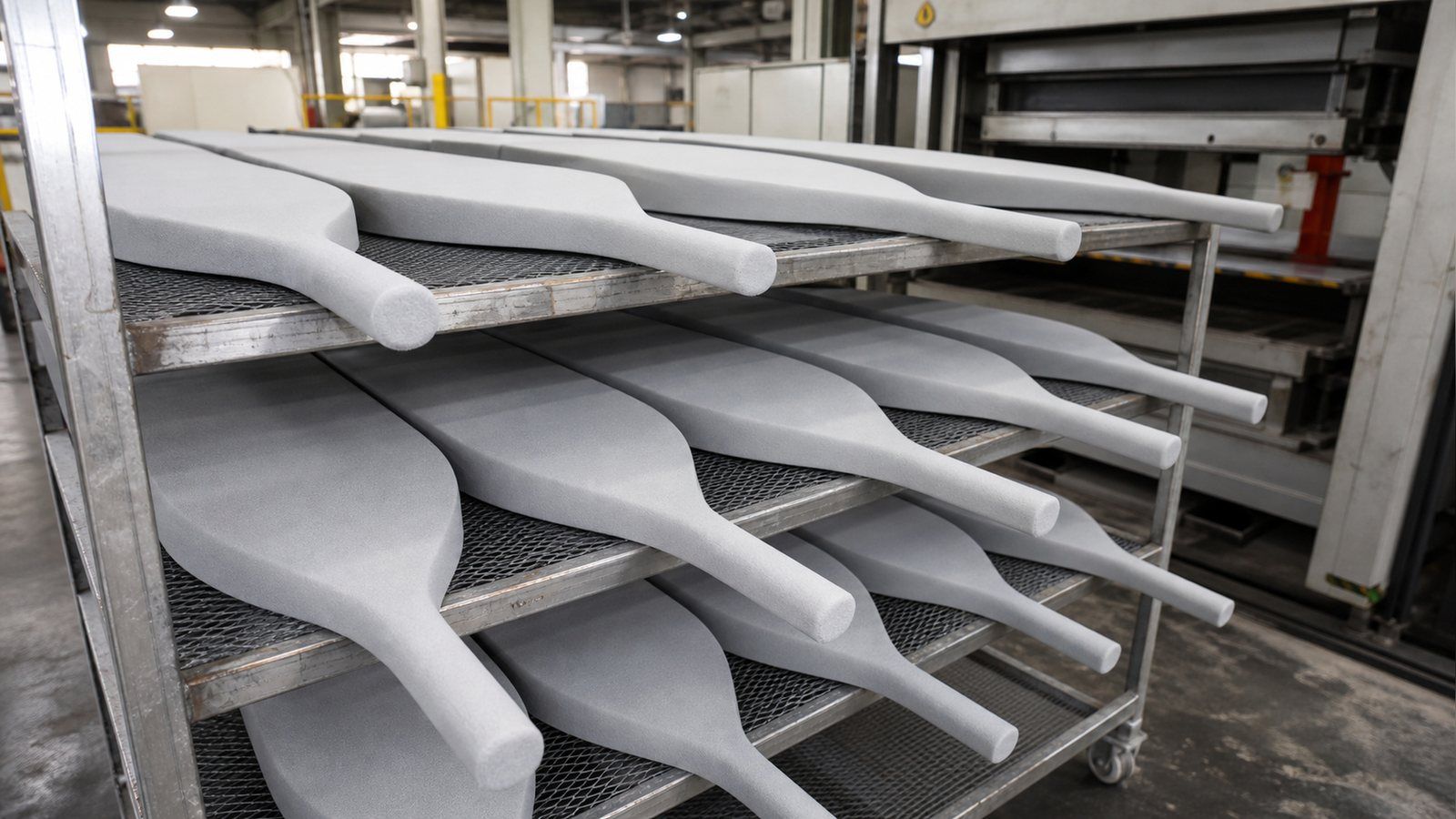
Rules do more than forbid things. They pull design in directions. Clause 2.E.6.f of the Equipment Standards Manual subjects springs, spring-like material, flexible membranes and any compressible material that creates a trampoline effect to coefficient-of-restitution compliance testing. Read that clause against a falling PBCoR ceiling and an engineering direction becomes visible. This is industry inference, not a shipment statistic, so it is labelled as such: the rules push construction toward perimeter foam walls and thicker cores.
A thin-face, hot-core build is exactly the design that clause describes and that the ceiling punishes. Foam perimeter walls stiffen the edge while the face works within the limit. Thicker cores give the ball a longer, more controlled dwell — in our reading of current retail and B2B listings, 16-millimetre builds now appear as a selling feature where thinner cores were once standard; that is a labelled listing observation, not shipment data. Raw-carbon, thermoformed faces are the paired trend, because they deliver stiffness without trampoline.
The buyer-facing consequence: construction claims now need test language attached. "Foam wall" and "thermoformed" describe geometry and process, not compliance. A supplier quoting those words should also say where the design sits against the 0.43 ceiling and what evidence exists. The site's breakdown of gen-3 foam-wall paddles covers what the construction changes in play and in testing.
Shift 3: Quiet-Play Specs Graduated From Niche to Line Item
Noise is the constraint the equipment market cannot engineer around forever. Court restrictions in residential areas, complaints, limited play hours — the backlash has run for years across US communities. The sport's governing body answered with an equipment definition rather than a zoning argument.
USA Pickleball created a formal Quiet category. To qualify, equipment must cut noise by at least 50 percent against commonly used community equipment. The category covers paddles, balls, paddle covers and court noise barriers, with published test-fixture requirements and procedures. Announced in late 2023, it gave manufacturers something that did not exist before: a definition.
That definition is what turns a marketing word into a specifiable attribute. "Quiet" on a listing meant nothing measurable. A 50-percent threshold with a named test fixture can go into a purchase order, an inspection plan and a claims file. Our reading: quiet-play moves from niche accessory to a line item in standard catalogues. That is labelled inference from the existence of the standard, not a sales figure.
For buyers serving residential courts and noise-restricted venues, the practical step is treating acoustic performance like any other measured spec. The site's guide to sourcing quiet pickleball paddles for HOA settings walks through what to ask a factory before believing the word quiet.
Shift 4: Balls Became the Reorder Category, Not the Accessory
The sell-in data buries the old view of balls as a checkout add-on. SFIA category reporting puts 2025 US ball wholesale at USD 116.9 million, up 17.3 percent year over year. Paddle wholesale reached USD 292.8 million, up 24 percent. Do the division: a consumable generates roughly 40 percent as much wholesale value as the durable good it gets hit with.
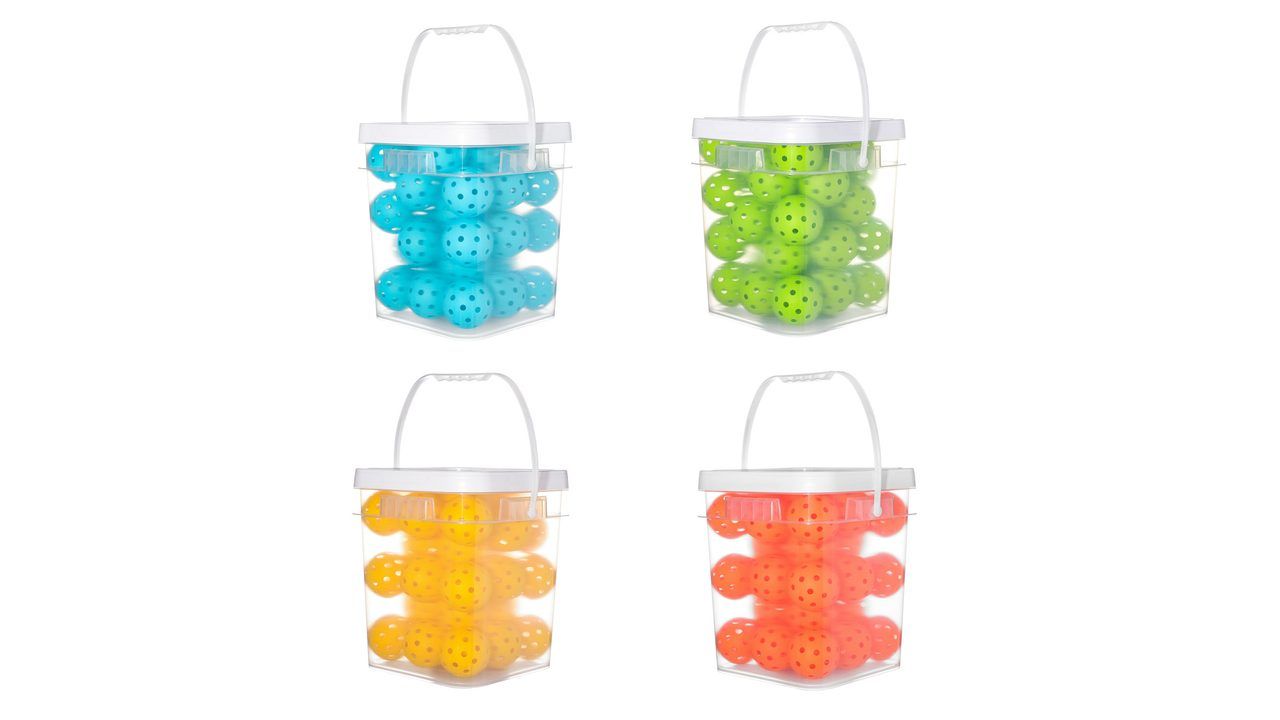
The mechanism is wear, not fashion. A paddle lasts a player for seasons. A ball loses its playing spec within weeks of club play, by common player experience rather than any published study, and facilities burn through stock faster than any retail attach rate explains. Larger pack formats have followed the demand, with multi-packs and large-format containers moving where single sleeves once did.
The sourcing consequence lands in the purchase order. If balls are a reorder category, consistency is the attribute that protects the reorder. Roundness, weight, bounce uniformity and seam integrity become inspection clauses rather than afterthoughts, because a batch that plays differently from the last one cancels the repeat purchase. The site's guide to buying pickleball balls in bulk sets out the spec language that belongs in the PO.
Shift 5: The Geography of Demand Moved
The US remains the centre of the pickleball equipment market, and it institutionalised. SFIA reporting puts 2025 equipment wholesale sell-in at USD 409.7 million, up 22 percent, the fastest-growing category in its manufactured-goods sales report. Participation keeps feeding it. SFIA's topline counted 19.8 million US players in 2024, up 45.8 percent year over year and 311 percent over three years. Casual players made up 13.6 million of that total; core players made up 6.2 million. Coverage of the subsequent SFIA topline reports 24.3 million players for 2025, a rise of roughly 22.7 percent. Paddle wholesale alone, USD 292.8 million, now outsells tennis equipment wholesale, which SFIA reporting puts at USD 287 million and growing 2.8 percent.
Southeast Asia moved from zero to measurable. In Vietnam, marketplace analytics firm Metric.vn tracked pickleball sales of roughly VND 511 billion, about USD 20 million, in the first half of 2025. The figure covers Shopee, TikTok Shop, Lazada and Tiki, and was reported by trade publication Sealark. That is roughly 13 times the same period a year earlier. The first quarter alone ran 19 times year on year. Some 2.4 million items sold, with the dominant price band under VND 1 million. Read those numbers as reported marketplace data, not an audited market size — but the direction is not ambiguous.
Europe presents a different signal: formalisation rather than a headline number. The measurable movement is regulatory, with compliance gates like the EU's General Product Safety Regulation sorting opportunistic imports from committed programmes. We treat that as labelled inference. We found no EU growth figure worth printing, and this page does not fill gaps with invented ones. For what the European gate actually requires of a paddle importer, the site's compliance guide for pickleball imports covers the obligations that now separate serious entrants from the rest.
What Stopped Moving
A market read is incomplete without the negative space. Two categories look to be losing momentum. Both calls are directional reads from the evidence above, not measured declines.
First: raw-power builds parked at the rule limit. The design philosophy behind the Gen 3 era — maximum rebound, compliance second — got delisted rather than developed. Extra screening within 10 percent of the ceiling means the edge of the limit is now an enforcement zone, not a product position. Factories still quoting maximum pop as the headline feature are quoting yesterday's brief.
Second: generic starter sets built for first-timers who never return. The participation base tilts toward repeat play. Core players — the segment that plays often and replaces gear — numbered 6.2 million in 2024, against 13.6 million casual players. The three-year participation curve says the base keeps compounding. Repeat buyers buy better, not cheaper. That is inference from the casual-core split, offered as such.
The honest caveat: these calls matter when you commit tooling money. No decline percentage appears here, by design. A number without a source would be the same fabrication this page accuses the analyst reports of.
What This Means If You Are About to Place an Order
The five shifts reduce to five questions on a sourcing checklist.
- Compliance headroom. Where does the build test against the 0.43 PBCoR ceiling, and what documented evidence ships with it?
- Construction evidence. Do foam-wall and core-depth claims carry test language, or just words?
- Quiet spec. Does the programme need a measurable noise position, and can the factory document one?
- Ball reorder cadence. Is consistency written into the PO as an inspection clause?
- Destination rules. Which approval and compliance gates does the destination market impose?
None of the five requires a leap of faith, because none relies on our say-so. Each maps to public evidence you can check yourself: clause numbers in the manual, SFIA's reported categories, named marketplace analytics. If a supplier resists documenting any of them, that resistance is itself information.
Some buyers will want those questions answered against real construction options: face materials, core depths, thermoformed versus cold-pressed builds. The site's OEM capability overview lays out what a factory programme like ours covers.
The next decision after the market read is the tier ladder: which SKUs carry the entry mix, which carry the compliance-forward mid-tier, and which carry the premium build. The walkthrough of building a good-better-best private-label catalogue picks up exactly there.
Conclusion
The 2026 pickleball equipment market is still growing by the only measure this page trusts: measured wholesale sell-in. Rules, not hype, are reshaping it. The power ceiling fell, construction followed, quiet became specifiable, balls became a reorder line, and demand moved geography. That is the whole read.
- Plan paddle programmes around the 0.43 PBCoR ceiling and documented headroom, not around pop claims.
- Treat foam-wall, thicker-core builds as the emerging default, and require test evidence with the construction words.
- Put ball consistency into the PO, because USD 116.9 million of annual wholesale says the reorder is the business.
- Match each destination market to its gate: USAP approval for sanctioned play, compliance duties for Europe.
Where the market is heading, in one line: toward measured, documented, specifiable equipment, and away from hot faces, vague claims and one-time starter sets. The shifts reward buyers who ask for evidence, because evidence is exactly what factories supplying this market now have to produce. If you are cutting a 2026 programme, cut it toward the side that can document itself.
Frequently Asked Questions
Is the pickleball equipment market still growing in 2026?
Yes, by measured sell-in. SFIA's category sales reporting puts US pickleball equipment wholesale at USD 409.7 million for 2025, up 22 percent year over year, the fastest-growing category tracked. Reported participation reached 24.3 million US players in 2025.
What is the biggest equipment change in 2026?
The PBCoR power limit. USA Pickleball's Not-To-Exceed value tightened from 0.44 to 0.43 effective November 1 2025, and it pushes paddle briefs toward foam-wall, thicker-core builds with documented compliance headroom.
How does PBCoR affect paddles that are already approved?
Approved models stay listed unless they are materially changed or degrade, under the manual's ongoing-compliance clauses. New submissions must meet whichever limit is in force, and paddles testing near the limit face extra screening.
How big is the pickleball equipment market?
Depends on who you ask — analyst forecasts diverge by more than two orders of magnitude. The defensible public number is measured US wholesale sell-in: USD 409.7 million in 2025 per SFIA reporting.
Want to source this quality for your brand?
Contact our factory directly on WhatsApp for an instant MOQ and pricing quote.