Good/Better/Best Paddle Tiers: What Actually Costs Money
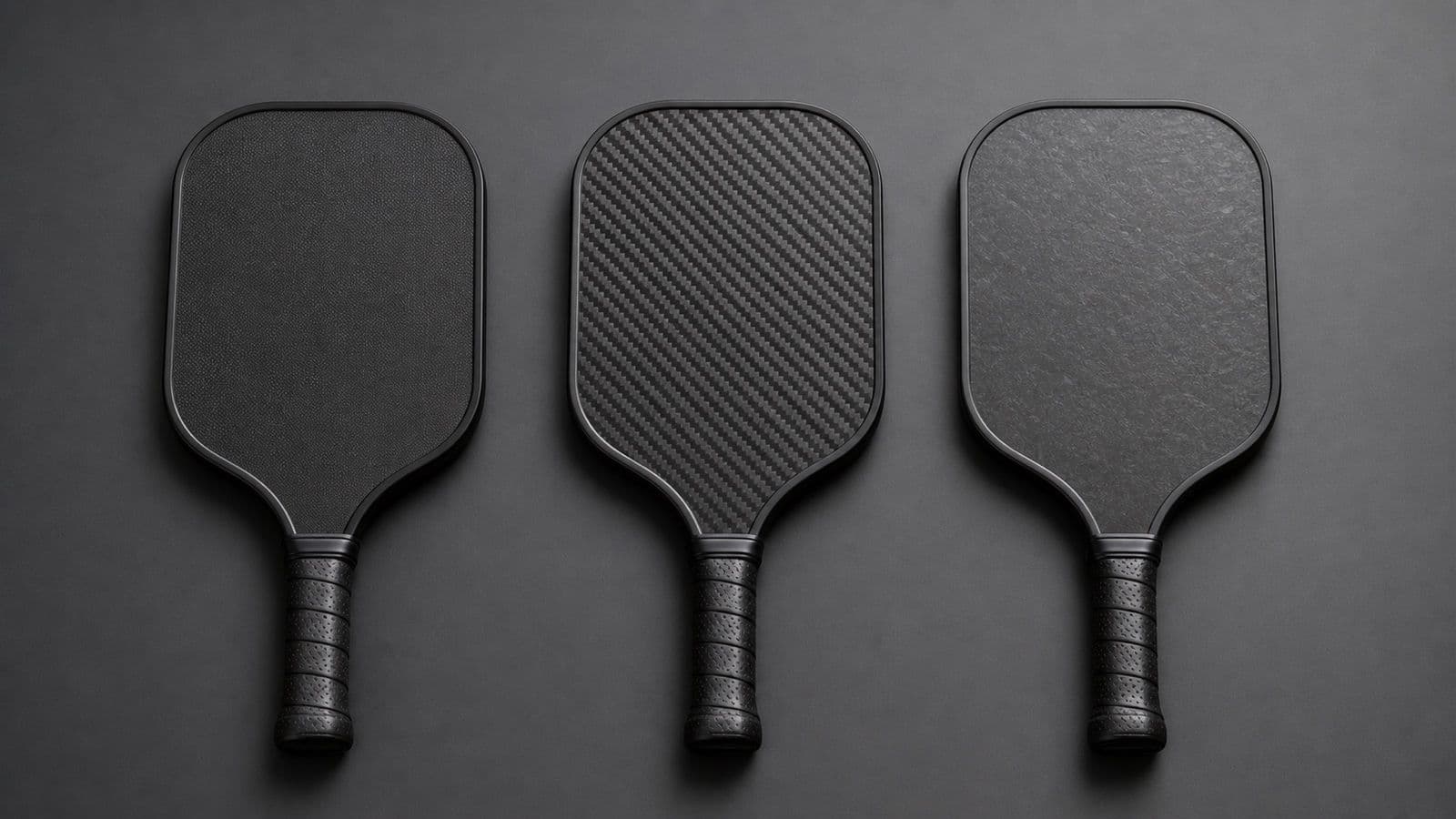
Every private-label paddle line starts the same way. You pick three specs that sound like a ladder — thin core for the cheap one, thick core for the mid, fancy carbon face for the flagship — and you assume the factory's cost follows the ladder. Then the quote comes back and two of your three upgrades cost the same as each other, one costs almost nothing, and the thing that actually moved your landed cost was the box.
This article is about which upgrades in a paddle line are real. Not in the abstract: against a real published catalogue, with the real published price gaps between one build spec and the next. The numbers below come from a working pickleball factory's own storefront, where nineteen paddle variants are listed with individual prices, and from the 2026 USA Pickleball rulebook, which quietly settles two of the arguments before they start.
Key Takeaways
- 13mm to 16mm core costs nothing. On a real 19-variant catalogue, Single Black 3K Carbon 13mm and Single Black 3K Carbon 16mm are both ₱1,204.41 — every figure on this page is a published catalogue price in Philippine pesos (PHP), quoted per single unit. The same holds in orange. Core thickness is a feel decision, not a tier.
- The face upgrade is real but small. 3K carbon to T700 frosted is +₱35.86, about 3% on the paddle. It is the only face step on this catalogue with a published price attached.
- Packaging outruns everything. The same six balls in a premium printed carton instead of a black box is +₱300.77, a 65% jump — roughly eight times the entire face upgrade.
- The rulebook removes two arguments. Rule 3.D.2 says there is no restriction on paddle thickness; 3.D.3 says none on weight. Nobody is stopping you, and nobody is charging you.
- Nineteen variants, three prices. Colourway proliferation is nearly free; spec proliferation is not. That asymmetry should shape your SKU count.
- Certification, not materials, is what makes a top tier expensive. UPA-A runs $10,000 per brand per year plus $3,000 per paddle. That is the real cost of a "pro" tier.
On this page
- The tier ladder you imagined vs the one the catalogue prices
- What a real 19-variant paddle catalogue actually charges for
- Core thickness: the upgrade that is free, and the rulebook agrees
- Face material: the one step with a price on it
- The deltas a player can actually feel
- Packaging is where your tier money really goes
- So which upgrades actually deserve a tier?
- How many SKUs should a first line carry?
- Three build sheets, worked end to end
- What to check before you sign anything
- Watch how a paddle is actually built
- Who this structure suits, and who it does not
- Frequently asked questions
The tier ladder you imagined vs the one the catalogue prices
The good/better/best instinct is sound. Retail buyers shop by price band, and a line with one paddle in it is a line that can only win one shelf slot. The mistake is not the structure — it is assuming the factory's cost curve is shaped like the retail price curve you have in your head.
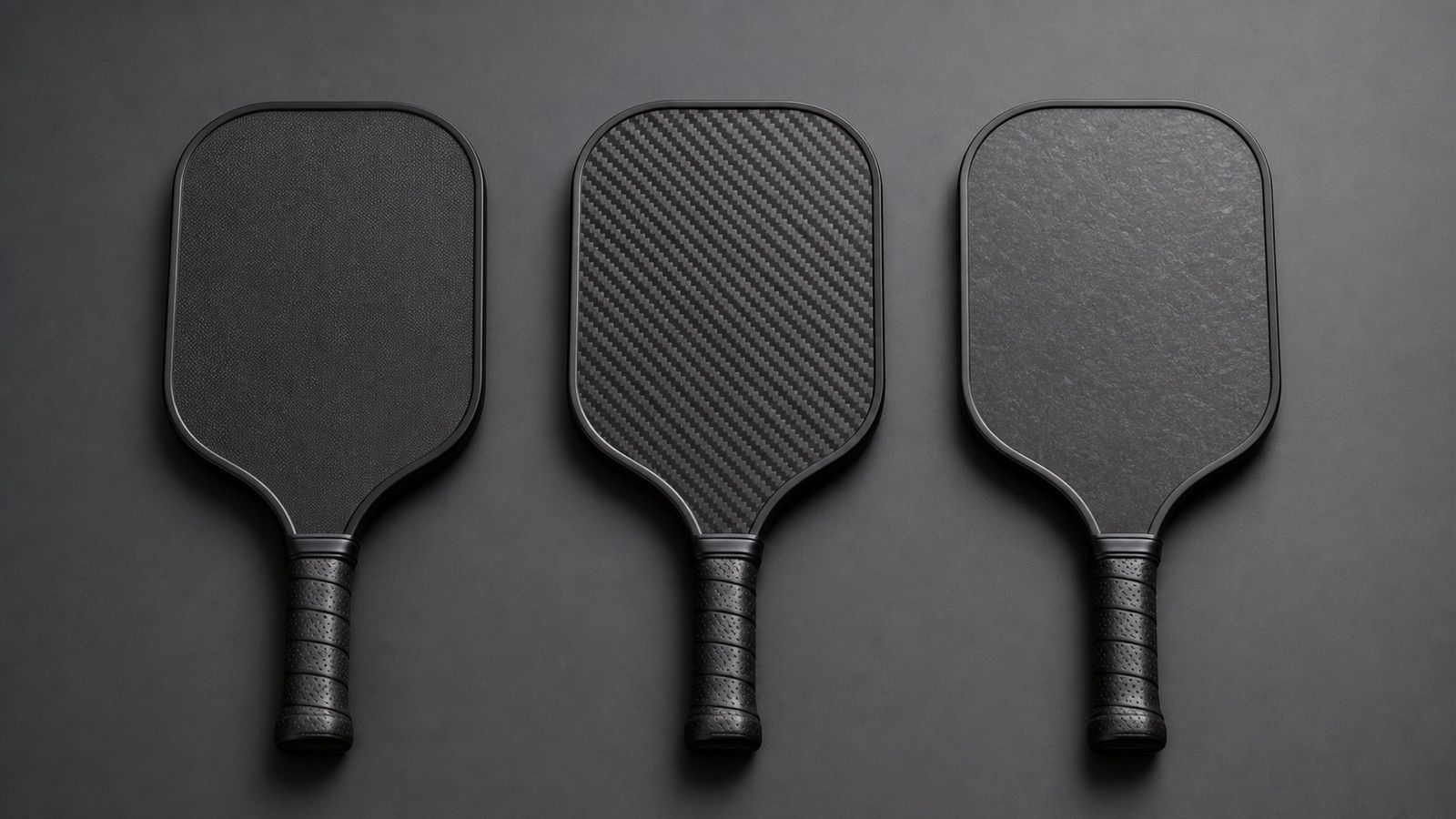
Three faces, three different looks. On the catalogue below, only one of those visual steps carries a price difference — and it is smaller than you would guess.
Here is the ladder most first-time brand owners bring to a sourcing call, in the order they usually rank it by expected cost: thicker core, then premium carbon face, then thermoformed construction, then a frameless edge, then custom paint and packaging last, as an afterthought. Read on and you will find that list is almost exactly upside down.
What makes this checkable rather than a matter of opinion is that the factory in question publishes its variant list openly. Nineteen paddle variants, each with its own price, each with a model designation that tells you what it is. You can read the price of a 13mm core and a 16mm core in the same colourway and subtract one from the other. That is a rare thing in this industry, and it is worth doing carefully before you commit tooling money to a tier that does not exist.
The option list you are actually choosing from
Before the deltas, it helps to see the menu. This factory states publicly that it builds raw T700 carbon and fiberglass faces on 13mm and 16mm polypropylene honeycomb cores, in thermoformed unibody or cold-pressed construction, with custom surface texture, edge guard, grip and full private-label branding. The retail catalogue adds 3K carbon as a face option and frameless as an edge option. Order minimums are published as 50 pieces for paddles and 1,000 pieces for balls.
That material range is available in a small, fixed set of grades and thicknesses, and its compactness is the point: every tier you are about to design has to be assembled out of those options. The question is not what exotic build you could dream up — it is which of these available choices are worth charging more for. Write that option list down the left side of a page, and the rest of this article fills in the right side.
A note on what these numbers are, and are not
Every price in this article is the brand's own published retail list price on its storefront, quoted in Philippine pesos because that is the market the storefront serves. They are not OEM FOB quotes, and your quoted unit cost at 500 or 5,000 pieces will not be these numbers. What survives the translation is the shape: which build changes the factory prices differently from one another, and by roughly what proportion. A step that is free at retail is not usually a step the factory is paying much for upstream, and a step that adds 65% at retail is not free anywhere.
What a real 19-variant paddle catalogue actually charges for
Nineteen purchasable paddle variants sit on the 3K carbon fiber paddle listing, each with its own price and stock figure. The Product schema on that page reports offerCount 19, with lowPrice 1087.87 and highPrice 1240.27. Nineteen variants, and between the cheapest and the most expensive sits a spread of ₱152.40 — about 14%.
That is the first surprise. An entire catalogue, top to bottom, fits inside a 14% band. Now look at how those nineteen variants distribute across that band:
| Published price | Variants at this price | What they are |
|---|---|---|
| ₱1,087.87 | 1 | Carbon Fiber Single BQ116 — a separate model designation, not part of the TX ladder |
| ₱1,204.41 | 8 | All 3K Carbon variants — 13mm and 16mm, edge-guarded and frameless, black, orange and white |
| ₱1,240.27 | 10 | All T700 Frosted 16mm variants — TX16-001 through TX16-043 |
Three prices. Nineteen variants. Ten of those variants — more than half the catalogue — are the same paddle in different graphics, all at ₱1,240.27. Eight more are the same story one rung down.
This is the single most useful structural fact on the page, and it is worth stating bluntly: this catalogue charges for face material and for nothing else. Not thickness. Not edge construction. Not colour. Not graphics. One variable moves the price, and it moves it by ₱35.86.
Why the cheapest paddle is the odd one out
Carbon Fiber Single BQ116 sits at ₱1,087.87, ₱116.54 below the 3K Carbon group. It is tempting to read that as "the entry tier" — but look at the model designation. Everything else on the catalogue is TX16-xxx or a named 3K Carbon variant. BQ116 is its own code, which is the tell that it is a different platform, not a de-specced version of the same one.
That distinction matters commercially. A cheaper variant of the same platform shares tooling, shares a certification, shares a spec sheet. A different platform shares none of those. If you are building a good/better/best line and your "good" tier comes off a different mould from your "better" tier, you have not built a ladder — you have built two products that happen to sit next to each other, with two of everything behind them.
It is also worth noticing what the ₱116.54 gap between BQ116 and the 3K group implies. That step — a whole different platform — is only about three times the face upgrade, and still under 10% of the paddle price. The entire vertical range of this catalogue, from a separate entry platform up to the top face material, is ₱152.40. Whatever separates a cheap paddle from an expensive one at retail, it is not a large spread in what the factory charges.
Read the model codes before you read the prices
There is a practical habit buried in this. The model designation is doing more work than the price does. TX16-004 and TX16-054 tell you core, family and that one is frameless; BQ116 tells you it is something else entirely. When you receive a quote sheet, the codes are what let you tell a graphic variant from a spec variant — and by extension what lets you tell a cheap SKU addition from an expensive one.
This is not a cosmetic concern. Rule 3.D.1 requires a clearly marked brand and model name or number on the paddle, and approved-equipment lists are maintained per model. A model designation is a regulatory object as much as a catalogue one, which means "just make it slightly different" is never actually a small request. Ask your supplier which changes trigger a new model code, and you will have learned where your real cost boundaries sit before you have spent anything.
Core thickness: the upgrade that is free, and the rulebook agrees
Here is the delta that should change how you spend your tier budget.
| Variant | Core | Published price | Delta |
|---|---|---|---|
| Single Black 3K Carbon 13mm | 13mm | ₱1,204.41 | baseline |
| Single Black 3K Carbon 16mm TX16-004 | 16mm | ₱1,204.41 | ₱0.00 |
| Single Orange 3K Carbon 13mm | 13mm | ₱1,204.41 | baseline |
| Single Orange 3K Carbon 16mm TX16-003 | 16mm | ₱1,204.41 | ₱0.00 |
| Single Black 3K Carbon 16mm Frameless TX16-054 | 16mm, frameless | ₱1,204.41 | ₱0.00 |
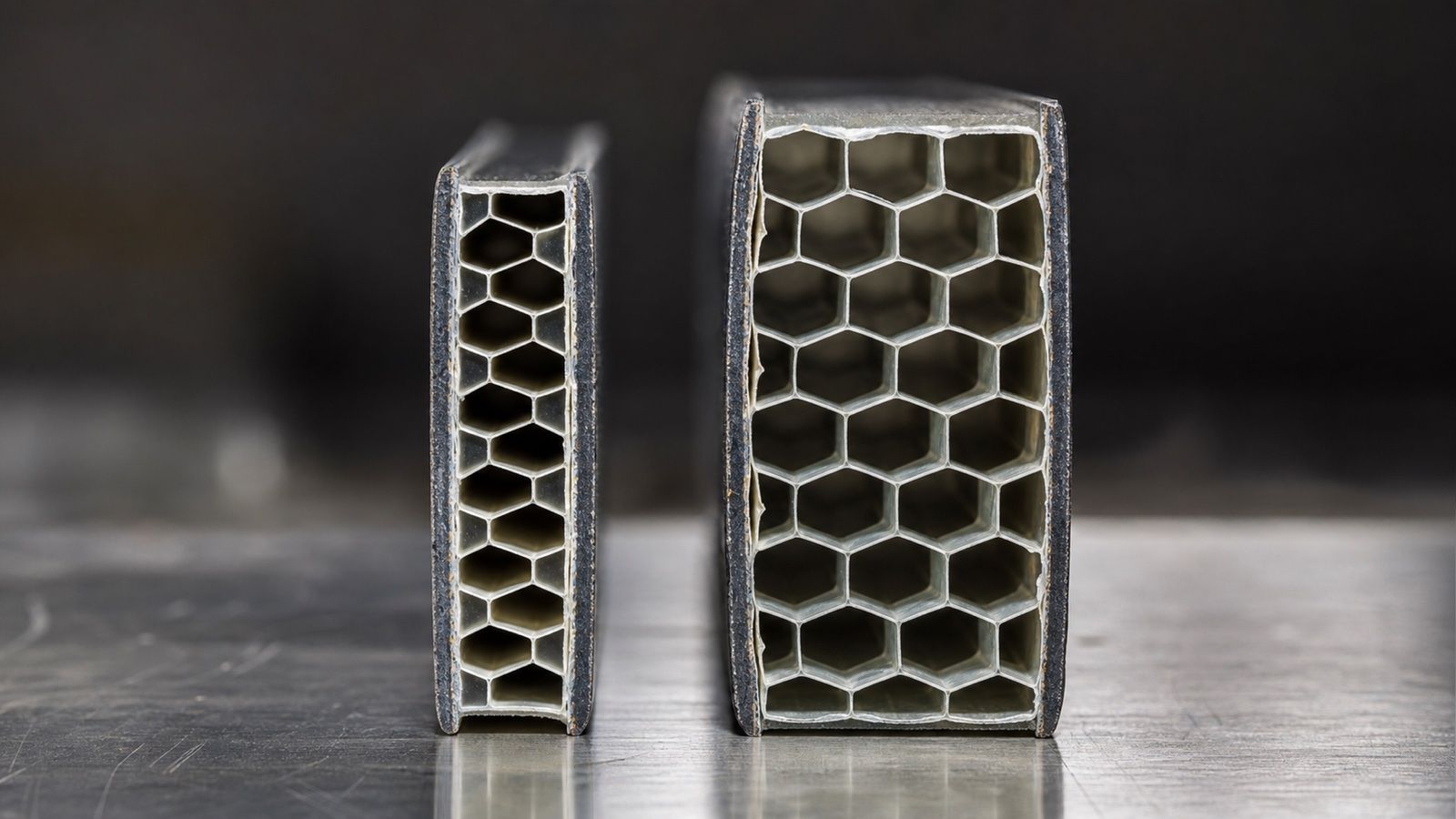
More core is more material — but on a cut honeycomb blank it is not more work, and the price list shows it.
Two independent colourways confirm it, so this is not a single-SKU pricing accident. Adding three millimetres of polypropylene honeycomb changes the published price by nothing at all. Going frameless — losing the edge guard entirely, which buyers routinely assume is a premium construction — also changes it by nothing.
The mechanism is not mysterious once you have seen a paddle pressed. A honeycomb core arrives as sheet stock and gets cut to a blank. A 16mm blank and a 13mm blank take the same cut, the same handling, the same face layup, the same press cycle and the same finishing. The extra material is a few grams of polypropylene. What you are really paying for on a paddle is the face and the labour around it, and neither of those changed.
The rulebook closes the other half of the argument
If cost does not constrain your core choice, perhaps compliance does? It does not. The 2026 USA Pickleball Official Rulebook is explicit in Rule 3.D.2: after setting the dimensional limits, it states plainly, "There is no restriction on paddle thickness." Rule 3.D.3, on weight, is equally short: "There is no restriction on paddle weight."
So on core thickness you have no cost pressure and no regulatory pressure. The choice is returned entirely to feel and to positioning — which is exactly where it belongs, and exactly where most brands never let it sit because they have convinced themselves the thick core is the expensive one.
The dimensional limits that do bind are elsewhere in the same rule. Combined length and width, including any edge guard and butt cap, must not exceed 24 inches (60.96 cm), and paddle length must not exceed 17 inches (43.18 cm). Those are shape constraints, and they are worth checking against any elongated silhouette you are considering — our note on elongated versus widebody paddle shapes covers where brands run out of room.
Face material: the one step with a price on it
One upgrade on this catalogue carries a published price, and it is the face.
| Step | From → to | Delta | As % of base |
|---|---|---|---|
| Core thickness | 13mm → 16mm | ₱0.00 | 0% |
| Edge construction | edge-guarded → frameless | ₱0.00 | 0% |
| Colourway / graphics | any of 10 TX16 designs | ₱0.00 | 0% |
| Face material | 3K carbon → T700 frosted | +₱35.86 | +2.98% |
Three percent. That is the entire published premium for the material step that most brands build their flagship story around, and it is the only line in that table that is not zero.
Two things follow. First, if you have been told a carbon face upgrade will blow up your unit cost, that is not what this catalogue shows. Second — and this is the harder lesson — a 3% cost step is a very thin foundation for a retail price step of 40% or 60%. It can be done, and brands do it every day, but you are selling a story and a finish, not a cost difference. Price the tier on what the buyer perceives, and know that the factory invoice will not defend the gap for you.
Why the face is the only thing that moves
The reason face material is the lone paid variable is worth understanding, because it tells you what else will and will not cost you when you ask for something custom. A paddle's cost concentrates in two places: the composite fabric itself, and the labour of laying it up and finishing it. Core stock is cheap sheet material that gets cut to a blank. Edge guard is an extruded strip and a few seconds of application. Paint and film are consumables applied during a step that happens anyway.
Face fabric is different on both counts. It is the expensive input, and it is the input whose handling changes when you change it. A different weave drapes differently over the mould, cures differently, and finishes differently — which is why the price moved when the face changed and stayed put when everything else did.
The practical inference for your RFQ: expect any spec change that alters the fabric or the process to carry a real number, and expect any change that only alters material volume or applied decoration to be close to free. Thicker core is volume. A different colourway is decoration. A different weave is a process change. That single distinction will predict most of your quote before you receive it.
It also explains a quote pattern that confuses first-time buyers. Ask for a thermoformed unibody instead of a cold-pressed build and you are changing the process, not the volume — so that one genuinely does move, in a way the 13mm-to-16mm question never will. If you want a premium tier that is defensible on manufacturing rather than on story, construction is a more honest place to put it than thickness.
We have written separately on what actually distinguishes these materials in the layup — raw carbon T700 vs T300 vs fiberglass faces goes into how to verify what you are being sold, and the aramid hybrid face production guide covers the tier above this one, where the cutting and finishing penalties start to bite in a way a price list does not show.
The deltas a player can actually feel
A cost delta and a perceptible delta are different animals, and a good line is built where the two diverge in your favour. Here is the honest mapping between the build changes above and what a club-level player will notice in the first ten minutes.
- 13mm vs 16mm core — highly perceptible, costs nothing. This is the single biggest feel change available to you and it is free. A 13mm core plays firmer and more powerful with a smaller sweet spot; 16mm plays softer, more controlled and more forgiving. Players describe this difference unprompted. It is the best value change in the entire catalogue.
- Frameless vs edge-guarded — perceptible in balance, costs nothing. Removing the edge guard moves mass and changes how the paddle swings. Some players love it, some find it fragile-feeling. It is a genuine differentiator with a genuine durability trade-off, and it is free.
- 3K carbon vs T700 frosted — perceptible in surface feel and grip on the ball, costs 3%. Real, but subtler than the core change, and heavily confounded by what the player expects from the look.
- Colourway — highly perceptible on a shelf, costs nothing. Not a performance variable at all, and the cheapest differentiation you will ever buy.
The insider warning. Notice what just happened. The two most perceptible changes available — core thickness and edge construction — are both free, and the change brands spend their tier budget on is the least perceptible of the three that cost anything. If you build good/better/best as 13mm-thin / 16mm-thick / T700, you have built a ladder where the first rung is free, the second rung is free, and only the third costs you anything. That is not a problem — it is an opportunity, provided you know it going in and price the tiers on perceived value rather than on a cost stack you assumed was there.
What the rulebook will not let you differentiate
Before you design a premium tier around surface treatment, read Rule 3.D.5. The hitting surface must not contain rough texturing, sandpaper characteristics, natural or synthetic rubber, moving parts that increase head momentum, or "anti-skid paint, paint textured with sand, rubber particles, vinyl compounds, or any material that causes additional spin." It also bars a reflective finish that might adversely affect opponents' vision.
In practice this means the spin story on your premium tier has to be engineered into the layup and the cured surface, not sprayed on afterwards, and the eye-catching mirror finish your designer wants is a compliance question rather than a taste question. Decals and tape are constrained too: Rule 3.D.7 holds them to no more than 1.0 inch (2.54 cm) above the top of the grip and 0.5 inch (1.27 cm) inside the outer edge, or inside the edge guard where one is fitted.
Packaging is where your tier money really goes
Now the number that reframes the whole exercise. The same factory publishes ball packs, and because the ball inside is constant across several of them, the packaging delta is readable directly.
| Pack | Contents | Published price | Vs black box |
|---|---|---|---|
| 6-Pack Mesh Bag | 6 × 40-hole | ₱419.28 | −₱42.13 |
| 6-Pack New Style Black Color Box | 6 × 40-hole | ₱461.41 | baseline |
| 6-Pack Color Box | 6 × 40-hole | ₱762.18 | +₱300.77 (+65.18%) |
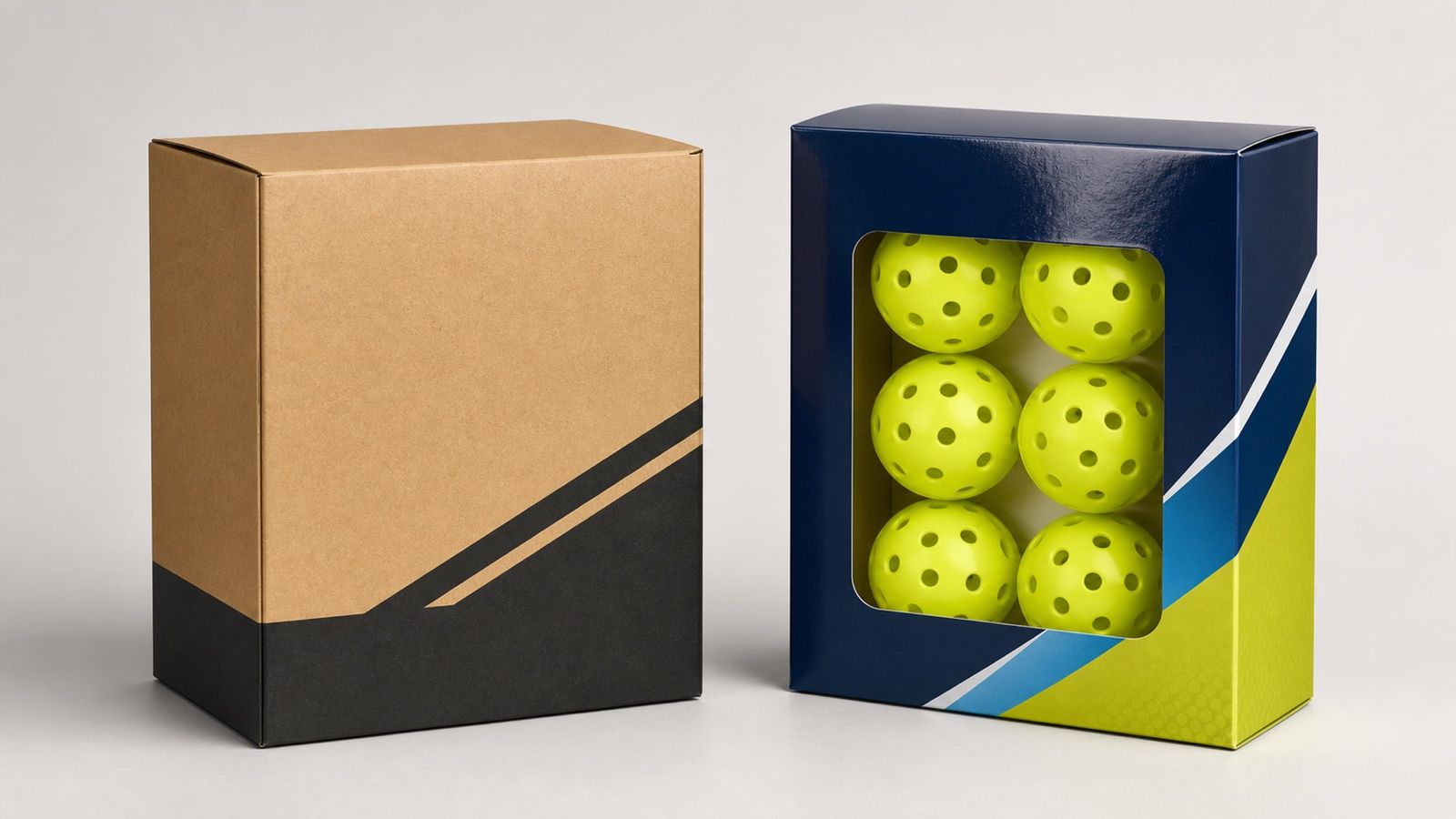
Same six balls, two presentations. On the published catalogue the box on the right adds 65% — about eight times the entire T700 face upgrade.
Read those two numbers together and the priorities invert. The face upgrade everyone agonises over is +₱35.86. The carton nobody discusses until week six is +₱300.77. The packaging decision is roughly eight times the size of the material decision on this catalogue.
The 4-pack tells the same story in miniature: a standard color box is ₱380.28, the premium JT-series box is ₱457.38, a delta of ₱77.10 or 20.27% — again for identical balls. And the mesh bag, at ₱419.28, undercuts even the plain black box: the cheapest way to present six balls is to barely present them at all.
Pack size is a second, separate lever
Depth of pack moves the per-unit economics independently of presentation. The 36-pack bucket is ₱2,453.58 across all nine colourways, which works out to ₱68.16 per ball. The black 6-pack works out to ₱76.90 per ball. Buying three dozen at a time takes about 11% off the per-ball price — a discount that comes from the pack format, not from the ball.
If your line is aimed at clubs and rental fleets rather than retail shelves, that is your tier structure right there, and it has nothing to do with materials. Our private-label packaging guide covers the artwork and carton side in more depth, and the starter-set assembly post works through kitting a multi-component set.
Why packaging behaves so differently from the paddle
The size of the packaging delta surprises people, so it is worth saying why it is structurally larger rather than a quirk of one price list. A printed retail carton is a manufactured product in its own right, with its own tooling — a cutting die — its own material grade, its own print setup and its own minimum run. None of that is shared with the paddle line.
That has a consequence most first-time brand owners meet late and painfully: the carton usually sets your real minimum order, not the paddle. A 50-piece paddle minimum is generous. A print run of custom-printed retail cartons typically is not, because the setup cost has to be spread across the run. You can order 50 paddles and then discover the box you designed for them has a minimum several times that.
One caveat, stated plainly: no public figure exists for this factory's carton minimum or its print tooling cost. Those numbers are not on the public catalogue, and an invented one would be worse than none. What the catalogue does establish is the direction and the rough magnitude: a premium presentation is a 65.18% step on a six-ball pack, and a 20.27% step on a four-ball pack. Both are an order of magnitude above the 2.98% face upgrade, and both are decided by a vendor who is not the paddle factory.
The operational takeaway is sequencing. Quote your packaging at the same time as your paddles, from the start, not after the build sheet is settled. If the carton minimum turns out to exceed your launch volume, you want to find that out while you can still choose a simpler presentation for tier one — not after you have committed 300 paddles to a box you cannot afford to print.
Finish and colour are free on balls too
One more zero worth banking. The Pro Tournament 3-pack lists four variants — Rotational Frosted Neon Yellow, Rotational Frosted Neon Green, Rotational Glossy Yellow and Rotational Glossy Orange — and all four are ₱461.95, with the schema confirming lowPrice and highPrice both at 461.95 across four offers. Frosted versus glossy, neon versus standard: no price difference. Note that Rule 3.C.3 requires the ball to be one uniform colour apart from identification markings, and Rule 3.C.4 requires a manufacturer or supplier name printed or embossed on the surface — your brand mark on the ball is a rulebook requirement, not an upsell.
So which upgrades actually deserve a tier?
Pulling it together, here is where the money and the perception actually sit — and where a tier boundary earns its keep.
| Variable | Published cost delta | Player-perceptible? | Use it as a tier boundary? |
|---|---|---|---|
| Core 13mm → 16mm | ₱0.00 | Strongly yes | No — use it to split by playing style, not by price |
| Frameless edge | ₱0.00 | Yes, in balance | Only as a look, and mind the durability trade |
| Colourway / graphics | ₱0.00 | On the shelf, strongly | No — this is range width, not a tier |
| Face 3K → T700 | +₱35.86 (+2.98%) | Moderately | Yes — the one clean material boundary |
| Premium retail carton | +65.18% on a 6-ball pack | At point of sale, decisively | Yes — and it is the biggest lever you have |
| Tour certification | $10,000/brand/yr + $3,000/paddle | Only to competitive players | Yes — this is what a real "pro" tier costs |
The honest summary: on materials alone you have exactly one defensible boundary, and it is worth 3%. Everything else that costs real money is downstream of the paddle — the box it arrives in, and the certification that lets it be used in sanctioned play.
The rule this gives you
A tier boundary earns its place when the buyer can see the difference and you can defend the price step. Those are two separate tests, and the table above shows they rarely land on the same variable.
Core thickness passes the perception test and fails the cost test — so it belongs on your range as a choice, not a ladder rung. Offering 13mm and 16mm at the same price is not leaving money on the table; it is how you cover two playing styles from one platform without splitting your forecast. A buyer who wants control and a buyer who wants power both find a paddle, and you carry one bill of materials.
The face passes both tests weakly. It is the only material step with a real number behind it, so it is the only one that survives a category manager asking why the premium SKU costs more — but a 3% input backing a 40% retail step means the rest of that gap has to come from finish, graphics, packaging and the story on the box. Which is fine, as long as you built the box to carry it.
Packaging and certification pass the cost test emphatically and the perception test in different places: the carton is decisive at the shelf and irrelevant on court, while certification is invisible at the shelf and decisive to a competitive player. That is why they suit opposite ends of a line. A retail-facing tier should spend on the box. A tournament-facing tier should spend on the approval and can afford a plainer one.
The failure mode this avoids is the most common one in the category: a brand that builds three tiers on three core thicknesses, prices them 30% apart, and cannot explain the gap to anyone — because there is no gap in the build, and the player who buys the expensive one gets a paddle that is genuinely different but not more expensive to make. That works until a competitor prices the same build lower, and then nothing defends it.
For brand owners, importers and retail buyers specifying a two- or three-tier private-label paddle line at wholesale volume. The OEM page lists what is actually selectable — 13mm and 16mm polypropylene honeycomb cores, raw T700 carbon and fiberglass faces, thermoformed unibody or cold-pressed construction, custom surface texture, edge guard and grip, plus golden-sample approval and DDP delivery terms — so you can put two build sheets side by side and ask for both to be priced.
See the OEM option listHow many SKUs should a first line carry?
The catalogue answers this one structurally, if you read what it chose to multiply and what it chose to hold still.
Nineteen variants sit on three price points and, as far as the price list reveals, a small number of build specs. Ten of the nineteen are one build — T700 frosted, 16mm — in ten different graphic treatments. That is the shape of a range that has learned something: multiply graphics, not specs.
The cost of a wide line is not the unit price. It is this: some variants sell out while their neighbours sit, and every extra SKU is another forecast you have to get right.
The reason is forecast risk, and it compounds differently for the two kinds of variant. A graphic variant shares its core, its face, its press cycle and — critically — its model designation and any approval attached to it. If black outsells orange, you have misallocated paint and film. A spec variant shares none of that. If your 16mm outsells your 13mm, you have misallocated core stock, press time and possibly a separate certification.
The published stock figures have a clear limit, worth naming before they get over-read. The catalogue publishes stock figures — every one of the nineteen variants shows five-figure availability, from 9,252 to 9,967 units — but stock on hand is not sell-through. It shows that graphic variants are stocked in real depth, which is itself informative about how cheap they are to carry. It does not tell you which colour sells fastest, and inventory on hand should not be dressed up as demand data.
A practical starting shape
For a first private-label line, a defensible structure is two build specs and four to six graphics — not six build specs. Concretely: one 16mm 3K carbon platform and one 16mm T700 platform, each offered in two or three colourways. That gives a retail buyer a visible good/better choice and gives you a range that photographs like a line, while leaving you with two forecasts to get right instead of six.
The published paddle minimum is 50 pieces, quoted on the product pages as "MOQ 1,000 pcs (Balls) / 50 pcs (Paddles)". A 50-piece floor per variant is what makes a four-to-six graphic range feasible at all for a launch: at 50 pieces a colourway, six colourways is a 300-paddle commitment rather than a 3,000-paddle one. That figure is worth confirming for your own configuration, since minimums usually move with how much of the build is custom — our custom paddle MOQ guide and tooling cost guide go into where the floor actually comes from.
What the tier ladder costs once certification enters
If your top tier is meant to be tournament-credible, the cost structure changes character entirely. USA Pickleball maintains the approved paddle list referenced throughout Rule 3.D, and Rule 3.D.1 requires a clearly marked brand and model name or number plus the USA Pickleball Approved seal or text treatment on the paddle itself.
For the professional tours, UPA-A publishes its own schedule: $10,000 per brand annually for eligibility at professional UPA events, plus $3,000 per paddle for testing, valid for 24 months from approval. A separate Marketing and Broadcast Licence runs $50,000 annually, waived where a brand sponsors PPA or MLP at $100,000 or above. UPA-A also caps performance: Paddle Efficiency Factor at .385 new and .405 after break-in, and spin at 2,100 RPM.
Set that against a ₱35.86 face upgrade and the picture is stark. Per-model testing alone costs multiples of the material premium on an entire production run. This is the real reason "pro tier" is expensive, and it is a fee schedule, not a bill of materials. It is also why a wide spec range is dangerous: each distinct model designation is a potential testing fee, which is another argument for multiplying graphics rather than specs.
One figure could not be confirmed and is not worth guessing at: USA Pickleball does not publish a public evaluation fee schedule. The registration flow and submission FAQ exist, but no dollar figures are posted, and the commonly cited per-model number traces back to an undated post on a paddle brand's own blog. Get that figure in writing from the certifying body before you build it into a tier budget. Our comparison of USAPA, UPA-A and IFP certification lays out which body matters for which market.
Three build sheets, worked end to end
Here is the whole argument as three build sheets you can lift onto an RFQ. The deltas are the published catalogue deltas; the reasoning is what you can defend to a retail buyer.
| Build sheet | GOOD — club / rental | BETTER — the volume SKU | BEST — the halo |
|---|---|---|---|
| Core | 16mm PP honeycomb | 16mm PP honeycomb | 16mm PP honeycomb |
| Face | Fiberglass or 3K carbon | 3K carbon | T700 frosted (+₱35.86) |
| Edge | Edge-guarded (durability) | Edge-guarded | Frameless (₱0 delta, a look) |
| Colourways | 1–2 | 3–4 | 1–2 |
| Packaging | Sleeve or poly, minimal | Printed carton | Premium carton — your biggest real delta |
| Certification | None required for rec play | USAP approval if retail asks | USAP, plus UPA-A only if you sponsor pro play |
| Where the money went | Nowhere — this is the free tier | Graphics and the box | Certification, then the box, then 3% of face |
Walk the scenario. You are launching with 300 paddles at the 50-piece minimum. You choose one platform — 16mm, 3K carbon, edge-guarded — in four colourways: that is 200 paddles across your GOOD and BETTER tiers, and on this catalogue's structure those four colourways cost you the same per unit as one would. You add a 50-piece T700 frosted frameless run as the halo. That is 250 paddles, five SKUs, two build specs, and exactly one line on the quote where the spec change costs anything.
Then you spend your remaining budget on the carton, because that is where the published data says the perceived value actually lives. And you get the lead time in writing per tier before you commit, because that is the one number nobody publishes — including this catalogue — and it is the number that will decide whether your launch lands before or after the season.
What to check before you sign anything
Six questions, each of which turns something in this article into a number on your quote sheet. They are ordered by how expensive the mistake is if you skip them.
- Ask for the price of the same paddle at both core thicknesses. If your supplier quotes a premium for 16mm, ask what specifically costs more. There may be a real answer for your configuration — but on a published catalogue the delta is zero, so the burden of proof is theirs.
- Ask whether your tiers share a platform. Different model codes usually mean different moulds, different spec sheets and separate approvals. Two tiers off one platform is a line; two tiers off two platforms is two products.
- Get the carton quoted separately from the paddle. It is your largest controllable delta and it should never be buried in a unit price.
- Confirm the MOQ against your actual colour split. Fifty per variant, published, is what makes a multi-colour launch viable — confirm it applies per colourway and not per order.
- Pin the certification path per tier in writing. Which body, which model designation, who pays, and what happens to the approval if you later change the face.
- Settle golden-sample approval in the contract. Golden-sample approval is named as part of this factory's documented process, and it is the gate between a spec sheet and 300 paddles you cannot return. Agree in writing who signs it off and what happens if the run deviates.
For brand owners, importers and wholesale buyers who already know their tier structure and want two build sheets priced side by side rather than one at a time. Quote a core SKU and a premium SKU together at the published 50-paddle MOQ and the gap between them becomes a number you can plan against.
Message the factory on WhatsAppWatch how a paddle is actually built
If the cost logic above feels abstract, watching a paddle come together makes it concrete — you can see immediately why the core blank is a minor step and the face layup and finishing are where the labour concentrates.

It is a third-party factory tour, not ours, and the construction shown is one manufacturer's approach rather than a universal process. It is included because the sequence — core blank, face layup, press, finish, grip — is the same sequence the price deltas in this article describe.
Watch specifically for how long the core spends being handled versus how long the face does. The core is cut and set; the face is positioned, pressed, cured, trimmed and finished. That imbalance in labour is the physical reason a 13mm-to-16mm change reads as ₱0.00 on a price list while a 3K-to-T700 change reads as ₱35.86, and it is easier to believe once you have seen it than when you read it in a table.
It is also a useful reference point when a supplier tells you a spec change is expensive. If the change does not visibly alter any of the steps in that sequence, ask which one it alters. A good factory will tell you straight away; the answer is usually either "the layup" or "nothing, we just quote it that way."
Who this structure suits, and who it does not
Best for: brand owners launching a first or second private-label paddle line who need a range that photographs like a range without carrying six forecasts; importers and distributors adding a house brand alongside the brands they already carry; retail buyers building a good/better/best shelf where the price steps have to be defensible to a category manager.
Not for: brands whose differentiation is a genuinely novel construction — a foam-wall or thermoformed unibody platform changes the cost structure enough that the deltas here do not describe it, and our notes on thermoformed versus cold-pressed and Gen-3 foam-wall paddles are the better starting point. Also not for anyone whose line is defined by tour certification from day one: at $10,000 a year plus $3,000 a model, that budget dominates every material decision and the sequencing question becomes which single model to certify first.
And a caveat that applies to everyone: these are one factory's published retail prices in one market. The direction of the deltas — thickness free, face small, packaging large, certification largest — is a structural pattern that reflects how paddles are actually made, and it will survive translation to your own quote. The exact percentages will not. Use them to know which questions to ask, then make your supplier put their own numbers next to yours.
Frequently asked questions
Does a 16mm core cost more than a 13mm core?
Not on this published catalogue. Single Black 3K Carbon 13mm and Single Black 3K Carbon 16mm are both ₱1,204.41, and the same holds in orange. The core blank takes the same cut, press and finishing either way.
Is there a legal limit on pickleball paddle thickness?
No. Rule 3.D.2 of the 2026 USA Pickleball rulebook states there is no restriction on paddle thickness, and 3.D.3 states none on weight. The binding limits are dimensional: 24 inches combined length and width, 17 inches maximum length.
How much more does a T700 carbon face cost than 3K carbon?
On the published catalogue, +₱35.86 per paddle — 2.98% on the 3K price. It is the only build change on that catalogue with a price attached, and it is smaller than most brands assume.
How many SKUs should my first paddle line have?
Two build specs and four to six colourways is a defensible launch shape. Graphic variants share tooling and approvals; spec variants do not. Multiply graphics, not specs.
What is the minimum order for private-label paddles?
The published figure is "MOQ 1,000 pcs (Balls) / 50 pcs (Paddles)". Confirm whether 50 applies per colourway or per order, since that determines how wide a launch range you can afford.
What does it cost to certify a paddle for professional play?
UPA-A publishes $10,000 per brand annually plus $3,000 per paddle for testing, valid 24 months. USA Pickleball does not publish a public fee schedule — get that figure from the certifying body in writing.
Can I differentiate my premium tier with a grippier surface?
Only within Rule 3.D.5, which bars rough texturing, sandpaper characteristics, and anti-skid or sand-textured paint. Spin has to be engineered into the layup and cured surface, not applied afterwards.
What is the lead time per tier?
No lead-time figure is published first-party for these configurations, so this article does not give one. Ask for it in writing per tier — premium cartons and certification both add time that the paddle build itself does not.
Want to source this quality for your brand?
Contact our factory directly on WhatsApp for an instant MOQ and pricing quote.