Paddle Surface Roughness: The Rz Limit and How It's Tested
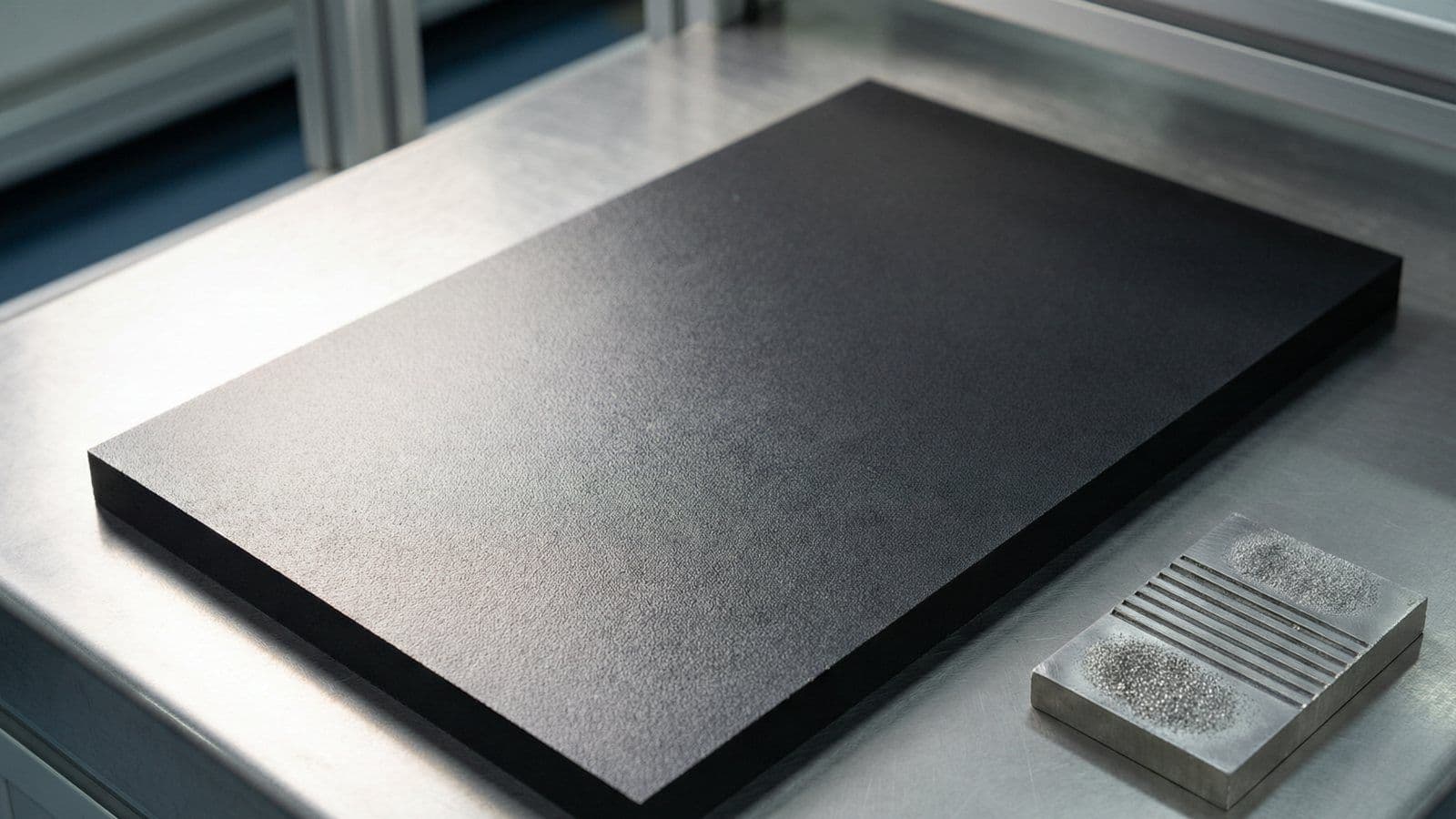
A USA Pickleball approved paddle face averages no more than 30 micrometres Rz and 40 micrometres Rt, returns a kinetic coefficient of friction of 0.1875 or lower, and reflects no more than 80 gloss units at 60 degrees. None of those four numbers appears in the Rulebook. The 2026 Official Rulebook bans rough texturing, sandpaper characteristics and anti-skid paint in words, and Rule 3.D.4 then sends the actual criteria to the Equipment Standards Manual, where clause 2.E.2.a.1 turns the words into readings.
How the reading is taken decides as much as the limit does. Each face is measured six times, in six different directions, and averaged on its own. No single one of those readings may pass 33 micrometres Rz or 44 micrometres Rt. A face can average 28 micrometres and still fail on one spike.
Key Takeaways
- The limits live in the Equipment Standards Manual, not the Rulebook. Rule 3.D.4 defers to it; clause 2.E.2.a.1 holds the numbers.
- Average 30 micrometres Rz and 40 micrometres Rt per face, with single-reading ceilings of 33 and 44 micrometres across the six readings taken on that face.
- Both faces are judged separately. The data set is the six readings on one face, averaged for that face alone.
- Friction is a separate test: 0.1875 kinetic maximum under ASTM D1894-14. Gloss is a third, capped at 80 GU at 60 degrees.
- Ra and Sa do not answer this specification. The manual caps peak-to-valley heights, and ISO 21920-2:2021 lists mean-deviation heights as different parameters.
- Approval is not a one-off. Clause 2.F.2.a requires compliance across the paddle's entire useful life, including degradation that works in the player's favour.
On this page
- The four numbers a legal paddle face has to clear
- Rz, Rt, Ra, Sa: which parameter the standard actually caps
- Six directions, both faces, and the single reading that fails a face
- The reading moves between your golden sample and the container
- The spec-sheet lines, and what we check before a face ships
- Conclusion
- Frequently asked questions
First, a third-party primer on the parameters.

The Four Numbers a Legal Paddle Face Has to Clear
Rule 3.D.5 of the 2026 Rulebook is a list of words. It prohibits holes, cracks, delamination, rough texturing, sandpaper characteristics, rubber, anti-skid or sand-textured paint, anything else that lets a player impart excessive spin, and a reflective finish that might affect an opponent's vision. Not one line carries a number. Rule 3.D.4 explains why: paddle material criteria are the ones "specified in the USA Pickleball Equipment Standards Manual".
The manual, Revision 3.0 of January 2025, calls itself the flow down from the Rulebook to "specific definition of the testing that is done to confirm compliance". Clause 2.E.2 repeats the prohibition, then adds the part that makes it enforceable. The surface is judged by roughness, coefficient of friction and coefficient of restitution measurements. Three tests, three sets of numbers, and a gloss ceiling in 2.E.2.b on top. The third of those tests, coefficient of restitution, is the power limit covered in our explainer on the PBCoR standard. In millimetres the caps read 0.030 mm Rz and 0.040 mm Rt, a scale a machinist recognises and a paint shop rarely does.
Read the table as four independent gates. A face that clears roughness can still fail friction: different protocols, different questions.
| Surface property | Average limit per face (µm, ratio or GU) | Single-reading cap (µm) | Clause | Verdict: what fails it |
|---|---|---|---|---|
| Roughness Rz, peak to valley | 30 µm | 33 µm | 2.E.2.a.1 | A high average, or one spike above the cap |
| Roughness Rt, peak to valley | 40 µm | 44 µm | 2.E.2.a.1 | Same six readings, second parameter, judged the same way |
| Kinetic coefficient of friction | 0.1875 | none stated | 2.E.2.a.2 | Any value above it, whatever the finishing process |
| Gloss measured at 60 degrees | 80 GU | none stated | 2.E.2.b | A glossy edge guard, not only a glossy face |
Rz, Rt, Ra, Sa: Which Parameter the Standard Actually Caps
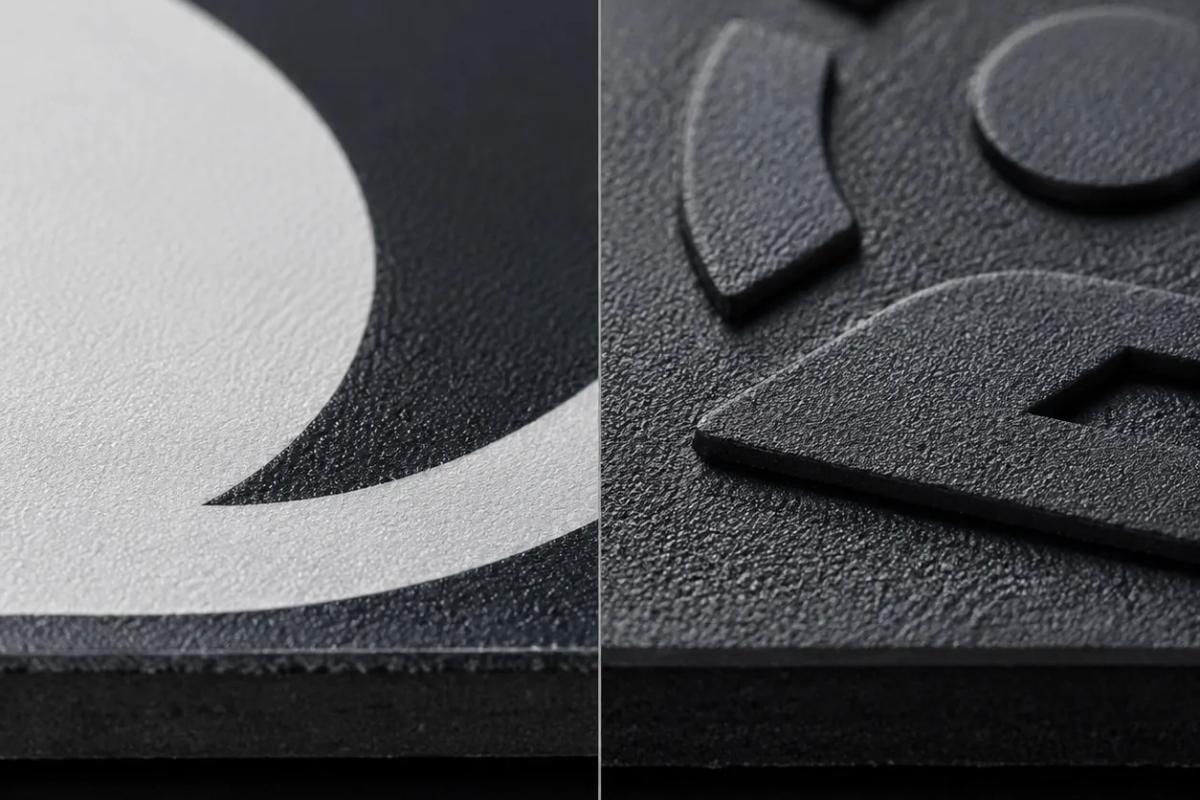
Roughness is not one number. It is a family of parameters, and the manual caps two. Clause 2.E.2.a.1 names Rz, glossed there as "average maximum height, peak to valley", and Rt, "maximum height, peak to valley". Both describe how far the highest peak sits above the deepest valley. Neither describes average deviation, which is what Ra reports.
That difference is why a lab report can be accurate and useless at once. Arithmetic mean height and total height sit as separate parameters in clause 4.2 of ISO 21920-2:2021, the standard that defines profile surface texture today. A smooth-looking face with a few tall, widely spaced peaks can hold a low Ra and still break the single-reading ceiling of 0.033 mm. Peaks are what the sport regulates. Peaks are what grab the ball.
Two version facts belong on the spec sheet. ISO 21920-2:2021 cancels and replaces ISO 4287:1997, and Germany's metrology institute records the ISO 21920 series as replacing ISO 4287 and ISO 4288. The new edition relates all field parameters to the evaluation length. Two reports quoting the same parameter under different editions were not computed the same way. Name the edition, or the number is half a fact.
| Parameter | What it reports | Defined in | Verdict for a submission report |
|---|---|---|---|
| Rz | Peak-to-valley height, profile method | ISO 21920-2:2021 | Required. This is the capped average of 30 µm |
| Rt | Total peak-to-valley height, profile method | ISO 21920-2:2021 | Required. This is the capped average of 40 µm |
| Ra | Arithmetic mean height, profile method | ISO 21920-2:2021 | Not accepted. The manual caps peaks, not averages |
| Sa | Arithmetic mean height of an areal scan | ISO 25178-2:2021 | Not accepted. Different standard, different quantity |
| Capped roughness parameter | Average limit per face (µm) | Single-reading ceiling (µm) |
|---|---|---|
| Rz | 30 | 33 |
| Rt | 40 | 44 |
Six Directions, Both Faces, and the Single Reading That Fails a Face
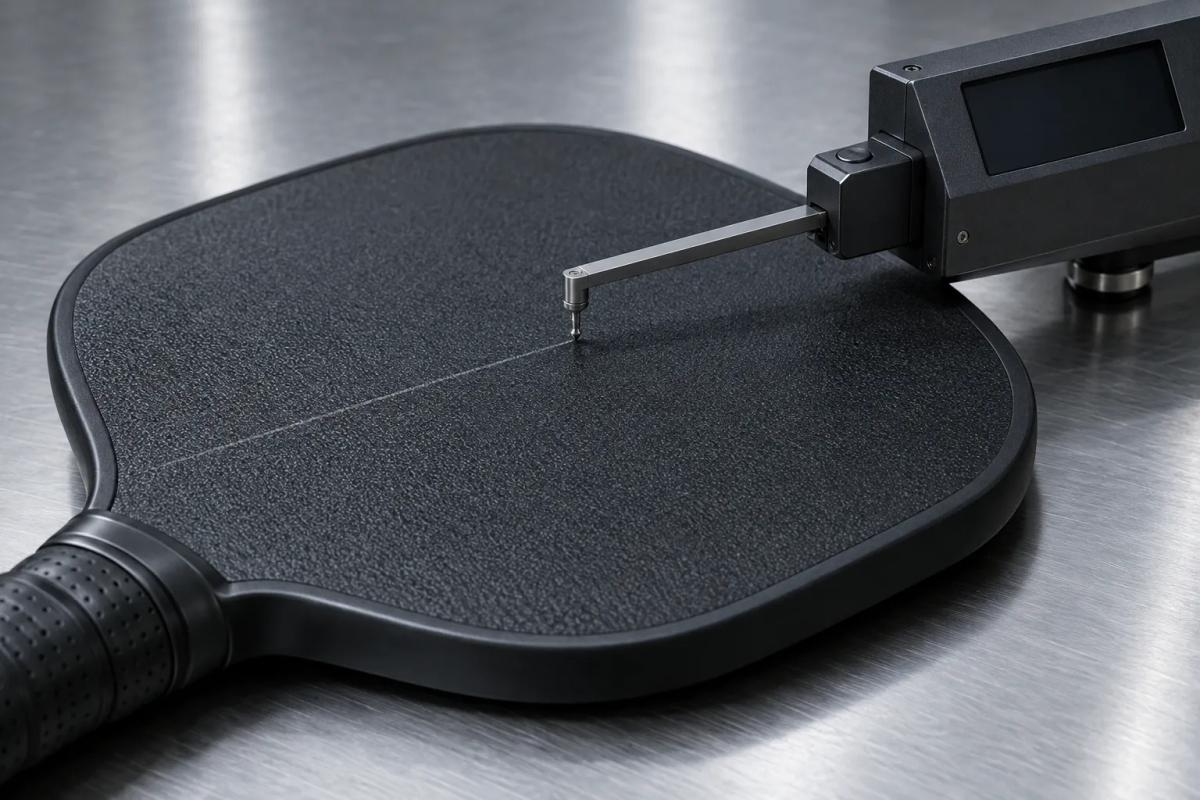
Clause 2.E.2.a.1 sets the method as tightly as the limit. A Starrett SR160 or SR300 surface roughness tester, or an equivalent, takes readings "in six different directions". The six values are averaged for that face, and each face has to meet the requirement on its own average. The data set is those six points, and no one of them may exceed 33 micrometres Rz or 44 micrometres Rt, which is 0.033 mm and 0.044 mm.
Three consequences follow, and a production spec usually misses them. Direction matters: a woven or peel-ply pattern can read differently across the weave than along. The face is the unit, so a paddle with a printed logo on one side and bare weave on the other is two measurements. And the spike rule beats the average, so one embedded particle can fail a face that reads low five times out of six.
Friction is a second, unrelated test. Clause 2.E.2.a.2 runs it in accordance with ASTM D1894-14, a method written to determine the coefficients of starting and sliding friction "of plastic film and sheeting", and passes a paddle at a kinetic coefficient of 0.1875 or lower. Two things follow from that scope. The number is a comparison against a fixed protocol, not a property of the paddle. The edition is specific too: the active edition of D1894 is the 2024 revision, while the manual still names the 2014 one. Testing runs through labs hosted at Element U.S. Space and Defense, reviewed by the Equipment Evaluation Committee.
Ask for the six raw readings per face, not the averages. An average hides the spike that fails a lot.
Where the Reading Moves Between Your Golden Sample and the Container
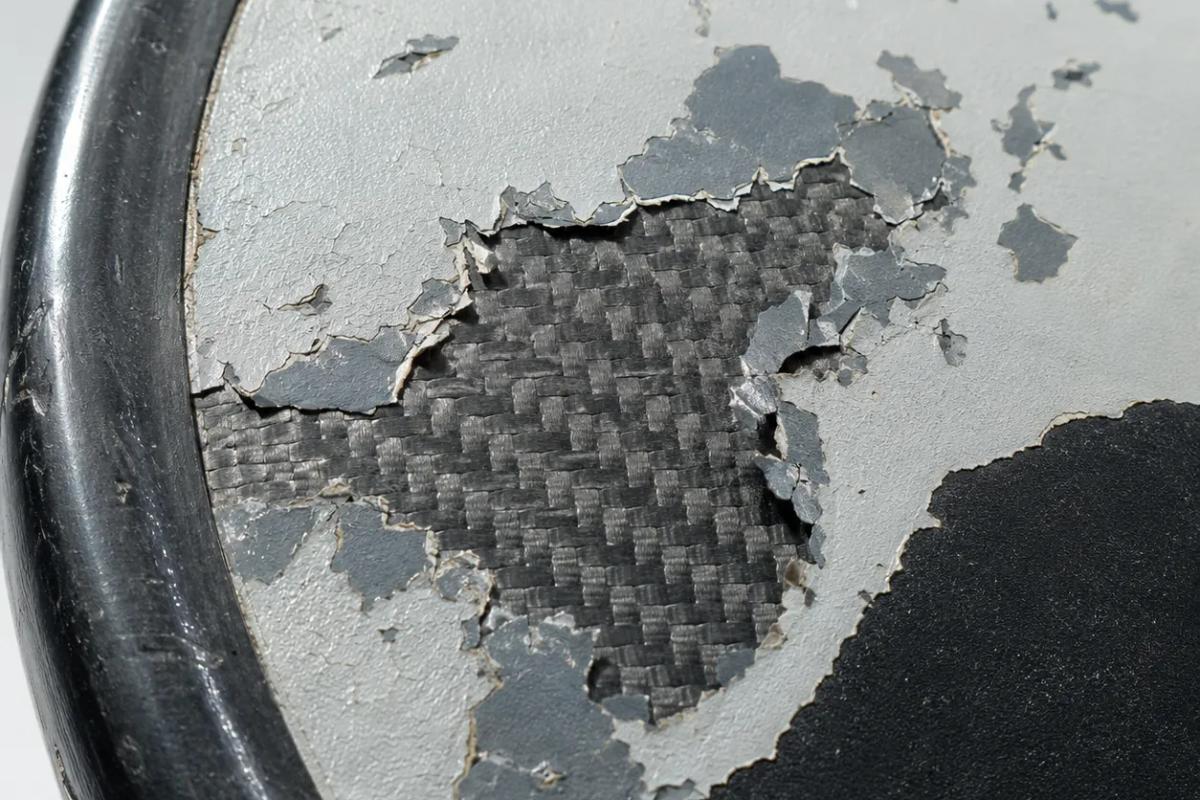
A passed sample is a snapshot of one face on one day. Clause 2.F.2 subjects manufacturers to ongoing compliance testing so that "all products as produced and sold are identical to the paddle that has been tested/certified". Clause 2.F.2.a goes further. Where a design has break-in periods or gradual change, the paddle must stay compliant across its entire useful life, "inclusive of any degradation to benefit". A finish that gets grippier as the resin wears is a compliance problem, not a feature.
Changing the finish is also a paperwork event. Clause 2.E.7 requires a unique name or number for paddles with a different core material, surface material or other significant differences. Adding a coating to an approved raw face creates a new model, not a new batch. Clause 2.E.6 closes the other door. Anti-skid paint, paint textured with sand, rubber or vinyl compounds, rubber surfaces and sandpaper characteristics are prohibited outright, and each is judged by the same three measurements.
Approval can also be withdrawn. Clause 2.F.1 allows revocation on 18 months' notice where equipment was materially changed or degrades under ordinary use. Specifications move through a Notice of Proposed Rulemaking to manufacturers, so a limit locked two seasons ago deserves a re-read before the next run.
This is where a texture decision stops being a styling choice. We build raw T700 carbon and fiberglass faces on 13 mm and 16 mm polypropylene honeycomb cores, with custom surface texture, through the OEM paddle programme, and the finishing step is the variable that moves a reading. Which texture to choose is a separate argument, made in our guide to paddle grit and spin. This page is about whether the face you chose can be proved legal.
The Spec-Sheet Lines, and What We Check Before a Face Ships
Most surface specifications say "USAPA compliant texture" and stop. That line cannot be checked, and a report written against it settles nothing. Seven lines make the reading verifiable, and every one comes out of clause 2.E.2. They slot into the surface block of a paddle specification sheet.
- Parameters: Rz and Rt, reported together. Ra or Sa alone is not a result against this specification.
- Limits: average 30 µm Rz and 40 µm Rt per face, no single reading above 33 µm Rz or 44 µm Rt.
- Sampling: six readings in six different directions on each face, averaged per face, both faces reported separately.
- Instrument: Starrett SR160 or SR300, or an equivalent named in the report.
- Friction: kinetic coefficient of friction of 0.1875 maximum, tested in accordance with ASTM D1894-14 as the manual names it.
- Gloss: 80 GU maximum at 60 degrees, on the edge guard as well as the face.
- Editions: name the manual revision and date, and the ISO edition the parameters were computed under.
What we document, and what we do not publish
Our side of that block is what a buyer can verify before a run starts. Full spec documentation is available, and every paddle passes QC before it leaves the line. The finish is fixed at golden-sample approval, not agreed in a chat thread, and the minimum is 50 paddles.
What we do not publish is an in-house Rz reading. We have not measured one under the six-direction protocol, and an invented number is worth less than none. Read every figure here, from 0.030 mm upward, as the published limit it is.
For private-label brands and importers specifying a paddle face from the 50-piece MOQ upward. The carbon build page lists the face and core options the spec lines above are written against.
See the 3K carbon paddle buildConclusion
Write the surface line as numbers and a method, not as a claim of compliance: 30 and 40 micrometres averaged per face, 33 and 44 as single-reading ceilings, 0.1875 kinetic friction, 80 GU of gloss, six directions on each face. The answer flips only when USA Pickleball moves the specification through a Notice of Proposed Rulemaking, so the revision and its date belong in the same sentence as the limit.
Before you ask a factory to price a textured face, have three things ready: the parameter pair you will accept in a report, the edition of each standard you are citing, and whether both faces are to be reported separately. Those three answers turn a texture conversation into a specification you can both check against the same document. The core-side equivalent sits in our rulebook decoder for paddle core legality.
Frequently Asked Questions
Is it legal to put sandpaper on a pickleball paddle?
No. Rule 3.D.5.c of the 2026 USA Pickleball Official Rulebook prohibits sandpaper characteristics on the hitting surface, and clause 2.E.6.c of the Equipment Standards Manual judges that prohibition by roughness, friction and restitution measurements.
What surface roughness does USA Pickleball allow on a paddle face?
An average of no more than 30 micrometres Rz and 40 micrometres Rt across six readings on that face, with no single reading above 33 micrometres Rz or 44 micrometres Rt, under Equipment Standards Manual clause 2.E.2.a.1.
Should a pickleball paddle be smooth or rough?
A legal face sits below the roughness and friction ceilings, so texture is bounded rather than open. Anything marketed as rougher than the competition is either inside those limits or outside the approved paddle list.
Does an Ra value prove a paddle face is compliant?
No. Clause 2.E.2.a.1 caps the peak-to-valley parameters Rz and Rt, and ISO 21920-2:2021 lists arithmetic mean height as a different parameter. A report quoting only Ra, or the areal Sa from ISO 25178-2, answers a different question.
Does adding a coating to an approved face create a new paddle model?
Clause 2.E.7 requires a unique name or number for paddles with a different surface material, so a coating change is a new model designation rather than a running change to an approved one.
Want to source this quality for your brand?
Contact our factory directly on WhatsApp for an instant MOQ and pricing quote.