Acoustic Barrier Fence for Pickleball Courts: What the Datasheet Must Say Before You Buy
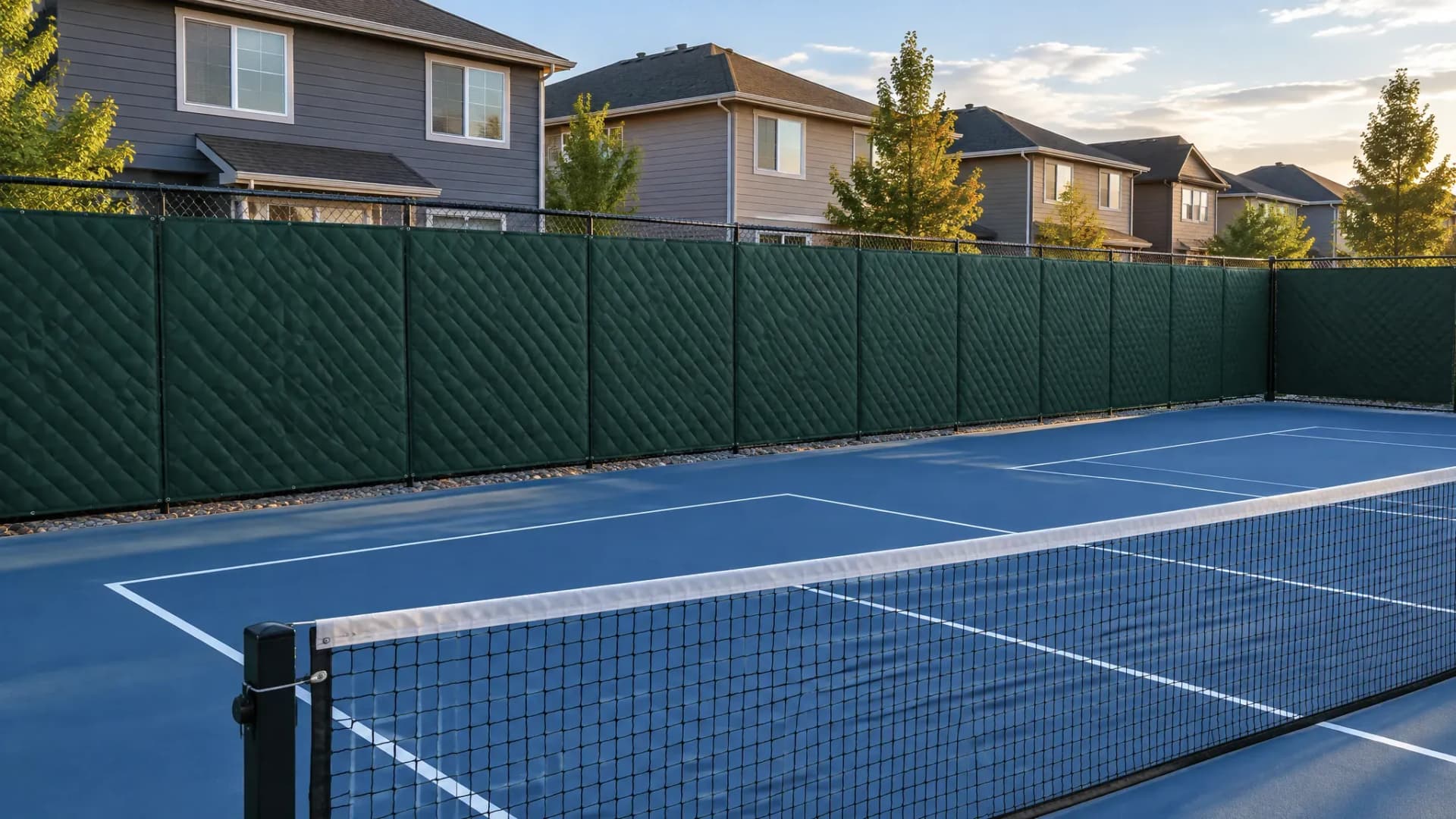
An HOA board has three quotes for acoustic barrier fence on the court side that faces the houses. One says "STC 28", one says "cuts noise up to 90%", one lists nothing but height. The datasheet you can compare has to state five things. STC comes from an ASTM E90 lab test rated under ASTM E413 (or Rw under ISO 10140-2), with the full transmission-loss curve. The rest are NRC from ASTM C423 for the court-facing side, surface density, the lab report number, and a fire and wind line. None of those is the drop the neighbours hear. That figure is insertion loss, set mostly by height and line of sight.
Key Takeaways
- STC is a lab rating of sound through the panel. ASTM E90-23 says it is not intended for field tests.
- NRC is absorption: the average of the 250, 500, 1000 and 2000 Hz coefficients, rounded to the nearest 0.05.
- FHWA: just breaking line of sight gives about 5 dB(A); each extra 1 m of height about 1.5 dB(A); a thin wall tops out near 20 dB(A).
- Acoustical engineers conservatively credit a pickleball court barrier with about 10 dB.
- Distance: a point source drops 6 dB(A) per doubling of distance, from spreading alone.
Cheddar's explainer on highway noise barriers, and how they can make traffic louder, comes from the same road-noise world as the FHWA rules used below.

Three ratings, three different tests
Acoustic fence datasheets mix numbers from different rooms. STC and Rw come from a two-room lab where the panel is the only path for sound. NRC comes from a reverberation room and measures how much sound the face soaks up. Insertion loss is measured at a house, before and after the barrier goes up.
| Rating | Test standard | Where measured | Use it to |
|---|---|---|---|
| STC | ASTM E90-23 test, E413-22 rating | Two-room lab | Rank panels against each other |
| Rw | ISO 10140-2:2021 test, ISO 717-1:2020 rating | Two-room lab | Compare European datasheets |
| DLR | EN 1793-2:2025 | Lab, reverberant rooms | Compare road-barrier products |
| NRC | ASTM C423-23 | Reverberation room | Judge echo between facing fences |
| Insertion loss | FHWA definition, site measurement | At the receiver | Predict what neighbours hear |
The standards say plainly where their numbers stop. ASTM E90 states that it "is not intended for field tests", sends field work to E336, and calls lab results an upper limit to what a field test would find. ASTM E413 built STC around speech, radio and television in offices and buildings, and says it is not appropriate for sources with very different spectra, naming machinery, music and road, rail and air traffic. The FHWA goes further: use of the STC rating is limited to interior wall structures.
A paddle strike is neither speech nor traffic. Tennis Warehouse University measured 110 paddles at 99 to 106 dB peak, one metre from impact, with 80% of the sound power below about 750 Hz. STC grades 16 one-third octave bands from 125 to 4000 Hz, so two panels with the same STC can differ in the low bands a paddle actually excites. Treat STC as a way to rank panels. It is not a prediction.
The datasheet fields to demand
Most acoustic fence pages on the first page of Google cite no test standard at all. A datasheet you can put in front of a board or a parks committee carries each of these lines, with the edition year and a report you can ask to see.
| Field | Method | Accept when | Verdict: reject when |
|---|---|---|---|
| Transmission loss | ASTM E90 / E413 | Curve 125 to 4000 Hz plus STC and report number | Only a percentage, or STC with no report |
| Absorption | ASTM C423, mounting per E795 | NRC for the court-facing face, mounting named | NRC quoted for a side facing away |
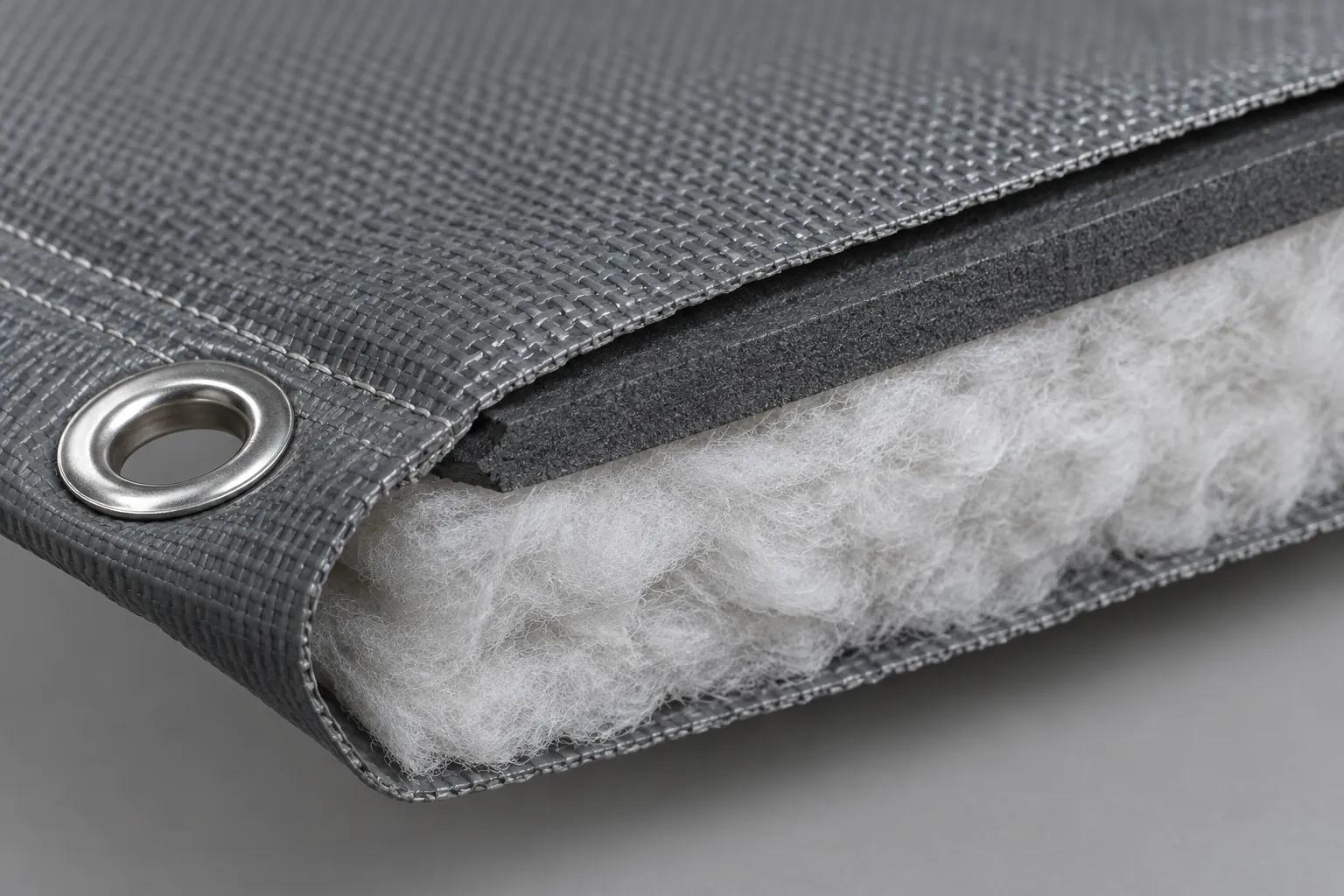
| Surface density | Weight per area | lb/ft² or kg/m² for the whole panel | Missing, or core layer only |
| Tested specimen | Report description | Same product and seam detail you are buying | Report is for another product |
| Fire | ASTM E84 (current E84-26a) | Flame spread and smoke indices stated | "Fire retardant" with no index |
| Wind and fixing | ASCE 7-22 Section 29.3 | Load on posts stated for your fence | "Fits any chain-link" |
Surface density is the quickest sanity check. The FHWA barrier handbook says any material weighing 20 kg/m² (4 lb/ft²) or more has a transmission loss of at least 20 dB(A), enough for a noise reduction of at least 10 dB(A) by diffraction. That is a highway rule. Pickleball Science puts a typical outdoor mass-loaded vinyl at 2 lb/ft², half that mass. A 2 lb/ft² blanket is not automatically wrong, but its measured curve has to carry the argument, because the rule of thumb no longer does.
European suppliers may quote DLR to EN 1793-2 for insulation and DLα to EN 1793-1 for absorption. Both are lab values for road traffic noise devices, so read them the way you read STC and NRC.
What sets the drop at the neighbour's house
The FHWA defines insertion loss as the level at a receiver before the barrier minus the level at the same receiver after it. Sound that goes through a good panel is small next to sound that bends over the top, so height and line of sight decide most of the result. The FHWA rules of thumb for highway barriers:
- About 5 dB(A) once the barrier just breaks the line of sight from source to receiver.
- About 1.5 dB(A) more for each additional 1 m (3.3 ft) of height above that.
- A maximum near 20 dB(A) for a thin wall, 23 dB(A) for an earth berm.
- Length: the distance from a receiver to the barrier end should be at least four times the perpendicular distance to the barrier.
On courts the working number is lower. Pickleball Science reports that acoustical engineers conservatively credit a pickleball court barrier with about 10 dB, because holes, flanking paths and reflections off nearby structures leak sound the lab never saw. A second-floor window that still sees the court over the fence gets little of even that. The model noise ordinance says as much, and our quiet equipment guide covers its limits.
Two courts fenced on facing sides add a problem NRC exists for. The FHWA reports that reflective parallel barriers can lose 2 to as much as 6 dB(A) each to sound bouncing between them. An absorptive court-facing side is what the NRC line on the datasheet buys.
| Rule of thumb | LoS break (FHWA) | 2x distance (FHWA) | Court est. (PB Sci.) | Thin-wall max (FHWA) |
|---|---|---|---|---|
| Credited attenuation | 5 | 6 | 10 | 20 |
Distance against height
Distance is the other lever. The FHWA gives 6 dB(A) per doubling of distance for a point source and 3 dB(A) for a line source. A single paddle strike behaves as a point source, so moving a court from 30 m to 60 m from a house takes about 6 dB(A) off by spreading alone, more than a fence that only just breaks line of sight. That figure is geometry only. ISO 9613-2:2024 adds air absorption, ground effect and screening, and it predicts levels for downwind conditions, so real sites move either way from the clean number.
Fitting it to an existing court fence
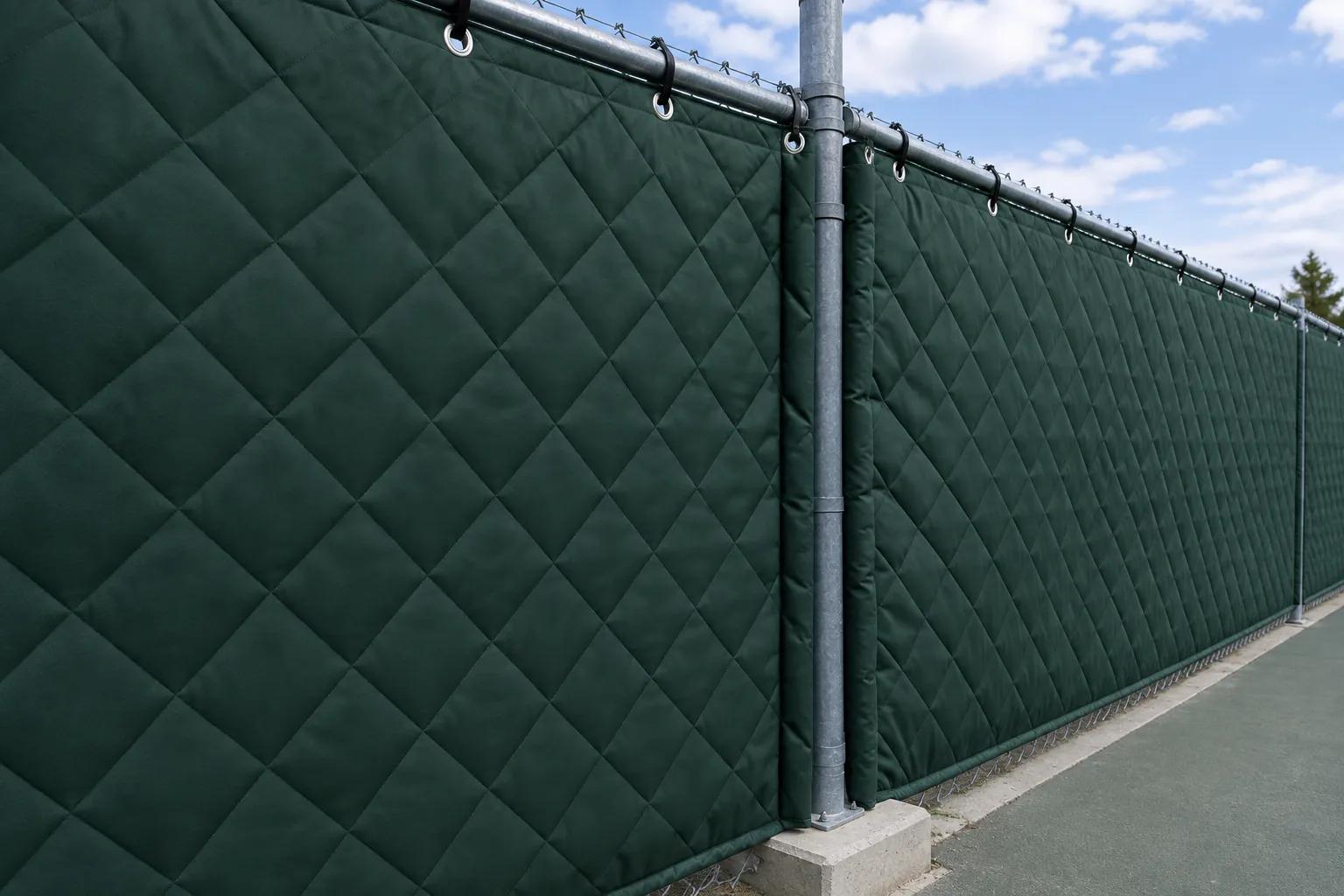
Most court barriers hang on chain-link that was designed to let wind through. Cover it and the fence becomes a solid freestanding wall, which ASCE 7-22 handles in Section 29.3 on design wind loads for solid freestanding walls and signs. Ask the supplier for the load their panel puts on each post at your site's design wind speed, and have an engineer check the existing posts and footings before anything is hung. Fence heights and runs around a battery are set out in our multi-court layout plan.
Lead time
Lead time has no published norm we could verify, so ask each supplier for production weeks and freight weeks as separate lines, and say whether custom heights, colours or printed panels change them. A single "ships fast" figure hides the part that slips. Our lead time guide explains how to read a split quote.
Where we stop
We do not make acoustic fence. We make the paddles and balls played behind it, as an OEM pickleball factory, and the equipment side of a noise complaint is covered in our quiet paddle guide for HOAs.
For clubs, HOAs and facility buyers ordering private-label paddles or rotomolded balls at wholesale volume, from a low MOQ.
See OEM paddles and ballsBefore you sign: five checks
- Report, not adjective. An E90 report number and the one-third-octave curve, for the product you are buying.
- Absorption on the right side. A C423 NRC for the court-facing face, with the mounting named.
- Mass stated. Surface density for the whole panel, read against the FHWA 20 kg/m² (4 lb/ft²) rule.
- Height drawn against sight lines. A section from court to the nearest window, showing whether the top breaks line of sight.
- Engineer and schedule. Post loads checked under ASCE 7-22 Section 29.3, and production and freight weeks quoted apart.
Frequently asked questions
Do acoustic fence panels work on pickleball courts?
Partly. Acoustical engineers conservatively credit a pickleball court barrier with about 10 dB, and only for receivers that lose line of sight to the court. Upper windows that still see the court get far less.
What STC rating does a pickleball court barrier need?
No standard sets one. STC is a lab rating that ASTM E413 ties to speech-type sources. Ask for the E90 transmission-loss curve instead; the FHWA treats 20 dB(A) of transmission loss as enough for 10 dB(A) of barrier reduction.
What is the difference between STC and NRC?
STC rates how much sound passes through a panel, from an ASTM E90 lab test. NRC rates how much the face absorbs: the average of the 250, 500, 1000 and 2000 Hz coefficients, rounded to the nearest 0.05.
Does distance reduce pickleball noise?
Yes. A point source drops 6 dB(A) per doubling of distance, from spreading alone. Ground, air absorption and wind then move the real figure either way.
Want to source this quality for your brand?
Contact our factory directly on WhatsApp for an instant MOQ and pricing quote.