Pickleball Edge Tape in Bulk: Fit, Weight and SKU Control
Buying pickleball edge tape in bulk starts with the finished paddle edge, not the core thickness on its label. Specify compatible paddle models, strip width and length, installed weight, cut profile and pack identification. Approve a physical wrap on each model before buying the assortment. Protection claims and attractive artwork cannot establish fit, service life or tournament compliance.
This guide is for a club, retailer or brand adding a protective accessory to an existing paddle range. It uses published manufacturer specifications and USA Pickleball equipment rules. It does not establish a tested DJW tape product, factory MOQ or delivery schedule. DJW’s paddle catalogue and OEM enquiry are starting points for a paddle discussion. Edge-tape supply remains unconfirmed: ask whether the exact accessory can be sourced before requesting its sample, quotation or production schedule.
Key takeaways
- Core thickness and finished guarded edge thickness are different dimensions.
- Compare named paddle-and-tape pairs; a universal fit label needs physical evidence.
- Protective tape adds installed mass even when it is not sold as weighted tape.
- Approve artwork and physical compatibility separately.
- Keep adhesive performance and protection claims separate from sporting legality.
- Label width, compatible models and pack count so a correct sample becomes a correct shipment.
This independent creator’s video introduces clear edge-tape application on a pickleball paddle. Use the physical sample and purchasing checks below to qualify fit for each paddle model.
Why thickness labels do not approve fit
A core dimension describes an internal construction choice. The tape must fit the outside of the finished paddle, including the guard, shoulders and curves it crosses. A retailer can stock several paddles advertised at the same core thickness and still need different wraps. Conversely, one tape can fit several core groups when their actual outside geometries are compatible. Neither possibility should be turned into a universal rule.
Published sizing conventions show the problem. Selkirk lists 15, 20 and 30 mm tape widths with recommendations tied to named paddle families. Edgy's custom wholesale page offers 23 and 26 mm; its 26 mm recommendation describes 15–16 mm cores with guards that typically bring the total edge thickness to 18–20 mm. Those are those suppliers' recommendations, not a conversion table for every paddle.
CRBN labels its options by paddle fit: 12–14 mm and a 16 mm option identified for its TruFoam paddles. A number can therefore name a target paddle family rather than the physical width of the strip. Before comparing quotations, ask whether the supplier's size field means strip width, intended core thickness or finished edge thickness. Record each dimension in its own column.
Start a compatibility record with the exact paddle model and revision, whether it has a guard, the measured outer edge profile and the intended coverage. Include the upper corners and the transition toward the handle. A sample that looks acceptable across a straight section can bunch at a corner or end awkwardly at the throat. Photograph the completed wrap beside the unwrapped reference paddle; do not accept a flat strip photograph as fit evidence.
Use geometry to screen, then wrap the paddle
A simple calculation can reject an implausible width before sampling. In an idealised flat cross-section, subtract the finished edge thickness from tape width and divide by two to estimate the material available to turn onto each face. This assumes a centred strip, a rectangular edge and no material consumed by curvature or stretching. Real guards violate those assumptions, so the result is a screening calculation, not the final face overlap.
Illustrative example, not a measured product: a 26 mm strip around an assumed 20 mm rectangular edge leaves 6 mm in total, or 3 mm per face if centred. Around an assumed 16 mm edge it leaves 10 mm, or 5 mm per face. The same tape creates different face coverage. A supplier saying “fits 16 mm” has not resolved which outside edge was used in that statement.
| Strip width | Assumed edge | Ideal overlap per face |
|---|---|---|
| 26 mm | 20 mm | 3 mm |
| 26 mm | 16 mm | 5 mm |
For USA Pickleball play, the official linked Equipment Standards Manual, revision 3.0, January 2025, permits edge guard tape among player alterations. It also requires the altered paddle to meet the specifications. Section 2.E.5.b limits tape to 0.5 inch inside the paddle's outer edge or, where fitted, inside the edge guard, and no farther than 1.0 inch above the grip.
Measure the installed paddle as well. ESM 2.E.3 limits combined length and width, including guard and butt cap, to 24 inches; length alone cannot exceed 17 inches. A narrow amount added around a perimeter still consumes dimensional room. The paddle dimensional-envelope guide owns the full sizing question. This accessory decision is whether the selected wrap preserves the already compliant configuration.
A wide strip is not automatically unlawful, and a narrow strip is not automatically satisfactory. Position, edge geometry and installed dimensions decide the relevant limits. Do not advertise that a tape option guarantees tournament eligibility for any paddle. A permitted alteration is conditional on the completed equipment continuing to meet the requirements.
Declare the installed configuration
Protective tape and weighted tape are different purchase intentions. They are not separated by a rule that protective tape weighs nothing. CRBN's protective tape listing states approximately 10 g per strip. That manufacturer figure is useful evidence that an ordinary protective accessory can have material mass; it does not establish the mass of another supplier's tape or the portion remaining after trimming.
For a bundle, distinguish bare-paddle weight, accessory weight supplied and paddle weight after application. Weigh the finished configuration using the actual cut length and overlap agreed for that model. A whole unused strip is not the installed mass when the customer trims it. The backing and packaging are not part of the paddle. Retain the measurement record rather than inferring mass from the shipping-weight field in an online listing.
The ESM places no paddle weight restriction, but that does not make mass irrelevant to a product promise. An advertised lightweight paddle bundle can arrive with a heavier usable configuration than the buyer expected. Choose whether the customer receives separate tape, a factory-applied wrap or a club-fitted wrap, then make the listing describe that configuration. Do not reuse a bare-paddle weight range as if it were the final wrapped result.
Where the sales promise includes a particular feel or weight band, evaluate the assembled configuration before release. Static mass alone does not establish swing weight, twist weight or a quantified playing benefit. No such performance change is measured here. Keep the existing paddle batch-weight specification for paddle production, and add a separate accessory/configuration field to the bundle record.
Define the adhesive and finish evidence
“Strong adhesive” leaves a receiving inspector with no usable decision. The adhesive has to bond to the actual guard or laminate surface, conform around the specified curves and behave acceptably during the intended storage and use. A stronger bond can also make removal less acceptable. Decide whether clean removability is a requirement and identify what residue, finish lifting or other change would fail that requirement.
Ask the tape supplier for its substrate preparation and application instructions, adhesive identification, storage requirements and declared shelf life. Match preparation to the paddle manufacturer's care instructions. Do not prescribe a solvent, heat treatment or waiting period because another brand's tape instructions mention one. The approved pairing must identify the compatible surface and method; changing either can change what the sample demonstrated.
Agree a repeatable evaluation with the supplier before judging performance. Record the actual paddle surface, application method, observation period, storage/use conditions and failure definitions. Corner lifting, wrinkling and removal residue can be observed without inventing a universal peel-force threshold. If a quantitative adhesive test is proposed, name its method, specimens, conditioning and acceptance level explicitly. This article supplies no validated numerical adhesive acceptance limit.
Do the same for protection claims. Tape that covers an edge is not evidence of a stated reduction in breakage or extended service life. Request the test or restrict the copy to what the product actually demonstrates. Structural cracks and delamination require their own equipment assessment; covering damage with tape is not a repair or compliance clearance. The guarded versus edgeless construction guide explains that different decision.
Finish belongs in the specification too. ESM 2.E.2.b addresses adverse reflection from paddles and edge guards and gives an 80 GU ceiling measured at 60 degrees. A glossy appearance does not provide a gloss reading. Request relevant evidence for the final configuration when making a compliance claim; neither a matte colour name nor a supplier's “tournament” tag proves that result.
Approve artwork and physical compatibility separately
An artwork proof answers whether the colour, repeat and logo placement match the intended design. It cannot answer whether the tape stays flat on a particular paddle. A physical sample answers a different question and must use the proposed strip construction, cut profile and adhesive. If the eventual production material changes after the proof, retain the artwork approval but repeat the affected physical checks.
For a multi-model order, use the following sequence. It is a procurement control proposal, not a tested factory service or a universal laboratory protocol. Give every pass and refusal an owner so a visual sample approval cannot silently authorise an untested model.
- Identify each paddle model, revision, outer edge and intended delivered configuration.
- Request actual strip dimensions, construction and model-specific fit recommendations.
- Apply the proposed sample by the agreed instructions; inspect corners, face overlap and installed dimensions.
- Record installed mass and evaluate adhesion/removal against the agreed conditions.
- If any requirement is unresolved, hold that pairing for correction; approve only the documented pairings.
- Freeze compatible models, tape revision, artwork and pack labels before bulk release.
For example, a club may have two guarded models with the same nominal core thickness. The supplier recommends one tape width for both. If the first wrap fits but the second lifts at the upper corners, the second pairing remains unapproved. The club can request a different cut profile or width, or omit that pairing. It should not average the results into “fits both” or approve the entire assortment from the easier sample.
This decision prevents a practical warehouse mistake: a visually identical colour option may conceal a different width or cut. Put the approved pairing on the purchase order rather than leaving it in an email photograph. A proposed adhesive, die-cut or supplier substitution requires review of the affected evidence before it becomes the next reorder.
Use the DJW paddle OEM enquiry to discuss the paddle model and delivered configuration. Ask separately whether a compatible tape option is available; no tape stock, MOQ or manufacturing capability is established by this guide.
Discuss your paddle configuration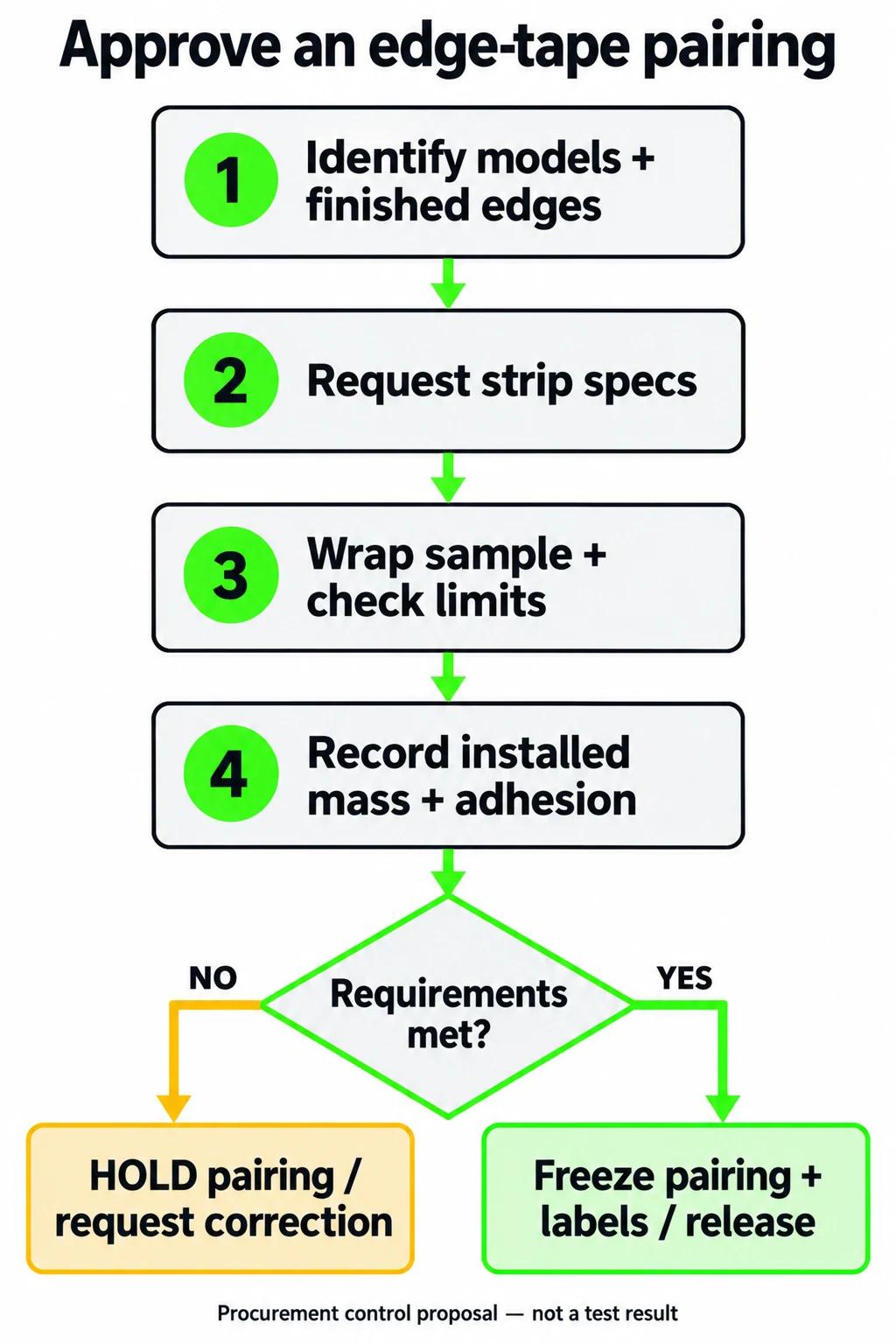
- Identify models + finished edges
- Request strip specs
- Wrap sample + check limits
- Record installed mass + adhesion
If requirements are unmet, hold the pairing and request correction. When all documented requirements are met, freeze the pairing and labels before release.
Copy this sample-pairing record
Complete one record per paddle model and tape revision. Blank fields are requests for evidence, not approved values. Send the completed record to the party actually supplying the tape; the paddle maker and tape seller may be different businesses.
| Field | Your record | Decision or evidence to retain |
|---|---|---|
| Paddle maker, model and revision | ________________ | Named finished paddle, not core thickness alone |
| Finished edge thickness and edge photographs | ________________ | Measurement location and guard profile |
| Tape supplier, product/revision, width, length and cut | ________________ | Actual candidate and retained sample identification |
| Dry wrap and corner fit | Pass / hold: ________ | Photographs of both faces, corners and overlap; note trimming |
| Installed mass and finished dimensions | ________________ | Record after trimming; check applicable equipment limits |
| Adhesion, removal and finish observation | ________________ | Agreed method, conditions, duration and observed result |
| Artwork, pack label and quantity | ________________ | Separate physical and artwork approvals |
| Buyer decision, name and date | Release / hold: ________ | Release only this pairing; record unresolved items |
If a required fit or finish observation fails, hold that pairing. If evidence is missing, leave the result pending. Approval of another paddle or a digital print proof does not fill the blank.
Build an assortment the warehouse can pick
Start with the compatible paddle groups, then decide finishes. Reversing that order produces a colour collection with unresolved fit. A SKU should identify the actual strip specification and pack format; a compatibility label should identify the approved paddle models. A core-thickness shorthand can remain a helpful search label, provided it does not replace the model-specific record.
For clubs with a mixed rental fleet, keep unapproved pairings out of the fitting stock. For retail, avoid a listing that implies one pack covers every model simply because the supplier markets it as universal. For a private-label bundle, confirm whether the tape arrives installed or loose and whether the buyer is expected to trim it. Those choices change assembly responsibility, instructions and the disclosed product configuration.
| Record | Why it changes the decision | Release evidence |
|---|---|---|
| Compatible models and revisions | Same core label can conceal different guards | Completed pairing record |
| Strip width, length and cut | Controls coverage and curve behaviour | Physical sample dimensions |
| Installed configuration and mass | Defines what the customer actually uses | Finished wrapped-paddle record |
| Adhesive, finish and removal criteria | Limits unsupported durability claims | Agreed evaluation and observations |
| Pack count and variant label | Prevents correct samples becoming wrong picks | Approved physical pack and receiving check |
Count the sellable unit explicitly: an individual strip, a multipack and a roll are not interchangeable. Edgy's published custom listing discusses its existing branded packaging and asks buyers to discuss logo removal. That example shows why custom artwork should not be interpreted as unbranded packaging. Confirm the inner pack, instructions and branding separately from the printed strip.
At receipt, compare the delivered variant labels and pack counts with the approved record and retain identification for the lot. Quarantine a width or revision that cannot be identified. A claim of compatibility is only useful if the warehouse can connect the stock to the evaluated pairing. The private-label packaging guide handles the wider packaging programme; this record keeps a small accessory from becoming an untraceable substitute.
Conclusion
Release a bulk edge-tape order when the paddle models, physical wraps, installed configuration and pack labels agree. Use supplier sizing advice to choose candidates, geometry to screen obvious mismatches and actual samples to approve the pairing. Keep unknown adhesion, protection and availability claims out of the sales promise. The result is a manageable accessory assortment with a documented reason for each compatibility label.
Frequently asked questions
Does 16 mm tape fit every 16 mm paddle?
No. A size label may describe the target core rather than strip width. The finished guard geometry and actual wrap determine compatibility.
Is protective edge tape weightless?
No. CRBN publishes approximately 10 g per protective strip. Another product or trimmed installation needs its own mass measurement.
Does edge tape make any paddle tournament legal?
No. USA Pickleball permits edge guard tape as an alteration, but the finished paddle must still meet the applicable equipment specifications.
Can a digital artwork proof approve a bulk tape order?
It approves artwork only. Model-specific fit, installed mass, adhesive behaviour and physical pack identification need separate evidence.
Confirm edge-tape availability first
This guide does not confirm that DJW supplies edge tape. Ask whether the required tape can be supplied before requesting model-specific samples. Send paddle model, finished edge width, tape dimensions, estimated quantity and destination. Availability, suitability, MOQ, pricing and lead time require confirmation; no response time or shipping service is promised.