Paddle Weight Tolerance: Holding a Batch Band in Production

The spec sheet said 8.0 oz. The samples were 8.0 oz. The production run arrives, your warehouse pulls six paddles off the top of the carton, and they read 7.7, 8.3, 8.0, 8.4, 7.8 and 8.1. Nobody lied to you. There was simply never a sentence in your purchase order that made any of those readings wrong.
This is the most common specification failure in private-label paddle manufacturing, and it is not caused by a bad factory. It is caused by a number written without a band. A target weight tells a production line what to aim at. It does not tell anyone what to do with the paddles that miss.
What follows is where those grams actually come from — traced through the bill of materials with published supplier tolerances rather than guesswork — and then the two procedures that fix it: how to write a weight tolerance a factory can be held to, and how to test whether a supplier's promise about one is real before you place the order.
Key takeaways
- No governing body limits paddle weight. The 2026 USA Pickleball Rulebook, Rule 3.D.3, reads in full: "There is no restriction on paddle weight." There is no regulatory backstop to catch a drifting batch — your specification is the only limit that exists.
- The core is the largest single source of variance, and it is bought that way. Polypropylene honeycomb is sold against a published density tolerance of ±10%, not an exact density. That tolerance is in your paddle before anything is pressed.
- Weight enters at six places — core, face laminate, adhesive bondline, edge guard, grip wrap and butt cap — and the variances stack rather than cancel.
- A tolerance without a measurement method is not enforceable. State the target, the band, whether the band applies per paddle or to the run average, and the as-shipped condition being weighed.
- Tightening the band raises the unit price rather than lowering it. A narrower window rejects more of an unchanged distribution. That is a sorting cost, and somebody pays it.
- This article gives you no factory's tolerance figures, including ours. It gives you the evidence to demand so that any supplier's claim becomes testable.
On this page
- No Rule Sets Paddle Weight — Which Is Exactly Why Your Spec Sheet Has To
- Where a Paddle's Grams Actually Come From
- The Number on the Product Page Is a Spec, Not a Measurement
- How to Write a Weight Tolerance Clause a Factory Can Be Held To
- How to Verify a Supplier's Tolerance Claim Before You Commit
- Why a Tighter Band Costs More, Not Less
- Matching Weights Across a Batch: What to Ask For by Order Type

No Rule Sets Paddle Weight — Which Is Exactly Why Your Spec Sheet Has To
Most paddle specifications lean on the rulebook somewhere. Face roughness, length, thickness, prohibited surface features — a buyer can point at a clause and say the factory must comply. Weight is the exception, and the exception is total.
Rule 3.D.3 of the 2026 USA Pickleball Official Rulebook reads, in its entirety: "Weight. There is no restriction on paddle weight." The Equipment Standards Manual repeats it independently at section 2.E.4 in the same words. Two separate governing documents, and neither imposes a gram, an ounce or a band.
Compare that with the dimensions immediately above it. Rule 3.D.2 caps combined length and width at 24 inches (60.96 cm) including edge guard and butt cap, and paddle length at 17 inches (43.18 cm). Those are hard numbers with a testing regime behind them. Weight has nothing.
The practical consequence is worth stating plainly, because it is the reason this article exists. On a regulated parameter, a factory that drifts eventually gets caught by somebody else's test. On weight, nobody is testing. If your purchase order does not carry a band, there is no external mechanism anywhere in the system that will catch a batch running heavy — not the certification, not the approved paddle list, not an inspection booked against the rulebook.
The certification does not do what buyers assume. Rule 3.D.1 requires an approved model to carry a brand and model marking plus the "USA Pickleball Approved" seal, with the model listed on the USA Pickleball Approved Paddle List. Approval attaches to a model on a list. It says nothing about whether the unit in the carton matches the unit that was submitted for testing, and it certainly says nothing about weight, which is unrestricted anyway. Certification and batch consistency are unrelated commitments, and only one of them is something you can buy in a contract.
Where a Paddle's Grams Actually Come From
A paddle looks like one object, so buyers reason about its weight as one number. The factory experiences it as a stack of purchased inputs, each arriving with its own tolerance, assembled by processes that add mass of their own. Understanding that stack is what turns "why are these different" into a set of answerable questions.
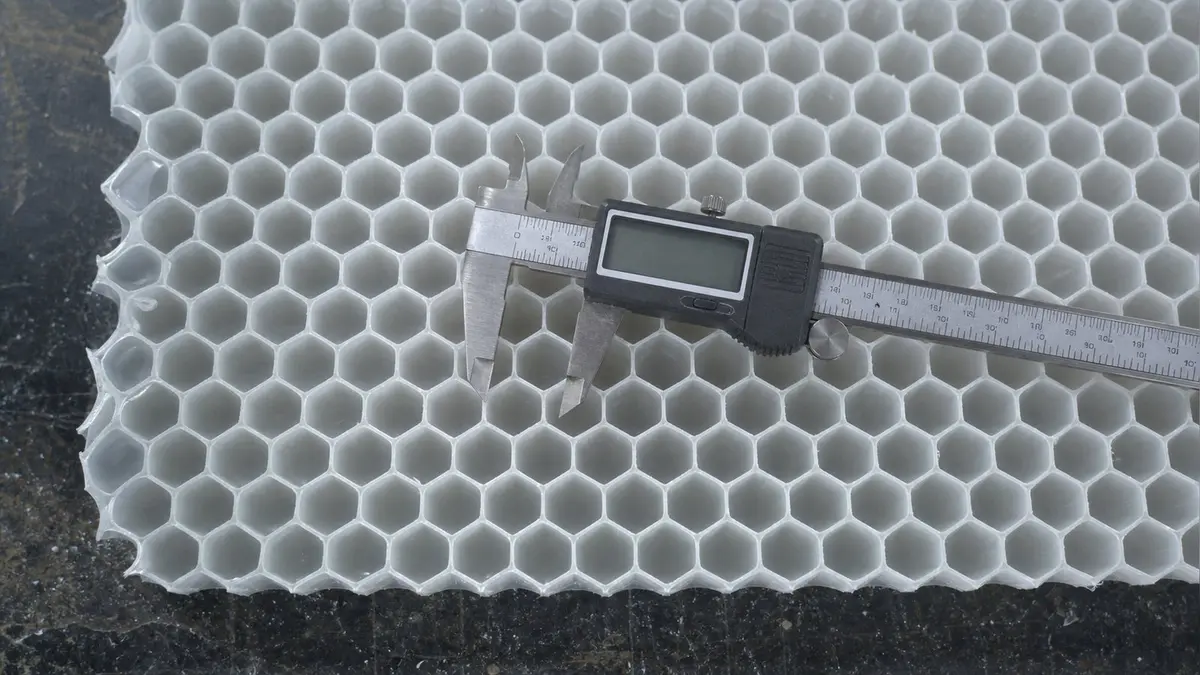
The core: bought against a tolerance, not a number
The polypropylene honeycomb core is the largest single contributor, and the reason is that core is not sold by weight at all. It is sold by density, and density carries a published tolerance. Plascore's polypropylene honeycomb, offered from 2.5 to 12.0 pcf, specifies Density: ±10% alongside Cell Size ±10% and Thickness ±.02 inch. The same ±10% density convention appears on the company's aerospace-grade PN2 aramid honeycomb, so this is a materials-industry norm rather than one supplier being loose.
Read that as a buyer. Two core sheets, both perfectly within specification, both invoiced as the same product, can differ in mass by a fifth of their nominal weight relative to each other. A paddle maker publishing on this openly puts the same figure on it: Brick House Paddles states that "one of the largest contributors is the core material which can vary by as much as +/- 10% or roughly 0.4 to 0.5oz per paddle." A factory cannot buy that variance away. It can only sort around it after the fact.
The face laminate: two ranged variables, not one
Composite face material carries two independent quantities that both affect mass. Toray's 3900 prepreg system is offered with fiber areal weight from 70 g/m² to 300 g/m² and resin content from 34% to 44% by weight. Fiber areal weight is normally locked by your specification. Resin content is the one buyers never think about, and it moves the finished face weight without changing a single line on the spec sheet.
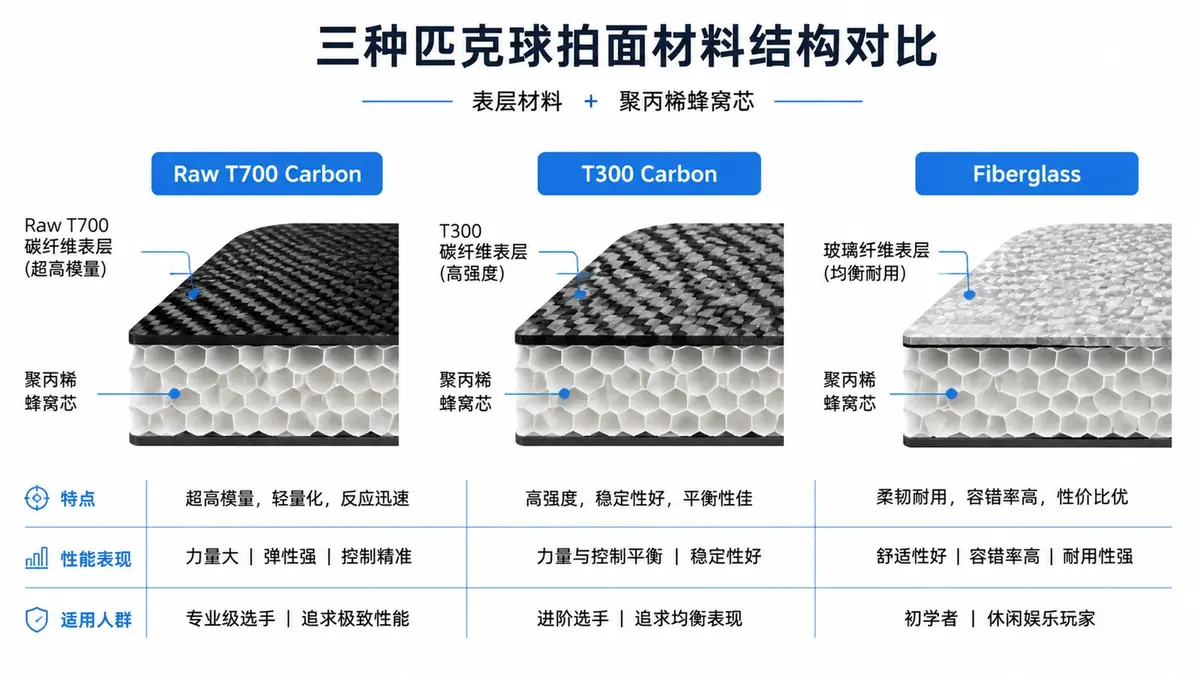
The bondline: the contributor nobody writes down
This is the one that separates a real answer from a guess, and no consumer-facing article on paddle weight mentions it. The adhesive holding the face to the core is itself specified by areal weight. Hexcel's bonding guidance states that "for good overall properties and bonding to honeycomb core, areal weights of film adhesives in the range 150-400 g/m² should be used," with lightweight film of 60-150 g/m² adequate "when close tolerance joints are achievable."
That is a span of more than sixfold, across a surface roughly the size of the paddle face, on both sides of the core. Adhesive quantity is a genuine process variable — a lever a line can pull for bond quality, for pressing consistency, or simply because a different operator laid it differently. It is also a lever that moves finished weight, which is why a factory can hold every documented input constant and still see the output drift.
The trim: small, constant, and the easiest thing to get wrong
Edge guard, grip wrap and butt cap are the last mass to go on and the least controlled, because they are consumables applied by hand. Grip wrap in particular is cut to length, and Selkirk names the mechanism directly in its own weight guidance: "a little more adhesive used on this paddle, a little less grip length on this one."
The part buyers get backwards: these variances do not average each other out. Each input varies independently, so a paddle can draw a heavy core, a resin-rich face, a generous bondline and a long grip wrap all at once. Those are the units at the edges of your distribution, and they are the ones your customers complain about. The spread is what you are buying when you buy a tolerance — not the average, which usually looks fine.
| Where mass enters | Published tolerance or range | What to ask your supplier |
|---|---|---|
| Honeycomb core | Density ±10% (Plascore PP and PN2 aramid) | Which core supplier, and is incoming density checked per lot or taken on the certificate? |
| Face laminate | FAW 70–300 g/m²; resin content 34–44% (Toray 3900 system) | Is resin content fixed by the material spec, or does it float within the supplier's range? |
| Adhesive bondline | Film adhesive 150–400 g/m² typical for honeycomb bonding (Hexcel) | Is the adhesive areal weight a controlled document, and is it the same on both faces? |
| Edge guard, grip, butt cap | Hand-applied consumables; no published band | Is the paddle weighed before or after grip fitting, and which state does my tolerance apply to? |
None of the numbers above are ours, and that is deliberate. They come from the technical data sheets of the material suppliers who sell into this industry, which means you can look them up, put them in front of any factory, and ask the questions in the right-hand column without taking anyone's word for it. If you want the construction context behind these inputs, our explanation of honeycomb core cell size and the comparison of thermoformed versus cold-pressed construction cover how these layers go together.
The Number on the Product Page Is a Spec, Not a Measurement
There is a gap between the weight printed on a listing and the weight of the object in the box, and the industry is fairly open about it once you look at who measures independently. Pickleball Studio, which maintains a database of 352+ paddles it measures itself, states the position bluntly: "Manufacturers often list advertised specs that can differ from the actual paddle you receive."
That is not an accusation of dishonesty. A published weight is a design target. The unit you receive is a manufacturing outcome. Both can be accurate descriptions of different things, which is exactly why a purchase order needs to say which one it is buying.
Centre of band versus spread within the batch
Here is the distinction that decides whether your clause binds, and it is the one most often missed. "8.0 oz ±0.25 oz" can mean two completely different commitments:
- Every paddle falls between 7.75 and 8.25 oz. This constrains the spread, and it is the expensive one, because it requires the factory to do something about the units that miss.
- The run average is between 7.75 and 8.25 oz. This constrains nothing a customer can feel. A batch of paddles at 7.4 and 8.6 oz averages 8.0 and satisfies the clause completely.
A factory quoting against the second reading and a buyer imagining the first will both believe they agreed. The disagreement surfaces after the container lands, when the arithmetic is on the factory's side. Write which one you mean, in the sentence itself.
Why the average is almost always fine
There is a reason this failure is so persistent: the average genuinely is correct most of the time. A line aiming at 8.0 oz with inputs varying symmetrically around their nominal values will produce batches averaging very close to 8.0 oz, run after run. The mean is the easy thing to hit, and a factory reporting it is not being evasive.
The customer experience, though, is not built from the mean. It is built from the paddle a specific person opened, and complaints come from the tails of the distribution. This is why a buyer can receive a batch that satisfies every number in the contract and still field returns — the contract measured the thing that was never going to be wrong. When you ask a supplier for evidence in the next section, ask for the spread, because the average will always look reassuring.
How to Write a Weight Tolerance Clause a Factory Can Be Held To
A weight tolerance needs four elements. Miss any one and the clause degrades into a target, which is where this article started.
- The target and the band, with the band's scope stated. Not "8.0 oz" but "8.0 oz, every individual paddle within ±X, verified per the sampling plan below." The phrase "every individual paddle" is doing the work.
- The as-shipped condition being weighed. Grip fitted or bare? Edge guard on? Plastic wrap and hang tag included or excluded? Trim items are real mass, and if you do not name the state, the factory will weigh in whichever state it already weighs.
- The instrument and its resolution. A scale reading to 1 g and a scale reading to 0.1 g will disagree about whether a borderline paddle passed. Name the resolution and require calibration records.
- The remedy. What happens to a lot that misses — rework, sort at the supplier's cost, price adjustment, or rejection. A clause with no consequence is a preference.
Keep this compact. It is four lines on a specification sheet, and it belongs alongside the rest of your parameters rather than as a separate document; our paddle specification checklist covers the surrounding rows. If you are still choosing which weight figure to specify in the first place — static weight, swing weight or twist weight are three different numbers serving three different buyers — start with swing weight explained and twist weight, then come back and put a band on whichever one you locked.
One deliberate omission: this article does not tell you which band to write. A number pulled from an article and dropped into your purchase order commits your supplier to something neither of you has costed. The band is an outcome of the conversation in the next section, and it belongs in a quotation where it has been priced. When you take that conversation to a factory, an OEM paddle programme that runs golden-sample approval before mass production is the setting where a band gets agreed and recorded rather than assumed.
How to Verify a Supplier's Tolerance Claim Before You Commit
Every factory will say yes. Tolerance claims are cheap to make in an email and expensive to hold on a line, and the gap between the two is where your margin goes. Competitor sales material advertises specific bands freely — one OEM's public checklist claims "±0.1 oz across all paddles" for premium work while attributing "±0.3–0.5 oz, high variance between batches" to budget factories. Treat any such figure, including any figure a supplier quotes you, as a claim that has not yet been evidenced.
Five requests separate a real capability from a confident email. None of them requires you to be in the building.
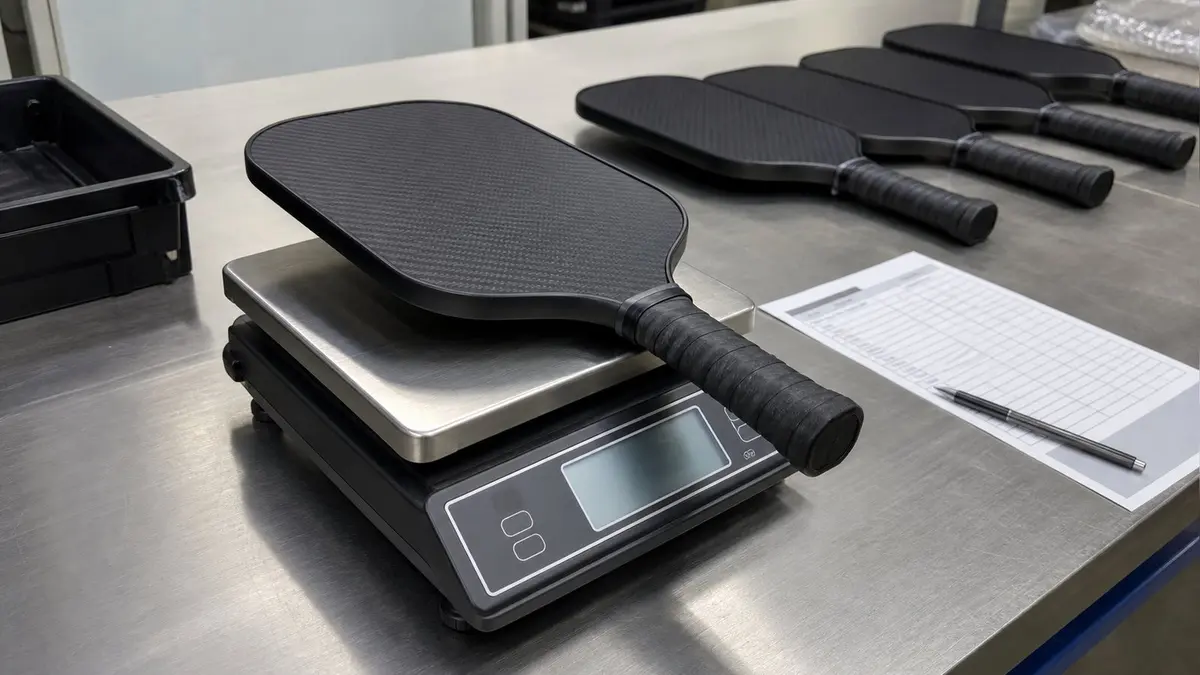
1. Ask for the golden sample's recorded weight
Not the design weight — the actual measured weight of the approved sample, written down. A supplier who runs a golden-sample process will have this. A supplier who does not will send you the spec sheet number again, which tells you what you needed to know.
2. Ask for consecutive units, not a selection
Request the weights of a run of paddles as they came off the line — twenty consecutive units, in order. A curated set of five proves only that five paddles exist somewhere near the target. Consecutive units show you the spread, which is the thing you are actually buying.
3. Ask which instrument, and when it was last calibrated
A weight record without an instrument behind it is a number in a spreadsheet. This question is also a fast character test: a factory running real weight control answers it immediately, because the answer is a piece of equipment it owns and a certificate it renews.
4. Ask what happens to out-of-band units
This is the highest-yield question on the list. A band is only real if something happens to the paddles that fall outside it. If the answer is vague, or if it turns out those units ship anyway into the same order, then the band was never a control — it was a description of where most paddles happen to land. Ask specifically whether out-of-band units are re-sorted into a different grade, held for another order, or scrapped, and who absorbs that cost.
5. Discount any band quoted without a method
"±0.1 oz" on its own is marketing. "±0.1 oz per individual paddle, bare weight before grip fitting, verified on a 0.1 g scale calibrated quarterly, out-of-band units pulled and re-sorted" is a commitment. The difference is not pedantry — it is the difference between a sentence you can enforce and a sentence you can only be disappointed by.
Who this is for: private-label brand owners, importers and procurement buyers working to a paddle MOQ who already have a target weight and now need a supplier to commit to a band in writing. Our OEM paddle programme runs golden-sample approval as a standard stage, followed by pre-despatch QC. That approval step is where a weight band gets recorded against an approved reference unit rather than agreed in an email.
Why a Tighter Band Costs More, Not Less
Buyers routinely assume that a tighter tolerance is a sign of a better factory and should come free with a better factory. The mechanism runs the other way, and understanding it will save you an argument during quotation.
Tightening a band does not change the distribution coming off the line. The core still arrives at ±10% density, the resin content still floats, the bondline still varies. What changes is how much of that unchanged output now falls outside the window. Narrow the window and you reject more of the same production — and those paddles do not evaporate. They are re-sorted into another grade, held for a different order, reworked, or scrapped. Somebody handles them, and somebody pays for the handling.
The market prices this openly, which is the clearest evidence available that it is real. Selkirk sells a guaranteed weight range as a selectable option: "The weight range guarantees you will get a weight within 0.2oz. For example, if your target weight is around 7.6oz, you can select a guaranteed weight range of 7.5oz - 7.7oz and you are guaranteed a 7.6oz paddle +/- 0.1oz." A consumer brand does not build a selection mechanism around a tolerance unless holding that tolerance costs something worth recovering.
This article deliberately gives no price figures, and that is not evasion — a tolerance band has no standalone price structure to quote. What it has is a set of cost drivers, and those are worth naming so you can read a quotation properly:
- the width of the band relative to the factory's natural spread;
- the order quantity available to sort against;
- whether out-of-band units can be absorbed into another grade or become dead stock;
- whether individual weights must be recorded per unit.
Ask a supplier to price the same paddle at two different bands. The difference between those two numbers is the only honest figure in this discussion, and it is specific to your paddle, your quantity and that factory.
So the sensible question at quotation is not "how tight can you go." It is "what does each step tighter do to my unit cost and my lead time, and at which step does it stop being worth it for the paddle I am actually selling." Ask for the band as a priced option rather than a promise, and you will learn more about a factory's real capability from how it answers than from the number itself.
Matching Weights Across a Batch: What to Ask For by Order Type
Weight matching is not a universal virtue to be maximised. It is a feature with a cost, and whether you should buy it depends entirely on what happens to the paddle after it leaves your warehouse.
| Order type | What actually matters | What to specify |
|---|---|---|
| Rental and club fleets | Consistency between paddles, not proximity to a target. Players swap paddles mid-session. | A spread limit across the fleet. The centre value matters less than the range. |
| Private-label retail | The band on your printed spec is a public promise. Returns cite it. | A per-paddle band no wider than what your own packaging claims. |
| Tournament and pro-level | Matched pairs and repeatability for players who tune with lead tape. | A tight per-paddle band plus recorded individual weights, priced as an option. |
| Promotional and entry-level | Almost nothing. The end user will not measure and will not notice. | A wide band stated honestly. Do not pay for sorting you cannot monetise. |

Who should not buy a tight band: if you are selling into promotional channels, gift sets or entry-level retail, a tight weight tolerance is a cost you will not recover. Spend it on face durability or edge guard adhesion instead, where a failure generates a return and a weight variation does not.
A worked example you can reuse
A brand launching a club-fleet paddle wants weight consistency but has no idea what to ask for. Rather than naming a band, they send three suppliers the same four questions: what weight was recorded against the approved golden sample, what did twenty consecutive units from any recent run weigh, what is the scale resolution and last calibration date, and what happens to units outside the stated band.
Supplier A returns the spec sheet figure again and a sentence saying quality is guaranteed. Supplier B returns five weights, all within 0.05 oz of each other — a curated set, which tells you five paddles were selected, not that twenty consecutive ones would look like that. Supplier C returns twenty consecutive readings with a visible spread, names a 0.1 g scale, and says out-of-band units are pulled and held for a lower-tier order.
Supplier C looks the worst on paper and is the only one demonstrating a process. The spread is honest, the instrument is real, and the disposal route for rejects exists — which means the band is a control rather than a description. That is the read the five questions are designed to produce, and it is available before anyone quotes.
Order size decides whether sorting is even possible
Order size interacts with all of this, because sorting is only economic if there is a run to sort. Our published catalogue MOQ for paddles is 50 pcs, which is a low bar for entering production but a small population to sort against — a batch that size has limited room to reject units and still fill the order.
If matched weights are central to your product, discuss the tolerance and the quantity in the same conversation rather than separately. Our production timeline guide shows where sorting and QC sit in the schedule, and the 3K carbon paddle page publishes that MOQ alongside the construction it applies to.
Where we stop
This article quotes no tolerance band for our own production, and that omission is deliberate rather than coy. Publishing a band means publishing the measured spread behind it, and any figure not backed by recorded production data would be marketing dressed as engineering — which is exactly what the five questions above are designed to detect in anyone else. Apply them to us on the same terms: ask what was recorded against the golden sample, ask for consecutive readings, ask which scale and when it was last calibrated, and ask where out-of-band units go. A supplier worth using should be improved rather than embarrassed by the question.
What to Do Next
Weight is the one paddle parameter with no regulator behind it. Rule 3.D.3 leaves it entirely to you, which means the quality of your outcome is determined by the quality of one clause and one conversation.
Three actions, in order:
- Decide which weight you are specifying — static, swing or twist — and whether your band applies per paddle or to the run average. Write that sentence before you contact anyone.
- Send the five verification questions to every supplier on your shortlist, in the same email, and compare the answers rather than the claims. The one who answers question four concretely is the one running a real process.
- Ask for the band as a priced option at quotation, not as a promise after the fact, and match the tightness to what your channel can actually monetise.
Frequently Asked Questions
Does USA Pickleball set a maximum paddle weight?
No. Rule 3.D.3 of the 2026 Rulebook states there is no restriction on paddle weight, and the Equipment Standards Manual repeats this at section 2.E.4. Length and combined dimensions are capped; weight is not.
Why do two paddles of the same model weigh different amounts?
Because the inputs are bought against tolerances. Honeycomb core carries a published density tolerance of ±10%, face resin content varies within the material's range, and adhesive is specified across a broad areal-weight band. Those differences stack.
What weight tolerance should I ask for?
Ask for it as a priced option rather than adopting a number from an article. What matters more than the figure is stating whether it applies to every paddle or to the run average, and naming the weighing method.
Does a USA Pickleball approved paddle guarantee batch consistency?
No. Approval attaches to a model listed on the Approved Paddle List under Rule 3.D.1. It is not a per-unit conformity check, and since weight is unrestricted, it carries no weight commitment at all.
Is a tighter weight tolerance cheaper because it means better quality?
No, it costs more. A narrower band rejects more of an unchanged production distribution, and those units must be sorted, regraded or scrapped. That handling cost appears somewhere in your unit price.
Should the paddle be weighed with or without the grip?
Whichever you specify — but you must specify it. Grip wrap is cut to length and applied by hand, so bare and fitted weights differ, and an unstated condition means the factory weighs in whichever state it already uses.
Want to source this quality for your brand?
Contact our factory directly on WhatsApp for an instant MOQ and pricing quote.