Pickleball Net Fabric: Denier, UV Testing and Mesh Specs
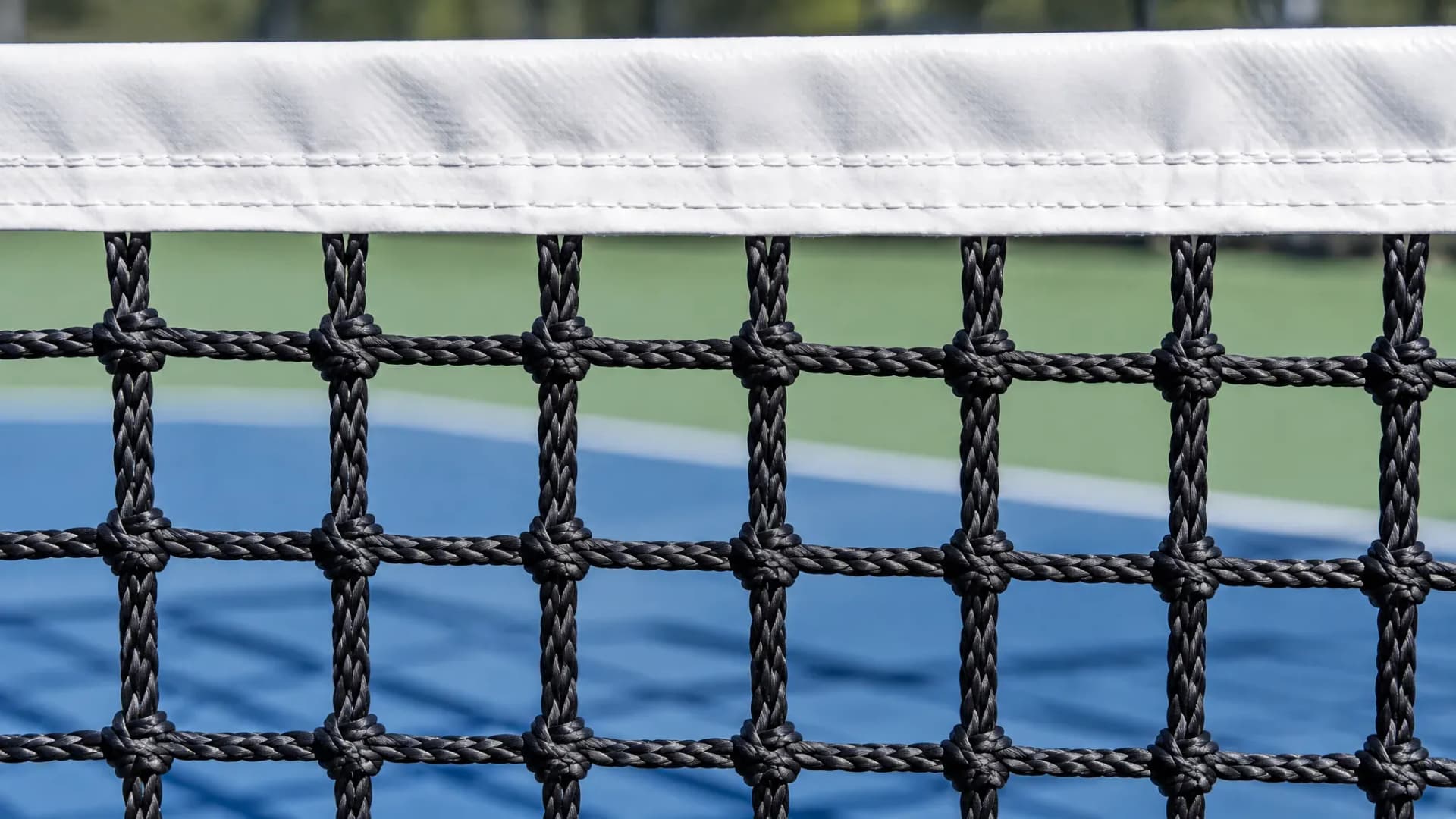
A club replacing nets on eight outdoor courts asked three suppliers for the same thing and got three vocabularies: a denier figure with the words UV treated; 3.0 mm braided polyethylene at 285 lb breaking strength; and heavy duty, weather resistant. Only the middle quote is a specification. Denier is a unit of linear mass density, defined under the ISO 1144 Tex System as grams per 9,000 metres of yarn, so it records polymer per length of yarn and nothing about the force that yarn carries. The rulebook adds almost nothing. Rule 3.B.1 reads, in full, that the net may be made of any mesh fabric material that will not allow a ball to pass through it.
Everything else gets written by the buyer or by nobody. The five lines below are what turns a net quote into a checkable document.
Key Takeaways
- Denier is mass, not force. One denier is one gram per 9,000 m of yarn (ISO 1144); ASTM D1907/D1907M-12(2018) measures it and holds no strength test.
- Mass buys less force than you would guess. Across one maker’s tiers, 3.0 mm to 3.5 mm is 36% more cord cross-section for 14% more breaking strength, 285 lb to 325 lb.
- The rulebook governs eleven words of fabric. Rules 3.B.1–3.B.7 name no mesh aperture, cord diameter, denier, fibre or UV requirement.
- The pass-through test has a number behind it. The Equipment Standards Manual sets ball diameter at 2.87–2.97 in, so 2.87 in is the aperture ceiling.
- ASTM G154 and G155 set no pass mark. Both are apparatus practices with no duration and no acceptance level.
- A UV clause needs five parts: apparatus, cycle, hours, retained property, method. Two state highway specifications both write 50% retained after 500 h.
On this page
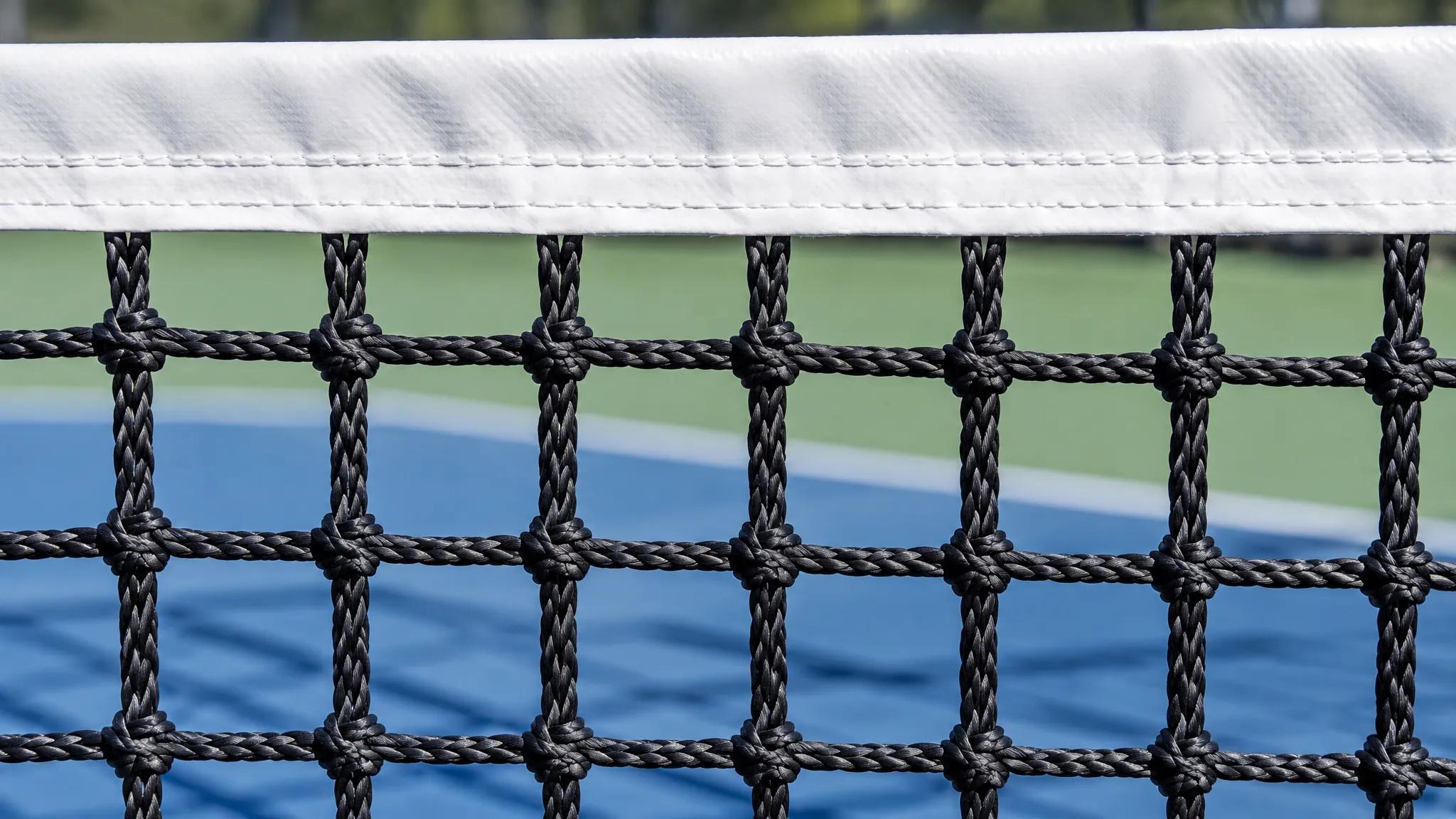
What sunlight does to the polymer is the mechanism behind the fibre evidence further down.

What Denier Measures, and What It Cannot Tell You
The Tex System, ISO 1144:2016, states linear density in tex: grams per kilometre of yarn. Its conversion table gives denier as grams per 9,000 m, a factor of 0.1111 to tex. The ASTM method for it, ASTM D1907/D1907M-12(2018), covers linear density and stops there. No breaking force appears in its scope, because mass per length and load capacity are measured on different equipment.
Two figures from one manufacturer show how weakly the pair tracks. Douglas lists 3.0 mm netting at 285 lb break strength and 3.5 mm netting at 325 lb. Moving from 3.0 mm to 3.5 mm multiplies cross-section by 1.36, so roughly 36% more mass per metre at equal polymer density. Published breaking strength rises by 14%. Treat that as arithmetic on two catalogue numbers rather than a measured coefficient, since braid construction may differ between the tiers.
A denier figure fails for a second reason. Denier describes a yarn. A net cord is a braid of many yarns, so a 1,000-denier yarn says nothing until you know how many are in the braid.
| Cord tier (mm diameter) | Area (% of 3.0 mm) | Breaking force (% of 3.0 mm) |
|---|---|---|
| 3.0 mm | 100.0 | 100.0 |
| 3.5 mm | 136.1 | 114.0 |
Where the USA Pickleball Rulebook Stops Governing Your Net
Section 3.B of the 2026 Official Rulebook declares itself closed: the requirements for the net and related elements are set forth in Rules 3.B.1 through 3.B.7. Read all seven and the fabric appears once. Rule 3.B.3 asks for a net at least 21 ft 9 in long and 30 in from bottom edge to top. Rule 3.B.4 asks for a 2 in white tape binding over a cord or cable. Nothing names a mesh aperture, cord diameter, denier, fibre or UV requirement.
The Equipment Standards Manual, Revision 3.0 of January 2025, does not fill the gap. Its Section 2.C says only: net specifications, see Rules for description. The documents point at each other, which is how a durability convention ends up in a compliance clause.
One number does fall out of 3.B.1, because a pass-through test needs something to pass through. Section 2.D.3 of the manual sets the ball at 2.87 in to 2.97 in, so the smallest approved ball, 2.87 in, is the ceiling the rule implies. Douglas publishes a 1-3/4 in square mesh, about 61% of that ceiling. The gap is a durability decision and it belongs to you. Our net height regulation spec sheet covers the dimensional clauses, and the permanent net post spec covers what holds the fabric up.
Why “UV Treated” Is Not a Specification
The two standards most often named on net listings describe machines. ASTM G154-23 covers fluorescent UV lamp apparatus and states that on its own it does not deliver a specific result, being limited to obtaining, measuring and controlling conditions of exposure. ASTM G155-21 says the same of xenon arc apparatus. Neither sets a duration or a pass mark.
Edition matters as much as designation. ISO 4892-2:2013 remains the current xenon-arc exposure standard, confirmed in 2023. The fluorescent-UV part moved: ISO 4892-3:2024 published on 3 October 2024, and the 2013 and 2016 editions still quoted on supplier sheets are now withdrawn.
Textile procurement solved this by pairing a cabinet with a retained-property threshold. ASTM D4355/D4355M-21 determines deterioration in tensile strength after xenon-arc exposure, and the acceptance level is written by whoever places the order. Arizona DOT Section 1014 requires at least 50% retained strength after 500 hours; WSDOT Form 220-040 writes the same. Both are highway geotextile clauses and neither governs a pickleball net. Copy the shape, not the jurisdiction.
| Spec line | Unit to ask for | Published method (edition) | What it tells you | Verdict |
|---|---|---|---|---|
| Cord size | mm diameter | No public sports method; maker’s own sheet | Physical size of the braid | Ask for it: institutional sheets already state it |
| Linear density | denier (g/9,000 m) or tex (g/1,000 m) | ASTM D1907/D1907M-12(2018) | Mass of polymer per length of yarn | Context only; never accept it as a strength claim |
| Mesh breaking force | lb or N | ISO 1806:2002, wet and dry | Load the mesh carries before failing | Make this the contract line, not denier |
| UV performance | % strength retained after stated hours | G154-23 or G155-21 cabinet plus a D4355-style retention test | Whether the strength survives sunlight | Reject any UV claim missing hours and a percentage |
| Mesh aperture | in or mm | Rulebook 3.B.1 pass-through, against a 2.87 in ball | The only fabric line the rules constrain | Ceiling 2.87 in; specify well below it |
Fibre Choice: What the Evidence Actually Supports
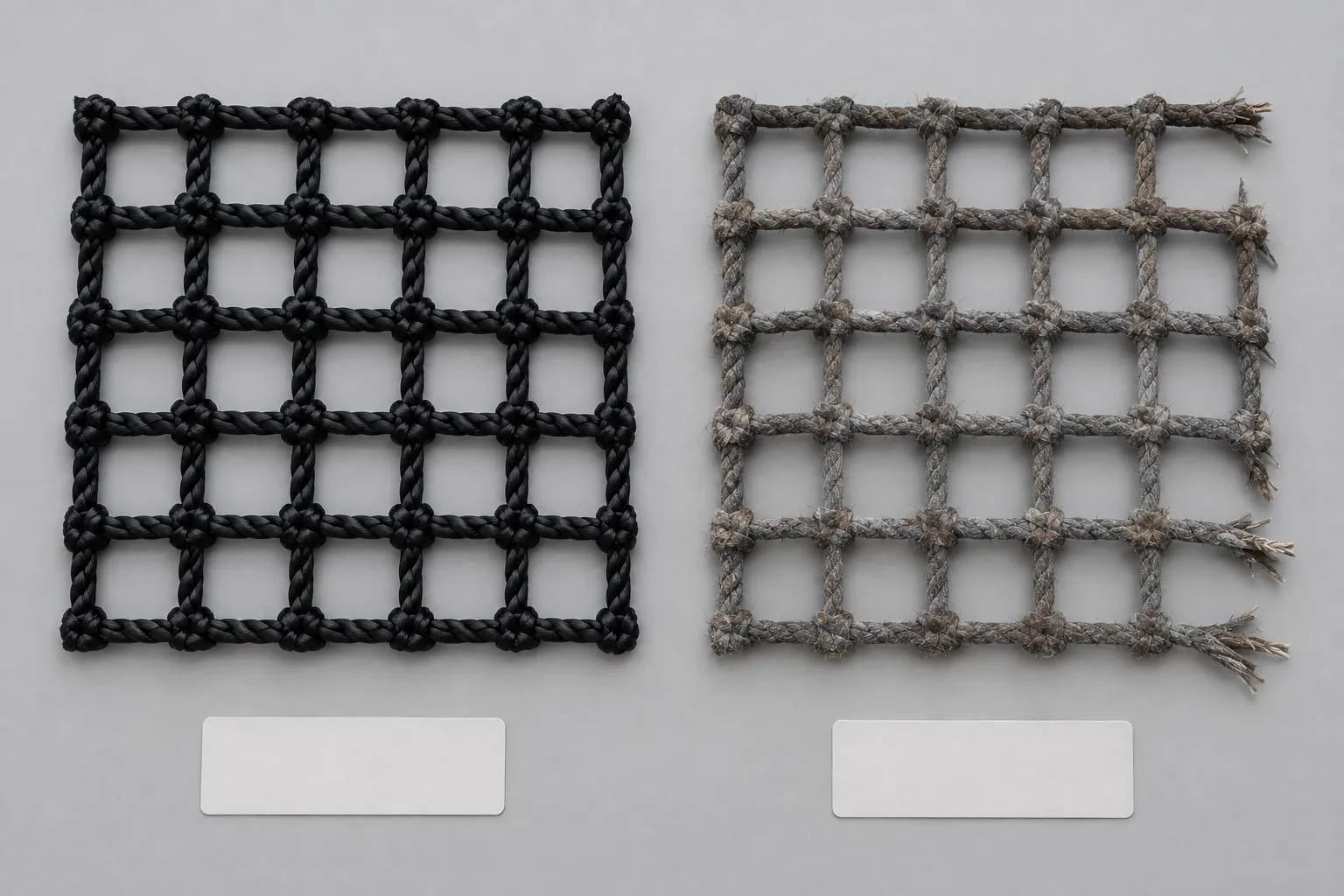
Under laboratory UV with no stabiliser present, the four common fibre polymers do rank. Gijsman, Meijers and Vitarelli measured oxidation rates and found polypropylene fastest, polybutylene terephthalate slightly ahead of polyamide 6, and polyethylene slowest, reaching about 500 mmol/kg oxygen uptake in roughly 60, 100 and 230 hours (Polymer Degradation and Stability, 1999). That holds for unstabilised polymer, which nobody ships.
Put formulated products outdoors and the order inverts. The UNEP assessment by Andrady and colleagues reports a four-year natural weathering comparison: polypropylene retained 47% of the measured property, PBT 27%, HDPE 20% and polycarbonate 17% (Photochemical & Photobiological Sciences, 2023).
Side by side, the reading is that a fibre name predicts field life poorly: the stabiliser package, the pigment and the extrusion decide most of it. So specify the outcome. A quote saying polyethylene, and one saying polyethylene with 50% strength retained after 500 hours of xenon exposure, describe different products. Only the second can be enforced.
The Five Lines to Put on the Purchase Order
Two published sheets show the spread. Douglas states 3.0 mm braided solid-core polyethylene at 285 lb break strength, a 1-3/4 in square mesh, a 65 oz two-ply vinyl-coated polyester headband, and a 5/32 in galvanised steel cable at 2,300 lb. Gared states braided polyethylene twine, a vinyl headband and PVC-coated aircraft cable, with no diameter and no breaking force. Neither publishes a UV method. The first sheet answers four of the five lines below; the second, one.
| PO line | What to write, with the unit | What silence on it means |
|---|---|---|
| Cord | Diameter in mm and breaking force in lb or N | The supplier is reselling and has not seen a spec sheet |
| Mesh | Aperture in in or mm, stated as square or diamond | Nobody has checked the 2.87 in pass-through ceiling |
| UV | Apparatus, cycle, hours, % retained strength, test method | No weathering test was run on this fabric |
| Headband and cable | 2 in white binding per 3.B.4, band weight, cable break force | The first failure point is unspecified |
| Acceptance | Named report per lot, issued before shipment | Every line above is a wish rather than a term |
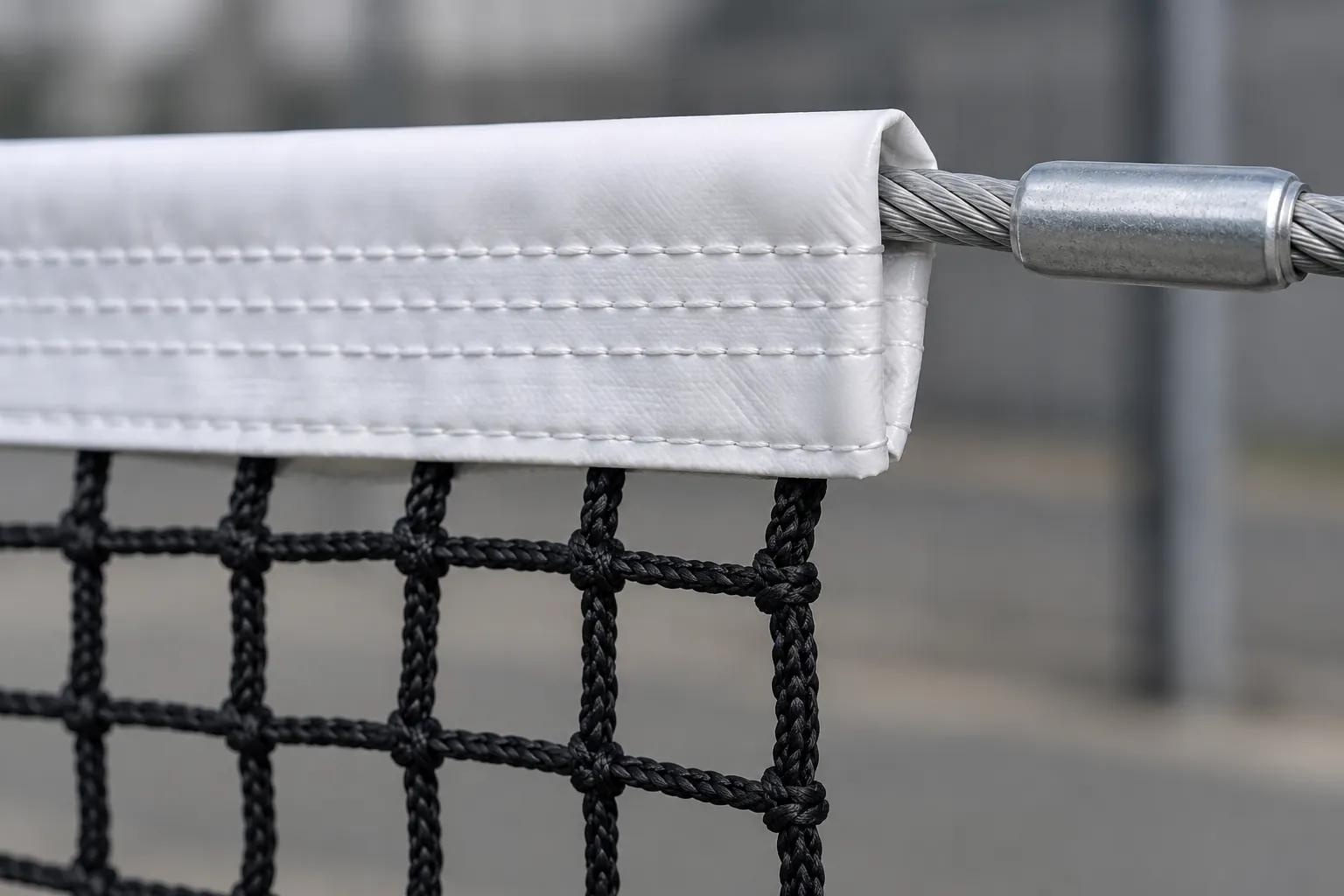
Acceptance is the line venues drop, and it makes the other four real. A supplier who can produce a dated report against a named method for your lot has a quality system. A generic certificate from another run does not. Where a maker cannot answer the UV line, ask for the resin stabiliser package and a retained-strength figure from any exposure test they have run, then write that figure into the order. The nets and court accessories we build are specified on these five lines, and the same structure carries into an OEM programme: our portable net system sourcing guide and bulk net notes set it out.
For club, school and municipal procurement teams writing a net line into a tender. We quote cord, mesh, headband and cable against your document, and say which figures are test results.
See the net range and ask for a specConclusion
The rulebook gives you eleven words and one implied number, 2.87 in. The fabric belongs to whoever writes the order. Strike any denier figure from the compliance column. Put mesh breaking force in lb or N in its place, with ISO 1806 named. Write the UV requirement as hours plus a retained-strength percentage against a named cabinet standard, with its current edition year. Then add the acceptance line, because a test nobody has to report is a test nobody runs.
Frequently Asked Questions
What does denier mean on a pickleball net?
It is the linear density of the yarn, defined in the ISO 1144 Tex System as grams per 9,000 m. A higher denier yarn carries more polymer per length. It does not follow that the finished net is stronger, because breaking force, braid construction and UV stabilisation are measured separately.
Does USA Pickleball specify a net mesh size or material?
No. Rule 3.B.1 of the 2026 Official Rulebook allows any mesh fabric material that will not allow a ball to pass through it, and Rules 3.B.1 to 3.B.7 name no aperture, cord diameter, denier or fibre. With the ball set at 2.87 to 2.97 in, 2.87 in is the aperture ceiling implied.
Is a UV resistant pickleball net claim meaningful?
Only with a method and a result attached. ASTM G154-23 and G155-21 describe exposure cabinets and set no duration and no pass mark. Ask for the apparatus, the cycle, the exposure hours and the percentage of tensile strength retained, in the form highway specifications use: 50% retained after 500 hours.
Which fibre lasts longest in an outdoor pickleball net?
The published evidence does not support a clean ranking. Unstabilised polyethylene oxidises slowest in laboratory UV, yet in a four-year outdoor comparison HDPE retained 20% of the measured property against 47% for polypropylene. Specify a retained-strength result rather than a fibre name.
Want to source this quality for your brand?
Contact our factory directly on WhatsApp for an instant MOQ and pricing quote.