Regrind vs Virgin Resin in Pickleballs: A Buyer's Inspection Guide
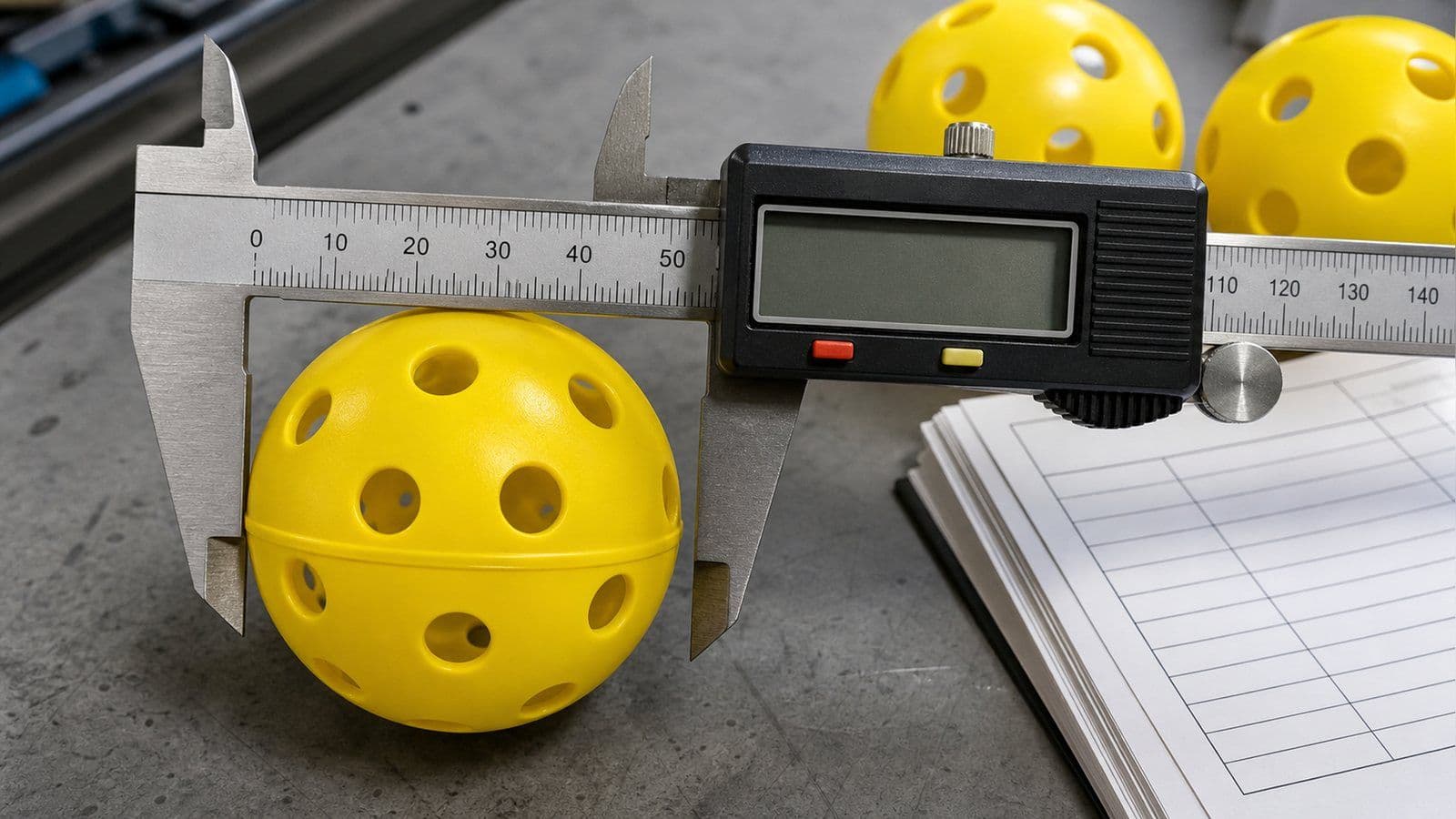
Two ball quotes land in your inbox. Same 40-hole outdoor shape, same neon yellow, both described as tournament grade, both within a few cents of each other. One supplier is moulding from virgin resin. The other is running a regrind blend. Nothing in either quotation tells you which is which, and nothing in the USA Pickleball standard requires anyone to say.
This is the one material variable in a pickleball that no spec sheet has a field for. It is not exotic and it is not illegal — reprocessing factory scrap back into the melt is ordinary practice across rotational moulding. But it changes the polymer, and the published data says it changes it most in exactly the loading case a struck ball lives in. The purpose of this guide is narrow and practical: what regrind does mechanically, what you can and cannot see in the carton when the shipment arrives, and the specific test and sampling language that turns "please use good plastic" into something a supplier has to answer.

Key Takeaways
- The regrind penalty is energy-dependent, and the widely-quoted summary hides that. In peer-reviewed testing of rotationally moulded polyethylene sandwich structures, reprocessed material held 91% residual flexural strength against 93% at 15 J — but at 30 J the same comparison fell to 66% against 88%, with peak force dropping from 4,462 N to 3,588 N.
- The mechanism is chain scission. Reprocessing breaks polymer chains autocatalytically; across five extrusion cycles of polypropylene, mass-average molar mass fell 65% and notched Charpy impact strength fell from 5.0 kJ/m² to 3.5 kJ/m².
- Shorter chains mean a higher melt flow rate, and a higher melt flow rate raises the ductile-brittle transition temperature. That is why a regrind ball can pass every approval test and still fail on a cold court.
- USA Pickleball does not regulate this. ESM 2.D.1 asks only for "a durable material molded with a smooth surface" — no resin grade, no virgin-content floor — and the bounce test is run at an ambient 70°F ± 5°F.
- You cannot see regrind content. Colour drift, weight scatter and sink marks are triggers to investigate, not proof. The test that actually settles it is melt flow index to ASTM D1238, run against a declared virgin baseline.
- A 2,000-piece lot under ISO 2859-1 General Inspection Level II draws sample size code letter K — 125 pieces, with Ac=7 / Re=8 at AQL 1.0. That is the sampling language to put in the PO.
What regrind actually is, and why nobody quotes it on a ball spec sheet
Regrind is material that has already been through the process once. In rotational moulding the stream is described plainly in the trade literature: defective parts and unused mouldings are "often reground to the desired size and incorporated into" subsequent production. The peer-reviewed work on the subject is more specific still — the reprocessed feedstock characterised by Saifullah and colleagues consisted of "rotationally moulded off-cuts, scarp and non-used parts, and waste purge materials" that were "reground for polymer powder generation."
Read that list again from a procurement seat. Off-cuts, rejected parts, purge. Every one of those is material that has already absorbed a full heat history — and in the case of purge, material that sat in a hot barrel precisely because something went wrong. It is not contamination and it is not fraud. It is the factory's scrap loop, and every moulder has one.
Three things buyers routinely conflate
- Virgin resin — polymer that has never been melted into a part. It arrives with a datasheet from the resin producer stating its grade and its melt flow rate.
- Regrind (internal reprocessed) — the factory's own scrap, reground on site. Its composition is known to the moulder and invisible to you. This is what this article is about.
- Post-consumer recycled (PCR) — material recovered from the waste stream after use. Different provenance, different variability, and usually a deliberate marketing claim rather than a silent cost decision.
The reason the variable never surfaces is structural rather than sinister. A ball spec sheet has fields for the things somebody standardised: diameter, weight, hole count, bounce, hardness. Nobody standardised resin heat history, so the form has no box for it, so the question never gets asked, so the answer never gets given. A supplier running 30% regrind is not hiding it from you in any meaningful sense — you simply never asked, and the industry gave you no vocabulary in which to ask.
Our companion guide on what pickleballs are made of maps the polymer families — HDPE, LDPE, LLDPE, polypropylene — and that is the right place to start if you are still choosing between them. This guide assumes the family is settled and asks the next question: how many times has this particular polymer been melted?
What the published impact data shows — and the half the industry summary leaves out
There is a good, directly relevant piece of primary research on this: Saifullah and colleagues, published in Materials in 2022, testing rotationally moulded polyethylene sandwich structures made with reprocessed material against the same structures made without it. Impact testing to ASTM D3763-02, hemispherical 19 mm impactor, two incident energies.
If you search for this, what you will most likely find is the trade-press summary. It quotes the 15 J result: 91% residual flexural strength for reprocessed material against 93% for non-reprocessed, and concludes that the trade-offs are minor. That number is real and it is correctly quoted. It is also half the table.
| Impact energy | Non-reprocessed | Reprocessed | Gap |
|---|---|---|---|
| 15 J — residual flexural strength | 93% | 91% | 2 points |
| 30 J — residual flexural strength | 88% | 66% | 22 points |
| 15 J — peak force | 3,263 N | 3,070 N | 5.9% |
| 30 J — peak force | 4,462 N | 3,588 N | 19.6% |
Double the impact energy and the two-point gap becomes a twenty-two-point gap. The material that looked equivalent under a gentle hit is retaining two thirds of its strength where the virgin material retains seven eighths. Nothing about the reprocessed material announced this at 15 J.
Why energy-dependence is the whole story for a ball
A pickleball is not loaded gently and it is not loaded uniformly. A dink is a low-energy event. A third-shot drive off the sweet spot of a stiff carbon paddle is not, and neither is the ball hitting a fence post or a concrete edge. If the penalty for reprocessed material were flat, you could reason about it as a small quality tax. It is not flat. It concentrates in the high-energy tail — which is precisely the population of events that cracks balls.
Read the numbers honestly. These specimens were rotationally moulded polyethylene sandwich panels, not pickleballs, tested to ASTM D3763-02 with a 19 mm hemispherical impactor. The direction of the effect transfers to a rotomoulded PE ball; the magnitude does not transfer, and anyone quoting "66%" as a pickleball figure — including us — would be overreaching. What transfers is the shape of the curve: the gap widens with energy.
The mechanism: chain scission, melt flow rate, and why the ball cracks in the cold
The impact numbers tell you that something changed. The mechanism tells you what to test for — and it is a chain of three well-documented steps that no single source lays out end to end.
Step one: heat and shear break the polymer chains
Every melt cycle degrades the polymer. In polypropylene the route is documented precisely: "β-scission of tertiary carbons generates double bonds and free radicals; these entities react with oxygen to produce peroxides and hydroperoxides, which then create more radicals, making the degradation an autocatalytic process." Autocatalytic is the operative word. The damage from the second pass is not simply twice the damage from the first — degradation products accelerate further degradation.
The magnitude is measurable. Across five extrusion cycles of a commercial polypropylene grade, mass-average molar mass fell 65%, from 1.8 × 10⁵ g/mol to 6.3 × 10⁴ g/mol, and notched Charpy impact strength fell from 5.0 kJ/m² to 3.5 kJ/m² — roughly a 30% reduction, tested to EN ISO 179-1.
Step two: shorter chains flow more easily
Molecular weight and melt flow rate are inversely related, so the collapse in molar mass shows up directly as an easier-flowing melt. In controlled reprocessing trials over three twin-screw cycles, the melt flow index ratio climbed from 1.3 to 2.0 at 500 rpm, from 1.7 to 3.3 at 1,000 rpm, and from 2.5 to 5.1 at 1,500 rpm. In a quad-screw extruder at 1,500 rpm it went from 2.7 to 9.0. Over the same trials notched Izod impact fell from 530 J/m unprocessed to between 100 and 200 J/m after reprocessing.
This step matters commercially because melt flow rate is cheap to measure and is reported on every resin datasheet. The degradation you cannot see has left a fingerprint you can buy a test for.
Step three: higher melt flow rate raises the brittleness threshold
Polymers do not fail the same way at every temperature. Above a certain point they yield and deform; below it they fracture. That point is the ductile-brittle transition temperature, and for polypropylene the relationship to flow is stated directly in the patent literature: "the ductile brittle transition temperature increases as the crystallinity of the polymer increases … the DBTT also increases as the MFR of the polymer increases," while "the higher molecular weight of the polypropylene lowers the ductile brittle transition temperature."
Put the three steps together and you have the answer to a question every club buyer eventually asks. Reprocessing shortens chains. Shorter chains raise melt flow rate. Higher melt flow rate raises the temperature at which the material stops deforming and starts fracturing. A ball whose DBTT has crept upward behaves perfectly in a warm equipment room and splits on a February morning, and no test in the approval process would have caught it.
What we will not tell you: a temperature. There is no published ductile-brittle transition temperature for a pickleball, and we have not run that test ourselves. The peer-reviewed survey that mapped DBTT across 181 recycled polyolefin compounds and 7,587 measurements found transitions spanning −60 °C to 51 °C depending on the compound — a distribution across materials, not a threshold you can apply to a ball. Any supplier or article quoting you a specific cracking temperature for regrind balls is inventing it. What you can do is specify the test: instrumented puncture to ISO 6603-2, with DBTT taken where puncture energy falls below 66% of the upper-shelf energy.
Why an approved ball can still disappoint: what the USA Pickleball tests do and do not cover
"USAPA approved" is the phrase that ends most material conversations. It should not, and the reason is in the standard's own text. The USA Pickleball Equipment Standards Manual, Revision 3.0, states the entire material requirement in rule 2.D.1: "The ball shall be made of a durable material molded with a smooth surface and free of texturing."
A durable material. That is the whole specification. No polymer family, no resin grade, no molecular weight, no melt flow rate, and — the point of this article — no virgin-content floor and no cap on reprocessed material. A ball moulded from 40% regrind and a ball moulded from certified virgin resin are equally compliant with 2.D.1 provided both pass the performance tests.
And the performance tests run warm
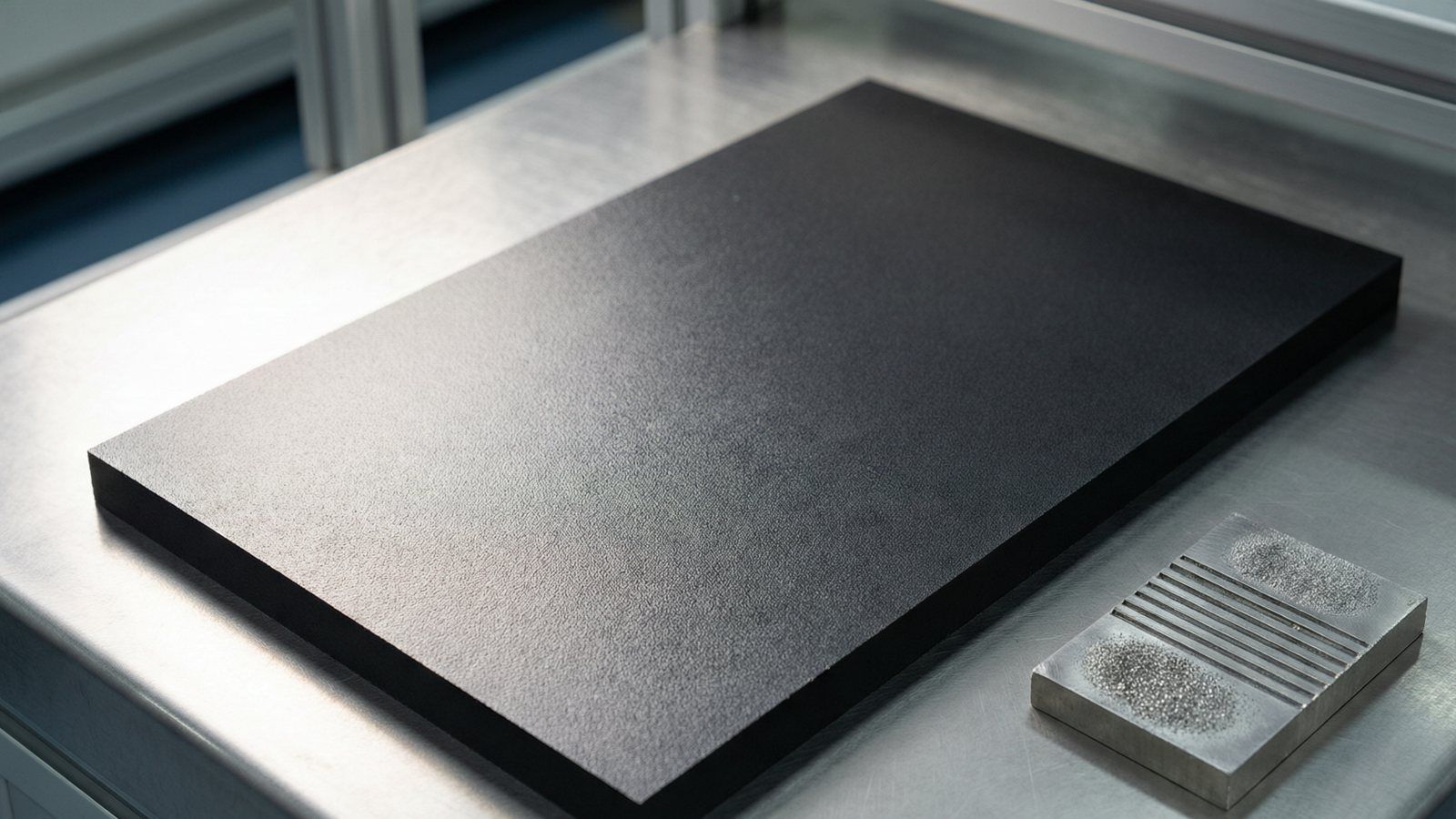
This is where the standard and the failure mode pass each other without touching. The bounce test drops the ball 78 inches (198.1 cm) onto a granite surface plate of at least 12 × 12 × 4 inches (30.5 × 30.5 × 10.2 cm) and requires a rebound of 30 to 34 inches to the top of the ball — and it is "performed at an ambient temperature of 70 degrees F plus or minus 5 degrees F." The compression test, run to ASTM F1888-09, requires an average result of under 43 LBF, with each ball tested twice, once perpendicular and once parallel to the seam.
Both tests are sound and both are necessary. Neither is looking for the thing this article is about. A resin whose ductile-brittle transition has crept up by ten degrees will bounce identically at 70 °F, compress identically at 70 °F, and behave differently on an outdoor court in early spring. The approval is a room-temperature performance certificate; it was never a material certificate.
One more piece of the standard is worth knowing, because it is your only structural leverage: approval is granted by the USA Pickleball Board of Directors on the recommendation of the Equipment Evaluation Committee, and under rule 2.F.1 it "may be revoked by the Board of Directors." Approval attaches to a submitted model with an ongoing conformity obligation — it is not a permanent property of everything subsequently shipped under that name. The full dimensional envelope, including the 2.87 to 2.97 inch diameter and the 0.78 to 0.935 ounce weight window, is broken down in our USAPA ball approval spec decoder; there is no reason to restate it here.
The visual and low-cost tells a buyer can actually use on arrival
Start with the honest limit, because most guides on this subject skip it: you cannot see regrind content. There is no visual signature that distinguishes a well-processed 20% regrind blend from virgin resin. What you can see are consequences — the process-control problems that tend to travel with an undisciplined scrap loop. Treat every item below as a trigger to ask a question, never as a verdict.
Colour and gloss drift across the carton
Pull twenty balls from different layers of the same carton and line them up under one light source. Consistent colour tells you the masterbatch dosing and the melt were stable. Visible drift — one ball slightly duller, one slightly greener — tells you something upstream was varying. That something might be pigment dispersion, it might be a masterbatch lot change, it might be oven cycle variation, or it might be a regrind fraction that climbed mid-run because the scrap bin filled up. Colour drift does not tell you which. It tells you to ask.
Weight scatter inside the legal window
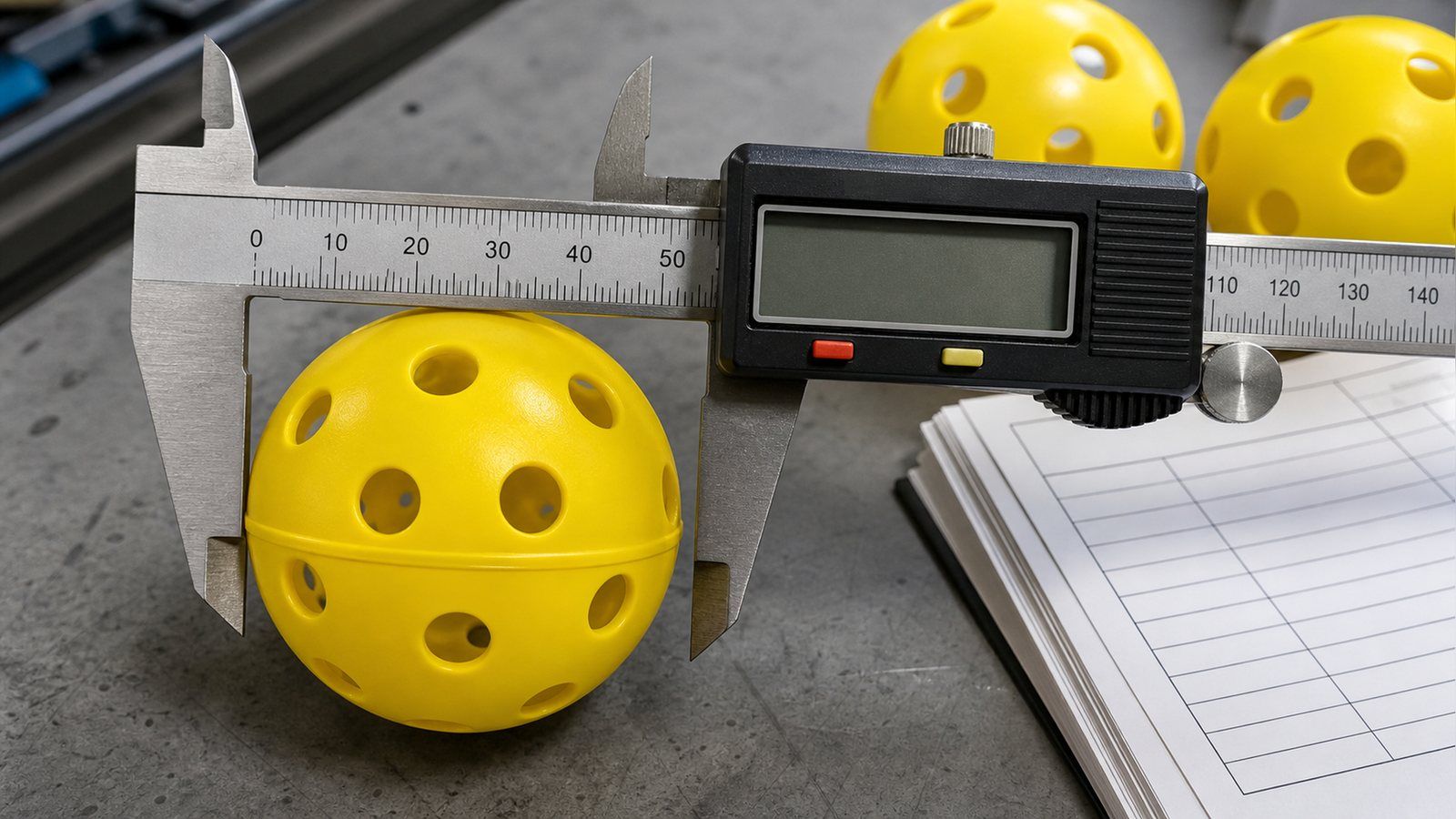
This is the most useful cheap measurement you can make, and it needs nothing more than a kitchen scale that reads to a tenth of a gram. The approved weight window is 0.78 to 0.935 ounces (22.1 to 26.5 grams) — wide enough that every ball in a bad batch can sit legally inside it while the batch itself is uncontrolled. Do not test for compliance; test for spread.
Weigh 20 balls, record the heaviest and the lightest, and look at the range rather than the average. A tight cluster indicates consistent shot weight and consistent wall thickness. A batch spanning most of the legal window is telling you the process was not in control, and inconsistent wall thickness is a direct predictor of inconsistent impact performance.
Seam quality, flash and sink marks
Run a thumbnail around the seam of ten balls. The standard tolerates "a slight ridge at the seam" provided it does not significantly affect flight, so a ridge is not itself a defect — but a ridge that varies noticeably from ball to ball is another consistency signal. Look also for sink marks around the moulded holes: shallow depressions where material shrank away as it cooled. Sink marks point to wall-thickness or cooling-rate variation, both of which sit closer to the mould and the cycle than to the resin, and both of which belong in the same conversation.
The drop test, and what it does not prove
Dropping a ball on a hard floor and listening is a real habit among experienced buyers, and it is worth doing — a dull, dead sound against a bright ring across otherwise identical balls is a genuine difference in wall stiffness or wall thickness. But be clear about what you have learned. You have detected an acoustic difference between two balls. You have not measured resin heat history, you have not measured molecular weight, and you cannot infer regrind percentage from a sound. Use it to select which balls go into the sample bag for real testing.
Our wholesale ball QC guide covers the bounce, roundness, seam and weight checks as a standalone inspection routine. What that routine does not tell you — and what this section exists to add — is which of its findings point back at the resin and which point at the mould or the cycle.
Writing it into the PO: acceptance criteria, sampling, and the one lab test that settles it
Everything above is diagnosis. This is the part you can act on, and it comes down to three clauses: a declared baseline, a test that detects deviation from it, and a sampling plan that says how many pieces you will look at.
Clause one: make the supplier declare a baseline
Ask for the resin grade and the resin producer's stated melt flow rate for the material being used. This is an ordinary request — the number is printed on the resin technical datasheet — and it costs the supplier nothing to answer if the answer is stable. What you are buying with this clause is not the number itself but a fixed reference point. Without a declared virgin baseline, no later measurement means anything.
Clause two: melt flow index is the test that settles it
Melt flow rate is measured by extrusion plastometer under ASTM D1238, with ISO 1133 as the parallel international method. The conditions matter and belong in the PO text: 230 °C at 2.16 kg for polypropylene, 190 °C at 2.16 kg for polyethylene. Any competent third-party lab runs this, and it is one of the cheapest polymer tests available.
Interpretation follows a practitioner rule of thumb rather than a specification limit, and it should be quoted as such: a post-moulding melt index sitting 50% or more above the virgin grade's stated value is read as an indicator of regrind content, against a 20 to 30% rise attributable to normal processing alone. Treat those figures as a trained expectation, not a pass/fail line — the underlying physics, that reprocessing raises melt flow rate, is what the peer-reviewed data establishes. Write the clause so that a result more than 30% above the declared virgin baseline triggers a conversation and a documented explanation, not an automatic rejection.
Clause three: a real sampling plan
Use ISO 2859-1, single sampling, normal inspection, General Inspection Level II. It is the plan your inspection agency already works to, so quoting it removes ambiguity rather than adding cost. The numbers you need for realistic ball lots:
| Lot size | Code letter | Sample size | Ac / Re at AQL 1.0 |
|---|---|---|---|
| 501 – 1,200 | J | 80 | — |
| 1,201 – 3,200 | K | 125 | 7 / 8 |
| 3,201 – 10,000 | L | 200 | — |
For a 2,000-piece lot at code letter K, the sample is 125 pieces. At AQL 2.5 the accept/reject numbers are 14/15; at AQL 1.0 they are 7/8; at AQL 0.65 they are 5/6. Choose the AQL deliberately rather than accepting the default — a rental fleet that replaces balls constantly has different tolerance for cosmetic defects than a brand shipping into retail packaging.
One thing to settle before you write any of this in: agree the lead time the test adds. A melt flow index result typically comes back from an independent lab within a few working days, but where it sits in the schedule is a commercial question — test at first article and it costs you nothing on the critical path; test at pre-shipment and it holds the container. Ask your supplier which of the two they will accept, because that answer varies by factory and we cannot quote a universal figure for it.
Then add the clause that costs nothing and does the most work: retain a sealed, dated golden sample from the approved first article, and check each later delivery back against it. Resin drift is a slow problem, and comparison against a physical reference from eighteen months ago will catch what no single-shipment inspection can.
A worked example, end to end
A club buyer orders 2,000 outdoor balls for a rental fleet in a climate with cold winters. He asks the supplier for the resin grade and its datasheet melt flow rate, and gets an answer: a named HDPE grade, MFR stated. He approves a first article, seals two balls in a dated bag, and files the datasheet with them. The PO says: ISO 2859-1, Level II, AQL 1.0, sample 125 pieces; melt flow index per ASTM D1238 at 190 °C / 2.16 kg on three balls from the shipment; a result more than 30% above the declared baseline requires written explanation before acceptance.
Eleven months later the reorder arrives. Weight spread across 20 balls has widened noticeably against the retained sample, and the MFI comes back 44% above baseline. Nothing here is proof of anything on its own — but the buyer now has a documented deviation from an agreed reference, tested by an agreed method, and a supplier obliged to explain it. That is the entire objective. You are not trying to prove regrind content; you are making resin heat history a variable somebody has to be accountable for.
One practical note on order scale: our own rotationally moulded tournament ball line runs a published minimum of 1,000 pieces for balls, which sits at the boundary between the 80-piece and 125-piece sample sizes above — worth knowing when you set the AQL, because a first order at MOQ draws a smaller sample than the reorder will. If you are still sizing the first order, buying pickleballs in bulk covers the quantity and packaging decisions that sit alongside this one.
Conclusion
The risk in this subject is not that regrind exists. It is that it is the only major cost lever in a pickleball that leaves no trace on any document you receive. Every other variable — polymer family, hole count, weight, colour, packaging — is written down somewhere. Resin heat history is written down nowhere, which is exactly why it is where margin gets found when a quote has to come down.
So the failure you are guarding against is specific and it is delayed. It does not look like a bad shipment. It looks like a batch that inspected clean, played fine through the summer, and produced an unusual number of cracked balls in the first cold week — by which point the container is paid for, the balls are in members' hands, and the supplier can point at a compliant test report. Every mechanism in this article converges on that one scenario.
Best suited to this approach
Private-label brands committing to a ball SKU they will reorder; clubs and rental fleets in climates with real winters; anyone whose last order produced cracking complaints they could not explain.
Not worth the effort for
One-off promotional or event orders that will be played a handful of times; indoor-only programmes in climate-controlled facilities, where the cold-temperature failure mode largely does not arise. In both cases the sampling plan alone is enough and the melt flow clause is overkill.
The four lines to add before you sign
- Declared resin grade and the producer's datasheet melt flow rate, recorded on the PO.
- Melt flow index per ASTM D1238 — 230 °C / 2.16 kg for PP, 190 °C / 2.16 kg for PE — with a deviation threshold that triggers explanation, not automatic rejection.
- ISO 2859-1 Level II sampling with the AQL chosen deliberately: 125 pieces for a 1,201–3,200 lot.
- A sealed, dated golden sample retained against every reorder.
One transparency note, because this article asks you to demand evidence from suppliers. We have not published our own cold-chamber testing of balls at graduated regrind ratios. Every figure above is third-party published research on related materials, cited so you can read the sources yourself, and none of it is a measurement of a pickleball. When we have our own data, it will appear here with its method attached — and you should hold any supplier claiming such data to the same standard.
If you want to test a supplier's position on this in one message, ask two questions: what resin grade are you using, and what is its datasheet melt flow rate? A factory in control of its material answers both in a sentence. Ask us those two questions directly if you have a quote in hand and want a comparison point.
Frequently Asked Questions
Is regrind allowed in USA Pickleball approved balls?
Yes. ESM rule 2.D.1 requires only "a durable material molded with a smooth surface." The standard sets no resin grade and no virgin-content floor, so a ball containing regrind can be fully approved provided it passes the performance tests.
Can I tell regrind content by looking at a ball?
No. Colour drift, weight scatter and sink marks are consistency signals that justify asking questions, but none of them measures resin heat history. The only reliable check is melt flow index to ASTM D1238 against a declared virgin baseline.
At what temperature do regrind pickleballs start cracking?
No published figure exists for pickleballs, and anyone quoting one is guessing. A survey of 181 recycled polyolefin compounds found ductile-brittle transitions spanning −60 °C to 51 °C depending on compound. Specify an ISO 6603-2 test rather than accepting a claimed threshold.
How much weaker is a reprocessed ball?
For pickleballs specifically, nobody has published that. In rotomoulded PE sandwich panels the residual-strength gap was 2 points at 15 J and 22 points at 30 J, so the penalty grows sharply with impact energy. Direction transfers to balls; magnitude does not.
How many balls should I inspect from a shipment?
Under ISO 2859-1 General Inspection Level II, a 1,201 to 3,200 piece lot draws code letter K and a 125-piece sample. At AQL 1.0 the accept/reject numbers are 7 and 8. Lots of 3,201 to 10,000 draw 200 pieces.
Does a supplier have to tell me the regrind percentage?
Nothing obliges them unless your contract does. The practical route is a declared resin grade plus a melt flow baseline written into the PO — verifiable facts, rather than a percentage nobody must disclose or can prove.
Want to source this quality for your brand?
Contact our factory directly on WhatsApp for an instant MOQ and pricing quote.