Temporary Pickleball Line Sets: Choosing a System That Survives a Shared Gym Floor
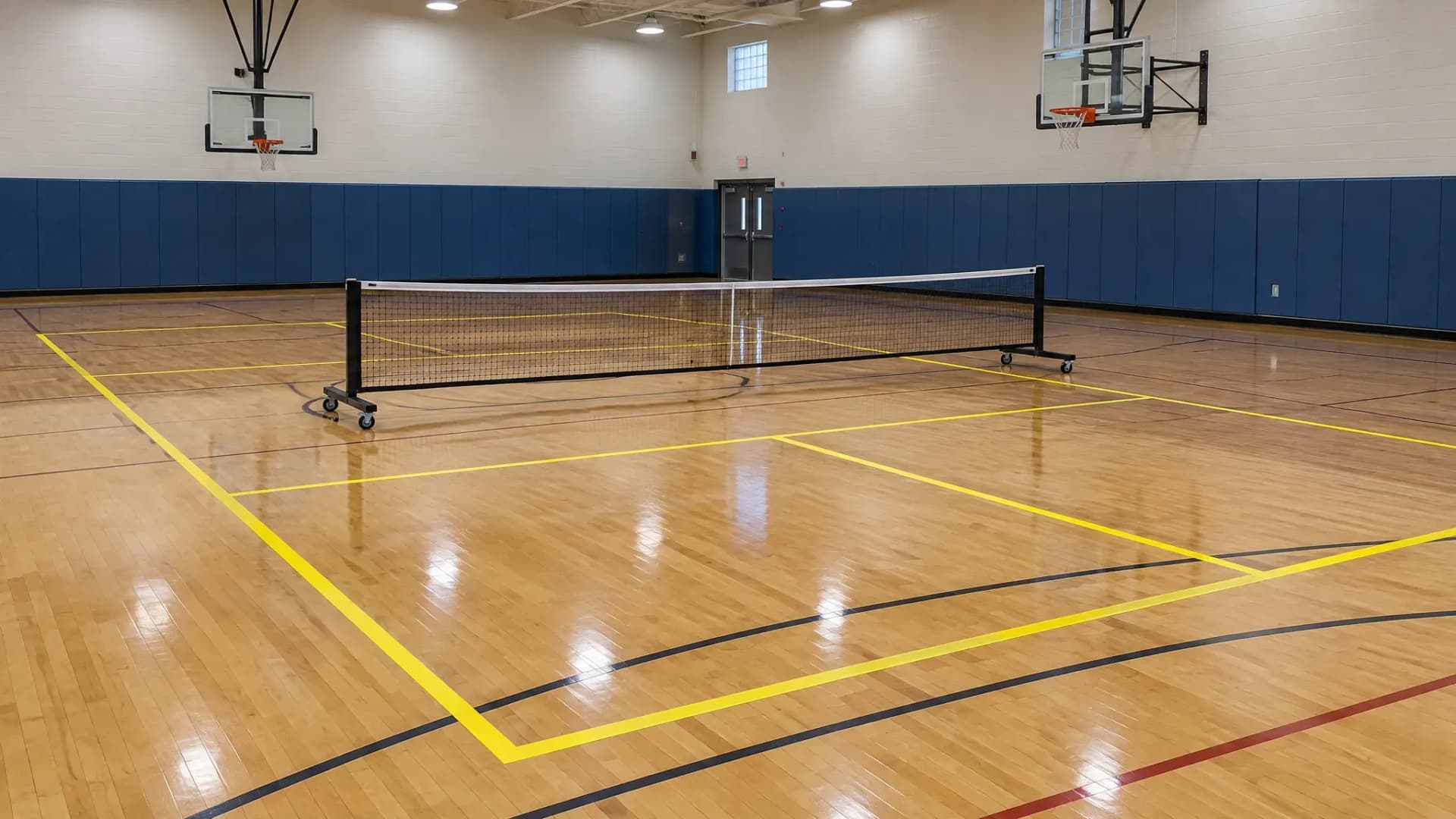
On a finished maple gym floor, the Maple Flooring Manufacturers Association (MFMA) does not recommend any kind of tape to mark temporary court boundaries on a finished maple floor. That leaves three removable options for a club sharing the gym: a loose line set with no adhesive, laid for each session; a floor cover with the lines applied; or game lines painted in by the floor contractor. Synthetic floors follow the floor maker's warranty, not MFMA.
Whichever system you choose, one court takes 198 linear ft (60.4 m) of 2 in line. Under the 2026 USA Pickleball Official Rulebook, court measurements must be made to the outside edge of the perimeter and non-volley zone lines, so each strip sits inside its mark. Centre a strip on the mark and the court grows to 20 ft 2 in by 44 ft 2 in.
A line-set quote should state width, color, thickness, edge profile, underside material, piece list, packed size, MOQ and lead time, and the supplier should agree to a one-set trial order on a corner of your floor before the bulk order.
Key Takeaways
- MFMA does not recommend any kind of tape to mark temporary court boundaries on a finished maple floor.
- One court takes 198 linear ft (60.4 m) of 2 in line.
- Court measurements must be made to the outside edge of the perimeter and non-volley zone lines (Rule 3.A.2).
- All lines should be 2 in (5.08 cm) wide and the same color, clearly contrasting with the color of the playing surface and court (Rule 3.A.4.e).
- No line-set MOQ or lead time is published by pickleoem; get both per set and per color in writing.
The Maple Flooring Manufacturers Association's own short video on tape for temporary court lines goes with its written position statement quoted throughout this guide.

Five ways to mark a court on a shared floor
The floor decides first. MFMA's statement on tape gives three reasons. Removal can peel away layers of the finish. Tape grips differently from the finish around it, so players cross a change in traction at every line when they start, stop and pivot. And adhesive resins can etch or stain the finish, or the maple under it. The ASBA / USA Pickleball construction manual (2020 edition; USA Pickleball lists 2023 as current) makes the same point about outdoor tennis-court conversions. Temporarily taped or adhered lines may leave residue on the court or may damage the surface when pulled up.
| System | Finished maple floor | Synthetic floor | Between sessions | Verdict |
|---|---|---|---|---|
| Adhesive tape, any kind | Not recommended by MFMA | Only with the floor maker's written approval | Stays down; removal risks the finish | Avoid on maple |
| Loose line set, no adhesive | No MFMA position; trial on a corner first | Trial plus the floor maker's approval | Laid and lifted each session | Best for shared weekly slots |
| Corner and T markers only | No adhesive; marks points, not lines | Same as maple | Fastest to lay | Drills and casual play only |
| Floor cover with lines applied | An MFMA-listed alternative | Check the cover's load on the floor | Cover rolled out per event | Best for events and tournaments |
| Painted game lines | An MFMA-listed alternative, by the floor contractor | The floor maker's own line system | Permanent | Best for fixed weekly programs |
Two rows need a warning. Corner markers leave the line itself to the eye, and Rule 8.E says players must not call a ball out unless they can clearly see a space between the line and the ball when it lands. With no 2 in line to judge against, every close ball becomes an argument. Painted lines settle it, but only on a floor that can take one more color. Our indoor facility equipment guide covers the net carts and floor loads that go with each floor type.
Synthetic floors: the warranty is the rulebook
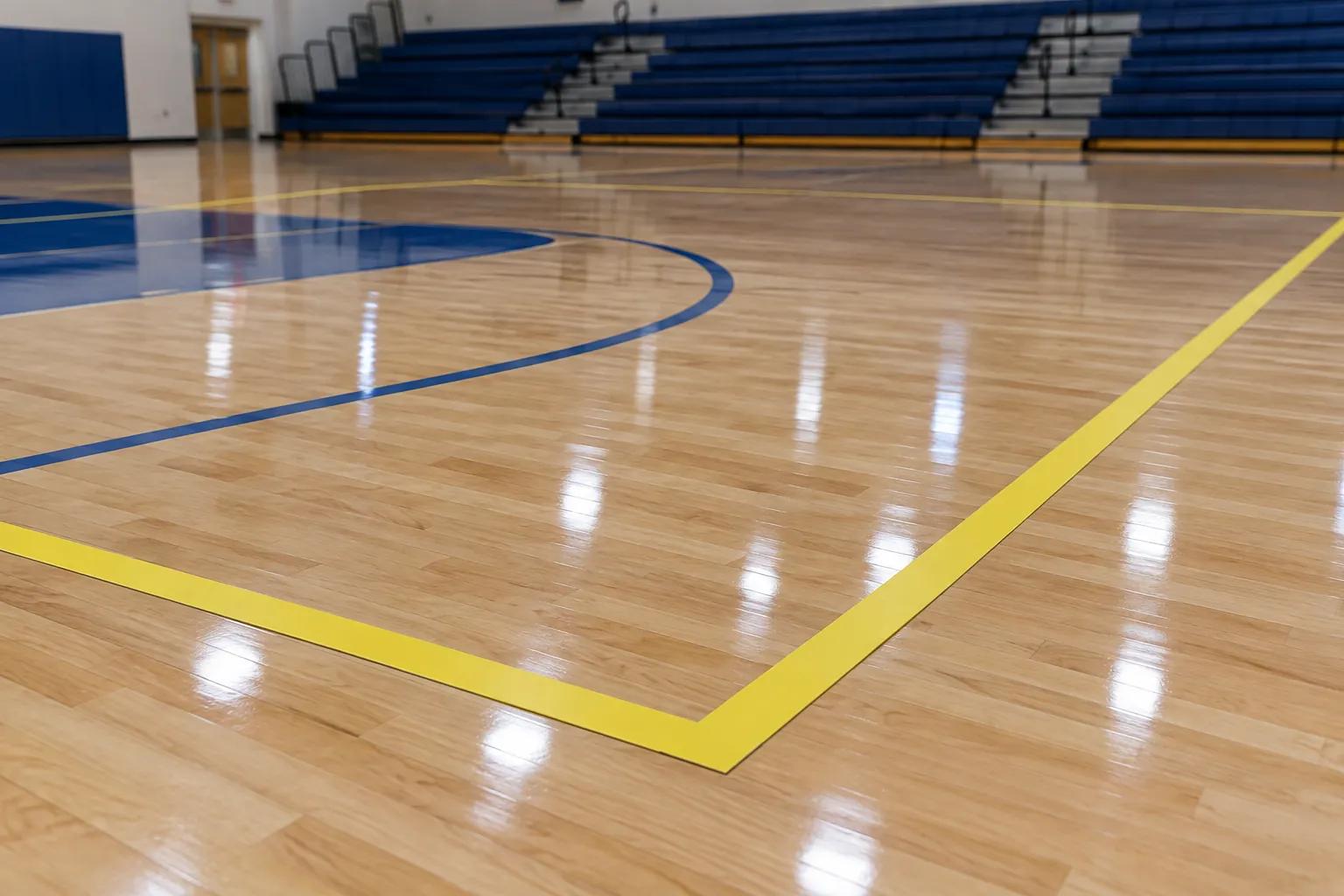
MFMA speaks for maple only. A rolled PVC or poured polyurethane floor comes with its own maintenance instructions and warranty, and those decide what may touch the surface. Before any line product arrives, put three questions to the floor maker or installer in writing. Which marking products, if any, are approved? May a loose strip with a rubber or PVC underside lie on the floor for a session? What cleaning is needed afterwards? Keep the reply in the facility file. If the floor later shows marks where the lines ran, that letter is the difference between a warranty claim and a refinishing bill.
Floor covers: same rules, different owner
A cover with lines applied moves the question from the floor to the cover. Lines on a cover are measured the same way as lines on the floor, so the cover maker should work to the outside-edge rule in the next section. The cover also has to lie flat and line up with the same reference points every time it is rolled out.
198 feet of line: how the pieces add up
Line quantity comes straight from the rulebook. Rule 3.A.1 fixes the court at 20 ft by 44 ft. Rule 3.A.4.c puts the non-volley zone lines 7 ft from the net on each side, and Rule 3.A.4.d runs the centerline from the non-volley zone line to the baseline, which is 22 − 7 = 15 ft per end.
| Line | Lines per court (count) | Length each (ft) | Total (ft) |
|---|---|---|---|
| Baseline | 2 | 20 | 40 |
| Sideline | 2 | 44 | 88 |
| Non-volley zone line | 2 | 20 | 40 |
| Centerline | 2 | 15 | 30 |
| All lines | 8 | – | 198 |
| Line type (two of each per court) | Linear feet per court (ft) |
|---|---|
| Baselines | 40 |
| Sidelines | 88 |
| NVZ lines | 40 |
| Centerline | 30 |
At 2 in wide that is 33 sq ft of line per court, which is what a floor maker will ask about if the underside touches the finish. Placement is where temporary courts go wrong. Rule 3.A.2 says court measurements must be made to the outside edge of the perimeter and non-volley zone lines. So:
- Perimeter strips go inside the mark. Lay the outer edge on the 20 ft and 44 ft marks. Centred on the marks, the outer edges sit 1 in beyond each one and the court measures 20 ft 2 in by 44 ft 2 in.
- The non-volley zone strip sits inside 7 ft. The line belongs to the zone, so its edge away from the net goes on the 7 ft mark. Centred on the mark, the zone becomes 7 ft 1 in deep.
- Mark the corners once. Put small permanent reference dots at the eight line ends if the floor maker allows it, so staff lay the set to the same points every session.
Scale it to the program before you price anything. A rec department laying three courts for a two-hour evening slot handles 3 × 198 = 594 ft of line before play and the same again afterwards. Every joint in that run is a place where a piece can shift a little each session, and a shifted perimeter piece changes the court for the whole evening. Reference dots, a piece list printed on the storage carton, and one person who checks the four corners with a tape measure before play keep the court at 20 ft by 44 ft.
The court dimensions spec has every measurement and the run-off around the court; this page only needs the lines.
What to check in a line-set quote
Most line-set listings describe the product in adjectives. A procurement file needs numbers you can hold a delivery to. Ask each supplier for its material options and thickness range, and if the floor maker names a test for approved products, ask for that test report. The table lists what to put in the RFQ and what an evasive answer sounds like.
| Spec line | Why it matters | Ask for | Weak answer |
|---|---|---|---|
| Width | Rule 3.A.4.e: lines should be 2 in (5.08 cm) | Measured width per piece | “Standard size” |
| Color | One color for every line, contrasting with floor and other lines | Color chip checked on your floor | “Any color you like” |
| Thickness and edge | Players cross every line at speed | Thickness in mm and an edge drawing | “Low profile” |
| Underside | Nothing may mark, stain or stick to the finish | Backing material name, adhesive-free statement | “Grips the floor” |
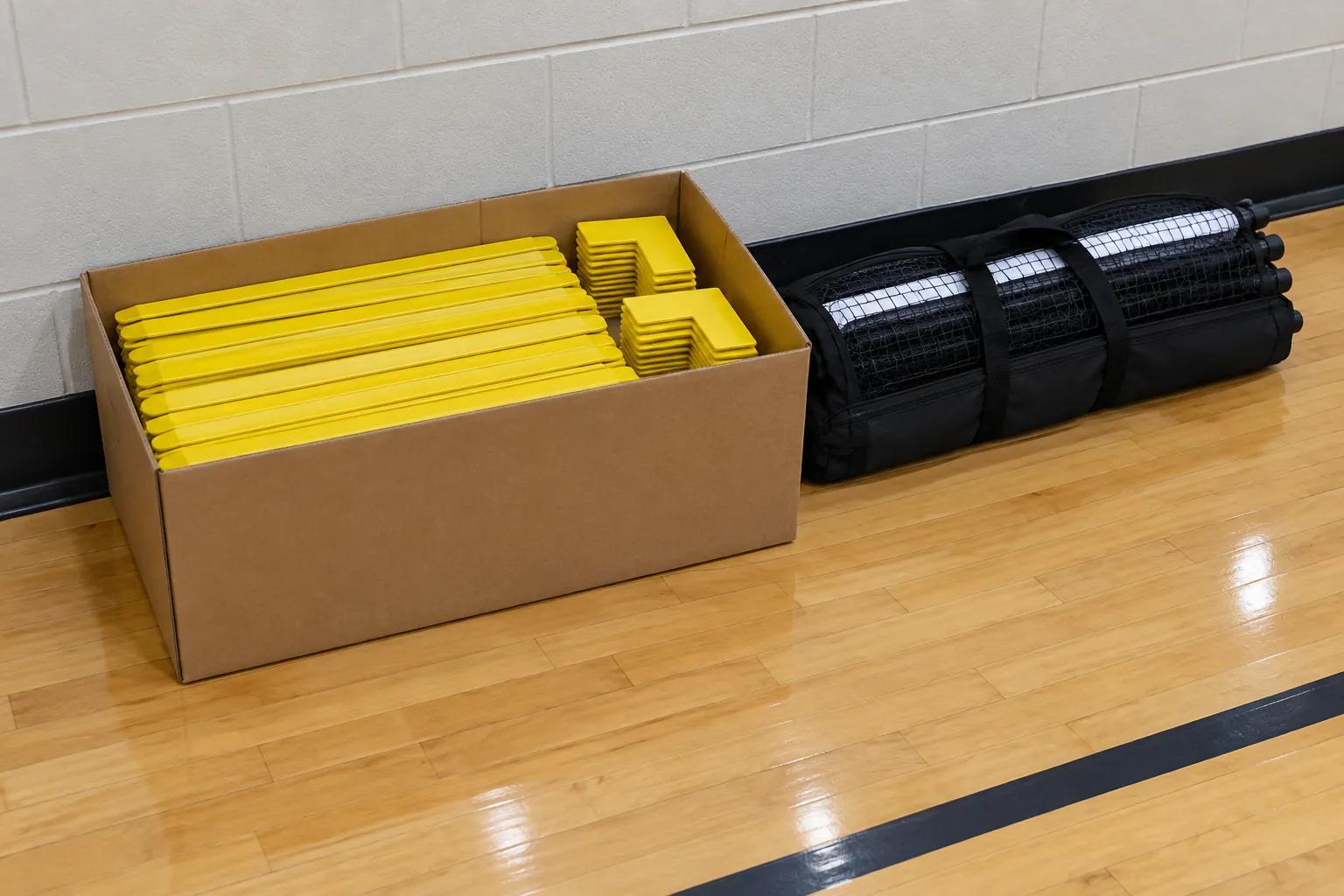
| Piece list | 198 ft per court arrives as segments and corners | Piece count, lengths, joint type | “Full court kit” |
| Packed size | Sets go on and off the floor each session | Set weight and carton size | No answer |
Two lines deserve more weight than the rest. color:inherit"https://salemnh.gov/DocumentCenter/View/3500/001-Pickleball-Appendix-B---Construction-Manual-FINAL" rel="noopener" target="_blank">ASBA / USA Pickleball manual says that where other sports share a painted surface, their lines should give way to the white playing lines and stop 3 in short of them. A gym is the reverse case, because the basketball lines were there first, so the pickleball color has to stand out against both the floor and every other line. Thickness: no public standard sets a maximum for a loose line strip, so judge it on your own floor. Walk, shuffle and pivot across a joint, and bounce a ball on the strip and beside it. If the ball kicks or a foot catches, the set fails.
What to check on a trial set
- Width of three pieces with a tape measure against the 2 in the quote states.
- Color against the floor and against the nearest basketball line, from the far baseline.
- Joints after 1 hour of play, and the finish under the strips after they are lifted.
Joints and curl: the two faults a listing never shows
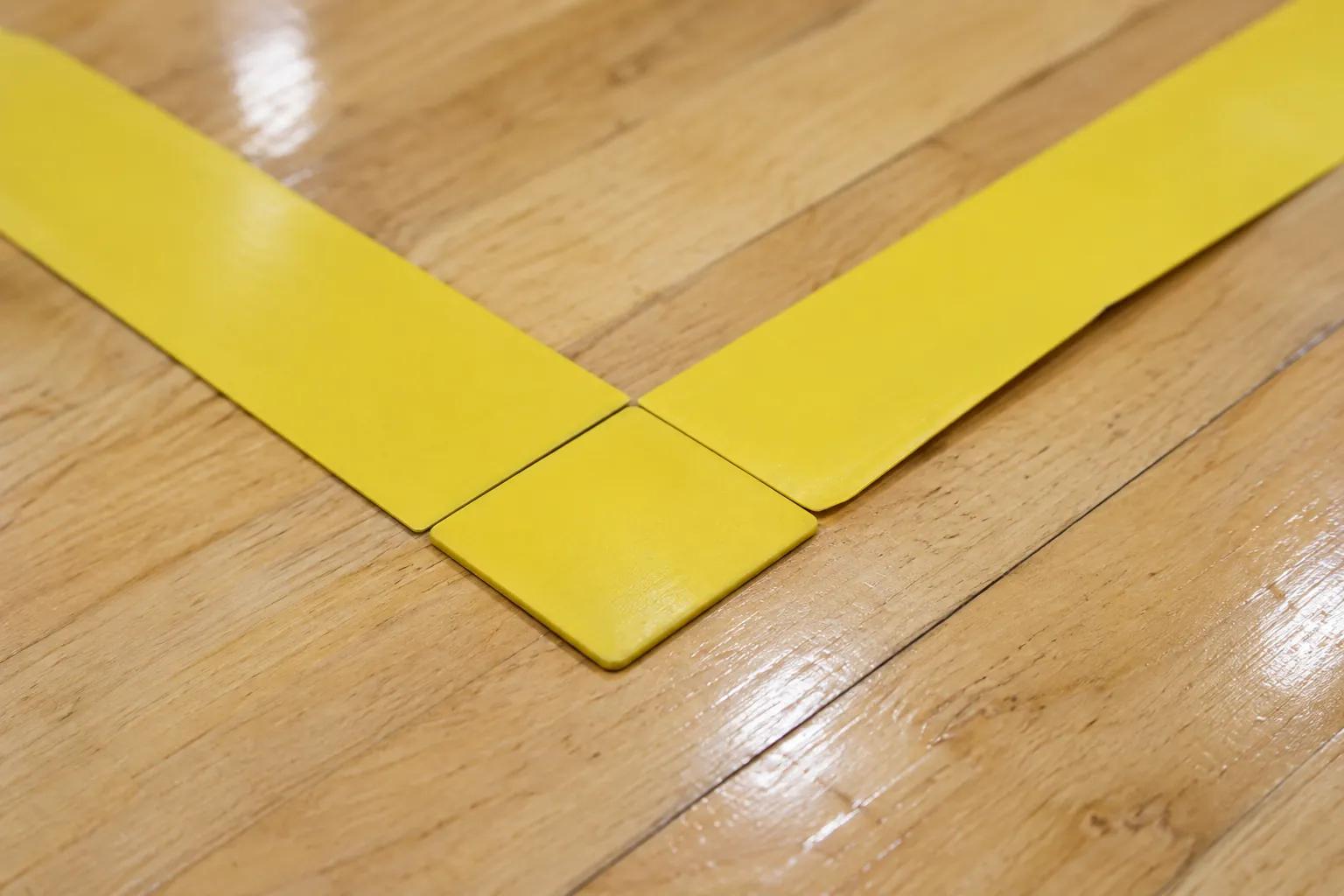
A court's 198 ft arrives as segments, so the line is only as continuous as its joints. A gap at a joint on the baseline is exactly where a close ball lands, and Rule 8.E leaves the call to what players can see. Ask how pieces join (butt, overlap or connector), and lay a full set during the trial to see whether the joints stay closed through a full session. Then check curl: a strip that has been rolled in a carton can keep the roll in its ends. Unpack the trial set, lay it out, and look at the ends before the first game. Ends that lift are a trip point, and they stay that way.
MOQ and lead time for line sets
We publish one MOQ: 1,000 pcs (Balls) / 50 pcs (Paddles). We publish no MOQ, specification or lead time for line sets, so do not read the ball and paddle figures across. For line sets, get these in writing before you compare prices:
- MOQ per set and per color. A stock color and a custom color can carry different minimums; ask for both.
- What changes the MOQ. A logo, printed corner pieces or custom packaging can each move it.
- Lead time as separate lines. Production time from order to finished goods, then freight time by mode, in weeks. One combined figure hides which part can move.
- What drives production time. Stock color from inventory, a new color compound, cutting to your piece list, and packing per court each add their own step.
Count sets the way the program runs, not the way the listing sells them. One set per court covers a normal night. Damage tends to hit single pieces rather than whole sets, so ask whether single replacement pieces are sold, and get the price per set and per replacement piece with freight quoted separately. A supplier who sells only complete sets turns one damaged corner into a whole-set reorder, subject to the same MOQ.
Work backwards from your first league night: floor-maker approval, a one-set trial on your floor, the bulk order, then freight. The trial is the step people skip, and it is the only one that answers the traction and marking questions. If the same order includes balls and paddles for the program, our OEM paddle and ball factory quotes those alongside, and the portable net frame guide covers the nets.
For clubs and rec programs ordering private-label paddles or rotomolded balls at wholesale volume, from a low MOQ, with pre-shipment QC.
See OEM paddles and ballsA four-question path to the right system
- Is the floor finished maple? Yes: drop tape, go to question 2. No: get the floor maker's written list of what may touch the floor, then go to question 2.
- Do the lines stay down between sessions? Yes, several days a week, year round: ask the floor contractor to price painted game lines at the next recoat. No: go to question 3.
- Is the floor already covered for events? Yes: buy the cover with the lines applied. No: go to question 4.
- How many courts, and who sets up? Multiply 198 ft of 2 in line by the court count, then time one volunteer laying one trial set. That time, and the packed size, decide whether a loose set works for your slot.
Question 2 is where budgets go wrong. A program that plays four nights a week and lays and lifts a loose set every time pays in staff hours for as long as the program runs. Painted lines are done once, ideally at a scheduled recoat. A program that plays one morning a week in a gym booked for basketball the rest of the time has the opposite answer. Painted lines would add a color the gym does not want, while a loose set or a cover leaves the floor as it found it.
For a gym running several courts side by side, the multi-court layout plan covers spacing between courts before you count sets.
Frequently asked questions
How do you make temporary pickleball lines on a gym floor?
On a finished maple floor, use a loose line set with no adhesive, a floor cover with the lines applied, or game lines painted by the floor contractor. MFMA does not recommend any kind of tape to mark temporary court boundaries on a finished maple floor. On a synthetic floor, the floor maker's warranty decides what may touch it.
How much line do you need to mark one pickleball court?
One court takes 198 linear ft (60.4 m) of 2 in line: 128 ft of perimeter, 40 ft of non-volley zone line and 30 ft of centerline. Order a little extra for trimming corners if the system is cut to length.
Can you put tape on a gym floor for pickleball?
Not on a finished maple floor: MFMA does not recommend any kind of tape to mark temporary court boundaries on a finished maple floor, because removal can peel the finish and the tape changes traction. On synthetic floors, ask the floor maker in writing.
What color should pickleball lines be on a basketball court?
Rule 3.A.4.e says all lines should be 2 in (5.08 cm) wide and the same color, clearly contrasting with the color of the playing surface and court. On a shared floor, pick one color that differs from the basketball lines and use it for every pickleball line.
Your next steps before ordering
- Get the floor answer in writing: MFMA's position for maple, the floor maker's for synthetic.
- Measure the gym wall to wall and mark the eight line ends per court. Place each strip's outer edge on its mark, so the court measures 20 ft by 44 ft and not 20 ft 2 in by 44 ft 2 in.
- Send the RFQ lines above, with MOQ per set and per color and lead time split into production and freight.
- Lay one trial set on a corner, play on it for a session, then lift it and inspect the finish before the bulk order.
Want to source this quality for your brand?
Contact our factory directly on WhatsApp for an instant MOQ and pricing quote.