Fitting Out an Indoor Pickleball Venue: The Equipment Decisions a Gym Floor Forces on You
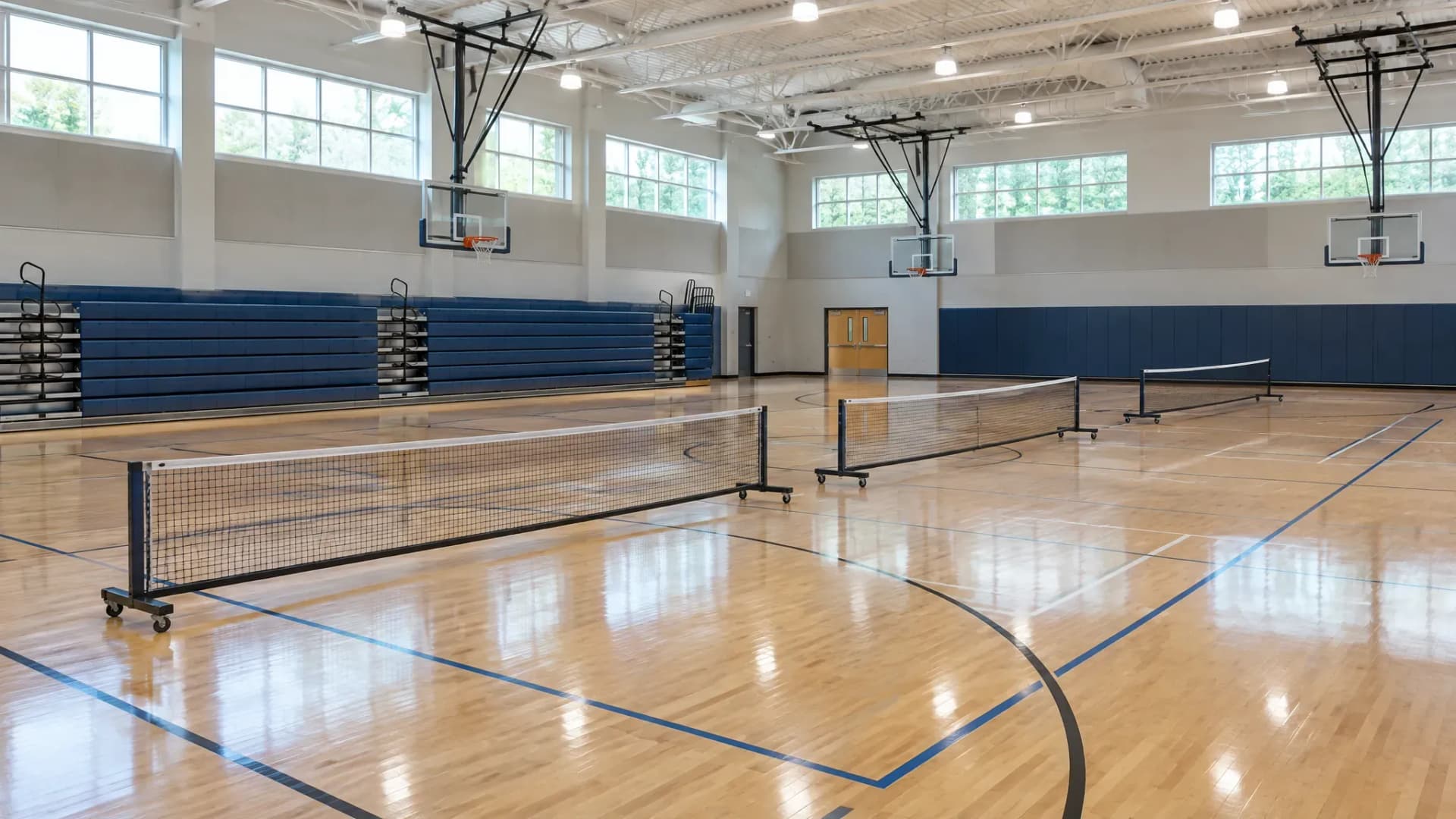
A parks department has one maple-floored gym, a weeknight basketball league and a request for six pickleball courts by January. The indoor pickleball equipment catalogue shows portable nets, line tape and divider netting. The floor, not the catalogue, decides which of those can be used at all.
Here is the short answer: the floor sets the equipment list. On a finished maple gym floor, skip tape. The Maple Flooring Manufacturers Association does not recommend masking, construction, electrical, duct or adhesive tape, so budget for game lines from the floor contractor or a floor cover. Then pick an indoor pickleball net whose base carries the load on wide, non-marking wheels and feet.
A synthetic sports floor is sold with an EN 14904 or ASTM F2772 test report, and that report should be read before any net cart is chosen. Over a court surface on concrete, permanent posts are the better buy. Count courts against the Rulebook's minimum playing surface of 30 ft by 60 ft, not against the painted basketball lines: a full-size basketball court has room for three crosswise courts, not six, and only if the floor runs past its sidelines.
We manufacture nets, net systems and court accessories. We have not published our own lead times or minimums for indoor kits, so where our number would go, this page gives the question to ask instead.
Key Takeaways
- MFMA does not recommend masking, construction, electrical, duct or adhesive tape for temporary lines on a maple floor.
- Net posts, including connected wheels, arms and legs, are permanent objects under the 2026 Rulebook.
- Synthetic floors: hold the net cart to the rolling-load value on the floor's EN 14904 report, or ask the maker on an ASTM F2772-24 floor.
- Count courts against a minimum playing surface of 30 ft by 60 ft per court.
- Net height is the same indoors: 36 in +/- 0.25 in at the sidelines and 34 in +/- 0.25 in at center.
- Ask every supplier for lead time split by production and freight, and MOQ per SKU.
On this page
- Three floors side by side
- Maple gym floors
- Synthetic sports floors
- Court surface over concrete
- How many courts a gym holds
- Which fit-out fits your venue
- Ordering: lead time, MOQ, checks
- FAQ
MFMA’s alternative to tape on maple is game lines added by the floor contractor. This short training demo from a flooring-supply distributor shows that job on a maple panel: the line is masked with a tape machine, then painted with a roller.

Three floors side by side
Indoor venues sit on one of three floors, and each one closes off some equipment choices before price enters the conversation. The table below is the spine of this page. Net height does not change with the floor: Rules 3.B.6 and 3.B.7 of the 2026 USA Pickleball Official Rulebook require 36 in +/- 0.25 in at the sidelines and 34 in +/- 0.25 in at center, measured above the playing surface. If you lay a floor cover, that means above the cover.
| Floor | Net system | Lines | Best for | Verdict |
|---|---|---|---|---|
| Finished maple gym floor | Portable, wide non-marking wheels and feet | No tape; contractor game lines or floor cover | Shared school, church and rec gyms | Portable nets only; budget for lines |
| Synthetic sports floor (PVC, PU) | Portable, loaded wheel within the floor's rolling-load rating | Only what the floor maker approves | Rec centers and multi-sport halls | Read the floor's test report first |
| Court surface over concrete | Permanent posts in sleeves | Painted lines | Dedicated indoor clubs | Permanent posts; lowest daily handling |
Maple gym floors: no tape, soft feet, lines by the floor contractor
The default advice online is to tape the lines. The people who make maple sports floors disagree. The Maple Flooring Manufacturers Association (MFMA) does not recommend masking, construction, electrical, duct or adhesive tape for temporary lines on a maple floor. Its statement on tape gives the reasons: removal can peel layers of finish, the adhesive can etch or stain the finish and the wood under it, and tape grips differently from the finish around it, so players cross a change in traction at every line.
The MFMA flooring FAQ offers two alternatives: ask the sport floor contractor to add the game lines, or use a protective gym floor cover and mark lines on the cover. Painted game lines are simplest to add when the floor is due for a recoat anyway, since the contractor is already on the floor. Rule 3.A.4.e asks only that lines should be 2 in (5.08 cm) wide and the same color, clearly contrasting with the playing surface. A pickleball color that differs from the basketball lines meets that on a busy floor. Our guide to equipment needed to start covers the rule itself; the maple floor only removes tape from the options.
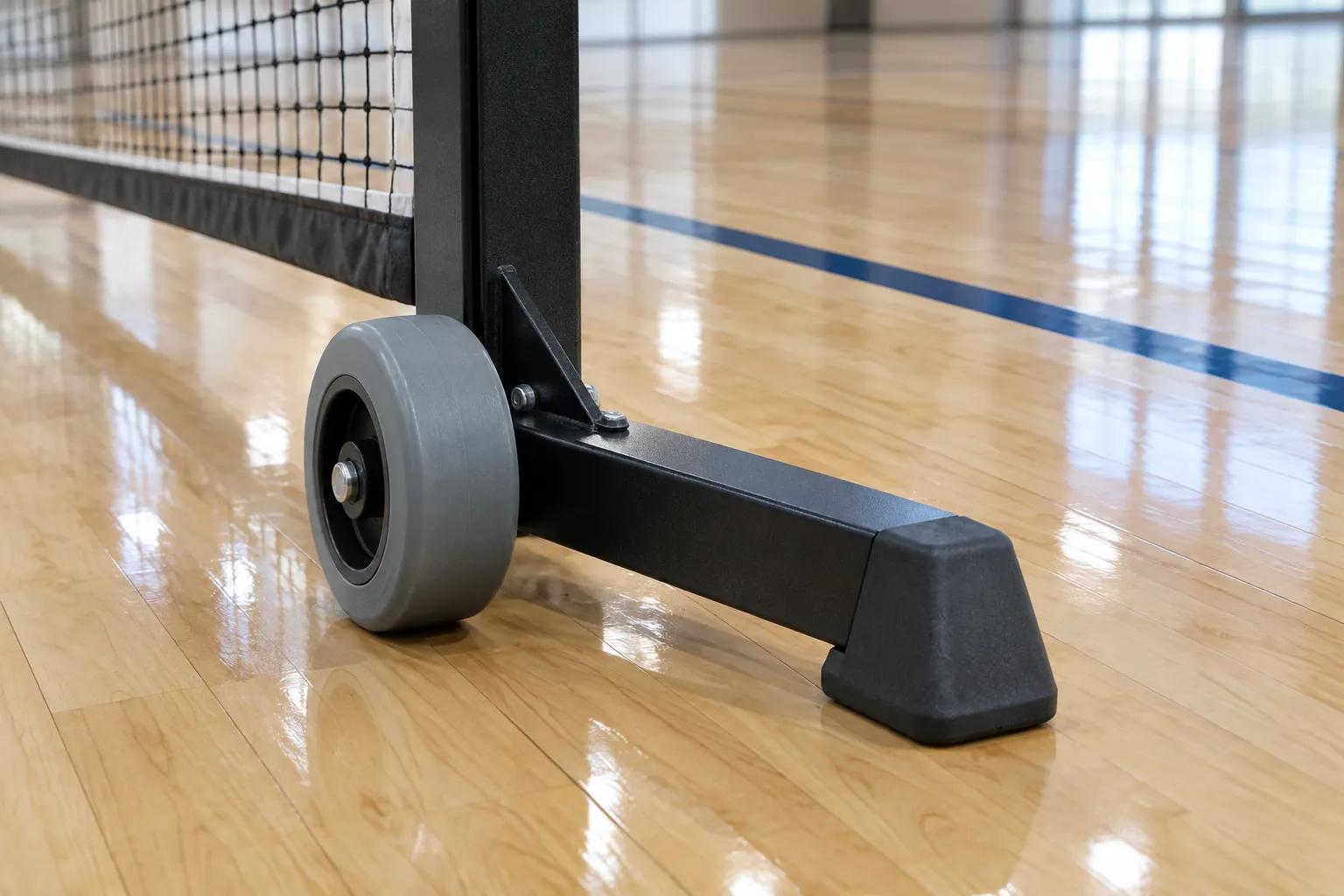
The net system matters for a second reason. Under the Rulebook, net posts, including connected wheels, arms and legs, are permanent objects, and a ball that contacts a permanent object before bouncing is a fault against the player who hit it. A base with legs splayed into the court turns into a line call every session. On maple, the same legs are also what drag and scuff when staff reposition a net, so ask for wide, non-marking wheels and feet and for the footprint drawing before you order.
Synthetic sports floors: the test report decides the net cart
Rolled PVC and poured polyurethane floors are usually specified against a performance standard. In Europe that is BS EN 14904:2006, published 30 June 2006, status current, under review, according to the BSI record. In the US it is ASTM F2772-24, which covers multi-purpose indoor sports floor systems and rates force reduction, ball rebound, vertical deformation and surface finish effect.
One figure matters for equipment. A summary of EN 14904 published by Pulastic, a floor maker, lists force reduction 25% to 75%, vertical deformation no more than 5.0 mm, rolling load resistance at least 1,500 N. That rolling-load line is the one to hold a net cart to: a loaded net system concentrates its weight on a few small wheels. Confirm the value on your own floor's EN 14904 test report, then ask the net supplier for the loaded weight on each wheel and compare the two. ASTM F2772-24 does not list a rolling-load property among its four, so on a US-spec floor ask the floor maker directly.
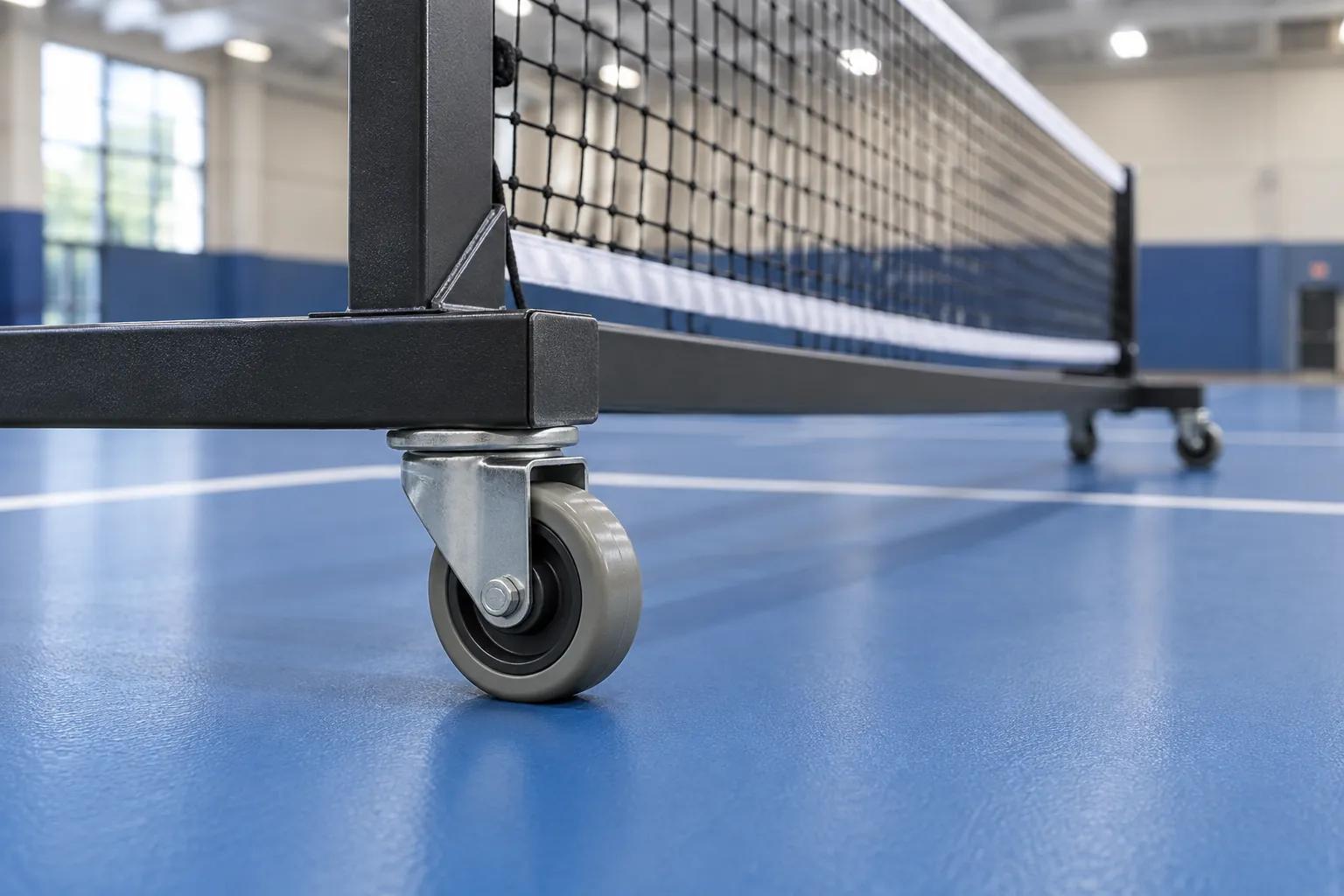
Tape is a question for the floor maker too. MFMA speaks only for maple, and a synthetic floor's warranty may name approved tapes or forbid them. Get that answer in writing before a single roll arrives. Our portable nets and court accessories can be specified to the load and footprint your floor report allows.
Court surface over concrete: where permanent posts earn their place
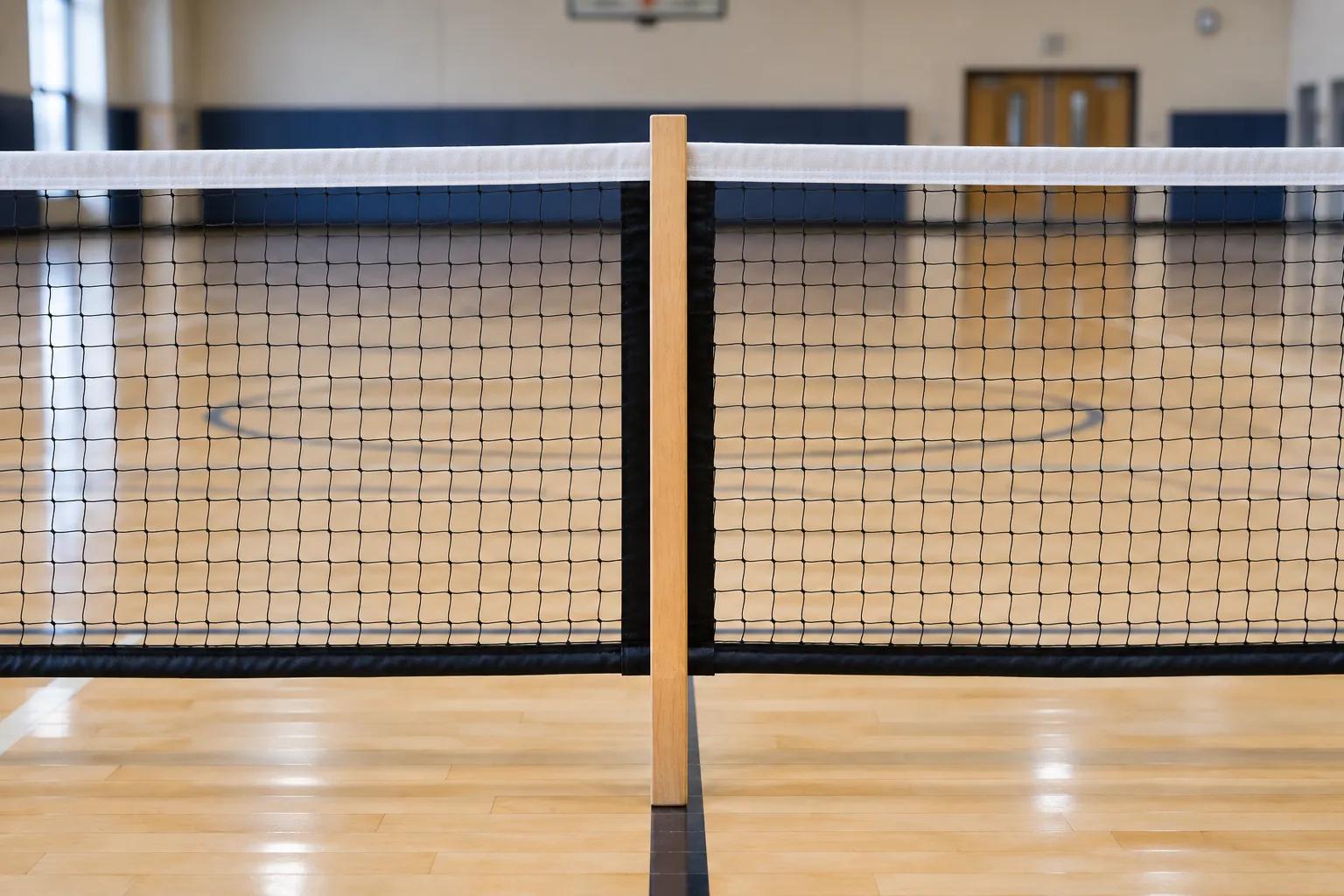
A dedicated indoor club usually plays on an acrylic system or modular tile laid over a concrete slab. Nothing else shares the space, so the net can stay up, the lines can be painted, and permanent posts in floor sleeves stop being overkill. They remove the daily setup that portable systems impose. Rule 3.B.2 says posts should be 22 ft +/- 1 in apart, inside to inside, with a maximum diameter of 3 in. On a 20 ft court that puts each post about 1 ft outside its sideline.
The trade-offs of acrylic against tile are covered in our court surface comparison, and sleeve depth and footing in the permanent net post installation spec. The single indoor-specific point: core the slab only after the court layout is final, because a sleeve is the one piece of equipment you cannot move later.
How many courts a basketball gym actually holds
The six-court request usually comes from counting painted court shapes. Rule 3.A.1 fixes the court at 20 ft wide and 44 ft long, but Rule 3.A.3 sets a minimum playing surface of 30 ft by 60 ft, with 34 ft by 64 ft recommended for new construction and tournament play. The 2025-26 NBA Official Playing Rules draw a full-size basketball court 94 ft long by 50 ft wide.
Three courts laid across a 94 ft by 50 ft court take 90 ft of width at 30 ft each, but get 50 ft of length, 10 ft short of the 60 ft minimum. A 44 ft court inside 50 ft leaves 3 ft behind each baseline, against 8 ft at the 60 ft minimum. Players back up for lobs into that gap, so the shortfall shows up as collisions with walls and bleachers. Measure wall to wall, not line to line: floor beyond the painted court often recovers the missing length, and many school gyms are shorter than 94 ft.
| Layout | Courts (count) | Length per court (ft) | Run-off per baseline (ft) | Verdict |
|---|---|---|---|---|
| Painted court only, 94 x 50 | 3 | 50 | 3 | Below the 60 ft minimum |
| Floor extends 5 ft past each basketball sideline | 3 | 60 | 8 | Meets the minimum |
| Floor extends 7 ft past each basketball sideline | 3 | 64 | 10 | Meets new-construction recommendation |
| Floor available across the basketball court | Length per court (ft) | 3.A.3 minimum (ft) | Recommended (ft) |
|---|---|---|---|
| Painted court only | 50 | 60 | 64 |
| +5 ft each sideline | 60 | 60 | 64 |
| +7 ft each sideline | 64 | 60 | 64 |
Look up as well as out. The Rulebook sets no ceiling height; it lists ceilings and lighting fixtures as permanent objects, so a low beam simply becomes a fault waiting for a lob. Measure clear height over each court with backboards raised. The USA Pickleball and ASBA construction manual is in its 2023 edition, with the next edition slated for 2026.
Divider netting between side-by-side courts has no rule behind it. If it hangs from the roof structure, the lift that installs it is a heavy load. MFMA guidance is that for lifts up to 4,500 lb gross load, at least two layers of 3/4 in protective sheathing with staggered seams go down first. Quantities per court belong to our club fit-out sourcing guide.
Which fit-out fits your venue
- Shared school, church or rec gym on maple. Portable nets with non-marking wheels and feet, game lines from the floor contractor or a floor cover, three crosswise courts if the floor length allows. You give up permanent setups and accept daily handling.
- Rec center with a synthetic floor. Portable nets whose loaded wheel stays inside the floor's rolling-load rating, and only floor-maker-approved tape. You give up choice of net cart until the test report is in hand.
- Dedicated indoor club over concrete. Permanent posts, painted lines, divider netting between courts. You give up flexibility of layout once the sleeves are cored.
Ball choice does not change with the floor: all approved balls are acceptable for indoor or outdoor play under Rule 3.C.1, and our indoor vs outdoor ball guide covers which plays better where. Portable system anatomy is in the portable net system guide.
For facility managers, rec department procurement teams and court contractors who know their floor type and court count and want portable nets or posts specified to it.
See the net and court accessory rangeOrdering for an indoor floor: lead time, MOQ and what we check
An indoor RFQ fails when the supplier never hears about the floor. Send the floor type, the rolling-load value from its test report, the clear ceiling height and the court count with the request, and ask for the answers below in writing.
| Ask | Why it matters | Weak answer | Verdict |
|---|---|---|---|
| Loaded weight per wheel, and wheel material | Compare with the floor's rolling-load rating | "It's light" | Required on synthetic floors |
| Base footprint drawing | Legs in the court are permanent objects | A photo | Required before ordering |
| Height check: 36 in and 34 in | Rules 3.B.6 and 3.B.7 are musts | "Regulation size" | Measure on delivery |
| Lead time split: production, finishing, freight | Tells you which part can move | One total figure | Ask per SKU |
| MOQ per SKU and per mixed order | Nets, lines and dividers often ship together | "Depends" | Get it before sampling |
Price structure follows the same split. Ask for the net system, the line kit and the divider netting as separate lines, with freight shown apart, so you can compare suppliers item by item rather than on a bundle total. When a unit arrives, we would check three things first. Sideline and center heights should read 36 in (91.44 cm) and 34 in (86.36 cm) within 0.25 in (0.635 cm) on your floor. No wheel or foot should leave a mark after a slide test on an off-court corner. And the base footprint should match the drawing. For keeping a fleet running after opening, see our net spares program guide.
For operators and court contractors with a floor type, rolling-load value and court count in hand who want lead time and MOQ answered for their kit.
Message us your floor detailsFrequently asked questions
What tape should I use for pickleball lines on a gym floor?
On a finished maple floor, none: the Maple Flooring Manufacturers Association does not recommend masking, construction, electrical, duct or adhesive tape, and suggests game lines added by the sport floor contractor or a floor cover instead. On a synthetic floor, ask the floor maker which tape its warranty allows before buying any.
How many pickleball courts fit in a basketball gym?
On a 94 ft by 50 ft basketball court, three courts laid across it take 90 ft of width at 30 ft each, but get 50 ft of length, 10 ft short of the 60 ft minimum. Measure wall to wall, because floor beyond the painted lines can recover that length.
Is there a minimum ceiling height for indoor pickleball?
The 2026 USA Pickleball Official Rulebook sets none. It lists ceilings as permanent objects, and a ball that contacts a permanent object before bouncing is a fault against the player who hit it. Measure clear height over each court, including lights and raised backboards.
Do I need different balls for indoor courts?
No rule requires it: under Rule 3.C.1, all approved balls are acceptable for indoor or outdoor play. The larger-hole ball is customarily used indoors. Which one plays better on your floor is covered in our indoor vs outdoor ball guide.
Can a portable net's wheels or legs sit inside the court?
They can, but the rulebook counts them against play: net posts, including connected wheels, arms and legs, are permanent objects. A ball striking a leg before it bounces is a fault, so bases that keep their feet off the court surface cost fewer disputed points.
Conclusion
Each floor trades flexibility for handling. Maple keeps the gym shared but rules out tape and puts the load on net feet and contractor lines. A synthetic floor allows a portable fleet only as heavy as its rolling-load rating. Concrete with a court surface gives the lowest daily effort and the least freedom to move later. Pick the floor's constraint first, then the equipment.
Want to source this quality for your brand?
Contact our factory directly on WhatsApp for an instant MOQ and pricing quote.