Net Spares That Keep Courts Open: Building a Replacement-Parts Program for a Club Fleet

A court rarely closes because the net finally wore out. It closes on a Saturday morning because a center strap snapped, or the crank handle walked off, and the replacement that arrived the following week did not fit the post. A replacement strap lists at $14.00 and a handle at $24.00. An empty court costs more than both, every hour it stays taped off.
The short answer for a club running several courts: hold a component kit instead of whole spare systems, and build it around the parts that only fit your post family. Crank handles are sold against named post models, gear assemblies and caps per post family, and ground sleeves per post outside diameter; no general supplier can rescue you on those. Generic parts such as strap web and cable can sit on a supplier's shelf if it ships faster than the court-days you will accept losing. Size the rest with a reorder point from your own usage log.
We manufacture nets, posts and net-system parts. We have not published our own spares lead times or minimums, so where our number would go, this page gives the question to ask instead. Rule figures come from the 2026 USA Pickleball Official Rulebook.
Key Takeaways
- Only height is a "must" in Rule 3.B: 36 in +/- 0.25 in at the sidelines, 34 in +/- 0.25 in at center, strap included.
- Stock the tension path first: winder or gear, crank handle, cable, center strap and anchor.
- Handles, gear assemblies and caps are sold per post family; sleeves are sold per post OD, 2-7/8 in or 3 in.
- A component kit per post family beats whole spare systems for permanent courts.
- Size generic stock with a reorder point from your own swap log, not a rule of thumb.
- Ask every supplier for lead time by segment and MOQ per SKU and per mixed carton.
On this page
- Which failures close a court
- Three ways to hold spares
- Parts that fit one post family
- Keeping a replacement legal
- Stock depth and the reorder point
- Which program fits your fleet
- Supplier questions and our checks
- FAQ
Every repair here ends with a height check. This short, neutral video shows one done properly.

Which failures actually close a court
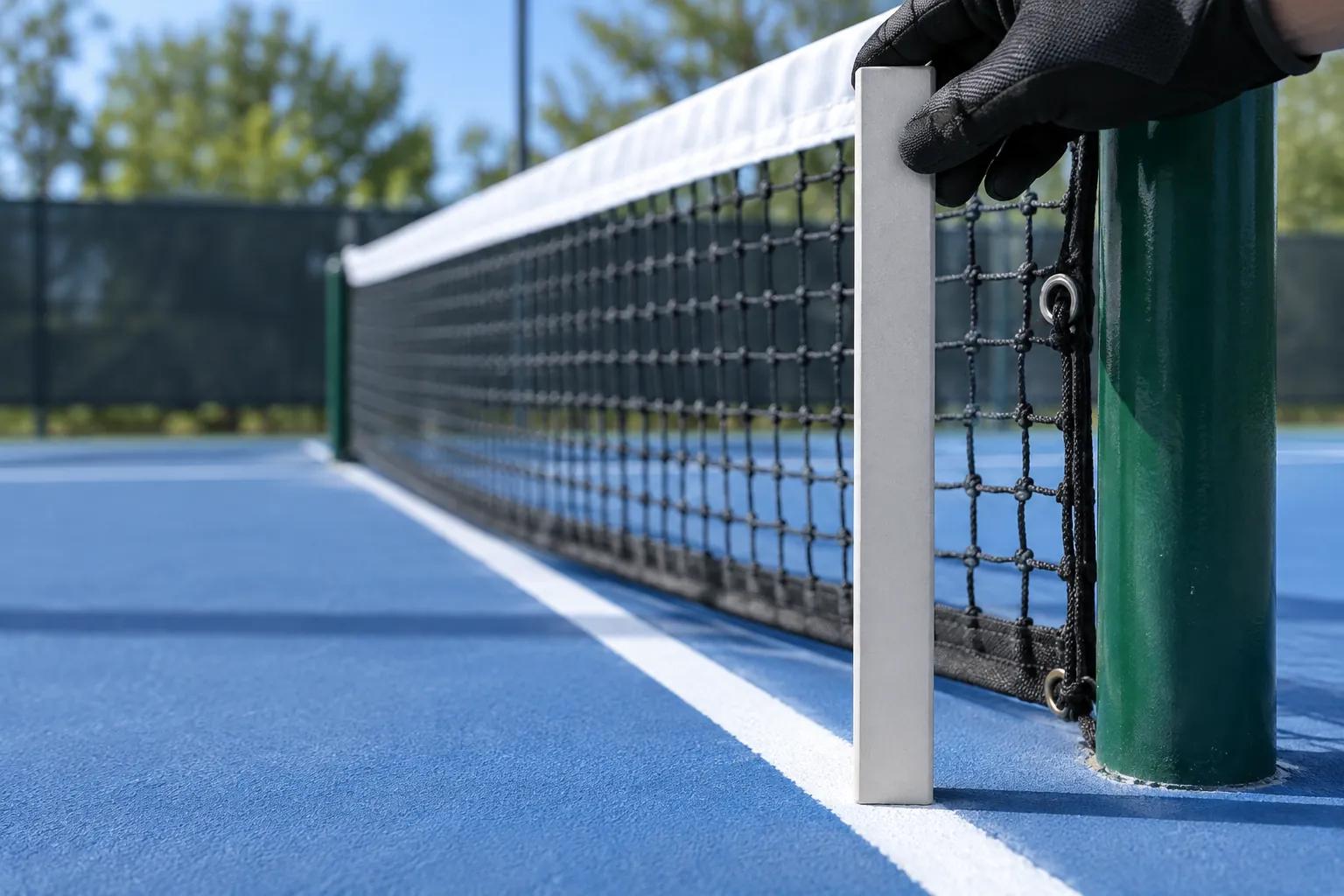
Section 3.B of the 2026 USA Pickleball Official Rulebook sets out everything the rules say about the net, in Rules 3.B.1 through 3.B.7, and the verbs matter. Size, post spacing and the edging tape are written as "should". Height is written as "must". Rule 3.B.6 sets 36 in +/- 0.25 in (91.44 cm +/- 0.635 cm) where the net crosses the outer edge of the sidelines. Rule 3.B.7 sets 34 in +/- 0.25 in (86.36 cm +/- 0.635 cm) at the center point, with the center strap included in that measurement. A quarter of an inch either way is the whole tolerance.
That split is the stocking priority. Any part in the tension path, meaning the winder or gear, the crank handle, the cable, the center strap and its anchor, can push a height outside tolerance the moment it slips. Those failures close a court. A faded headband, a small mesh repair or a scuffed cap departs from nothing binding and can wait for the next scheduled order.
Two further rules raise the cost of a tired tension path. Rule 13.A.1, in Part II, applies to every match, standard or tournament. It says a rally must be replayed when a returned ball that crosses the net contacts a part of the net draping on the ground, so a sagging net starts deciding points at any level. In sanctioned tournaments, Part III adds a referee layer on top of that: the referee checks net height before each match (17.B.2) and rechecks it whenever the net is disturbed (17.D.7). A venue hosting events cannot nurse a slipping winder through a day of matches.
Three ways to hold spares, compared
Clubs end up in one of three models, usually without choosing. Some keep a complete spare post pair and net. Some keep a box of parts. Most rely on phoning the supplier. Each has a place, and the published list prices show why the choice turns on which part fails.
On one US distributor's pages, read on 23 September 2026, a Douglas center strap lists at $14.00 and a center pipe anchor at $18.00. A replacement crank handle runs $24.00 to $29.00, post caps $59.00 to $79.00 and ground sleeves $69.00 to $79.00. A reel with handle and hardware is $139.00, and a gear assembly $159.00 to $249.00. Those are retail list prices from one distributor, quoted for their structure rather than as a benchmark. The pattern holds regardless of the dollar figures: the cheap parts are the ones that fail most visibly, and the dear ones are specific to a post family.
| Part | Lowest listed (USD) | Highest listed (USD) | Listing |
|---|---|---|---|
| Center strap | 14 | 14 | Douglas Velcro ACS Center Strap, SKU 20601 |
| Center pipe anchor | 18 | 18 | Center pipe anchor, SKU 63428 |
| Crank handle | 24 | 29 | Deluxe Chrome Handle / Reel-1 Replacement Handle |
| Post cap | 59 | 79 | Cap replacements, Premier RD to PPS-22 / Premier SQ |
| Ground sleeve | 69 | 79 | GS-24RD/AL, /PVC (2-7/8 in OD) and /ST (3 in OD) |
| Reel with handle and hardware | 139 | 139 | Deluxe Reel / Reel-1, each with handle and hardware |
| Gear assembly | 159 | 249 | Gear assemblies for PPS-22 & Premier SQ, Premier RD & XS |
A whole spare system answers every failure with the same swap, which is its strength and its cost. When the failure is a lost handle, you are changing a post to replace a part that lists at $24. A component kit costs a fraction as much but only works if every family-specific part in it matches the posts you actually have. Supplier-held stock costs nothing to hold and is only as good as the dispatch time. The same distributor lists its center pipe anchor as ships in 1-2 weeks, which means two weekends of a closed court if nothing is on your shelf.
| Model | What sits on your shelf | Main risk | Best for | Verdict |
|---|---|---|---|---|
| Whole spare system | A complete post pair and net | Capital tied up; a whole post swapped for a $24 part | Portable fleets; sites where post bodies fail | Costliest per fix; hold it as a fallback behind a component kit |
| Component kit | Tension-path parts per post family | A part that does not match the post | Permanent fleets with recorded post families | Default for most clubs |
| Supplier-held stock | Nothing, or a standing order | Dispatch slower than acceptable downtime | Single-family sites near a stocking distributor | Generic parts only, never family-specific ones |
The parts that only fit one post family
Interchangeability is where spares programs fail quietly. The makers' own listings show how narrow the fit is. Within one manufacturer's range, the Douglas Premier XS-36 and SW-36 posts are 2-7/8 in (73 mm) outside diameter and the Premier RD-36 is 3 in (76.2 mm), a difference of 1/8 in (3.2 mm). Even inside one catalogue, the outside diameter to record runs 73 to 76.2 mm. The ground sleeves follow the post: GS-24RD/AL and GS-24RD/PVC are 24 in long for 2-7/8 in OD posts, while GS-24RD/ST is 24 in long for 3 in OD posts. Rule 3.B.2 recommends a maximum post diameter of 3 in, so both sizes sit within the rule, and neither sleeve is a spare for the other.
The same listings sell one gear assembly for PPS-22 and Premier SQ posts and another for Premier RD and XS posts, with caps split the same way. Crank handles are narrower still. A Har-Tru replacement crank handle for a 3 in square post with internal wind is listed as a fit for post models 100-244 or 100-245 only. That is the honest answer to anyone searching for a tennis net crank: the handle that fits the tennis post on the next court is no evidence it fits yours.
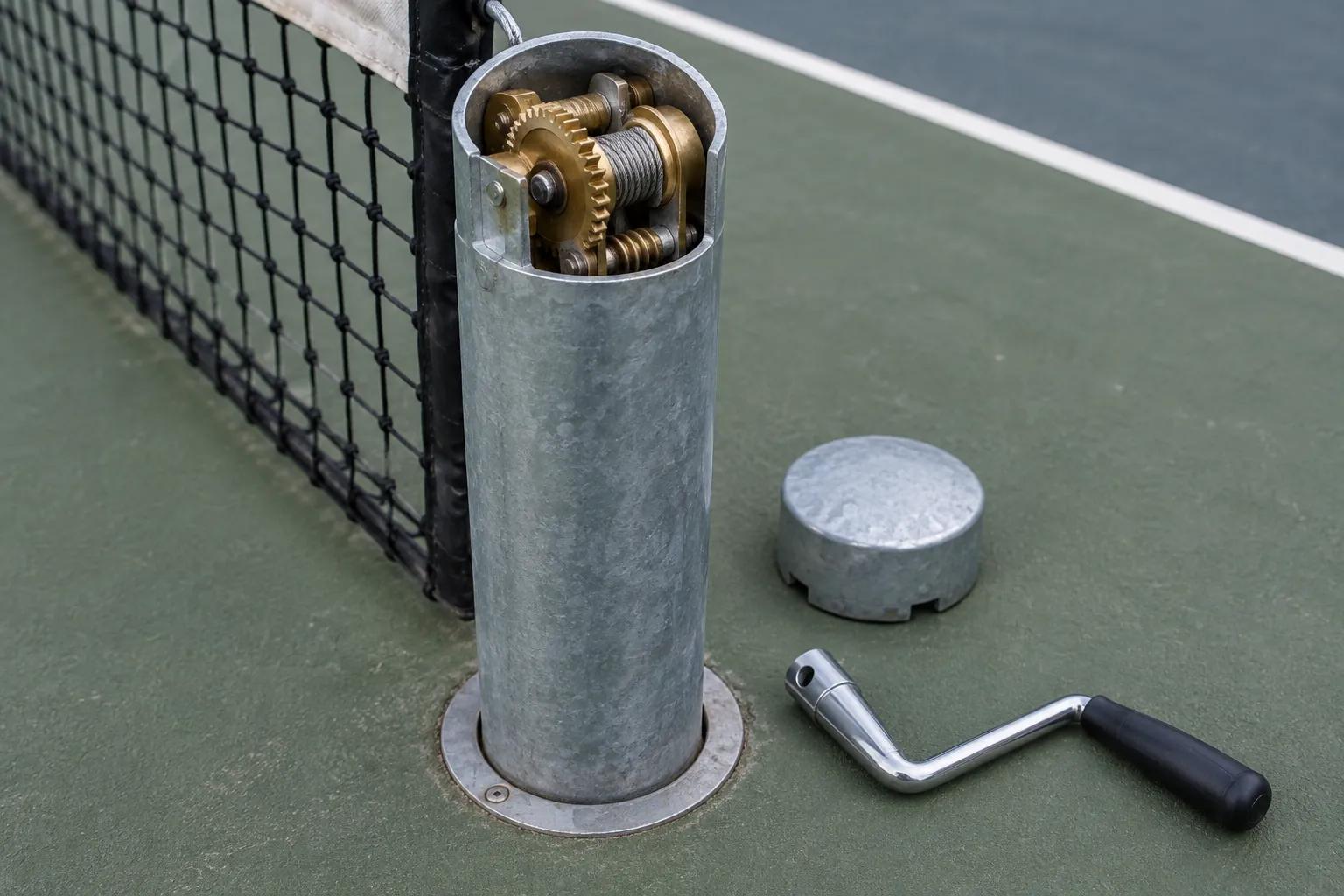
Portable systems are tighter again. Dominator's replacement-parts listing for its portable net runs to tube sections A, B, C and D, a net post, a center dowel, a caster, a replacement net and a top clip, all lettered to that system. A mixed portable fleet from three makers needs three parts lists.
The fix costs an afternoon. For every court, record the post maker, model number, outside diameter, gear material, handle drive and sleeve part number, and photograph the winder with the cap off. Then source family-specific parts against that record, and generic parts such as the nets, cables and center straps we make against the rule. Frame-side part minimums are covered in our portable net system frames guide, and sleeve geometry in the permanent net post installation spec.
| Part | Sold per | Record to keep | Verdict |
|---|---|---|---|
| Crank handle | Named post model number | Post maker, model, handle drive | Family-specific: shelve one per family |
| Gear or winder assembly | Post family (e.g. RD and XS) | Gear material and family | Family-specific: shelve one per family |
| Post cap | Post family | Cap part number | Family-specific: shelve one set per family |
| Ground sleeve | Post outside diameter (2-7/8 in or 3 in) | Sleeve part number and post OD | Order with posts; never cross-fit |
| Portable tube sections and clips | One maker's system | Maker, system name, section letter | Buy with the system |
| Cable | Length and diameter | Cable length per system | Generic if length matches |
| Center strap | Anchor and closure type | Closure variant in use | Generic; standardize one closure |
| Net panel | Rule 3.B.3 minimums, then depth | Panel depth you run | Generic within the rule |
What a replacement part must match to keep the net legal
A spare that fits the post can still leave the court outside the rules. Check each one against the clause it touches.
Net panel
Rule 3.B.3 asks for a net at least 21 ft 9 in (6.63 m) long and at least 30 in (76.2 cm) from bottom edge to top. Replacement nets are not all the same size above that floor: Douglas lists its PN-30 at 31 in x 21 ft 9 in and its JTN-30 at 36 in x 21 ft 9 in. Both clear the minimum, and a deeper panel changes how much hangs below the cable, so reorder the depth you already run.
Tape and cable
Rule 3.B.4 calls for a 2 in (5.08 cm) white tape binding over a cord or cable, and says the binding must rest upon it. The cable is a separate part. Douglas's RVC-27 replacement pickleball cable is 27 ft of galvanized steel, 5/32 in vinyl coated to 1/4 in (about 4 mm coated to 6.35 mm), looped at each end. That is 5 ft 3 in longer than a 21 ft 9 in net. The excess is what reaches the winder and the far post, so cable length belongs on the per-system record rather than the net order.
Center strap and anchor
The strap is optional under Rule 3.B.5, placed at the center of the net, centered 10 ft from the outside edge of the sidelines. If you run one, its spare has to meet the anchor you already have. Douglas's Velcro ACS strap is 2 in polyester web with a swivel loop bolt snap, and the matching center pipe anchor is 1.9 in (48 mm) OD galvanized steel. Douglas also sells Classic and Deluxe ACS variants, and each closure adjusts differently, so standardize on one across the fleet.
Re-measure after every swap
Any change in the tension path resets the heights. Douglas's tennis instructions crank the net to 38 in at center, warn "DO NOT OVERWIND", then pull the center down to 36 in with the strap; that is a tennis sequence with tennis heights. For pickleball, Gared's in-ground system instructions tension until the net top measures 34 in at the center. Measure 36 in at the outer sideline edge and 34 in at center, strap included, before reopening. The net height spec sheet sets out where each reading is taken, and the net fabric spec guide covers what to write on a replacement-net order.
Setting stock depth: the reorder point, part by part
There is no published ratio of spares per court that we could stand behind, so this section gives the method instead of a number. It rests on two floors.

Floor one: family-specific parts
The first floor is structural. For every family-specific part, hold at least one per post family on site: one handle type, one gear assembly, one cap set per family. No supplier can substitute for these, so the shelf is the only source when one fails. A club with two post families holds two sets, even if it has only eight courts.
Floor two: the reorder point
The second floor is arithmetic. For generic parts, the reorder point is the number you use during one replenishment cycle, plus a buffer sized to the court-days you accept losing. Both inputs come from a log: date, court, part, cause, and how long the court was out. After one season the log gives you a usage rate per part, and the rate gives you the reorder point. Our club fit-out sourcing guide plans consumables by court-hours, which is the right unit here too.
Replenishment time, segment by segment
Replenishment time is the input clubs guess worst. From a domestic distributor's stock it is dispatch plus transit, and the ships in 1-2 weeks listing above, 7 to 14 days, is a real example of the first half. From a factory it is several segments: making the part, finishing it (galvanizing or powder coating on metal parts), consolidating it into a shipment, freight, customs clearance and inland delivery. Ask for each segment separately, because only some of them move when you ask for speed. The lead time you plan against is the sum, not the production figure alone.
MOQ decides where a part comes from
Minimum order quantity decides where each part comes from. A spares order is many SKUs in small quantities, so ask every supplier for its MOQ per SKU and again per mixed carton or container. Where the per-SKU minimum is higher than a season's use, add the spares to the next system order so they ship together.
Which spares program fits your fleet
Work down this tree. The first question that matches your venue decides the program.
- More than one post family on site? Run a component kit per family, with the structural floor held for each. Mixed fleets are where a wrong part arrives most often.
- Hosting sanctioned tournaments? Keep every tension-path part on site for each family, whatever the distributor's dispatch time. Rechecks under 17.D.7 happen mid-event, and a replacement shipping in 1-2 weeks arrives after the draw is over.
- Portable fleet? Buy spares from the system's maker at the time of purchase, while the lettered tube sections and clips are still listed. If you run only a handful of portables, one complete spare unit is simpler than a parts bin.
- One post family, and a distributor that ships faster than your acceptable downtime? Shelf only the family-specific parts and let the supplier hold generic stock against a standing order.
Whichever branch applies, whole-system spares make sense only for portables or for a site where a post body itself is the part that fails.
For club operators and parks procurement teams who have recorded post maker, model and outside diameter per court and want replacement nets, cables and center straps specified against Rule 3.B.
See the net and spares rangeWhat to ask a spares supplier, and what we check first
A spares RFQ is short. The table below lists what we would put in it, and what a weak answer sounds like. Put the rule minimums in writing too: a replacement net at least 21 ft 9 in (6.63 m) long and 30 in (76.2 cm) deep, edged with 2 in (5.08 cm) tape. Ask for those dimensions as a written statement of conformity with Rules 3.B.3 and 3.B.4.
| Ask | Why it matters | Weak answer | Verdict |
|---|---|---|---|
| Which post families does each part fit? | Handles, gears and caps are family-specific | "It's universal" | Reject without model numbers |
| Lead time split by segment | Only some segments move when you pay | One figure, no breakdown | Ask again in writing |
| MOQ per SKU and per mixed carton | Spares are many SKUs, few units | Only a per-SKU minimum | Pair spares with a system order |
| Unit price per part | Shows the price structure | Spares as a percent of system price | Ask for a parts list |
| Net size and edging vs Rule 3.B | Keeps a replacement within the rules | No dimensions stated | Require length, depth, tape width |
Price structure deserves one more line. Ask for unit prices per part, not only per system, and ask whether the spare is the identical part shipped in the system or a substitute. The distributor listings above sell parts singly, which is the structure to expect; a supplier that can only quote spares as a percentage of the system price has not built a parts list.
What we check before quoting a spares list
- Post maker, model number and outside diameter for every court.
- Gear material and handle drive, from a photo of the winder with the cap off.
- Whether a center strap is used, and which closure and anchor.
- Net panel depth and cable length currently installed.
- Whether the venue hosts sanctioned tournaments, which moves tension-path parts onto the shelf.
- Where we stop: we quote parts for posts we can identify; we do not guess a fit.
On our own numbers: we have not published lead time or MOQ for spares on this page, because we would rather answer for your post family than print a figure that fits someone else's. Send us the post record and we will answer both, in writing.
For operators with post maker, model and OD recorded per court who want a spares list with lead time by segment and MOQ per SKU, in writing.
Message us your post recordFrequently asked questions
What are the parts of a pickleball or tennis net system?
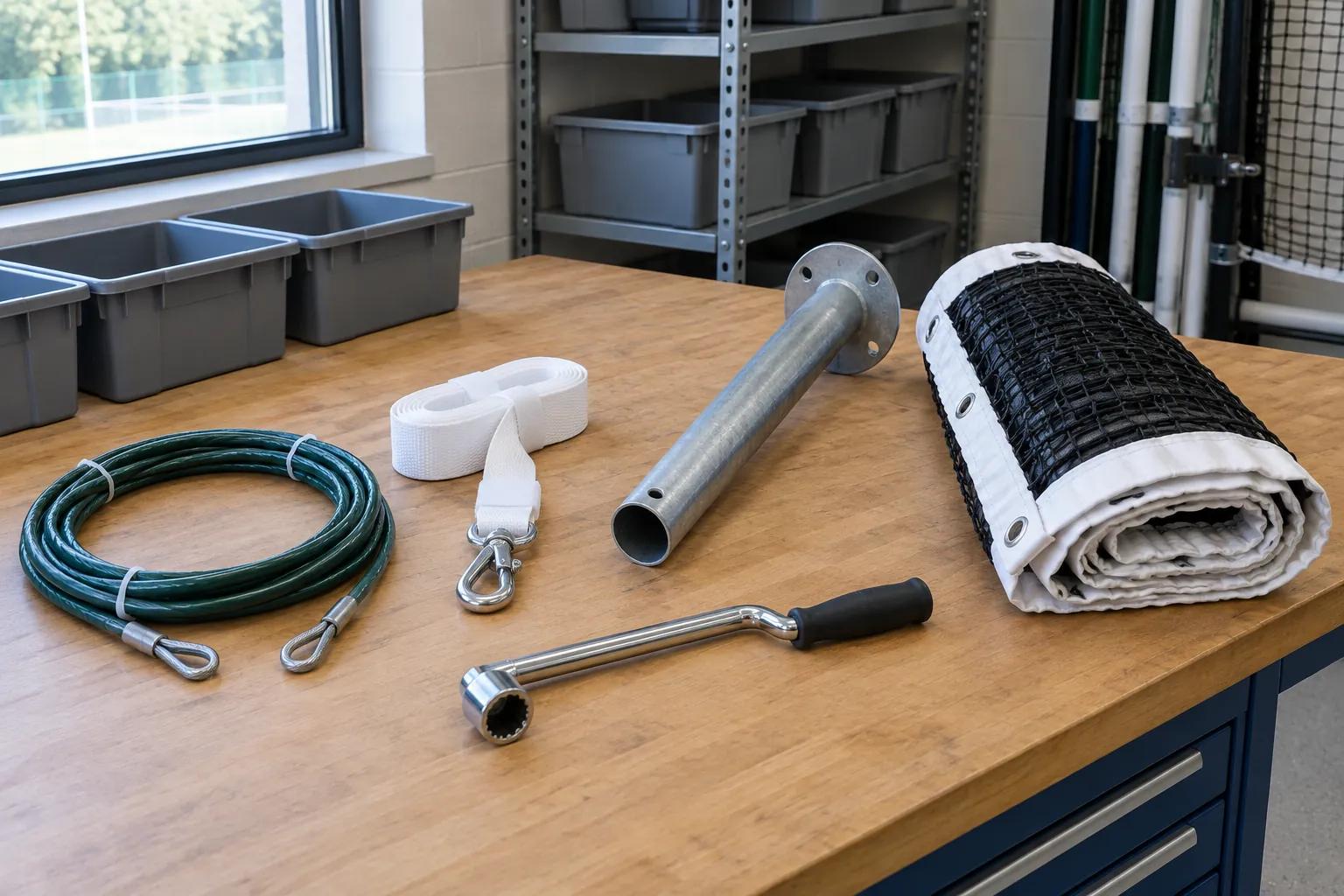
The net panel, the top tape and the cable running through it, two posts with a winder or gear assembly and a crank handle on one side, post caps, ground sleeves for in-ground posts, and optionally a center strap with its anchor. The winder, handle, cable, strap and anchor form the tension path, and a failure there is what takes a court out of play.
How does the center strap affect net height?
Under Rule 3.B.7 of the 2026 USA Pickleball Official Rulebook, the center height of 34 in +/- 0.25 in is measured with the center strap included. A strap that stretches or slips moves that reading directly, so re-measure after replacing a strap or anchor. The strap itself is optional under Rule 3.B.5.
Are all pickleball nets the same size?
No. Rule 3.B.3 sets minimums of 21 ft 9 in long and 30 in deep, and manufacturers build above that: Douglas lists its PN-30 at 31 in x 21 ft 9 in and its JTN-30 at 36 in x 21 ft 9 in. Reorder the depth you already run, so the net hangs the same way on every court.
Will any tennis net crank fit my pickleball post?
Not reliably. Replacement crank handles are listed against named post models; a Har-Tru handle for 3 in square internal-wind posts is listed as a fit for models 100-244 or 100-245 only. Record your post maker, model and handle drive before ordering, and treat the handle as a family-specific spare.
How many spare nets and parts should a club keep?
There is no published ratio we can stand behind. Hold at least one of every family-specific part per post family on site, then set generic stock with a reorder point: parts used during one replenishment cycle plus a buffer for the court-days you accept losing, taken from your own swap log.
Conclusion
A spares program is a short checklist, run once and kept current:
- Record post maker, model, outside diameter, gear material and handle drive for every court.
- Shelve one of each family-specific part per post family: handle, gear assembly, caps.
- Stock the tension path first, because height is the only "must" in Rule 3.B.
- Log every swap, and set generic stock with a reorder point from that log.
- Ask suppliers for lead time by segment and MOQ per SKU and per mixed carton, in writing.
- Re-measure 36 in at the sidelines and 34 in at center after every tension-path repair.
The cheapest parts close the most courts. Put them on the shelf first.
Want to source this quality for your brand?
Contact our factory directly on WhatsApp for an instant MOQ and pricing quote.