How Pickleballs Are Made: Inside the Rotomolding Process
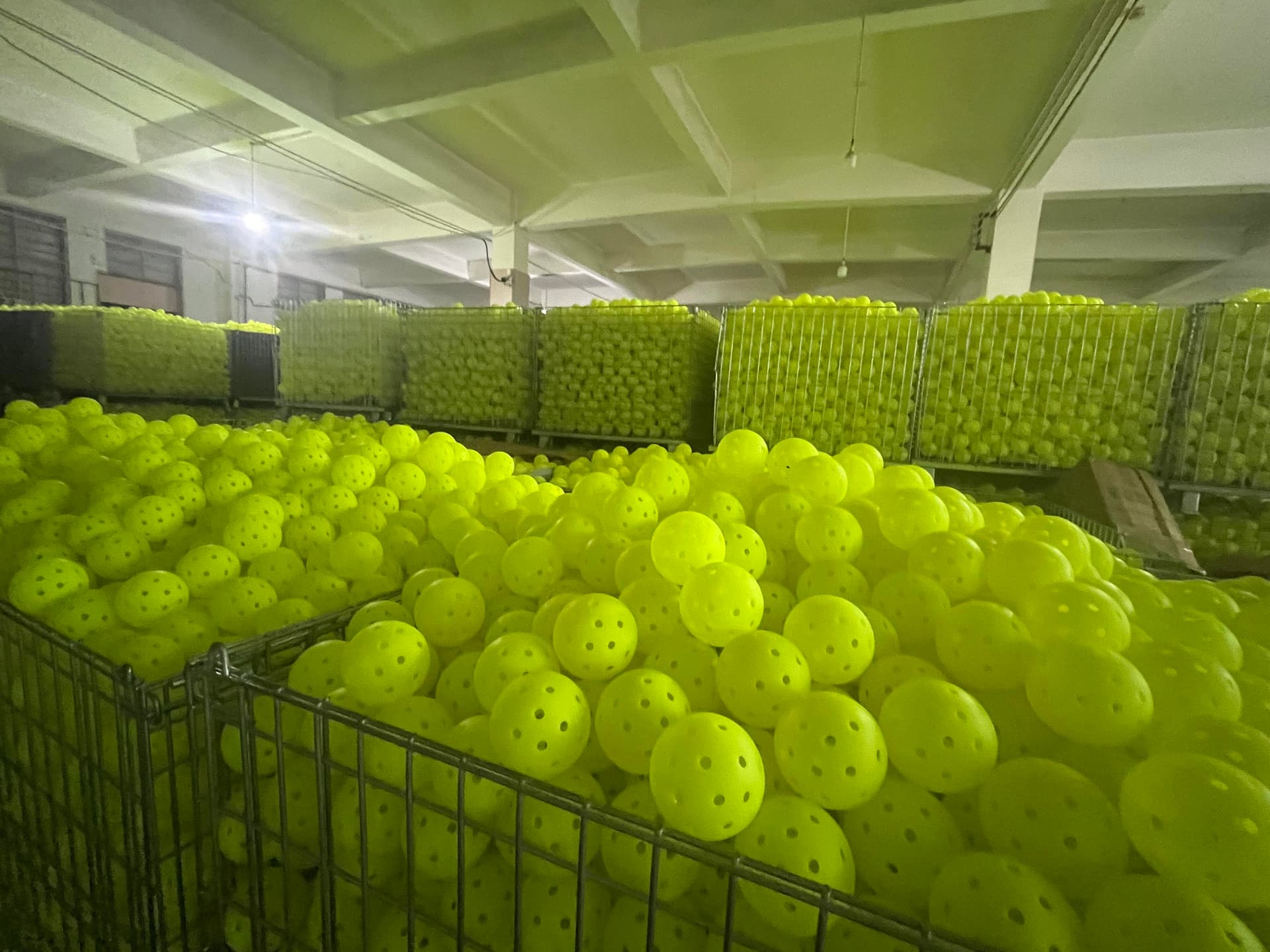
A pickleball looks like the simplest object in the sport — a hollow plastic sphere with holes. That simplicity hides the reason two balls that look identical in a photo behave nothing alike on court: one flies straight and survives a winter of asphalt, the other cracks at the seam in three weeks. The difference is decided at the mold, before a single hole is drilled. If you buy balls in volume, understanding how they are actually made is the fastest way to stop paying for the ones that come back as returns.
This walks through how a rotomolded outdoor pickleball is produced on a real factory line — from powder to a packed bucket — and where each step quietly sets flight, bounce, and crack resistance. We run rotomolding in-house, so this is the process as it happens on the floor, not a textbook diagram. By the end you'll know what to ask a supplier and which stage separates a ball that holds its shape for a season from one that fails on the first cold morning.

Key Takeaways
- An outdoor pickleball starts as high-rebound polyethylene (PE) powder, not pellets — powder is what lets rotational molding coat a mold evenly into a seamless sphere.
- The mold spins on two axes inside an oven so the melting plastic layers onto the wall uniformly; that uniform wall is why a one-piece ball tracks straight.
- Holes are precision-drilled after the ball is solid — around 40 for an outdoor ball — not molded in. Ragged holes are a QC reject because they disturb flight.
- USA Pickleball's window for an approved outdoor ball is roughly 2.874–2.972 in diameter and 24.3–26.2 g, so wall thickness and cooling have to be controlled batch to batch.
- Injection-molded balls are made from two half-shells fused at a seam — faster and cheaper, but the seam is the built-in weak point rotomolding avoids.
- The quality gap between a good ball and a cheap one is set by material grade, oven time, and post-mold inspection — three things you can and should ask any supplier to describe.
What "rotomolding" actually means
Rotomolding — short for rotational molding — is the process behind kayaks, water tanks, and traffic barriers, and it's what makes a seamless outdoor pickleball. The core idea is counterintuitive: instead of forcing plastic into a shape under pressure, you let gravity and slow rotation coat the inside of a hollow mold. No injection pressure, no two halves to join. The ball forms as one continuous wall.
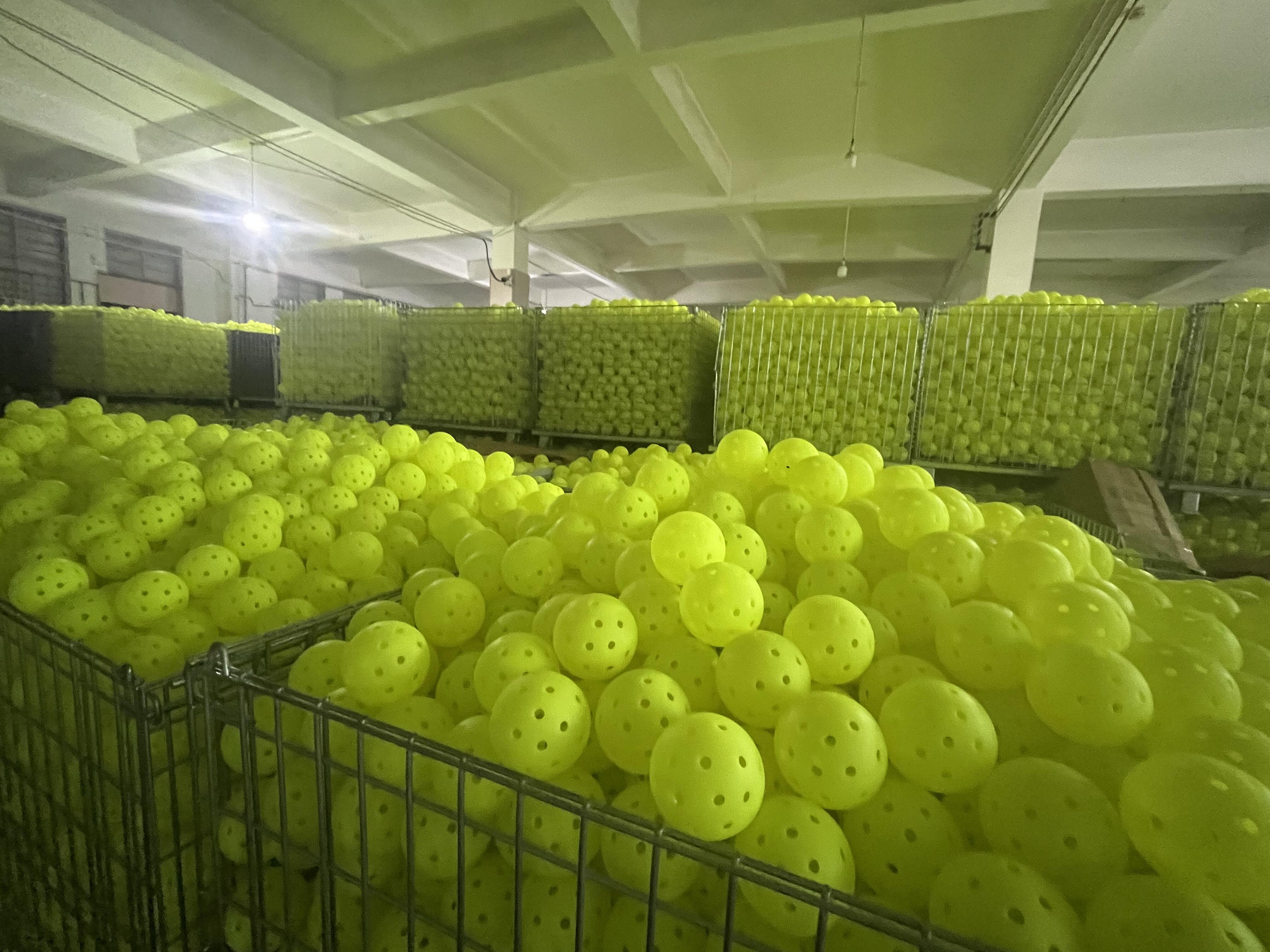
Because there is no seam, there is no built-in fault line for a crack to start from. That single structural fact is the whole reason the process exists in this sport: it trades speed and unit cost for a ball that fails later and more gracefully on rough courts. Everything below is just the steps that turn that principle into a finished ball.
Step by step: from powder to a packed ball
A rotomolded outdoor ball moves through five stages. Each one sets a property you'll later see as a spec on the datasheet — or as a complaint if it's rushed.
1. The material: high-rebound PE powder
It starts with polyethylene ground into a fine powder rather than pellets. Powder matters because it melts and flows across the mold wall evenly at oven temperature — pellets would leave thick and thin spots. The resin grade decides rebound and cold-weather behavior: a harder, higher-rebound PE gives the sharp bounce outdoor players expect and resists getting brittle when the temperature drops. Cheap regrind or a softer blend saves money per kilo and shows up later as dead bounce or first-cold-morning cracking.
2. Charging the mold
A measured dose of powder — the "charge" — goes into a hollow spherical mold cavity, which is then clamped shut. That charge weight is one of the quiet levers of quality: it determines final wall thickness, and wall thickness drives both weight and durability. Get it consistent and every ball in the run lands in the 24.3–26.2 g window. Let it drift and you get a batch that scatters on weight, which players feel as inconsistent bounce.
3. Biaxial rotation inside the oven
The clamped mold enters a heated chamber and rotates on two axes at once — this is the heart of the process. As the mold tumbles, the PE powder melts and coats the entire interior surface in an even layer, building the wall from the inside out. The two-axis motion is what guarantees uniform coverage: no matter the angle, fresh molten plastic keeps flowing to every part of the wall. Oven time and temperature have to be dialed in — too little and the wall is under-fused and weak, too much and the plastic degrades and turns brittle.
Uniform wall thickness is not a marketing line — it's the physical reason a one-piece ball flies straight. Even walls mean even weight distribution, and even weight is what keeps the ball from wobbling in the air.
4. Controlled cooling and demolding
After the wall is fully formed, the still-rotating mold moves to cooling. This stage is rushed more often than any other because cooling is slow, and slow costs money. But cool a ball too fast and the wall stresses unevenly, warping the sphere out of round or leaving internal stress that cracks later. Controlled cooling holds the shape true. The ball is then demolded as a solid, seamless, hole-less sphere.
5. Precision-drilling the holes
Here is the step most buyers don't expect: the holes are not in the mold. They are drilled after the ball is solid — roughly 40 for an outdoor ball, in a set pattern. The hole count and spacing tune aerodynamics: the denser 40-hole pattern cuts wind drift on open outdoor courts. Drilling quality matters as much as count — ragged edges or off-center holes disturb airflow and push a ball off-line, which is why clean, consistent drilling is a checkpoint, not an afterthought.
Why one-piece construction changes how the ball plays
The manufacturing method isn't trivia — it's the reason a ball behaves the way it does in a player's hand. Three on-court properties trace straight back to the process above.
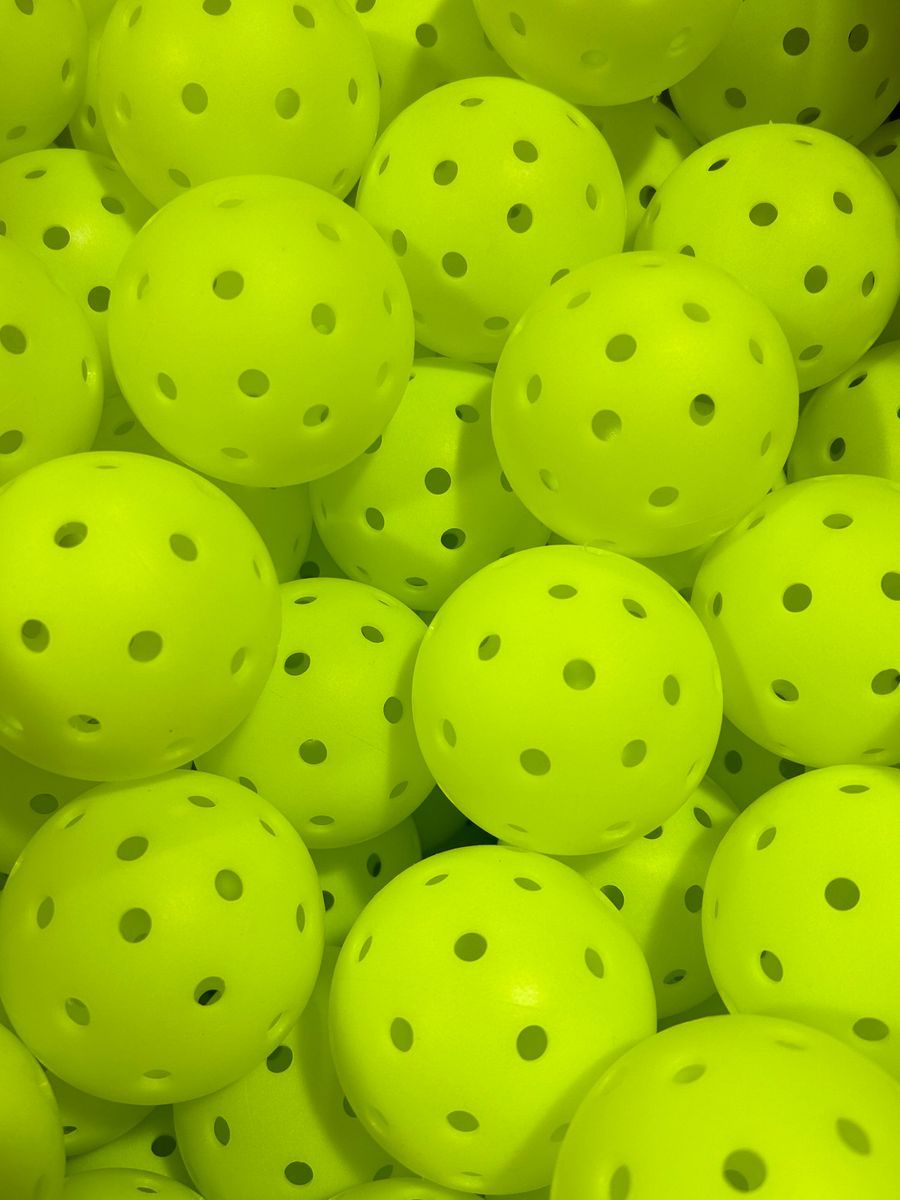
- Straight flight: Uniform wall thickness means weight is distributed evenly around the sphere, so the ball doesn't favor one side in the air. That's the flight consistency tournament players and their organizers care about.
- Crack resistance: No seam means no pre-set fault line. Impact spreads across a continuous wall instead of concentrating at a fused join, so the ball tends to crack later and less catastrophically on hard courts.
- Predictable bounce: A controlled charge weight and clean cooling keep every ball in the weight and roundness window, so bounce stays consistent across the batch — not lively out of one bucket and dead out of the next.
If you're weighing this construction against the cheaper alternative for a specific market, the trade-offs are laid out in detail in our guide to rotomolded vs injection-molded pickleball balls, and the SKU logic of hole count is covered in indoor vs outdoor pickleball balls.
How injection-molded balls are made differently
Not every pickleball is rotomolded, and it helps to know the contrast so you can read a spec sheet correctly. Injection molding takes the same family of plastic but forms the ball a different way: molten plastic is shot under pressure into two half-shell cavities — each already carrying half the holes — and the two shells are then fused together at the equator.
The upside is real: injection is faster, cheaper per unit once tooling exists, scales easily to huge quantities, and supports more colors and the softer 26-hole indoor ball that rotomolding doesn't typically run. The downside is structural: the fused equator is a seam, and a seam is a line where the wall is only as strong as the weld. Under hard play and temperature swings, that's where cracks usually begin. It isn't that injection balls are bad — a well-welded one performs at the top level — it's that the seam is a variable rotomolding simply doesn't have.
What separates a good ball from a cheap one
Two rotomolded balls can come off superficially similar lines and still fail at very different rates. The gap lives in three places, and each is something you can put to a supplier as a direct question.
| What sets quality | Good ball | Cheap ball |
|---|---|---|
| Resin grade | Virgin high-rebound PE, cold-tolerant | Regrind or softer blend, brittle in cold |
| Wall consistency | Even; balls hold the weight band | Scatters; inconsistent bounce |
| Cooling | Controlled; round and stress-free | Rushed; out-of-round, hidden stress |
| Drilling | Clean, centered, consistent pattern | Ragged edges, off-center holes |
| Inspection | Weight, roundness, bounce sampled per batch | Packed straight off the line, no sampling |
The tell is simple: a supplier who can describe their resin grade, charge control, cooling, and batch sampling is running a real process; one who only quotes a price is selling you an unknown. The full inspection routine — weight tolerance, roundness, seam and bounce testing — is broken down in our guide to wholesale pickleball ball QC, and the spec-and-MOQ side is in wholesale pickleball balls: specs, MOQ & compliance.
Conclusion
A pickleball is simple to look at and surprisingly exacting to make. In rotomolding, the ball's whole character is set before it ever reaches a player: powder grade decides bounce and cold resistance, charge weight sets the weight band, biaxial rotation builds the uniform wall that makes it fly straight, controlled cooling keeps it round, and clean drilling protects that flight. Skip or rush any one stage and the ball looks the same in the box but fails on the court.
For a buyer, that's the useful part: you don't have to guess at quality from a photo. Ask how the ball is made — resin, charge control, oven and cooling discipline, post-mold inspection — and the answers tell you whether you're buying a season of consistent play or a wave of returns. Sample first, check the weight band and roundness in your own hand, and buy the process, not just the price.
Frequently Asked Questions
What are pickleballs made of?
Outdoor pickleballs are made from high-rebound polyethylene (PE). For rotomolded balls the plastic starts as a fine powder, which melts and coats the mold evenly to form a seamless one-piece sphere. Resin grade drives bounce and cold-weather durability.
How are the holes made in a pickleball?
On a rotomolded ball the holes are precision-drilled after the ball is molded into a solid sphere — usually around 40 for an outdoor ball. On injection-molded balls the holes are formed in the two half-shells during molding. Clean, centered holes matter because ragged ones disturb flight.
What is rotational molding for pickleballs?
Rotational molding puts PE powder in a hollow mold that rotates on two axes inside an oven, so the melting plastic coats the wall evenly and forms the ball in one seamless piece. The absence of a seam is what gives the ball straighter flight and better crack resistance than a two-piece injection ball.
Why do some pickleballs crack so quickly?
Fast cracking usually traces to material or process: a soft or regrind resin that turns brittle in cold, rushed cooling that leaves internal stress, or — on injection balls — a poorly welded seam. A well-made rotomolded ball with even walls and controlled cooling resists cracking far longer on hard courts.
How many holes does an outdoor pickleball have?
A standard outdoor pickleball has about 40 holes. The dense pattern reduces wind drift on open courts. Indoor balls use a larger, 26-hole pattern for a softer, slower flight on gym floors, and are almost always injection molded.
Want to source this quality for your brand?
Contact our factory directly on WhatsApp for an instant MOQ and pricing quote.