Courtside Shade and Seating: Specifying Cabanas, Benches and Canopies That Survive Outdoors
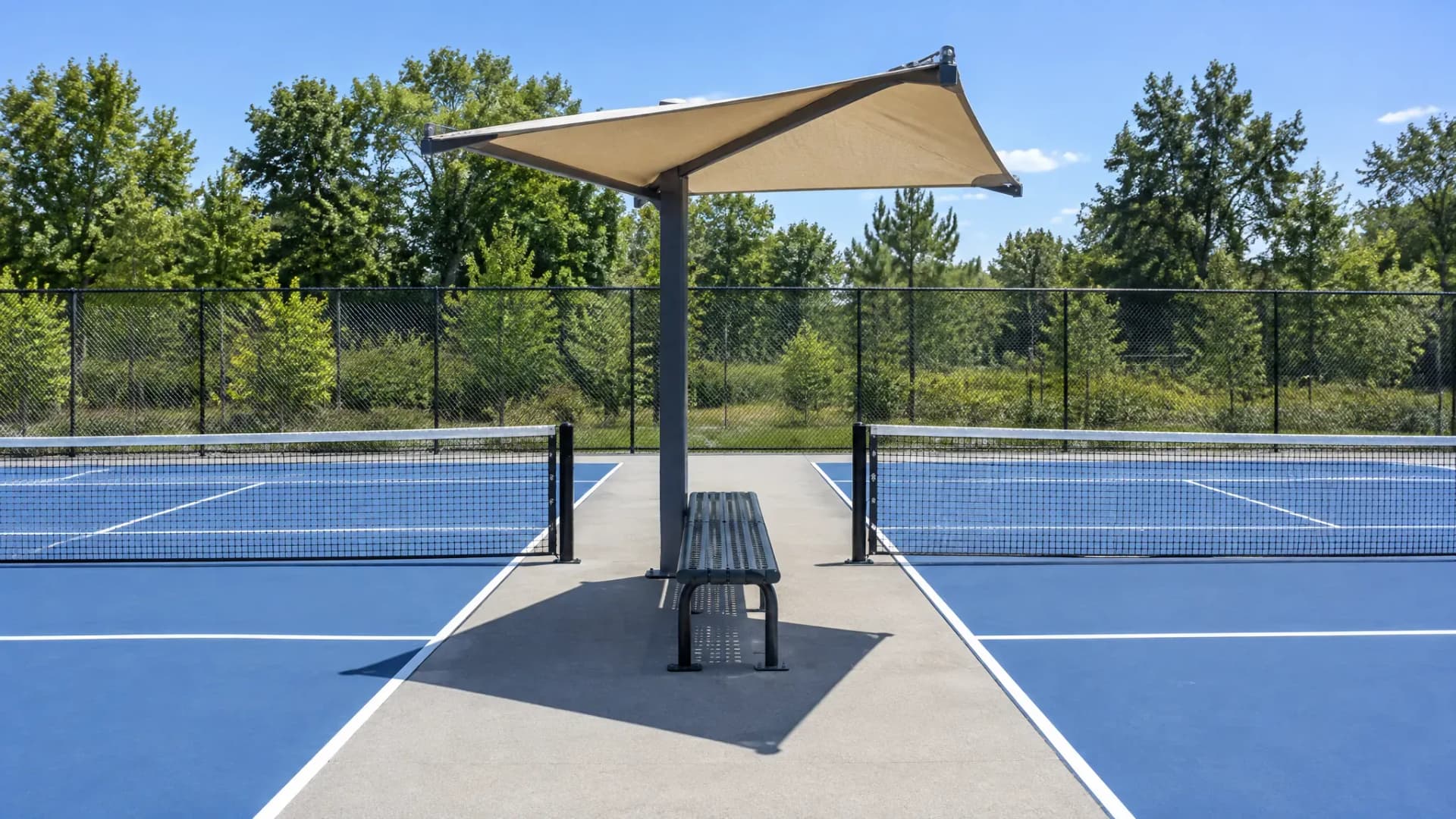
A pickleball court shade structure that stands between two courts has a size limit. The ASBA / USA Pickleball construction manual (2020 edition) caps the canopy at 5.5 x 9 ft in the 11 ft gap of a competitive battery and at 9.5 x 17 ft in the 19 ft gap of a wheelchair battery. Posts, benches and other fixed objects stay in a strip on the net line, 1 ft wide in the 11 ft gap and 5 ft wide in the 19 ft gap. Benches sit at least 5 ft from the sideline.
Whether it survives outdoors comes down to four lines in the quote. The fabric passes NFPA 701 and carries a UV rating measured to AS 4174:2018. Steel is galvanized to ASTM A123/A123M-24. Last, the frame is designed for the wind loads of the building code your jurisdiction adopted.
Key Takeaways
- Maximum canopy between courts: 5.5 x 9 ft at an 11 ft gap, 9.5 x 17 ft at a 19 ft gap (manual, 2020).
- Posts go outside the playing area, or between and in line with two adjacent net posts.
- Fabric: NFPA 701 Test Method 1 or 2 (IBC 2021, 3102.3.1); UV: an AS 4174 UVE rating, 95+ is the top band.
- Tube frames: ASTM A123 grade 75 (75 µm, 3.0 mils) once the wall is 1/8 in or thicker.
- Bleachers: CPSC recommends a 42 in guardrail once a footboard or seat is 30 in or more above ground.
This WBOY 12 News report shows new outdoor public courts opening at Veteran's Memorial Park in Clarksburg.

Manual figures are from the public 2020 edition; USA Pickleball lists 2023 as current, so have your court builder confirm them.
Canopy and post limits between two courts
The manual's drawing "Shade Shelter Locations and Other Fixed Obstruction Between Courts" gives two limits for each gap: the largest recommended canopy, and the strip where posts, benches and other fixed objects may stand.
| Gap between courts (ft) | Max canopy (ft) | Post and bench strip (ft) | Sideline to strip (ft) | Where the gap occurs |
|---|---|---|---|---|
| 11 | 5.5 x 9 | 1 x 8 to 9 | 5.0 | Competitive battery |
| 13 | 6.5 x 11 | 2 x 9 to 11 | 5.5 | Wider than competitive |
| 15 | 7.5 x 13 | 3 x 10 to 13 | 6.0 | Wider than competitive |
| 17 | 8.5 x 15 | 4 x 11 to 15 | 6.5 | Wider than competitive |
| 19 | 9.5 x 17 | 5 x 12 to 17 | 7.0 | Wheelchair battery |
Read it this way. The strip is centred on the net line, and its distance to each sideline is half of what the strip leaves of the gap: (11 − 1) / 2 = 5 ft (1.52 m). That 5 ft is the same minimum clearance to a fixed object the manual sets for benches. The canopy may be wider than the strip because it is overhead: 5.5 x 9 ft is 1.68 x 2.74 m, and 9.5 x 17 ft is 2.90 x 5.18 m.
Three rules ride along with the table:
- Fixed structures are smooth, with no hooks or other projections, from the playing surface up to 7 ft (2.13 m).
- The pad under the shelter lines up with the playing area and matches its texture and slip resistance.
- Posts stay outside the playing area, except one set between and in line with two adjacent net posts, so your permanent net post layout fixes where it goes.
| Gap between courts (ft) | Max canopy area (sq ft) | IBC 2021 temporary-structure permit line (120 sq ft) |
|---|---|---|
| 11 | 49.5 | 120 |
| 13 | 71.5 | 120 |
| 15 | 97.5 | 120 |
| 17 | 127.5 | 120 |
| 19 | 161.5 | 120 |
Risk to rule out: the table has no row for a gap under 11 ft. A recreational battery drawn at 8 ft between courts, as the manual allows, has no between-court shelter size to quote, so shade there goes outside the playing area. Single-court clearances are in our court dimensions guide.
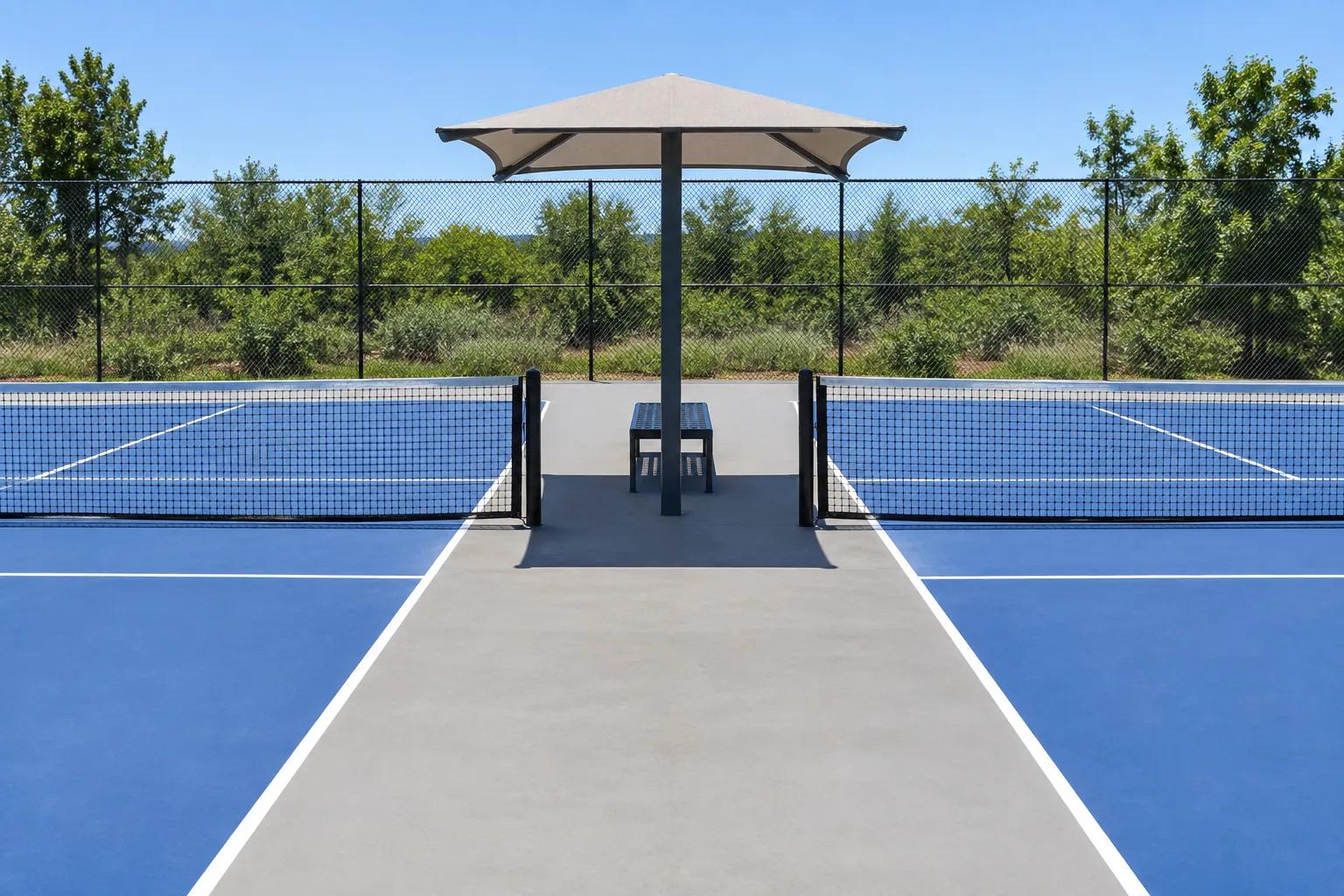
Cabana, group shelter or full-court canopy
The manual separates court-side shelters, serving one court or shared by two, from larger group shelters for tournaments and leagues. A third option covers the court itself.
| Structure | What it shades | Posts | Lead time (weeks) | Best for |
|---|---|---|---|---|
| Court-side cabana or umbrella | Rest area of 1 court, or 2 shared | 1 central post and up | Not published: ask | Between-court gaps of 11 ft and up |
| Group shelter or gazebo | Players and spectators in groups | Up to 8 (octagon) | Not published: ask | Tournaments, leagues, social space |
| Free-span court canopy | The playing surface | None in or around the court | 16 to 24 (HDPE); 24 to 32 (waterproof) | Shading play itself; height set in design |
A small shelter only helps if its shadow lands on the bench during play. The manual says the smaller the shelter, the more its shadow footprint needs analysing, so ask for a shadow plot at your latitude for your busiest hours.
Most small shelters are prefabricated steel frames with fabric canopies, many with quick-release canopies that come off in seconds before a thunderstorm or hurricane. In the north, the manual advises removing canopies and storing them over winter to extend fabric life. The 16 to 24 week figure comes from USA Pickleball's shading page, run with its shade partner, and applies to free-span structures over whole courts, not to cabanas.
Fabric: the fire test, the UV number and the permit threshold
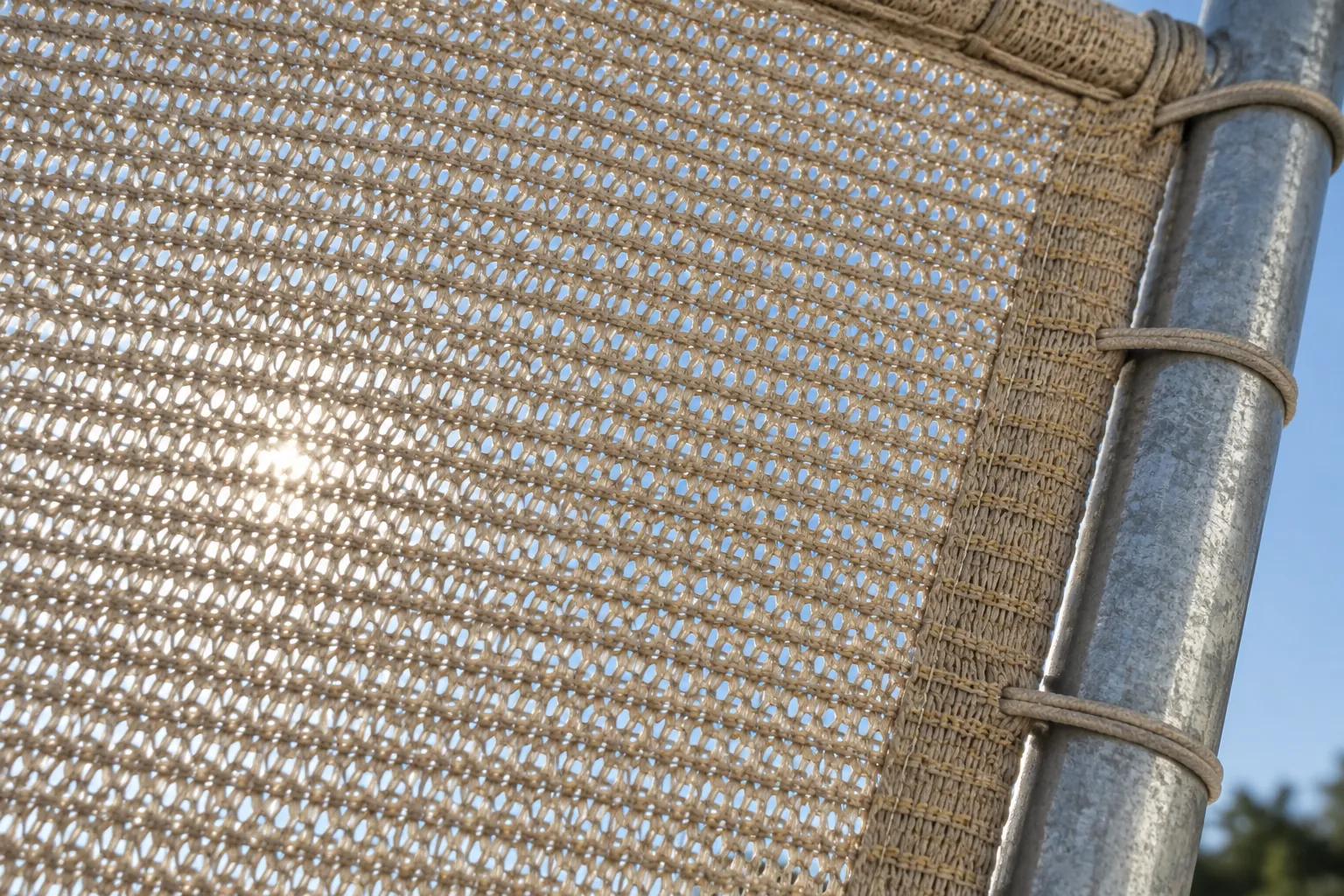
Under the 2021 International Building Code model text, a membrane-covered frame or tensile structure left up 180 days or longer is a membrane structure (Section 3102.1). Its membrane must be noncombustible or pass NFPA 701 Test Method 1 or 2 (3102.3.1), and tensile membranes are designed to ASCE 55 (3102.2). For awnings and canopies, Section 3105.3 also accepts a flame spread index of 25 or less under ASTM E84 or UL 723. NFPA 701 is in its 2023 edition; the code you are under may cite an older one, so the report should name the edition.
Structures up for less than 180 days, such as tournament tents and umbrellas, fall under the International Fire Code. The 2021 IBC model text (3103.1.2) also requires a permit once a temporary structure covers more than 120 sq ft. A 9.5 x 17 ft canopy is 161.5 sq ft; a 5.5 x 9 ft canopy is 49.5 sq ft. Your building official decides which section and edition apply.
For UV, ask for a rating to AS 4174:2018, the Australian standard for knitted and woven shade fabrics. Australia's radiation agency, ARPANSA, rates fabrics by Ultraviolet Effectiveness (UVE%) and calls 95+ the most effective band. The report should name the fabric and colour tested, the lab and the date.
Frame: galvanizing grade, smooth edges and wind design
ASTM A123/A123M-24 sets the minimum average zinc coating by material category and steel thickness. For pipe and tubing, the usual shelter frame, it is grade 45 below a 1/8 in wall and grade 75 from 1/8 in up. Grade 75 means 75 µm, or 3.0 mils. Ask the galvanizer for measured thickness readings against Table 1, not a "hot-dip galvanized" line on a drawing.
IBC 2021 Section 3105.2 requires awnings and canopies to resist the wind, lateral and live loads of chapter 16, with allowance for open construction, and structural members protected against deterioration. That makes footing size and anchor bolts a site question for a local engineer. A supplier who sizes footings without asking your design wind speed has not designed them.
Benches: length, placement and the court surface
The manual puts court benches at the net line, at least 5 ft from the sideline, in a material that resists weather and UV. Benches generally run 40 to 72 in long, with or without backs. Some leave dents in the surface, so protect the court where the feet sit.
Placement rules for movable furniture, from the same manual:
- Outside the playing area by default.
- If there is no room and the sideline overrun is 7 ft or wider: along the fence, within 10 ft either side of the net line, at least 5 ft from the sideline.
- Wheelchair courts: 12 ft from the sideline and 15 ft from the baseline.
The 2010 ADA Standards set bench dimensions in 903 (seat 42 in long minimum, 20 to 24 in deep, back support) but require them in rooms such as locker rooms, not courtside, so buying to 903 is optional. Benches are bought once and kept for years, as our club fit-out guide notes.
Bleachers: when a three-row set needs guardrails
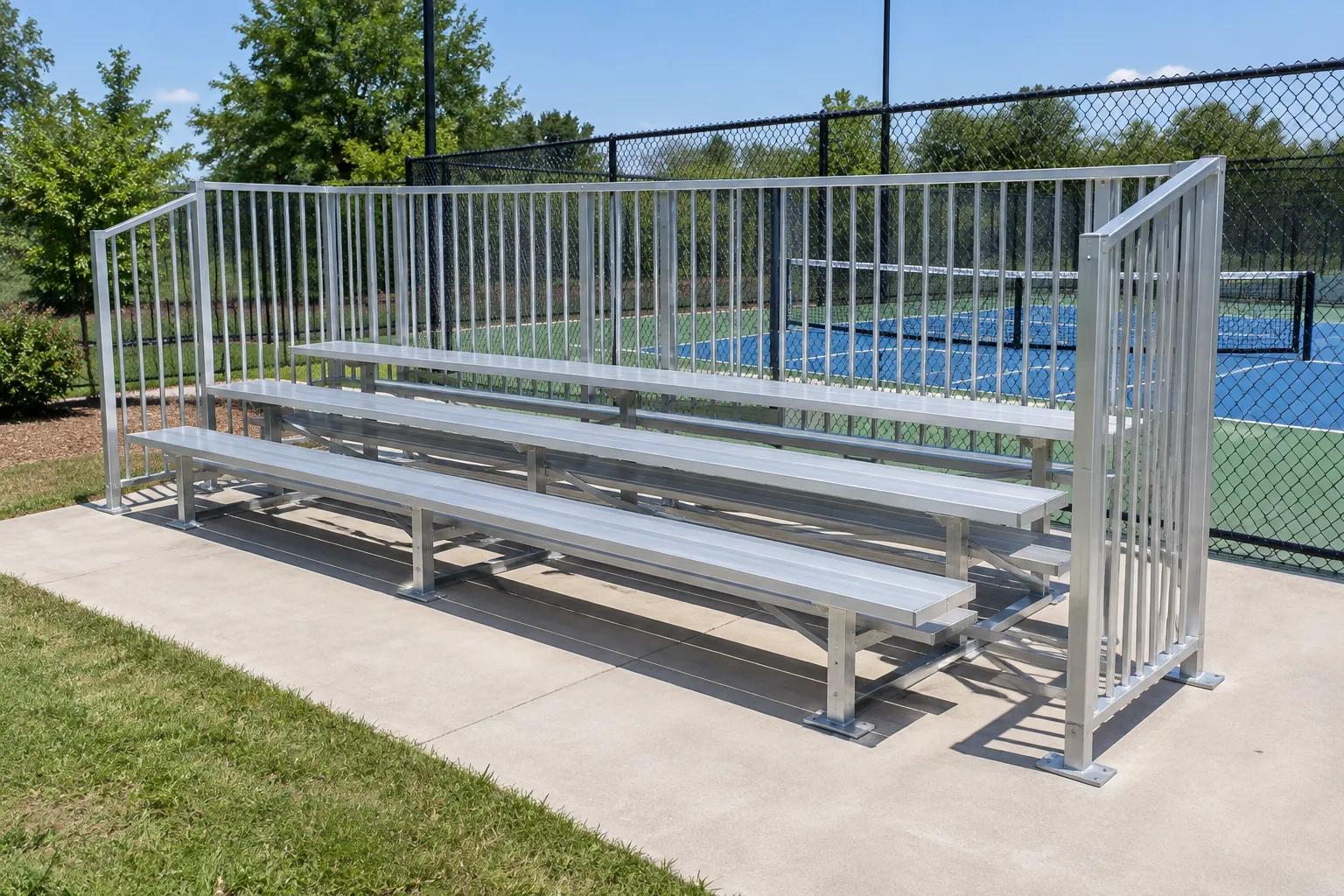
The CPSC Guidelines for Retrofitting Bleachers (Publication 330, 2000) recommend guardrails on the back and open ends wherever a footboard, seat or aisle is 30 in or more above the ground. The top rail should be at least 42 in above the adjacent footboard or seat, and no opening in or under it should pass a 4 in sphere. A set whose top row is nominally 30 in may be exempt, so get the top footboard height on every three-row quote. The CPSC text is guidance; your building code governs new bleachers.
Fixed seating also brings the 2010 ADA Standards in. Table 221.2.1.1 requires one wheelchair space for 4 to 25 seats, two for 26 to 50 and four for 51 to 150, each with a companion seat. The manual adds that bleachers should be sited so they do not intrude into the overrun.
What to check in a shade or seating quote
Send every supplier the same lines and compare the answers side by side.
| Item | What to specify | Standard or source | Evidence to request |
|---|---|---|---|
| Canopy and posts | Size and post position for your gap | Manual p.91 table | Plan drawing on your court layout |
| Fabric fire | NFPA 701 Method 1 or 2 | IBC 2021 3102.3.1 / 3105.3 | Test report for the fabric supplied |
| Fabric UV | UVE rating | AS 4174:2018 | Report naming fabric, colour, lab |
| Steel coating | Grade 75 on 1/8 in+ tube | ASTM A123/A123M-24 | Measured thickness readings |
| Wind and footings | Design wind speed of your site | IBC chapter 16 | Engineer-stamped calculations |
| Bleachers | Guardrail, openings, top height | CPSC Pub. 330; ADA 221 | Drawing with top footboard height |
| MOQ and lead time | Units per size and colour; weeks | Supplier quote | Production, freight, permit weeks as separate lines |
Engineering, permit review, custom sizes and fabric colour are all settled before fabrication starts. Ask each supplier to split engineering, production and freight weeks, and to state the MOQ per size and colour. Our lead time guide explains how to read those lines.
Where we stop: we make balls, paddles and nets, not shade structures or benches. Our published MOQ is 1,000 balls or 50 paddles, and an OEM pickleball factory quote for the courts under the shade can run alongside your shelter order. For schools and parks buying on a budget cycle, the rec program sourcing guide covers the equipment side.
For clubs and facility buyers ordering private-label paddles or rotomolded balls at wholesale volume, from a low MOQ, with pre-shipment QC.
See OEM paddles and ballsThree failures to rule out before you sign
- A post in the overrun. Anything fixed inside the 5 ft sideline clearance, or out of line with the net posts, is a collision point, and moving a footing means breaking the slab.
- Fabric with no test report. Without an NFPA 701 or E84 result for the exact fabric supplied, the inspector can refuse the shelter after it is built.
- A frame sized for someone else's wind. Footings drawn for a generic wind speed are a guess. Get the engineer's calculations for your site before fabrication starts.
Frequently asked questions
How do you shade a pickleball court?
Three ways: a courtside cabana or umbrella shelter over the rest area at the net line, a larger group shelter outside the battery, or a free-span canopy over the whole court. The ASBA / USA Pickleball manual keeps posts and canopies outside the playing area, except a post aligned between two adjacent net posts.
Can a shade structure go between two pickleball courts?
Yes, if the gap is wide enough. In the manual's 2020 drawing, an 11 ft gap takes a canopy of up to 5.5 x 9 ft, with posts and benches in a 1 ft strip on the net line. A 19 ft gap takes up to 9.5 x 17 ft. The table has no row for gaps under 11 ft.
Does a courtside shade structure need a permit?
It can, and your building department decides. In the 2021 IBC model text, fabric-covered frames up for 180 days or longer are membrane structures under Section 3102, and temporary structures over 120 sq ft need a permit under 3103.1.2.
How long should a pickleball court bench be?
The manual says court benches are generally 40 to 72 in long, with or without backs, in a weather- and UV-resistant material, placed at the net line at least 5 ft from the sideline.
Want to source this quality for your brand?
Contact our factory directly on WhatsApp for an instant MOQ and pricing quote.