Foam Core or Honeycomb: Which Construction to Put in an Order, and What Each Does to Your Approval Path
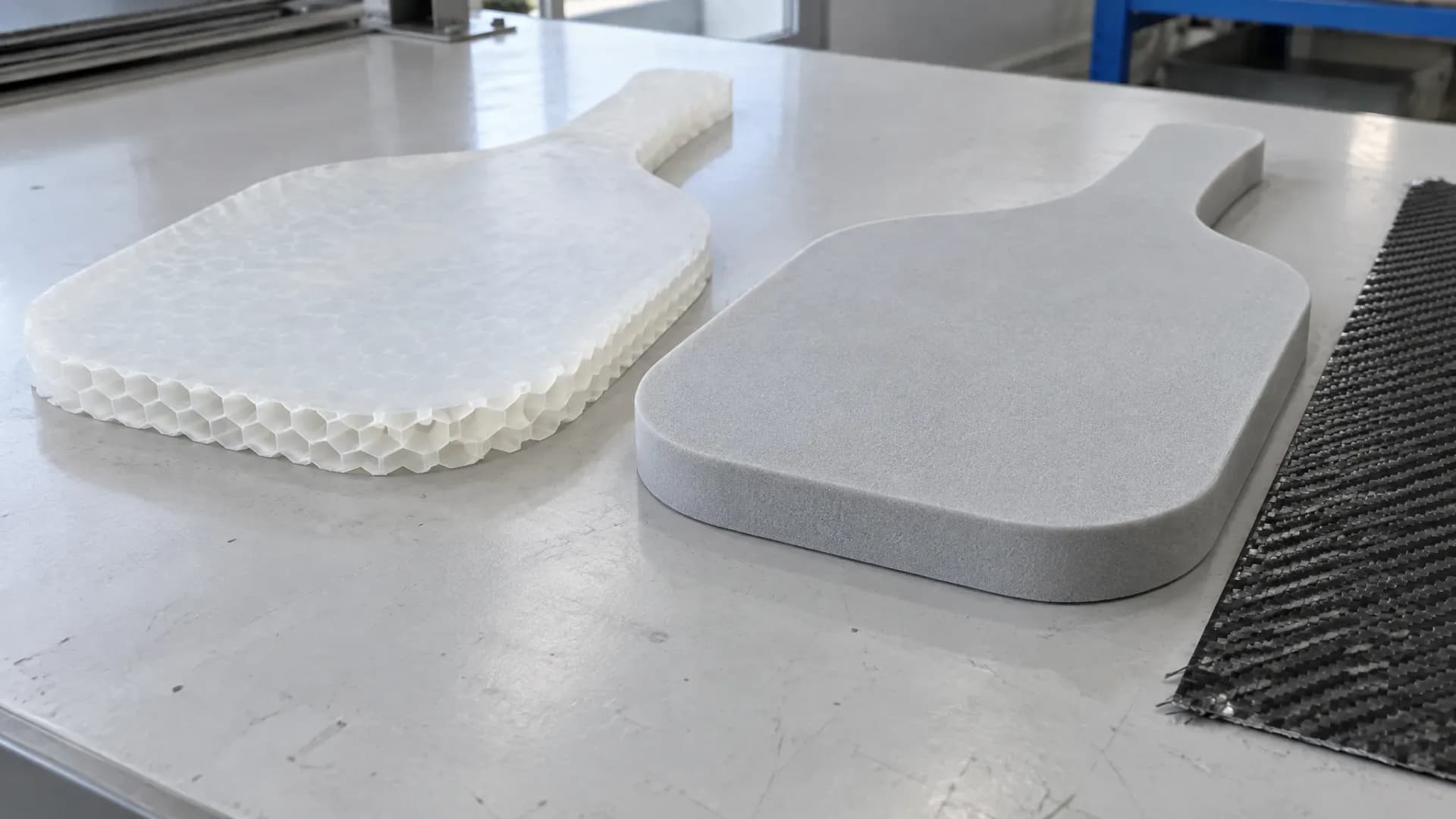
Two sample paddles come back from the factory. One has a polypropylene honeycomb core, the other a foam core, and on court they feel close enough that the decision lands on your desk as a price question. Then the purchase order needs a core line. “Foam core, 16 mm” turns out to fix almost nothing a second supplier could quote against.
The short answer: put polypropylene honeycomb in a first private-label order, and add foam later as a second model with its own name, its own test budget and a density written into the spec. Plascore specifies PP honeycomb by material, cell size, colour and thickness, with thickness held to ±0.02 in and density to ±10%. Foam is a family of grades: Kaneka’s EPERAN-PP black EPP grades mould from 30-45 g/L (VB45) up to 280-330 g/L (LB3).
And ESM clause 2.E.7 says paddles with different core material, surface material, or other significant differences must have a unique name or number, so foam never rides a honeycomb approval. Players picking a paddle for themselves can stop here: no rule favours either core. The rest is for whoever signs the order.
Key Takeaways
- Neither the 2026 rulebook nor the Equipment Standards Manual uses the word foam or the word honeycomb (counted 25 September 2026).
- Rule 3.D.4 of the 2026 rulebook requires paddles to be made of rigid, non-compressible material meeting the criteria in the Equipment Standards Manual.
- The PBCoR not-to-exceed limit is 0.43, effective 1 November 2025.
- ESM clause 2.E.7: paddles with different core material, surface material, or other significant differences must have a unique name or number.
- Our published minimum order is 50 paddles; ask whether any minimum applies per core.
A spec sheet says what a core should be; cutting a finished paddle open shows what is actually in it. In this short video an independent paddle-review creator saws open paddles across four price points.

In this guide
- The two cores on one sheet
- What to write on the PO
- Certification path
- Break-in testing
- Minimums, timing, cost lines
- Picking the core
- Pre-signing checklist
- Common questions
Foam and honeycomb on one spec sheet
Page 1 for “foam vs honeycomb core pickleball paddle” compares feel, pop and noise. This table compares what the two cores do to a purchase order, a spec sheet and a certified model.
| Factor | PP honeycomb | Foam core | Verdict |
|---|---|---|---|
| What the name fixes | Code: material, cell size, colour, thickness | A grade family, 30-45 to 280-330 g/L | Honeycomb |
| Published tolerance | Thickness ±0.02 in, density ±10% | Maker calls its data indicative | Honeycomb |
| Named in USAP rules | No (0 mentions) | No (0 mentions) | Neutral |
| Rules both must meet | Rigid, non-compressible; PBCoR 0.43 | Same tests | Neutral: test both |
| Adding it to an approved model | Same core, same model | New model name (ESM 2.E.7) | Honeycomb |
| UPA-A request form | Core material and cell size | Core material | Neutral |
| Our published build | 13 mm and 16 mm PP honeycomb | Not in our published build | Ask each supplier |
Every Verdict here is about the order, not the court. Honeycomb wins the rows where a buyer needs something to hold a supplier to: a code, a tolerance, an existing model name. Foam wins none of them outright. It simply asks you to write more of the spec yourself. A foam-walled honeycomb, often sold as Gen 3, sits between the two; our foam-wall paddle guide covers that hybrid.
What each core leaves undefined on a purchase order
Honeycomb: cell size sets the density
“13 mm PP honeycomb” is half a specification. Cell size and density move together. Plascore’s PP1-5.0-N1-8 polypropylene honeycomb (8 mm cell) is 80.0 kg/m³ typical density (75.0 minimum), with 275 psi (1.89 MPa) typical bare compression strength. Its 10 mm cell grade, PP1-4.0-N1-10, is 64.0 kg/m³ typical (60.0 minimum) with 180 psi (1.24 MPa) bare compression.
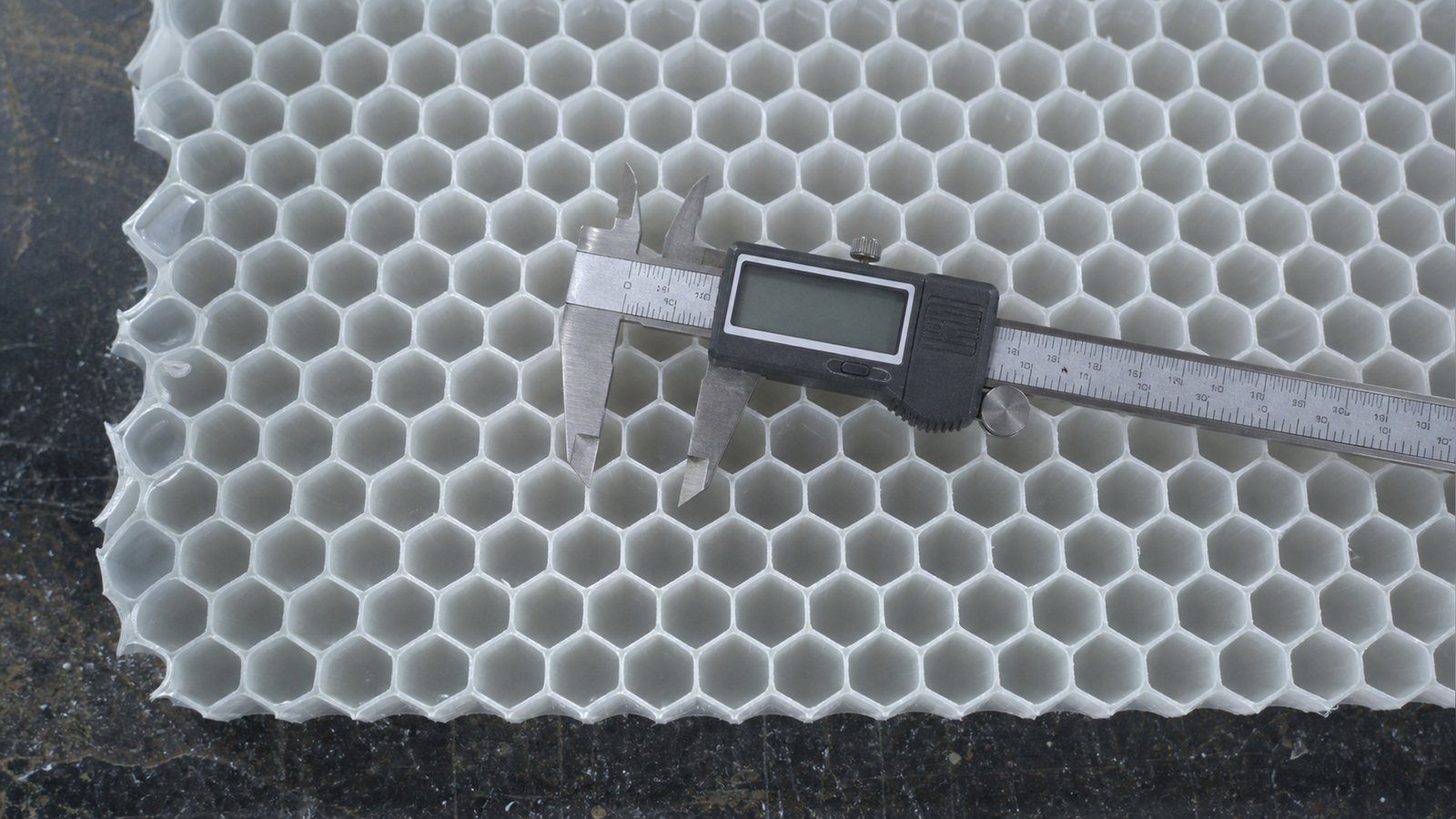
Same material, same thickness, two different cores. Write the cell size, the density grade and the thickness tolerance on the order, and read our honeycomb cell size guide and the 14 mm vs 16 mm comparison before you fix them.
Foam: the grade name does not pin the number
Foam leaves more open. The mid grades overlap: Kaneka lists MB12 at 85-100 g/L and MB11 at 95-110 g/L moulded density, so a grade name alone does not pin the number. Kaneka also states that EPP properties depend largely on part shape and size and on moulding parameters, so its data are indicative only. Read that as an engineer would. The catalogue tells you what the bead can do; only a core cut from your own production lot tells you what you bought. Two quotes for “EPP foam core, 16 mm” can describe two different paddles, and neither supplier has broken the order.
One unit note stops a common misreading. Because 1 kg/m³ equals 1 g/L, the 80.0 kg/m³ honeycomb grade sits inside the density span Kaneka publishes for moulded EPP. Density alone does not separate the two cores, so neither can be specified by density alone.
| Core grade | Honeycomb (kg/m³) | EPP low (g/L) | EPP high (g/L) |
|---|---|---|---|
| PP 10 mm cell | 64.0 | — | — |
| PP 8 mm cell | 80.0 | — | — |
| EPP VB45 | — | 30 | 45 |
| EPP MB12 | — | 85 | 100 |
| EPP MB11 | — | 95 | 110 |
| EPP LB3 | — | 280 | 330 |
| PO line | PP honeycomb | Foam core | Verdict |
|---|---|---|---|
| Material and grade | PP, grade code | Foam type and grade name | Both: name it |
| Structure | Cell size in mm | Moulded to shape, or cut from block | Both: name it |
| Density (kg/m³ or g/L) | Grade value, ±10% | Target value with your tolerance | Foam: you set it |
| Thickness (mm) | 13 or 16, ±0.02 in | Target with tolerance | Both: name it |
| Proof from production | Supplier data sheet per lot | Density measured on lot cores | Foam: test it |
What the core choice does to your approval
USA Pickleball: same tests, separate model
Start with what the rules leave out. Neither the 2026 rulebook nor the Equipment Standards Manual uses the word foam or the word honeycomb (counted 25 September 2026), and the manual served at USA Pickleball’s rules URL that day is still Revision 3.0 (January 2025). Rule 3.D.4 of the 2026 rulebook requires paddles to be made of rigid, non-compressible material meeting the criteria in the Equipment Standards Manual. ESM clause 2.E.1 repeats the same test: rigid, non-compressible material meeting the testing criteria defined in the manual.
Both cores face the same measurements, and the one that limits a lively core is rebound: the PBCoR not-to-exceed limit is 0.43, effective 1 November 2025 (it was 0.44 from 1 November 2024). Our PBCoR explainer covers the test.
The core matters at the model level. ESM clause 2.E.7: paddles with different core material, surface material, or other significant differences must have a unique name or number. ESM clause 2.F.2 subjects manufacturers to ongoing testing that products as produced and sold are identical to the paddle that was tested and certified. Put the two together and the answer is plain: an approved honeycomb model cannot ship with foam inside, and the foam version is tested under its own name. The order of steps is in our foam-core SKU certification sequence, and the clause-by-clause reading is in our core legality decoder.
UPA-A: the pro-event layer
Pro play adds a second body. UPA-A certification is required for professional events at PPA and MLP; amateur play accepts a paddle on the USAP Approved Paddle List without it. UPA-A’s 2026 request form asks for each model’s core material and honeycomb cell size. Its Average Deflection Force test requires both faces to reach 46 lb or more at 70-75°F, a stiffness floor, which is the number a soft foam build has to watch.
UPA-A’s 2026 fees are $3,000 per paddle (valid 24 months, 8 weeks), a $10,000 annual brand fee, and $2,000 to re-submit a failed paddle. One date applies to both cores: from 1 October 2026, paddles submitted to USA Pickleball must measure 2,100 RPM or less on the spin rate test.
Break-in and the useful-life clause
A paddle that passes on the day it is tested has not finished being judged. ESM clause 2.F.2.a: if a construction has failure modes, break-in periods, degradation or other gradual changes, the paddle must remain compliant over its entire useful life. ESM clause 2.F.1 lets the Board revoke an approval on 18 months’ notice if equipment is materially changed or materially degrades in ordinary use.
This is not theoretical. In its 27 December 2024 notice, USA Pickleball listed seven paddle models that exceeded testing standards and sunset them on 1 July 2025 for sanctioned tournament play. The notice names no core type as the cause, and we will not supply one. What it shows is that listed models get re-screened.
The test to write into the contract
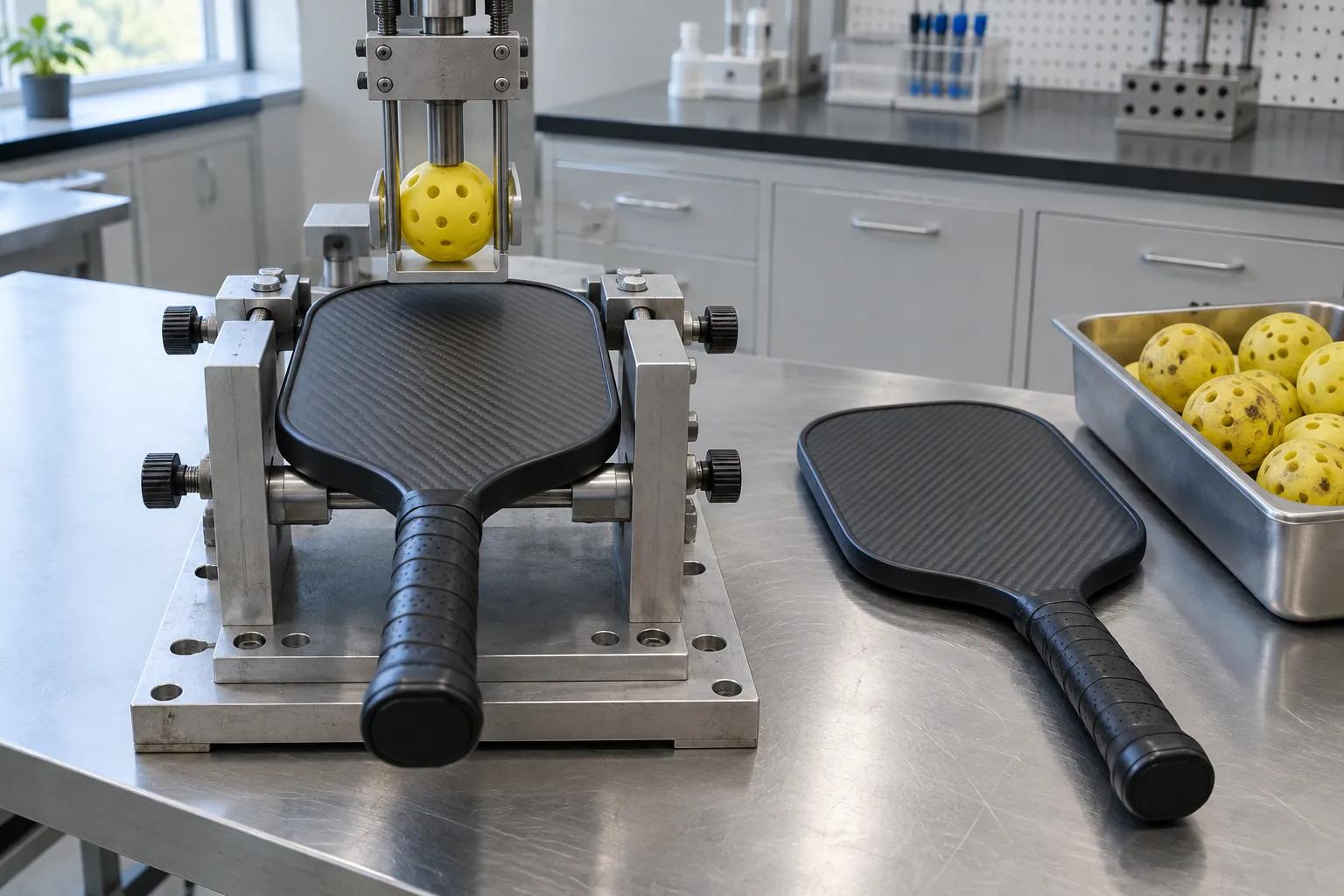
Brand and review blogs disagree about which core holds up longer. We have found no neutral data to settle it, so the protection is a test, not a belief. For whichever core you order, ask for PBCoR measured on new samples and again after a break-in you define in writing: the number of hits, the ball, the speed. A result that rises toward 0.43 after break-in is a warning on either core. Put the protocol and the pass line in the supply agreement, and make a failing lot a supplier cost.
What we supply, MOQ and the quote lines that move
Our published build, and where it stops
Our published minimum order is 50 paddles, on the polypropylene honeycomb builds we publish; the product page does not say whether that figure applies per model, per colour or per core, so ask. Our published build envelope is raw T700 carbon and fiberglass faces on 13mm and 16mm polypropylene honeycomb cores, thermoformed unibody or cold-pressed. Foam is not in it. For a honeycomb run on our line, the 3K carbon paddle shows the core options in stock form.
Minimum order: the mould question
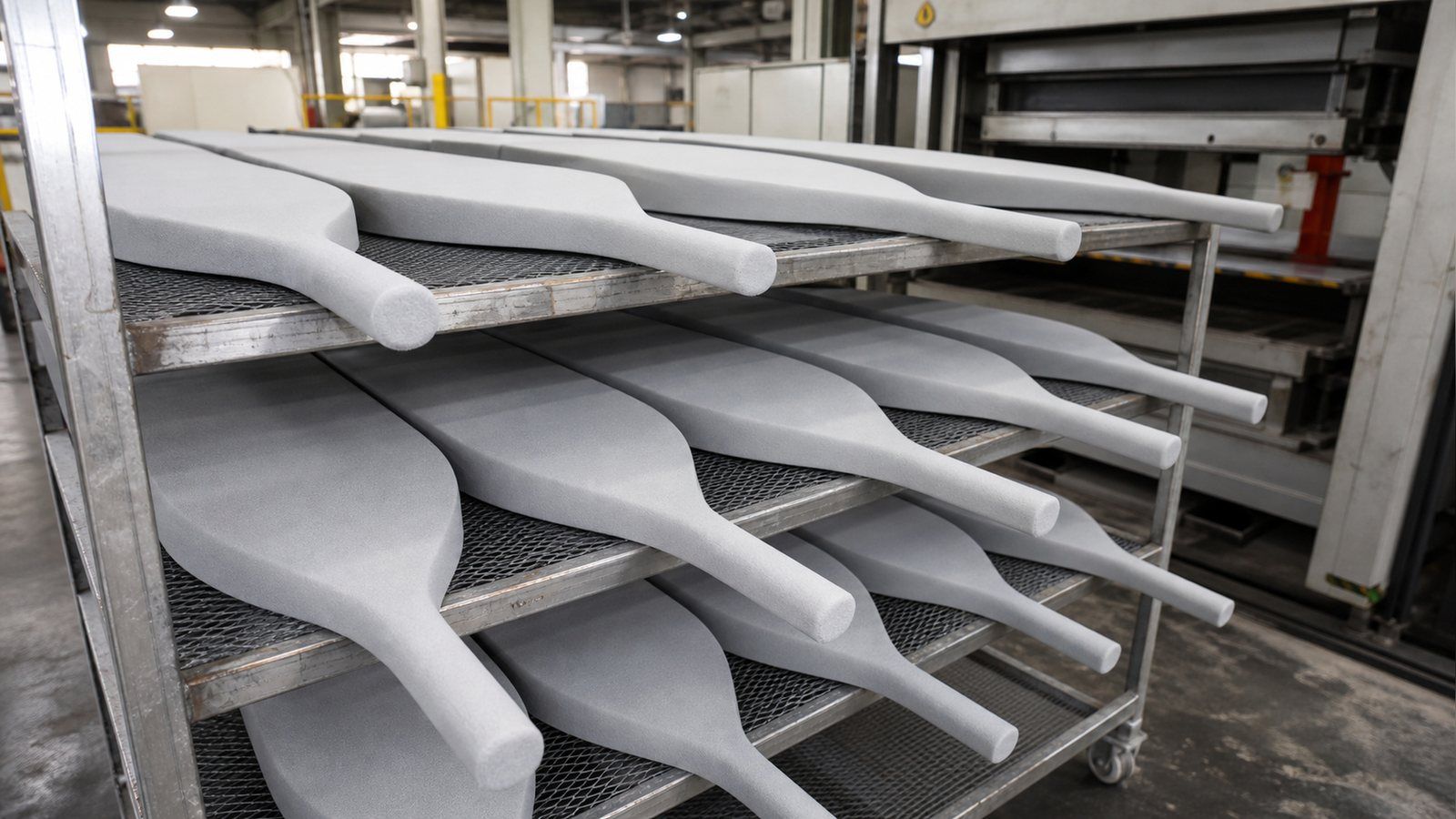
For foam from any supplier, start the MOQ conversation with one question: is the core moulded to the paddle outline, or cut from a moulded block? If it is moulded to shape, ask whether each outline and thickness needs its own mould, who owns it, what it costs and how many cores one fill yields. Honeycomb has no equivalent step. Plascore sells PP honeycomb as sheet up to 72 in wide or trimmed to part dimensions, so a new outline changes the cutting, not the core supply.
Lead time: ask for days per stage
Lead time needs the same treatment. We publish no per-stage figure, so ask every supplier for days per stage: core supply (stock sheet, or a moulding run), forming or pressing, finishing, golden-sample sign-off, and certification. Only the last has a published clock. UPA-A quotes 8 weeks standard and 4 weeks expedited for an extra $2,500; confirm USA Pickleball’s current testing window when you submit.
| Quote line | PP honeycomb | Foam core | Verdict |
|---|---|---|---|
| Core material | Per sheet or per blank | Per core, by density | Ask per paddle |
| Core tooling | None: cut from sheet | Mould per outline, if moulded | Foam: ask owner |
| UPA-A test (pro only) | $3,000 per paddle | $3,000 per paddle | Neutral |
| UPA-A samples | 5 paddles, no artwork | 5 paddles, no artwork | Neutral |
| Minimum order (pcs) | Ours: 50 published | Ask: per core? | Get it in writing |
Which core to put in the order
Walk the decision in this order and stop at the first yes.
- Is this your first paddle model? Order honeycomb at 13 mm or 16 mm. One model, one name, and a core bought to a code.
- Do you already sell an approved honeycomb model and want a softer second SKU? Order foam as a new model under its own name, with a density target, a break-in PBCoR test and a test budget. Keep the honeycomb model unchanged.
- Is the line aimed at PPA or MLP pro events? Either core, but each model needs UPA-A certification, and a foam build must clear the 46 lb ADF floor on both faces.
- Is it a club or rental fleet? Order honeycomb. Replacement units must match the certified paddle under ESM 2.F.2, and a coded core is easier to re-order identically.
| Line | Best for | Reason | Verdict |
|---|---|---|---|
| First private-label run | PP honeycomb | Coded core, one model name | Honeycomb |
| Second SKU beside an approved model | Foam | A distinct model, tested on its own | Foam, as a new model |
| Pro-event line | Either | UPA-A per model; ADF 46 lb floor | Test the foam early |
| Club or rental fleet | PP honeycomb | Identical re-orders under 2.F.2 | Honeycomb |
Brand owners and distributors: tell us the paddle outline and the core thickness you want, and we will send a line-by-line quote for the honeycomb builds we run in that shape.
Request a core quoteBefore you sign the PO
- Core line: material, grade, cell size or foam density, thickness, each with a tolerance.
- Model name: one per core, printed on the face (ESM 2.E.7).
- Break-in test: PBCoR new and after your written break-in, with a pass line below 0.43.
- Production match: units identical to the certified paddle (ESM 2.F.2).
- Quote: core, core tooling and testing on separate lines.
- Timing: days per stage, and whether the minimum applies per core.
If any line is blank, the core choice is not finished.
Brand owners and distributors with the shape already drawn: send the outline, the core thickness and the core you lean towards, and ask us for both figures for your order.
Send the spec on WhatsAppFrequently asked questions
Are foam core pickleball paddles legal?
Yes, when the model is on the USA Pickleball Approved Paddle List. Neither the 2026 rulebook nor the Equipment Standards Manual uses the word foam or the word honeycomb (counted 25 September 2026). Rule 3.D.4 of the 2026 rulebook requires paddles to be made of rigid, non-compressible material meeting the criteria in the Equipment Standards Manual, and that test applies to both cores.
Is a foam core or a honeycomb core more durable?
We have found no neutral published test that settles it, and brand claims point both ways. ESM clause 2.F.2.a: if a construction has failure modes, break-in periods, degradation or other gradual changes, the paddle must remain compliant over its entire useful life. Ask for PBCoR on new samples and again after a break-in you define.
What density should a foam paddle core be?
There is no rule figure to quote. Kaneka's EPERAN-PP black EPP grades mould from 30-45 g/L (VB45) up to 280-330 g/L (LB3), so write the grade and the moulded density with a tolerance into the purchase order, and have density measured on cores from the production lot.
Can a foam version use my honeycomb paddle's approval?
No. ESM clause 2.E.7: paddles with different core material, surface material, or other significant differences must have a unique name or number. The foam version is a separate model and is tested under its own name.
What is the minimum order for a custom foam or honeycomb paddle?
Our published minimum order is 50 paddles, and our published build is polypropylene honeycomb. Ask any supplier in writing whether its minimum applies per model, per colour or per core, and whether a foam core needs its own mould.
Want to source this quality for your brand?
Contact our factory directly on WhatsApp for an instant MOQ and pricing quote.