Portable Pickleball Court Systems: Tile, Rollout and Mat Specs a Buyer Must Fix Before Ordering
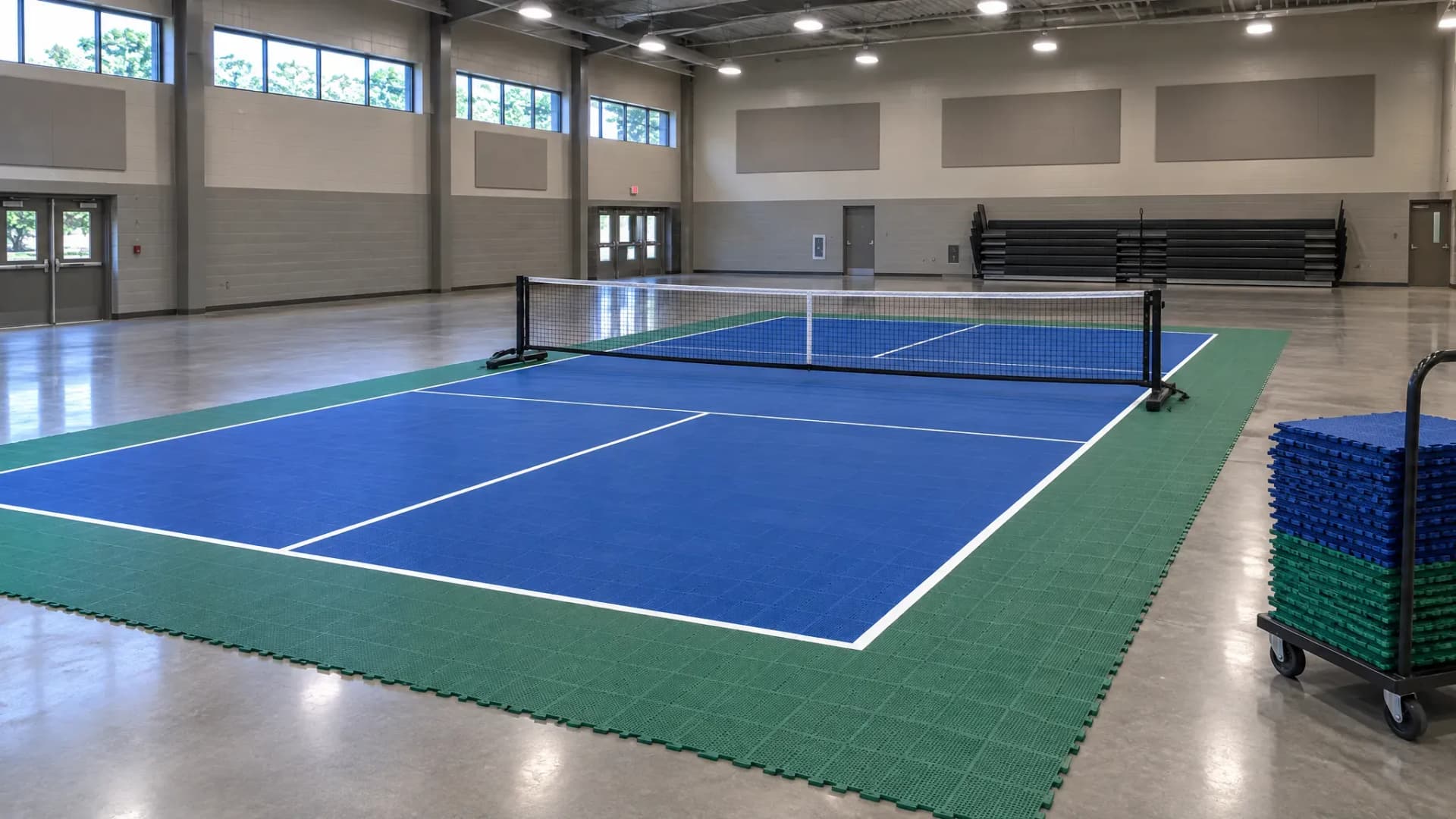
Most portable pickleball court quotes open with the tile. The tile should be the last thing a buyer fixes. Rule 3.A.3 of the 2026 USA Pickleball Official Rulebook sets the minimum playing surface area at 30 ft (9.14 m) wide and 60 ft (18.29 m) long. That is 1,800 sq ft, against 880 sq ft for the 20 by 44 ft court inside it, so a kit sized to the court lines leaves nowhere to chase a lob behind the baseline.
For a club, rec program or event, a portable court is one of three systems laid over a floor you already have: interlocking tiles, a roll-out sheet or mat, or a floor cover with lines applied.
Whichever you pick, five numbers go into the purchase order before the price. Size and thickness come first: the footprint against Rule 3.A.3, and the surface thickness, because net height is measured above the playing surface to +/- 0.25 in. Then come the edge height where the accessible route meets the court, the flatness of the floor underneath, and MOQ and lead time split into production and freight. The ASBA / USA Pickleball construction manual adds one more check before any of them: test playability on the sub-base first.
Key Takeaways
- Rule 3.A.3: minimum playing surface area 30 ft (9.14 m) wide and 60 ft (18.29 m) long, which is 1,800 sq ft or 1,800 twelve-inch tiles.
- The top of the net must be 36 in +/- 0.25 in above the playing surface at the sidelines and 34 in +/- 0.25 in at the center, so the net stands on the portable surface.
- ADA 303: up to 1/4 in may be vertical, 1/4 in to 1/2 in is beveled no steeper than 1:2, and anything higher is ramped. That applies at the accessible route to the court; the court itself is exempt as an area of sport activity.
- The manual recommends that court owners test the playability of these surfaces on the sub-base first.
- pickleoem publishes no tile, roll-out or mat MOQ or lead time; get both in writing, with production and freight as separate lines.
WXII 12 News report, November 2024:

Three portable systems and the floor each one needs
The ASBA / USA Pickleball construction manual (2020 edition; USA Pickleball lists 2023 as current) names carpet, gymnasium floors, prefabricated panel flooring systems and rolled out systems as court options. It says many of these surfaces can be installed indoors and outdoors, permanently or temporarily. It describes modular surfaces as interlocking tiles generally 10 in to 12 in square, made of polymer, plastic or other synthetic, laid over new or existing asphalt and concrete. The open-grid design lets water drain through, and damaged tiles can generally be easily removed and replaced.
| System | Lies on | Manual's guidance | Between events | Verdict |
|---|---|---|---|---|
| Interlocking tile, loose-laid | Asphalt, concrete, hall slab | 10 in to 12 in tiles; single tiles swapped | Lifted and stacked, or left down | Best for outdoor pop-ups and seasons |
| Tile over rubber underlay | Indoor concrete | Indoors only: modular flooring over 2 mm rubber | Two layers to lift | Best for semi-permanent indoor courts |
| Roll-out sheet or mat | Smooth, clean floor (maker to confirm) | Permanent roll goods are fully adhered | Rolled onto a core | Best for halls with roll storage |
| Floor cover with lines | Finished maple gym floor | MFMA-listed alternative to tape | Rolled out per event | Best where tiles are ruled out |
Roll-outs and textiles: the adhered-system caveat
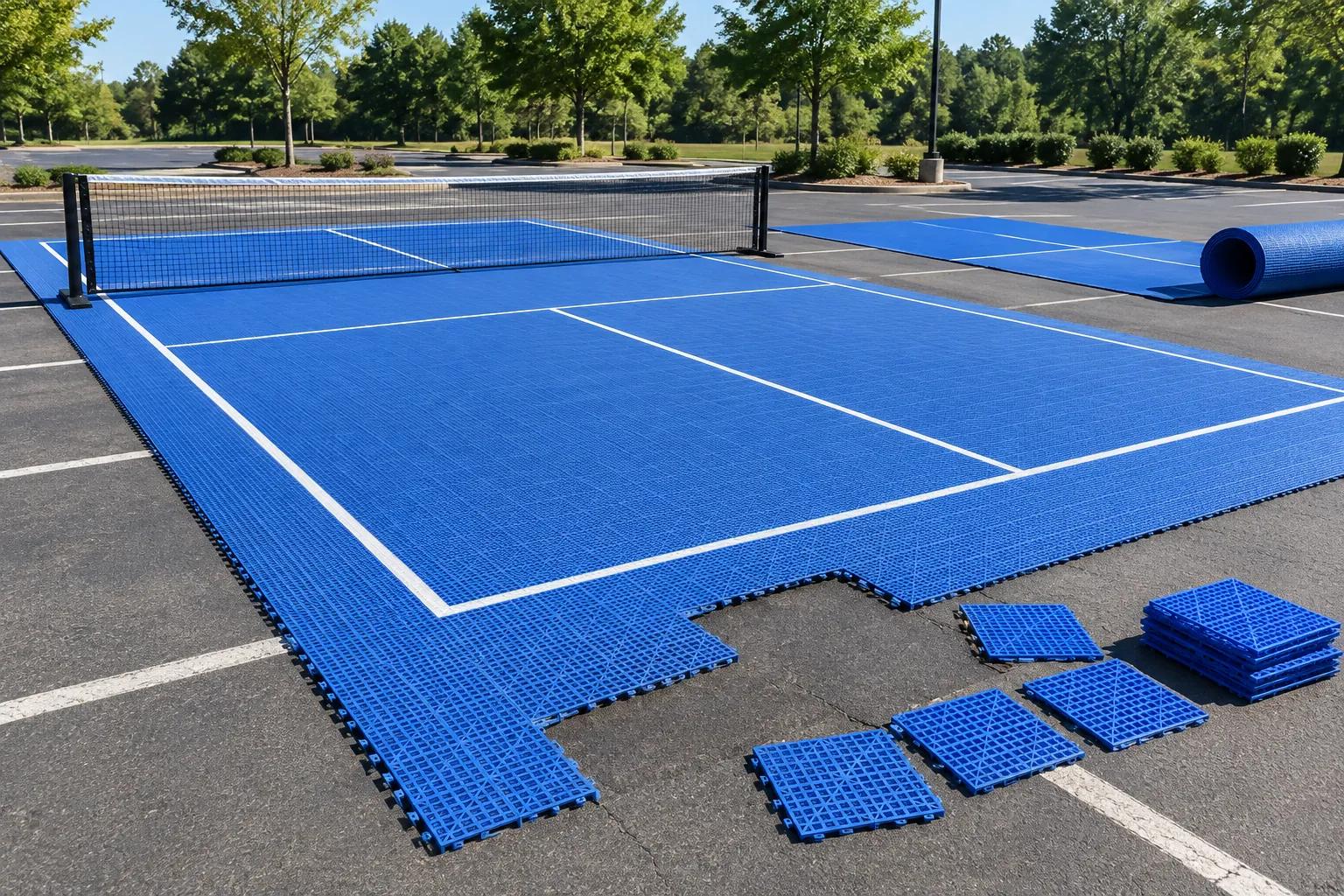
The manual describes roll goods as a multi-layer membrane or rubber-cushioned mat whose membrane should be fully adhered over the entire court surface, applied in strips and seamed together. A loose-laid roll-out court sits outside that guidance, and it may hold its seams by weight and friction alone unless the maker specifies tape or an interlock. Ask the maker to confirm how the seams join, then lay the full court during the trial and look at every seam after a session.
The manual is blunter about textiles, which should be adhered, not left free-floating, so a loose carpet court is the weakest option on the list.
On a maple gym floor, MFMA first suggests asking the floor contractor to add permanent game lines; another solution is to buy a protective gym floor cover and apply tape to the cover or buy it with game lines already applied. MFMA sets no rule for tiles or roll-outs on maple, so get the floor contractor's written approval before anything heavier than a cover goes down. If the court is going to stay, the permanent choice between acrylic and tile on a slab is a different decision, covered in our court surface comparison.
Step 1: Size the kit to the playing surface, not the court
Rule 3.A.1 fixes the court at 20 feet (6.10 m) wide and 44 feet (13.41 m) long for both singles and doubles. Rule 3.A.3 then sets the surface around it, with larger recommendations for new construction, tournaments and stadium courts. At one tile per square foot, the tile count equals the area.
| Surface | Size (ft) | Area (sq ft) | 12 in tiles (count) | Use |
|---|---|---|---|---|
| Court lines only | 20 x 44 | 880 | 880 | Never enough alone |
| Minimum playing surface | 30 x 60 | 1,800 | 1,800 | Rec play and events |
| New construction / tournament | 34 x 64 | 2,176 | 2,176 | Sanctioned play |
| Stadium court | 50 x 80 | 4,000 | 4,000 | Show courts |
| Rulebook size | Area to cover (sq ft) |
|---|---|
| Court lines 20x44 | 880 |
| Minimum 30x60 | 1800 |
| Tournament 34x64 | 2176 |
| Stadium 50x80 | 4000 |
With 10 in tiles the minimum surface takes 36 by 72 pieces, 2,592 in all, and every extra piece is one more joint to check and one more piece to stack. Listings call almost any footprint a court kit, so ask for the kit's outside dimensions in feet and hold them to this table before comparing prices. The failure is easy to picture: on a kit that stops at the court lines, a player backing up for a lob steps off a raised edge onto the hall floor in the middle of a rally.
Lines follow the same rules as on any court. Rule 3.A.2 says court measurements must be made to the outside edge of the perimeter and non-volley zone lines. Rule 3.A.4.e says all lines should be 2 in (5.08 cm) wide and the same color, clearly contrasting with the color of the playing surface and court. Printed or inlaid lines on tiles are fixed at the factory; loose lines on a roll-out are covered in the temporary line set guide. For several courts side by side, the multi-court layout plan sets the spacing before you multiply kits.
Step 2: Stand the net on the surface it plays over
Rules 3.B.6 and 3.B.7 say the top of the net must be 36 in +/- 0.25 in above the playing surface at the sidelines and 34 in +/- 0.25 in at the center. The reference is the playing surface, and on a portable court that surface is the top of the tile or mat.
Any surface more than 0.25 in thick moves the court out of tolerance if the net is set for the floor beneath. A 1/2 in surface under a net set to 36 in on the floor leaves 35.5 in at the sideline, and nobody notices until a league night argues about it.
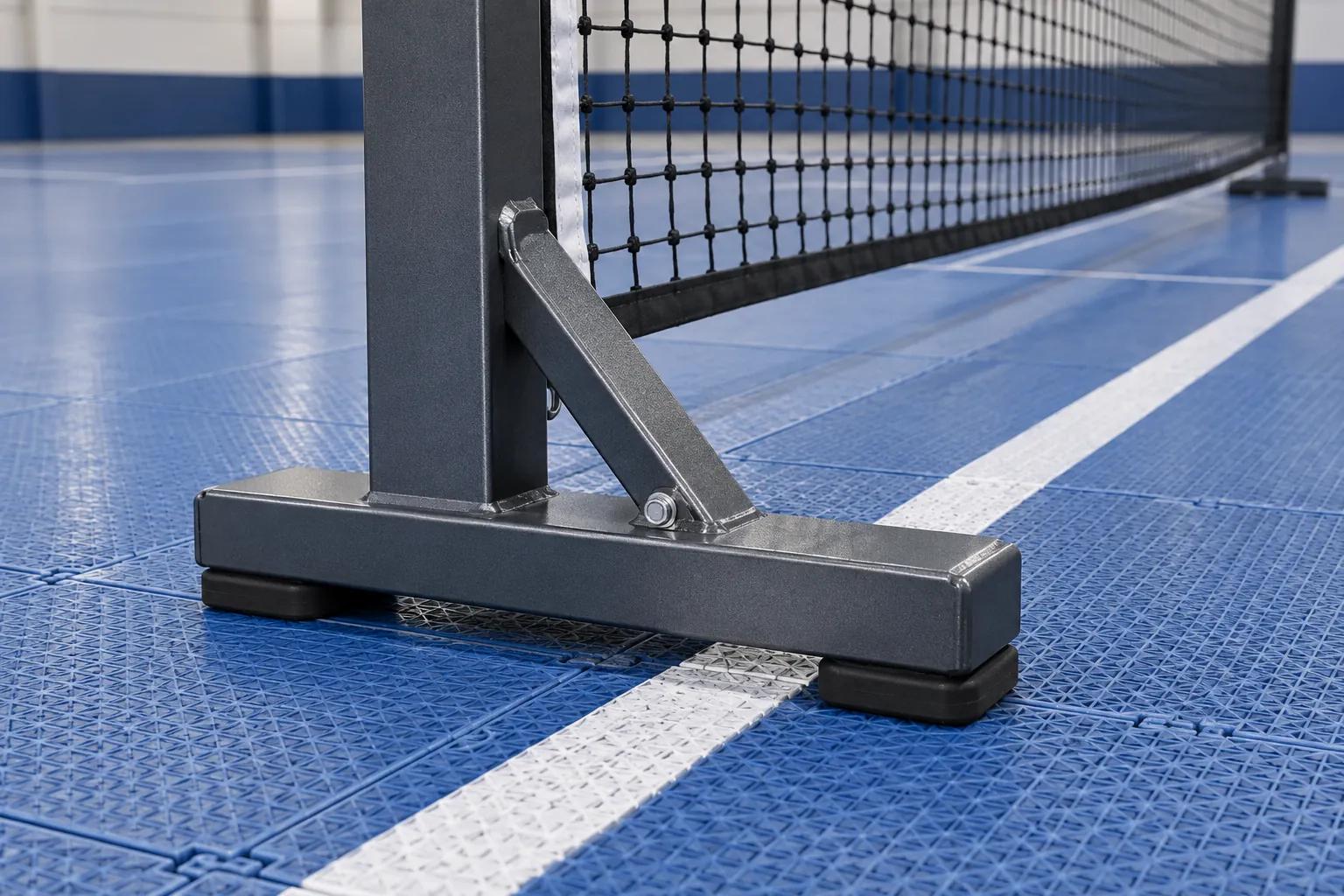
Two fixes work. Stand the net feet on the tiles, so the tile top is the reference for every reading, or set the net height from the tile top after every deployment. Ask the tile supplier whether the net base can sit on the tile without denting it, and read the net maker's base footprint against the tile pattern.
The manual's maintenance chapter adds that the metal of portable net systems can rust and scratch the court surface, so the rubber feet or pads where metal touches the surface must be intact. On a plastic tile, a missing foot is a scratch on day one. Frame and base choices are in the portable net frame guide.
Measure at three points after every setup
- Sideline height at each post, from the tile top: 36 in, within 0.25 in.
- Center height from the tile top: 34 in, within 0.25 in.
- The same three readings logged each time, so a tile that has settled under a post shows up as a trend.
Step 3: Check the floor underneath and the edge around it
A loose-laid system follows every dip in the floor under it. For indoor slabs the manual notes that most sport surface manufacturers require the slab to be flat with a variation of no more than 1/8 in in a 10 ft radius, testable with a 10 ft straightedge. Use it as the starting check for any hall, and ask the tile or mat maker for its own flatness tolerance, especially for outdoor asphalt, because a tile court cannot bridge a hollow.
For indoor installs the manual also asks for a room above 65 F and relative humidity between 50 and 75 percent one week before, during and one week after installation, or per the manufacturer. Ask the tile supplier what acclimatisation its product needs, since event crews tend to lay tiles straight off a cold truck.
The edge where the route meets the court
The edge is the other half. The 2010 ADA Standards exempt areas of sport activity from the surface and change-in-level rules (302.1 and 303.1), so the court itself is not the issue. But 206.2.12 says that in court sports, at least one accessible route shall directly connect both sides of the court. For an ADA-covered facility, such as a city rec program, treat the point where that route meets the raised edge as a change in level under 303.
| Edge height (in) | ADA rule | Run for a full bevel or ramp (in) | Verdict |
|---|---|---|---|
| Up to 1/4 | Vertical permitted (303.2) | 0 | No edge piece needed |
| 1/4 to 1/2 | Beveled, not steeper than 1:2 (303.3 and its Advisory) | 1 at a full 1/2 in bevel; 0.5 with a 1/4 in vertical lip | Order beveled edge strips |
| Over 1/2 | Ramped per 405 or 406 (303.4); 1:12 ramp (405.2) | 12 per inch; 9 at 3/4 in | Order ramp pieces for the route |
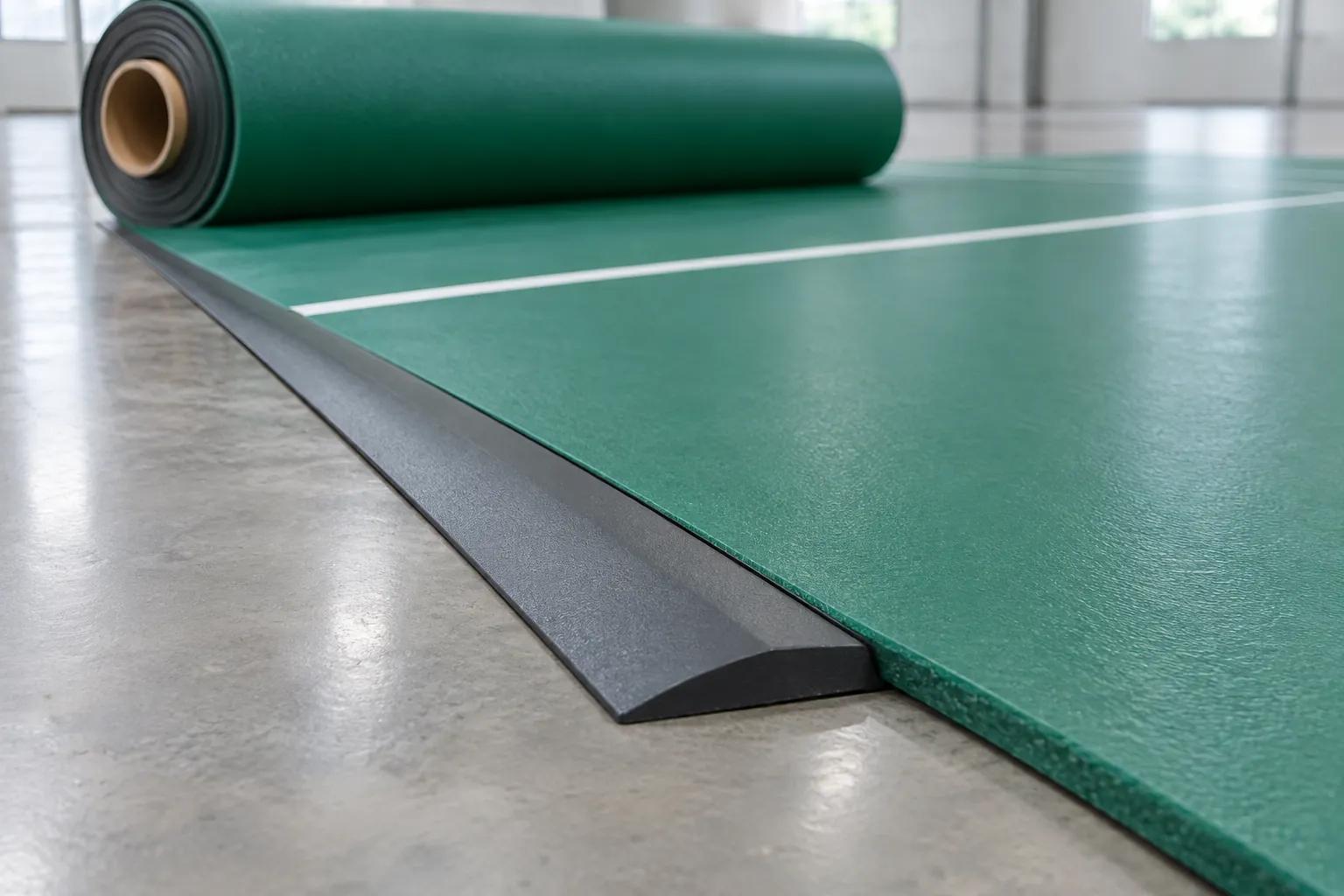
That makes edge height a purchase decision rather than an afterthought. Ask for the finished height of the tile or mat at its edge, and for the profile of the edge pieces, before the order. A system whose edge pieces stop at a bevel cannot serve a route across a thicker mat, and adding ramps after delivery means a second shipment on a second lead time.
Step 4: Play-test the sample on your own floor
The manual recommends that court owners test the playability of these surfaces on the sub-base first. It names Vertical Ball Rebound as important to pickleball and says a new sports surface should be consistent in all properties over its entire surface. A portable court adds joints, edges and a floor that changes from venue to venue, so consistency is what the test has to find.
Borrow a repeatable drop from the ball standard. The USA Pickleball Equipment Standards Manual (January 2025) tests a ball's bounce of 30 to 34 inches when dropped from 78 inches onto a granite plate. That is a ball specification, not a surface limit, but the 78 in drop gives a consistent method: same ball, same height, on the hall floor, on a tile center, on a joint and near an edge. Differences between those readings are what players will feel.
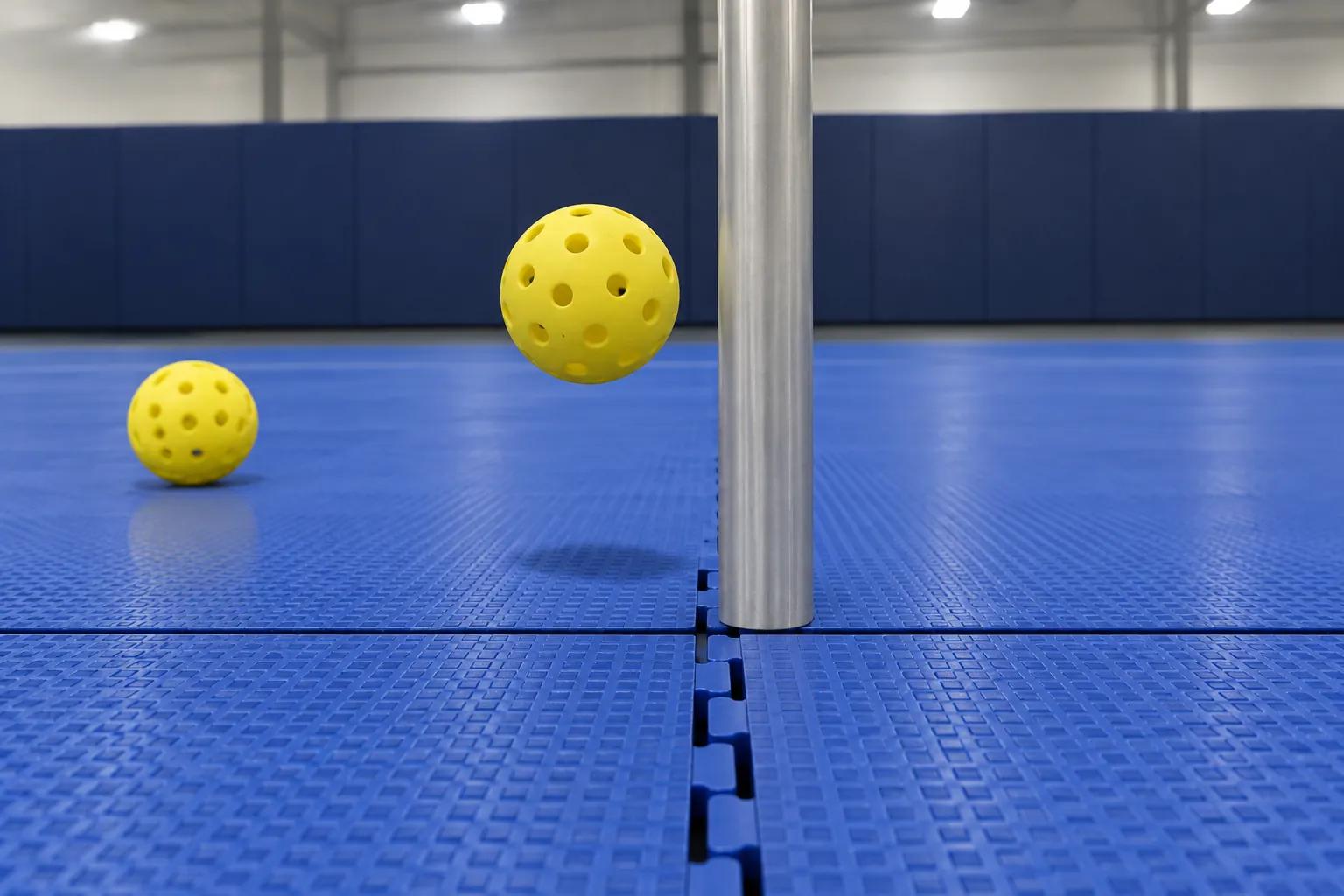
For indoor systems, ask for an ASTM F2772-24 report, the specification for multi-purpose indoor sports floor systems that covers shock absorption, vertical deformation, ball rebound and surface finish effect. Read which edition and which properties the report covers; the standard excludes turf and tennis-court materials and says nothing about outdoor use.
What to check on a trial section
- Bounce from 78 in at tile centers, joints and edges, logged against the bare floor.
- A pivot and a slide across a joint in court shoes, and the same on the roll-out seam.
- Line color read from the far baseline under the venue lights.
- The floor under the trial section after it is lifted.
- Minutes for two people to lay and pack the section, scaled to the full kit.
What the RFQ must state
Portable court listings sell adjectives. A procurement file needs numbers a delivery can be held to, and every row below traces back to a rule or a test in the steps above.
| Spec line | Why it matters | Ask for | Weak answer |
|---|---|---|---|
| Footprint | Rule 3.A.3 minimum 30 x 60 ft | Outside size, piece count | “Full court kit” |
| Thickness | Net height is set from the surface | Thickness at tile top, in mm | “Low profile” |
| Edge pieces | ADA 303 limits at the route | Edge profile drawing, length supplied | “Edges included” |
| Underside | Floor finish and its warranty | Underside material, underlay if any | “Floor safe” |
| Lines | Rule 3.A.4.e: 2 in, one color | Printed, inlaid or loose | “Lines available” |
| Test report | F2772-24 indoor properties | Report, edition, lab name | “Pro tested” |
Add the handling numbers the crew will live with: weight per piece and per kit, pieces per carton, cartons per pallet, and the packed volume of one court. At 1,800 pieces for the minimum surface, those figures decide whether two staff can set up before doors open and whether the kit fits the storage room. Because single damaged tiles can generally be swapped, ask for the spare-piece price and the minimum order on spares as well, or one cracked corner becomes a full reorder.
Import classification: the polymer picks the tariff line
Heading 3918 of the Harmonized Tariff Schedule covers floor coverings of plastics, whether or not self-adhesive, in rolls or in the form of tiles. PVC products fall under 3918.10: 3918.10.10 vinyl tile, 5.3%, or 3918.10.20.00 other, 5.3%. Other plastics such as polypropylene fall under 3918.90.10.00 floor coverings, 5.3%. Those are general column 1 rates only, HTSUS as read 2026-09-29.
Construction can move a product out of the heading. In HQ H270254 (June 9, 2016), CBP classified interlocking EVA foam floor tiles, 2 ft x 2 ft and 12 mm thick, in 3918.90.1000. In HQ H321772 (April 15, 2022), it classified interlocking artificial grass floor tiles, polypropylene turf glued to a molded rigid polypropylene interlocking base, in 6307.90.98.
A plain polypropylene court tile and a turf-topped tile can therefore land in different chapters. Put the material and any wear layer on the RFQ, ask the supplier for its declared code, and check Chapter 99 duties on that exact line before landed cost is fixed. Our HTS classification method and Section 301 guide walk through both checks.
MOQ and lead time for portable court surfaces
We publish one MOQ: 1,000 pcs (Balls) / 50 pcs (Paddles). We publish no MOQ, specification or lead time for court tiles, roll-outs or mats, so do not read the ball and paddle figures across. For a portable surface, get these in writing before you compare prices:
- MOQ per court and per color. Suppliers may quote per court kit or per square foot; ask for both, and for stock versus custom color.
- What changes the MOQ. Printed or inlaid lines, a logo, custom edge pieces and packing per court can each move it.
- Lead time as separate lines. Production time from order to finished goods, then freight time by mode, in weeks. One combined figure hides which part can move.
- What drives production time. Stock color from inventory, a new color compound, line printing, edge and ramp pieces, and palletising per court each add their own step.
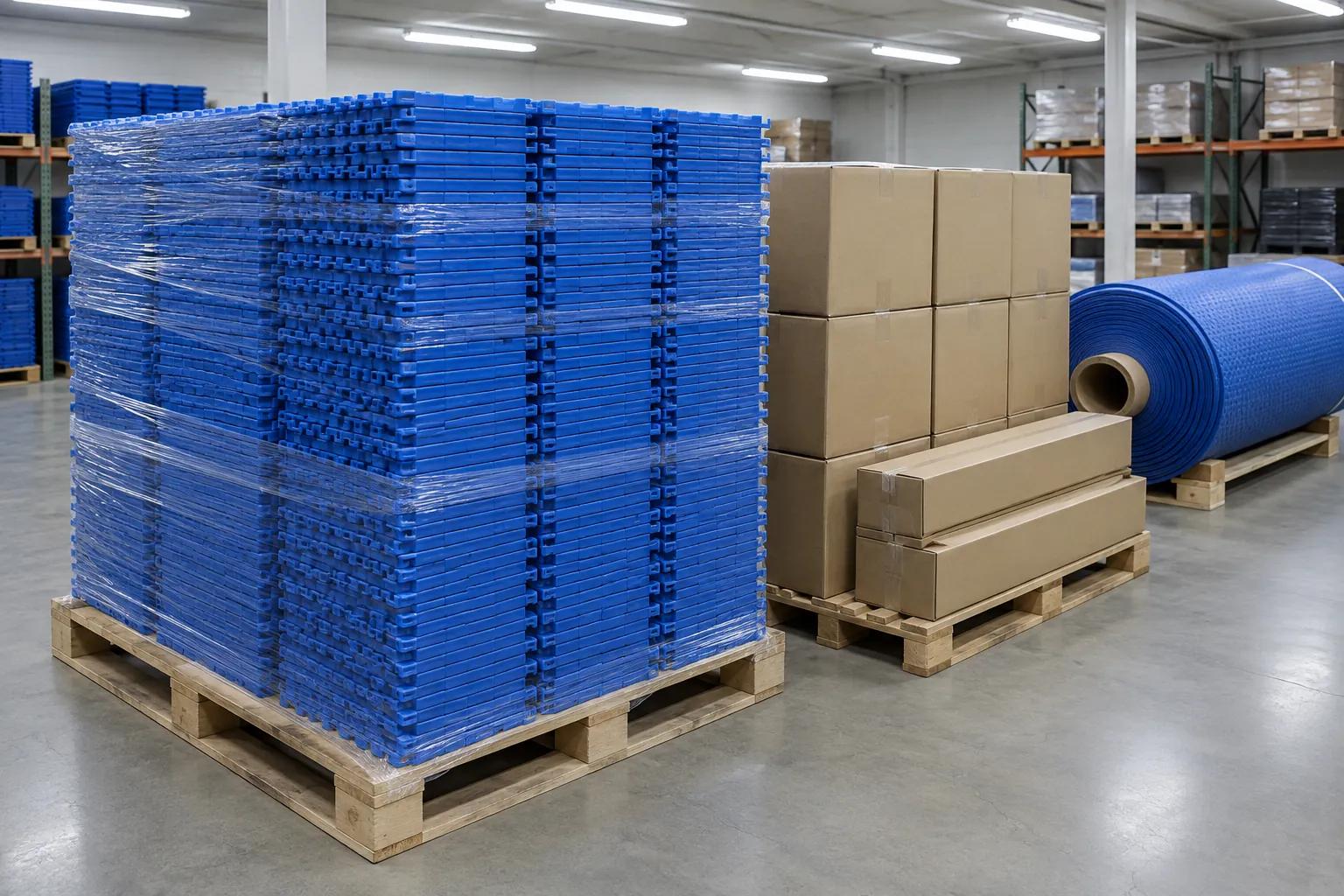
Work backwards from the first event: floor approval in writing, a trial section on the venue floor, the bulk order, then freight. The trial is the step people skip, and it is the only one that answers the bounce, seam and edge questions above. If the same program needs paddles and balls for the courts it sets up, our OEM paddle and ball factory quotes those alongside.
For clubs, rec programs and event operators ordering private-label paddles or rotomolded balls at wholesale volume, from a low MOQ, with pre-shipment QC.
See OEM paddles and ballsFrequently asked questions
Is there such a thing as a portable pickleball court?
Yes: interlocking tiles, a roll-out sheet or mat, or a floor cover with lines, laid over a floor you already have. For play, the kit should cover the minimum playing surface area of 30 ft (9.14 m) wide and 60 ft (18.29 m) long, not only the 20 by 44 ft court.
How many tiles does a pickleball court need?
The 30 by 60 ft minimum playing surface is 1,800 sq ft, which is 1,800 twelve-inch tiles or 2,592 ten-inch tiles. The 34 by 64 ft size recommended for new construction and tournaments takes 2,176 twelve-inch tiles.
Are sport court tiles good for pickleball?
They can be. The ASBA / USA Pickleball manual lists polypropylene tile as an option but recommends that court owners test the playability of these surfaces on the sub-base first. Test bounce at tile centers, joints and edges on your own floor.
Does a portable surface change the net height?
It can. The top of the net must be 36 in +/- 0.25 in above the playing surface at the sidelines and 34 in +/- 0.25 in at the center. Stand the net on the tiles, or set its height from the tile top every time.
Conclusion: the trade-off each system makes
Tiles drain outdoors and swap one piece at a time, at the cost of 1,800 pieces and joints to lay on the minimum surface. A roll-out has fewer joints to check, but confirm with the maker how its seams are held, and it needs a clean floor and roll storage. A cover protects a maple floor that rules out the other two. Fix footprint, thickness, edge height and the trial before price, and send the RFQ lines with MOQ and lead time split into production and freight.
Want to source this quality for your brand?
Contact our factory directly on WhatsApp for an instant MOQ and pricing quote.