Low-MOQ Private Label Pickleball: Sizing Your First Order
You have asked five factories the same question — what is your minimum order — and you have five answers that cannot all be true. One says four paddles. One says one. One says no minimum at all. One says fifty. One wants five hundred before it will talk about a logo. None of them is lying to you, and that is the part nobody explains.
The confusion comes from the question. "What is your MOQ" assumes a first order is one item with one minimum. It is not. A private-label launch is paddles, balls, packaging and usually a bag or a net, and each of those is made by a different process with a different setup. Each setup imposes its own floor. Your real first order is not the smallest of those numbers or the largest — it is the shape that emerges when all of them apply at once, and the one that binds is rarely the one you were worried about.
Key takeaways
- A minimum is a setup cost divided by units, not a policy. Different setup, different floor — which is why one factory honestly quotes 50 of one item and 1,000 of another.
- This factory publishes two minimums: 1,000 pieces for balls and 50 pieces for paddles. The twenty-to-one gap is the single most useful number on this page.
- The cheap item usually carries the big minimum. Balls, not paddles, are what size most first orders — and most launch plans get this backwards.
- Paddles, balls and accessories can share one booking, but they do not share one production clock. One shipment does not mean one lead time.
- How you pack a mixed order changes what it is at customs. CBP classified a paddles-plus-balls-plus-net-plus-bag set as a single article, not four.
- Ball dimensions are not in the rulebook. The 2026 rulebook points at the Equipment Standards Manual, and the ESM says 2.87–2.97 in — not the 2.874–2.972 in repeated across the web.
On this page: Why your first order has several minimums · The two minimums this factory publishes · Which line binds your order size · What actually consolidates into one shipment · The specs your order has to hit anyway · What to put in the first email · FAQ
Why your first order has several minimums, not one
A minimum is arithmetic, not a policy
Before a single unit is produced, somebody has to do work that does not scale: build or adjust a mould, cut a screen or a print plate, colour-match an ink, set up a die for a carton, run and scrap the first pieces until the line is stable. That work costs the same whether you order fifty units or fifty thousand. The minimum order quantity is simply the point where that fixed cost stops being absurd per unit.
Which means the number is entirely determined by what has to be set up. A paddle face that is cut from an existing blank and finished with your artwork needs a screen and a colour match. A moulded ball needs a mould, a resin changeover and a machine cycle nobody can interrupt halfway. Those are different orders of fixed cost, so they produce different floors, and a factory quoting both is not contradicting itself.
That explains the spread you have been staring at. Search this term today and the first page of results advertises, from separate vendors, a 4-unit minimum, a 1-unit minimum, no minimum at all, a 50-unit minimum, and a framework built around choosing between 100, 300 and 500 pieces. Those five claims sit within one screen of each other and every one of them is honestly stated.
They are telling the truth about different things. A supplier advertising a four-unit or one-unit minimum is selling you a stock paddle with your logo applied afterwards — the fixed cost is a heat press and five minutes. A supplier quoting five hundred is pricing a proprietary shape with its own mould. Neither is a scam; they are different products wearing the same words.
The tell is simple: ask what happens to the shape. If the shape is shared with other customers, the minimum is low and the paddle is not really yours. If the shape is yours, there is tooling behind it and the minimum reflects that.
The four setups a first order triggers at once
Run through a realistic launch and count the independent setups. There are usually four, and they do not move together.
| What you are ordering | The fixed cost behind it | Why the floor lands where it does |
|---|---|---|
| Paddles on an existing shape | Artwork setup, screen or transfer, colour match, finishing changeover | Low. The expensive object — the shape — already exists and is shared across customers. |
| Paddles on a proprietary shape | A mould belonging to your design | Much higher, and it is a tooling decision before it is a quantity decision. |
| Moulded balls in your colour | Resin and colour changeover, mould time, cycle stabilisation | High in unit terms, because the changeover is priced against a cheap item. |
| Printed retail packaging | Print plates, a cutting die, a board order from the carton supplier | Set by the carton plant, not the pickleball factory — a separate supply chain with its own rules. |
That last row is the one that ambushes people. Your packaging minimum is imposed by a printing business you never spoke to, and it does not care that your paddle order is fifty pieces. This is the most common way a "low MOQ" first order quietly stops being low: the goods were flexible and the box was not.
The two minimums this factory actually publishes
Most of this industry treats minimums as something you extract in a negotiation. Two of ours are printed on the site, on every product page, where anyone can check them: MOQ 1,000 pcs (Balls) / 50 pcs (Paddles).
Read those two numbers next to each other, because the ratio is the point. The paddle — the expensive item, the one carrying carbon fibre and a honeycomb core and your brand identity — has a minimum of fifty. The ball, which costs a fraction of that, has a minimum twenty times higher. Every instinct a new brand owner has says it should be the other way round.
It is not, because the ball is moulded and the paddle is assembled. A paddle at fifty pieces is possible because the shape already exists; you are paying for artwork, finishing and handling on top of components that are already in the building. A ball has no equivalent shortcut. The mould runs a cycle, the resin has to be purged and changed for your colour, and the machine cannot produce a hundred of yours and then politely stop. The published figures are what those two realities look like when someone writes them down.
What is not published, and how to ask for it
Being straight about the boundary matters more than filling it with a plausible number. Beyond those two figures, this site does not publish a per-configuration MOQ ladder, and you should be sceptical of any page that hands you one. Minimums move with face material, construction method, colour count, whether the packaging is a polybag or a printed box, and whether you are on a stock shape or your own. A published ladder that ignores all of that is decoration.
So ask for it against your actual mix, in one message, and you will get a usable answer: "Fifty paddles, T700 face, 16 mm core, two colourways, single-colour logo, polybag — and balls in one colour. What is the minimum on each line, and what changes if I go to a printed box?" That question has a real answer. "What's your MOQ?" does not.
The same discipline applies to price. Published wholesale ranges circulate freely — a competing OEM guide from NEX Pickleball, dated 2026, quotes thermoformed paddles at USD 32–45 per unit and hot-pressed at USD 18–35, with sea freight at USD 1.20–2.80 per paddle. Treat those as evidence that ranges exist and vary widely, not as a quote: they are one vendor's published figures for that vendor's products, and nothing in them is specific to your spec, your volume or your incoterm. What is verifiable here is the quantity floor — 1,000 balls, 50 paddles — and the rest has to be quoted against a real specification.
One currency, named, every time. Every figure in this article is in US dollars and says so beside the number. Adopt the same rule in your own correspondence and specify it in the first email, because a quote where the currency is implied is a quote you cannot compare — and the same numeral read as one currency instead of another can be wrong by a factor of fifty or more. Name the currency and the incoterm before anyone quotes anything.
Which line binds your order size
This is the decision the rest of the launch hangs on, and it takes about two minutes once the numbers are in front of you.
Work backwards from the ratio. If you private-label both lines at the published minimums, one thousand balls arrive alongside fifty paddles — twenty balls for every paddle you sell. Unless you are supplying clubs that burn through balls, that is not a launch inventory, it is a warehouse problem funded by your launch budget. The ball line is what sizes the order, and it does so whether or not you planned for it.
Run the ratio against your own plan
The test takes one line of arithmetic, and you can run it with your own numbers rather than anyone else's. Take the number of paddles you genuinely expect to sell in your first six months. Divide the ball minimum of 1,000 by that figure. The answer is how many branded balls you are committing to per paddle — and it is the number that tells you whether branding the ball is a decision or an accident.
| Paddles you expect to move | Branded balls per paddle at the 1,000-piece floor | What that tells you |
|---|---|---|
| 50 (the paddle minimum) | 20 | Do not brand the ball. You would be buying a two-year ball supply to launch a paddle test. |
| 250 | 4 | Borderline. Reasonable if you sell paddle-and-ball bundles, wasteful if you sell paddles alone. |
| 500+ | 2 or fewer | The ball minimum has stopped binding. Branding both lines now makes sense. |
| Club or league supply | Irrelevant — balls are consumed, not stocked | Invert the whole plan: lead with balls, treat paddles as the add-on. |
Notice what this model does not require: a price. You can decide the shape of your first order knowing only the quantity floors and your own sales expectation, and you should do it in that order — quantity first, then quote. A buyer who arrives having already worked out that the ball line does not bind him is a buyer who gets a useful quote back, because he has asked a question with one answer.
Which leaves three honest shapes for a first order.
| Shape of the first order | Best for | Not for |
|---|---|---|
| Paddles only, branded. Balls bought as stock, or left out entirely. | Testing a brand and a design with the least cash at risk. Retail and direct-to-consumer launches where the paddle carries the identity. | Anyone whose customer expects a complete branded range on day one, or who is pitching a club supply contract. |
| Balls-led. Commit at the ball minimum, add paddles on top. | Clubs, coaching programmes, leagues and rental fleets — anywhere balls are consumed and reordered continuously. | A brand with no distribution yet. A thousand branded balls with nowhere to go ages badly and ties up the budget. |
| Both, at both minimums. The full mixed consignment. | Buyers with committed volume — a signed retail order, an existing customer base, or a facility opening with known demand. | A first-time launcher testing demand. This is the shape that looks most like a "real brand" and is the most expensive way to discover you were wrong. |
The unglamorous middle path deserves more credit than it gets: private-label the paddles, and buy balls as stock product until your reorder rate tells you what colour and quantity you actually need. Your logo goes on the item the customer holds, evaluates and photographs. The ball is a consumable that gets lost in hedges. Branding it on day one is a decision you can defer at almost no cost to the brand, and deferring it removes the single largest quantity commitment from your first order.
For private-label brand owners, importers and club buyers planning a first OEM order across more than one product line. The OEM page sets out the custom paddle and rotomoulded ball scope — face materials, core options, construction and private-label branding — so you can name a specification before you ask for a number. Send the mix you are considering and ask what the minimum is on each line. The published floors are 1,000 pieces for balls and 50 for paddles; everything else is quoted against a specification. If you are buying a single paddle for yourself, this is not for you.
See the OEM and private-label optionsWhat actually consolidates into one shipment
The plan is usually to put everything in one box and move it once. That mostly works, and the places where it does not are predictable.
Goods made in the same factory ship on one booking, on one set of documents, under one incoterm. That is the real saving, and it is worth having: a single consolidated consignment beats several small ones on freight, on paperwork and on the number of things that can go wrong in transit.
One shipment does not mean one production clock
Here is the failure that costs new brands their launch date. Consolidation is a shipping decision, made at the end. Production is four separate clocks running at different speeds, and your consignment leaves when the slowest one finishes.
Paddles wait on artwork approval and a finishing line. Balls wait on a mould cycle and a colour changeout that has to be scheduled against other production. Printed cartons wait on a completely different supplier — plates, board, a print run, delivery to the factory — and cartons that arrive late hold up goods that were finished a fortnight ago.
A published OEM stage breakdown from NEX Pickleball's 2026 guide gives the shape of it: pre-production approval 7–14 days, tooling and design 10–15 days, production 20–35 days, an overall cycle of 60–90 days. Those are that vendor's published figures for that vendor's own process rather than a commitment from anyone else, but the structure is the useful part — the stages are sequential, and adding a line adds a clock rather than sharing one.
The practical move is to ask, before you commit, which item has the longest lead time and whether it can start first. If your printed boxes take longer than everything else, they should be approved and ordered before the paddle artwork is finalised, not after.
How you pack it changes what it is at customs
This is the part that surprises people who have consolidated shipments in other industries. Loose goods in one container are still separate products, each classified on its own. Put the same goods into a retail set and the set can become a single customs article.
US Customs ruling NY N347450, issued 29 April 2025, covered exactly this situation: a set of two wooden pickleball paddles, two plastic pickleballs, a 10-foot mesh net with iron tubes, and a drawstring polyester bag. CBP classified the whole thing under a single subheading — HTS 9506.99.6080, base duty 4% ad valorem — rather than classifying four different products.
The consequence is worth understanding before you design your packaging. A decision made for marketing reasons — bundling a starter set because it sells better — is also a customs decision, and it changes the code, the rate and the paperwork for those goods. Neither outcome is automatically better. What is expensive is assuming the classification and finding out at the border.
One caution on the numbers. Duty on Chinese-origin goods is assembled from several layers, and the additional-duty layers have moved repeatedly. Confirm the current stack with your broker for your destination rather than trusting any figure published in an article — including this one, which deliberately quotes only the base rate.
For the detail: this site's Section 301 tariff guide and HS code breakdown cover classification; the FCL versus LCL comparison covers full container against part load; and the mechanics of building a set as a sellable SKU — barcodes, carton maths, what changes when components change — are in the starter-set assembly guide.
The specs your first order has to hit anyway
A small order is not a licence to be vague about specification. If anything the opposite: on fifty paddles you have no room to absorb a rejected batch, and the spec is the only thing standing between you and an argument you cannot win.
Where the ball numbers actually live
Start with a correction, because almost every page you will read on this gets it wrong. The 2026 USA Pickleball Official Rulebook does not contain the ball's dimensions. Rule 3.C.2 says only that "the design of the ball must be approved by USA Pickleball as detailed in the Equipment Standards Manual" — the rulebook's ball section covers usage, colour, brand identification and construction, and delegates every number to a separate document.
That document is the Equipment Standards Manual, Revision 3.0, dated January 2025, and it is where the specification you should be quoting in a purchase order actually lives.
| Property | Requirement as written | Section |
|---|---|---|
| Diameter | 2.87 in (7.29 cm) to 2.97 in (7.54 cm); out-of-round variance not greater than ±0.020 in (0.51 mm) | ESM 2.D.3 |
| Weight | 0.78 to 0.935 ounces (22.1 to 26.5 grams) | ESM 2.D.4 |
| Holes | Minimum 26, maximum 40 circular holes | ESM 2.D.8 |
| Bounce | 30 to 34 in (76.2 to 86.4 cm), dropped from 78 in (198.1 cm) onto a granite plate at least 12 × 12 × 4 in, at 70 °F ± 5 °F | ESM 2.D.5 |
| Compression | Average result under 43 LBF, tested per ASTM F1888-09, each ball tested twice | ESM 2.D.6 |
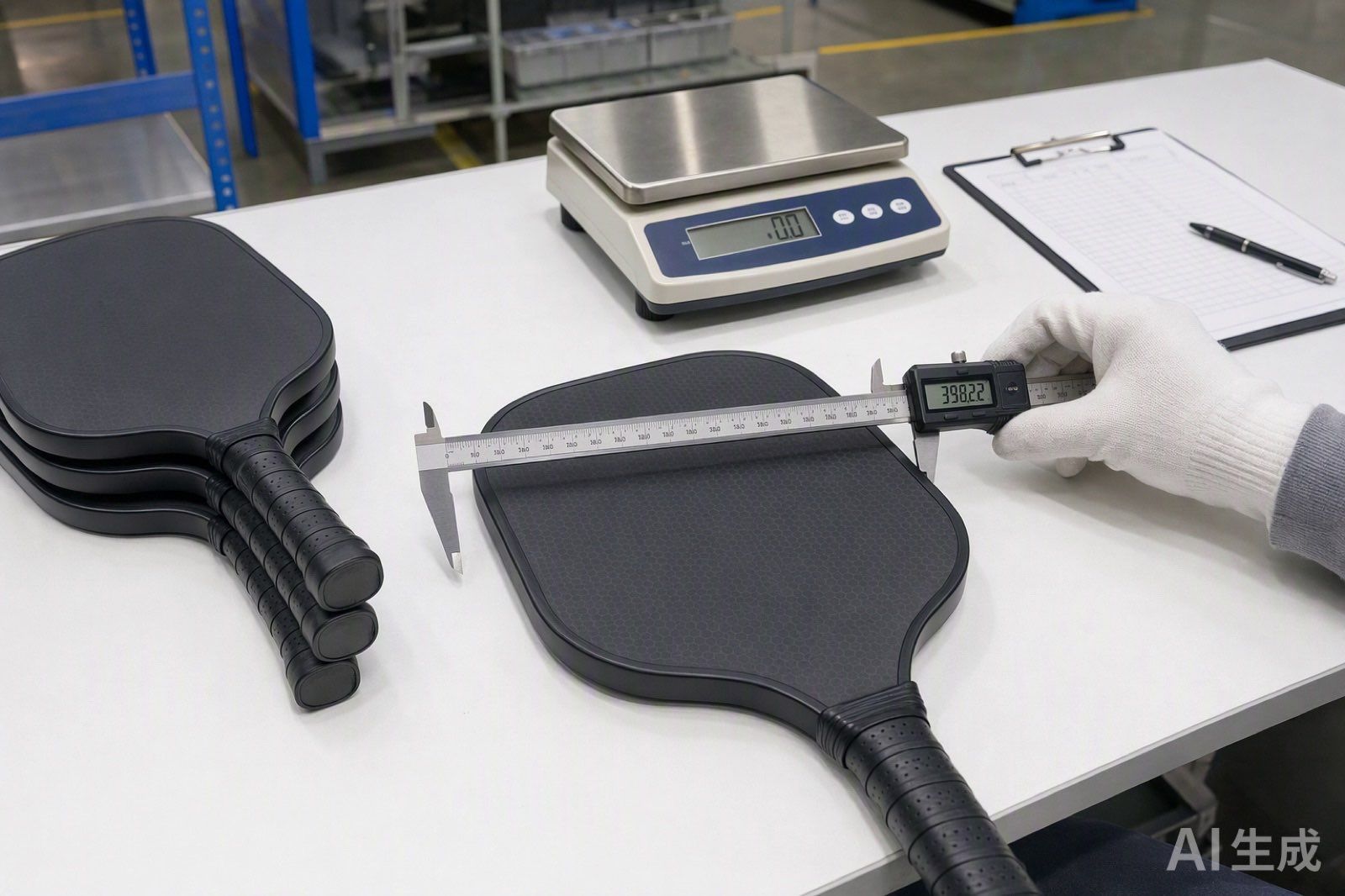
Two details in that table are worth more than the headline numbers. The diameter figure is 2.87 to 2.97 inches — you will constantly see "2.874 to 2.972" quoted as if it were official, and it is not what the governing document says. And the bounce specification is not a number, it is a test: a stated drop height, a granite plate of stated minimum size, and an ambient temperature window of 70 °F plus or minus 5. A supplier and a buyer arguing about bounce without agreeing those conditions are measuring two different things and will never reconcile.
The paddle limits, and the one people quote wrongly
Paddle dimensions are in the rulebook itself. Rule 3.D.2: combined length and width, including edge guard and butt cap, must not exceed 24 inches (60.96 cm), and length alone must not exceed 17 inches (43.18 cm). There is no restriction on thickness, and Rule 3.D.3 states plainly that there is no restriction on paddle weight either.
The surface roughness limit is where specifications go wrong quietly. The ESM allows an average of no more than 30 micrometres on Rz readings and 40 micrometres on Rt — but the method matters as much as the ceiling. Readings are taken in six different directions on each face and averaged per face, and no single reading may exceed 33 micrometres Rz or 44 micrometres Rt (ESM 2.E.2.a.1). A face can sit comfortably under the average and still fail on one outlier.
Two further tests sit alongside it. There is a separate coefficient-of-friction test to ASTM D1894-14 with a limit of ≤ 0.1875 (ESM 2.E.2.a.2), and Revision 3.0 introduced the PBCoR test for paddle power while tightening coverage of surface finish, gloss and shiny edge guards.
None of this means your first order needs certification. It means the goods should be built to specifications that could pass, so that certifying later is a submission rather than a redesign. Whether you need approval at all depends on where you sell and whether your buyers play sanctioned tournaments — the eligibility check walks through that decision. Fees and submission requirements change and are not published in the ESM; get them from USA Pickleball directly rather than from any blog, including this one.
Watch the video
If the ball minimum still feels arbitrary, watching the process explains it faster than any paragraph can: the mould, the cycle, and why the machine cannot economically make a hundred of anything.
Video: "How do they make pickleballs?" by the DP MACHINERY channel — an independent moulding-equipment source, included because it shows the production cycle rather than selling a paddle brand.
What to put in the first email
Most first enquiries get a vague answer because they asked a vague question. Six things turn an enquiry into a quote you can actually compare between suppliers.
- The specification, as a range you will accept. Face material, core thickness, construction, grip, colourways. "T700 face, 16 mm polypropylene honeycomb core, thermoformed or cold-pressed — quote both" is answerable. "A good paddle" is not.
- Quantities per line, and which one you will flex. Say what you want and say where you have room. A supplier who knows your paddle count is firm and your ball count is negotiable can propose something useful.
- The currency and the incoterm, named before any number. Ask for the quote in one stated currency, on one stated incoterm — FOB and DDP are different conversations. This site's published terms cover DDP shipping worldwide, so name which you want.
- Packaging, explicitly. Polybag, colour box, or a retail set — and ask what the minimum is on the printed component specifically, because it is set by a different supplier and it is the constraint most likely to move your total.
- Compliance, tied to where you sell. Name the destination market and whether you need the goods built to USA Pickleball equipment specifications. Quote the ESM sections rather than saying "must be approved".
- How the first batch gets verified. Put the approval steps in the terms yourself — an approved physical reference signed off before production starts, and a pre-shipment inspection after it. Agreeing both in writing before the deposit is what makes them enforceable, whoever you end up buying from.
On that last point, the approval-reference procedure is worth insisting on even at fifty pieces, whichever factory you use. An approved physical reference is the only thing that makes "not what I ordered" a resolvable claim rather than an opinion. Full customisation scope — surface texture, edge guard, grip, private-label branding across OEM and ODM paddles and rotomoulded balls — is set out on the OEM page, and if you are still choosing between specification tiers, the good/better/best catalogue breakdown shows which upgrades actually carry a cost.
Where this article deliberately stops
Three things this page does not do, on purpose. It does not give you a paddle MOQ ladder of 100 versus 300 versus 500 — that decision has its own guide. It does not price tooling, which is a genuinely separate question answered in the mould and tooling cost breakdown. And it does not publish a customer's order figures, because a case study built from reconstructed numbers teaches you to expect terms nobody agreed to.
Conclusion
Do these four things in order. Decide which product lines carry your brand on day one and which can wait — for most first orders that means paddles branded, balls bought as stock. Get the minimum quoted against your real specification mix rather than asking the generic question, and get the packaging minimum separately, because it comes from a different supplier. Name one currency and one incoterm before anyone sends you a number. Then agree an approved physical reference and a pre-shipment check in writing, so that the fifty paddles you cannot afford to write off arrive as the fifty paddles you signed off.
If you are planning a mixed first order and want the floors quoted against your own spec, the OEM page is the place to start that conversation.
Frequently asked questions
What is the lowest MOQ for private-label pickleball paddles?
This factory publishes 50 pieces for paddles. Vendors advertising four units, one unit or no minimum are generally applying a logo to a stock paddle rather than producing to your specification — a different product sold under the same words.
Why is the ball minimum higher than the paddle minimum?
Balls are moulded, paddles are assembled. A moulding run needs a resin and colour changeover plus cycles that cannot stop part-way, so the fixed cost lands on a cheap item. Paddles use existing shapes, so only finishing is set up.
Can I order paddles and balls in the same shipment?
Yes — same factory, one booking, one set of documents. But each line has its own production clock, so the consignment leaves when the slowest item finishes. Ask which item has the longest lead time before you commit to a ship date.
Does bundling goods into a set change the customs treatment?
It can. In ruling NY N347450 (29 April 2025) CBP classified a paddles, balls, net and bag set as one article under HTS 9506.99.6080 at 4% base duty, rather than as separate products. Confirm classification with your broker before finalising packaging.
What is the official pickleball diameter?
2.87 to 2.97 inches (7.29 to 7.54 cm), with out-of-round variance no greater than ±0.020 inch, per the USA Pickleball Equipment Standards Manual Rev 3.0, section 2.D.3. The 2026 rulebook itself delegates ball dimensions to that manual.
Do I need USA Pickleball approval for a first order?
Only if your customers play sanctioned tournaments. Either way, build to specifications that could pass, so certifying later is a submission rather than a redesign. Get current fees and submission requirements from USA Pickleball directly.
Want to source this quality for your brand?
Contact our factory directly on WhatsApp for an instant MOQ and pricing quote.