Pickleball Paddle Sample Order: Real Timeline, Fees & Costs
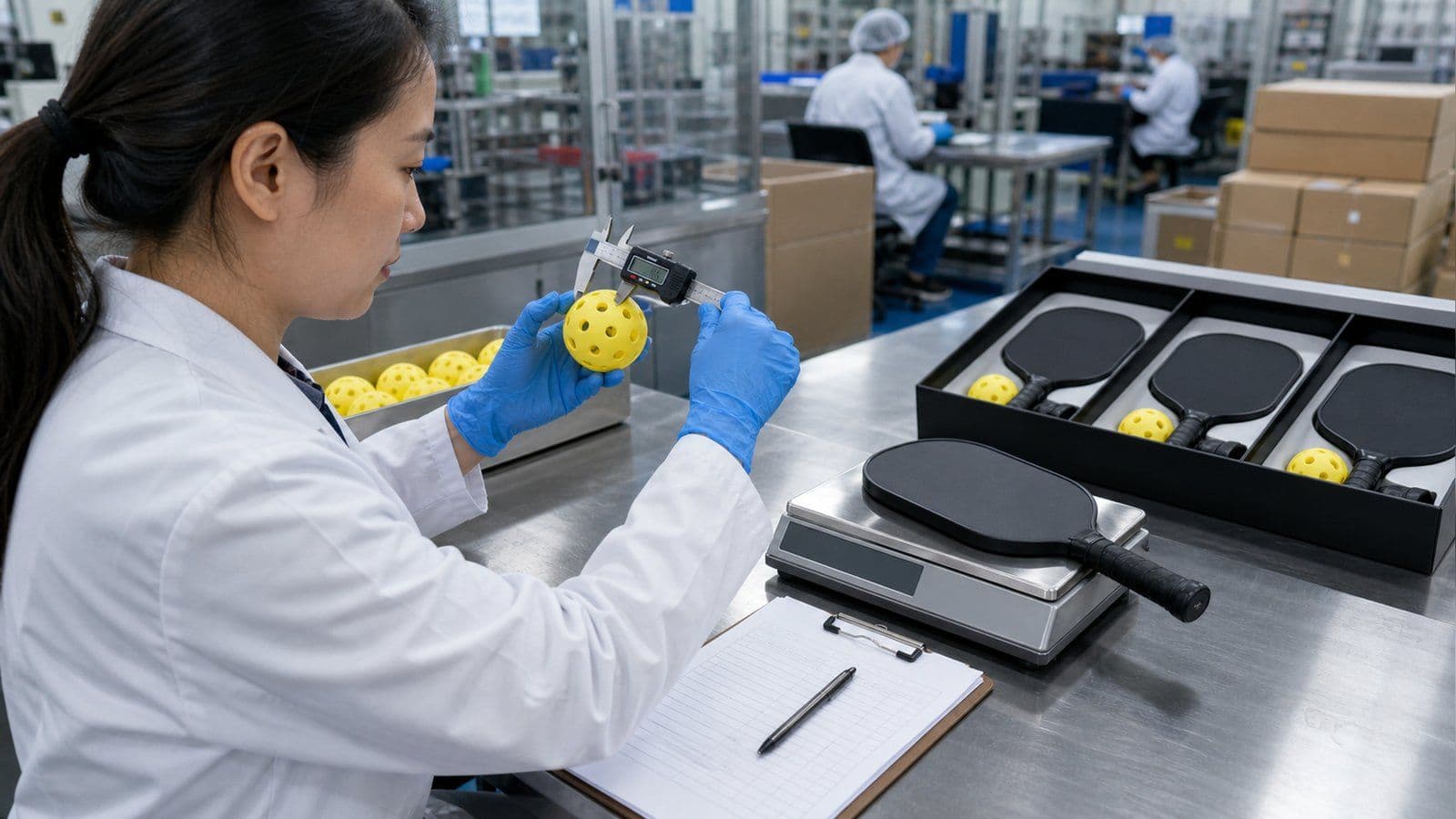
Four paddle factories advertise their sample turnaround publicly. One says 2–7 days. Another says 3–4 days. A third says 7–10 days to build plus 3–5 days for approval. The same factories quote 6–8 weeks for a complete ODM programme and 12–18 weeks for full OEM. Those numbers are not in conflict, and understanding why they are not in conflict is the whole subject of this article.
A sample order is not one event. It is eight, and only two of them happen inside the factory's production area. The advertised "2–7 days" almost always describes the build stage alone — the interval between a released work order and a finished paddle. It excludes spec confirmation, material staging, internal QC, photo approval, dispatch, transit, and the revision round that most first samples trigger. Buyers plan against the advertised number, then lose three weeks to stages nobody itemised for them.
This article itemises them. It also does something the pages currently ranking for this query do not: it prices that inbound parcel against the customs rules actually in force in 2026, rather than the pre-2025 rules most sourcing content still repeats.
Key takeaways
- The advertised sample time is the build stage only. A realistic door-to-door plan for a modified-existing-mould paddle sample runs three to five weeks, and a full-custom-tooling sample runs considerably longer.
- Your own spec sheet is the single biggest variable. Stage one is the only stage where the buyer, not the factory, controls the clock.
- Fixed customs fees, not the courier quote, dominate the landed cost of a small sample. The US Merchandise Processing Fee alone has a floor of USD 33.58 per formal entry regardless of how small the shipment is.
- The "samples under USD 800 come in duty-free" rule is gone. De minimis treatment was suspended on 29 August 2025 and the suspension is now indefinite.
- Declare the fair market value. HTS 9811.00.60 exists, but its conditions rarely fit a working paddle sample — and misdeclaring is a compliance exposure, not a saving.
On this page
- What a paddle sample order actually buys you
- The eight stages of a sample order, and how long each one really takes
- Where sample timelines actually slip
- Sample fees, credit terms, and the four questions to settle in writing
- What it costs to get the sample to your door
- How to declare a paddle sample correctly
- How to compress a sample round without paying for air twice
- Frequently asked questions
What a paddle sample order actually buys you
Before any date means anything, settle which of three very different things you are ordering. Factories use the word "sample" for all three, and the gap between them is measured in weeks and thousands of dollars.
A stock or blank sample is an existing paddle from the factory's catalogue, sometimes with your logo applied. Nothing is engineered. It answers one question — what does this factory's build quality feel like — and it answers it fast, because the paddle already exists in a finished-goods rack.
A modified-existing-mould sample is the common case for a private-label launch. The factory owns a mould in the shape you want, and your sample changes the face material, core thickness, surface finish, weight window, edge guard, grip and graphics against that existing geometry. No tooling is cut. This is the case most of this article's timings describe.
Before you can request any of the three, the factory needs the buildable window you are working inside. For a paddle programme that means a core thickness range of 13 to 16 mm, a face material choice across raw T700 carbon, 3K or 12K weave and fiberglass, a stated weight window in ounces with a tolerance, a grip circumference, and a construction method — thermoformed unibody or cold-pressed. A spec that names a single value with no tolerance is the most common reason a first sample comes back wrong.
A full custom-tooling sample requires a new mould in your own shape. Tooling has to be designed, cut, trialled and corrected before the first paddle exists. Any timeline that begins "samples in 7 days" is not describing this.
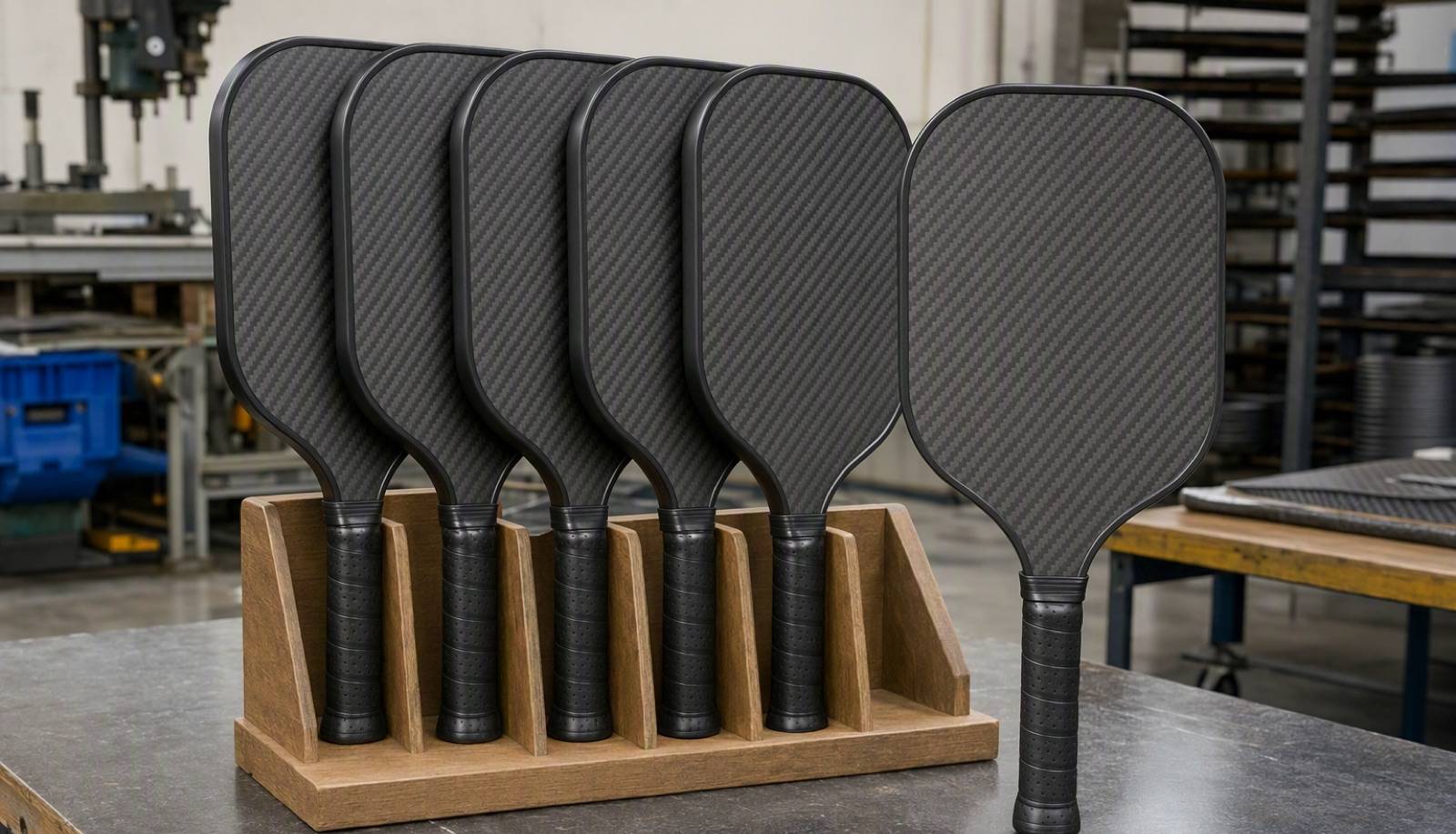
What a sample can prove: construction quality, surface texture, weight and balance in the hand, graphics registration and colour accuracy, grip feel, edge-guard fit. What a single sample cannot prove: batch consistency. One paddle tells you what the factory can build when it is paying attention to one paddle. Holding that quality across a few thousand units is a separate question, settled by a signed reference unit and an inspection standard rather than by the sample itself — which is why the golden-sample approval workflow exists as a distinct step after sampling ends.
The eight stages of a sample order, and how long each one really takes
Here is the decomposition. The day ranges below are market-typical planning ranges for a modified-existing-mould paddle sample, assembled from what paddle factories advertise publicly and from the structure of the process itself. They are planning figures, not a quotation from any single supplier, and any given factory will beat some of them and miss others.
| Stage | Typical days | What extends it | Whose move |
|---|---|---|---|
| 1. Spec confirmation and tooling review | 2–10 | Missing fields, vector artwork not supplied, no weight tolerance stated, unresolved shape question | Buyer |
| 2. Material staging | 3–15 | Non-stock face weave, unusual core thickness, custom Pantone, specialty grip — anything not on the shelf | Factory |
| 3. Build (the advertised number) | 2–7 | Press queue behind production runs; thermoformed builds need cure time that cannot be shortened | Factory |
| 4. Internal QC and rework | 1–4 | Weight outside the stated window, graphics registration off, edge-guard fit — each triggers a rebuild | Factory |
| 5. Photo and data approval | 1–5 | Time-zone round trips; buyer unavailable; no agreed list of what must be photographed or weighed | Buyer |
| 6. Dispatch and export paperwork | 1–3 | Incomplete commercial invoice; consignee tax ID not supplied; incorrect HS classification | Both |
| 7. Transit and customs clearance | 3–10 | Formal entry now required on shipments that once cleared informally; value or classification queries | Carrier / broker |
| 8. Evaluation and revision round | 7–21 per round | Each round repeats stages 1–7; changes requested one at a time instead of batched | Buyer |
Add the midpoints and a first sample on an existing mould lands in roughly three to five weeks door to door — not the one week the advertised figure implies. Note where the control sits. Three of the eight stages are the buyer's move, and stage one, the cheapest stage to get right, sets up stages two through eight.
Two structural points fall out of the table. First, the revision round is a full repeat of the cycle, which is why the number of rounds matters more than the speed of any single one. Second, transit and clearance now behave differently than they did before 2025, and that change is covered in detail further down. Which staging row applies to you is decided by how deep the customization goes, and that tracks the order tier. On our OEM paddle programme a screen-printed logo on an existing shape and core (50–100 units) skips material staging almost entirely, while full custom OEM at 300–500 units — where core density, profile and face material all change — is the tier that puts you in the longest row above.
Worked scenario. A brand launcher wants a 16mm thermoformed paddle with a raw T700 face, a custom Pantone edge guard and full-wrap graphics, and needs stock on hand for a March launch. Working forwards from a complete spec: stage 1 takes 4 days, stage 2 takes 12 (the Pantone edge guard is not a stock colour), stage 3 takes 5, stage 4 takes 2, stage 5 takes 3, stage 6 takes 2, stage 7 takes 6. That is 34 days to a first sample in hand.
One revision round to correct the weight window adds 14 more. Sampling alone consumes roughly seven weeks — before the production order is even placed, and before the mass-production timeline starts.
Where sample timelines actually slip
When a sample is late, it is late at a specific stage, and the diagnosis determines whose action unblocks it. These are the five causes worth checking first, in the order they most commonly occur.
An incomplete spec sheet. This is the most common cause and the only one entirely within your control. A spec that omits a weight tolerance, supplies raster logo files instead of vector artwork, or names a colour without a Pantone reference does not stop the factory — it makes the factory guess. The guess comes back as a paddle you reject, and the rejection costs a full revision cycle. Sending a complete paddle specification sheet before the first quote is the highest-leverage thing a buyer does in the entire process.
Custom tooling treated as a minor variation. If your shape does not exist in the factory's mould inventory, tooling must be cut before a sample can exist, and tooling schedules run on their own clock. This is a different project with a different budget, and it belongs in the plan as one — see what paddle tooling actually costs before assuming a shape change is free.
Material staging for anything non-stock. Standard face weaves and standard core thicknesses sit on the shelf. A specialty weave, an unusual core thickness, a custom-dyed grip or a specific Pantone on the edge guard has to be ordered in, and a sample-quantity purchase sits behind production-quantity purchases in the supplier's queue.
The factory calendar. Chinese New Year stops production for weeks, and the slowdown starts before the holiday and extends after it as staff return. Peak season congestion is a second, separate constraint. Neither is negotiable, and both are predictable — the annual sourcing calendar covers how to plan around them.
The approval clock you own. Stages 5 and 8 are buyer stages. A sample that sits in an office for nine days waiting for a decision has consumed more calendar than the entire build stage. Agree in advance who signs off, on what criteria, and within how many working days.
Sample fees, credit terms, and the four questions to settle in writing
Sample fee practice varies by supplier, and the public answers contradict each other. Four models are common across OEM manufacturing. Credit thresholds are supplier-specific and rarely published, so treat any qualifying quantity you are quoted as that supplier's own policy rather than an industry norm — confirm the quantity, the rounds covered, and whether courier cost is included in writing before you pay.
| Model | What it usually signals |
|---|---|
| No-charge unit, buyer pays courier | Stock or blank paddles the factory already holds. Rarely offered on customised builds. |
| Sample fee plus courier, no credit | The factory is covering real setup and material cost. Common for custom work from a new buyer. |
| Sample fee credited against the first production order | The most common OEM arrangement, and the one whose terms most need writing down. |
| No samples offered | A signal worth taking seriously on a custom programme. |
"Credited against your first order" is the phrase that causes disputes, because on its own it specifies almost nothing. Four questions turn it into a term you can hold someone to.
- Credited against what quantity? A credit that only applies above a volume you have no intention of ordering is not a credit. Get the qualifying quantity stated as a number, and check it against the supplier's minimum order quantity.
- How many sample rounds are covered? Most credit arrangements cover the first sample. Rounds two and three are frequently chargeable, and that is where an under-specified programme quietly gets expensive.
- Does the credit include the courier cost, or only the sample fee? Usually only the fee. On a small consignment the freight and clearance can exceed the fee itself, as the next section shows.
- Is tooling separate? It almost always is. Tooling is a capital item that carries its own ownership terms, and a credit against the sampling charge does not touch it.
Settle all four by email before paying anything. A supplier who answers all four in writing without hedging is telling you something useful about how the rest of the programme will run.
For brand launchers and importers who already have a spec. Our MOQ tiers are published, not quoted on request: stock paddle with a screen-printed logo runs 50–100 units at USD 18–25 per paddle, full-wrap UV print 100 units at USD 22–30, and full custom OEM — where you control core density, profile and face material — 300–500 units at USD 12–18. Name the tier you are sampling toward and we will quote the sample fee and credit terms against that specific number.
Ask about sample terms on WhatsAppWhat it costs to get the sample to your door
Most sourcing guides quote a courier price and stop. That is the smaller half of the number, and on a single-paddle shipment it is often not even the larger line item.
Express courier line-haul for a 1–3 kg parcel from China to the United States typically runs roughly USD 30–80 door to door with a 3–7 business day transit. Treat that as a market estimate rather than a quotation — it moves with fuel surcharges, which DHL Express now updates weekly rather than monthly as of 13 April 2026, and with the carrier's annual base-rate change, which averaged 5.9% on 1 January 2026.
The fees that do not move with parcel size are the ones worth planning around, because they are fixed floors. These are published amounts from the DHL Express Service & Rate Guide 2026 for the United States, all in USD:
| Line item | Published charge (USD) | When it applies |
|---|---|---|
| Merchandise Processing Fee | 0.3464% of net entered value, minimum 33.58, maximum 651.50 | Every formal entry. The minimum is what a small sample pays. |
| Clearance Processing | 15.00 per shipment | Routine clearance handling |
| Non Routine Entry | 35.00 per shipment | Anything that cannot clear on the standard path |
| Duty Tax Processing (account holders) | 2% of fiscal charges, minimum 17.50 | Whenever duties or taxes are advanced on your behalf |
| Clearance Paperwork | 20.00 per shipment | Paperwork prepared to facilitate clearance |
| Regulatory Charges | 1.34 per shipment | Standard regulatory recovery |
Now run the arithmetic that the courier quote hides. A single custom paddle with a declared value of USD 60, moving express as a formal entry: courier line-haul in the region of USD 50, Merchandise Processing Fee at its USD 33.58 minimum, Clearance Processing USD 15.00, Regulatory Charges USD 1.34, plus applicable duty and any Section 301 tariff on the paddle's classification. The fixed customs-side charges alone come to just under USD 50 on a USD 60 paddle. The sample fee was never the expensive part.
That USD 49.92 is a floor rather than a ceiling, and the reason is worth understanding before you use it as a budget line. Clearance Paperwork at USD 20.00 sits outside the base case because DHL's own service description conditions it: the charge applies when a commercial invoice is missing and DHL attaches the documentation on your behalf, or when you ask them to prepare it. Send your supplier's commercial invoice with the parcel and you avoid it; let the factory dispatch without one and the same shipment lands just under USD 70 instead.
Non Routine Entry at USD 35.00 and Duty Tax Processing at a USD 17.50 minimum behave the same way — each is published, each is real, and each is triggered by a condition you can usually control. So budget roughly USD 50 as the floor, USD 70 to USD 100 as the realistic first-shipment range before duty, and treat confirming the invoice and HS code with your supplier before dispatch as the cheapest way to stay at the bottom of it.
The planning consequence is direct: the fixed floor is charged per shipment, not per paddle. Two paddles in one parcel pay the MPF minimum once. Two paddles in two parcels pay it twice. That single fact is the strongest argument for batching your revision requests, and it is the arithmetic behind the compression tactics below.
How to declare a paddle sample correctly
This section describes general customs rules as published. It is not customs advice, and classification and valuation questions on your own shipments belong with a licensed customs broker.
Start with the change most sourcing content has not caught up with. The de minimis exemption is suspended. Duty-free treatment for low-value shipments under Section 321 ended for all modes other than the international postal network effective 29 August 2025, and the suspension was confirmed as indefinite in a Federal Register notice in June 2026. US Customs and Border Protection updated its systems to reject Section 321 manifest filings and entry type 86 releases; filers must now submit a formal or informal entry with payment of applicable duties, taxes and fees. Any guide still telling you that goods under USD 800 arrive duty-free is describing rules that no longer exist.
The second thing worth knowing is that the duty-free provision people reach for usually does not fit a paddle. HTS subheading 9811.00.60 covers, in its own words, "any sample … valued not over $1 each, or marked, torn, perforated or otherwise treated so that it is unsuitable for sale or for use otherwise than as a sample, to be used in the United States only for soliciting orders for products of foreign countries." (The "$1" in the quoted tariff text means USD 1.) Three conditions sit inside that sentence, and a working paddle sample typically fails at least two:
- The value test. Not over USD 1 each. A custom carbon paddle is not.
- The mutilation alternative. If the value exceeds USD 1, the item must be permanently altered so it cannot be sold. CBP expects an obvious, permanent alteration — a cut, a punched hole, or SAMPLE stamped in indelible contrasting ink — and the alteration must be made before importation, not on arrival. A paddle mutilated to that standard cannot be swung, weighed in the hand, or shown to a retail buyer, which destroys the reason you ordered it.
- The purpose test. The provision applies to samples used only for soliciting orders. CBP has addressed goods imported for testing and approval alongside order solicitation, and samples brought in for quality control, testing or photography do not meet the order-solicitation requirement. Evaluating a paddle before committing to production is exactly testing and approval.
So the honest position is this: for most paddle buyers, the sample is ordinary dutiable merchandise, and the correct approach is to declare it accurately and budget for the duty rather than to look for an exemption that does not fit.
What to put on the commercial invoice
Declare the fair market value of the goods — what the paddle is actually worth, which for a paid sample is what you paid. Where a supplier waives the charge, the invoice should still show the market value with a note that the amount has been waived; declaring zero or "no commercial value" is not an option customs rules accommodate.
Include the correct HS classification (9506.99.00 for pickleball paddles), an accurate goods description, country of origin, the consignee's tax identification, and the incoterm. Most sample delays at stage 7 trace back to one of these fields being missing or vague rather than to anything the carrier did.
Why under-declaring is a bad trade
Labelling a consignment as sample goods does not by itself create duty relief. As one trade-law analysis of these rules puts it, if the product is finished, functional and capable of being sold, customs is likely to treat it as ordinary merchandise.
Understating value on an entry is a misdeclaration. The realistic downside is not a small saving that occasionally gets caught; it is duties reassessed, penalties, clearance delays on the shipment in front of you, and elevated scrutiny of every shipment you send afterwards — which is a serious operating cost for a brand that intends to import containers later. Weighed against a duty on a USD 60 paddle, the trade makes no commercial sense even before the compliance question.
The compliance paperwork a sample can trigger
A sample crossing a border is still a regulated consumer good. US buyers importing children's or general-use sporting goods should expect to supply a CPSIA general certificate of conformity at production stage, EU and UK buyers work to CE and UKCA conformity requirements, and any paddle intended for sanctioned play needs to clear the relevant certification programme before it reaches a tournament — our guides to CE, CPSIA and REACH requirements and USAPA approval eligibility cover both.
At sample stage none of this is usually demanded by customs. The test reports behind it take weeks to obtain, though, so the time to ask which certificates a factory already holds is while you are waiting for the sample — not after you place the order.
The legitimate route for expensive reusable samples
If you are moving a high-value sample temporarily — a trade-show set that will be re-exported, for instance — Temporary Importation Under Bond or an ATA Carnet is the mechanism designed for it. DHL publishes Temporary Import/Export at USD 150.00 per shipment and an Under Bond Guarantee at USD 5.00 per USD 1,000 of bond with a USD 50.00 minimum, so it is worth the paperwork only above a certain value.
For a single paddle it is not; for a full range going to a show, it can be. Buyers moving into regular production volumes should also read up on Section 301 tariffs and paddle customs clearance before the first container.
How to compress a sample round without paying for air twice
Some of the eight stages compress with money or attention. Others do not compress at all. Knowing which is which stops you paying express rates to accelerate something that was never the bottleneck.
What genuinely compresses. Stage 1 collapses to a day or two if you arrive with a complete spec sheet and vector artwork. Stage 5 is pure responsiveness — agree a 24-hour turnaround on photo approval and name the person who signs. Stage 8 compresses dramatically when revisions are batched: send every change at once rather than discovering them one at a time over three emails, because each partial round repeats stages 1 through 7 and pays the fixed clearance floor again.
What does not. Thermoforming cure time is physics. Material lead time for a non-stock weave is somebody else's production queue. Tooling is a project. Chinese New Year is a calendar. No amount of expediting moves these, and a supplier who promises otherwise is telling you what you want to hear.
Parallel sampling. If you are undecided between two core thicknesses or two face materials, order both in one round rather than sequentially. Two paddles in one parcel share the USD 33.58 MPF minimum and one clearance-processing charge, and you save an entire two-to-three week cycle. This is usually the single highest-return decision available to a buyer against a launch date.
When paying for rush is worth it. Express air on the sample itself is generally worth it — the cost difference is small relative to a week of calendar. Paying a rush fee to jump the press queue is worth it only when stage 3 is genuinely the bottleneck, which the table above shows it usually is not. Diagnose the stage first, then spend.
Your action plan
- Decide which of the three sample types you are ordering, and re-read the timeline against that answer.
- Complete the spec sheet before requesting a quote — weight window, Pantone references, vector artwork, core thickness, face material.
- Get the four fee questions answered in writing: qualifying quantity, rounds covered, courier included or not, tooling separate.
- Budget the landed cost including the fixed clearance floor, not just the courier quote.
- Name your internal approver and commit to a turnaround, because stages 5 and 8 are yours.
- Batch every revision into one round, and order parallel variants in a single parcel.
Frequently asked questions
How long does a pickleball paddle sample take?
Plan three to five weeks door to door on an existing mould, longer if new tooling is needed. The 2–7 day figure factories advertise covers the build stage only — not spec confirmation, material staging, QC, approval, dispatch or transit.
Is the sample fee refundable?
Usually it is credited against your first production order rather than refunded in cash, and terms vary widely by supplier. Get the qualifying quantity, the rounds covered and whether courier cost is included stated in writing before you pay.
Can a paddle sample be imported duty-free?
Usually not. HTS 9811.00.60 requires a value not over USD 1 each or permanent mutilation making the item unsuitable for sale, and limits use to soliciting orders — testing and approval do not qualify. Treat a working paddle sample as dutiable merchandise.
Do samples under USD 800 still enter the US duty-free?
No. De minimis treatment under Section 321 was suspended on 29 August 2025 for all modes other than international post, and the suspension is now indefinite. A formal or informal entry with applicable duties and fees is required.
What value should I declare when the charge is waived?
Show the fair market value with a note that the amount was waived. Declaring zero or “no commercial value” does not meet customs requirements, and a vague value is a common cause of clearance delay.
Why does one small parcel cost so much to clear?
Fixed customs charges apply per shipment, not per unit. The US Merchandise Processing Fee has a published minimum of USD 33.58 per formal entry and clearance processing adds USD 15.00 — a floor close to USD 50 on a USD 60 paddle, before duty and before any conditional charge such as Clearance Paperwork.
How many sample rounds should I budget for?
Budget for at least one revision round beyond the first sample, because each round repeats the full cycle. Batching every requested change into a single round is the most effective way to keep the count down.
Does the sample fee include tooling?
Almost never. Tooling is a separate capital item carrying its own ownership terms, and a credit against the sampling charge does not cover it. Confirm this explicitly if your paddle needs a new mould.
Want to source this quality for your brand?
Contact our factory directly on WhatsApp for an instant MOQ and pricing quote.