What Type of Ball Is Used in Pickleball? The Rules vs the Myths
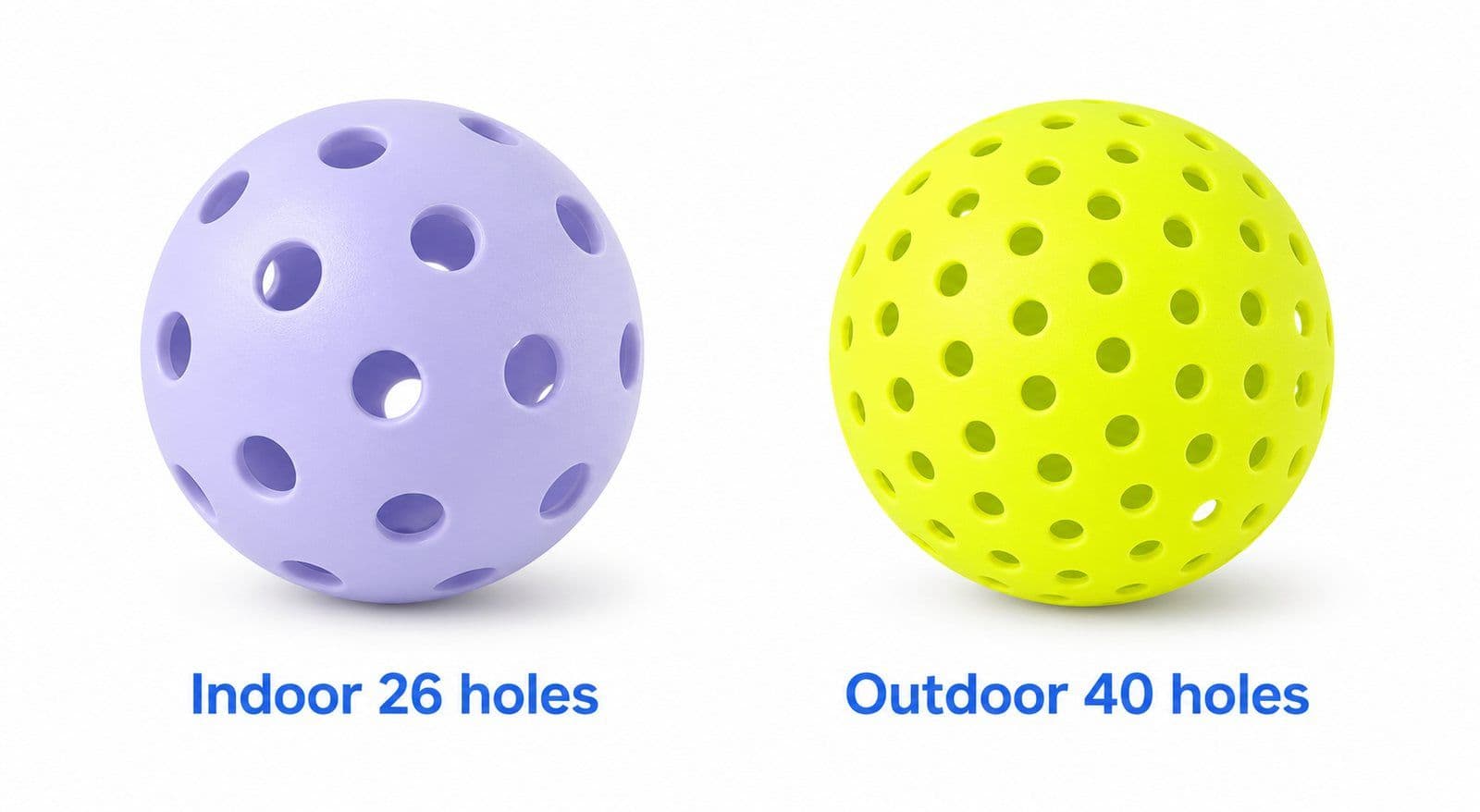
The ball used in pickleball is a hollow, one-piece or two-piece moulded polymer sphere with somewhere between 26 and 40 circular holes drilled or moulded through it, weighing under an ounce and roughly the size of a baseball. That is the whole answer, and it is worth noticing what it does not contain: a category. Ask most players and they will tell you there are two types, indoor and outdoor. Ask the rulebook and you get one ball, described by a set of tolerance ranges.
The gap between those two answers is where most of the confusion about pickleballs lives, and it is not trivial. USA Pickleball's own 2026 Rulebook says, in rule 3.C.1, that "All approved balls are acceptable for indoor or outdoor play." Meanwhile the organisation's approved ball register carried 379 distinct models from 255 manufacturers when we walked it on 18 August 2026 — and 70 of those entries are filed under a type code, I/O, that almost nobody writing about pickleball balls mentions at all.
Key takeaways
- One legal ball, not two. Rule 3.C.1 of the 2026 USA Pickleball Rulebook makes every approved ball legal indoors and outdoors. Indoor and outdoor are performance conventions, not rule categories.
- The legal envelope: 2.87–2.97 in diameter, 0.78–0.935 oz, 26–40 circular holes, bounce 30–34 in when dropped from 78 in.
- The hardness number everyone quotes is obsolete. USA Pickleball's Equipment Standards Manual marks the 40–50 Durometer D range "RECORDED FOR COROLLARY DATA ONLY, this is no longer a compliance requirement."
- The live gate is compression: under 43 LBF, tested to ASTM F1888-09 — a standard written for baseballs and softballs.
- The register uses three type codes, not two. Of 379 approved models: 236 Out, 70 I/O, 41 Ind — plus 32 carrying no type code at all.
- A Wiffle ball is not a pickleball. The rules require circular holes; Wiffle balls use oblong slots on one hemisphere to make the ball curve.
- Soft is worse than cracked. Under rule 10.G.2 a ball that goes soft mid-rally gets no replay — the result stands.
The short answer: one legal ball, two playing conventions
A pickleball is a rigid plastic sphere, hollow, perforated and smooth on the outside. It is not inflated, and it has no core, no cover and no stitching. Every ball legal for sanctioned play in the United States sits on a single published register, and every one was built to the same set of dimensional ranges.
Those ranges are wide enough to hold two quite different balls. A 26-hole ball and a 40-hole ball are both perfectly legal and they fly nothing alike. That is the origin of the indoor/outdoor split: not a regulation, but manufacturers building to opposite ends of one permitted range for two playing environments.
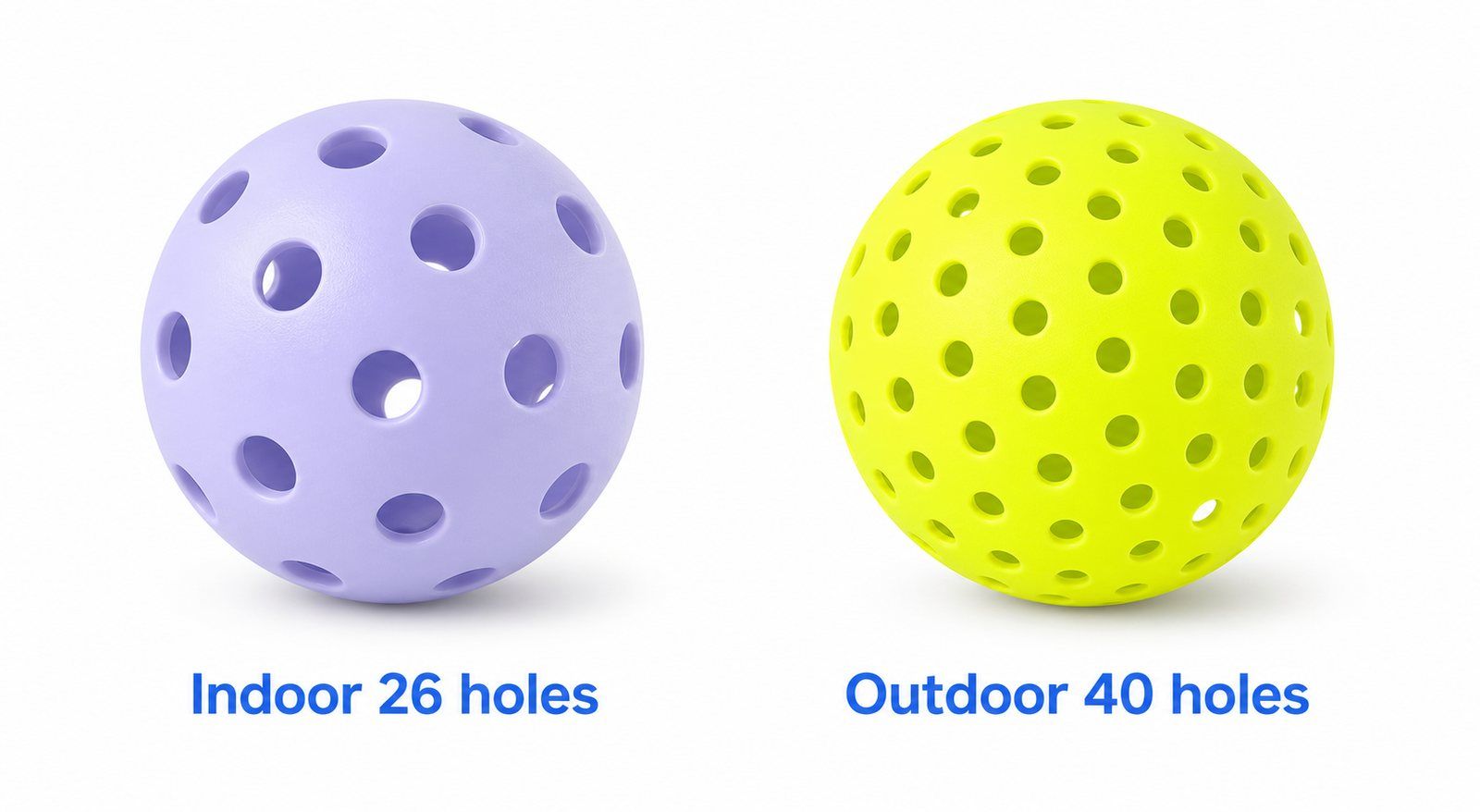
The 26-hole and 40-hole patterns sit at opposite ends of one legal range, not in two separate rule categories.
Why people say there are two types
Outdoor play has wind. A ball with more, smaller holes and a harder shell cuts through a crosswind more predictably and survives being scraped along concrete. Indoor play has no wind and a smoother floor, so a ball with fewer, larger holes and a softer wall gives longer rallies and more control. Both descriptions are accurate as engineering, and both are conventions rather than requirements. If you want the full head-to-head on how the two behave in play, our indoor vs outdoor pickleball ball comparison covers it spec by spec.
What it is not: the Wiffle ball question
The sport did start with a Wiffle ball in the mid-1960s before switching to the more durable Cosom Fun Ball, which is why the comparison persists sixty years later. But a Wiffle ball cannot be an approved pickleball, and the reason sits in the equipment rules rather than in quality.
Approved pickleballs need 26 to 40 circular holes distributed so the ball flies true. A Wiffle ball has eight elongated slots cut into one hemisphere only, and that asymmetry is the entire point — it makes the ball curve for a pitcher who cannot throw a curveball. One product is built for symmetry, the other for the opposite. They only look alike.
What the rulebook actually requires
The numbers live in USA Pickleball's Equipment Standards Manual rather than in the rulebook itself. This matters more in 2026 than it used to, because the current rulebook edition moved ball specifications from rule 2.D to rule 3.C and stripped the numeric values out of the rulebook body entirely — rule 3.C.2 now simply delegates design approval to the Equipment Standards Manual. If you find a page citing "Rule 2.D" for pickleball dimensions this year, it is quoting a superseded location, which is a reasonable first test of whether a source has actually opened the documents.
| Property | Requirement | Rule |
|---|---|---|
| Diameter | 2.87–2.97 in (7.29–7.54 cm) | ESM 2.D.3 |
| Out-of-round variance | max +/-0.020 in (0.51 mm) | ESM 2.D.3 |
| Weight | 0.78–0.935 oz (22.1–26.5 g) | ESM 2.D.4 |
| Bounce | 30–34 in, dropped from 78 in onto granite at 70°F ±5°F | ESM 2.D.5 |
| Compression | under 43 LBF average, per ASTM F1888-09 | ESM 2.D.6 |
| Holes | 26–40, circular, spaced for true flight | ESM 2.D.8 |
| Colour | one uniform colour; colours may vary | Rule 3.C.3 |
| Marking | manufacturer or supplier name or logo on the surface | Rule 3.C.4 |
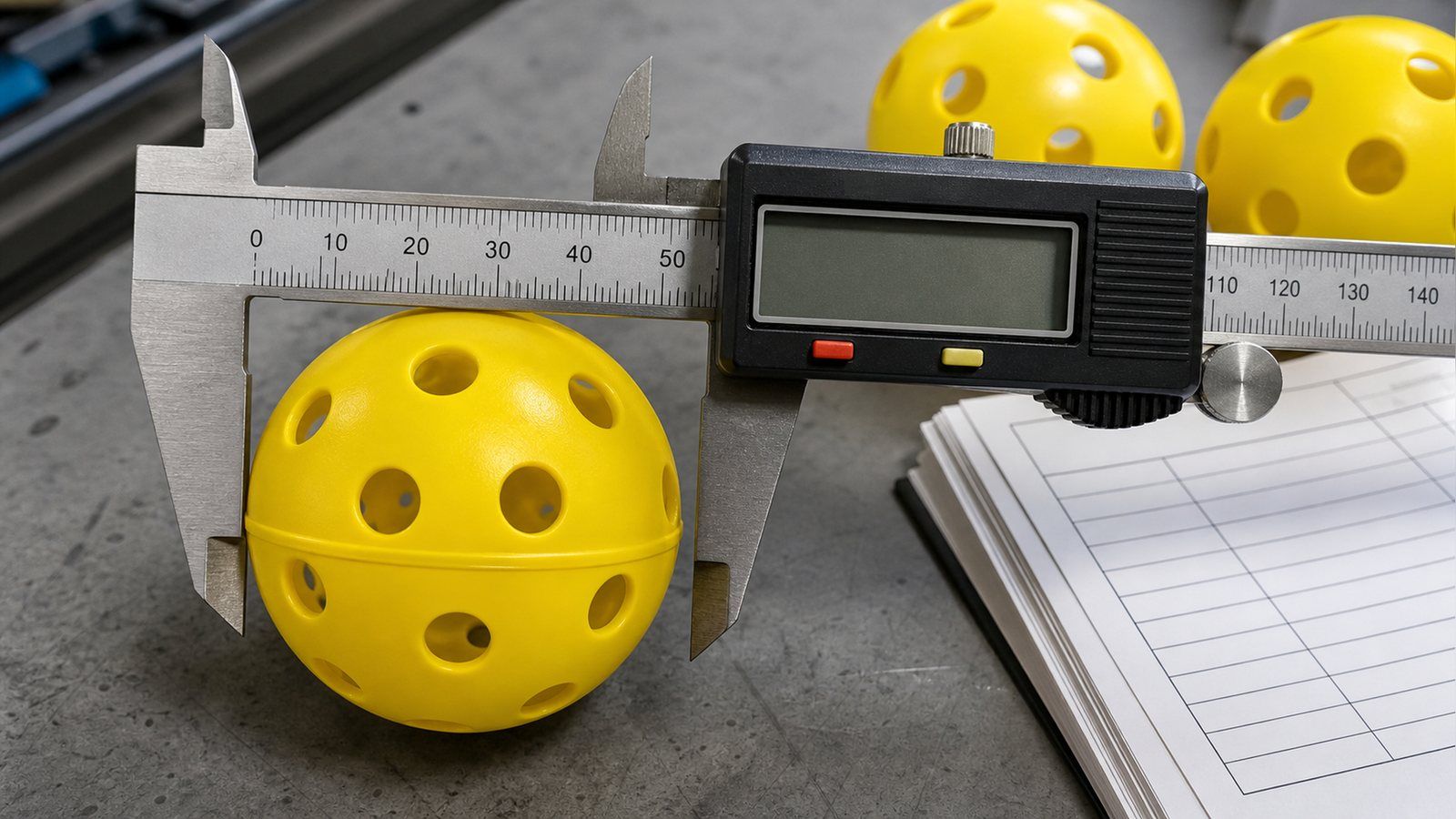
Roundness is measured as the difference between a ball's widest and narrowest diameters — which is why a gauge, not a ruler, decides it.
Why the bounce test specifies granite
The bounce requirement is not simply "30 to 34 inches." The manual specifies the drop height at 78 in, the surface as a granite plate at minimum 12 in by 12 in by 4 in, and the ambient temperature at 70°F plus or minus 5°F. Those conditions are the test.
Drop the same compliant ball on a gym floor, or on a cold morning, and you will read a number outside the range with nothing wrong with the ball. Anyone who has argued with a supplier about a bounce figure has usually been arguing about test conditions instead.
The spec everyone quotes that stopped being a requirement
One more piece of received wisdom is worth clearing up before you go looking at balls, because it changes what "the right ball" even means. Search for pickleball ball specifications and you will be told, more or less everywhere, that a legal ball measures 40 to 50 on the Durometer D scale. The number is real and it is in the manual. What almost nobody carries is the sentence wrapped around it. Rule 2.D.7 opens with a parenthesis in capital letters:
"Hardness. (RECORDED FOR COROLLARY DATA ONLY, this is no longer a compliance requirement). The ball shall have a hardness of 40 to 50 on a Durometer D scale at an ambient temperature of 70 degrees F plus or minus 5 degrees F."
Hardness is now data that gets written down, not a gate a ball has to pass. The gate immediately above it, in rule 2.D.6, is compression: a ball must yield an average compression result under 43 LBF. Each ball is tested twice, once with the load applied perpendicular to the seam and once parallel to it, or at two points roughly 90 degrees apart if the ball has no seam.
Pickleball borrows a baseball standard
The compression test runs to ASTM F1888-09, and it is worth knowing what that document is: the "Standard Test Method for Compression-Displacement of Baseballs and Softballs," reapproved in 2022. Pickleball has no compression standard of its own, so it uses the one written for a much older sport. That is not a criticism — borrowing a mature test method is sensible — but it explains why the equipment vocabulary around pickleball sometimes feels imported.
For a player, the practical upshot is simply that "harder" and "firmer" are not the spec words they used to be. If you are on the buying side and need the full envelope decoded tolerance by tolerance — including how the out-of-round figure is measured on a single ball rather than across a batch, and how to write these numbers onto a purchase order — that is a separate job, and our pickleball size, weight and spec tolerance guide does it properly.
Indoor, outdoor and the third category nobody mentions
Rule 3.C.1 is one sentence long and it settles the legality question completely: "Usage. All approved balls are acceptable for indoor or outdoor play." Nothing stops you taking an outdoor ball into a gym or an indoor ball onto a breezy court. The consequences are real, but they are all about play quality — nobody is going to rule your ball illegal for being in the wrong building. So if the rules do not recognise the categories, who does? The approved ball register itself, and with more nuance than the split usually gets credit for.
What is actually on the register
We walked USA Pickleball's published approved ball list in full on 18 August 2026, through all twenty result pages, and deduplicated it by manufacturer and model. The register returns 382 rows, of which three are duplicate entries for the same model, leaving 379 unique approved ball models from 255 manufacturers, the newest additions carrying a list date of 26 June 2026. Each entry carries a "Ball Type" code, and there are more than two of them in use:
- Out — 236 models. Roughly five-eighths of the register. Outdoor is the default assumption of the ball market.
- I/O — 70 models. Explicitly registered as indoor/outdoor. Nearly one entry in five, and a category the popular explanations of pickleball balls simply do not have.
- Ind — 41 models. Indoor-only balls are the smallest coded group, at around one in nine.
- No code — 32 models. Approved, listed, and carrying no type designation at all on the register.
Two things follow. Indoor-only balls are a minority product, so a venue stocking one ball for mixed use is on safer ground with an outdoor or I/O model. And the neat binary is not how the governing body's own list is organised: 102 of 379 entries are either dual-coded or uncoded. Any explanation presenting pickleball balls as strictly one thing or the other is describing a simplification of the register rather than the register.
What the hole pattern actually changes
Within the legal 26 to 40 range, hole count and hole diameter trade off against each other. More small holes let air pass with less deflection, so crosswind pushes the ball off line less and it carries faster and flatter. Fewer large holes catch more air, slowing the ball and softening its response — pleasant on a gym floor, unhelpful in a breeze. Neither is better; they are tuned for different air. The material behind those walls is a separate variable, covered in what pickleballs are made of.
How to tell which ball you are holding
A ball turns up in a club bin, or in a sample carton, and nobody knows what it is. Four checks, in this order, will identify it and tell you whether it is legal for sanctioned play. None of them needs equipment.
- Count the holes. Twenty-six large holes is the indoor convention; forty smaller ones is the outdoor convention. Anything outside 26–40, or holes that are not circular, means the ball is not approvable at all. This is the check that rules out a Wiffle ball in two seconds.
- Look for a seam. Run a fingernail around the equator. A faint ridge means two moulded hemispheres were bonded together; no ridge anywhere means the ball was cast in one piece. Both are legal — rule 3.C.5 permits a slight seam ridge provided it does not significantly affect flight.
- Read the marking. Rule 3.C.4 requires a manufacturer or supplier name or logo printed or embossed on the surface. An unmarked ball is not a legal ball, whatever else is right about it, and an unmarked ball in a sample carton is a supplier telling you something.
- Check the register. The name on the ball goes into USA Pickleball's published approved list. If the exact model is not there, it is not approved for sanctioned play — approval attaches to a specific model, not to a brand.
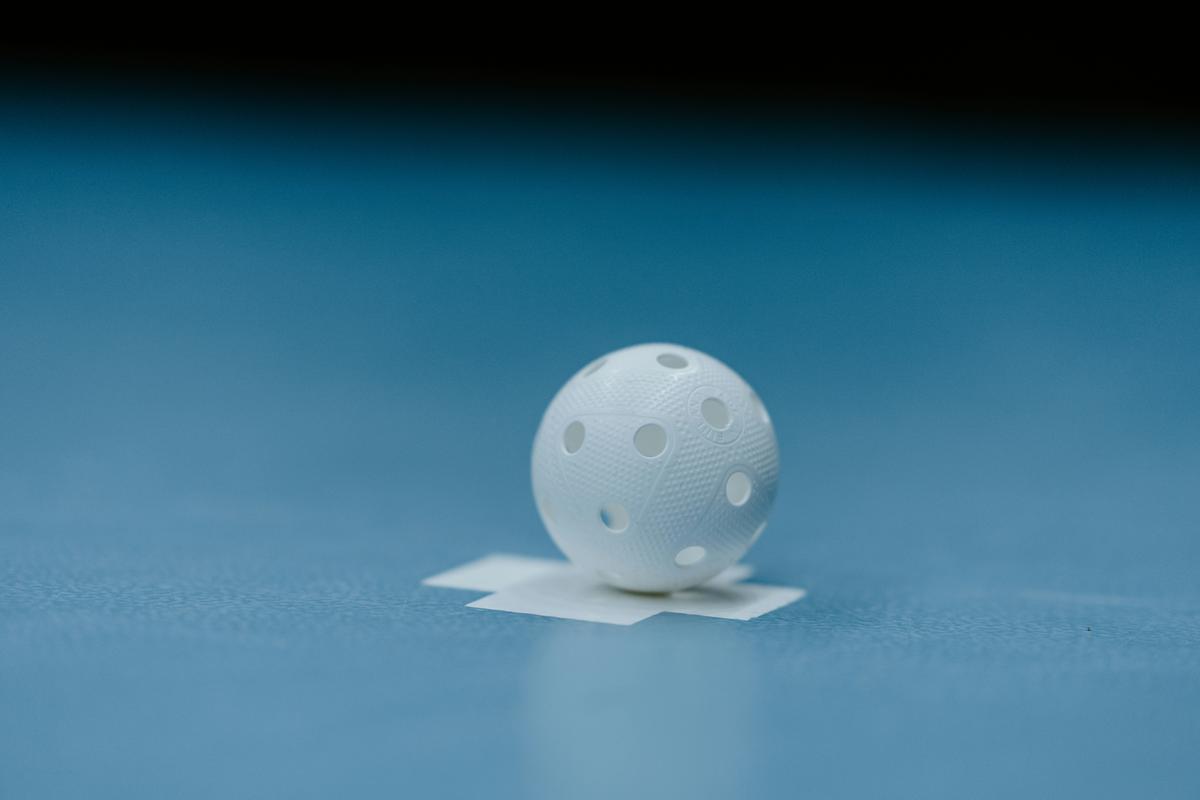
Hole count and the moulded manufacturer marking are the two checks that need no equipment.
That last point catches people out regularly. A manufacturer with six approved models can also sell a seventh that never went through testing, and nothing about the ball's appearance will tell you which one you have. The register is the only authority, and it is free to search. If you are checking balls at the carton level rather than one at a time, the inspection sequence in our wholesale ball QC guide covers bounce, roundness, seam and weight sampling.
Why two balls made the same way still behave differently
Two balls can both sit inside every published tolerance and still feel like different equipment. Part of that is the hole pattern. A larger part is how the ball was formed, and there are only two industrial answers to that question.
One piece or two
Rotational moulding casts the sphere as a single piece: resin goes into a mould that turns on two axes inside an oven, and the melt coats the cavity from the inside out. Injection moulding takes the other route — two hemispheres are moulded separately and then bonded, leaving a seam around the equator.
The equipment rules acknowledge both constructions directly. The compression procedure in rule 2.D.6 instructs the lab to load the ball perpendicular to the seam and then parallel to it, "if applicable," and specifies what to do "if there are no seams." The standard was written knowing both kinds of ball exist.
A seamless one-piece ball and a two-piece ball with a bonded equator — both legal constructions under rule 3.C.5.
The durability question is genuinely unsettled
Here we are going to decline to give you the confident answer you will find elsewhere. Published sources contradict each other flatly on whether seamless rotomoulded balls or two-piece injection-moulded balls last longer. Some argue the absence of a seam removes the obvious weak point; others argue injection moulding produces a more consistent wall and a tougher ball.
Both are mechanically plausible, and neither USA Pickleball nor any standards body publishes comparative durability data — because durability is not a compliance property and appears nowhere in the specification. Anyone stating the answer as settled fact is stating a preference. What can be said is that construction changes the failure mode: the seam is where a two-piece ball splits, if it splits at all.
What is not in dispute is that temperature moves the numbers. The bounce test is pinned to 70°F within 5 degrees precisely because the polymer stiffens as it cools; a ball that is compliant in a lab is a different ball on a cold court. That is a property of the plastic, not a defect. The manufacturing process behind pickleballs goes further into how each route is run.
When a ball stops being legal
Balls do not last. They crack, or they go soft and stop bouncing to spec, and the rulebook treats those two endings very differently. Rule 10.G says that when a ball becomes broken, cracked, soft or degraded, play continues to the end of the rally and the ball is replaced if all players agree.
What happens to the rally that just finished depends entirely on which failure it was. Under 10.G.1, if everyone agrees a broken or cracked ball affected the outcome, the rally is replayed. Under 10.G.2 — headed "No Replay – Soft or Degraded Ball" — when a ball is or becomes degraded or soft, the result of the prior rally stands.
Why softening is the expensive failure
A cracked ball is visible, obvious and recoverable — everyone can see it and the point can be replayed. A ball that has gone soft looks perfect and gets you no relief at all; you lose the point and you keep losing points until somebody notices the ball is dead. For a club running league nights, that is the failure mode worth managing, and it is the argument for rotating stock rather than playing a bucket until balls visibly break.
How long that takes is the one number in this article we cannot give you properly. Coaching and retail sources typically put outdoor balls somewhere between a few sessions and a few weeks of regular play, with indoor balls lasting considerably longer on a smooth floor — but no standards body publishes a service-life figure, because it depends on surface abrasion, temperature and how hard the group hits. Treat any precise lifespan claim as an estimate, including that one.
Sourcing questions this raises
Buying balls in quantity rather than in threes, the specification questions worth putting to a supplier follow directly from the rules above: which exact models hold USA Pickleball approval and certification on the published register, what compression result the batch tested at, how out-of-round was sampled, and whether the balls are one-piece or two-piece. Minimum order quantity, colour and print options and lead time sit alongside those. Our own factory ball MOQ is 1,000 pieces, and pricing is quoted against the size and colour mix of an order rather than published as one figure.
One distinction is worth keeping separate in your head. USA Pickleball approval is a sporting-equipment standard, not a market-access certification: it says a ball is legal for sanctioned play in the United States, and nothing more. Whatever product-safety regime applies where you intend to sell is assessed by different bodies against different criteria — our EU and UK import compliance guide covers that side, and the full commercial picture sits in our wholesale pickleball ball specs, MOQ and compliance guide.
Conclusion
The ball used in pickleball is a perforated plastic sphere built to one set of ranges — 2.87 to 2.97 inches, under 0.935 ounces, 26 to 40 circular holes — and the indoor/outdoor distinction everyone repeats is a manufacturing convention layered on top of that single legal definition, not a rule. Knowing which of the two you are dealing with matters for how the ball plays; knowing that both are legal everywhere saves an argument.
If you take one thing further, make it the compression figure rather than the hardness figure, because that is the one the standard still enforces. And if you are choosing balls for a venue or a catalogue rather than for a game, start from the approved register and work backwards to the supplier.
Frequently Asked Questions
What type of ball is used in pickleball?
A hollow moulded plastic ball, 2.87 to 2.97 inches in diameter, weighing 0.78 to 0.935 ounces, with 26 to 40 circular holes. Indoor and outdoor versions sit at opposite ends of that one legal range.
Can I use an outdoor pickleball indoors?
Yes. Rule 3.C.1 of the 2026 rulebook states that all approved balls are acceptable for indoor or outdoor play. It will feel faster and harder on a gym floor, but it is fully legal.
Is a pickleball the same as a Wiffle ball?
No. Approved pickleballs need 26 to 40 circular holes spaced for true flight. A Wiffle ball has eight oblong slots on one hemisphere, designed to make the ball curve, so it can never be approved.
How hard should a pickleball be?
Hardness of 40 to 50 Durometer D is recorded but is explicitly no longer a compliance requirement. The enforced test is compression: under 43 LBF average, measured to ASTM F1888-09.
How many pickleballs are USA Pickleball approved?
The published register held 379 unique models from 255 manufacturers when we counted it on 18 August 2026: 236 outdoor, 70 indoor/outdoor, 41 indoor and 32 carrying no type code.
What colour must a pickleball be?
Any single colour. Rule 3.C.3 requires only that the ball be one uniform colour apart from identification markings, and states that colours may vary. Neon yellow is a visibility convention, not a rule.
What happens if a ball cracks during a rally?
Play continues to the end of the rally. If all players agree a cracked ball affected the outcome, the rally is replayed. A ball that merely goes soft gets no replay under rule 10.G.2.
Want to source this quality for your brand?
Contact our factory directly on WhatsApp for an instant MOQ and pricing quote.