Parts of a Pickleball Paddle: Factory vs Retail Names (Buyer's Glossary)
Most guides to the parts of a pickleball paddle are written for someone deciding what to buy. This one is written for someone deciding what to order — and those are different jobs with different vocabularies.
Here is the problem nobody warns a first-time private-label buyer about. You write a brief using the words you learned from retail product pages. Your factory reads it using the words printed on its own process sheets. Both of you believe you are describing the same object. You find out you were not when the golden sample arrives with a grip you did not ask for, or a quotation prices a "thicker paddle" as a thicker core when you meant a thicker face.
The naming gap is not a translation problem. It is a domain problem, and it survives translation intact: an English-speaking sourcing agent makes the same mistakes. What follows maps every major component across the three vocabularies that meet on a purchase order — what retail calls it, what a factory and a spec sheet call it, and what the Chinese shop floor calls it (given in pinyin, with the literal meaning) — and flags which parts carry a rule from USA Pickleball's standards, because several of the parts most buyers treat as trim are regulated dimensions.
Key takeaways
- The edge guard and the butt cap are not trim. USA Pickleball's size clause counts both inside the 24-inch combined length-and-width limit (ESM 2.E.3), so a thicker edge guard consumes paddle face.
- The edge guard also carries a gloss ceiling — 80 GU at a 60-degree measurement angle (ESM 2.E.2.b) — which makes its colour and finish a spec line, not a styling choice.
- "Core thickness" and "paddle thickness" are different numbers, and cell size is a third, independent line. Commercial PP honeycomb ships in 6, 8, 10, 12 and 16 mm cell sizes at a ±0.5 mm thickness tolerance.
- On a thermoformed unibody build the handle stops being a separately bonded part, so the part list on your spec sheet changes with the construction method.
- Changing core material or face material forces a new model designation under ESM 2.E.7 — a substituted part is a certification event, not a running change.
On this page: The three vocabularies · The naming matrix · Face, core and the bond · Edge guard, edge tape and foam · The handle assembly · Four terms that diverge · Which parts carry a rule · Turning the vocabulary into a brief · The trade-off · FAQ
The Three Vocabularies of a Pickleball Paddle
A paddle has one anatomy and three naming systems layered over it, and each system was built for a different purpose.
Retail vocabulary exists to sell a feeling. It groups parts by what a player notices: the face, the core, the grip, the edge. It is deliberately coarse, because a shopper does not need to distinguish the moulded handle core from the wrap around it.
Factory and spec-sheet vocabulary exists to route material through a process. It splits parts by who makes them and at which station, which is why it separates things retail merges and merges things retail separates. A face is a "facesheet" because it arrives as a cut ply. A grip is two purchasing lines because the replacement grip and the overgrip come from different suppliers at different MOQs.
Chinese shop-floor vocabulary is what actually gets spoken when your order is running, and it is given below in pinyin. It matters even if every email you send is in English, because the person reading your drawing at the press is not reading your email.
The cost of the gap is measured in sample rounds. A brief that says "add a thicker edge" reads to a production engineer as a thicker extruded profile — more perimeter material, less face inside the same legal envelope. If what you meant was more perimeter foam inside the shell, you have described a different part in a different location, and you will not discover it until you are holding the sample.
Paddle Part Names: Retail Term, Factory Term, Chinese Term (Pinyin)
This is the table to paste into your own brief. The factory column is the wording that will not be misread on a spec sheet; the Chinese column gives the shop-floor term in pinyin with its literal meaning, so you can recognise it when it is said to you rather than dictate it back.
| Retail term | Factory / spec-sheet term | Chinese term (pinyin) | Rule attached? |
|---|---|---|---|
| Paddle face / hitting surface | Facesheet, face ply, surface material | mian cai ("face material") / mian ban cai zhi | Yes — roughness and friction |
| Core | Core, honeycomb core, core thickness + cell size | xin cai or nei xin ("core"); PP feng wo nei xin ("PP honeycomb core") | Indirect — material change forces new model |
| (not named at retail) | Bond line, adhesive film, lamination | jiao ceng ("adhesive layer") / re rong jiao mo ("hot-melt film") | Indirect — delamination is a failed surface |
| Perimeter foam / foam walls | Injected perimeter foam, foam wall | bian yuan fa pao ("edge foaming") / zhu ru pao mian ("injected foam") | Yes — trampoline clause |
| Edge guard | Edge guard, edge profile, bumper | hu bian ("edge protection") / TPU fang zhuang bian tiao | Yes — counts in size, and gloss |
| Edge tape | Edge guard tape (aftermarket, separate part) | hu bian jiao dai ("edge-protection tape") | Yes — named permitted alteration |
| Throat | Throat / transition (usually a moulded feature, not a part) | pai hou ("paddle throat") / guo du qu ("transition zone") | No |
| Handle | Handle core / handle assembly (absent on unibody) | shou bing ("handle") / bing xin ("handle core") | Indirect — artwork datum |
| End cap / butt cap | Butt cap, end cap | wei gai ("end cap"); pai wei = the butt of the handle | Yes — counts in size limit |
| Grip | Replacement grip (factory-fitted) | wo ba ("grip") / PU long gu fang hua xi han dai | Yes — artwork datum, permitted alteration |
| Grip / overgrip (same word) | Overgrip (separate SKU, separate supplier) | wai ceng wo ba bu ("outer grip cloth") / shou jiao | Yes — named permitted alteration |
Two cautions on the Chinese column. Usage genuinely varies by factory and by region — Hong Kong and Taiwan sourcing material tends to use nei xin and bian yuan fang hu tiao where mainland material uses xin cai and hu bian, and both are understood. And a term being common in sourcing material is not the same as it being the word on your supplier's process sheet. Use the column to recognise what you are being shown; confirm the wording once with your own factory and then freeze it.
The Hitting Surface: Face, Core and the Bond Between Them
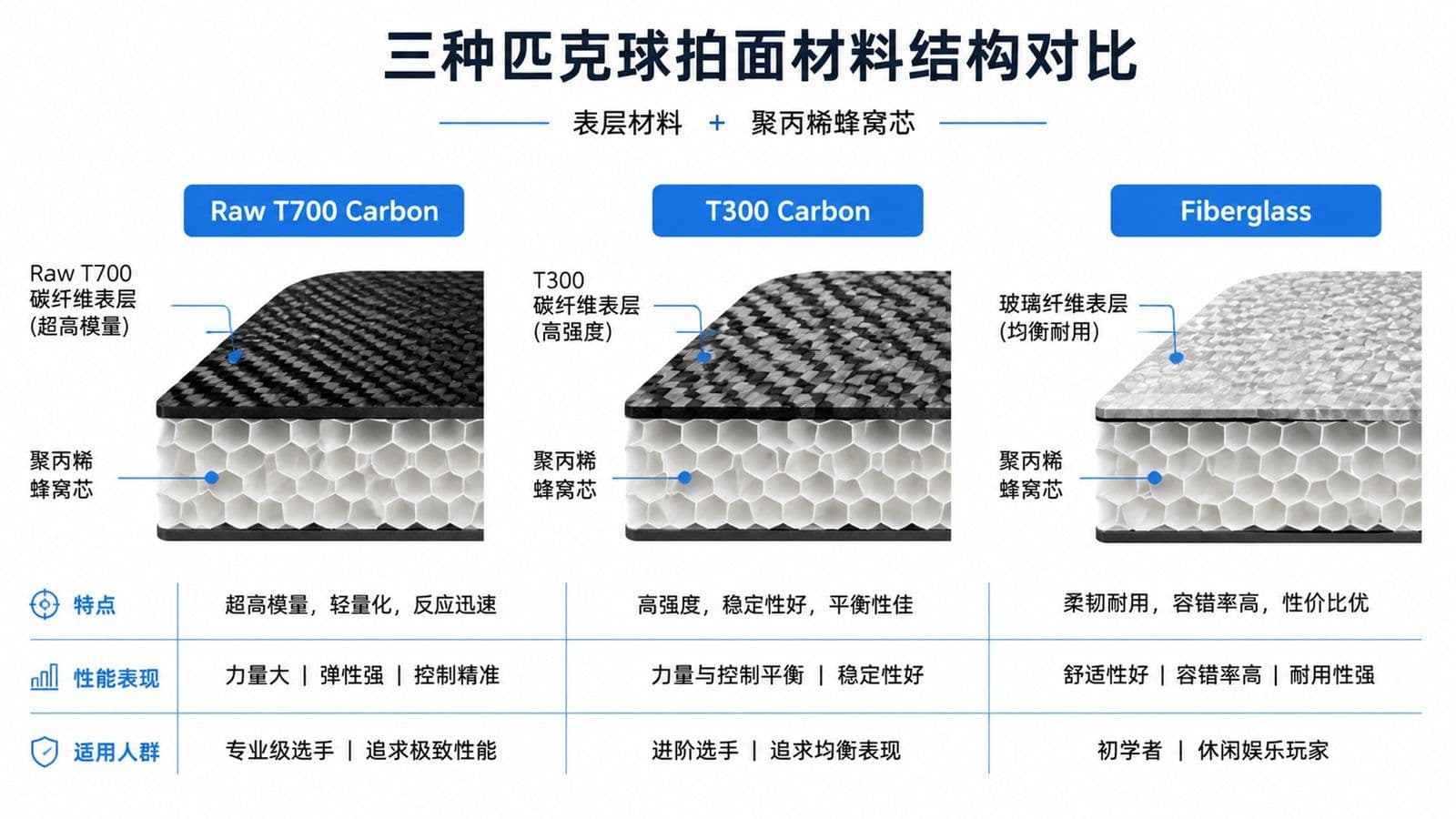
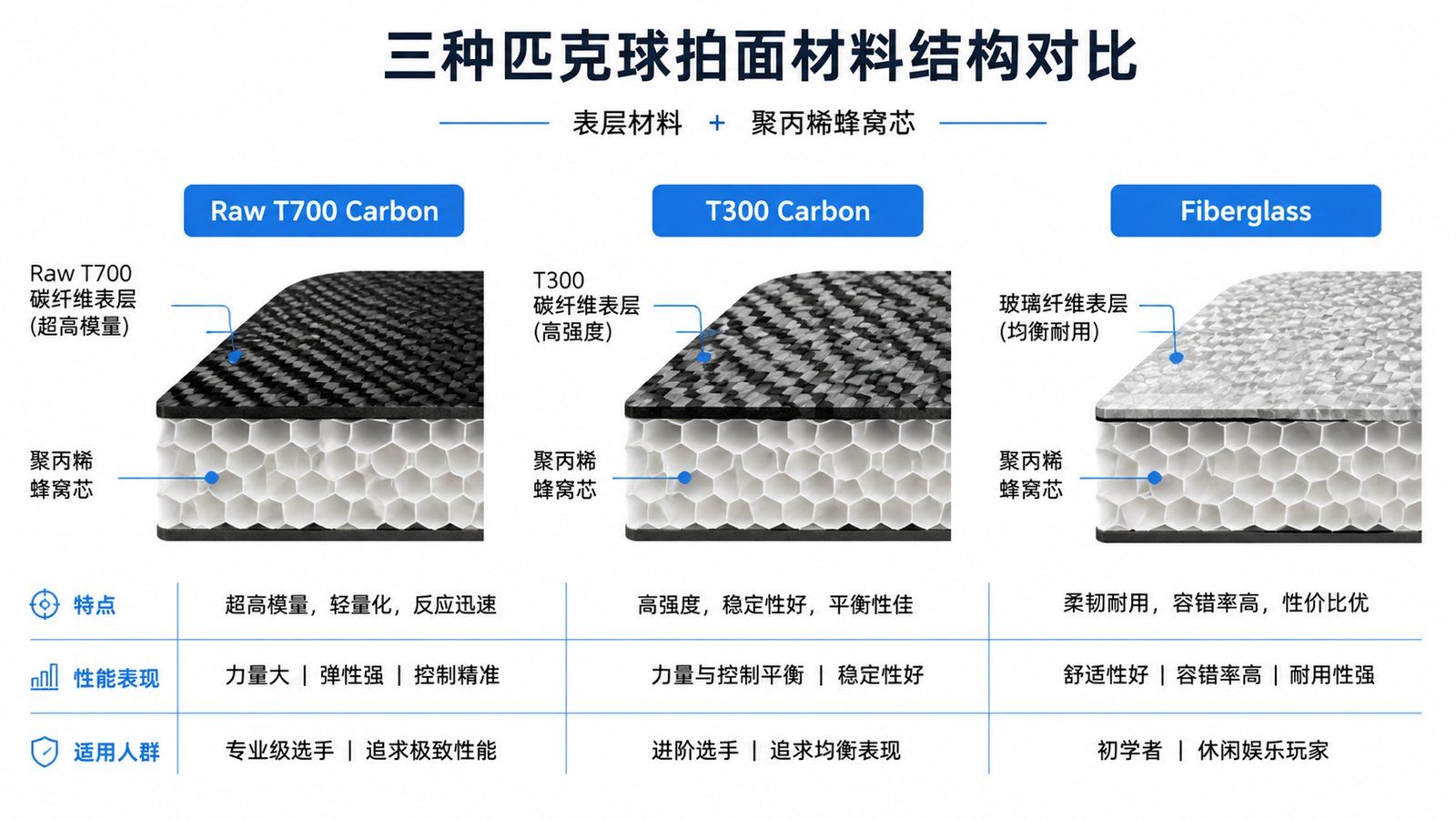
Retail treats the hitting surface as one thing. Manufacturing treats it as three purchased items and one process, and each carries its own spec line.
The facesheet, and the two tests it must survive
The face is where texture lives, and texture is the most heavily instrumented property on the whole paddle. USA Pickleball measures it two independent ways, which is the detail most buyers miss when they ask a factory for "more grit".
The first is a surface roughness reading taken with a Starrett SR160 or SR300 tester or equivalent: the average must not exceed 30 micrometres on Rz and 40 micrometres on Rt, with readings taken in six different directions on each face, and no single reading above 33 µm Rz or 44 µm Rt (ESM 2.E.2.a.1). The second is a separate kinetic coefficient-of-friction test to ASTM D1894-14 protocol, with a ceiling of 0.1875 (ESM 2.E.2.a.2). A surface can sit comfortably inside the roughness average and still fail on friction, or fail on one directional outlier while the average looks healthy.
The practical consequence for a brief: "add texture until it grips" is not a specifiable instruction. A texture target belongs on the spec sheet as a measured value against a named test, which is also how you make it inspectable at pre-shipment rather than arguable after landing. The surface grit and spin breakdown covers how those finishes are actually produced.
The core is two numbers, not one
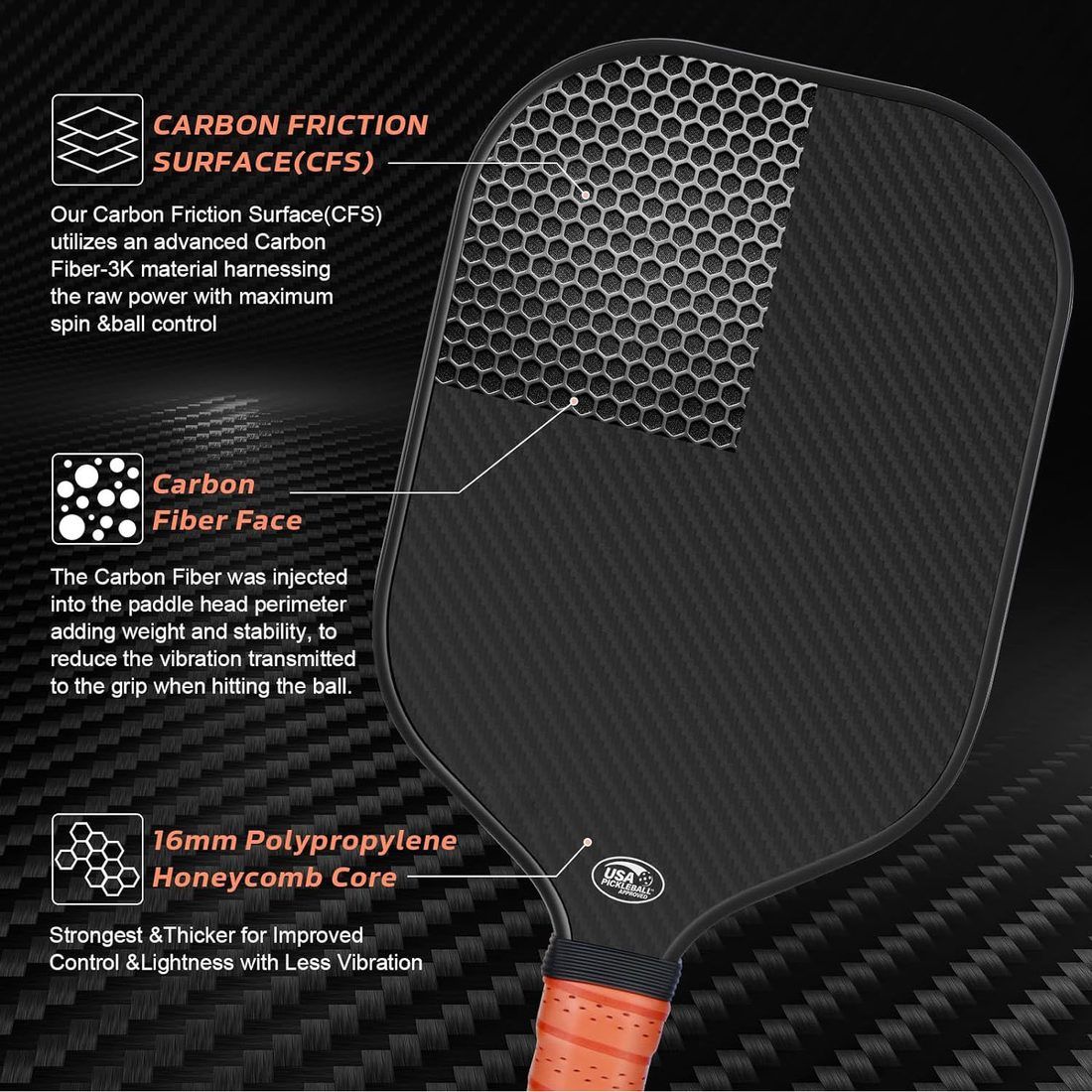
This is the single most common under-specification on a first spec sheet. "16 mm core" names the thickness and says nothing about cell size, and cell size changes the mechanical behaviour of nominally identical core.
Published supplier data makes the difference concrete. Plascore's PP1-5.0-N1-8 grade, at an 8 mm cell, runs a typical density of 80.0 kg/m³ with a bare compression strength of 275 psi (1.89 MPa). The PP1-4.0-N1-10 grade at a 10 mm cell runs 64.0 kg/m³ and 180 psi (1.24 MPa). Same material family, same nominal role, roughly a third less compression strength. Commercial PP honeycomb is supplied across 6, 8, 10, 12 and 16 mm cell sizes and from 5 mm to 500 mm thick at a ±0.5 mm thickness tolerance, so both numbers are quotable supplier lines with real tolerances attached — not adjectives.
Write both. A spec sheet that says "16 mm PP honeycomb, 8 mm cell" is a specification; one that says "16 mm polymer core" is a preference. Our own OEM build envelope runs 13 mm and 16 mm polypropylene honeycomb under raw T700 carbon or fiberglass faces, and the cell size guide covers how the two interact.
The bond line is a part you cannot see
Between facesheet and core sits an adhesive layer that appears on no retail page and on every process sheet. It has no name in retail vocabulary because it is invisible until it fails — at which point the failure has a very visible name, delamination, and a regulatory consequence: a delaminated face is a prohibited surface condition, and compressible material creating a trampoline effect falls under ESM 2.E.6.f and its restitution testing.
The Perimeter: Edge Guard, Edge Tape and Injected Foam
Three different parts, in three different physical locations, that buyers routinely collapse into "the edge". Getting these separate is worth more than any other single fix to a first brief.
The edge guard is a regulated dimension
Here is the fact that reframes the whole component. USA Pickleball's size clause reads: "The combined length and width, including any edge guard and butt cap, shall not exceed 24 inches (60.96 cm). The paddle length cannot exceed 17 inches (43.18 cm)" (ESM 2.E.3). The edge guard is inside the measured envelope. Every millimetre of profile you add around the perimeter is a millimetre of playing surface you gave up, or a millimetre closer to being out of spec.
It is regulated a second way that almost nobody specifies. The reflection clause caps gloss at 80 GU measured at a 60-degree angle, and it applies to "Paddles & Edge Guards" explicitly (ESM 2.E.2.b). A high-gloss edge guard in a brand colour is a compliance question, not only an aesthetic one.
And it is a bonded part with a temperature-dependent adhesive, which is why the bond gets specified by number rather than adjective. Our published spec rates the edge guard adhesive for 45°C sustained outdoor use and states it was tested for 6+ months of outdoor use — the kind of line worth asking any supplier to put in writing, because "strong glue" is not inspectable.
Edge tape is a different part with a different owner
Edge tape is aftermarket. It is applied by the player, not the factory, and the standard names it as a permitted alteration: edge guard tape and replacements sit on the short list of removable parts a certified paddle may have, alongside weighted tape, OEM integrated weight-system weights, grip-size inserts, grip wraps, OEM interchangeable grips and OEM replacement faces (ESM 2.E.5.a and 2.E.6.e).
If your brief says "edge tape in brand colours" your factory may quote a printed aftermarket tape SKU, an edge guard in a custom colour, or both. They are different tools, different MOQs and different unit costs.
Perimeter foam is inside the shell
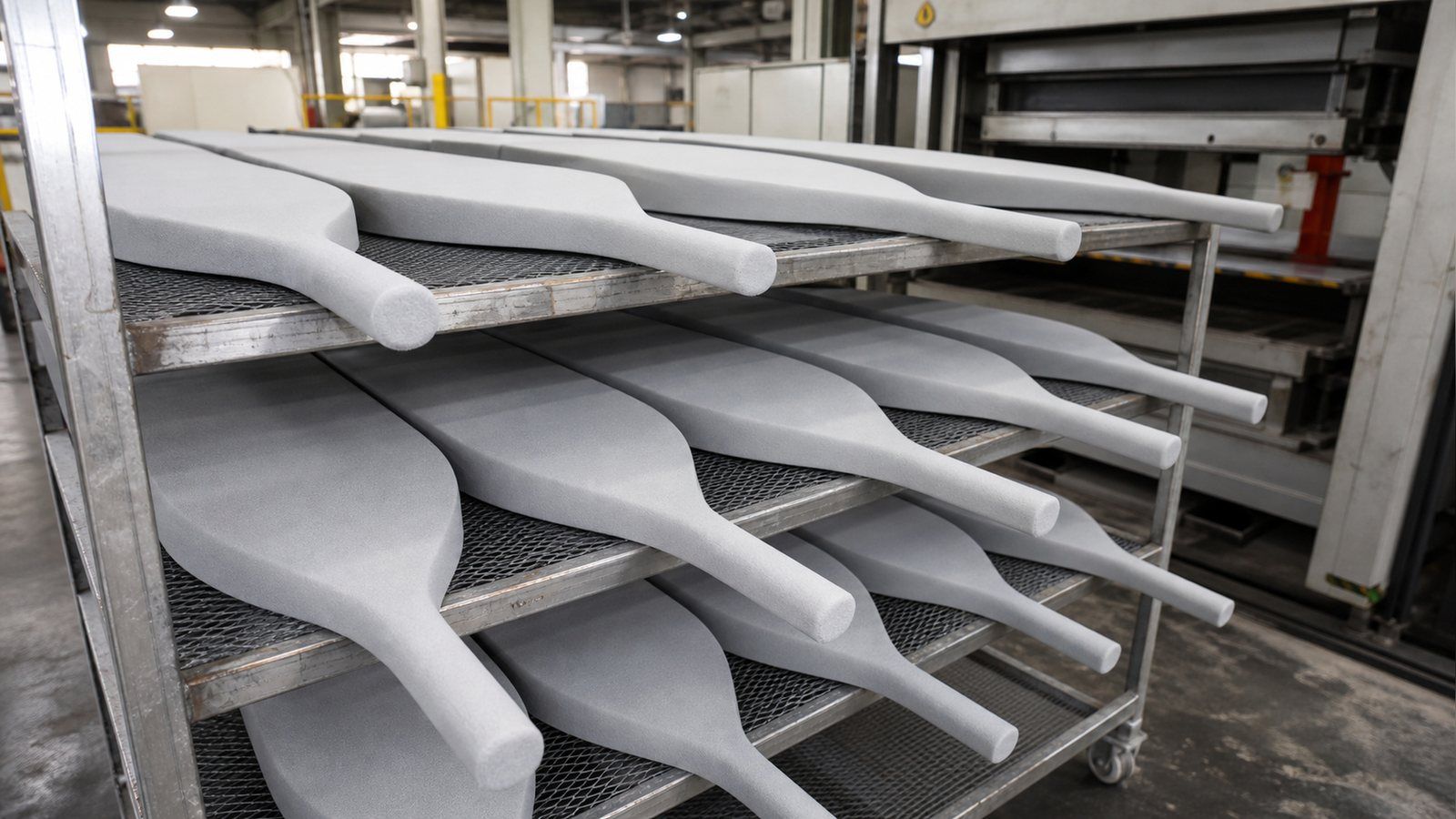
On thermoformed unibody builds, high-density foam is injected around the inside of the perimeter and, on many designs, down through the handle — described by the factories building them as foam walls integrated into a single sealed structure rather than a component added to the outside. It is not the edge guard, it is not visible, and it changes what the paddle does under the restitution test rather than what it looks like.
Be careful what you promise about it. Every published claim about perimeter foam expanding the sweet spot comes from supplier marketing, and no independent number supports a specific figure. What is documented is the regulatory hook: compressible material that creates a trampoline effect is subject to coefficient-of-restitution testing under ESM 2.E.6.f, and the PBCoR not-to-exceed limit dropped from 0.44 to 0.43 effective 1 November 2025. A foam change is a power change, and a power change can move a paddle across a certification line. The foam-wall construction guide covers the build in detail.
The Handle Assembly: Throat, Handle Core, Butt Cap and Grip
The handle is where the retail part list and the factory part list diverge most sharply, because on one common construction method half of these parts stop existing as parts.
The throat is a feature, not a component
Retail describes the throat as the section connecting face to handle, which is accurate as geometry and misleading as manufacturing. On most builds nobody manufactures a throat. It is the moulded transition where the paddle body narrows, formed in the same operation as everything around it. Asking a factory to "reinforce the throat" is asking for a change to the moulding, the layup or the foam distribution in that region — not for a stronger part.
What unibody construction does to this list
On a cold-pressed build the handle is a separate core that gets bonded to the body, and it behaves like a component: it has its own material, its own bond line and its own failure mode. On a thermoformed unibody build the body and handle are formed as one sealed structure, with the foam running down through the handle. The handle is no longer a bonded part; it is a region of one part.
This is why a spec sheet cannot be written independently of construction method. We quote both routes — thermoformed unibody and cold-pressed — and the part list, the failure modes and the inspection points differ between them. The thermoformed versus cold-pressed comparison covers which one suits which programme.
The butt cap carries your marking obligation
The butt cap closes the end of the handle. Two things make it more than a finishing part. It counts inside the 24-inch combined dimension along with the edge guard (ESM 2.E.3). And a paddle intended for sanctioned play must carry a clearly marked brand and model name or number plus the USA Pickleball Approved seal or text treatment (Rule 3.D.1) — the rule requires the mark on the paddle and does not dictate where, but the butt cap is where the industry commonly puts it. If your artwork plan does not say who applies that mark and at which station, it is an open question on your order.
Grip and overgrip are two purchase orders
Retail uses one word. Manufacturing uses two, because they are different products from different suppliers fitted at different points. The replacement grip is factory-fitted and wraps the handle core. The overgrip goes over it, is usually a separate SKU with its own MOQ, and is frequently not included in a paddle quotation at all unless you asked.
Both are named permitted alterations under the standard — grip-size inserts, grip wraps and OEM interchangeable grips all appear on the removable-parts list (ESM 2.E.6.e) — so a buyer supplying overgrips separately is on solid regulatory ground. The grip manufacturing guide covers the MOQ structures on each side.
Four Terms That Mean Different Things to You and to Your Factory
These four cause more sample-round losses than every other naming issue combined, because in each case both parties have a confident, coherent and different reading.
1. "Grip"
You mean the surface your hand touches. Your factory hears the factory-fitted replacement grip, quoted per paddle as part of the build. If you were budgeting for the overgrip your brand ships in the box, that line is missing from the quotation. Say which: "factory-fitted replacement grip" or "overgrip, supplied separately".
2. "Edge"
You may mean the visible edge guard, the aftermarket edge tape, or the injected perimeter foam. Three parts, three locations, three price behaviours — and only one of them is on the outside. Say which: name the part, not the region.
3. "Thickness"
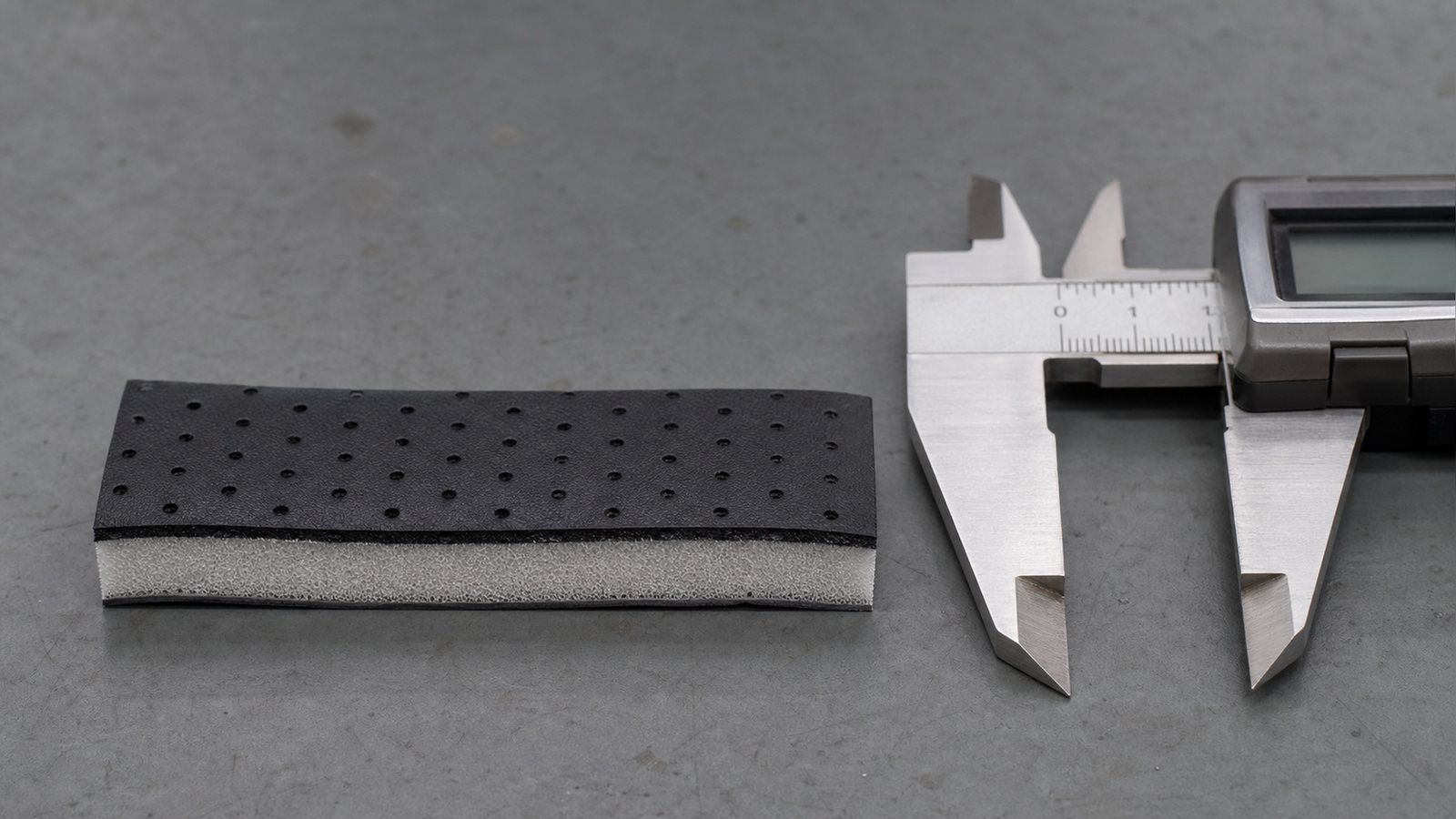
You almost certainly mean core thickness, because that is the number retail prints. A production engineer reading "paddle thickness" may reasonably measure the finished assembly including both facesheets. And neither number tells anyone your cell size. Say which: "core thickness 16 mm, cell size 8 mm, finished thickness to be confirmed on the golden sample."
4. "Handle"
On a cold-pressed build this is a real bonded component. On a thermoformed unibody build it is a region of a single moulded structure with no bond line to specify. The same word describes a part in one process and a zone in another. Say which: state the construction method first, then the handle spec — never the reverse.
For private-label brand launchers and importers handling their own procurement, who now know what to call each part and want to see how a factory quotes them. Our OEM page lists the build envelope we actually run — raw T700 carbon and fiberglass faces, 13 mm and 16 mm polypropylene honeycomb cores, thermoformed unibody or cold-pressed construction, with custom surface texture, edge guard and grip. If you are still comparing constructions rather than ordering, read the pages above first; this is a reference, not a sales pitch.
See the build envelope
Which Parts Carry a Rule, and Which Are Free
Buyers tend to assume the rules live on the face, because that is where texture controversies happen. In practice the standard reaches four components, and two of them are the ones most often treated as decoration.
| Part | What the standard constrains | Clause |
|---|---|---|
| Face | Rz ≤ 30 µm / Rt ≤ 40 µm average, six directions; single points ≤ 33 / 44 µm | 2.E.2.a.1 |
| Face | Kinetic coefficient of friction ≤ 0.1875, ASTM D1894-14 protocol | 2.E.2.a.2 |
| Face + edge guard | Gloss ≤ 80 GU at 60-degree measurement angle | 2.E.2.b |
| Edge guard + butt cap | Included in 24 in (60.96 cm) combined length + width; 17 in (43.18 cm) max length | 2.E.3 |
| Grip + edge guard | Artwork datums: decals ≤ 1.0 in above grip top, ≤ 0.5 in inside the edge guard | 2.E.5.b |
| Perimeter foam / any compressible fill | Trampoline-effect clause; restitution testing, PBCoR ≤ 0.43 since 1 Nov 2025 | 2.E.6.f |
| Core + face material | A change of either forces a unique model name or number | 2.E.7 |
| Throat, handle core, bond line | No dimensional or material rule of their own | — |
Two takeaways a buyer can act on immediately. First, there is no restriction on paddle thickness and no restriction on paddle weight in the standard — those are entirely your commercial decision, which is why weight belongs on your spec sheet as a tolerance you set rather than a limit you inherit. Our own published tolerance is ±3 g per unit against a stated industry-typical ±8–10 g, with the weight printed on the paddle; whatever number you pick, pick one, because "standard weight" is not inspectable.
Second, ESM 2.E.7 makes part substitution a certification event: paddles with different core material, surface material or other significant differences must carry a unique name or number. If a supplier proposes swapping a core grade mid-programme on an approved model, that is not a running change — it is a different model. Worth reading alongside the PBCoR standard explainer before you sign off any material substitution.
Watch the process
Seeing the parts arrive at their stations makes the vocabulary stick faster than a table does — particularly the moment the core, facesheets and edge profile become one assembly.
Video: "Inside the Factory Where Pickleball Paddles Are Made" by the Hidden Origins channel — an independent documentary source, included because it shows the assembly sequence rather than selling a paddle brand.
Turning the Vocabulary Into a Brief
Knowing the names is the input, not the output. The output is a document your factory can quote line by line without interpreting anything.
The shape that works: name the construction method first, because it decides which parts exist; then specify the parts that exist on that construction, each with a number and a tolerance rather than an adjective; then state which parts you are supplying and which the factory is supplying, because grip and overgrip are the classic split; then name the parts you are deliberately leaving to the factory's standard, so nobody guesses.
A worked example of the four terms above, written the way it should reach a quotation desk: "Thermoformed unibody. Core: 16 mm PP honeycomb, 8 mm cell. Face: raw T700 carbon. Perimeter foam: factory standard for this construction — confirm density on the golden sample. Edge guard: factory standard profile, matte finish, brand colour to be matched, must remain inside 24 in combined. Grip: factory-fitted replacement grip, perforated PU. Overgrip: not required, we supply. Weight: 226 g ±3 g. Butt cap: brand and model mark, artwork to follow." Every line in that block names one part, in the factory's vocabulary, with a number or an explicit deferral.
Your next step is the document itself. The paddle spec sheet template lays out the full row set, including the lines this glossary shows you how to name, and the weight tolerance guide covers how to set the one number the standard leaves entirely to you.
The Trade-Off Worth Remembering
There is a real tension in how precisely to write a first brief, and it is not resolved by specifying everything.
Over-specify and you buy rigidity: a spec sheet that dictates a bond adhesive and a foam density locks a factory out of the process it runs best, and you pay for the deviation in tooling time and unit cost. Under-specify and you buy ambiguity, which is cheaper to write and vastly more expensive to discover — every open term becomes a decision someone else makes on your behalf, and you meet it in a sample round or, worse, in a container.
The productive middle is not about the number of lines. It is about which lines you write. Specify tightly where a term is ambiguous or a rule applies — the four divergent terms above, the four regulated components, the two numbers that define a core. Leave genuinely to standard the things where your supplier's default is the product of more paddles than you will ever order, and say explicitly that you are doing so.
The parts of a pickleball paddle are not hard to learn. What is hard, and what actually costs money, is discovering that the word you used meant something else at the other end of the order.
Frequently Asked Questions
What are the main parts of a pickleball paddle?
The face, the core, the bond line between them, the edge guard, the perimeter foam on some builds, the throat, the handle core, the butt cap and the grip. Retail typically names seven; a factory spec sheet distinguishes ten or more because it separates parts by supplier and station.
Does the edge guard count towards the legal paddle size?
Yes. ESM 2.E.3 states the combined length and width, including any edge guard and butt cap, shall not exceed 24 inches (60.96 cm), with paddle length capped at 17 inches (43.18 cm). Perimeter profile consumes playing surface.
What is the difference between a grip and an overgrip?
The replacement grip is factory-fitted and wraps the handle core. The overgrip goes over it, is a separate SKU from a different supplier with its own MOQ, and is usually excluded from a paddle quotation unless requested explicitly.
Is the throat a separate part of a pickleball paddle?
On most builds, no. The throat is the moulded transition where the body narrows toward the handle, formed in the same operation as the surrounding structure rather than manufactured separately and bonded on.
What is perimeter foam in a pickleball paddle?
High-density foam injected around the inside of the perimeter, and often down through the handle, on thermoformed unibody builds. It sits inside the shell, not on the outside, and falls under the trampoline-effect clause at ESM 2.E.6.f.
Does changing the core material affect paddle certification?
Yes. ESM 2.E.7 requires paddles with different core material, surface material or other significant differences to carry a unique name or number, so a material substitution on an approved model creates a different model rather than a running change.
Want to source this quality for your brand?
Contact our factory directly on WhatsApp for an instant MOQ and pricing quote.