Sourcing a Franklin X-40 Equivalent: How to Private-Label a Tournament-Grade Outdoor Pickleball
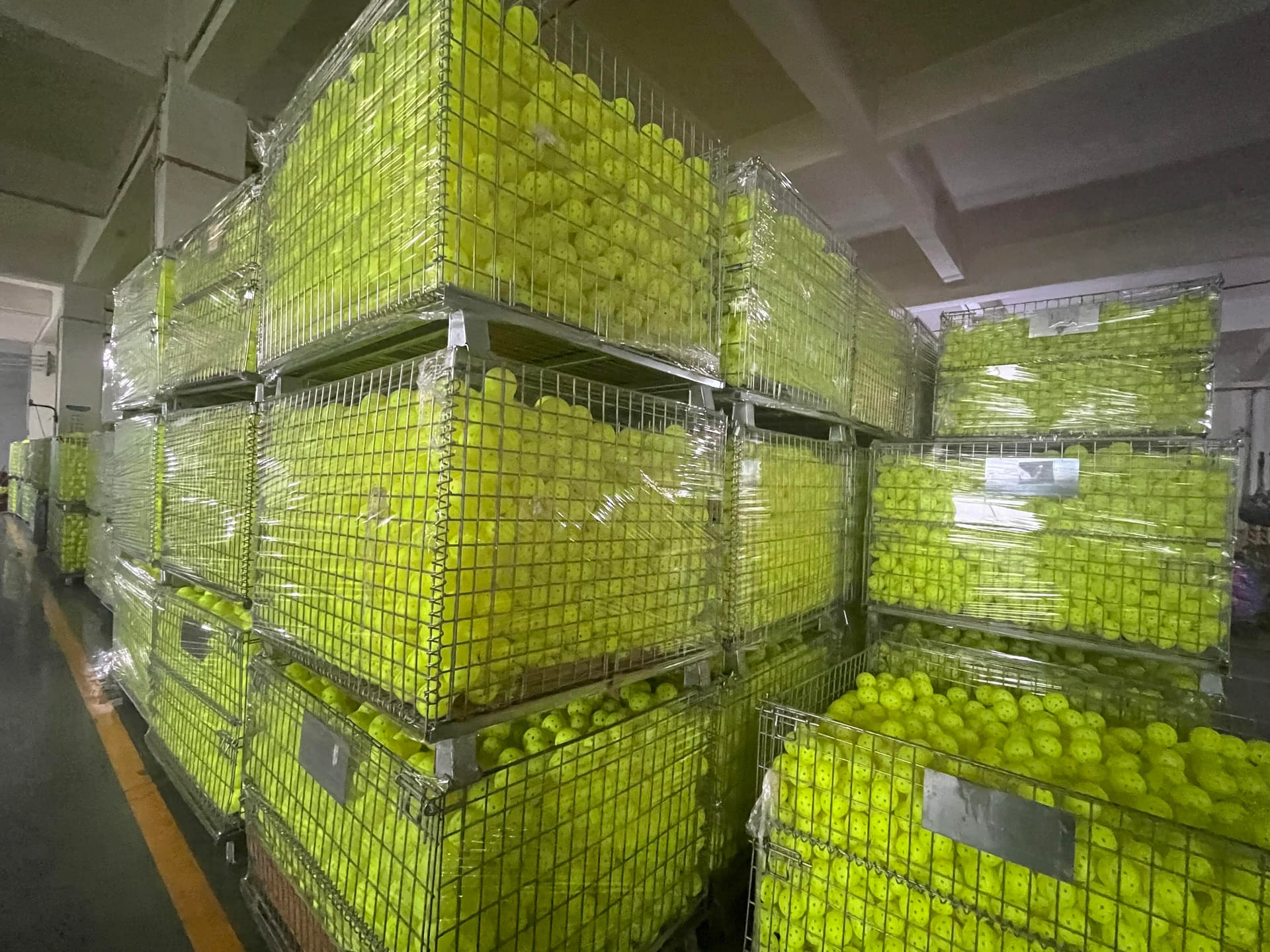
"Cheap alternative to Franklin X-40?" is one of the most repeated questions in outdoor pickleball forums, and it's the wrong question for anyone building a brand. A cheap alternative is a race to the bottom on a commodity ball. A private-label equivalent is a different project: a ball you spec to match — or beat — the two reference balls the outdoor game is measured against, the Franklin X-40 and the Onix Dura Fast 40, with your logo on it and your margin in it. The gap between those two intentions is where most first orders go wrong.
This guide is the spec walk-through we give brand owners and distributors who want an outdoor ball that plays like the balls their customers already trust, without cloning something they can't legally copy. It covers what "X-40 equivalent" actually means at the spec level, the one design feature that is patented and off-limits, how ball hardness and playing temperature decide durability, the USA Pickleball legal window your ball has to sit inside, and how to beat the single loudest complaint outdoor players have about the incumbents — that the ball goes out of round after a few games.

Key Takeaways
- "X-40 equivalent" means a one-piece rotomolded 40-hole outdoor ball inside the USA Pickleball legal window — roughly 2.874–2.972 inches in diameter and 0.78–0.935 ounces — not a visual clone of a specific brand.
- Onix holds US patent 8,357,062 B2 on the Dura Fast 40's variable hole sizing (16 holes near 0.26 inch, 24 holes near 0.32 inch). You can legally use uniform holes like the Franklin X-40's roughly 0.29-inch pattern; copying Dura's two-size pattern is a patent question for your IP counsel.
- Ball hardness is the durability lever, and it trades against climate. A new X-40 measures around 94 lb/in stiffness and a new Dura Fast 40 around 130 lb/in; the stiffer, harder ball plays faster but cracks sooner in the cold, while the softer ball resists cracking but over-softens in summer heat.
- Spec your ball's hardness to the dominant climate of your end market, not to a single "best" number — this is the one variable a source rotomolding factory can actually tune for you.
- The loudest outdoor-ball complaint is going out of round after a few games; roundness tolerance, seam consistency, and cooling discipline in the rotomolding cycle are what beat it, and they belong in your written spec and your pre-shipment inspection.
- A private-label equivalent only pays off above a real order volume; below it, buying stock brand balls is cheaper than tooling and certifying your own.
What "Franklin X-40 equivalent" actually means
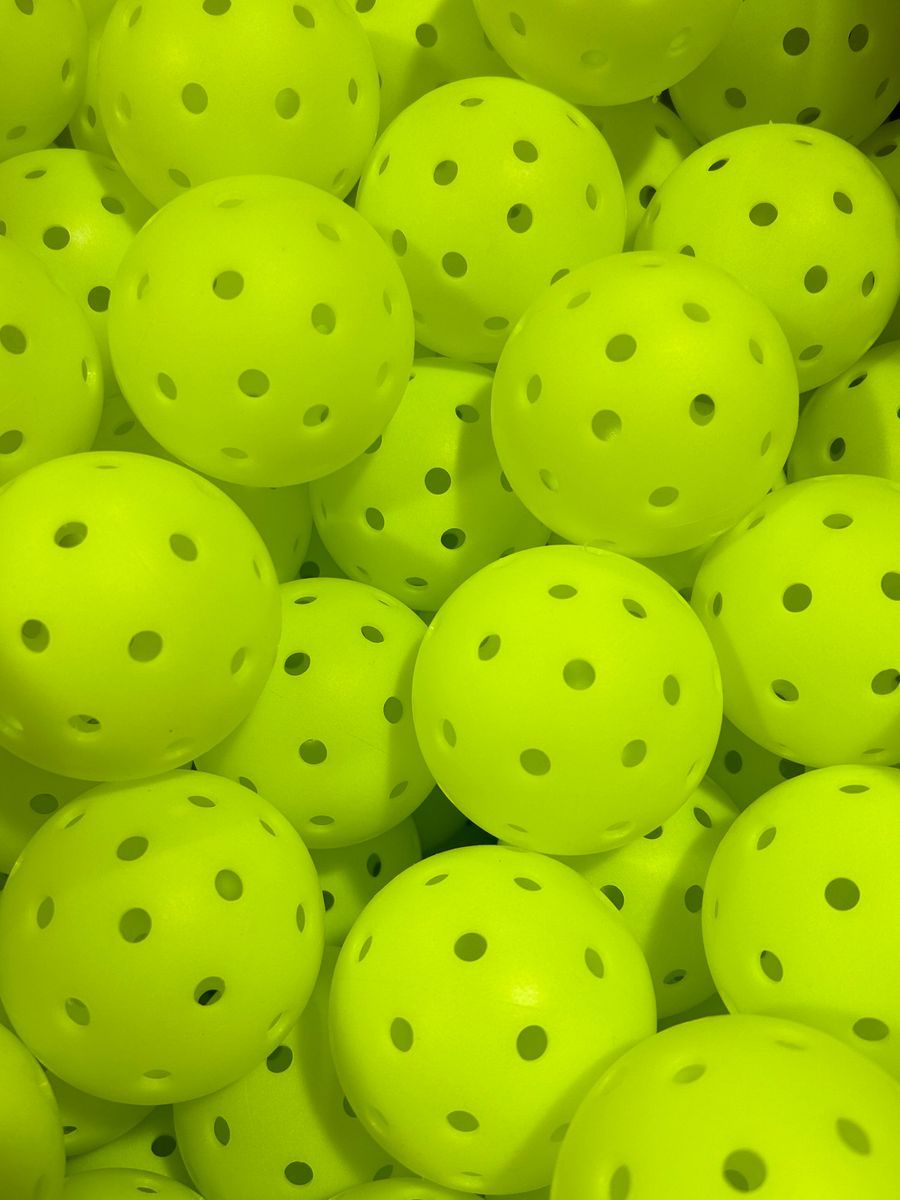
Both reference balls are one-piece, rotationally molded outdoor balls with 40 holes — the single-piece construction that stands up to concrete and asphalt, which two-piece injection-molded balls with a glued seam do not. The Franklin X-40 is the official ball of USA Pickleball, the APP Tour, and the US Open; the Onix Dura Fast 40 is the long-standing tournament ball players either love or fight with. "Equivalent" means matching their measurable spec envelope, not their branding, so your ball feels familiar in a customer's hand and clears the same legality bar.
The two balls are not identical, and the differences are the map for your own spec. The Franklin uses uniform holes of about 0.29 inch and plays softer; the Dura uses two hole sizes and plays harder and faster. Independent bench testing puts a new Dura Fast 40 near 130 lb/in stiffness against the X-40's roughly 94 lb/in — a real, feelable gap, not marketing. Deciding where your ball sits between those two poles is the first spec decision, and it drives every one after it.
| Spec | Franklin X-40 | Onix Dura Fast 40 |
|---|---|---|
| Construction | One-piece rotomolded | One-piece rotomolded |
| Holes | 40, uniform ~0.29 in | 40, two sizes (~0.26 & ~0.32 in) — patented |
| New-ball stiffness | ~94 lb/in (softer) | ~130 lb/in (harder, faster) |
| Wear pattern | Gradual softening (loses ~10% stiffness by ~7 games) | Holds stiffness, then cracks (often ~20+ games) |
| Player reputation | Forgiving, consistent flight, better in heat | Fast and firm, favored by advanced players |
The one thing you can't copy: the hole-pattern patent
The single feature you cannot blindly clone is the Dura Fast 40's hole design. Onix holds US patent 8,357,062 B2 covering the use of two different hole diameters on a pickleball to manage flight and reduce impact damage. The Dura's pattern — 16 holes near the equator at about 0.26 inch and 24 holes at about 0.32 inch — is the protected part. A factory that copies that exact two-size layout is handing you a legal exposure you don't want on a branded product.
The design-around is straightforward and legal: uniform holes, the way the Franklin X-40 does it with a single roughly 0.29-inch diameter across all 40 holes. Uniform holes are unpatented, well-proven, and simpler to tool and drill consistently. If you want the specific aerodynamic behavior a two-size pattern produces, that's a conversation for your own IP counsel about whether a distinct hole geometry avoids the claims — not something to decide from a supplier's assurance. Patent scope varies by claim language and by country, so confirm your ball's hole design with qualified counsel before you commit tooling. The safe default that keeps a first project moving is a uniform-hole outdoor ball.
Default to a uniform 40-hole pattern for a private-label outdoor ball. It plays like the X-40, sidesteps the Onix patent, and drills more consistently — which also helps the roundness problem covered further down.
Hardness vs climate: the real durability lever
Ask outdoor players why a ball failed and you'll get two answers that sound contradictory: "it cracked" and "it went soft." Both are hardness stories at different temperatures. A harder, stiffer ball — the Dura Fast 40 at around 130 lb/in when new — stays firm and fast, but hard plastic gets brittle as the temperature drops, which is why the firm balls develop cracks in cold-weather play. A softer ball — the X-40 near 94 lb/in — resists cracking in the cold, but the same softness that saves it there turns to mush in summer heat and the ball loses its pop.
This is why the forums never agree on which ball is "better in the cold." They're conflating two different things: playability (a firm ball stays lively in the cold, which advanced players like) and crack-durability (a firm ball is exactly the one that splits when a cold ball takes a hard paddle strike). Separate them and the engineering is clear — the resin blend and target wall hardness set where your ball lands on that trade-off. That's the one variable a source rotomolding factory can genuinely tune, and it's the reason to spec your own ball rather than resell a stock one.
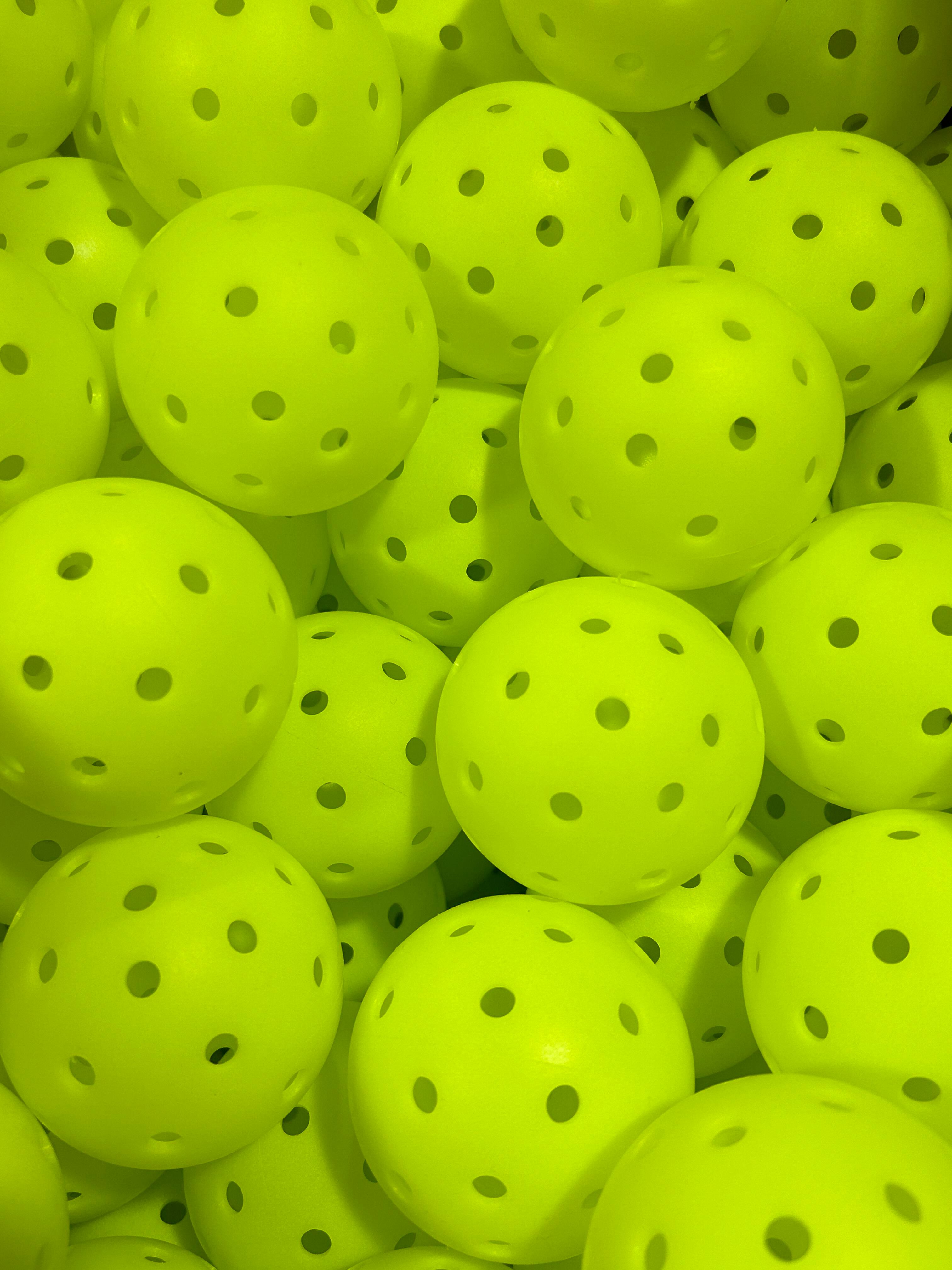
Practical rule: match the ball to where it will be played most. For a cold-climate club program — northern US, Canada, mountain regions with shoulder-season outdoor play — spec toward the softer, crack-resistant end and accept a slightly shorter warm-weather life. For a hot-climate market — the desert Southwest, the Gulf, Southeast Asia — spec toward the firmer end so the ball keeps its pop in the heat, and warn buyers to switch balls sooner when temperatures drop. A national distributor covering both often needs two SKUs, not one compromise ball. The temperature-and-hardness split is also why indoor and outdoor balls are engineered so differently.
Staying inside the USA Pickleball legal window
If your customers play sanctioned or club-league games, the ball has to sit inside the USA Pickleball equipment standards. The dimensional window is narrow, and a private-label ball that drifts outside it can't be marketed as tournament-legal. The figures below are the commonly published ranges; treat them as the target and confirm the current numbers against the USA Pickleball equipment standards manual before you lock a spec, because the standard is revised periodically.
| Parameter | Published range | Spec note |
|---|---|---|
| Diameter | 2.874–2.972 in | Aim for the middle; edge-of-window balls fail more units to normal variance |
| Weight | 0.78–0.935 oz (~22.1–26.5 g) | Outdoor balls typically target the upper end, ~24–26 g |
| Holes | 26–40, evenly spaced | Outdoor standard is 40; uniform sizing avoids the Onix patent |
| Bounce | ~30–34 in from a 78-in drop | Batch consistency matters as much as the absolute number |
| Hardness | ~40–50 (Shore D, commonly cited) | Your climate-tuned hardness lands inside this band |
Two traps worth naming. First, a fresh outdoor ball often measures near the top of the weight window — that's normal, but a ball spec'd right at 0.935 oz leaves no headroom, so a slightly heavy batch tips out of legal. Spec a target with margin. Second, "USA Pickleball approved" is a specific certification with a testing and listing process, not a phrase you can print on a box because your ball happens to measure in range. The approval path is its own project, covered below and in more depth in the guide to sourcing USA Pickleball approved balls.
Beating the out-of-round complaint
The most repeated gripe about outdoor balls — loud enough that "Dura Fast 40 gets lopsided after only a few games" is a recurring forum thread title — is loss of roundness. A ball that goes even slightly out of round wobbles on the bounce and gets rejected by serious players fast. Beating it is the clearest way a well-made private-label ball earns loyalty against a brand ball, and it is almost entirely a manufacturing-discipline problem, not a mystery.
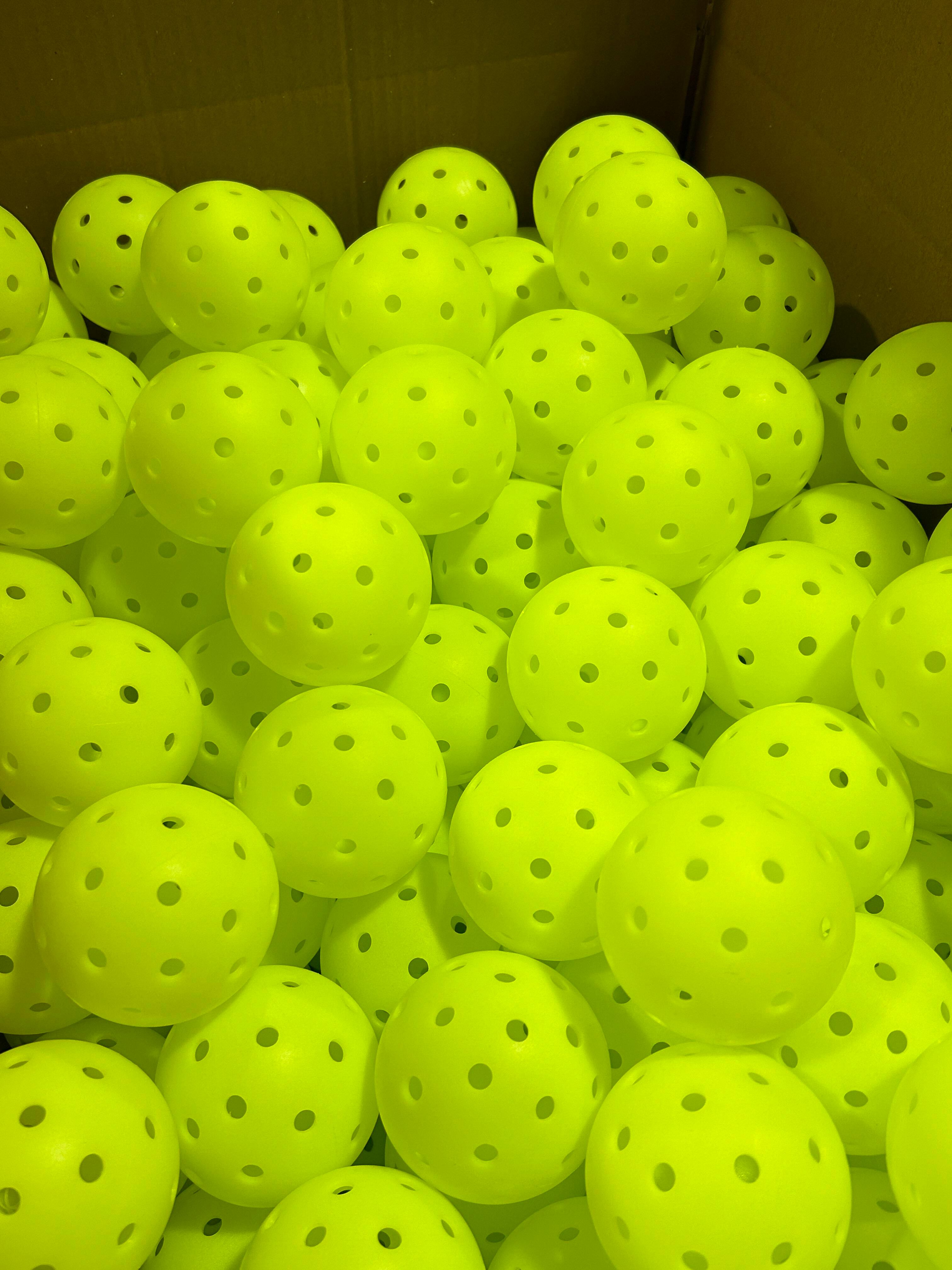
Three levers control it. Cooling discipline: a rotomolded ball pulled from the mold and cooled unevenly relaxes into an oval, so a controlled cooling cycle is non-negotiable. Wall-thickness uniformity: uneven wall thickness means uneven stiffness around the sphere, which shows up as wobble under stress. Roundness gauging at QC: every sampled ball measured on three axes against a tight tolerance, not eyeballed. Spelling out a roundness tolerance in your written spec — and requiring it in the pre-shipment ball QC — is how you make the factory own the number instead of shipping the variance to your customers. A supplier that won't commit to a roundness tolerance in writing is telling you something.
The buildable spec sheet
Pulling the decisions together, here's the spec a private-label outdoor ball is actually built from. Hand a factory this level of detail and you get a sample you can judge; hand them "make me something like an X-40" and you get whatever their default mold produces.
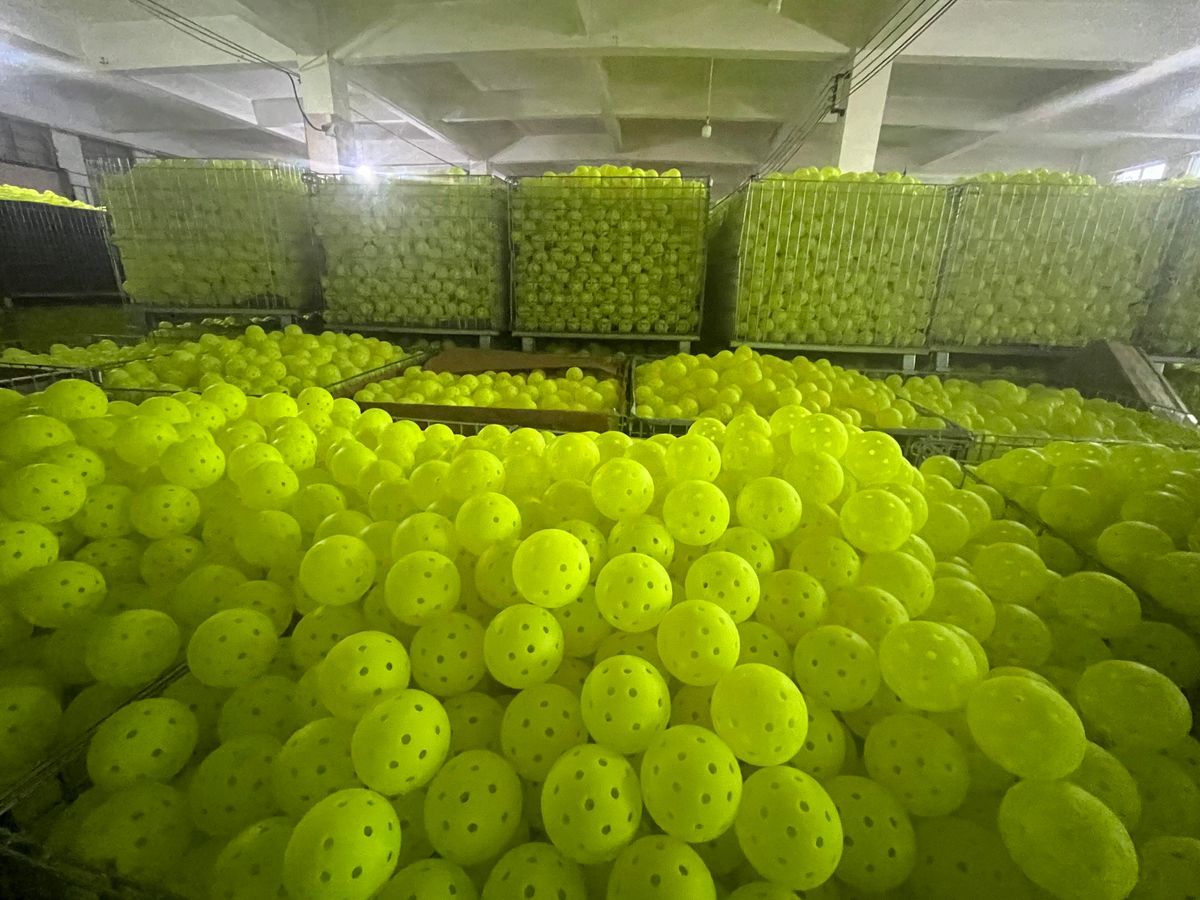
| Spec line | What to specify |
|---|---|
| Construction | One-piece rotomolded, seamless |
| Hole pattern | 40 holes, uniform ~0.29 in (patent-safe) |
| Hardness target | Tuned to end-market climate; softer for cold, firmer for heat |
| Diameter / weight | Mid-window with margin, e.g. ~2.92 in / ~24–25 g |
| Roundness tolerance | A written max out-of-round figure, gauged on 3 axes at QC |
| Color | High-visibility optic yellow standard; other colors optional |
| Branding | Pad-printed logo, print position and durability spelled out |
| Legality | Inside current USA Pickleball window; approval if claiming legal play |
Color and branding are where the ball stops being a commodity. Optic yellow is the safe default for visibility, but a distinct on-court color plus a clean pad-printed logo is what makes your ball recognizable in a bucket — the same logic covered in custom logo pickleballs. Keep the print spec explicit: location, size, and a rub-durability requirement so the logo doesn't wear off in the first week.
MOQ, samples, and lead time
A private-label ball is a tooling-and-volume commitment, not a catalog pick. A custom color and logo run against an existing mold carries a moderate minimum order; a fully custom hole layout or a proprietary mold pushes the minimum higher because the tooling has to be amortized. The honest framing for a first-timer: if your annual volume is a few cases, buy stock brand balls and put your energy elsewhere; if you're moving balls by the pallet, an equivalent earns its tooling back and hands you the margin a brand ball never will.
Budget the calendar, not just the order. A realistic path runs a sample round first — a physical ball you play-test and measure — then a pilot batch, then the main production run, with the whole cycle taking longer around Chinese New Year when factories close for weeks. Don't skip the sample to save two weeks; a ball that measures right on a spec sheet can still play wrong, and the sample is the only place you catch it before a container is committed. The full timing picture, including the seasonal shutdowns, is in the guide to pickleball sourcing lead times, and the discipline of signing off a physical reference before mass production is the golden-sample approval step.
Getting it approved for sanctioned play
If you'll market the ball as tournament-legal or sell into leagues that require approved equipment, measuring inside the window isn't enough — the ball has to go through USA Pickleball's testing and appear on the approved ball list. That means submitting samples, paying the testing and listing fees, and building the approval timeline into your launch. Requirements, fees, and processing times change, so confirm the current process directly with USA Pickleball before you promise a customer an approved ball on a date.
Approval isn't mandatory for every buyer. A recreational or facility-rental ball sold for open play doesn't strictly need to be on the list — plenty of balls sell perfectly well as "outdoor 40-hole, meets regulation size and weight" without formal approval. But the moment your marketing says "approved" or your customer is a sanctioned league, the certification is not optional and mislabeling it is a real liability. Decide which market you're in before you print the box, and keep any regulatory claim hedged to what you can actually document.
Best for / not for: is a private-label equivalent right for you?
A private-label equivalent is a strong move for some buyers and a waste of tooling money for others. The deciding factors are volume, brand intent, and whether ball performance is core to your offer or just a line item.
| Best for | Not ideal for |
|---|---|
| Brands selling balls by the pallet who want their own margin and identity | Low-volume sellers moving a few cases a year — stock brand balls are cheaper |
| Distributors in a specific climate who want a hardness-tuned SKU | Buyers who need an on-the-list approved ball tomorrow with no lead time |
| Clubs and facilities buying rental-fleet balls in bulk with a house logo | Anyone unwilling to run a sample round before committing tooling |
| Sellers who want to beat the out-of-round reputation with a spec'd tolerance | Projects where the ball is incidental and brand recognition doesn't matter |
A worked example: a cold-climate club ball
A distributor supplying clubs across the northern US and Canada wants a house-brand outdoor ball that stops cracking on cold shoulder-season mornings — the complaint driving returns on the brand balls they resell. The path from that problem to a container looks like this.
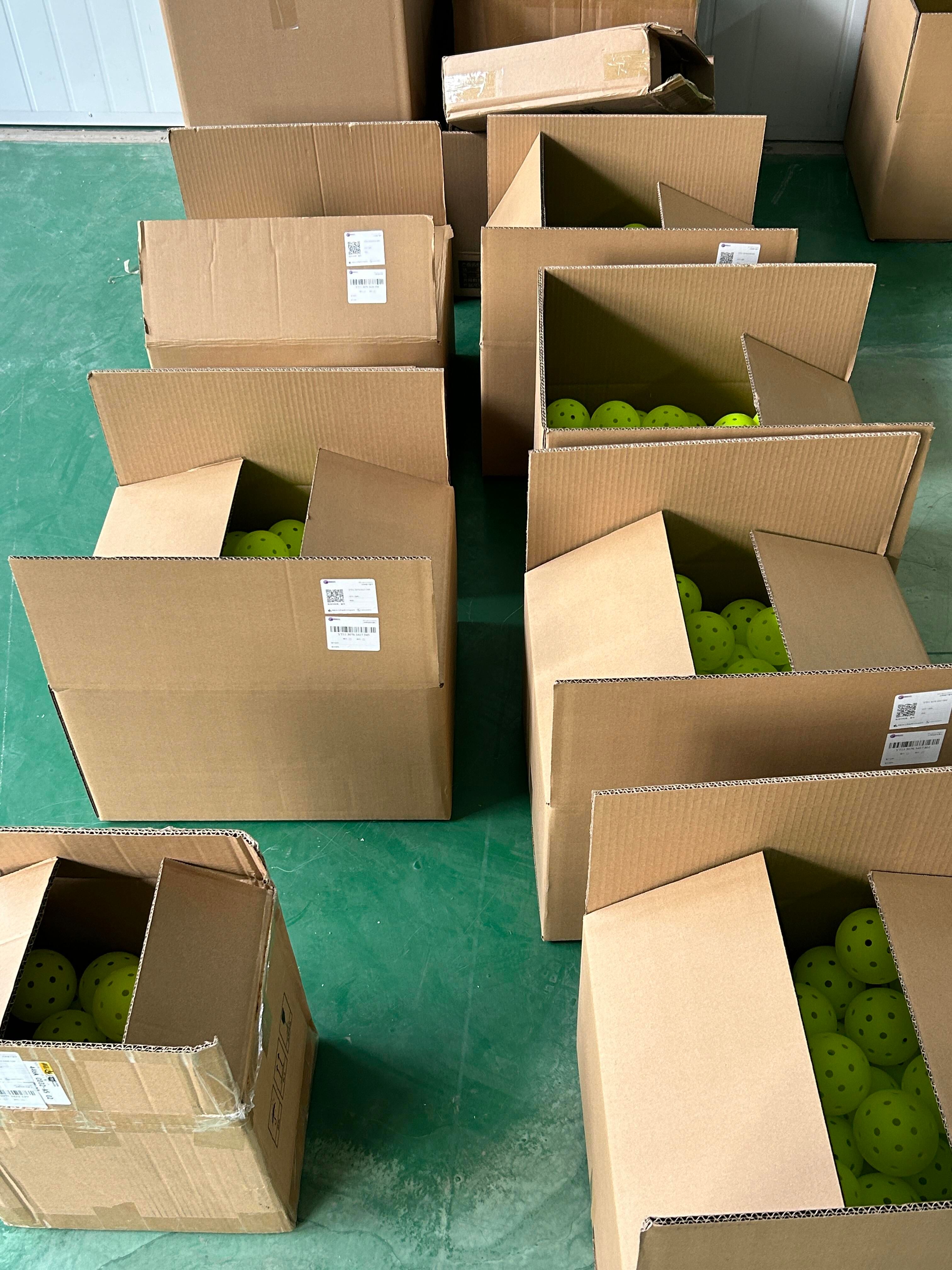
- Spec. One-piece rotomolded, 40 uniform holes at ~0.29 in, hardness tuned toward the softer/crack-resistant end for cold play, ~2.92 in diameter and ~24–25 g with margin off the top of the window, a written roundness tolerance, optic-yellow, pad-printed house logo.
- Sample. The factory rotomolds a sample batch to that spec. The distributor cold-plays them on a real outdoor court near freezing, checks for cracking after repeated hard strikes, and gauges roundness and weight against the spec sheet.
- Sign-off. The approved sample becomes the golden reference — the physical ball every production unit is judged against, not a marketing description.
- Pilot + QC. A pilot run is inspected before the main batch, with the roundness, weight, bounce, and hole checks written into the pre-shipment inspection scope so the factory owns the tolerances.
- Ship. With a passing inspection, the container books, and the distributor's file holds the QC report as the reference against any post-arrival complaints.
The result isn't a "cheap alternative." It's a ball engineered for the exact climate its buyers play in, with a tolerance the brand balls never promised — which is the whole point of going private label instead of reselling someone else's ball. The one-piece rotomolding process behind it is covered in how pickleballs are made and compared against injection molding in rotomolded vs injection-molded balls.
Frequently Asked Questions
Can I legally make a ball that copies the Franklin X-40?
You can build an outdoor ball to the same measurable spec envelope — one-piece rotomolded, 40 uniform holes, inside the USA Pickleball size and weight window — because those specs aren't owned by any brand. What you cannot do is copy a competitor's trademark, trade dress, or a patented feature. The X-40's uniform-hole approach is unpatented; the Onix Dura Fast 40's two-size hole pattern is covered by US patent 8,357,062 B2. Match the category spec, not a specific brand's protected design, and confirm your hole geometry with IP counsel.
What actually makes an outdoor ball crack?
Cold plus hardness. Harder, stiffer outdoor balls stay fast but become brittle as temperature drops, so they crack under hard paddle strikes in cold weather. Softer balls resist cracking in the cold but over-soften and lose pop in summer heat. Cracking is largely a materials-and-temperature interaction, which is why the durability lever on a private-label ball is the resin hardness spec tuned to the climate it will be played in.
Why do outdoor balls go out of round, and can it be prevented?
Out-of-round comes from uneven cooling after molding and uneven wall thickness, not bad luck. A controlled cooling cycle, uniform wall thickness, and roundness gauging on three axes at QC are what prevent it. Specify a written maximum out-of-round tolerance and require it in pre-shipment inspection, and a well-run factory can hold roundness far better than the cheap balls that draw the "lopsided after a few games" complaints.
Does a private-label ball have to be USA Pickleball approved?
Only if you market it as tournament-legal or sell into sanctioned leagues that require approved equipment. A recreational or facility ball sold for open play can be sold as regulation size and weight without formal approval. If you do claim approval, the ball must actually be tested and listed by USA Pickleball — measuring in range is not the same as being approved, and mislabeling it is a liability. Confirm the current approval process and fees with USA Pickleball directly.
What's the minimum order for a custom outdoor ball?
It depends on how custom you go. A house color and logo on an existing mold carries a moderate minimum; a fully custom hole layout or proprietary mold raises it because the tooling cost has to be amortized across the run. As a rule of thumb, if you're buying a few cases a year, stock brand balls are cheaper than tooling your own; a private-label equivalent pays off once you're moving balls by the pallet.
Should I match the Franklin X-40 or the Dura Fast 40?
Match the play profile your market wants, not a brand name. Lean toward the X-40 profile — softer, forgiving, crack-resistant, better in heat — for recreational players, mixed-climate programs, and anywhere cracking drives returns. Lean toward the Dura profile — firmer, faster, favored by advanced players — for competitive and hot-climate markets, accepting that firmer balls crack sooner in the cold. A distributor covering both climates often needs two SKUs rather than one compromise ball.
Want to source this quality for your brand?
Contact our factory directly on WhatsApp for an instant MOQ and pricing quote.